APPLIED ECONOMICS
A B M S P E C I A L I Z E D S U B J E C T
This course deals with the basic principles of applied economics,
and its application to contemporary economic issues facing the
Filipino entrepreneur such as prices of commodities, minimum
wage, rent, and taxes.
It covers an analysis of industries for identification of potential
business opportunities. The main output of the course is the
preparation of a socioeconomic impact study of a business venture.
esentation made by:
GIAN PAULO M. RABANAL, LPT,
MBA©
Chapter 1
Introduction to AppliedEconomics
Lesson 1.1 Introduction to Economics
Lesson 1.2 Economics as an Applied
Science
At the end of the session the learners will be able to:
a. Differentiate Economics as a Social Science and as an Applied Science
b. Give real-life situation in which the Principles of Applied Economics are used.
c. Cite current economic issues that needs to be addressed.
d. Relate the Principles of Applied Economics to current issues using critical
thinking.
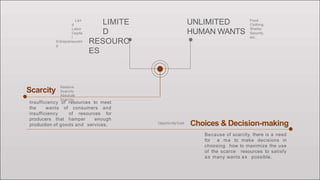
Scarcity
Insufficiency of resources to meet
the wants of consumers and
insufficiency of resources for
producers that hamper enough
production of goods and services.
LIMITE
D
RESOURC
ES
UNLIMITED
HUMAN WANTS
Choices & Decision-making
Because of scarcity, there is a need
for a ma to make decisions in
choosing how to maximize the use
of the scarce resources to satisfy
as many wants as possible.
Lan
d
Labor
Capita
l
Entrepreneurshi
p
Food
Clothing
Shelter
Security,
etc.
Relative
Scarcity
Absolute
Scarcity
Opportunity Cost
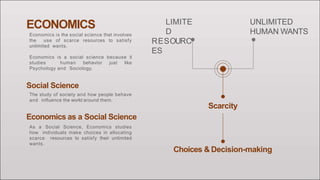
ECONOMICS
Economics is the social science that involves
the use of scarce resources to satisfy
unlimited wants.
Economics is a social science because it
studies human behavior just like
Psychology and Sociology.
Social Science
The study of society and how people behave
and influence the world around them.
Economics as a Social Science
As a Social Science, Economics studies
how individuals make choices in allocating
scarce resources to satisfy their unlimited
wants.
Scarcity
LIMITE
D
RESOURC
ES
UNLIMITED
HUMAN WANTS
Choices & Decision-making
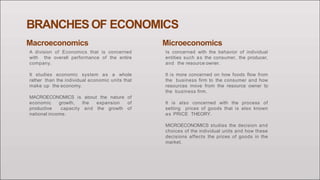
BRANCHES OF ECONOMICS
Macroeconomics
A division of Economics that is concerned
with the overall performance of the entire
company.
It studies economic system as a whole
rather than the individual economic units that
make up the economy.
MACROECONOMICS is about the nature of
economic growth, the expansion of
productive capacity and the growth of
national income.
Microeconomics
Is concerned with the behavior of individual
entities such as the consumer, the producer,
and the resource owner.
It is more concerned on how foods flow from
the business firm to the consumer and how
resources move from the resource owner to
the business firm.
It is also concerned with the process of
setting prices of goods that is also known
as PRICE THEORY.
MICROECONOMICS studies the decision and
choices of the individual units and how these
decisions affects the prices of goods in the
market.
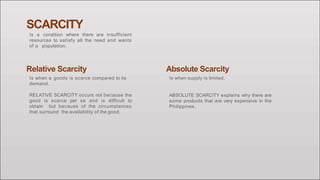
SCARCITY
Is a condition where there are insufficient
resources to satisfy all the need and wants
of a population.
Relative Scarcity
Is when a goods is scarce compared to its
demand.
RELATIVE SCARCITY occurs not because the
good is scarce per se and is difficult to
obtain but because of the circumstances
that surround the availability of the good.
Absolute Scarcity
Is when supply is limited.
ABSOLUTE SCARCITY explains why there are
some products that are very expensive in the
Philippines.
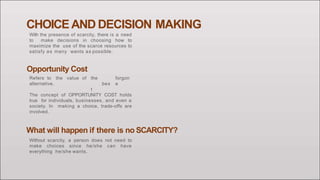
CHOICE AND DECISION MAKING
With the presence of scarcity, there is a need
to make decisions in choosing how to
maximize the use of the scarce resources to
satisfy as many wants as possible.
the
bes
t
forgon
e
Opportunity Cost
Refers to the value of
alternative.
The concept of OPPORTUNITY COST holds
true for individuals, businesses, and even a
society. In making a choice, trade-offs are
involved.
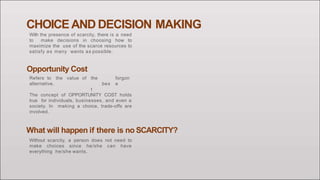
What will happen if there is no SCARCITY?
Without scarcity, a person does not need to
make choices since he/she can have
everything he/she wants.
CHOICE AND DECISION MAKING
With the presence of scarcity, there is a need
to make decisions in choosing how to
maximize the use of the scarce resources to
satisfy as many wants as possible.
the
bes
t
forgon
e
Opportunity Cost
Refers to the value of
alternative.
The concept of OPPORTUNITY COST holds
true for individuals, businesses, and even a
society. In making a choice, trade-offs are
involved.
What will happen if there is no SCARCITY?
Without scarcity, a person does not need to
make choices since he/she can have
everything he/she wants.
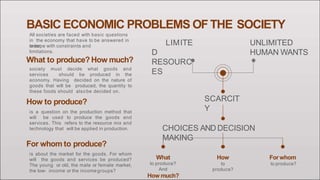
BASIC ECONOMIC PROBLEMS OFTHE SOCIETY
All societies are faced with basic questions
in the economy that have to be answered in
orderto cope with constraints and
limitations.
What to produce? How much?
society must decide what goods and
services should be produced in the
economy. Having decided on the nature of
goods that will be produced, the quantity to
these foods should also be decided on.
How to produce?
is a question on the production method that
will be used to produce the goods and
services. This refers to the resource mix and
technology that will be applied in production.
SCARCIT
Y
LIMITE
D
RESOURC
ES
UNLIMITED
HUMAN WANTS
CHOICES AND DECISION
MAKING
What
to produce?
And
How much?
How
to
produce?
For whom
to produce?
For whom to produce?
is about the market for the goods. For whom
will the goods and services be produced?
The young or old, the male or female market,
the low- income or the incomegroups?
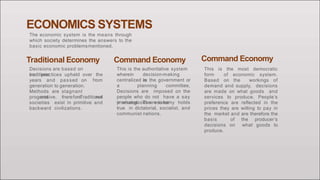
ECONOMICS SYSTEMS
The economic system is the means through
which society determines the answers to the
basic economic problemsmentioned.
Traditional Economy
Decisions are based on
traditions
years and passed on
and practices upheld over the
from
generation to generation.
Methods are stagnant
and therefore notprogressive. Traditional
societies exist in primitive and
backward civilizations.
Command Economy
This is the authoritative system
wherein decision-making
iscentralized in the government or
a planning committee,
Decisions are imposed on the
people who do not have a say
in what goods are to beproduced. The economy holds
true in dictatorial, socialist, and
communist nations.
Command Economy
This is the most democratic
form of economic system.
Based on the workings of
demand and supply, decisions
are made on what goods and
services to produce. People’s
preference are reflected in the
prices they are willing to pay in
the market and are therefore the
basis of the producer’s
decisions on what goods to
produce.
WHY ECONOMICS IS IMPORTANT?
Read the front page of the newspapers
or watch the news on TV.
WHYDOWE NEED TOSTUDY ECONOMICS?
ECONOMICS will help the students understand why there is a need for everybody, including
the
government, to budget and properly allocate the use of whatever resources are available.
It will help one understand how to make more rational decisions in spending money, saving
part of it, and even investing some of it.
On the national level, economics will enable the students to take a look on how the economy
operates and to decide for themselves if the government officials and leaders are effective in
trying to shape up the economy and formulate policies for the good of the nation.
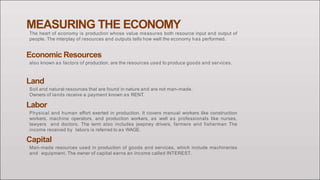
MEASURING THE ECONOMY
The heart of economy is production whose value measures both resource input and output of
people. The interplay of resources and outputs tells how well the economy has performed.
Economic Resources
also known as factors of production, are the resources used to produce goods and services.
Land
Soil and natural resources that are found in nature and are not man-made.
Owners of lands receive a payment known as RENT.
Labor
Physical and human effort exerted in production. It covers manual workers like construction
workers, machine operators, and production workers, as well as professionals like nurses,
lawyers and doctors. The term also includes jeepney drivers, farmers and fisherman The
income received by labors is referred to as WAGE.
Capital
Man-made resources used in production of goods and services, which include machineries
and equipment. The owner of capital earns an income called INTEREST.
GNP vs. GDP
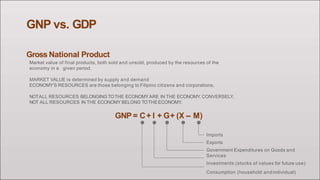
Gross National Product
Market value of final products, both sold and unsold, produced by the resources of the
economy in a given period.
MARKET VALUE is determined by supply and demand
ECONOMY’S RESOURCES are those belonging to Filipino citizens and corporations.
NOTALL RESOURCES BELONGING TOTHE ECONOMYARE IN THE ECONOMY. CONVERSELY,
NOT ALL RESOURCES IN THE ECONOMY BELONG TOTHEECONOMY.
GNP = C+ I + G+ (X – M)
Imports
Exports
Government Expenditures on Goods and
Services
Investments (stocks of values for future use)
Consumption (household and individual)
GNP vs. GDP
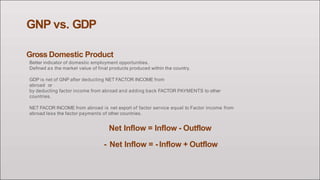
Gross Domestic Product
Better indicator of domestic employment opportunities.
Defined as the market value of final products produced within the country.
GDP is net of GNP after deducting NET FACTOR INCOME from
abroad or
by deducting factor income from abroad and adding back FACTOR PAYMENTS to other
countries.
NET FACOR INCOME from abroad is net export of factor service equal to Factor income from
abroad less the factor payments of other countries.
Net Inflow = Inflow - Outflow
- Net Inflow = - Inflow + Outflow
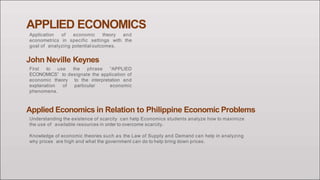
APPLIED ECONOMICS
Application of economic theory and
econometrics in specific settings with the
goal of analyzing potential outcomes.
John Neville Keynes
First to use the phrase “APPLIED
ECONOMICS” to designate the application of
economic theory to the interpretation and
explanation of particular economic
phenomena.
Applied Economics in Relation to Philippine Economic Problems
Understanding the existence of scarcity can help Economics students analyze how to maximize
the use of available resources in order to overcome scarcity.
Knowledge of economic theories such as the Law of Supply and Demand can help in analyzing
why prices are high and what the government can do to help bring down prices.
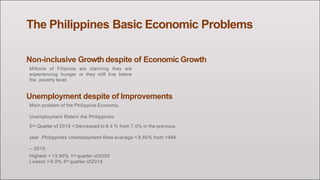
The Philippines Basic Economic Problems
Non-inclusive Growth despite of Economic Growth
Millions of Filipinos are claiming they are
experiencing hunger or they still live below
the poverty level.
Unemployment despite of Improvements
Main problem of the Philippine Economy.
Unemployment Ratein the Philippines:
2nd Quarter of 2015 = Decreased to 6.4 % from 7.0% in the previous
year Philippines Unemployment Rate average = 8.85% from 1994
– 2015
Highest = 13.90% 1st quarter of2000
Lowest = 6.0% 4th quarter of2014
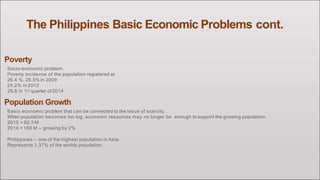
The Philippines Basic Economic Problems cont.
Poverty
Socio-economic problem.
Poverty incidence of the population registered at
26.4 %, 26.5%in 2009
25.2% in 2012
28.8 in 1st quarter of2014
Population Growth
Basic economic problem that can be connected to the issue of scarcity.
When population becomes too big, economic resources may no longer be enough to support the growing population.
2010 = 92.3 M
2014 = 100 M – growing by 2%
Philippines – one of the highest population in Asia.
Represents 1.37% of the worlds population.
Class Activity:
Debate
Download a copy and read the article “What’s in the proposed
2018 national budget?” using the link provided below.
Based on the budget, determine what expenditures are the government’s top priorities,
and then expenditures which are the least priorities.
The debate topic would be “Isit right to prioritize EDUCATION in preparing the National
Budget?”
30 minutes preparation per team
15 minutes debateproper.
LINK:
https://www.rappler.com/move-ph/issues/budget-watch/145988-proposed-2017-national-
budget
Thank You!
Reference(s):
Dinio and Villasis 2017. Applied Economics. Rex Bookstore First Edition. Pages 2 -14
Rappler
https://www.rappler.com/move-ph/issues/budget-watch/145988-proposed-2017-national-
budget

Applied Economics

  • 1.
    APPLIED ECONOMICS A BM S P E C I A L I Z E D S U B J E C T This course deals with the basic principles of applied economics, and its application to contemporary economic issues facing the Filipino entrepreneur such as prices of commodities, minimum wage, rent, and taxes. It covers an analysis of industries for identification of potential business opportunities. The main output of the course is the preparation of a socioeconomic impact study of a business venture. esentation made by: GIAN PAULO M. RABANAL, LPT, MBA©
  • 2.
    Chapter 1 Introduction toAppliedEconomics Lesson 1.1 Introduction to Economics Lesson 1.2 Economics as an Applied Science At the end of the session the learners will be able to: a. Differentiate Economics as a Social Science and as an Applied Science b. Give real-life situation in which the Principles of Applied Economics are used. c. Cite current economic issues that needs to be addressed. d. Relate the Principles of Applied Economics to current issues using critical thinking.
  • 3.
    Scarcity Insufficiency of resourcesto meet the wants of consumers and insufficiency of resources for producers that hamper enough production of goods and services. LIMITE D RESOURC ES UNLIMITED HUMAN WANTS Choices & Decision-making Because of scarcity, there is a need for a ma to make decisions in choosing how to maximize the use of the scarce resources to satisfy as many wants as possible. Lan d Labor Capita l Entrepreneurshi p Food Clothing Shelter Security, etc. Relative Scarcity Absolute Scarcity Opportunity Cost
  • 4.
    ECONOMICS Economics is thesocial science that involves the use of scarce resources to satisfy unlimited wants. Economics is a social science because it studies human behavior just like Psychology and Sociology. Social Science The study of society and how people behave and influence the world around them. Economics as a Social Science As a Social Science, Economics studies how individuals make choices in allocating scarce resources to satisfy their unlimited wants. Scarcity LIMITE D RESOURC ES UNLIMITED HUMAN WANTS Choices & Decision-making
  • 5.
    BRANCHES OF ECONOMICS Macroeconomics Adivision of Economics that is concerned with the overall performance of the entire company. It studies economic system as a whole rather than the individual economic units that make up the economy. MACROECONOMICS is about the nature of economic growth, the expansion of productive capacity and the growth of national income. Microeconomics Is concerned with the behavior of individual entities such as the consumer, the producer, and the resource owner. It is more concerned on how foods flow from the business firm to the consumer and how resources move from the resource owner to the business firm. It is also concerned with the process of setting prices of goods that is also known as PRICE THEORY. MICROECONOMICS studies the decision and choices of the individual units and how these decisions affects the prices of goods in the market.
  • 6.
    SCARCITY Is a conditionwhere there are insufficient resources to satisfy all the need and wants of a population. Relative Scarcity Is when a goods is scarce compared to its demand. RELATIVE SCARCITY occurs not because the good is scarce per se and is difficult to obtain but because of the circumstances that surround the availability of the good. Absolute Scarcity Is when supply is limited. ABSOLUTE SCARCITY explains why there are some products that are very expensive in the Philippines.
  • 7.
    CHOICE AND DECISIONMAKING With the presence of scarcity, there is a need to make decisions in choosing how to maximize the use of the scarce resources to satisfy as many wants as possible. the bes t forgon e Opportunity Cost Refers to the value of alternative. The concept of OPPORTUNITY COST holds true for individuals, businesses, and even a society. In making a choice, trade-offs are involved. What will happen if there is no SCARCITY? Without scarcity, a person does not need to make choices since he/she can have everything he/she wants.
  • 8.
    CHOICE AND DECISIONMAKING With the presence of scarcity, there is a need to make decisions in choosing how to maximize the use of the scarce resources to satisfy as many wants as possible. the bes t forgon e Opportunity Cost Refers to the value of alternative. The concept of OPPORTUNITY COST holds true for individuals, businesses, and even a society. In making a choice, trade-offs are involved. What will happen if there is no SCARCITY? Without scarcity, a person does not need to make choices since he/she can have everything he/she wants.
  • 9.
    BASIC ECONOMIC PROBLEMSOFTHE SOCIETY All societies are faced with basic questions in the economy that have to be answered in orderto cope with constraints and limitations. What to produce? How much? society must decide what goods and services should be produced in the economy. Having decided on the nature of goods that will be produced, the quantity to these foods should also be decided on. How to produce? is a question on the production method that will be used to produce the goods and services. This refers to the resource mix and technology that will be applied in production. SCARCIT Y LIMITE D RESOURC ES UNLIMITED HUMAN WANTS CHOICES AND DECISION MAKING What to produce? And How much? How to produce? For whom to produce? For whom to produce? is about the market for the goods. For whom will the goods and services be produced? The young or old, the male or female market, the low- income or the incomegroups?
  • 10.
    ECONOMICS SYSTEMS The economicsystem is the means through which society determines the answers to the basic economic problemsmentioned. Traditional Economy Decisions are based on traditions years and passed on and practices upheld over the from generation to generation. Methods are stagnant and therefore notprogressive. Traditional societies exist in primitive and backward civilizations. Command Economy This is the authoritative system wherein decision-making iscentralized in the government or a planning committee, Decisions are imposed on the people who do not have a say in what goods are to beproduced. The economy holds true in dictatorial, socialist, and communist nations. Command Economy This is the most democratic form of economic system. Based on the workings of demand and supply, decisions are made on what goods and services to produce. People’s preference are reflected in the prices they are willing to pay in the market and are therefore the basis of the producer’s decisions on what goods to produce.
  • 11.
    WHY ECONOMICS ISIMPORTANT? Read the front page of the newspapers or watch the news on TV. WHYDOWE NEED TOSTUDY ECONOMICS? ECONOMICS will help the students understand why there is a need for everybody, including the government, to budget and properly allocate the use of whatever resources are available. It will help one understand how to make more rational decisions in spending money, saving part of it, and even investing some of it. On the national level, economics will enable the students to take a look on how the economy operates and to decide for themselves if the government officials and leaders are effective in trying to shape up the economy and formulate policies for the good of the nation.
  • 12.
    MEASURING THE ECONOMY Theheart of economy is production whose value measures both resource input and output of people. The interplay of resources and outputs tells how well the economy has performed. Economic Resources also known as factors of production, are the resources used to produce goods and services. Land Soil and natural resources that are found in nature and are not man-made. Owners of lands receive a payment known as RENT. Labor Physical and human effort exerted in production. It covers manual workers like construction workers, machine operators, and production workers, as well as professionals like nurses, lawyers and doctors. The term also includes jeepney drivers, farmers and fisherman The income received by labors is referred to as WAGE. Capital Man-made resources used in production of goods and services, which include machineries and equipment. The owner of capital earns an income called INTEREST.
  • 13.
    GNP vs. GDP GrossNational Product Market value of final products, both sold and unsold, produced by the resources of the economy in a given period. MARKET VALUE is determined by supply and demand ECONOMY’S RESOURCES are those belonging to Filipino citizens and corporations. NOTALL RESOURCES BELONGING TOTHE ECONOMYARE IN THE ECONOMY. CONVERSELY, NOT ALL RESOURCES IN THE ECONOMY BELONG TOTHEECONOMY. GNP = C+ I + G+ (X – M) Imports Exports Government Expenditures on Goods and Services Investments (stocks of values for future use) Consumption (household and individual)
  • 14.
    GNP vs. GDP GrossDomestic Product Better indicator of domestic employment opportunities. Defined as the market value of final products produced within the country. GDP is net of GNP after deducting NET FACTOR INCOME from abroad or by deducting factor income from abroad and adding back FACTOR PAYMENTS to other countries. NET FACOR INCOME from abroad is net export of factor service equal to Factor income from abroad less the factor payments of other countries. Net Inflow = Inflow - Outflow - Net Inflow = - Inflow + Outflow
  • 15.
    APPLIED ECONOMICS Application ofeconomic theory and econometrics in specific settings with the goal of analyzing potential outcomes. John Neville Keynes First to use the phrase “APPLIED ECONOMICS” to designate the application of economic theory to the interpretation and explanation of particular economic phenomena. Applied Economics in Relation to Philippine Economic Problems Understanding the existence of scarcity can help Economics students analyze how to maximize the use of available resources in order to overcome scarcity. Knowledge of economic theories such as the Law of Supply and Demand can help in analyzing why prices are high and what the government can do to help bring down prices.
  • 16.
    The Philippines BasicEconomic Problems Non-inclusive Growth despite of Economic Growth Millions of Filipinos are claiming they are experiencing hunger or they still live below the poverty level. Unemployment despite of Improvements Main problem of the Philippine Economy. Unemployment Ratein the Philippines: 2nd Quarter of 2015 = Decreased to 6.4 % from 7.0% in the previous year Philippines Unemployment Rate average = 8.85% from 1994 – 2015 Highest = 13.90% 1st quarter of2000 Lowest = 6.0% 4th quarter of2014
  • 17.
    The Philippines BasicEconomic Problems cont. Poverty Socio-economic problem. Poverty incidence of the population registered at 26.4 %, 26.5%in 2009 25.2% in 2012 28.8 in 1st quarter of2014 Population Growth Basic economic problem that can be connected to the issue of scarcity. When population becomes too big, economic resources may no longer be enough to support the growing population. 2010 = 92.3 M 2014 = 100 M – growing by 2% Philippines – one of the highest population in Asia. Represents 1.37% of the worlds population.
  • 18.
    Class Activity: Debate Download acopy and read the article “What’s in the proposed 2018 national budget?” using the link provided below. Based on the budget, determine what expenditures are the government’s top priorities, and then expenditures which are the least priorities. The debate topic would be “Isit right to prioritize EDUCATION in preparing the National Budget?” 30 minutes preparation per team 15 minutes debateproper. LINK: https://www.rappler.com/move-ph/issues/budget-watch/145988-proposed-2017-national- budget
  • 19.
    Thank You! Reference(s): Dinio andVillasis 2017. Applied Economics. Rex Bookstore First Edition. Pages 2 -14 Rappler https://www.rappler.com/move-ph/issues/budget-watch/145988-proposed-2017-national- budget