School Improvement
... is the single most important business
of the school. It is the process schools
use to ensure that all students are
achieving at high levels.
School Improvement Planning Process Guide
http://www.k12.wa.us/SchoolImprovement/Resou
rces/default.aspx
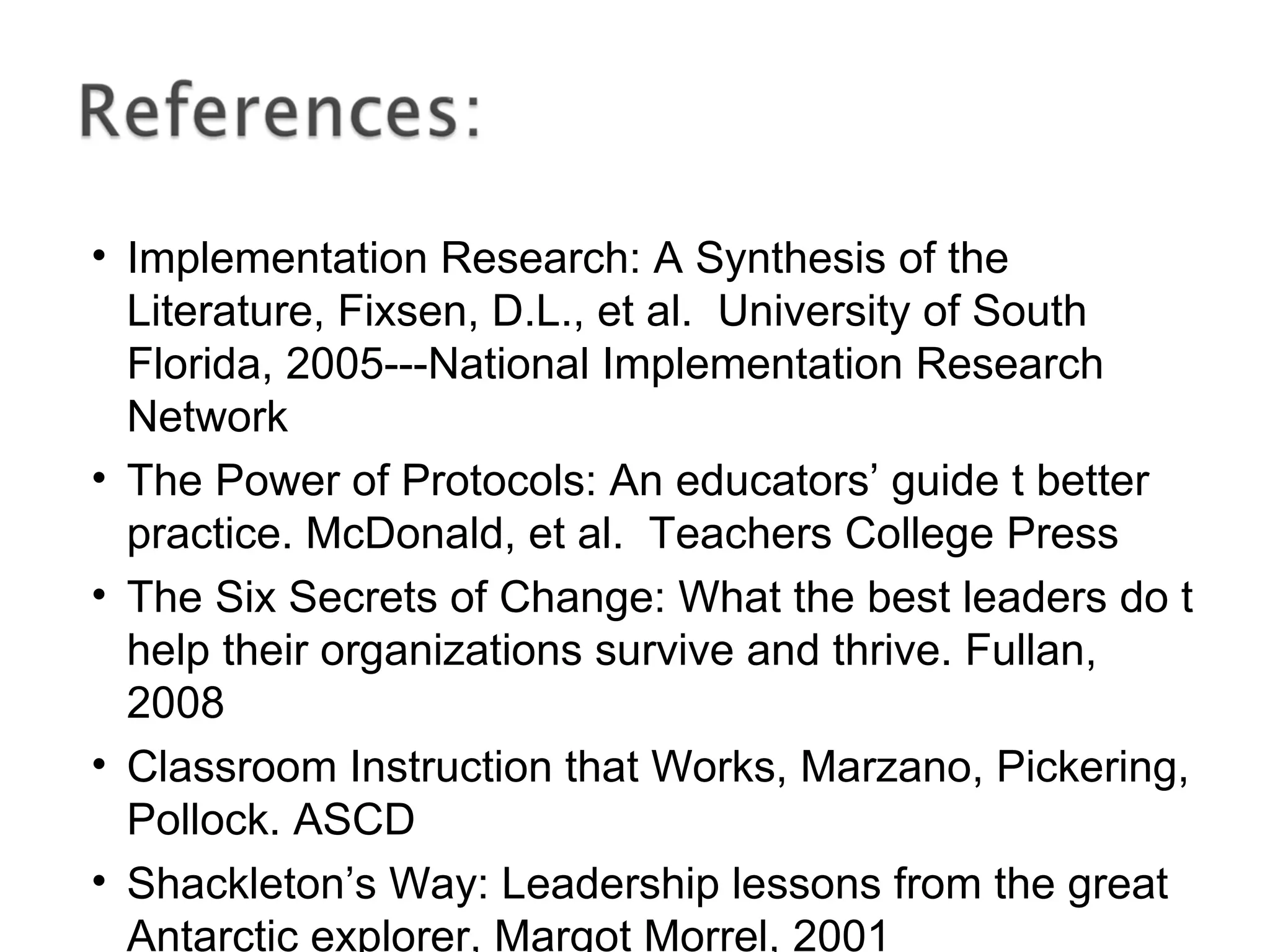
Relationships among characteristics
Do we define it?
Do we expect it?
How do we support it?
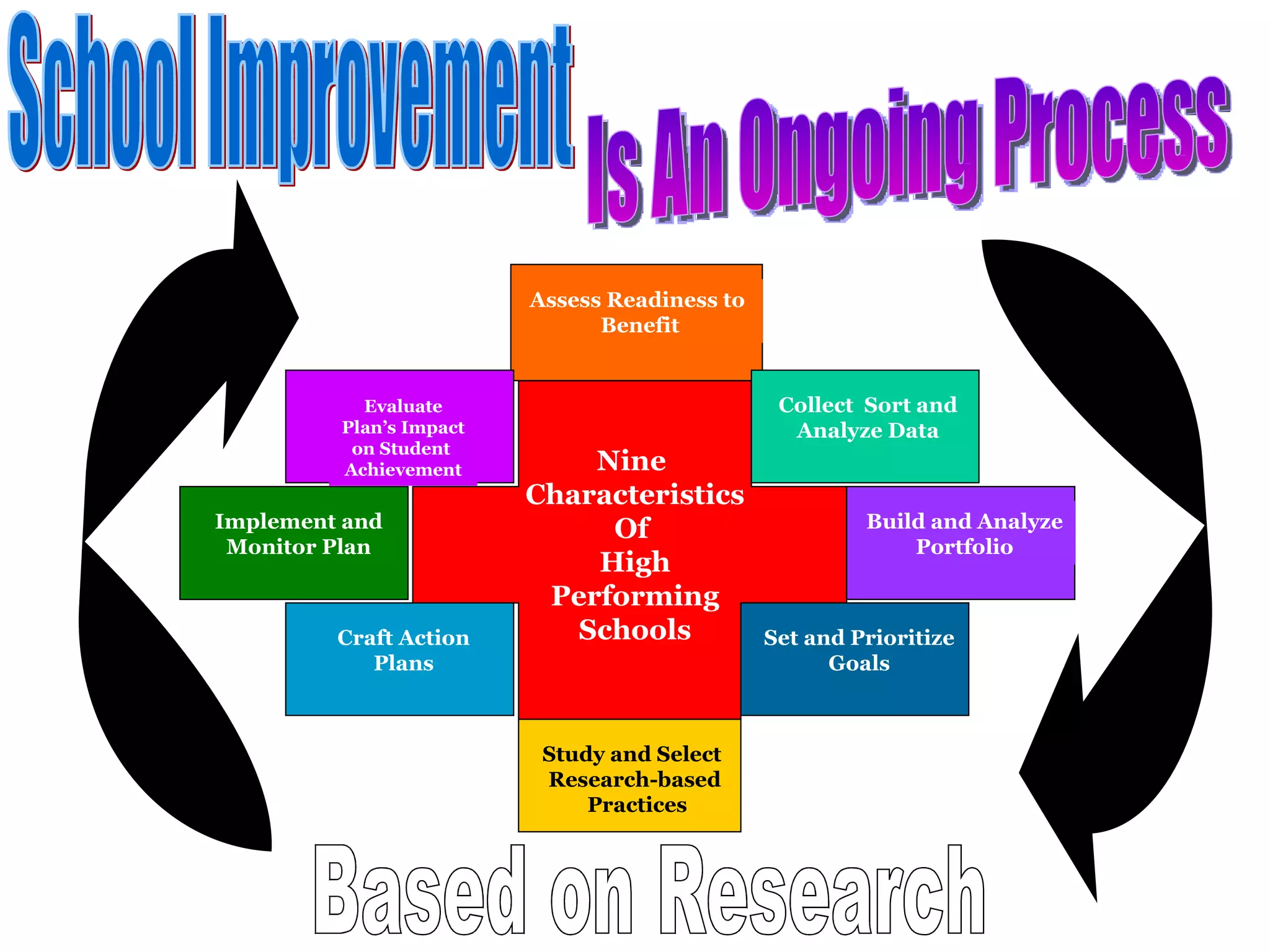
Nine
Characteristics
Of
High
Performing
Schools
Assess Readiness to
Benefit
Collect Sort and
Analyze Data
Build and Analyze
Portfolio
Set and Prioritize
Goals
Study and Select
Research-based
Practices
Craft Action
Plans
Implement and
Monitor Plan
Evaluate
Plan’s Impact
on Student
Achievement
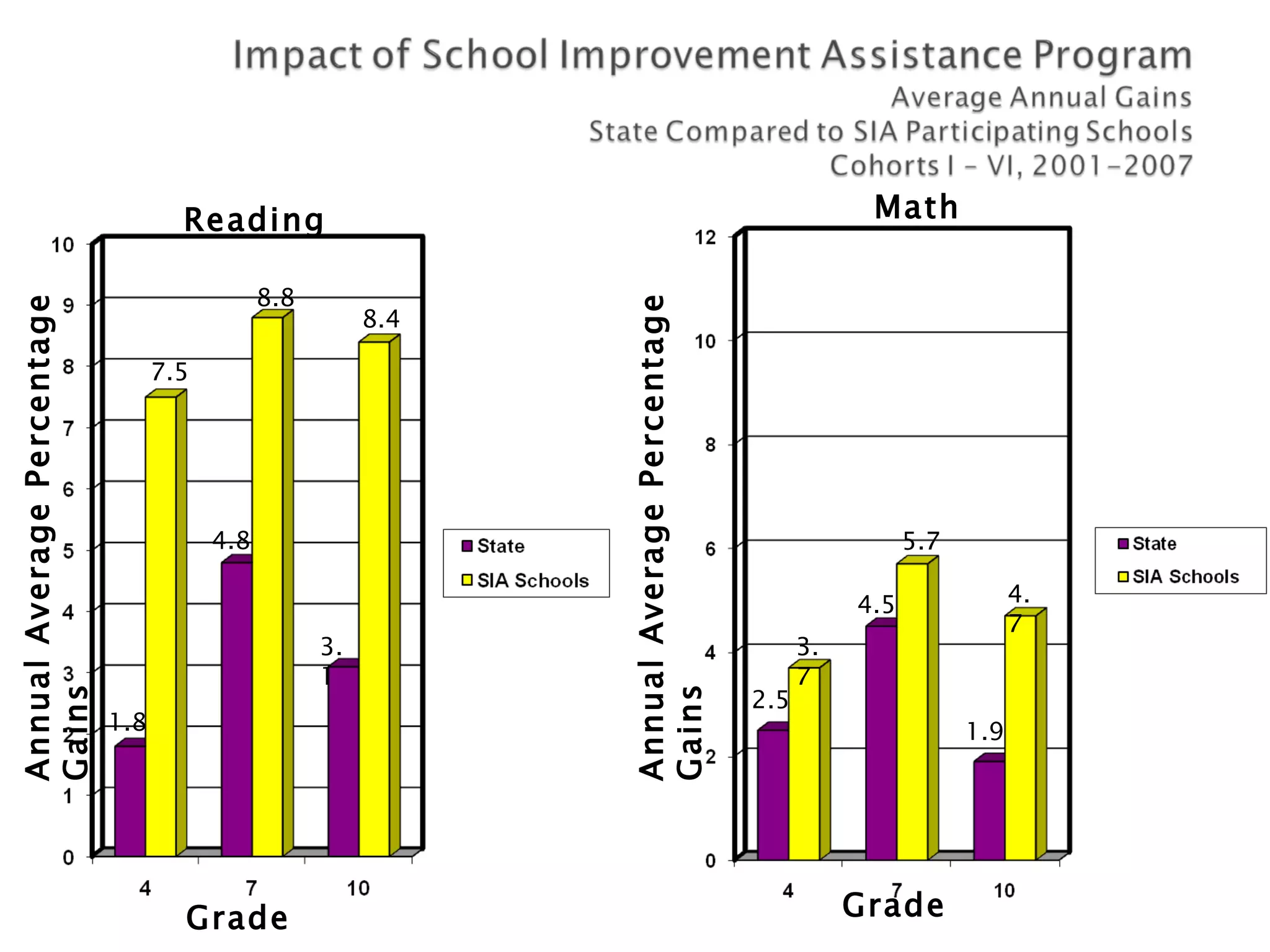
1.8
7.5
4.8
8.8
3.
1
8.4
Grade
AnnualAveragePercentage
Gains
Grade
2.5
3.
7
4.5
5.7
1.9
4.
7
Reading Math
AnnualAveragePercentage
Gains
Where the SIA-SIP program/process did
not result in improved student learning,
sustained over time, what might be some
reasons for the lack of positive change?
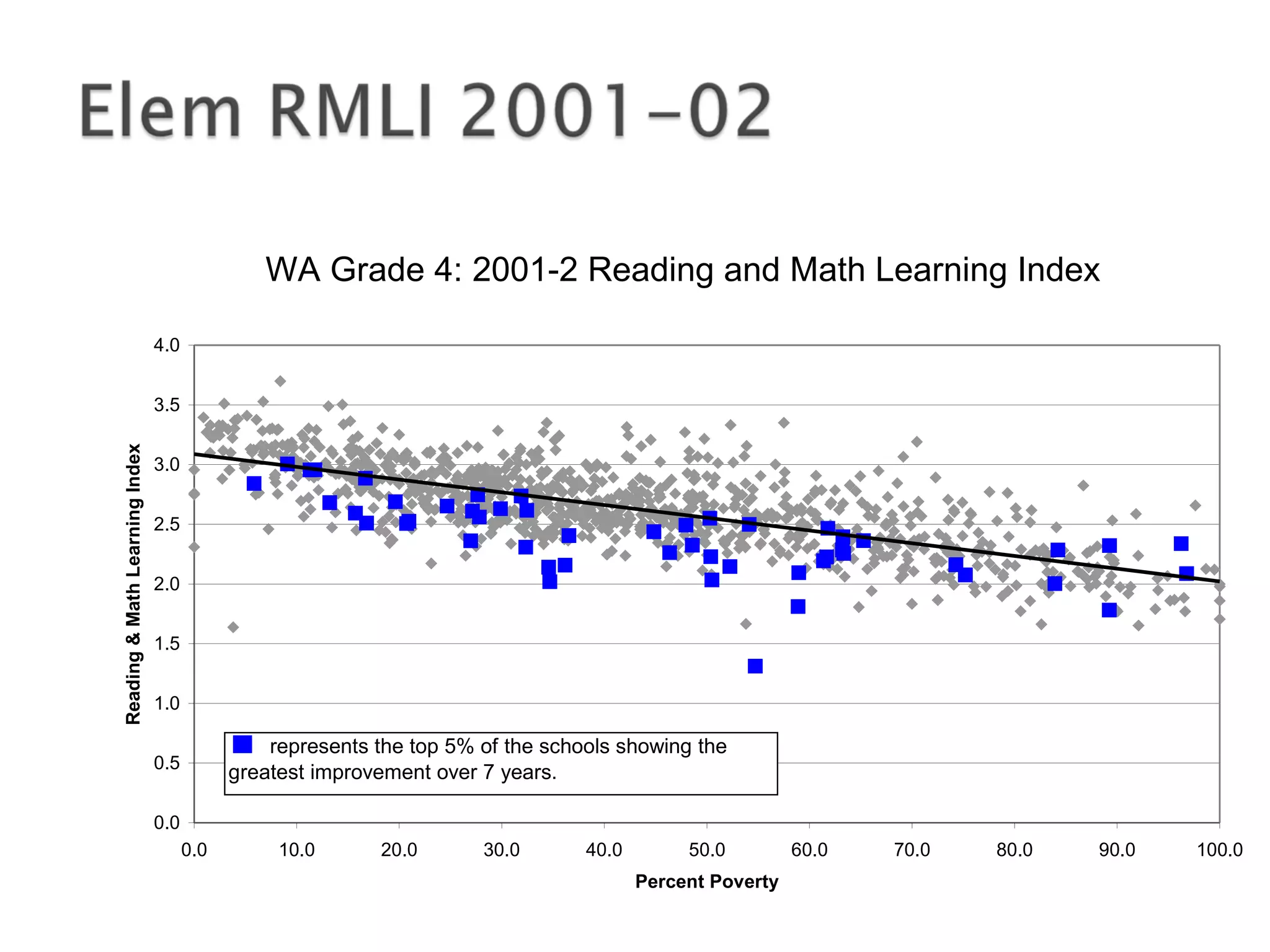
WA Grade 4: 2001-2 Reading and Math Learning Index
0.0
0.5
1.0
1.5
2.0
2.5
3.0
3.5
4.0
0.0 10.0 20.0 30.0 40.0 50.0 60.0 70.0 80.0 90.0 100.0
Percent Poverty
Reading&MathLearningIndex
represents the top 5% of the schools showing the
greatest improvement over 7 years.
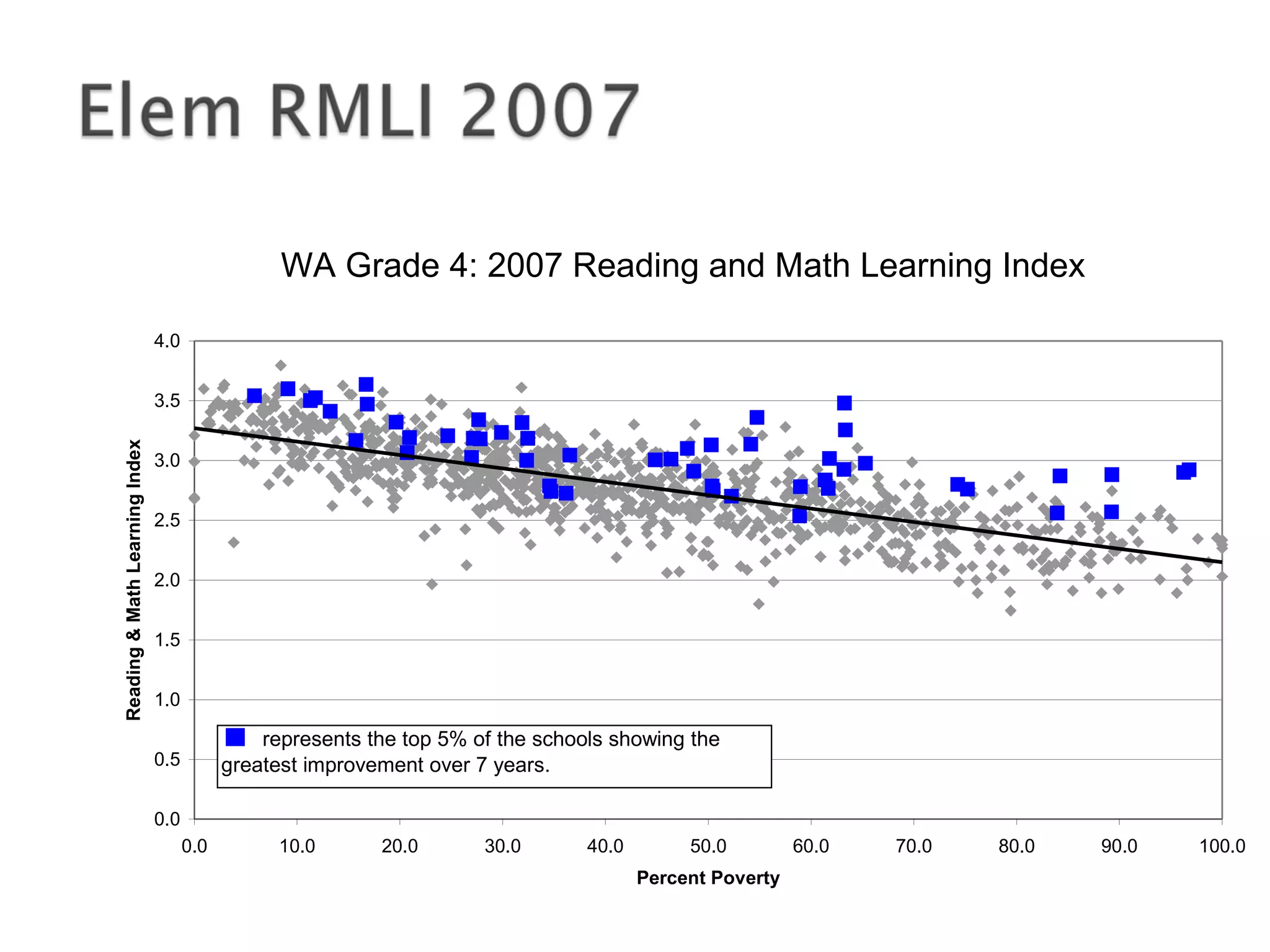
WA Grade 4: 2007 Reading and Math Learning Index
0.0
0.5
1.0
1.5
2.0
2.5
3.0
3.5
4.0
0.0 10.0 20.0 30.0 40.0 50.0 60.0 70.0 80.0 90.0 100.0
Percent Poverty
Reading&MathLearningIndex
represents the top 5% of the schools showing the
greatest improvement over 7 years.
• What is the connection of LEADERSHIP
to IMPLEMENTATION?
It’s not that leadership
makes a
difference-----it IS the
difference!
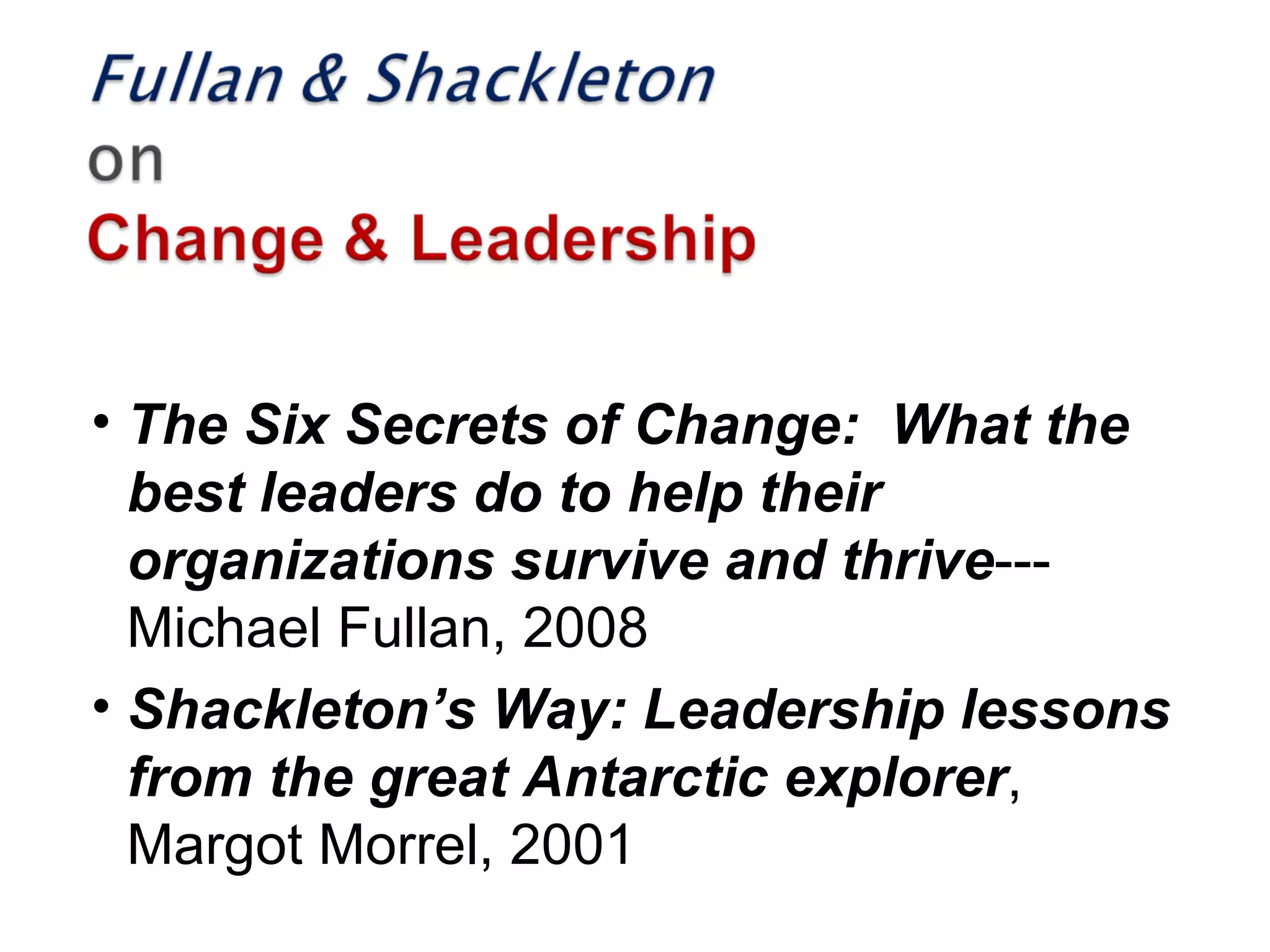
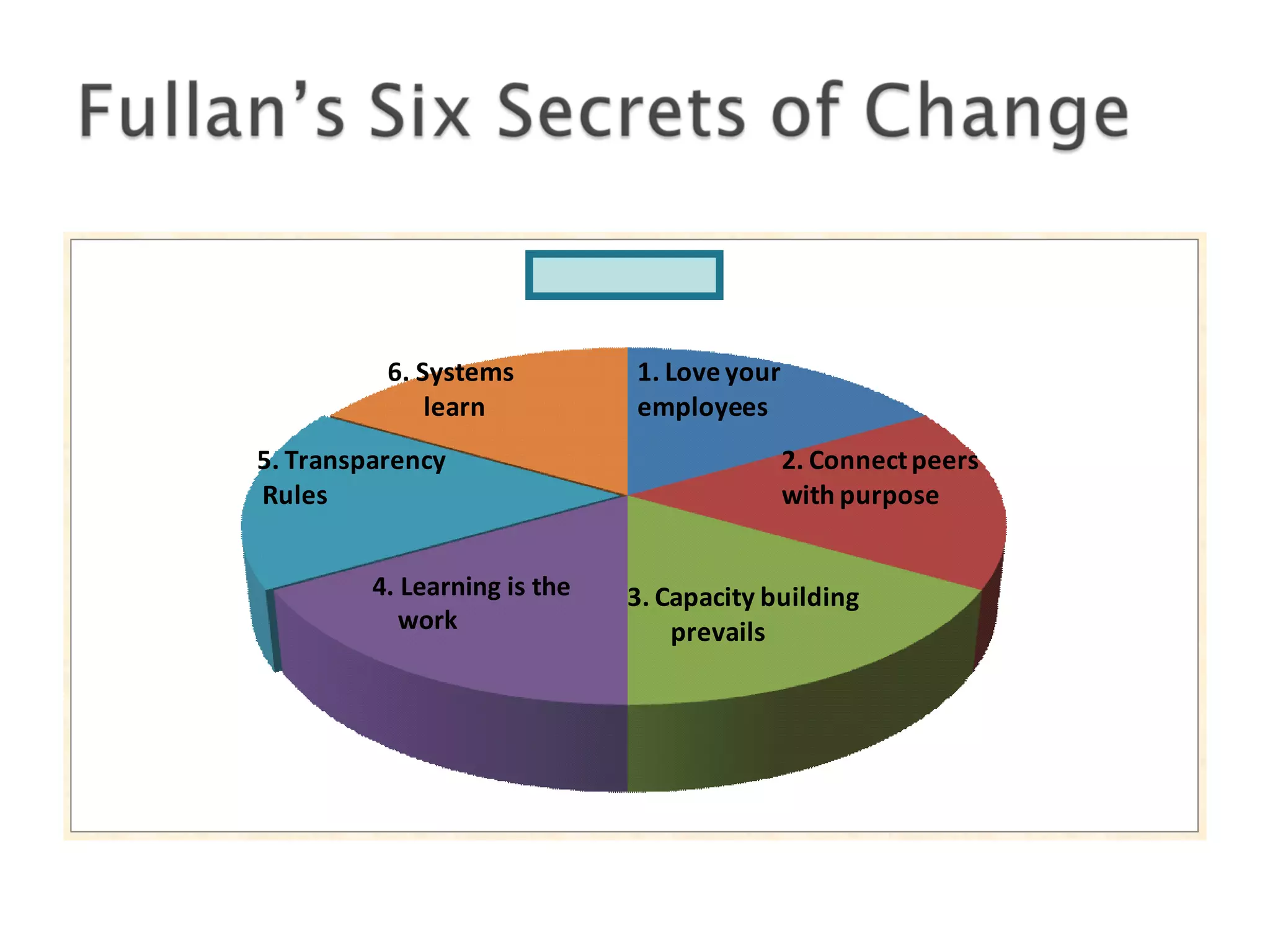
• The Six Secrets of Change: What the
best leaders do to help their
organizations survive and thrive---
Michael Fullan, 2008
• Shackleton’s Way: Leadership lessons
from the great Antarctic explorer,
Margot Morrel, 2001
He has been called "The greatest leader that
ever came on God's earth, bar none," yet he
never led a group larger than 27, he failed to
reach nearly every goal he ever set, and, until
recently, he had been little remembered after
his death. But once you learn the story of Sir
Ernest Shackleton and his remarkable
Antarctic expedition of 1914-1916 you'll
come to agree with the effusive praise of
those under his command. He is a model of
great leadership and, in particular, a master
of guidance in crisis.
---Earnest Shackleton
Improving schools require collaborative
cultures…. Without collaborative skills
and relationships, it is not possible to learn
and to continue to learn as much as you
need to know to improve.
Michael Fullan
Column1
1. Love your
employees
2. Connectpeers
with purpose
3. Capacity building
prevails
5. Transparency
Rules
6. Systems
learn
4. Learning is the
work
Which one of the six factors resonates with
you? Why?
Dr. Mary Alice Heuschel
Superintendent
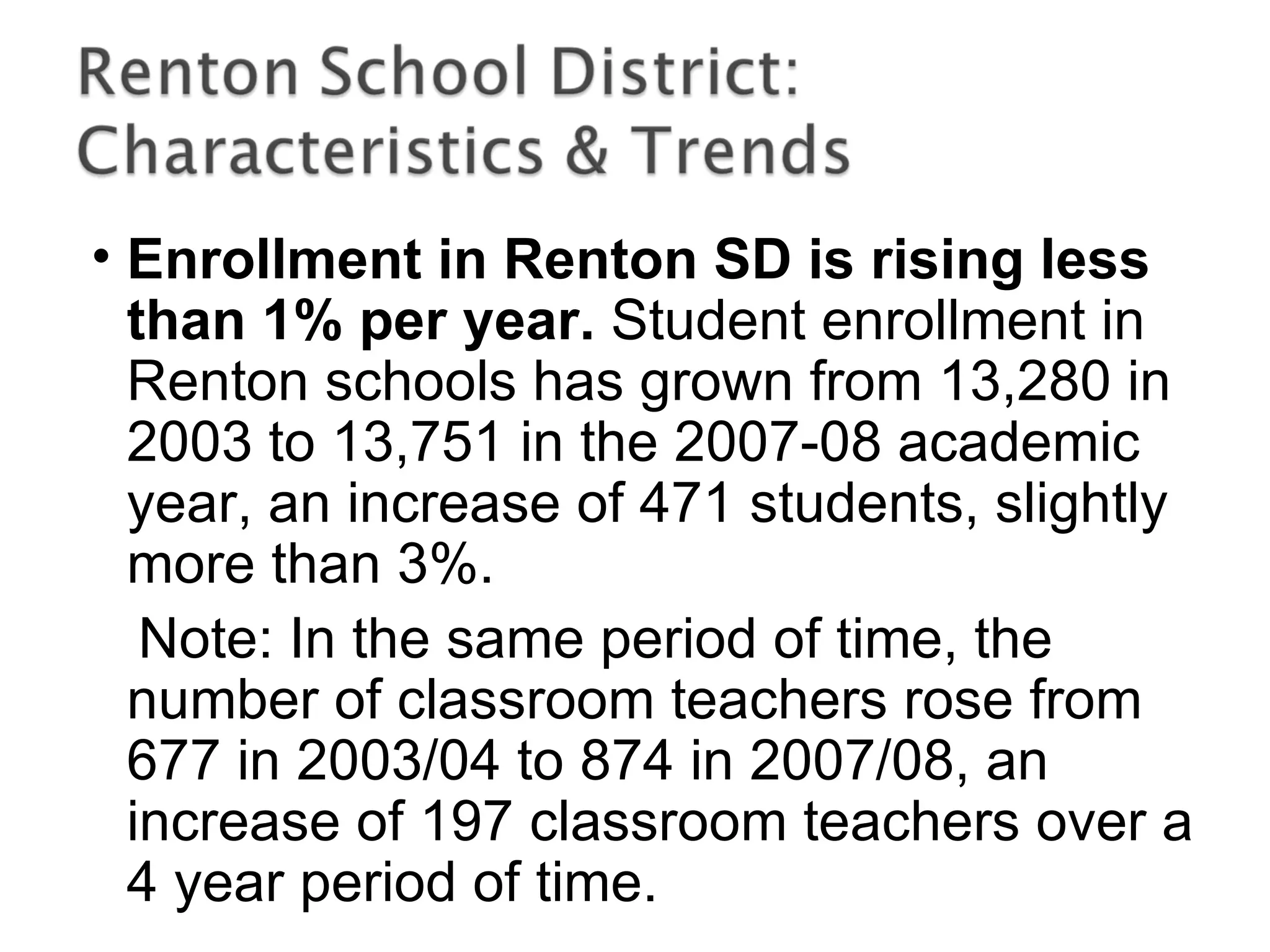
• Enrollment in Renton SD is rising less
than 1% per year. Student enrollment in
Renton schools has grown from 13,280 in
2003 to 13,751 in the 2007-08 academic
year, an increase of 471 students, slightly
more than 3%.
Note: In the same period of time, the
number of classroom teachers rose from
677 in 2003/04 to 874 in 2007/08, an
increase of 197 classroom teachers over a
4 year period of time.
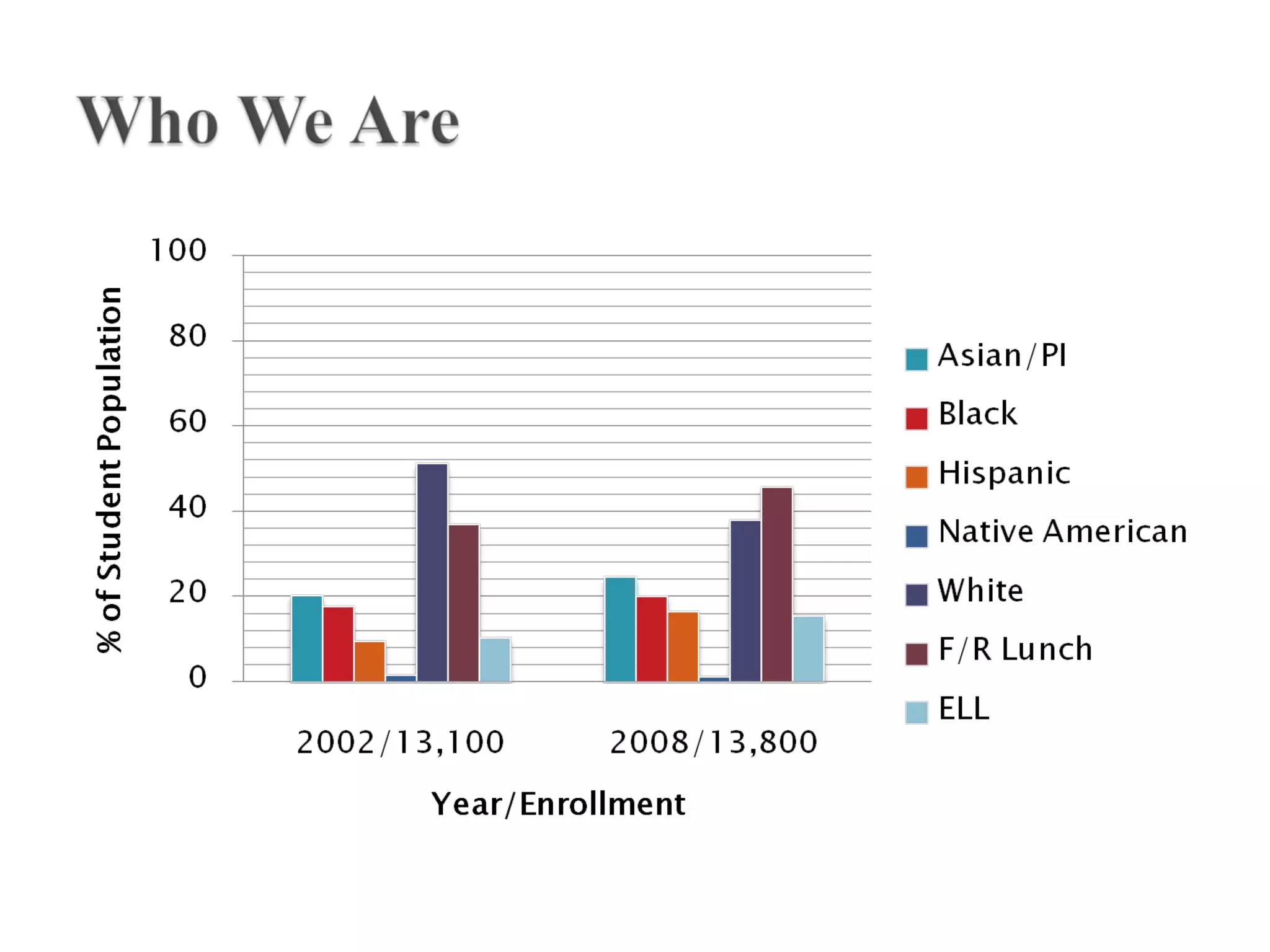
• The ethnicity of the Renton SD student
population is shifting from White to
Hispanic, Asian and Black. The Renton
SD student enrollment is primarily from
four ethnic groups: White, 38% (down
10% from 48% in 2003); Hispanic, 17%
(up from 11% in 2003); Asian, 25% (up
from 21% in 2003); Black, 20% (up from
18% in 2003); and American Indian, less
than 2% (stable over the same four year
• The rate of poverty in the Renton SD is
steady at 42%. Statewide poverty is 38%,
a 2% increase since 2003.
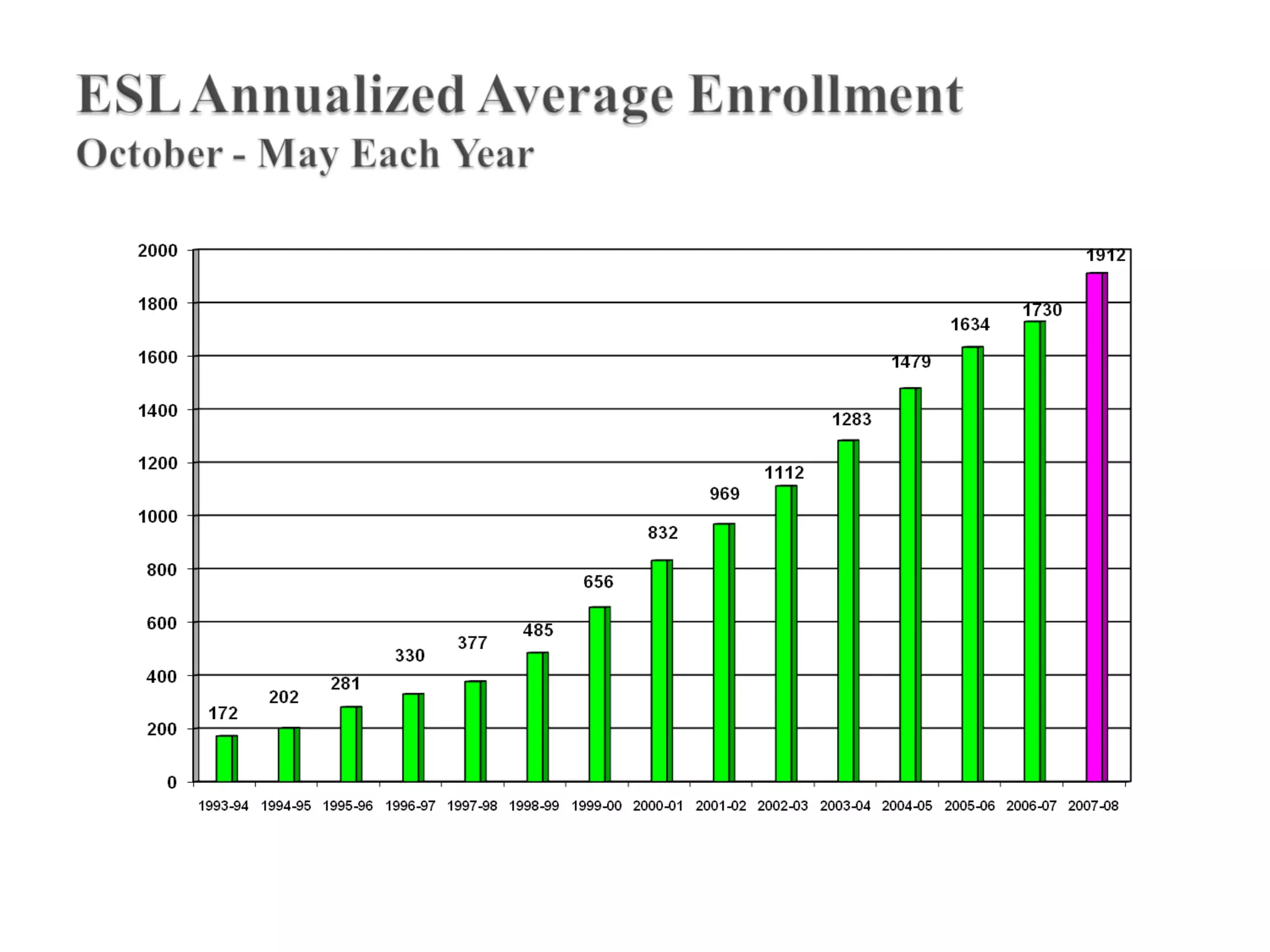
• The percentage of Renton SD students
receiving Transitional Bilingual
services increased by one percent
each year over the four year time
period. Renton SD students receiving
Bilingual (English Language Learner)
support increased from 10% in 2003 to
15% in the 2007-08 academic year. The
state percentage currently is 8%, an
increase of less than one percent over the
• Special Education services are
delivered to 12% of Renton SD
students – a number that has increased
less than 1% over the past four years.
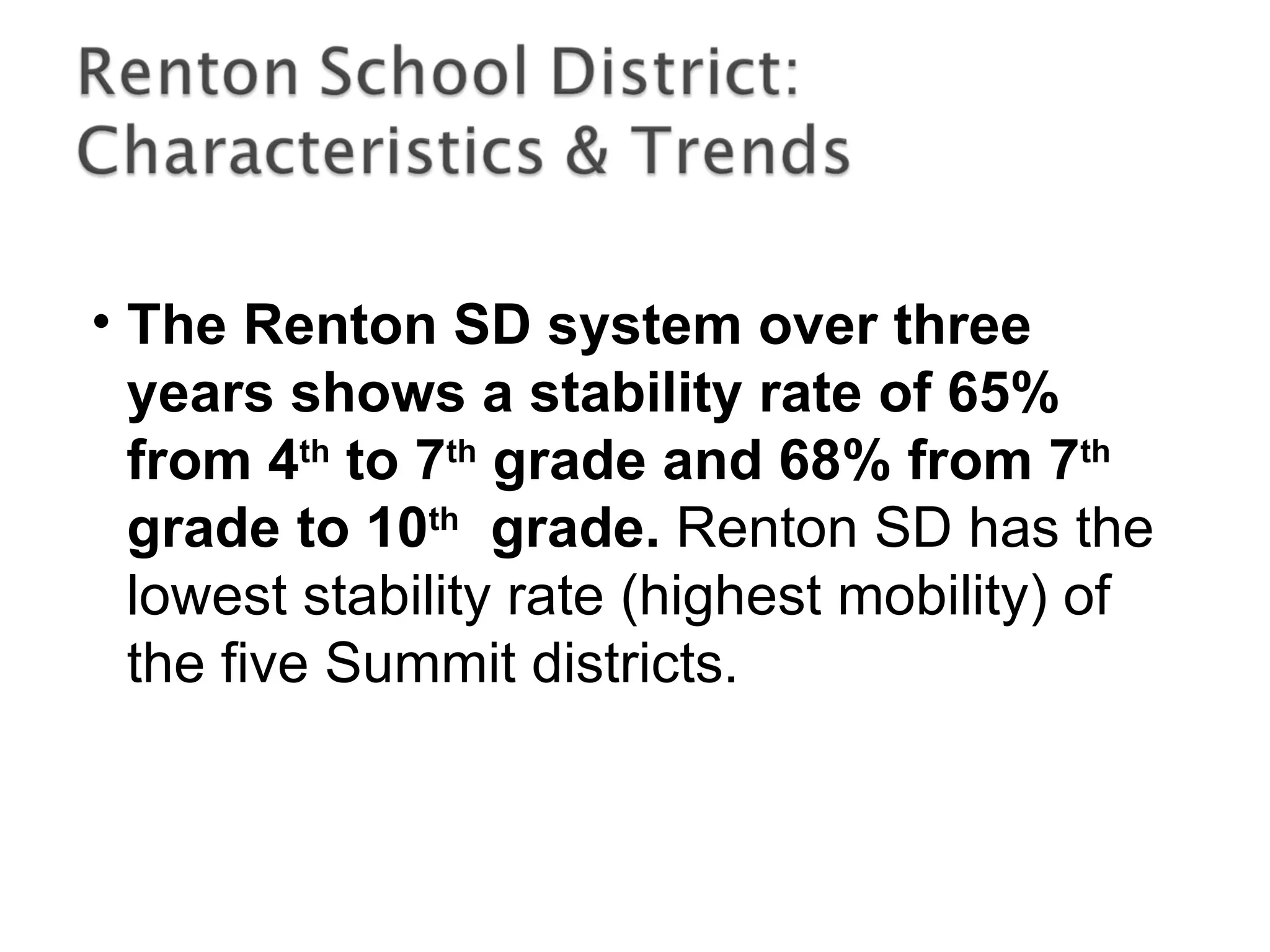
• The Renton SD system over three
years shows a stability rate of 65%
from 4th
to 7th
grade and 68% from 7th
grade to 10th
grade. Renton SD has the
lowest stability rate (highest mobility) of
the five Summit districts.
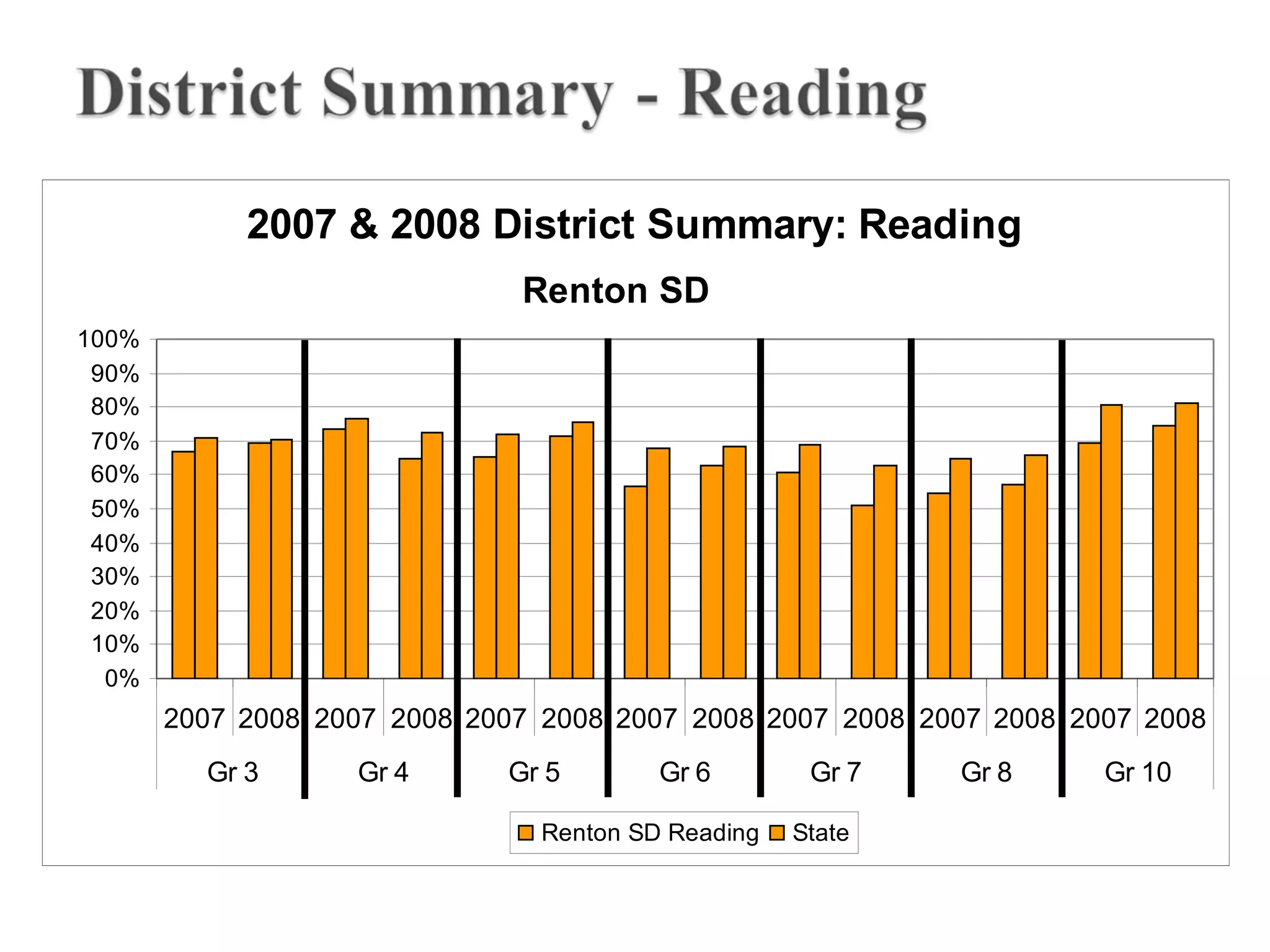
2007 & 2008 District Summary: Reading
0%
10%
20%
30%
40%
50%
60%
70%
80%
90%
100%
2007 2008 2007 2008 2007 2008 2007 2008 2007 2008 2007 2008 2007 2008
Gr 3 Gr 4 Gr 5 Gr 6 Gr 7 Gr 8 Gr 10
Renton SD Reading State
Renton SD
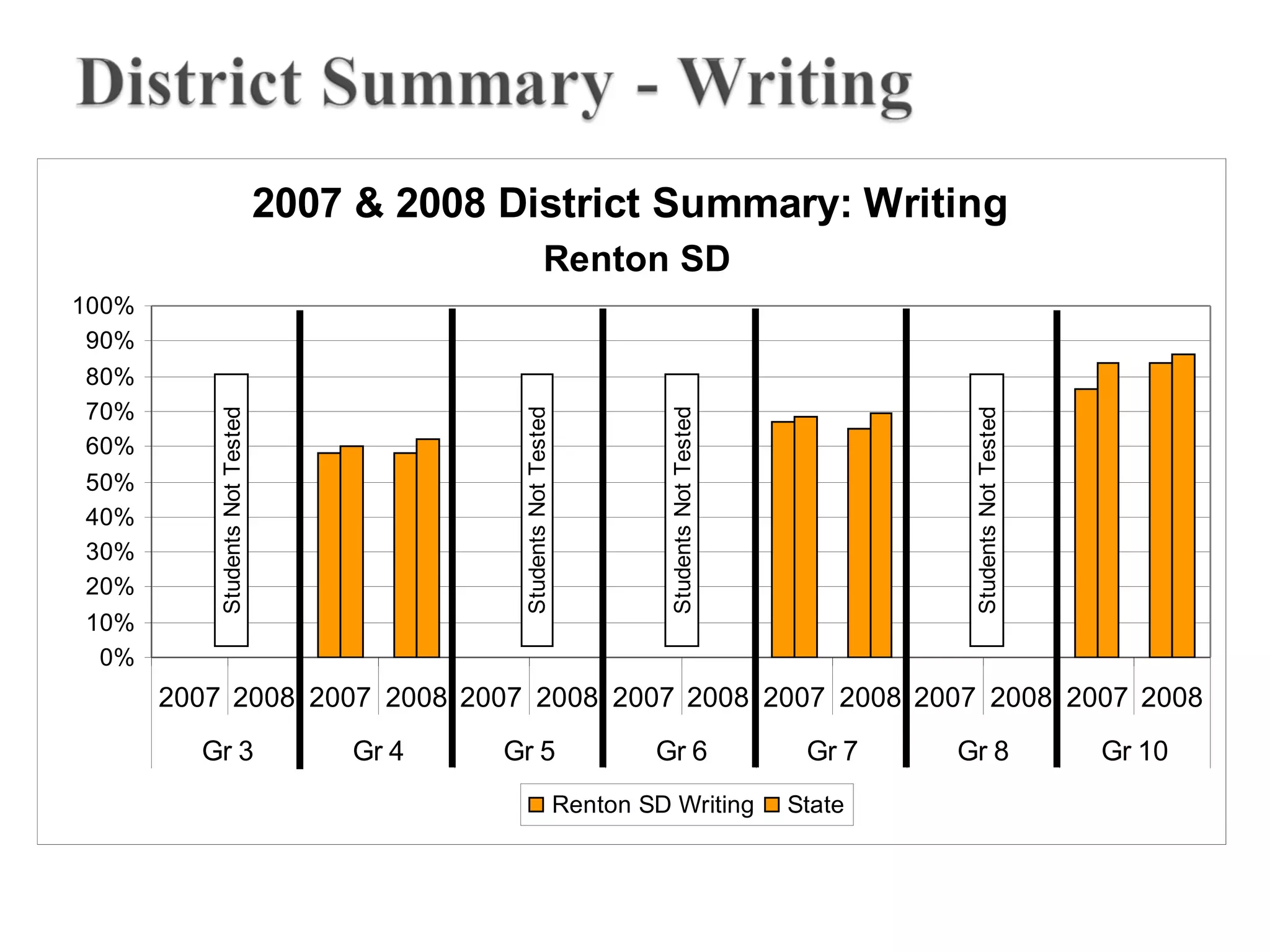
2007 & 2008 District Summary: Writing
0%
10%
20%
30%
40%
50%
60%
70%
80%
90%
100%
2007 2008 2007 2008 2007 2008 2007 2008 2007 2008 2007 2008 2007 2008
Gr 3 Gr 4 Gr 5 Gr 6 Gr 7 Gr 8 Gr 10
Renton SD Writing State
Renton SD
StudentsNotTested
StudentsNotTested
StudentsNotTested
StudentsNotTested
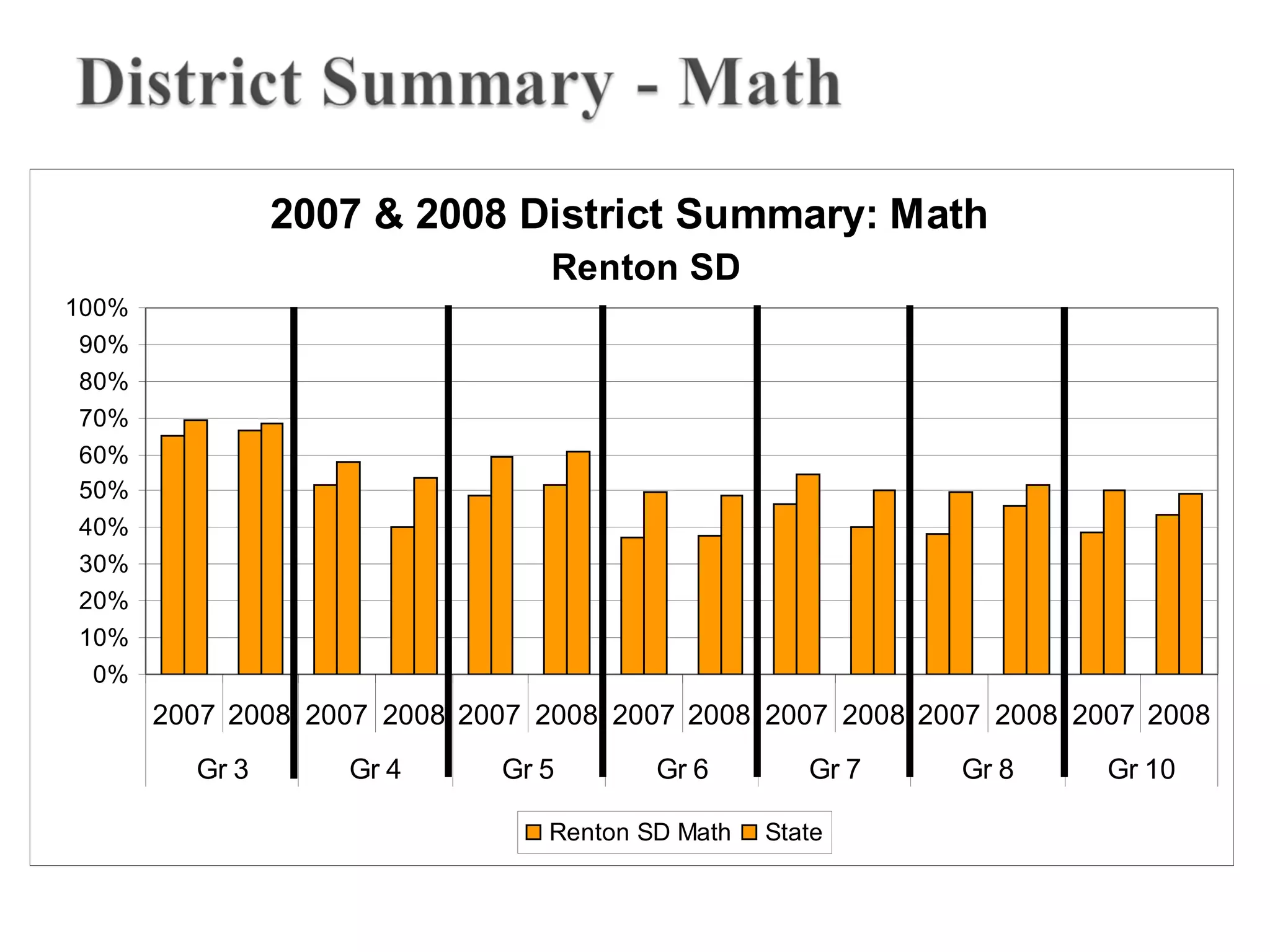
2007 & 2008 District Summary: Math
0%
10%
20%
30%
40%
50%
60%
70%
80%
90%
100%
2007 2008 2007 2008 2007 2008 2007 2008 2007 2008 2007 2008 2007 2008
Gr 3 Gr 4 Gr 5 Gr 6 Gr 7 Gr 8 Gr 10
Renton SD Math State
Renton SD
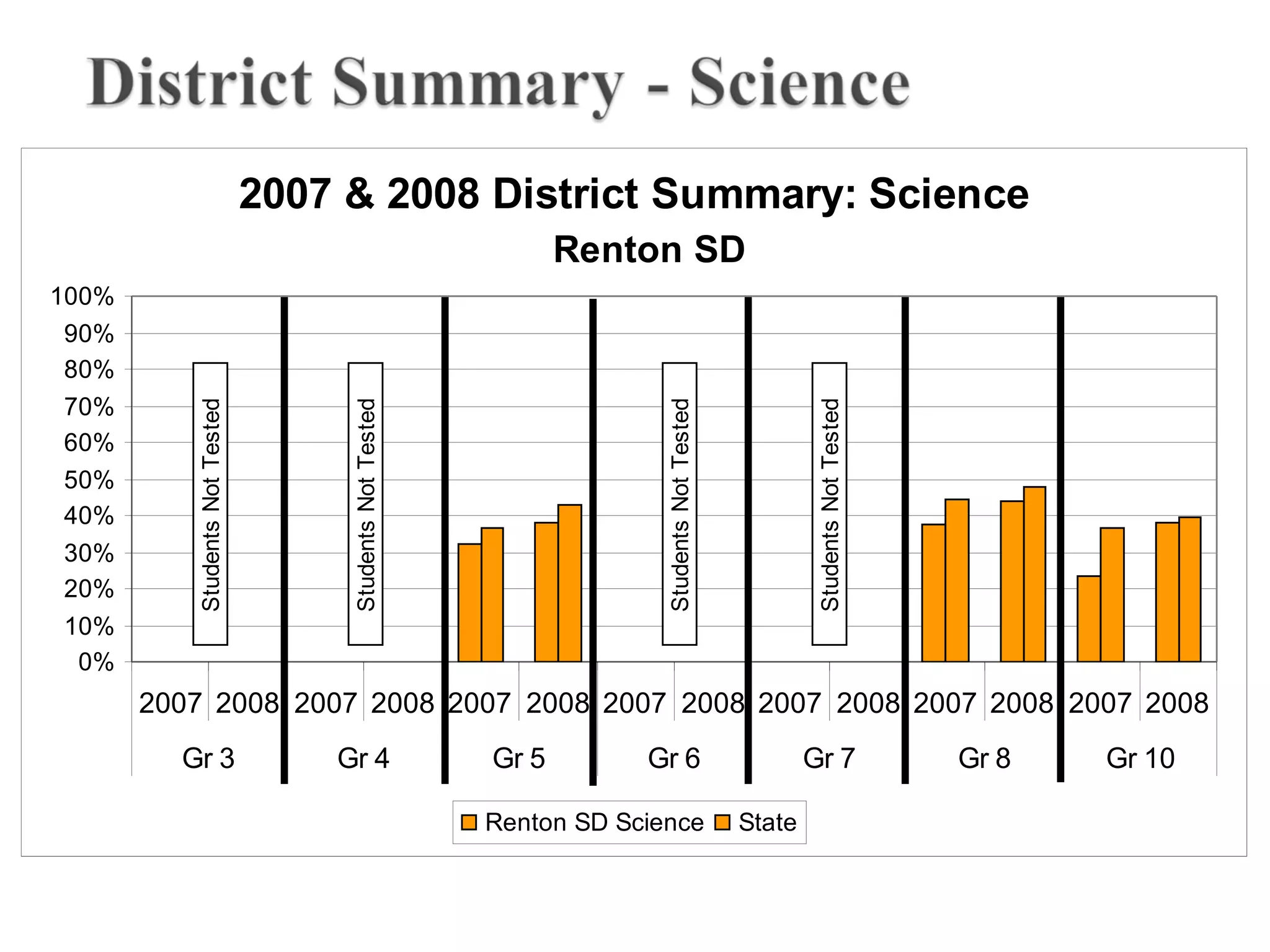
2007 & 2008 District Summary: Science
0%
10%
20%
30%
40%
50%
60%
70%
80%
90%
100%
2007 2008 2007 2008 2007 2008 2007 2008 2007 2008 2007 2008 2007 2008
Gr 3 Gr 4 Gr 5 Gr 6 Gr 7 Gr 8 Gr 10
Renton SD Science State
Renton SD
StudentsNotTested
StudentsNotTested
StudentsNotTested
StudentsNotTested
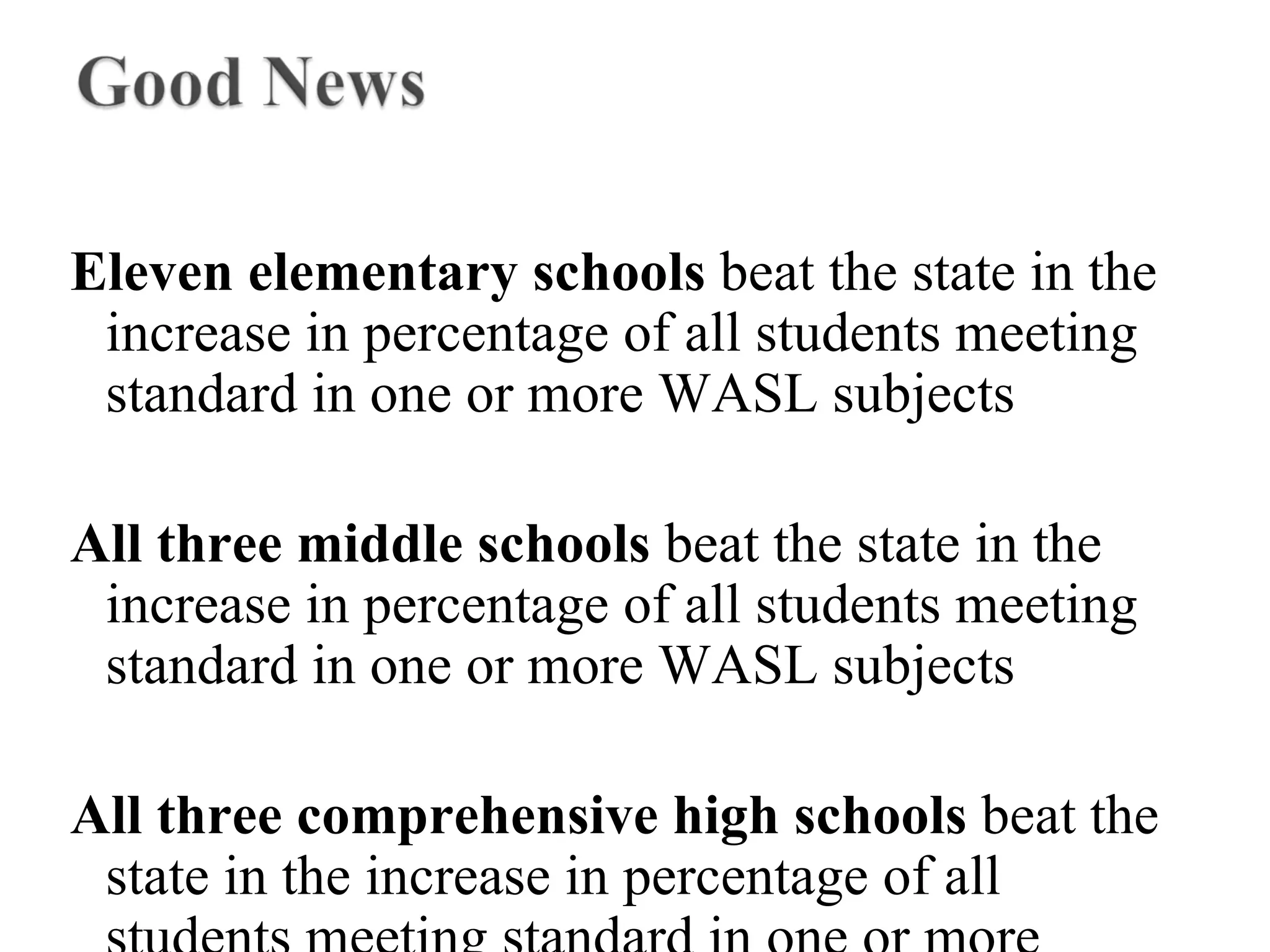
Eleven elementary schools beat the state in the
increase in percentage of all students meeting
standard in one or more WASL subjects
All three middle schools beat the state in the
increase in percentage of all students meeting
standard in one or more WASL subjects
All three comprehensive high schools beat the
state in the increase in percentage of all
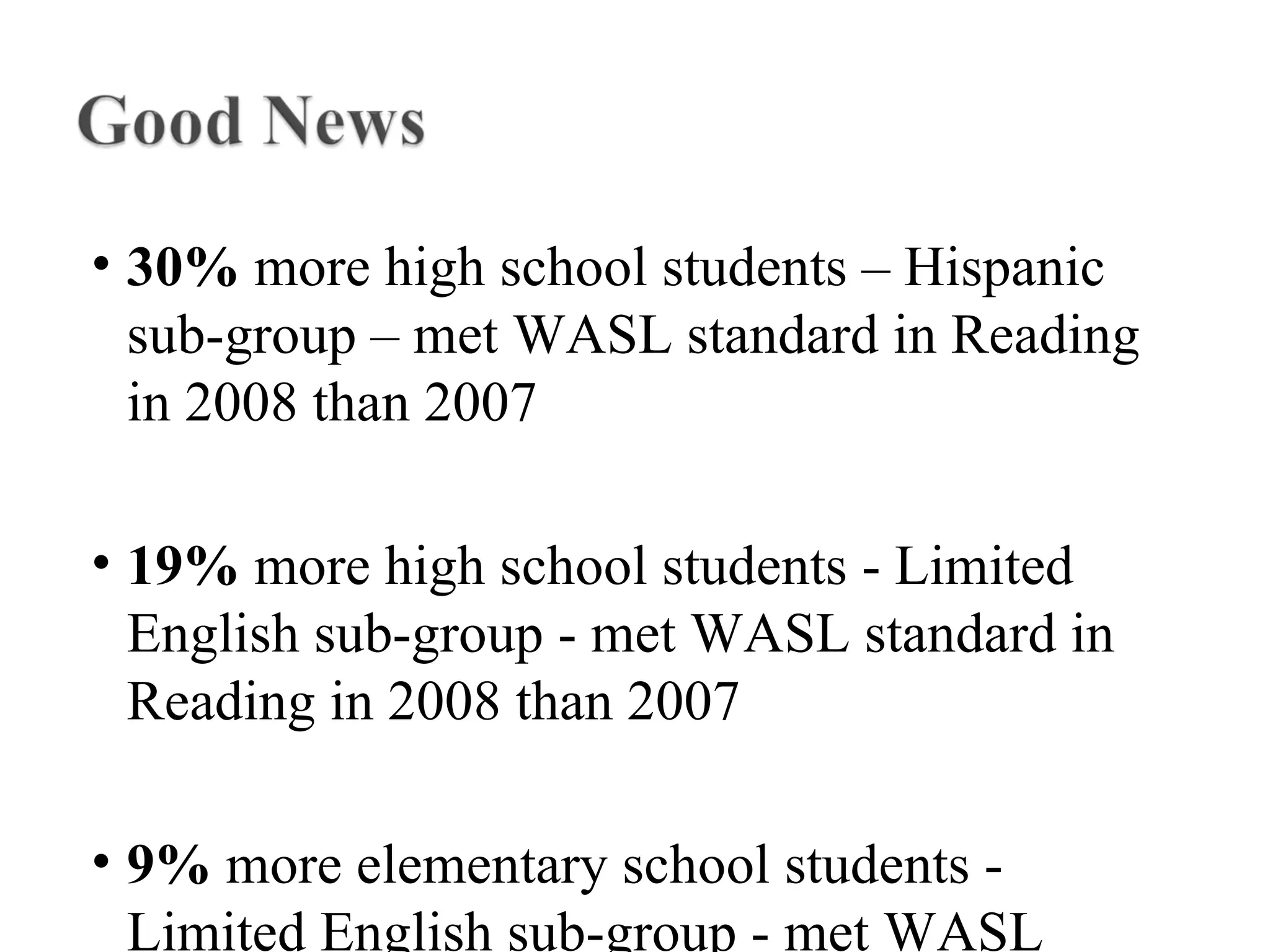
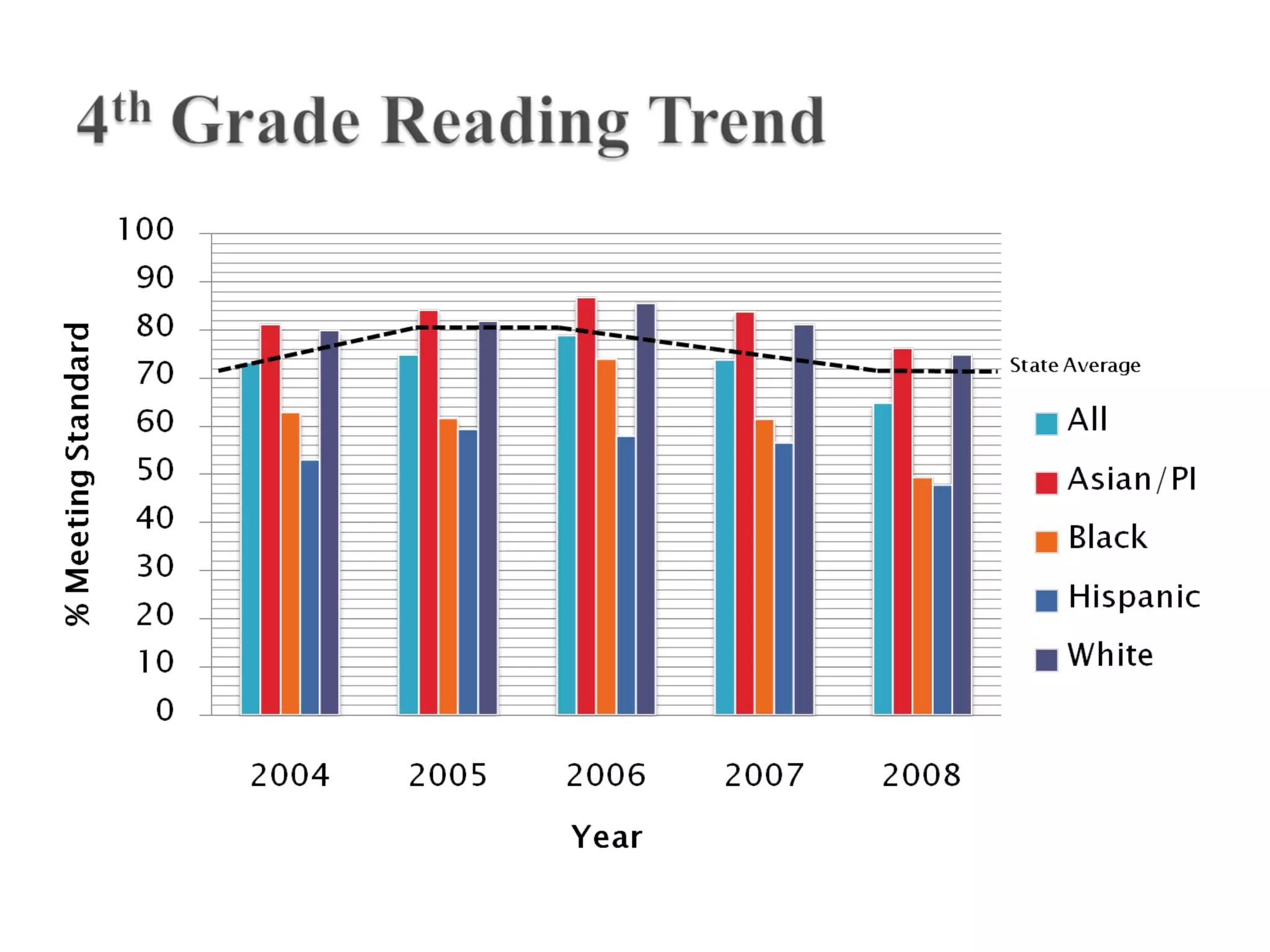
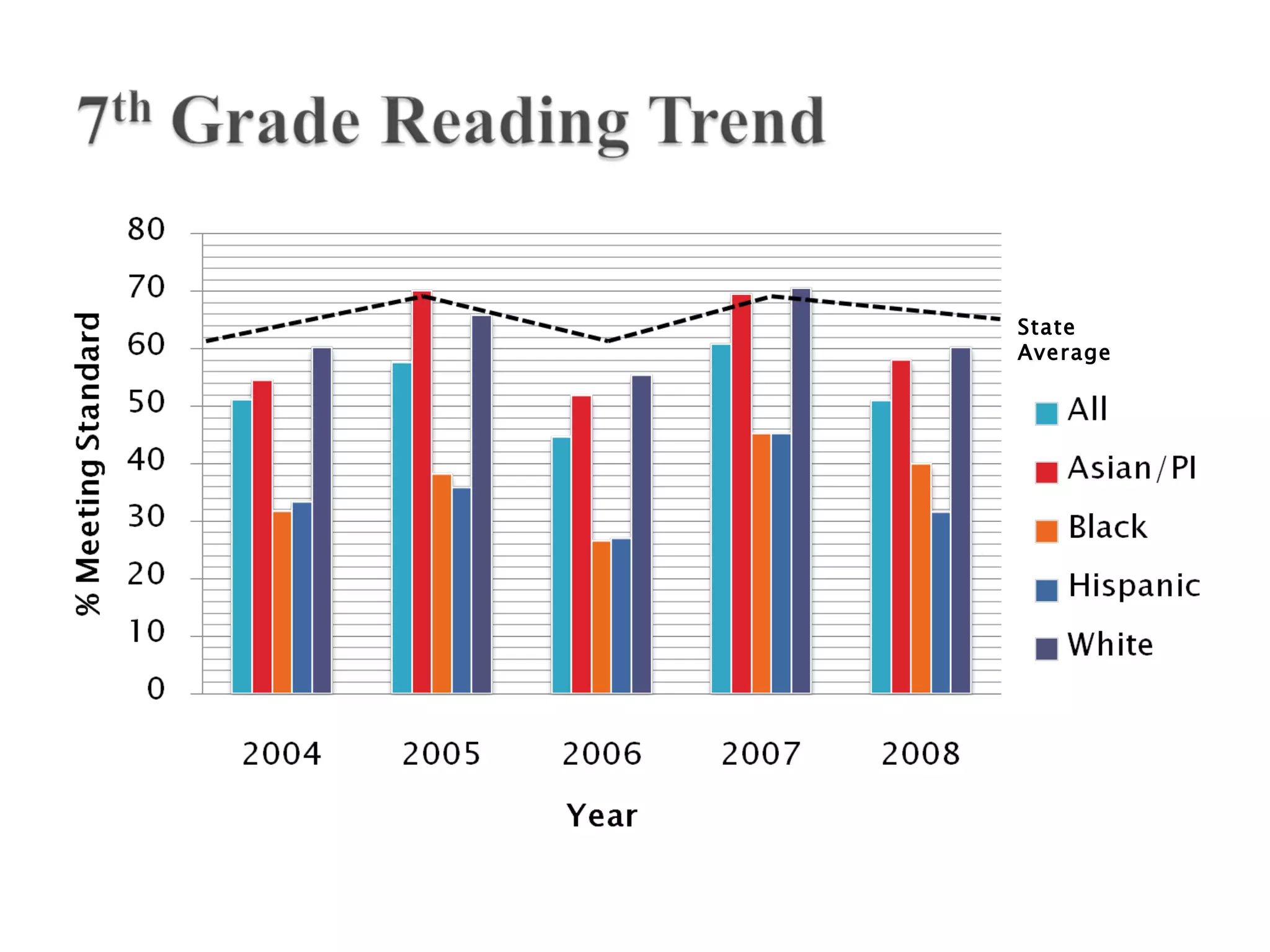
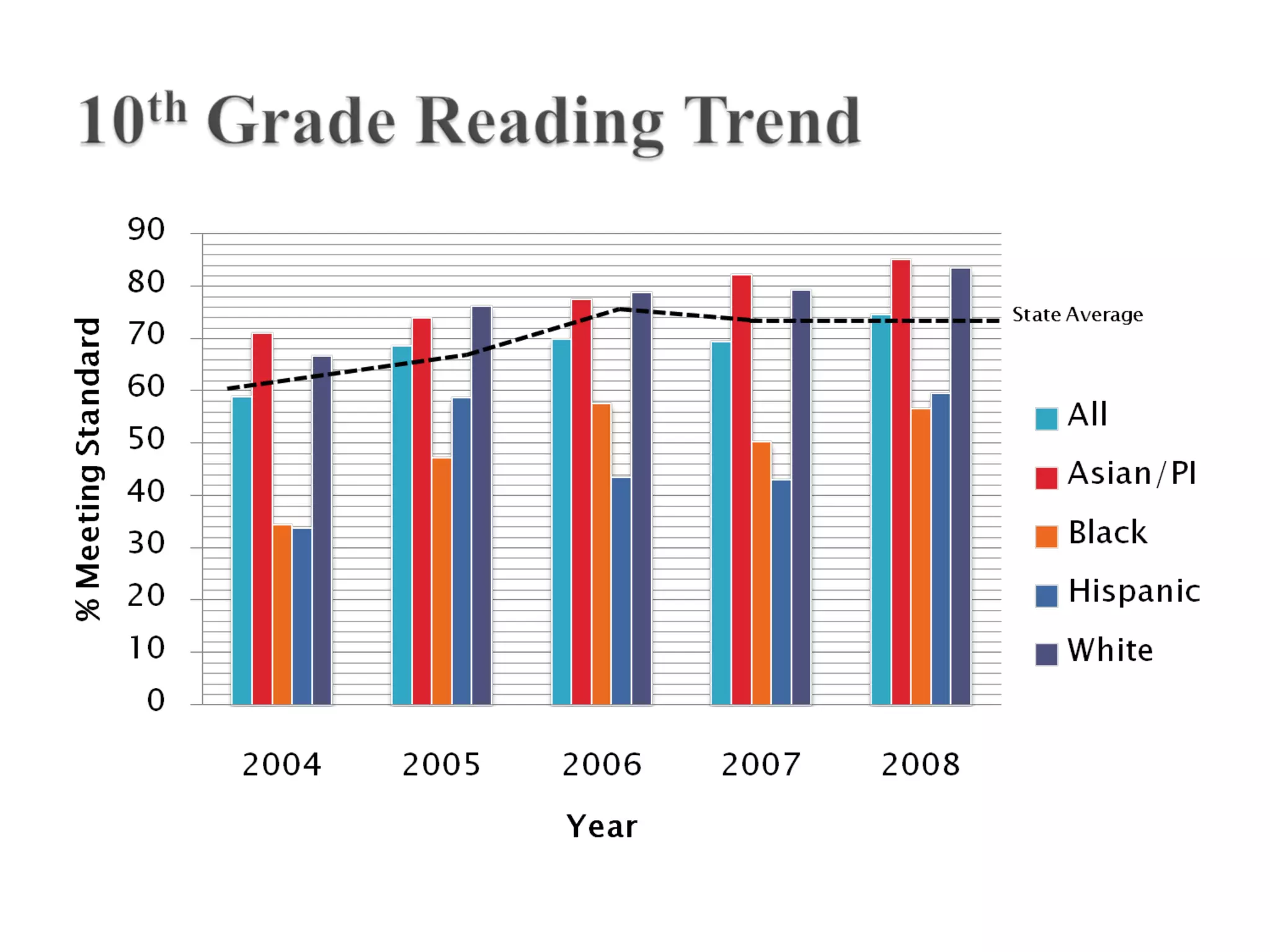
• 30% more high school students – Hispanic
sub-group – met WASL standard in Reading
in 2008 than 2007
• 19% more high school students - Limited
English sub-group - met WASL standard in
Reading in 2008 than 2007
• 9% more elementary school students -
Limited English sub-group - met WASL
State
Average
• Students in Renton (regardless of race,
ethnicity, socio-economic status) are below the
state average in reading and mathematics
• An Achievement Gap exists between the
academic achievement of our white students
and the academic achievement of our students
of color
• An Achievement Gap exists between the
academic achievement of students in poverty
The Summit Initiative – additional resources and
expertise to enhance district efforts
–Support for our Renton School District goals
• P-12 Reading
• P-12 Math
• Equity and Access
–Support for Renton School District initiatives
• Professional Learning Communities (PLC)
• Response To Intervention (RTI)
• Positive Behavior Support (PBS)
• Sheltered Instruction, Observation Protocol
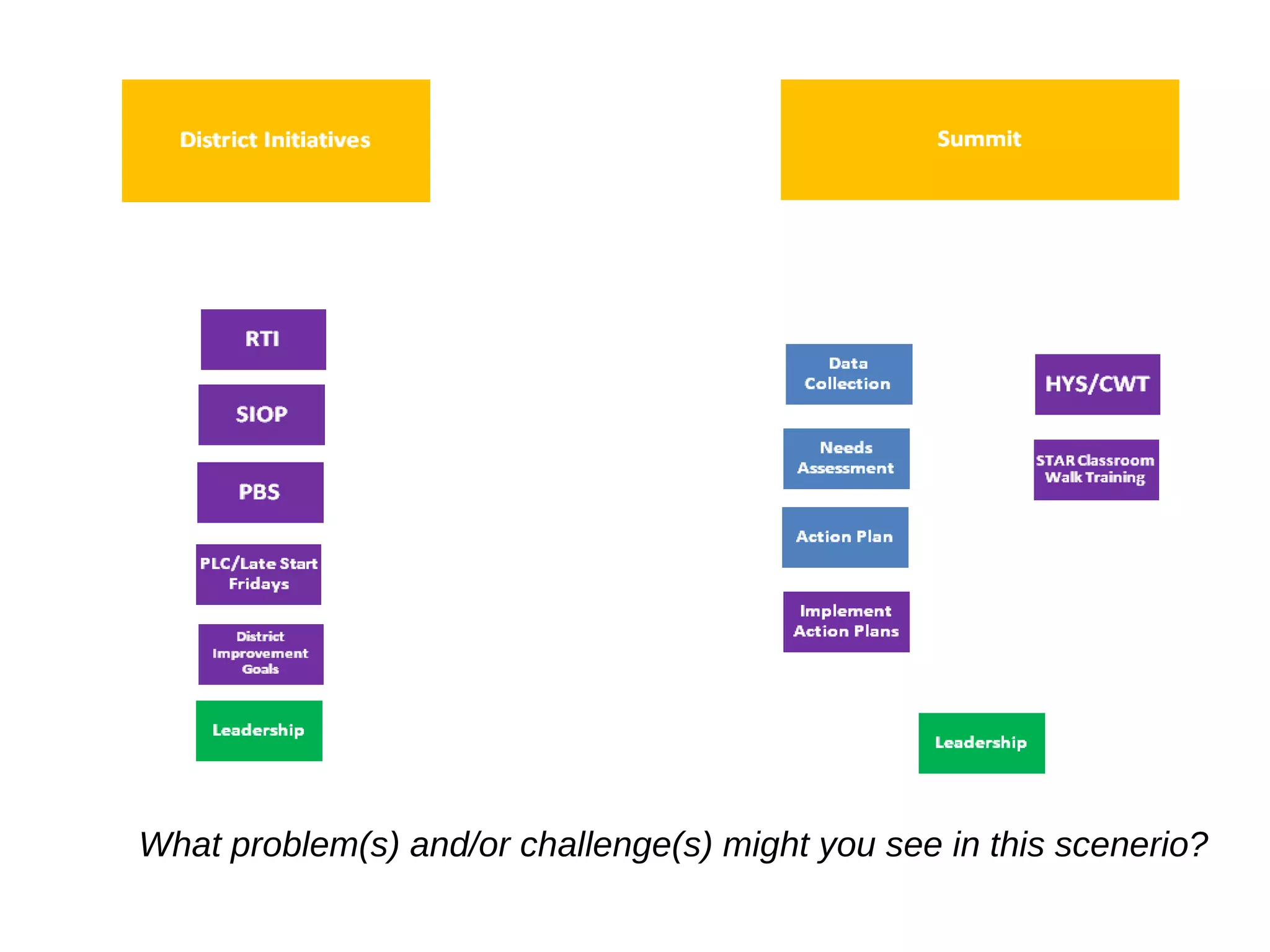
What problem(s) and/or challenge(s) might you see in this scenerio?
Raising student achievement
to new heights
• Increase capacity of participating districts to
accelerate achievement for all students
district-wide.
• Develop and field test Summit Initiative
program elements intended to strengthen
and support a systems approach to raising
achievement.
• Develop an improvement model that can,
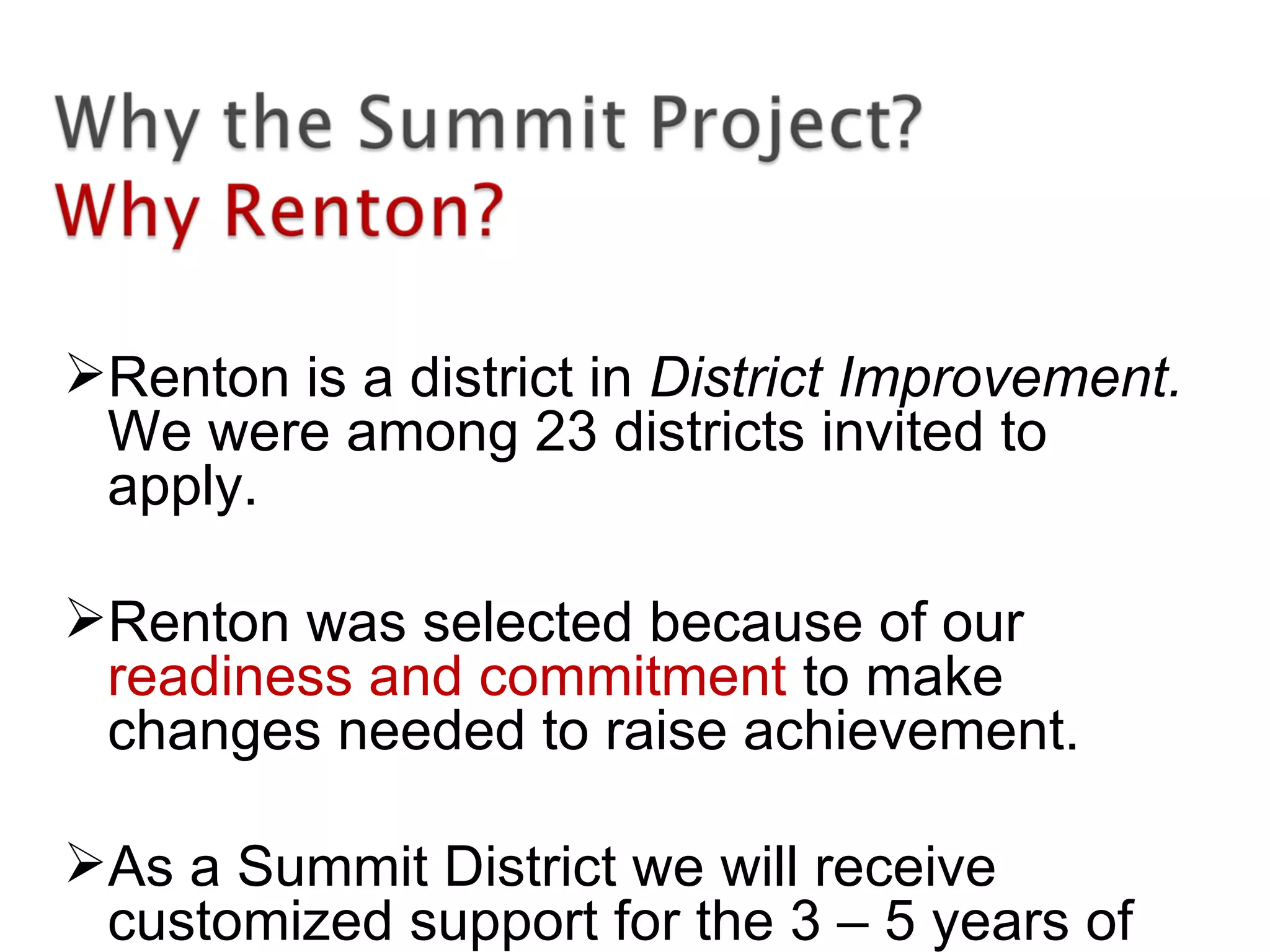
Renton is a district in District Improvement.
We were among 23 districts invited to
apply.
Renton was selected because of our
readiness and commitment to make
changes needed to raise achievement.
As a Summit District we will receive
customized support for the 3 – 5 years of
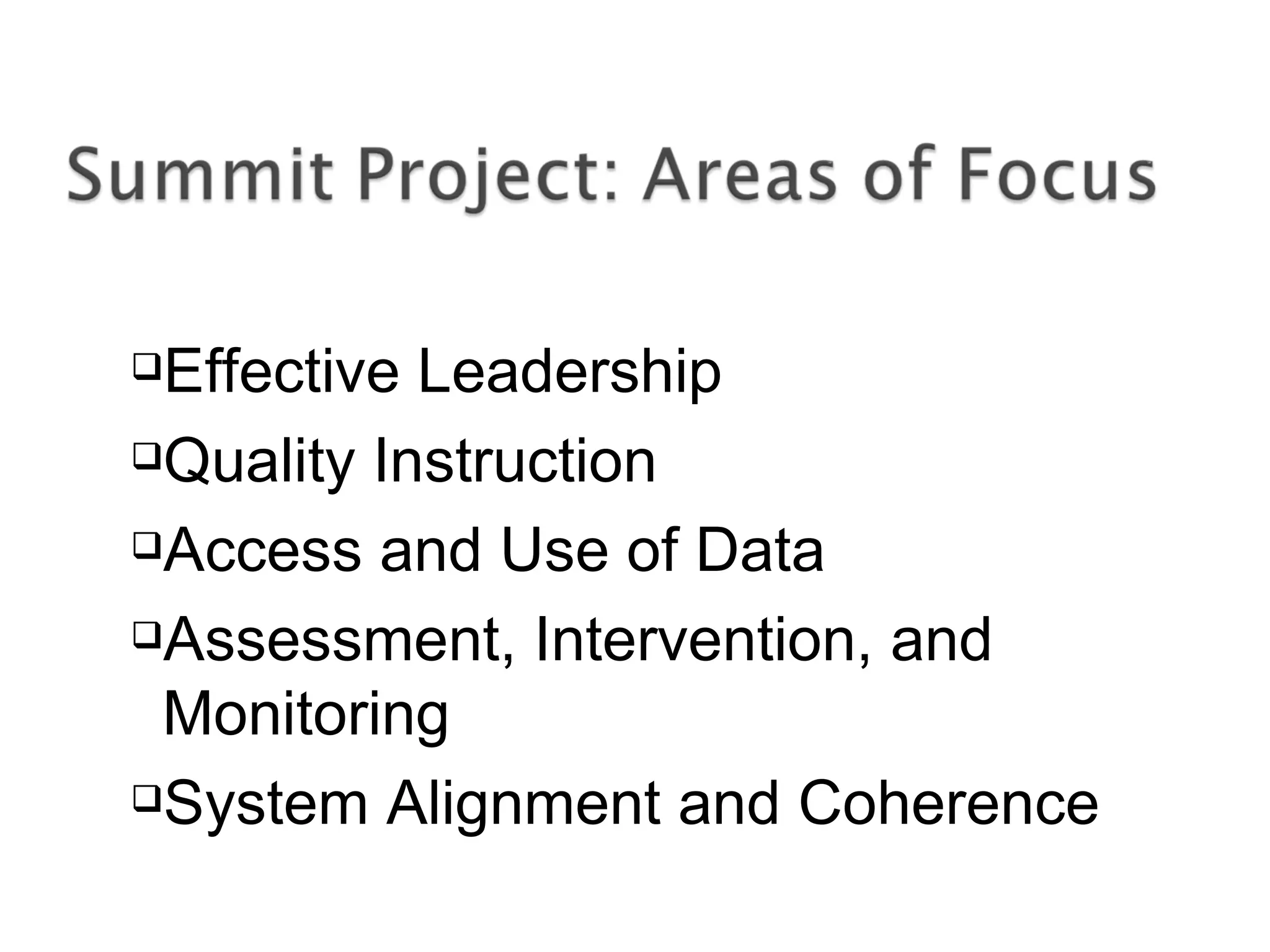
Effective Leadership
Quality Instruction
Access and Use of Data
Assessment, Intervention, and
Monitoring
System Alignment and Coherence
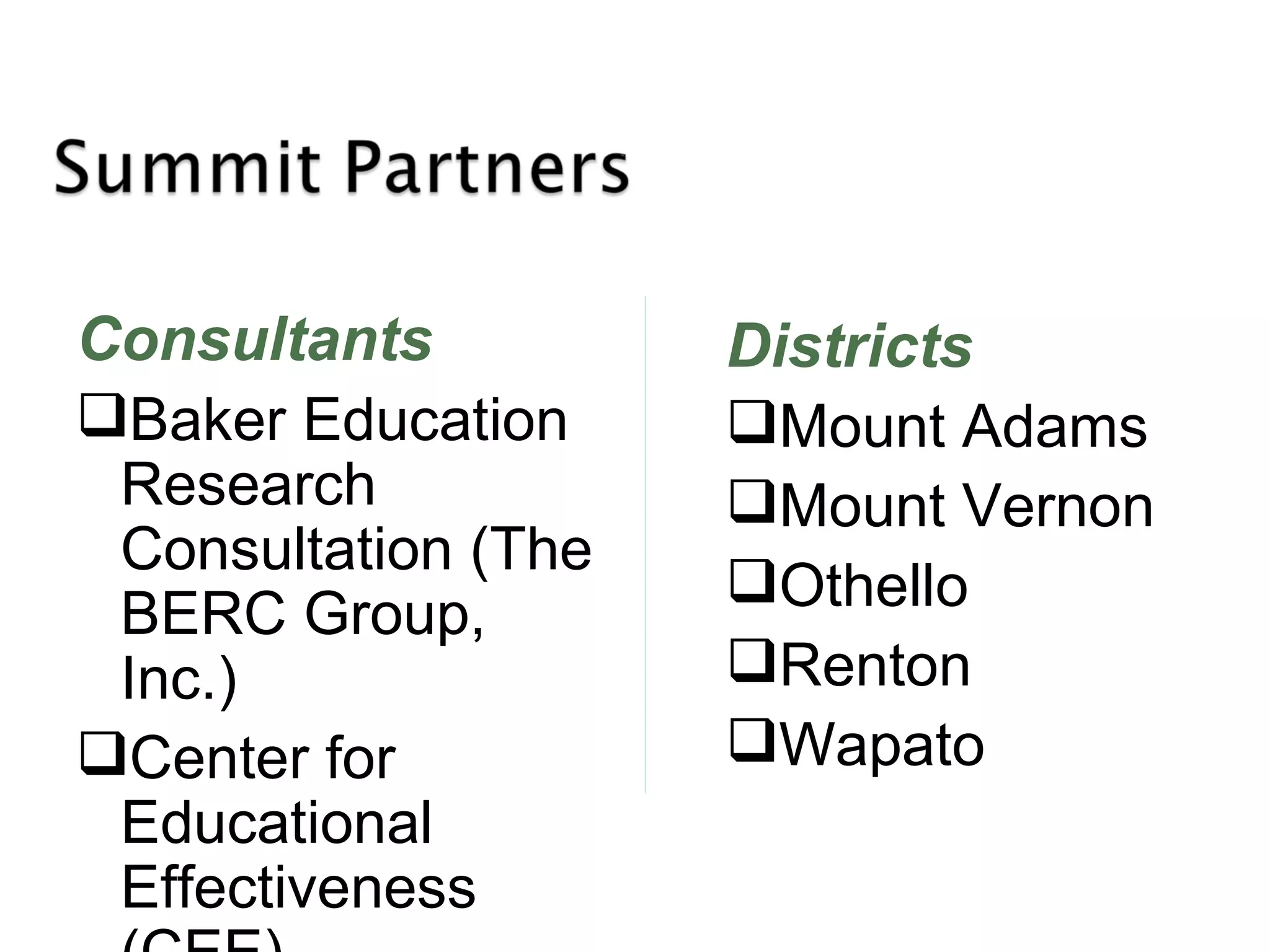
Consultants
Baker Education
Research
Consultation (The
BERC Group,
Inc.)
Center for
Educational
Effectiveness
Districts
Mount Adams
Mount Vernon
Othello
Renton
Wapato
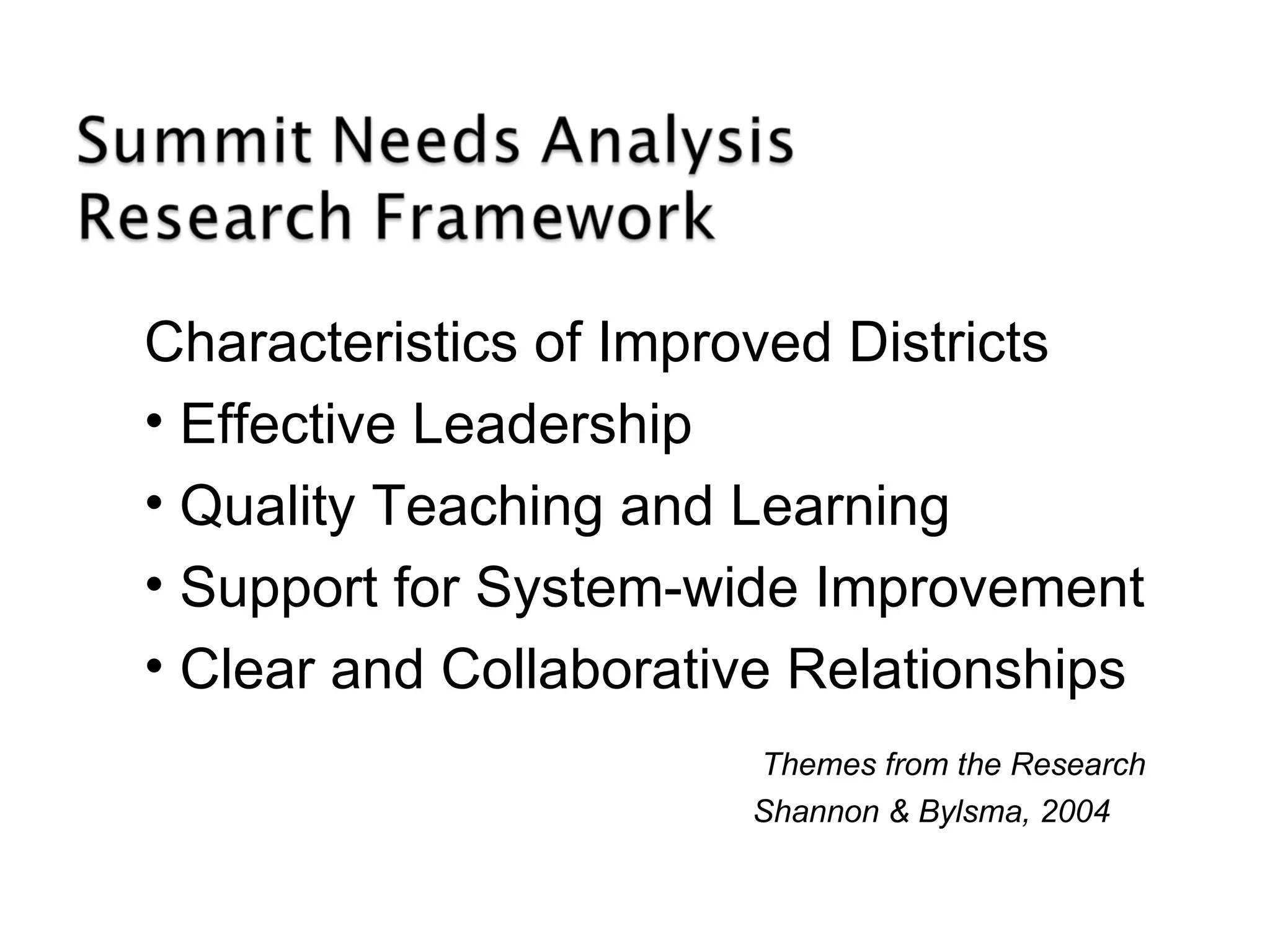
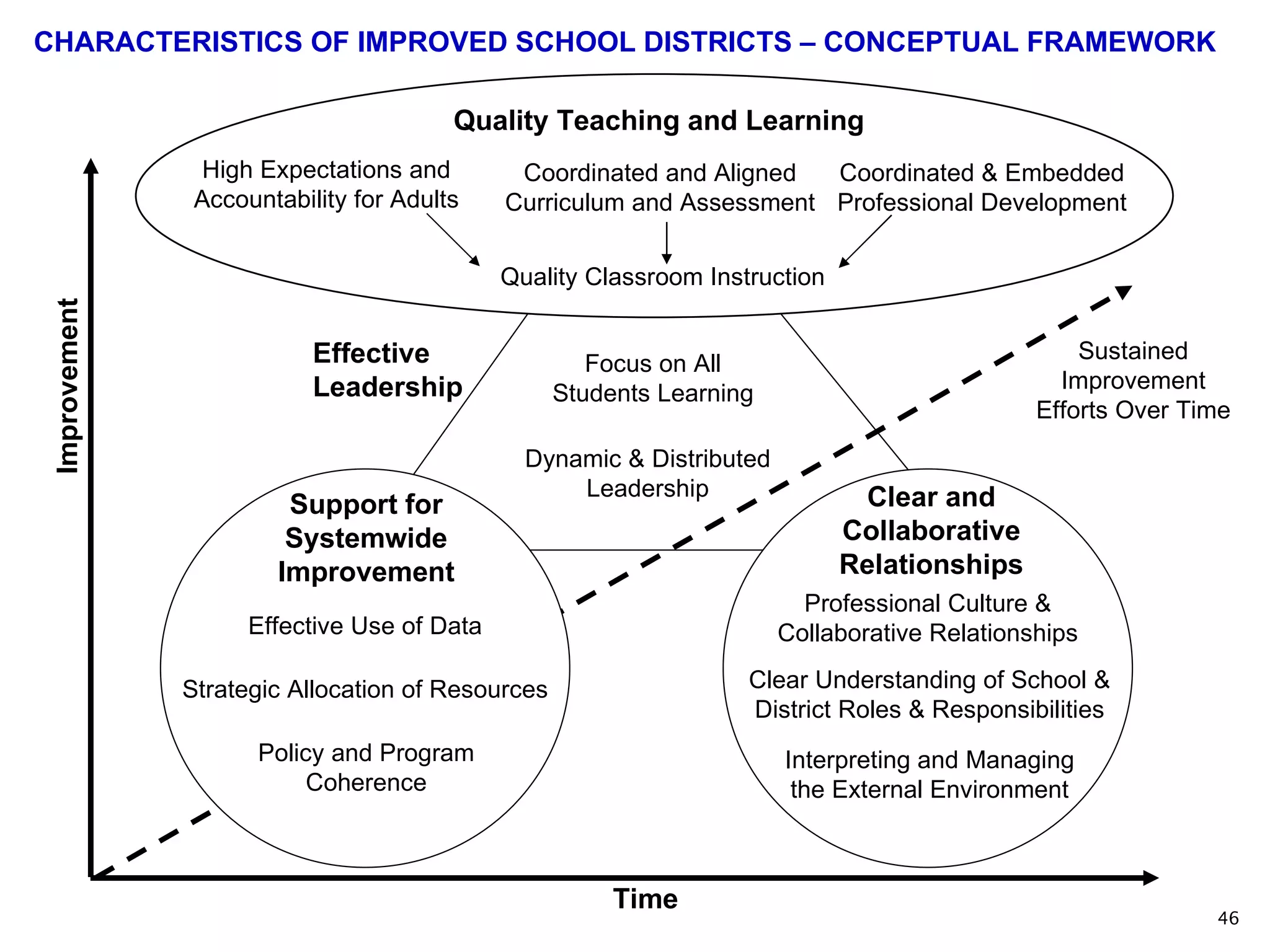
Characteristics of Improved Districts
• Effective Leadership
• Quality Teaching and Learning
• Support for System-wide Improvement
• Clear and Collaborative Relationships
Themes from the Research
Shannon & Bylsma, 2004
Focus on All
Students Learning
Dynamic & Distributed
Leadership
Support for
Systemwide
Improvement
Effective Use of Data
Strategic Allocation of Resources
Policy and Program
Coherence
Clear and
Collaborative
Relationships
Professional Culture &
Collaborative Relationships
Clear Understanding of School &
District Roles & Responsibilities
Interpreting and Managing
the External Environment
Effective
Leadership
Sustained
Improvement
Efforts Over Time
Quality Teaching and Learning
High Expectations and
Accountability for Adults
Coordinated and Aligned
Curriculum and Assessment
Coordinated & Embedded
Professional Development
Quality Classroom Instruction
Time
Improvement
CHARACTERISTICS OF IMPROVED SCHOOL DISTRICTS – CONCEPTUAL FRAMEWORK
46
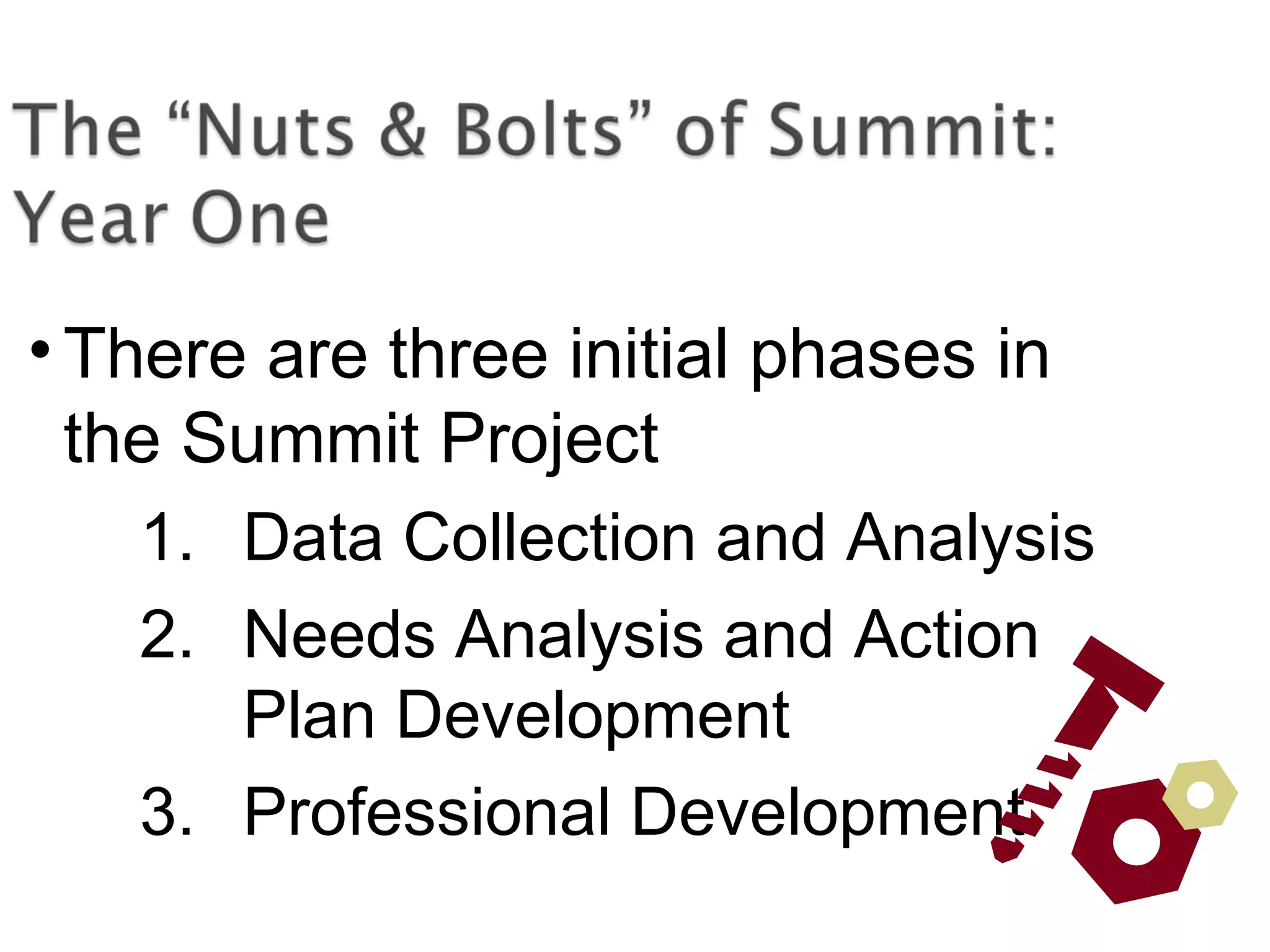
• There are three initial phases in
the Summit Project
1. Data Collection and Analysis
2. Needs Analysis and Action
Plan Development
3. Professional Development
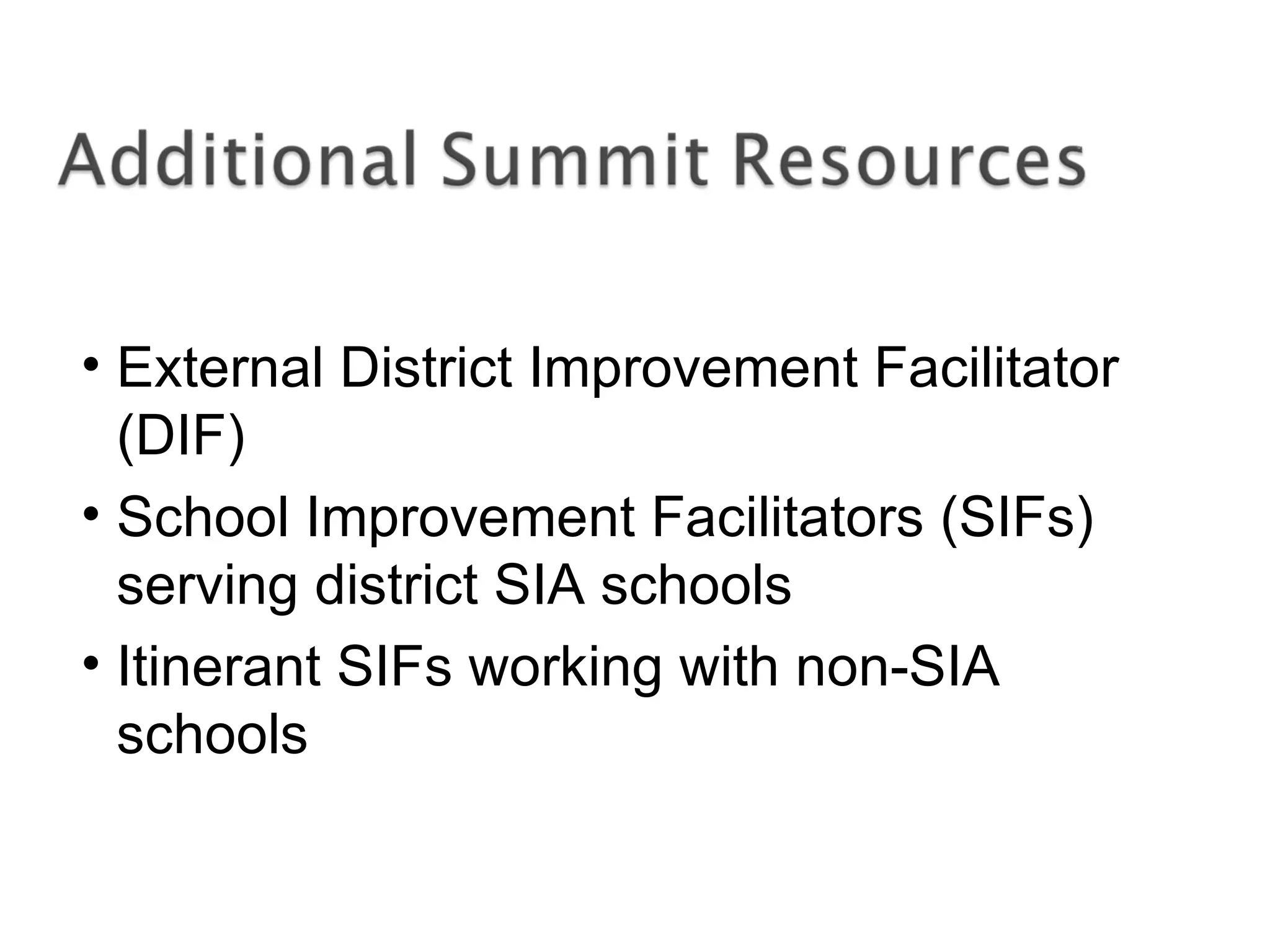
• External District Improvement Facilitator
(DIF)
• School Improvement Facilitators (SIFs)
serving district SIA schools
• Itinerant SIFs working with non-SIA
schools
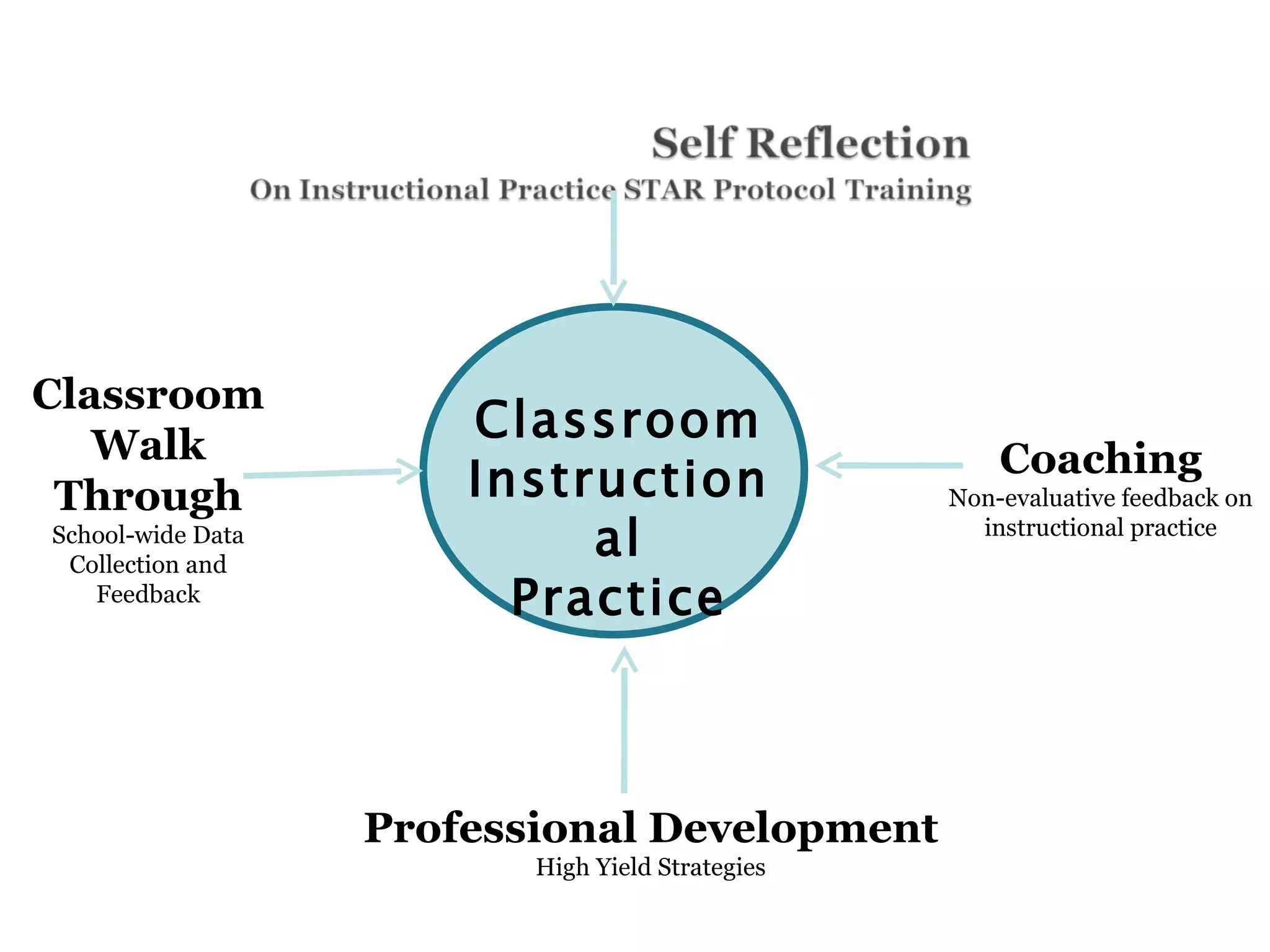
Classroom
Instruction
al
Practice
Classroom
Walk
Through
School-wide Data
Collection and
Feedback
Coaching
Non-evaluative feedback on
instructional practice
Professional Development
High Yield Strategies
• Classroom Walkthrough Study (BERC)
• EES Perception Surveys (CEE)
• WASL achievement and growth analysis
• Summit School Performance Reviews
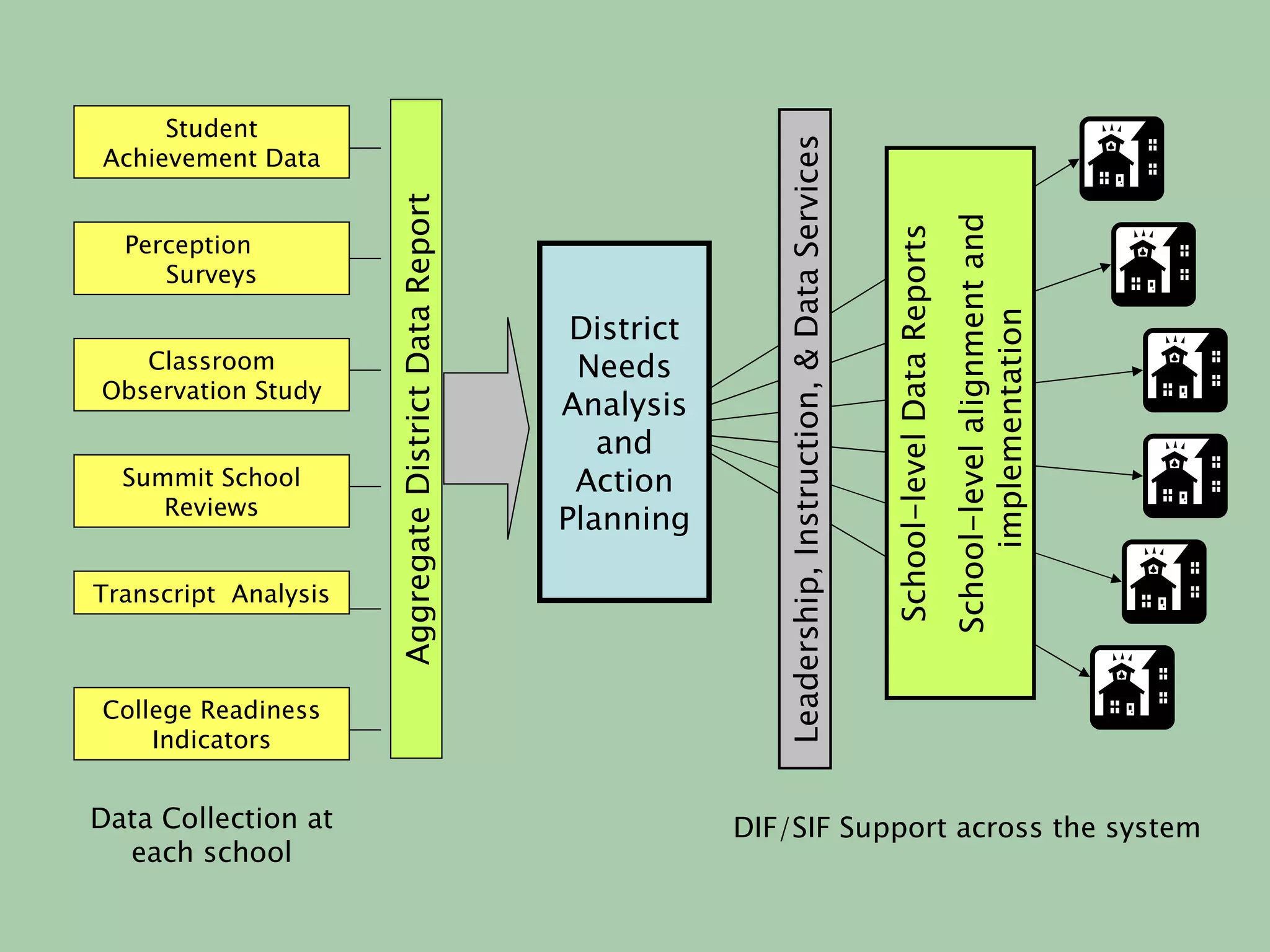
Student
Achievement Data
Perception
Surveys
Classroom
Observation Study
Summit School
Reviews
Transcript Analysis
AggregateDistrictDataReport
School-levelDataReports
School-levelalignmentand
implementation
Data Collection at
each school
District
Needs
Analysis
and
Action
Planning
College Readiness
Indicators
Leadership,Instruction,&DataServices
DIF/SIF Support across the system
What problems might you predict would
come up in the roll out of this initiative in a
district like Renton?
Onsite District Needs Analysis
• Meet with Renton Summit Stakeholders to
present initial findings of district needs. Data
report will include achievement, perceptual,
and college eligibility and attendance sources,
as well as classroom walkthrough and school
review data.
 WestEd and OSPI team will further investigate
areas of need through focus groups and
Action Planning
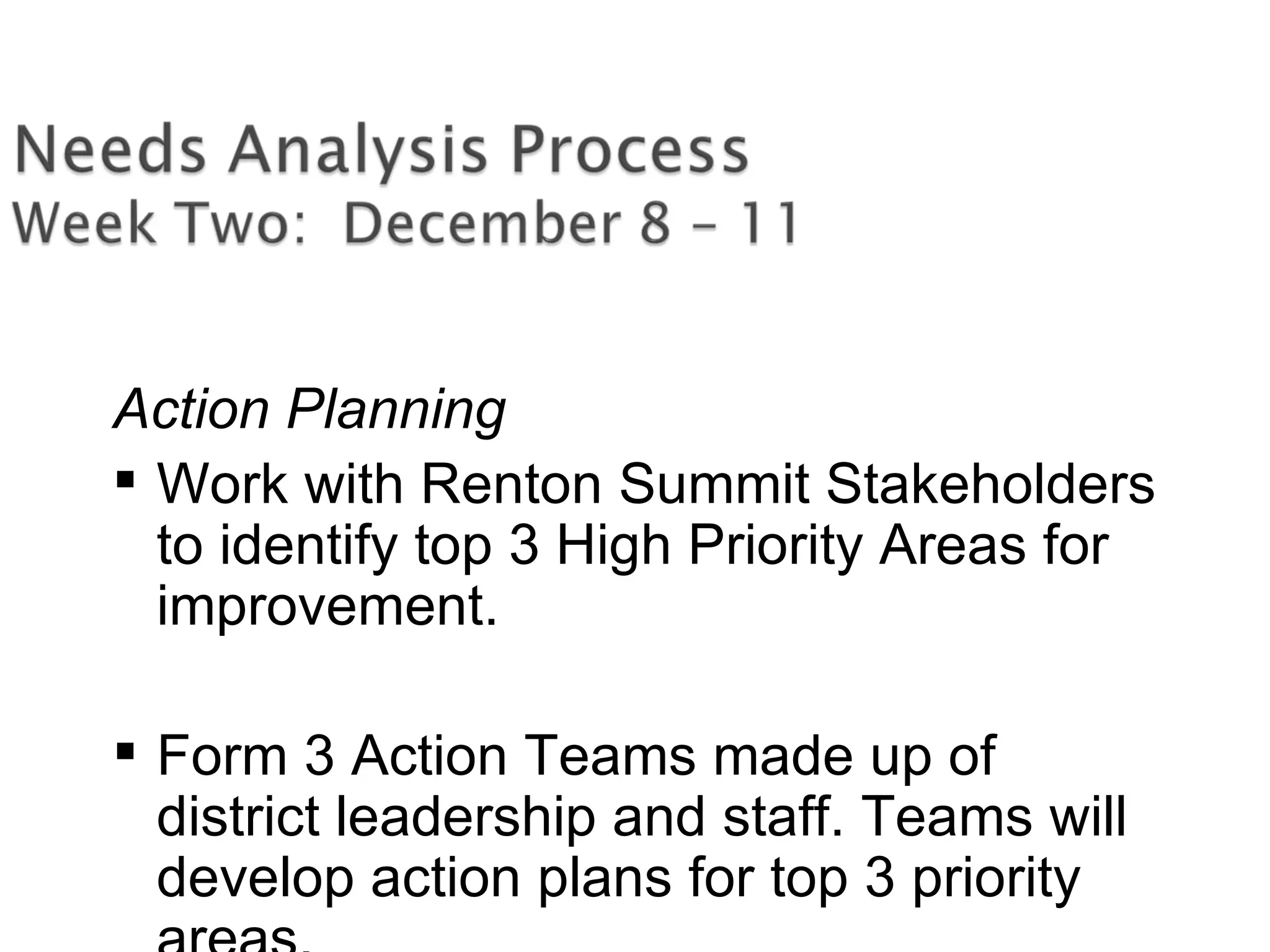
 Work with Renton Summit Stakeholders
to identify top 3 High Priority Areas for
improvement.
 Form 3 Action Teams made up of
district leadership and staff. Teams will
develop action plans for top 3 priority
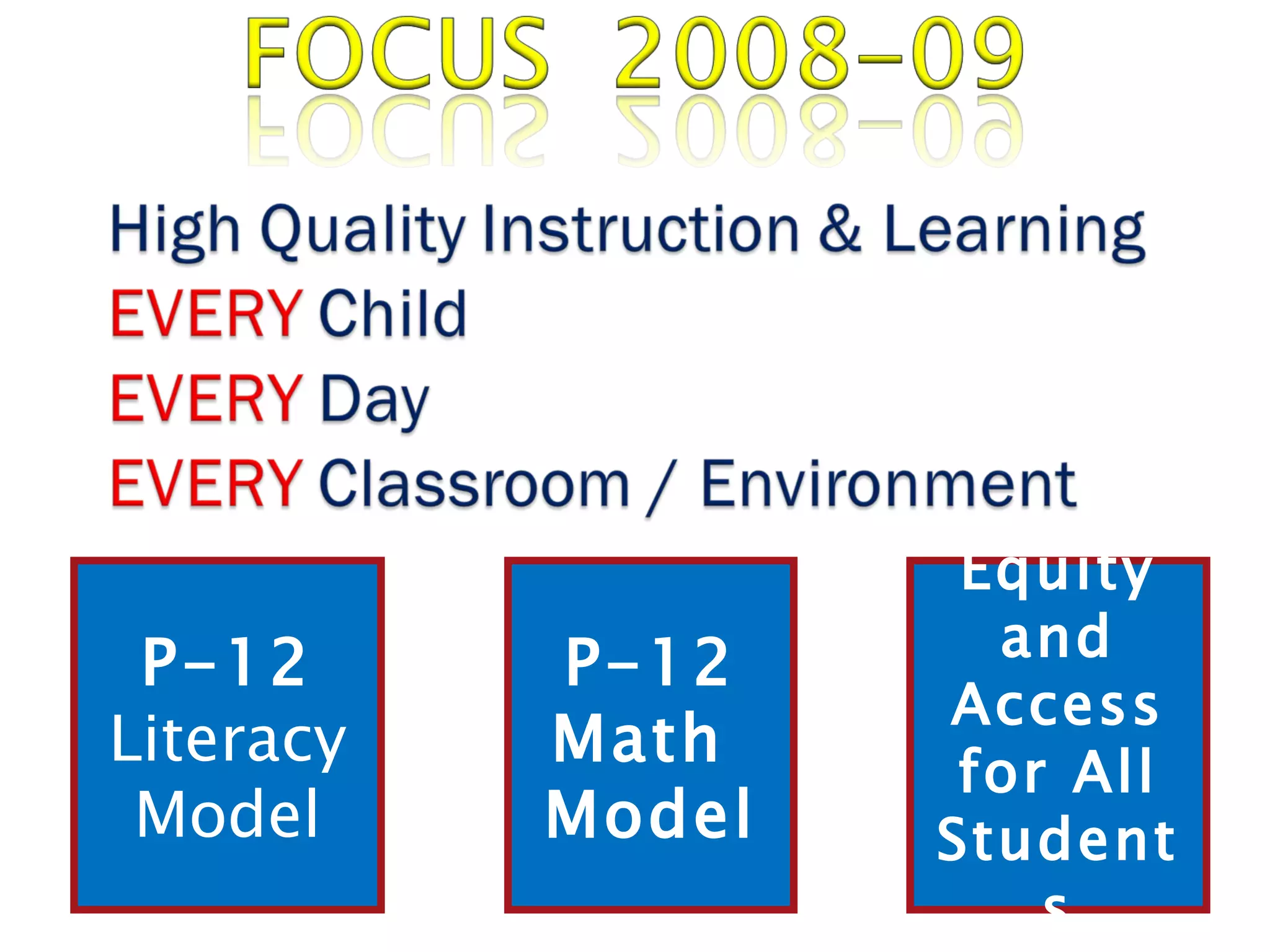
P-12
Literacy
Model
P-12
Math
Model
Equity
and
Access
for All
Student
s
Renton SD Focus Areas Action Questions
•Focus on Student Learning
•Quality Classroom Instruction
•High Expectations and
Accountability for Adults
•Coordinated and Aligned
Curriculum and Assessment
•Effective Use of Data
•Policy and Program Coherence
•How do we build instructional
leadership t support quality
instruction and high levels of
student achievement?
•How do we ensure that all
students engage in effective and
intentional instruction?
•How do we align our policy,
resources, and efforts to support
all students’ rigorous learning
and all students’ readiness for
college and career after
graduation?
1. What did you learn?
2. What do you wonder about?
3. What suggestions do you have for our
team?
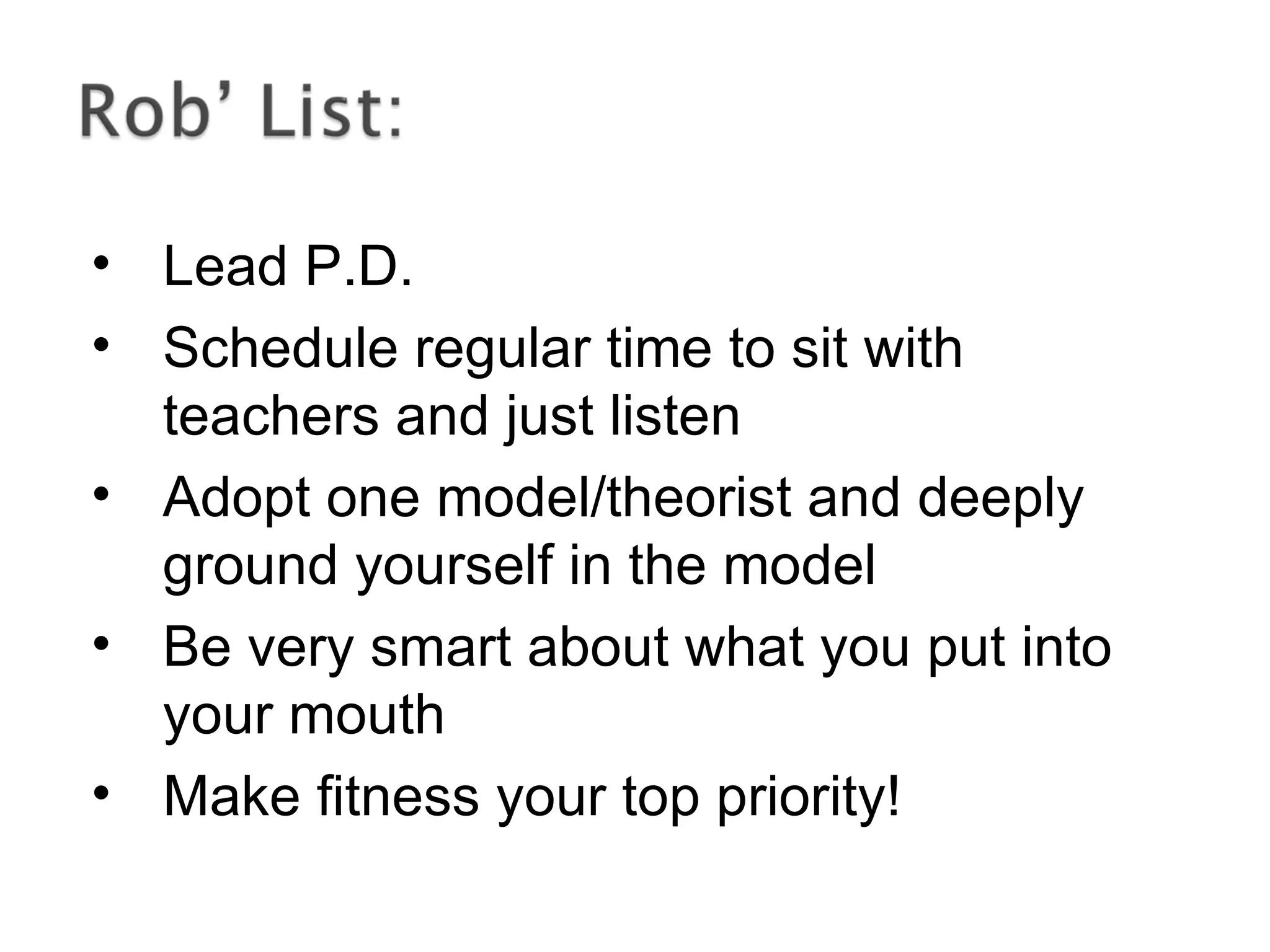
• Lead P.D.
• Schedule regular time to sit with
teachers and just listen
• Adopt one model/theorist and deeply
ground yourself in the model
• Be very smart about what you put into
your mouth
• Make fitness your top priority!
• Implementation Research: A Synthesis of the
Literature, Fixsen, D.L., et al. University of South
Florida, 2005---National Implementation Research
Network
• The Power of Protocols: An educators’ guide t better
practice. McDonald, et al. Teachers College Press
• The Six Secrets of Change: What the best leaders do t
help their organizations survive and thrive. Fullan,
2008
• Classroom Instruction that Works, Marzano, Pickering,
Pollock. ASCD
• Shackleton’s Way: Leadership lessons from the great
Antarctic explorer, Margot Morrel, 2001
Rob\'s Presentation November 2008 Powerpoint 2003

  • 1.
    School Improvement ... isthe single most important business of the school. It is the process schools use to ensure that all students are achieving at high levels. School Improvement Planning Process Guide http://www.k12.wa.us/SchoolImprovement/Resou rces/default.aspx
  • 2.
  • 3.
    Do we defineit? Do we expect it? How do we support it?
  • 4.
    Nine Characteristics Of High Performing Schools Assess Readiness to Benefit CollectSort and Analyze Data Build and Analyze Portfolio Set and Prioritize Goals Study and Select Research-based Practices Craft Action Plans Implement and Monitor Plan Evaluate Plan’s Impact on Student Achievement
  • 5.
  • 6.
    Where the SIA-SIPprogram/process did not result in improved student learning, sustained over time, what might be some reasons for the lack of positive change?
  • 7.
    WA Grade 4:2001-2 Reading and Math Learning Index 0.0 0.5 1.0 1.5 2.0 2.5 3.0 3.5 4.0 0.0 10.0 20.0 30.0 40.0 50.0 60.0 70.0 80.0 90.0 100.0 Percent Poverty Reading&MathLearningIndex represents the top 5% of the schools showing the greatest improvement over 7 years.
  • 8.
    WA Grade 4:2007 Reading and Math Learning Index 0.0 0.5 1.0 1.5 2.0 2.5 3.0 3.5 4.0 0.0 10.0 20.0 30.0 40.0 50.0 60.0 70.0 80.0 90.0 100.0 Percent Poverty Reading&MathLearningIndex represents the top 5% of the schools showing the greatest improvement over 7 years.
  • 10.
    • What isthe connection of LEADERSHIP to IMPLEMENTATION?
  • 11.
    It’s not thatleadership makes a difference-----it IS the difference!
  • 12.
    • The SixSecrets of Change: What the best leaders do to help their organizations survive and thrive--- Michael Fullan, 2008 • Shackleton’s Way: Leadership lessons from the great Antarctic explorer, Margot Morrel, 2001
  • 13.
    He has beencalled "The greatest leader that ever came on God's earth, bar none," yet he never led a group larger than 27, he failed to reach nearly every goal he ever set, and, until recently, he had been little remembered after his death. But once you learn the story of Sir Ernest Shackleton and his remarkable Antarctic expedition of 1914-1916 you'll come to agree with the effusive praise of those under his command. He is a model of great leadership and, in particular, a master of guidance in crisis.
  • 14.
  • 15.
    Improving schools requirecollaborative cultures…. Without collaborative skills and relationships, it is not possible to learn and to continue to learn as much as you need to know to improve. Michael Fullan
  • 16.
    Column1 1. Love your employees 2.Connectpeers with purpose 3. Capacity building prevails 5. Transparency Rules 6. Systems learn 4. Learning is the work
  • 17.
    Which one ofthe six factors resonates with you? Why?
  • 19.
    Dr. Mary AliceHeuschel Superintendent
  • 20.
    • Enrollment inRenton SD is rising less than 1% per year. Student enrollment in Renton schools has grown from 13,280 in 2003 to 13,751 in the 2007-08 academic year, an increase of 471 students, slightly more than 3%. Note: In the same period of time, the number of classroom teachers rose from 677 in 2003/04 to 874 in 2007/08, an increase of 197 classroom teachers over a 4 year period of time.
  • 21.
    • The ethnicityof the Renton SD student population is shifting from White to Hispanic, Asian and Black. The Renton SD student enrollment is primarily from four ethnic groups: White, 38% (down 10% from 48% in 2003); Hispanic, 17% (up from 11% in 2003); Asian, 25% (up from 21% in 2003); Black, 20% (up from 18% in 2003); and American Indian, less than 2% (stable over the same four year
  • 22.
    • The rateof poverty in the Renton SD is steady at 42%. Statewide poverty is 38%, a 2% increase since 2003.
  • 23.
    • The percentageof Renton SD students receiving Transitional Bilingual services increased by one percent each year over the four year time period. Renton SD students receiving Bilingual (English Language Learner) support increased from 10% in 2003 to 15% in the 2007-08 academic year. The state percentage currently is 8%, an increase of less than one percent over the
  • 24.
    • Special Educationservices are delivered to 12% of Renton SD students – a number that has increased less than 1% over the past four years.
  • 25.
    • The RentonSD system over three years shows a stability rate of 65% from 4th to 7th grade and 68% from 7th grade to 10th grade. Renton SD has the lowest stability rate (highest mobility) of the five Summit districts.
  • 28.
    2007 & 2008District Summary: Reading 0% 10% 20% 30% 40% 50% 60% 70% 80% 90% 100% 2007 2008 2007 2008 2007 2008 2007 2008 2007 2008 2007 2008 2007 2008 Gr 3 Gr 4 Gr 5 Gr 6 Gr 7 Gr 8 Gr 10 Renton SD Reading State Renton SD
  • 29.
    2007 & 2008District Summary: Writing 0% 10% 20% 30% 40% 50% 60% 70% 80% 90% 100% 2007 2008 2007 2008 2007 2008 2007 2008 2007 2008 2007 2008 2007 2008 Gr 3 Gr 4 Gr 5 Gr 6 Gr 7 Gr 8 Gr 10 Renton SD Writing State Renton SD StudentsNotTested StudentsNotTested StudentsNotTested StudentsNotTested
  • 30.
    2007 & 2008District Summary: Math 0% 10% 20% 30% 40% 50% 60% 70% 80% 90% 100% 2007 2008 2007 2008 2007 2008 2007 2008 2007 2008 2007 2008 2007 2008 Gr 3 Gr 4 Gr 5 Gr 6 Gr 7 Gr 8 Gr 10 Renton SD Math State Renton SD
  • 31.
    2007 & 2008District Summary: Science 0% 10% 20% 30% 40% 50% 60% 70% 80% 90% 100% 2007 2008 2007 2008 2007 2008 2007 2008 2007 2008 2007 2008 2007 2008 Gr 3 Gr 4 Gr 5 Gr 6 Gr 7 Gr 8 Gr 10 Renton SD Science State Renton SD StudentsNotTested StudentsNotTested StudentsNotTested StudentsNotTested
  • 32.
    Eleven elementary schoolsbeat the state in the increase in percentage of all students meeting standard in one or more WASL subjects All three middle schools beat the state in the increase in percentage of all students meeting standard in one or more WASL subjects All three comprehensive high schools beat the state in the increase in percentage of all
  • 33.
    • 30% morehigh school students – Hispanic sub-group – met WASL standard in Reading in 2008 than 2007 • 19% more high school students - Limited English sub-group - met WASL standard in Reading in 2008 than 2007 • 9% more elementary school students - Limited English sub-group - met WASL
  • 35.
  • 37.
    • Students inRenton (regardless of race, ethnicity, socio-economic status) are below the state average in reading and mathematics • An Achievement Gap exists between the academic achievement of our white students and the academic achievement of our students of color • An Achievement Gap exists between the academic achievement of students in poverty
  • 38.
    The Summit Initiative– additional resources and expertise to enhance district efforts –Support for our Renton School District goals • P-12 Reading • P-12 Math • Equity and Access –Support for Renton School District initiatives • Professional Learning Communities (PLC) • Response To Intervention (RTI) • Positive Behavior Support (PBS) • Sheltered Instruction, Observation Protocol
  • 39.
    What problem(s) and/orchallenge(s) might you see in this scenerio?
  • 40.
  • 41.
    • Increase capacityof participating districts to accelerate achievement for all students district-wide. • Develop and field test Summit Initiative program elements intended to strengthen and support a systems approach to raising achievement. • Develop an improvement model that can,
  • 42.
    Renton is adistrict in District Improvement. We were among 23 districts invited to apply. Renton was selected because of our readiness and commitment to make changes needed to raise achievement. As a Summit District we will receive customized support for the 3 – 5 years of
  • 43.
    Effective Leadership Quality Instruction Accessand Use of Data Assessment, Intervention, and Monitoring System Alignment and Coherence
  • 44.
    Consultants Baker Education Research Consultation (The BERCGroup, Inc.) Center for Educational Effectiveness Districts Mount Adams Mount Vernon Othello Renton Wapato
  • 45.
    Characteristics of ImprovedDistricts • Effective Leadership • Quality Teaching and Learning • Support for System-wide Improvement • Clear and Collaborative Relationships Themes from the Research Shannon & Bylsma, 2004
  • 46.
    Focus on All StudentsLearning Dynamic & Distributed Leadership Support for Systemwide Improvement Effective Use of Data Strategic Allocation of Resources Policy and Program Coherence Clear and Collaborative Relationships Professional Culture & Collaborative Relationships Clear Understanding of School & District Roles & Responsibilities Interpreting and Managing the External Environment Effective Leadership Sustained Improvement Efforts Over Time Quality Teaching and Learning High Expectations and Accountability for Adults Coordinated and Aligned Curriculum and Assessment Coordinated & Embedded Professional Development Quality Classroom Instruction Time Improvement CHARACTERISTICS OF IMPROVED SCHOOL DISTRICTS – CONCEPTUAL FRAMEWORK 46
  • 47.
    • There arethree initial phases in the Summit Project 1. Data Collection and Analysis 2. Needs Analysis and Action Plan Development 3. Professional Development
  • 48.
    • External DistrictImprovement Facilitator (DIF) • School Improvement Facilitators (SIFs) serving district SIA schools • Itinerant SIFs working with non-SIA schools
  • 49.
    Classroom Instruction al Practice Classroom Walk Through School-wide Data Collection and Feedback Coaching Non-evaluativefeedback on instructional practice Professional Development High Yield Strategies
  • 50.
    • Classroom WalkthroughStudy (BERC) • EES Perception Surveys (CEE) • WASL achievement and growth analysis • Summit School Performance Reviews
  • 51.
    Student Achievement Data Perception Surveys Classroom Observation Study SummitSchool Reviews Transcript Analysis AggregateDistrictDataReport School-levelDataReports School-levelalignmentand implementation Data Collection at each school District Needs Analysis and Action Planning College Readiness Indicators Leadership,Instruction,&DataServices DIF/SIF Support across the system
  • 52.
    What problems mightyou predict would come up in the roll out of this initiative in a district like Renton?
  • 53.
    Onsite District NeedsAnalysis • Meet with Renton Summit Stakeholders to present initial findings of district needs. Data report will include achievement, perceptual, and college eligibility and attendance sources, as well as classroom walkthrough and school review data.  WestEd and OSPI team will further investigate areas of need through focus groups and
  • 54.
    Action Planning  Workwith Renton Summit Stakeholders to identify top 3 High Priority Areas for improvement.  Form 3 Action Teams made up of district leadership and staff. Teams will develop action plans for top 3 priority
  • 55.
  • 56.
    Renton SD FocusAreas Action Questions •Focus on Student Learning •Quality Classroom Instruction •High Expectations and Accountability for Adults •Coordinated and Aligned Curriculum and Assessment •Effective Use of Data •Policy and Program Coherence •How do we build instructional leadership t support quality instruction and high levels of student achievement? •How do we ensure that all students engage in effective and intentional instruction? •How do we align our policy, resources, and efforts to support all students’ rigorous learning and all students’ readiness for college and career after graduation?
  • 57.
    1. What didyou learn? 2. What do you wonder about? 3. What suggestions do you have for our team?
  • 58.
    • Lead P.D. •Schedule regular time to sit with teachers and just listen • Adopt one model/theorist and deeply ground yourself in the model • Be very smart about what you put into your mouth • Make fitness your top priority!
  • 59.
    • Implementation Research:A Synthesis of the Literature, Fixsen, D.L., et al. University of South Florida, 2005---National Implementation Research Network • The Power of Protocols: An educators’ guide t better practice. McDonald, et al. Teachers College Press • The Six Secrets of Change: What the best leaders do t help their organizations survive and thrive. Fullan, 2008 • Classroom Instruction that Works, Marzano, Pickering, Pollock. ASCD • Shackleton’s Way: Leadership lessons from the great Antarctic explorer, Margot Morrel, 2001