
Supports K–12 School Effectiveness Framework: A Support for School
Improvement and Student Success (2010).
The integrated process of assessment and instruction
 can support school boards developing their Board Improvement Plans for
Student Achievement (BIPSA).
It assists in:
•• aligning and focusing initiatives at the ministry, board, and school levels;
•• building capacity to help improve student learning on the level of
individuals, schools, and school systems;
•• strengthening both students’ and teachers’ sense of efficacy with respect to
improving student achievement;
•• reinforcing the understanding on the part of teachers that every student
progresses along an individual learning and growth continuum from
Kindergarten to Grade 12;
•• the use of planning tools for assessment and instruction to support student
learning;
This guide focuses on ways in which teachers and/or teams of educators
can plan and provide the kind of assessment and instruction that enables all
students to learn best.
 Three elements – personalization, precision, and professional learning – are critical
to the process.
Personalization – provides assessment and instruction that are tailored to
students’ particular learning and motivational needs.
Precision – A system that links “assessment for learning” to evidence-informed
instruction on a daily basis, in the service of providing instruction that is precise to
the level of readiness and the learning needs of the individual student.
Professional learning – Focused, ongoing learning for every educator “in
context”, to link new conceptions of instructional practice with assessment of
student learning.
(Fullan et al., 2006, pp.16–26, 87)
Beliefs
•• All students can succeed.
•• Each student has his or her own unique patterns of learning.
•• Successful instructional practices are founded on evidence-based research,
tempered by experience.
•• Universal design and differentiated instruction are effective and interconnected
means of meeting the learning or productivity needs of any group of students.
•• Classroom teachers are the key educators for a student’s literacy and numeracy
development.
•• Classroom teachers need the support of the larger community to create a
learning environment that supports all students.
•• Fairness is not sameness.
Three Effective Approaches
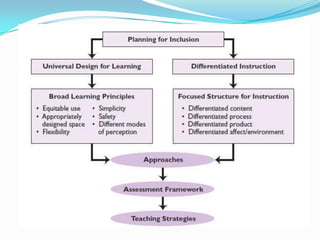
Responds to a diverse group of students with
•• Universal Design for Learning (UDL),
•• Differentiated Instruction, and
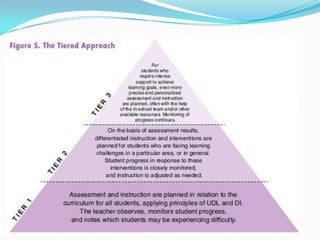
•• the Tiered approach to prevention and intervention.

Used in combination, UDL and differentiated instruction enable teachers to
respond effectively to the strengths and needs of all students. UDL
provides teachers with broad principles for planning instruction for a
diverse group of students, whereas differentiated instruction allows them
to address specific skills and difficulties (Raynal & Rieunier, 1998). The two
approaches overlap, such as providing a range of instructional
strategies, resources, activities, and assessment tools in order to meet the
different strengths, needs, readiness, and learning styles or preferences of
the students in a class.
Differentiated Instruction
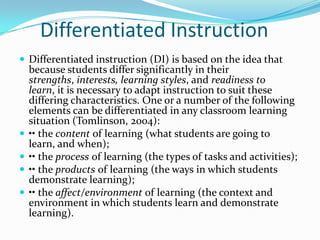
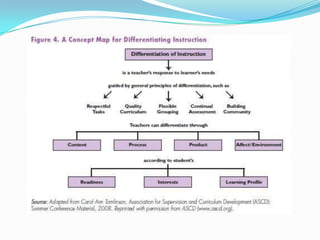
 Differentiated instruction (DI) is based on the idea that
    because students differ significantly in their
    strengths, interests, learning styles, and readiness to
    learn, it is necessary to adapt instruction to suit these
    differing characteristics. One or a number of the following
    elements can be differentiated in any classroom learning
    situation (Tomlinson, 2004):
   •• the content of learning (what students are going to
    learn, and when);
   •• the process of learning (the types of tasks and activities);
   •• the products of learning (the ways in which students
    demonstrate learning);
   •• the affect/environment of learning (the context and
    environment in which students learn and demonstrate
    learning).
The tiered approach to ongoing prevention and
intervention offers a systematic method for the early
identification of students who are experiencing particular
difficulties and, through ongoing monitoring of their
progress, provides the precise level of support those
students need.
All these approaches help improve student achievement
because they rely on greater personalization and
precision in instruction
Guides for
Assessment
             The primary purpose of
             assessment and evaluation is to
             improve student learning.

             To ensure that
             assessment, evaluation, and
             reporting are valid and
             reliable, and that they lead to the
             improvement of learning for all
             students, teachers use practices
             and procedures that:
 The Seven Fundamental Principles
 • are fair, transparent, and equitable for all students;
 • support all students, including those with special education
    needs, those who are learning the language of instruction (English or
    French), and those who are First Nation, Métis, or Inuit;
   • are carefully planned to relate to the curriculum expectations and
    learning goals and, as much as possible, to the interests, learning styles
    and preferences, needs, and experiences of all students;
   • are communicated clearly to students and parents at the beginning of
    the school year or course and at other appropriate points throughout
    the school year or course;
   • are ongoing, varied in nature, and administered over a period of time
    to provide multiple opportunities for students to demonstrate the full
    range of their learning;
   • provide ongoing descriptive feedback that is
    clear, specific, meaningful, and timely to support improved learning
    and achievement;
   • develop students’ self-assessment skills to enable them to assess their
    own learning
The various contexts for collecting data included:
•• Student Success programs and other at-risk programs
•• programs for English Language Learners (ELLs)
•• developing Individual Education Plans (IEPs)
•• preparing report cards
•• developing student/class profiles
•• determining graduation rates.
 The various tools through which student literacy achievement
    data was collected or against which student performance was
    measured included:
   •• PM Benchmarks
   •• Comprehension Attitude Strategies Interests (CASI)
   •• Developmental Reading Assessment (DRA)
   •• Oral Language Assessment
   •• The Observation Survey
   •• Pre-Referral Intervention Manual (PRIM)
   •• Education Quality and Accountability Office (EQAO) testing
   •• Brigance inventories and screens
   •• Ontario Writing Assessment (OWA)
   •• Canadian Achievement Tests (CAT•4)
   •• Culminating Performance Tasks (CPT)
   •• teacher-created assessments, samples from “marker” students,
   diagnostic and culminating tasks

Learning for all k 12

  • 2.
    Supports K–12 SchoolEffectiveness Framework: A Support for School Improvement and Student Success (2010). The integrated process of assessment and instruction can support school boards developing their Board Improvement Plans for Student Achievement (BIPSA). It assists in: •• aligning and focusing initiatives at the ministry, board, and school levels; •• building capacity to help improve student learning on the level of individuals, schools, and school systems; •• strengthening both students’ and teachers’ sense of efficacy with respect to improving student achievement; •• reinforcing the understanding on the part of teachers that every student progresses along an individual learning and growth continuum from Kindergarten to Grade 12; •• the use of planning tools for assessment and instruction to support student learning;
  • 3.
    This guide focuseson ways in which teachers and/or teams of educators can plan and provide the kind of assessment and instruction that enables all students to learn best. Three elements – personalization, precision, and professional learning – are critical to the process. Personalization – provides assessment and instruction that are tailored to students’ particular learning and motivational needs. Precision – A system that links “assessment for learning” to evidence-informed instruction on a daily basis, in the service of providing instruction that is precise to the level of readiness and the learning needs of the individual student. Professional learning – Focused, ongoing learning for every educator “in context”, to link new conceptions of instructional practice with assessment of student learning. (Fullan et al., 2006, pp.16–26, 87)
  • 4.
    Beliefs •• All studentscan succeed. •• Each student has his or her own unique patterns of learning. •• Successful instructional practices are founded on evidence-based research, tempered by experience. •• Universal design and differentiated instruction are effective and interconnected means of meeting the learning or productivity needs of any group of students. •• Classroom teachers are the key educators for a student’s literacy and numeracy development. •• Classroom teachers need the support of the larger community to create a learning environment that supports all students. •• Fairness is not sameness.
  • 5.
    Three Effective Approaches Respondsto a diverse group of students with •• Universal Design for Learning (UDL), •• Differentiated Instruction, and •• the Tiered approach to prevention and intervention. Used in combination, UDL and differentiated instruction enable teachers to respond effectively to the strengths and needs of all students. UDL provides teachers with broad principles for planning instruction for a diverse group of students, whereas differentiated instruction allows them to address specific skills and difficulties (Raynal & Rieunier, 1998). The two approaches overlap, such as providing a range of instructional strategies, resources, activities, and assessment tools in order to meet the different strengths, needs, readiness, and learning styles or preferences of the students in a class.
  • 7.
    Differentiated Instruction  Differentiatedinstruction (DI) is based on the idea that because students differ significantly in their strengths, interests, learning styles, and readiness to learn, it is necessary to adapt instruction to suit these differing characteristics. One or a number of the following elements can be differentiated in any classroom learning situation (Tomlinson, 2004):  •• the content of learning (what students are going to learn, and when);  •• the process of learning (the types of tasks and activities);  •• the products of learning (the ways in which students demonstrate learning);  •• the affect/environment of learning (the context and environment in which students learn and demonstrate learning).
  • 9.
    The tiered approachto ongoing prevention and intervention offers a systematic method for the early identification of students who are experiencing particular difficulties and, through ongoing monitoring of their progress, provides the precise level of support those students need. All these approaches help improve student achievement because they rely on greater personalization and precision in instruction
  • 11.
    Guides for Assessment The primary purpose of assessment and evaluation is to improve student learning. To ensure that assessment, evaluation, and reporting are valid and reliable, and that they lead to the improvement of learning for all students, teachers use practices and procedures that:
  • 12.
     The SevenFundamental Principles  • are fair, transparent, and equitable for all students;  • support all students, including those with special education needs, those who are learning the language of instruction (English or French), and those who are First Nation, Métis, or Inuit;  • are carefully planned to relate to the curriculum expectations and learning goals and, as much as possible, to the interests, learning styles and preferences, needs, and experiences of all students;  • are communicated clearly to students and parents at the beginning of the school year or course and at other appropriate points throughout the school year or course;  • are ongoing, varied in nature, and administered over a period of time to provide multiple opportunities for students to demonstrate the full range of their learning;  • provide ongoing descriptive feedback that is clear, specific, meaningful, and timely to support improved learning and achievement;  • develop students’ self-assessment skills to enable them to assess their own learning
  • 13.
    The various contextsfor collecting data included: •• Student Success programs and other at-risk programs •• programs for English Language Learners (ELLs) •• developing Individual Education Plans (IEPs) •• preparing report cards •• developing student/class profiles •• determining graduation rates.
  • 14.
     The varioustools through which student literacy achievement data was collected or against which student performance was measured included:  •• PM Benchmarks  •• Comprehension Attitude Strategies Interests (CASI)  •• Developmental Reading Assessment (DRA)  •• Oral Language Assessment  •• The Observation Survey  •• Pre-Referral Intervention Manual (PRIM)  •• Education Quality and Accountability Office (EQAO) testing  •• Brigance inventories and screens  •• Ontario Writing Assessment (OWA)  •• Canadian Achievement Tests (CAT•4)  •• Culminating Performance Tasks (CPT)  •• teacher-created assessments, samples from “marker” students,  diagnostic and culminating tasks