This is a partial PowerPoint
based on CESA 6 presentation
           materials
The majority of our students have
great teachers and administrators
          who want to:
• Maximize student learning for every child
• Be the very best teachers/administrators
  that they can be
Majority is not
good enough!
Which teacher a student
gets within a school
matters more than which
school the student happens
to attend.
        Nye, Konstantopoulos, & Hedges, 2004, (p. 247)


·
If a student had a good teacher
as opposed to an average teacher
for 4 to 5 years in a row, the
increased learning would be
sufficient to close entirely the
average gap between a typical
low income student and one who
is not on free and reduced lunch.
                         Hanushek, 2008.

·
Dallas Research: Cumulative
            Effect
Students started at the same level of
math achievement. Three years later,
those students placed with highly
effective teachers vs. those placed
with ineffective teachers experienced
a 50% greater achievement level.
(Similar results occurred in their study
on Reading Achievement.)
Eliminating the worst 6% to 10% of
teachers in terms of effectiveness
would bring student achievement up
by ½ standard deviation. (Note:
Ranking of countries was based on
average mathematics score on the
PISA tests in 2003 - U.S. students
perform significantly below the
OECD average. The variance
between the U.S. and the top
performing country is 2/3 standard
deviation.)
                           Hanushek, 2008
Spillover Effect

Highly effective teacher –
achievement goes up in that
teacher’s classroom – that would be
expected. Also, however, the
achievement of surrounding
teachers’ classes will go up when
they work with this highly effective
teacher. Student achievement in
these other teachers’ classes goes
up 10-20%. (PLC’s)
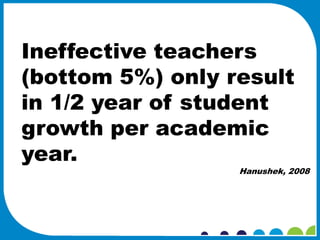
Ineffective teachers
(bottom 5%) only result
in 1/2 year of student
growth per academic
year.
                  Hanushek, 2008
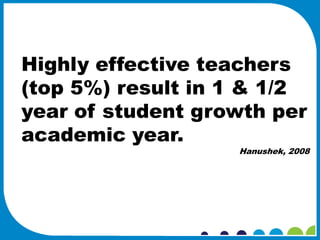
Highly effective teachers
(top 5%) result in 1 & 1/2
year of student growth per
academic year.
                   Hanushek, 2008
Phi Delta Kappa/Gallup Poll - 2011
    What Americans said about the public schools
                    QUALITY TEACHING
We’ll take larger classes with more effective teachers over smaller
classes with less effective teachers and access to higher-quality
instruction over the Internet over learning in a classroom with a less
effective teacher. The message: Quality/Effectiveness of a teacher
does count.
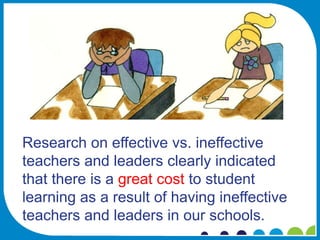
Research on effective vs. ineffective
teachers and leaders clearly indicated
that there is a great cost to student
learning as a result of having ineffective
teachers and leaders in our schools.
Reality
We all know that we have ineffective
 teachers and administrators that do
exist and have existed in our schools
           for many years
So …
  If we know that a teacher or
 administrator is ineffective, why
haven’t we done something about
                it?
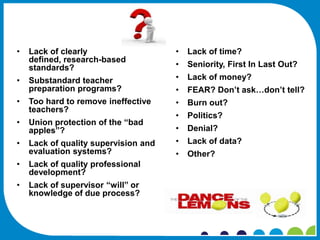
•   Lack of clearly                   •   Lack of time?
    defined, research-based
    standards?                        •   Seniority, First In Last Out?
•   Substandard teacher               •   Lack of money?
    preparation programs?             •   FEAR? Don’t ask…don’t tell?
•   Too hard to remove ineffective    •   Burn out?
    teachers?
                                      •   Politics?
•   Union protection of the “bad
    apples”?                          •   Denial?
•   Lack of quality supervision and   •   Lack of data?
    evaluation systems?               •   Other?
•   Lack of quality professional
    development?
•   Lack of supervisor “will” or
    knowledge of due process?
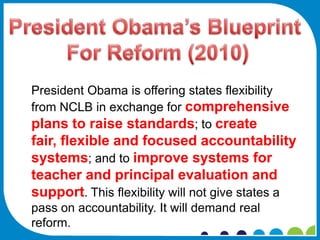
President Obama is offering states flexibility
from NCLB in exchange for comprehensive
plans to raise standards; to create
fair, flexible and focused accountability
systems; and to improve systems for
teacher and principal evaluation and
support. This flexibility will not give states a
pass on accountability. It will demand real
reform.
Section 9401 of the Elementary
and Secondary Education Act of
1965 (as amended by the No Child
Left Behind Act) allows the
Secretary to waive certain
statutory or regulatory
requirements of the ESEA.
comprehensive plans to raise
standards; to create fair, flexible and
focused accountability systems; and to
improve systems for teacher and
principal evaluation and support.
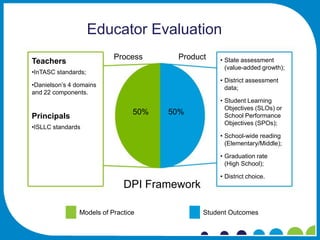
Educator Evaluation
                           Process      Product   • State assessment
Teachers
                                                    (value-added growth);
•InTASC standards;
                                                  • District assessment
•Danielson’s 4 domains                              data;
and 22 components.
                                                  • Student Learning
                                                    Objectives (SLOs) or
                                 50%   50%
Principals                                          School Performance
                                                    Objectives (SPOs);
•ISLLC standards
                                                  • School-wide reading
                                                    (Elementary/Middle);

                                                  • Graduation rate
                                                    (High School);

                                                  • District choice.
                              DPI Framework

                Models of Practice            Student Outcomes
…proposed plans to raise
standards, improve
accountability, and support reforms
to improve principal and teacher
effectiveness.
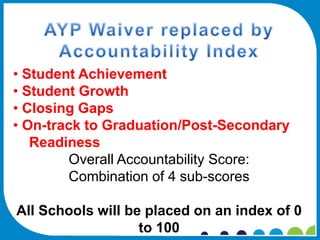
• Student Achievement
• Student Growth
• Closing Gaps
• On-track to Graduation/Post-Secondary
   Readiness
        Overall Accountability Score:
        Combination of 4 sub-scores

All Schools will be placed on an index of 0
                   to 100
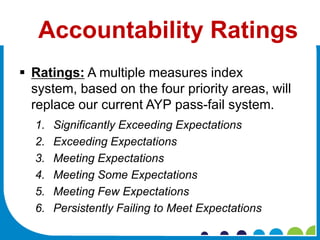
Accountability Ratings
 Ratings: A multiple measures index
  system, based on the four priority areas, will
  replace our current AYP pass-fail system.
  1.   Significantly Exceeding Expectations
  2.   Exceeding Expectations
  3.   Meeting Expectations
  4.   Meeting Some Expectations
  5.   Meeting Few Expectations
  6.   Persistently Failing to Meet Expectations
• Student Achievement
• Student Growth
• Closing Gaps
• On-track to Graduation/Post-Secondary
   Readiness

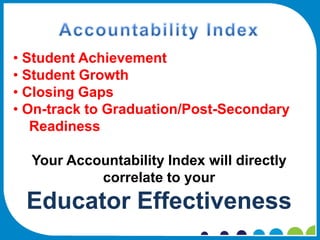
  Your Accountability Index will directly
           correlate to your
 Educator Effectiveness
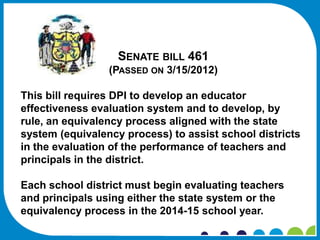
SENATE BILL 461
                 (PASSED ON 3/15/2012)

This bill requires DPI to develop an educator
effectiveness evaluation system and to develop, by
rule, an equivalency process aligned with the state
system (equivalency process) to assist school districts
in the evaluation of the performance of teachers and
principals in the district.

Each school district must begin evaluating teachers
and principals using either the state system or the
equivalency process in the 2014-15 school year.
SENATE BILL 461

Under the state system, 50 percent of the
total evaluation score assigned to a
teacher or principal must be based on
measures of student performance, and 50
percent of the total evaluation score must
be based upon the extent to which the
teacher's or principal's practice …..
Our primary means, however, for
 improving student achievement will
occur as the result of our creating an
Effectiveness/Evaluation System that
               will be:
• Fully customizable to district needs and
  state requirements
• Easily and efficiently implemented

That will result in improved effectiveness for
  EVERY teacher, specialist, and
  administrator and
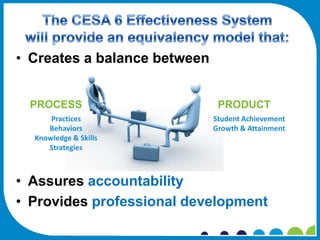
• Creates a balance between


 PROCESS                       PRODUCT
      Practices               Student Achievement
     Behaviors                Growth & Attainment
  Knowledge & Skills
     Strategies


• Assures accountability
• Provides professional development
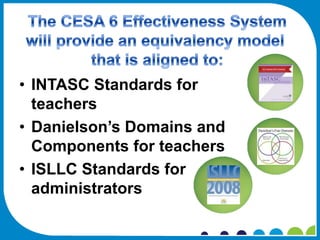
• INTASC Standards for
  teachers
• Danielson’s Domains and
  Components for teachers
• ISLLC Standards for
  administrators
• Multiple Measures of Evidence
  to evaluate teachers &
  administrators:
   Observations
   Walk Throughs
   Surveys
   Teacher Artifacts & Documents
   District identified measures of evidence
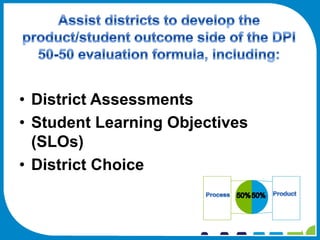
• District Assessments
• Student Learning Objectives
  (SLOs)
• District Choice
• Monitor
• Measure
• Rate and Rank (if a district
  desires)

      Teacher & School Administrator
               Effectiveness
• Generate diagnostic profiles of
  effectiveness for individual teachers,
  schools, districts, and regionally
• Identify professional development
  opportunities based on this standards
  driven, performance-based data
• Establish an Effectiveness Academy
  that will provide on-going face-to-face
  and virtual professional development
  around the Evaluation System
• On-going training and coaching for:
    teachers
    evaluators
    district Effectiveness Project Implementation
    Coaches (EPICs)
Note: Each district will be assigned a CESA
 Liaison to assist the district to implement the
 Effectiveness System.
• Calibration training for evaluators to
  assure consistency and fidelity of the
  evaluation system
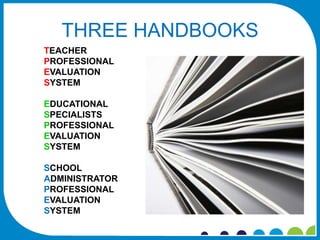
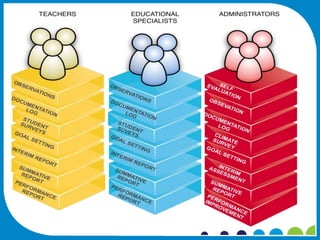
THREE HANDBOOKS
TEACHER
PROFESSIONAL
EVALUATION
SYSTEM

EDUCATIONAL
SPECIALISTS
PROFESSIONAL
EVALUATION
SYSTEM

SCHOOL
ADMINISTRATOR
PROFESSIONAL
EVALUATION
SYSTEM
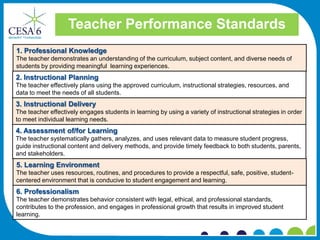
Teacher Performance Standards
1. Professional Knowledge
The teacher demonstrates an understanding of the curriculum, subject content, and diverse needs of
students by providing meaningful learning experiences.
2. Instructional Planning
The teacher effectively plans using the approved curriculum, instructional strategies, resources, and
data to meet the needs of all students.
3. Instructional Delivery
The teacher effectively engages students in learning by using a variety of instructional strategies in order
to meet individual learning needs.
4. Assessment of/for Learning
The teacher systematically gathers, analyzes, and uses relevant data to measure student progress,
guide instructional content and delivery methods, and provide timely feedback to both students, parents,
and stakeholders.
5. Learning Environment
The teacher uses resources, routines, and procedures to provide a respectful, safe, positive, student-
centered environment that is conducive to student engagement and learning.
6. Professionalism
The teacher demonstrates behavior consistent with legal, ethical, and professional standards,
contributes to the profession, and engages in professional growth that results in improved student
learning.
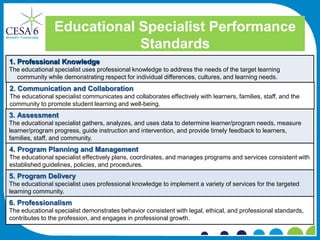
Educational Specialist Performance
                            Standards
1. Professional Knowledge
The educational specialist uses professional knowledge to address the needs of the target learning
  community while demonstrating respect for individual differences, cultures, and learning needs.
2. Communication and Collaboration
The educational specialist communicates and collaborates effectively with learners, families, staff, and the
community to promote student learning and well-being.
3. Assessment
The educational specialist gathers, analyzes, and uses data to determine learner/program needs, measure
learner/program progress, guide instruction and intervention, and provide timely feedback to learners,
families, staff, and community.
4. Program Planning and Management
The educational specialist effectively plans, coordinates, and manages programs and services consistent with
established guidelines, policies, and procedures.
5. Program Delivery
The educational specialist uses professional knowledge to implement a variety of services for the targeted
learning community.
6. Professionalism
The educational specialist demonstrates behavior consistent with legal, ethical, and professional standards,
contributes to the profession, and engages in professional growth.
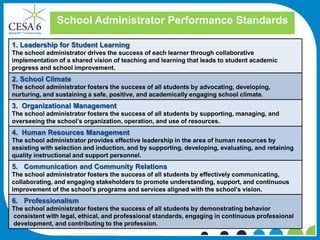
School Administrator Performance Standards

1. Leadership for Student Learning
The school administrator drives the success of each learner through collaborative
implementation of a shared vision of teaching and learning that leads to student academic
progress and school improvement.
2. School Climate
The school administrator fosters the success of all students by advocating, developing,
nurturing, and sustaining a safe, positive, and academically engaging school climate.
3. Organizational Management
The school administrator fosters the success of all students by supporting, managing, and
overseeing the school’s organization, operation, and use of resources.
4. Human Resources Management
The school administrator provides effective leadership in the area of human resources by
assisting with selection and induction, and by supporting, developing, evaluating, and retaining
quality instructional and support personnel.
5. Communication and Community Relations
The school administrator fosters the success of all students by effectively communicating,
collaborating, and engaging stakeholders to promote understanding, support, and continuous
improvement of the school’s programs and services aligned with the school’s vision.
6. Professionalism
The school administrator fosters the success of all students by demonstrating behavior
consistent with legal, ethical, and professional standards, engaging in continuous professional
development, and contributing to the profession.
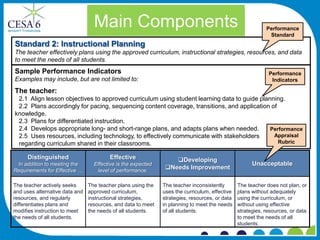
Main Components                                                          Performance
                                                                                                            Standard
Standard 2: Instructional Planning
The teacher effectively plans using the approved curriculum, instructional strategies, resources, and data
to meet the needs of all students.
Sample Performance Indicators                                                                               Performance
Examples may include, but are not limited to:                                                                Indicators

The teacher:
 2.1 Align lesson objectives to approved curriculum using student learning data to guide planning.
 2.2 Plans accordingly for pacing, sequencing content coverage, transitions, and application of
knowledge.
 2.3 Plans for differentiated instruction.
 2.4 Develops appropriate long- and short-range plans, and adapts plans when needed.         Performance
 2.5 Uses resources, including technology, to effectively communicate with stakeholders       Appraisal
 regarding curriculum shared in their classrooms.                                               Rubric

     Distinguished                      Effective                 Developing
 In addition to meeting the       Effective is the expected                                          Unacceptable
Requirements for Effective …       level of performance.
                                                               Needs Improvement

The teacher actively seeks      The teacher plans using the   The teacher inconsistently       The teacher does not plan, or
and uses alternative data and   approved curriculum,          uses the curriculum, effective   plans without adequately
resources, and regularly        instructional strategies,     strategies, resources, or data   using the curriculum, or
differentiates plans and        resources, and data to meet   in planning to meet the needs    without using effective
modifies instruction to meet    the needs of all students.    of all students.                 strategies, resources, or data
the needs of all students.                                                                     to meet the needs of all
                                                                                               students.
• straight-forward
• easy-to-use
• customizable
• loaded into district systems/multiple
  technology devices
• using the OASYS data management
  webware
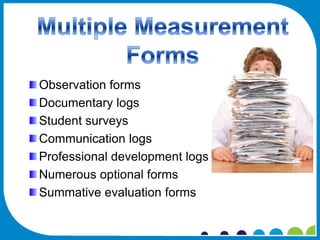
Observation forms
Documentary logs
Student surveys
Communication logs
Professional development logs
Numerous optional forms
Summative evaluation forms
• $80/User/Year
    Users = Teachers, Ed.
    Specialists, School
    Administrators, and
    Evaluators
• $1500 one-time cost
  for OASYS webware
  configuration

Possible Source of
 Funding: Title II
Additional Services from CESA
 External   Evaluation

 CESA   as EPIC ($4800/year)

 EvaluationSystem Awareness
 for Teachers

Cesa 6 effectiveness project ppt

  • 1.
    This is apartial PowerPoint based on CESA 6 presentation materials
  • 3.
    The majority ofour students have great teachers and administrators who want to: • Maximize student learning for every child • Be the very best teachers/administrators that they can be
  • 6.
  • 7.
    Which teacher astudent gets within a school matters more than which school the student happens to attend. Nye, Konstantopoulos, & Hedges, 2004, (p. 247) ·
  • 8.
    If a studenthad a good teacher as opposed to an average teacher for 4 to 5 years in a row, the increased learning would be sufficient to close entirely the average gap between a typical low income student and one who is not on free and reduced lunch. Hanushek, 2008. ·
  • 9.
    Dallas Research: Cumulative Effect Students started at the same level of math achievement. Three years later, those students placed with highly effective teachers vs. those placed with ineffective teachers experienced a 50% greater achievement level. (Similar results occurred in their study on Reading Achievement.)
  • 10.
    Eliminating the worst6% to 10% of teachers in terms of effectiveness would bring student achievement up by ½ standard deviation. (Note: Ranking of countries was based on average mathematics score on the PISA tests in 2003 - U.S. students perform significantly below the OECD average. The variance between the U.S. and the top performing country is 2/3 standard deviation.) Hanushek, 2008
  • 11.
    Spillover Effect Highly effectiveteacher – achievement goes up in that teacher’s classroom – that would be expected. Also, however, the achievement of surrounding teachers’ classes will go up when they work with this highly effective teacher. Student achievement in these other teachers’ classes goes up 10-20%. (PLC’s)
  • 12.
    Ineffective teachers (bottom 5%)only result in 1/2 year of student growth per academic year. Hanushek, 2008
  • 13.
    Highly effective teachers (top5%) result in 1 & 1/2 year of student growth per academic year. Hanushek, 2008
  • 14.
    Phi Delta Kappa/GallupPoll - 2011 What Americans said about the public schools QUALITY TEACHING We’ll take larger classes with more effective teachers over smaller classes with less effective teachers and access to higher-quality instruction over the Internet over learning in a classroom with a less effective teacher. The message: Quality/Effectiveness of a teacher does count.
  • 15.
    Research on effectivevs. ineffective teachers and leaders clearly indicated that there is a great cost to student learning as a result of having ineffective teachers and leaders in our schools.
  • 16.
    Reality We all knowthat we have ineffective teachers and administrators that do exist and have existed in our schools for many years
  • 17.
    So … If we know that a teacher or administrator is ineffective, why haven’t we done something about it?
  • 18.
    Lack of clearly • Lack of time? defined, research-based standards? • Seniority, First In Last Out? • Substandard teacher • Lack of money? preparation programs? • FEAR? Don’t ask…don’t tell? • Too hard to remove ineffective • Burn out? teachers? • Politics? • Union protection of the “bad apples”? • Denial? • Lack of quality supervision and • Lack of data? evaluation systems? • Other? • Lack of quality professional development? • Lack of supervisor “will” or knowledge of due process?
  • 25.
    President Obama isoffering states flexibility from NCLB in exchange for comprehensive plans to raise standards; to create fair, flexible and focused accountability systems; and to improve systems for teacher and principal evaluation and support. This flexibility will not give states a pass on accountability. It will demand real reform.
  • 26.
    Section 9401 ofthe Elementary and Secondary Education Act of 1965 (as amended by the No Child Left Behind Act) allows the Secretary to waive certain statutory or regulatory requirements of the ESEA.
  • 27.
    comprehensive plans toraise standards; to create fair, flexible and focused accountability systems; and to improve systems for teacher and principal evaluation and support.
  • 28.
    Educator Evaluation Process Product • State assessment Teachers (value-added growth); •InTASC standards; • District assessment •Danielson’s 4 domains data; and 22 components. • Student Learning Objectives (SLOs) or 50% 50% Principals School Performance Objectives (SPOs); •ISLLC standards • School-wide reading (Elementary/Middle); • Graduation rate (High School); • District choice. DPI Framework Models of Practice Student Outcomes
  • 29.
    …proposed plans toraise standards, improve accountability, and support reforms to improve principal and teacher effectiveness.
  • 30.
    • Student Achievement •Student Growth • Closing Gaps • On-track to Graduation/Post-Secondary Readiness Overall Accountability Score: Combination of 4 sub-scores All Schools will be placed on an index of 0 to 100
  • 31.
    Accountability Ratings  Ratings:A multiple measures index system, based on the four priority areas, will replace our current AYP pass-fail system. 1. Significantly Exceeding Expectations 2. Exceeding Expectations 3. Meeting Expectations 4. Meeting Some Expectations 5. Meeting Few Expectations 6. Persistently Failing to Meet Expectations
  • 32.
    • Student Achievement •Student Growth • Closing Gaps • On-track to Graduation/Post-Secondary Readiness Your Accountability Index will directly correlate to your Educator Effectiveness
  • 33.
    SENATE BILL 461 (PASSED ON 3/15/2012) This bill requires DPI to develop an educator effectiveness evaluation system and to develop, by rule, an equivalency process aligned with the state system (equivalency process) to assist school districts in the evaluation of the performance of teachers and principals in the district. Each school district must begin evaluating teachers and principals using either the state system or the equivalency process in the 2014-15 school year.
  • 34.
    SENATE BILL 461 Underthe state system, 50 percent of the total evaluation score assigned to a teacher or principal must be based on measures of student performance, and 50 percent of the total evaluation score must be based upon the extent to which the teacher's or principal's practice …..
  • 37.
    Our primary means,however, for improving student achievement will occur as the result of our creating an Effectiveness/Evaluation System that will be: • Fully customizable to district needs and state requirements • Easily and efficiently implemented That will result in improved effectiveness for EVERY teacher, specialist, and administrator and
  • 38.
    • Creates abalance between PROCESS PRODUCT Practices Student Achievement Behaviors Growth & Attainment Knowledge & Skills Strategies • Assures accountability • Provides professional development
  • 39.
    • INTASC Standardsfor teachers • Danielson’s Domains and Components for teachers • ISLLC Standards for administrators
  • 40.
    • Multiple Measuresof Evidence to evaluate teachers & administrators: Observations Walk Throughs Surveys Teacher Artifacts & Documents District identified measures of evidence
  • 41.
    • District Assessments •Student Learning Objectives (SLOs) • District Choice
  • 43.
    • Monitor • Measure •Rate and Rank (if a district desires) Teacher & School Administrator Effectiveness
  • 44.
    • Generate diagnosticprofiles of effectiveness for individual teachers, schools, districts, and regionally
  • 45.
    • Identify professionaldevelopment opportunities based on this standards driven, performance-based data
  • 46.
    • Establish anEffectiveness Academy that will provide on-going face-to-face and virtual professional development around the Evaluation System
  • 47.
    • On-going trainingand coaching for: teachers evaluators district Effectiveness Project Implementation Coaches (EPICs) Note: Each district will be assigned a CESA Liaison to assist the district to implement the Effectiveness System.
  • 48.
    • Calibration trainingfor evaluators to assure consistency and fidelity of the evaluation system
  • 49.
  • 50.
    Teacher Performance Standards 1.Professional Knowledge The teacher demonstrates an understanding of the curriculum, subject content, and diverse needs of students by providing meaningful learning experiences. 2. Instructional Planning The teacher effectively plans using the approved curriculum, instructional strategies, resources, and data to meet the needs of all students. 3. Instructional Delivery The teacher effectively engages students in learning by using a variety of instructional strategies in order to meet individual learning needs. 4. Assessment of/for Learning The teacher systematically gathers, analyzes, and uses relevant data to measure student progress, guide instructional content and delivery methods, and provide timely feedback to both students, parents, and stakeholders. 5. Learning Environment The teacher uses resources, routines, and procedures to provide a respectful, safe, positive, student- centered environment that is conducive to student engagement and learning. 6. Professionalism The teacher demonstrates behavior consistent with legal, ethical, and professional standards, contributes to the profession, and engages in professional growth that results in improved student learning.
  • 51.
    Educational Specialist Performance Standards 1. Professional Knowledge The educational specialist uses professional knowledge to address the needs of the target learning community while demonstrating respect for individual differences, cultures, and learning needs. 2. Communication and Collaboration The educational specialist communicates and collaborates effectively with learners, families, staff, and the community to promote student learning and well-being. 3. Assessment The educational specialist gathers, analyzes, and uses data to determine learner/program needs, measure learner/program progress, guide instruction and intervention, and provide timely feedback to learners, families, staff, and community. 4. Program Planning and Management The educational specialist effectively plans, coordinates, and manages programs and services consistent with established guidelines, policies, and procedures. 5. Program Delivery The educational specialist uses professional knowledge to implement a variety of services for the targeted learning community. 6. Professionalism The educational specialist demonstrates behavior consistent with legal, ethical, and professional standards, contributes to the profession, and engages in professional growth.
  • 52.
    School Administrator PerformanceStandards 1. Leadership for Student Learning The school administrator drives the success of each learner through collaborative implementation of a shared vision of teaching and learning that leads to student academic progress and school improvement. 2. School Climate The school administrator fosters the success of all students by advocating, developing, nurturing, and sustaining a safe, positive, and academically engaging school climate. 3. Organizational Management The school administrator fosters the success of all students by supporting, managing, and overseeing the school’s organization, operation, and use of resources. 4. Human Resources Management The school administrator provides effective leadership in the area of human resources by assisting with selection and induction, and by supporting, developing, evaluating, and retaining quality instructional and support personnel. 5. Communication and Community Relations The school administrator fosters the success of all students by effectively communicating, collaborating, and engaging stakeholders to promote understanding, support, and continuous improvement of the school’s programs and services aligned with the school’s vision. 6. Professionalism The school administrator fosters the success of all students by demonstrating behavior consistent with legal, ethical, and professional standards, engaging in continuous professional development, and contributing to the profession.
  • 53.
    Main Components Performance Standard Standard 2: Instructional Planning The teacher effectively plans using the approved curriculum, instructional strategies, resources, and data to meet the needs of all students. Sample Performance Indicators Performance Examples may include, but are not limited to: Indicators The teacher: 2.1 Align lesson objectives to approved curriculum using student learning data to guide planning. 2.2 Plans accordingly for pacing, sequencing content coverage, transitions, and application of knowledge. 2.3 Plans for differentiated instruction. 2.4 Develops appropriate long- and short-range plans, and adapts plans when needed. Performance 2.5 Uses resources, including technology, to effectively communicate with stakeholders Appraisal regarding curriculum shared in their classrooms. Rubric Distinguished Effective Developing In addition to meeting the Effective is the expected Unacceptable Requirements for Effective … level of performance. Needs Improvement The teacher actively seeks The teacher plans using the The teacher inconsistently The teacher does not plan, or and uses alternative data and approved curriculum, uses the curriculum, effective plans without adequately resources, and regularly instructional strategies, strategies, resources, or data using the curriculum, or differentiates plans and resources, and data to meet in planning to meet the needs without using effective modifies instruction to meet the needs of all students. of all students. strategies, resources, or data the needs of all students. to meet the needs of all students.
  • 54.
    • straight-forward • easy-to-use •customizable • loaded into district systems/multiple technology devices • using the OASYS data management webware
  • 55.
    Observation forms Documentary logs Studentsurveys Communication logs Professional development logs Numerous optional forms Summative evaluation forms
  • 57.
    • $80/User/Year Users = Teachers, Ed. Specialists, School Administrators, and Evaluators • $1500 one-time cost for OASYS webware configuration Possible Source of Funding: Title II
  • 58.
    Additional Services fromCESA  External Evaluation  CESA as EPIC ($4800/year)  EvaluationSystem Awareness for Teachers

Editor's Notes

  • #32 New School and District Report Cards will be developed over the coming year, in consultation with Wisconsin’s TAC, school and district staff, and other stakeholders. Report cards based on the accountability index will be publicly reported beginning in summer 2013. DPI will set differentiated expectations (Annual Measurable Objectives) based on each school’s and district’s overall performance on the index. Schools further behind will have more aggressive AMO’s, requiring all schools to be at an acceptable level within four years, regardless of their starting point. Additional AMOs for test participation, dropout rates, and absenteeism will be the same across the state and represent the importance of achieving certain standards in these areas, which impact each of the index’s priority areas.