Prepared Especially for the  Elementary Professional Learning Community of MIDDLESEX COUNTY PUBLIC SCHOOLS by  Dan Mulligan, Ed. D. January 2010
MOVING from  ETCH-a SKETCH  Learning To  Each STUDENT  UNDERSTANDING
 
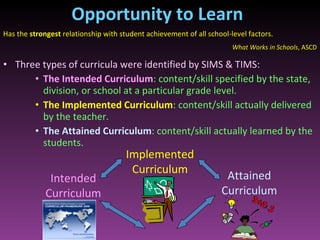
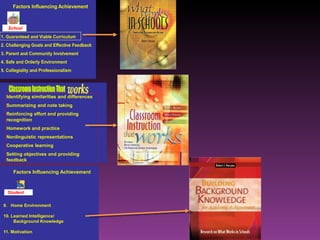
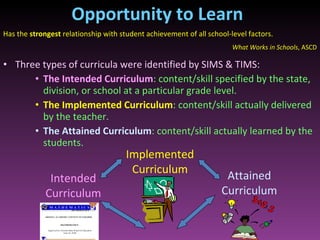
Opportunity to Learn Three types of curricula were identified by SIMS & TIMS: The Intended Curriculum : content/skill specified by the state, division, or school at a particular grade level. The Implemented Curriculum : content/skill actually delivered by the teacher. The Attained Curriculum : content/skill actually learned by the students. Intended Curriculum Implemented Curriculum Attained Curriculum Has the  strongest  relationship with student achievement of all school-level factors. What Works in Schools , ASCD
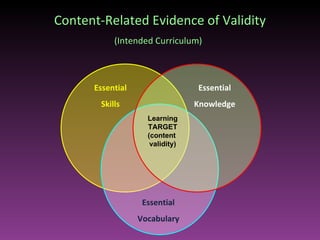
Content-Related Evidence of Validity (Intended Curriculum)   Essential Skills Essential Knowledge Essential Vocabulary Learning TARGET (content  validity)
Essential Knowledge What do the roots do for a plant? Essential Vocabulary What is the  blossom  of a plant? Essential Skills Create a model of a plant.
 
Main Myth about Learning Some part of the learner’s anatomy must be in contact with the chair in order for learning to take place!
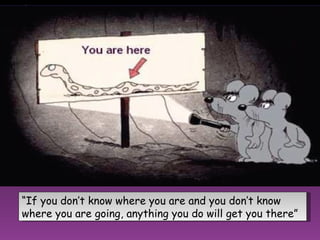
“ If you don’t know where you are and you don’t know where you are going, anything you do will get you there”
Steps: Find a person currently not seated next to you. Make friends     2. This person is now your  FOUR-SECOND PARTNER !
Record your responses on the last page…
1. The percent  of  FEMALE  students scoring  Advanced  on the Grade K-5  Writing SOL test in 2009. 2. The percent  of  MALE  students scoring  Advanced  on the Grade K-5  Writing SOL test in 2009. 3. According to  the  Silent Epidemic , the percent of U.S. dropouts who would have  stayed in school if learning was more interesting and real-world. 4. According to  the  Silent Epidemic , the percent of U.S. dropouts who felt  they were ‘ too far behind’  by the end of elementary school. 5.  The percent  of  BLACK  students scoring  Advanced  on the Grade 3 Reading SOL test in 2009. The percent  of  WHITE  students scoring  Advanced  on the Grade 3 Reading SOL test in 2009. 7.  The percent  of  FEMALE  students  Graduating On-Time  in the Class of 2009. 8.  The percent  of  MALE  students  Graduating On-Time  in the Class of 2009. 32 13 80 51 16 42 91 At MIDDLESEX COUNTY Public Schools: SOLUTIONS:  13,  16,  32,  42,  51,  78,  80,  91 78
Middlesex County  – On-time Graduation Rate -  Class of 2009 Subgroup # in Cohort Adv. Dip. Stand. Dip. Mod. St. Dip. Spec. Dip. On-Time Rate GED Cohort Completion Rate Dropout Rate All 133 40 64 < < 85.0 < 88.7 9.0 Female 74 28 35 < < 90.5 < 93.2 5.4 Male 59 12 29 < < 78.0 < 83.1 13.6 Black 32 < 16 < < 87.5 0 87.5 12.5 White 100 32 47 < < 84.0 < 89.0 8.0 Disabled 24 < 10 < < 83.3 0 87.5 12.5 Poverty 56 < 31 < < 80.4 < 83.9 12.5
SOL Reading Results – Middlesex County White Black All SWD Does the system perform?
SOL Math Results – Middlesex County White Black All SWD Does the system perform?
SOL Science Results – Middlesex County White Black All SWD Does the system perform?
SOL History Results – Middlesex County White Black All SWD Does the system perform?
SOL Writing Results – Middlesex County White Black All SWD Does the system perform?
Improve academic achievement for ALL students while closing achievement gaps.  2. Establish and maintain school climates and facilities that are safe, orderly and supportive of effective teaching and learning.  3. Reduce the over-representation of minority and other at-risk students in Special Education.   4. Develop programs to promote the recruitment and retention of a quality staff.  5. Promote and encourage positive home, school, business and community relations that encourage student achievement. Strategic Goals:
 
 
Give   One   …     Get   One   … On the back of your handout, write one way being a teacher in Virginia is like an astronaut on a walk in space. Think and be creative. When signaled, circulate the room to meet a colleague. Give him/her your answer and get their answer. You need a total of 2 answers. You may not get more than one idea from an individual. When you have completed your task, return to your seat. Enjoy!
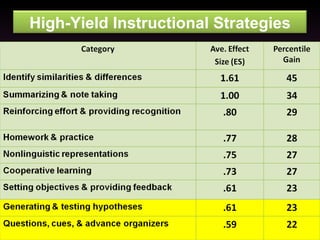
High-Yield Instructional Strategies
Identifying  Similarities and Differences
a.  The number of cavities the sixth graders have? b.  The number of people in the sixth graders’ families?  c.  The ages of the sixth graders’ mothers? d.  The heights of the sixth graders in inches?
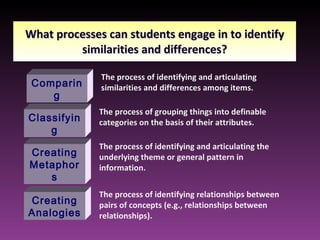
What processes can students engage in to identify similarities and differences? Comparing The process of identifying and articulating similarities and differences among items. Classifying The process of grouping things into definable categories on the basis of their attributes. Creating Metaphors The process of identifying and articulating the underlying theme or general pattern in information. Creating Analogies The process of identifying relationships between pairs of concepts (e.g., relationships between relationships).
 
Hey… This looks familiar… Which of the high yield instructional strategies do you see in this structure?
 
“ Learning from Explaining: Does It Matter if Mom is Listening” Learning improves dramatically among young children who take the time to explain academic concepts to their mothers or who explain their logic aloud to themselves. On a test of reasoning to 4 and 5 year olds: Children who explained concepts to their mothers before taking a test scored correctly on 75% of questions; Children  who explained concepts aloud to themselves before taking a test scored correctly on 72% of questions; Children who did not explain concepts at all prior to a test scored correctly on only 42% of questions; The study examined youngsters’ ability to place toy insects in a certain pattern based on color and type. Breaden Research study completed in  2007
 
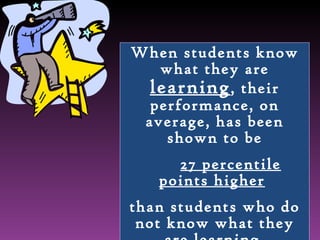
When students know what they are  learning , their performance, on average, has been shown to be 27 percentile points higher   than students who do not know what they are learning.
 
 
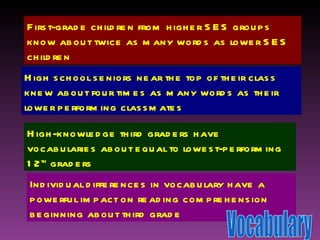
First-grade children from higher SES groups know about twice as many words as lower SES children High school seniors near the top of their class knew about four times as many words as their lower performing classmates High-knowledge third graders have vocabularies about equal to lowest-performing 12 th  graders Individual differences in vocabulary have a powerful impact on reading comprehension beginning about third grade Vocabulary
 
 
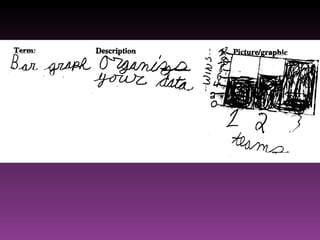
Types of pictures: Draw the  actual  thing . Marine biologist
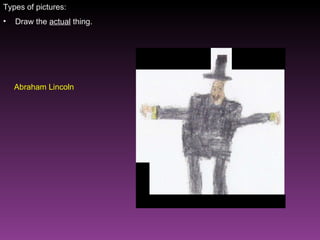
Types of pictures: Draw the  actual  thing . Abraham Lincoln
Mutualism When one thing helps another. Types of pictures: Draw the concept.
Change Types of pictures: Draw the concept.
Explorer Types of pictures: Draw an  example.
revolve Types of pictures: Draw the concept.
Research on Imagery as Elaboration Students  who used  imagery  to learn vocabulary, on average, performed # of studies 6 37 percentile pts. higher than…  … students who kept repeating definitions. 4 21 percentile pts.  higher than…  … students who were using the terms in a sentence.
http://visual.merriam-webster.com/
 
 
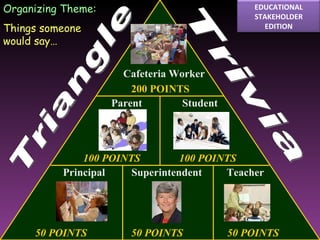
50 POINTS 50 POINTS 50 POINTS 100 POINTS 100 POINTS 200 POINTS Principal Organizing Theme: Things someone would say… Student Teacher Superintendent Parent Cafeteria Worker Triangle Trivia EDUCATIONAL STAKEHOLDER EDITION
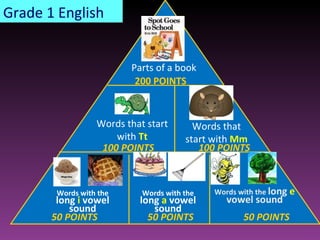
50 POINTS 50 POINTS 50 POINTS 100 POINTS 100 POINTS 200 POINTS Grade 1 English Words with the  long   i   vowel sound Words with the  long  a   vowel sound Words with the  long  e  vowel sound Words that start with   Tt Words that start with  Mm Parts of a book
50 POINTS 50 POINTS 50 POINTS 100 POINTS 100 POINTS 200 POINTS Science Experiment Hypothesis Energy Electron Dissolve Atmosphere
50 POINTS 50 POINTS 50 POINTS 100 POINTS 100 POINTS 200 POINTS Grade 4  Math Ways to make .25 Things that are parallel perimeter Types of graphs area  Types of angles
 
50 POINTS 50 POINTS 50 POINTS 100 POINTS 100 POINTS 200 POINTS YOUR TURN!!!


High-Yield Instructional Strategies
Self-Assessment Tool
 
Research-based Strategy:   Cooperative learning Percentile Gain   2 7 The GARDEN Plot
 
Opportunity to Learn Three types of curricula were identified by SIMS & TIMS: The Intended Curriculum : content/skill specified by the state, division, or school at a particular grade level. The Implemented Curriculum : content/skill actually delivered by the teacher. The Attained Curriculum : content/skill actually learned by the students. Intended Curriculum Implemented Curriculum Attained Curriculum Has the  strongest  relationship with student achievement of all school-level factors. What Works in Schools , ASCD
Content-Related Evidence of Validity (Intended Curriculum)   Essential Skills Essential Knowledge Essential Vocabulary Learning TARGET (content  validity)
R equired pass rates for each subgroup: 2005 tests –  reading (65%)      math (63%) 2006 tests –  reading (69%)   math (67%)  2007 tests –  reading (73%)   math (71%) 2008 tests – reading (77%) math (75%) 2009 tests – reading (81%) math (79%) 2010 tests – reading (85%) math (83%)
2008-09 RLR3 RLR4 RLR5 MTH3 MTH4 MTH5 SCI3 SCI5 HST3 VA.St Writ. All  Advanced 38 39 18 63 33 23 52 26 70 36 20 Proficient 39 39 62 28 50 50 37 60 24 48 58 Fail 24 22 20 9 17 27 11 14 6 16 22 Female  Advanced 53 47 18 68 38 24 55 18 80 33 32 Proficient 34 34 61 25 51 55 38 63 15 50 55 Fail 13 18 21 8 11 21 8 18 5 17 13 Male  Advanced 26 31 17 59 28 22 49 32 62 38 11 Proficient 42 44 64 31 49 46 37 57 32 46 60 Fail 32 26 19 10 23 33 14 11 6 15 30 Black  Advanced 16 24 8 42 12 24 26 19 50 25 16 Proficient 37 44 65 47 48 48 47 58 40 42 60 Fail 47 32 27 11 40 28 26 23 10 33 24 White  Advanced 42 46 22 70 41 21 60 29 76 39 20 Proficient 41 36 60 21 53 52 33 60 19 53 58 Fail 17 18 17 9 6 28 7 10 4 8 22 Disabled Advanced 12 - 7 31 - 20 25 7 41 - 8 Proficient 24 - 60 38 - 33 31 67 29 - 15 Fail 65 - 33 31 - 47 44 27 29 - 77 Poverty  Advanced 24 26 9 55 21 18 45 15 62 33 12 Proficient 47 49 70 36 59 55 39 73 32 41 58 Fail 29 26 21 9 21 27 15 12 6 26 30
High-Yield Instructional Strategies
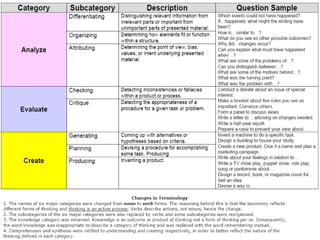
BLOOM’S REVISED TAXONOMY         Higher-order thinking Creating Generating new ideas, products, or ways of viewing things Designing, constructing, planning, producing, inventing. Evaluating Justifying a decision or course of action Checking, hypothesizing, critiquing, experimenting, judging   Analyzing Breaking information into parts to explore understandings and relationships Comparing, organizing, deconstructing, interrogating, finding Applying Using information in another familiar situation Implementing, carrying out, using, executing Understanding Explaining ideas or concepts Interpreting, summarizing, paraphrasing, classifying, explaining  Remembering Recalling information Recognizing, listing, describing, retrieving, naming, finding page 8 & 9
 
 
Remember it .  (Describe its colors, shapes, and sizes. What does it look like?) Understand it .  (What does it make you think of?) Apply it.  (What can you do with it? How is it used?) Analyze it .  (How is it made or what is it composed of?) Evaluate it.  (Take a stand and list reasons for supporting it.) Create it.  (Generate a new version of it. How is it an improvement from the original?) CUBING  2009
 
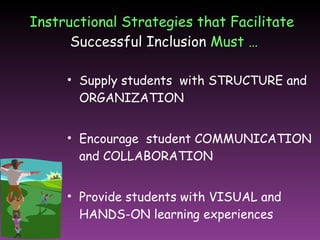
Instructional Strategies that Facilitate  Successful Inclusion   Must … Supply students  with STRUCTURE and ORGANIZATION Encourage  student COMMUNICATION and COLLABORATION Provide students with VISUAL and HANDS-ON learning experiences
Summarizing and Note Taking Generalizations form the research: Verbatim note-taking is, perhaps, the least effective technique. Notes should be considered a work in progress. Notes should be used as a study guide for tests. The more notes that are taken, the better.
 
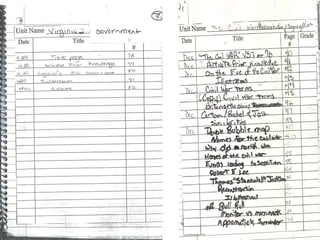
Table of Content Samples


21st century learning k 5

  • 1.
    Prepared Especially forthe Elementary Professional Learning Community of MIDDLESEX COUNTY PUBLIC SCHOOLS by Dan Mulligan, Ed. D. January 2010
  • 2.
    MOVING from ETCH-a SKETCH Learning To Each STUDENT UNDERSTANDING
  • 3.
  • 4.
    Opportunity to LearnThree types of curricula were identified by SIMS & TIMS: The Intended Curriculum : content/skill specified by the state, division, or school at a particular grade level. The Implemented Curriculum : content/skill actually delivered by the teacher. The Attained Curriculum : content/skill actually learned by the students. Intended Curriculum Implemented Curriculum Attained Curriculum Has the strongest relationship with student achievement of all school-level factors. What Works in Schools , ASCD
  • 5.
    Content-Related Evidence ofValidity (Intended Curriculum) Essential Skills Essential Knowledge Essential Vocabulary Learning TARGET (content validity)
  • 6.
    Essential Knowledge Whatdo the roots do for a plant? Essential Vocabulary What is the blossom of a plant? Essential Skills Create a model of a plant.
  • 7.
  • 8.
    Main Myth aboutLearning Some part of the learner’s anatomy must be in contact with the chair in order for learning to take place!
  • 9.
    “ If youdon’t know where you are and you don’t know where you are going, anything you do will get you there”
  • 10.
    Steps: Find aperson currently not seated next to you. Make friends   2. This person is now your FOUR-SECOND PARTNER !
  • 11.
    Record your responseson the last page…
  • 12.
    1. The percent of FEMALE students scoring Advanced on the Grade K-5 Writing SOL test in 2009. 2. The percent of MALE students scoring Advanced on the Grade K-5 Writing SOL test in 2009. 3. According to the Silent Epidemic , the percent of U.S. dropouts who would have stayed in school if learning was more interesting and real-world. 4. According to the Silent Epidemic , the percent of U.S. dropouts who felt they were ‘ too far behind’ by the end of elementary school. 5. The percent of BLACK students scoring Advanced on the Grade 3 Reading SOL test in 2009. The percent of WHITE students scoring Advanced on the Grade 3 Reading SOL test in 2009. 7. The percent of FEMALE students Graduating On-Time in the Class of 2009. 8. The percent of MALE students Graduating On-Time in the Class of 2009. 32 13 80 51 16 42 91 At MIDDLESEX COUNTY Public Schools: SOLUTIONS: 13, 16, 32, 42, 51, 78, 80, 91 78
  • 13.
    Middlesex County – On-time Graduation Rate - Class of 2009 Subgroup # in Cohort Adv. Dip. Stand. Dip. Mod. St. Dip. Spec. Dip. On-Time Rate GED Cohort Completion Rate Dropout Rate All 133 40 64 < < 85.0 < 88.7 9.0 Female 74 28 35 < < 90.5 < 93.2 5.4 Male 59 12 29 < < 78.0 < 83.1 13.6 Black 32 < 16 < < 87.5 0 87.5 12.5 White 100 32 47 < < 84.0 < 89.0 8.0 Disabled 24 < 10 < < 83.3 0 87.5 12.5 Poverty 56 < 31 < < 80.4 < 83.9 12.5
  • 14.
    SOL Reading Results– Middlesex County White Black All SWD Does the system perform?
  • 15.
    SOL Math Results– Middlesex County White Black All SWD Does the system perform?
  • 16.
    SOL Science Results– Middlesex County White Black All SWD Does the system perform?
  • 17.
    SOL History Results– Middlesex County White Black All SWD Does the system perform?
  • 18.
    SOL Writing Results– Middlesex County White Black All SWD Does the system perform?
  • 19.
    Improve academic achievementfor ALL students while closing achievement gaps.  2. Establish and maintain school climates and facilities that are safe, orderly and supportive of effective teaching and learning.  3. Reduce the over-representation of minority and other at-risk students in Special Education.   4. Develop programs to promote the recruitment and retention of a quality staff.  5. Promote and encourage positive home, school, business and community relations that encourage student achievement. Strategic Goals:
  • 20.
  • 21.
  • 22.
    Give One … Get One … On the back of your handout, write one way being a teacher in Virginia is like an astronaut on a walk in space. Think and be creative. When signaled, circulate the room to meet a colleague. Give him/her your answer and get their answer. You need a total of 2 answers. You may not get more than one idea from an individual. When you have completed your task, return to your seat. Enjoy!
  • 23.
  • 24.
    Identifying Similaritiesand Differences
  • 25.
    a. Thenumber of cavities the sixth graders have? b. The number of people in the sixth graders’ families? c. The ages of the sixth graders’ mothers? d. The heights of the sixth graders in inches?
  • 26.
    What processes canstudents engage in to identify similarities and differences? Comparing The process of identifying and articulating similarities and differences among items. Classifying The process of grouping things into definable categories on the basis of their attributes. Creating Metaphors The process of identifying and articulating the underlying theme or general pattern in information. Creating Analogies The process of identifying relationships between pairs of concepts (e.g., relationships between relationships).
  • 27.
  • 28.
    Hey… This looksfamiliar… Which of the high yield instructional strategies do you see in this structure?
  • 29.
  • 30.
    “ Learning fromExplaining: Does It Matter if Mom is Listening” Learning improves dramatically among young children who take the time to explain academic concepts to their mothers or who explain their logic aloud to themselves. On a test of reasoning to 4 and 5 year olds: Children who explained concepts to their mothers before taking a test scored correctly on 75% of questions; Children who explained concepts aloud to themselves before taking a test scored correctly on 72% of questions; Children who did not explain concepts at all prior to a test scored correctly on only 42% of questions; The study examined youngsters’ ability to place toy insects in a certain pattern based on color and type. Breaden Research study completed in 2007
  • 31.
  • 32.
    When students knowwhat they are learning , their performance, on average, has been shown to be 27 percentile points higher than students who do not know what they are learning.
  • 33.
  • 34.
  • 35.
    First-grade children fromhigher SES groups know about twice as many words as lower SES children High school seniors near the top of their class knew about four times as many words as their lower performing classmates High-knowledge third graders have vocabularies about equal to lowest-performing 12 th graders Individual differences in vocabulary have a powerful impact on reading comprehension beginning about third grade Vocabulary
  • 36.
  • 37.
  • 38.
    Types of pictures:Draw the actual thing . Marine biologist
  • 39.
    Types of pictures:Draw the actual thing . Abraham Lincoln
  • 40.
    Mutualism When onething helps another. Types of pictures: Draw the concept.
  • 41.
    Change Types ofpictures: Draw the concept.
  • 42.
    Explorer Types ofpictures: Draw an example.
  • 43.
    revolve Types ofpictures: Draw the concept.
  • 44.
    Research on Imageryas Elaboration Students who used imagery to learn vocabulary, on average, performed # of studies 6 37 percentile pts. higher than… … students who kept repeating definitions. 4 21 percentile pts. higher than… … students who were using the terms in a sentence.
  • 45.
  • 46.
  • 47.
  • 48.
    50 POINTS 50POINTS 50 POINTS 100 POINTS 100 POINTS 200 POINTS Principal Organizing Theme: Things someone would say… Student Teacher Superintendent Parent Cafeteria Worker Triangle Trivia EDUCATIONAL STAKEHOLDER EDITION
  • 49.
    50 POINTS 50POINTS 50 POINTS 100 POINTS 100 POINTS 200 POINTS Grade 1 English Words with the long i vowel sound Words with the long a vowel sound Words with the long e vowel sound Words that start with Tt Words that start with Mm Parts of a book
  • 50.
    50 POINTS 50POINTS 50 POINTS 100 POINTS 100 POINTS 200 POINTS Science Experiment Hypothesis Energy Electron Dissolve Atmosphere
  • 51.
    50 POINTS 50POINTS 50 POINTS 100 POINTS 100 POINTS 200 POINTS Grade 4 Math Ways to make .25 Things that are parallel perimeter Types of graphs area Types of angles
  • 52.
  • 53.
    50 POINTS 50POINTS 50 POINTS 100 POINTS 100 POINTS 200 POINTS YOUR TURN!!!
  • 54.
  • 55.
  • 56.
  • 57.
  • 58.
  • 59.
  • 60.
  • 61.
    Research-based Strategy: Cooperative learning Percentile Gain 2 7 The GARDEN Plot
  • 62.
  • 63.
    Opportunity to LearnThree types of curricula were identified by SIMS & TIMS: The Intended Curriculum : content/skill specified by the state, division, or school at a particular grade level. The Implemented Curriculum : content/skill actually delivered by the teacher. The Attained Curriculum : content/skill actually learned by the students. Intended Curriculum Implemented Curriculum Attained Curriculum Has the strongest relationship with student achievement of all school-level factors. What Works in Schools , ASCD
  • 64.
    Content-Related Evidence ofValidity (Intended Curriculum) Essential Skills Essential Knowledge Essential Vocabulary Learning TARGET (content validity)
  • 65.
    R equired passrates for each subgroup: 2005 tests – reading (65%) math (63%) 2006 tests – reading (69%) math (67%) 2007 tests – reading (73%) math (71%) 2008 tests – reading (77%) math (75%) 2009 tests – reading (81%) math (79%) 2010 tests – reading (85%) math (83%)
  • 66.
    2008-09 RLR3 RLR4RLR5 MTH3 MTH4 MTH5 SCI3 SCI5 HST3 VA.St Writ. All Advanced 38 39 18 63 33 23 52 26 70 36 20 Proficient 39 39 62 28 50 50 37 60 24 48 58 Fail 24 22 20 9 17 27 11 14 6 16 22 Female Advanced 53 47 18 68 38 24 55 18 80 33 32 Proficient 34 34 61 25 51 55 38 63 15 50 55 Fail 13 18 21 8 11 21 8 18 5 17 13 Male Advanced 26 31 17 59 28 22 49 32 62 38 11 Proficient 42 44 64 31 49 46 37 57 32 46 60 Fail 32 26 19 10 23 33 14 11 6 15 30 Black Advanced 16 24 8 42 12 24 26 19 50 25 16 Proficient 37 44 65 47 48 48 47 58 40 42 60 Fail 47 32 27 11 40 28 26 23 10 33 24 White Advanced 42 46 22 70 41 21 60 29 76 39 20 Proficient 41 36 60 21 53 52 33 60 19 53 58 Fail 17 18 17 9 6 28 7 10 4 8 22 Disabled Advanced 12 - 7 31 - 20 25 7 41 - 8 Proficient 24 - 60 38 - 33 31 67 29 - 15 Fail 65 - 33 31 - 47 44 27 29 - 77 Poverty Advanced 24 26 9 55 21 18 45 15 62 33 12 Proficient 47 49 70 36 59 55 39 73 32 41 58 Fail 29 26 21 9 21 27 15 12 6 26 30
  • 67.
  • 68.
    BLOOM’S REVISED TAXONOMY        Higher-order thinking Creating Generating new ideas, products, or ways of viewing things Designing, constructing, planning, producing, inventing. Evaluating Justifying a decision or course of action Checking, hypothesizing, critiquing, experimenting, judging   Analyzing Breaking information into parts to explore understandings and relationships Comparing, organizing, deconstructing, interrogating, finding Applying Using information in another familiar situation Implementing, carrying out, using, executing Understanding Explaining ideas or concepts Interpreting, summarizing, paraphrasing, classifying, explaining  Remembering Recalling information Recognizing, listing, describing, retrieving, naming, finding page 8 & 9
  • 69.
  • 70.
  • 71.
    Remember it . (Describe its colors, shapes, and sizes. What does it look like?) Understand it . (What does it make you think of?) Apply it. (What can you do with it? How is it used?) Analyze it . (How is it made or what is it composed of?) Evaluate it. (Take a stand and list reasons for supporting it.) Create it. (Generate a new version of it. How is it an improvement from the original?) CUBING 2009
  • 72.
  • 73.
    Instructional Strategies thatFacilitate Successful Inclusion Must … Supply students with STRUCTURE and ORGANIZATION Encourage student COMMUNICATION and COLLABORATION Provide students with VISUAL and HANDS-ON learning experiences
  • 74.
    Summarizing and NoteTaking Generalizations form the research: Verbatim note-taking is, perhaps, the least effective technique. Notes should be considered a work in progress. Notes should be used as a study guide for tests. The more notes that are taken, the better.
  • 75.
  • 76.
  • 77.
  • 78.

Editor's Notes

  • #36 Here are some of the big ideas from the book