Malleolar Fracture of Ankle
By: Alhassan Mahdi Al Salem
Definition:
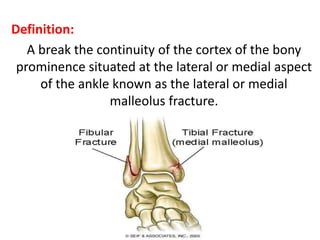
A break the continuity of the cortex of the bony
prominence situated at the lateral or medial aspect
of the ankle known as the lateral or medial
malleolus fracture.
Epidemiology:
The incidence is about 187 fractures per 100,000 each
year.
In athletics and the elderly .
The majority of ankle fractures are malleolar fractures:
• 60 to 70 % occur as unimalleolar fractures
• 15 to 20 % as bimalleolar fractures
• Male-to-female ratio is 2:1
• Men have a higher rate as young adults,
while women have higher rates in the 50 to 70-year age.
Mechanism of injury
• The patient stumbles and falls.
• The ankle is twisted and the talus tilts and/or
rotates causing a low-energy fracture of one
or both malleoli, with or without associated
injuries of the ligaments.
• If a malleolus is pushed off, it usually fractures
obliquely.
• if it is pulled off, it fractures transversely.
Classification
• The Weber ankle fracture
classification (or Danis-Weber classification)
is a simple system for classification of lateral
malleolar fractures, relating to the level of the
fracture in relation to the ankle joint. It has a
role in determining treatment.
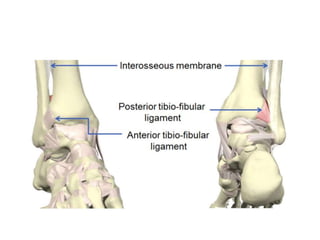
Syndesmosis
• There are several ligaments/membranes
referring to the syndesmosis or structures
which hold the tibia and fibula in position.
These are:
• the interosseous membrane
• the syndesmotic ligaments
- posterior tibio-fibular ligament
- anterior tibio-fibular ligament
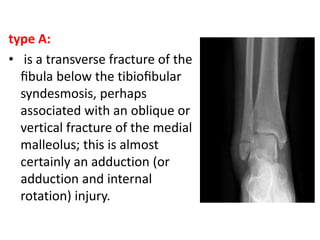
type A:
• is a transverse fracture of the
fibula below the tibiofibular
syndesmosis, perhaps
associated with an oblique or
vertical fracture of the medial
malleolus; this is almost
certainly an adduction (or
adduction and internal
rotation) injury.
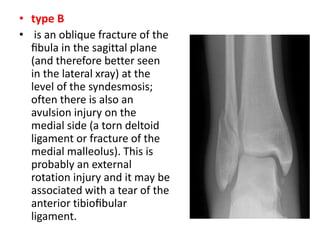
• type B
• is an oblique fracture of the
fibula in the sagittal plane
(and therefore better seen
in the lateral xray) at the
level of the syndesmosis;
often there is also an
avulsion injury on the
medial side (a torn deltoid
ligament or fracture of the
medial malleolus). This is
probably an external
rotation injury and it may be
associated with a tear of the
anterior tibiofibular
ligament.
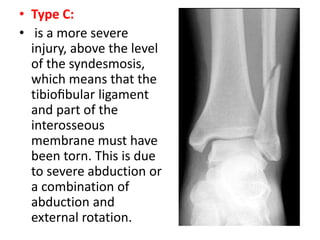
• Type C:
• is a more severe
injury, above the level
of the syndesmosis,
which means that the
tibiofibular ligament
and part of the
interosseous
membrane must have
been torn. This is due
to severe abduction or
a combination of
abduction and
external rotation.
Clinical features
• history of severe twisting injury.
• Severe pain.
• Swelling .
• Deformity.
• And if both the medial and lateral sides are
tender, a double injury (bony or ligamentous)
must be suspected.
Investigation
• History and clinical examination.
• X ray:
At least three views:
1- anterior posterior view.
2- Lateral view.
3- 30-degree oblique ‘mortise’ view.
Treatment
1st undisplaced fractures:
A- Type A:
Minimal splintage.
B- Type B:
below-knee cast is applied with the ankle in the
neutral (anatomical position).
C- Type C:
fracture may displaces in a cast therefore, type
C fractures are better fixed from the outset.
• 2nd displaced fractures:
A- Type A:
Open reduction and internal fixation.
B- Type B:
Close reduction with traction if succeed cast is
applied and if fail internal fixation.
C- Type C:
Almost all type C fractures are unstable and will
need open reduction and internal fixation.
complications
• Early:
Vascular injury
Wound breakdown and infection.
• Late:
Incomplete reduction.
Nonunion.
Joint stiffness.
Osteoarthritis.

Malleolar fracture

  • 1.
    Malleolar Fracture ofAnkle By: Alhassan Mahdi Al Salem
  • 2.
    Definition: A break thecontinuity of the cortex of the bony prominence situated at the lateral or medial aspect of the ankle known as the lateral or medial malleolus fracture.
  • 3.
    Epidemiology: The incidence isabout 187 fractures per 100,000 each year. In athletics and the elderly . The majority of ankle fractures are malleolar fractures: • 60 to 70 % occur as unimalleolar fractures • 15 to 20 % as bimalleolar fractures • Male-to-female ratio is 2:1 • Men have a higher rate as young adults, while women have higher rates in the 50 to 70-year age.
  • 4.
    Mechanism of injury •The patient stumbles and falls. • The ankle is twisted and the talus tilts and/or rotates causing a low-energy fracture of one or both malleoli, with or without associated injuries of the ligaments. • If a malleolus is pushed off, it usually fractures obliquely. • if it is pulled off, it fractures transversely.
  • 5.
    Classification • The Weberankle fracture classification (or Danis-Weber classification) is a simple system for classification of lateral malleolar fractures, relating to the level of the fracture in relation to the ankle joint. It has a role in determining treatment.
  • 6.
    Syndesmosis • There areseveral ligaments/membranes referring to the syndesmosis or structures which hold the tibia and fibula in position. These are: • the interosseous membrane • the syndesmotic ligaments - posterior tibio-fibular ligament - anterior tibio-fibular ligament
  • 8.
    type A: • isa transverse fracture of the fibula below the tibiofibular syndesmosis, perhaps associated with an oblique or vertical fracture of the medial malleolus; this is almost certainly an adduction (or adduction and internal rotation) injury.
  • 9.
    • type B •is an oblique fracture of the fibula in the sagittal plane (and therefore better seen in the lateral xray) at the level of the syndesmosis; often there is also an avulsion injury on the medial side (a torn deltoid ligament or fracture of the medial malleolus). This is probably an external rotation injury and it may be associated with a tear of the anterior tibiofibular ligament.
  • 10.
    • Type C: •is a more severe injury, above the level of the syndesmosis, which means that the tibiofibular ligament and part of the interosseous membrane must have been torn. This is due to severe abduction or a combination of abduction and external rotation.
  • 11.
    Clinical features • historyof severe twisting injury. • Severe pain. • Swelling . • Deformity. • And if both the medial and lateral sides are tender, a double injury (bony or ligamentous) must be suspected.
  • 12.
    Investigation • History andclinical examination. • X ray: At least three views: 1- anterior posterior view. 2- Lateral view. 3- 30-degree oblique ‘mortise’ view.
  • 13.
    Treatment 1st undisplaced fractures: A-Type A: Minimal splintage. B- Type B: below-knee cast is applied with the ankle in the neutral (anatomical position). C- Type C: fracture may displaces in a cast therefore, type C fractures are better fixed from the outset.
  • 14.
    • 2nd displacedfractures: A- Type A: Open reduction and internal fixation. B- Type B: Close reduction with traction if succeed cast is applied and if fail internal fixation. C- Type C: Almost all type C fractures are unstable and will need open reduction and internal fixation.
  • 15.
    complications • Early: Vascular injury Woundbreakdown and infection. • Late: Incomplete reduction. Nonunion. Joint stiffness. Osteoarthritis.