www.luxoft.com
Facilitating Conversations
and Decision-Making
Webinar
www.luxoft.com
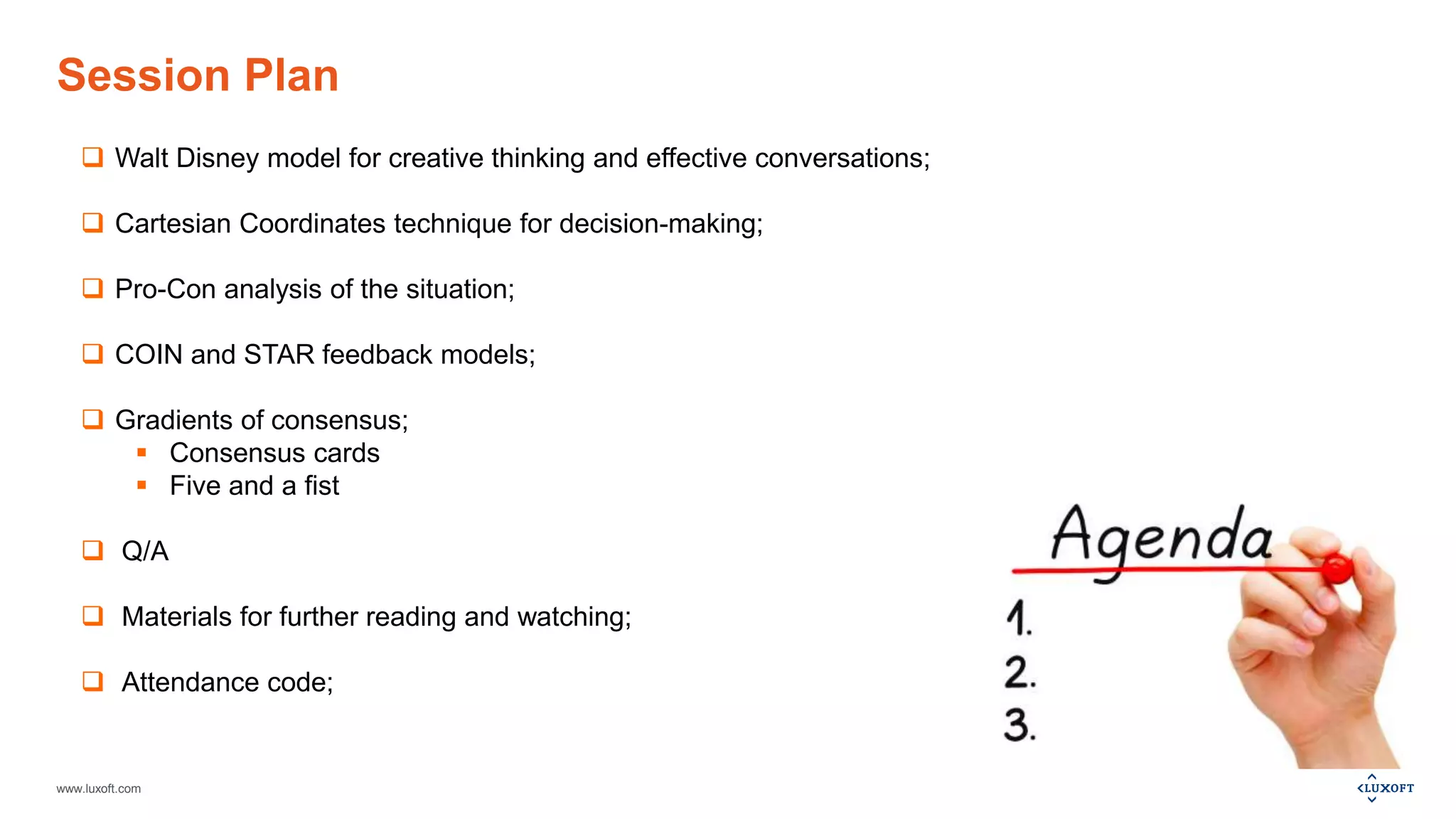
Session Plan
 Walt Disney model for creative thinking and effective conversations;
 Cartesian Coordinates technique for decision-making;
 Pro-Con analysis of the situation;
 COIN and STAR feedback models;
 Gradients of consensus;
 Consensus cards
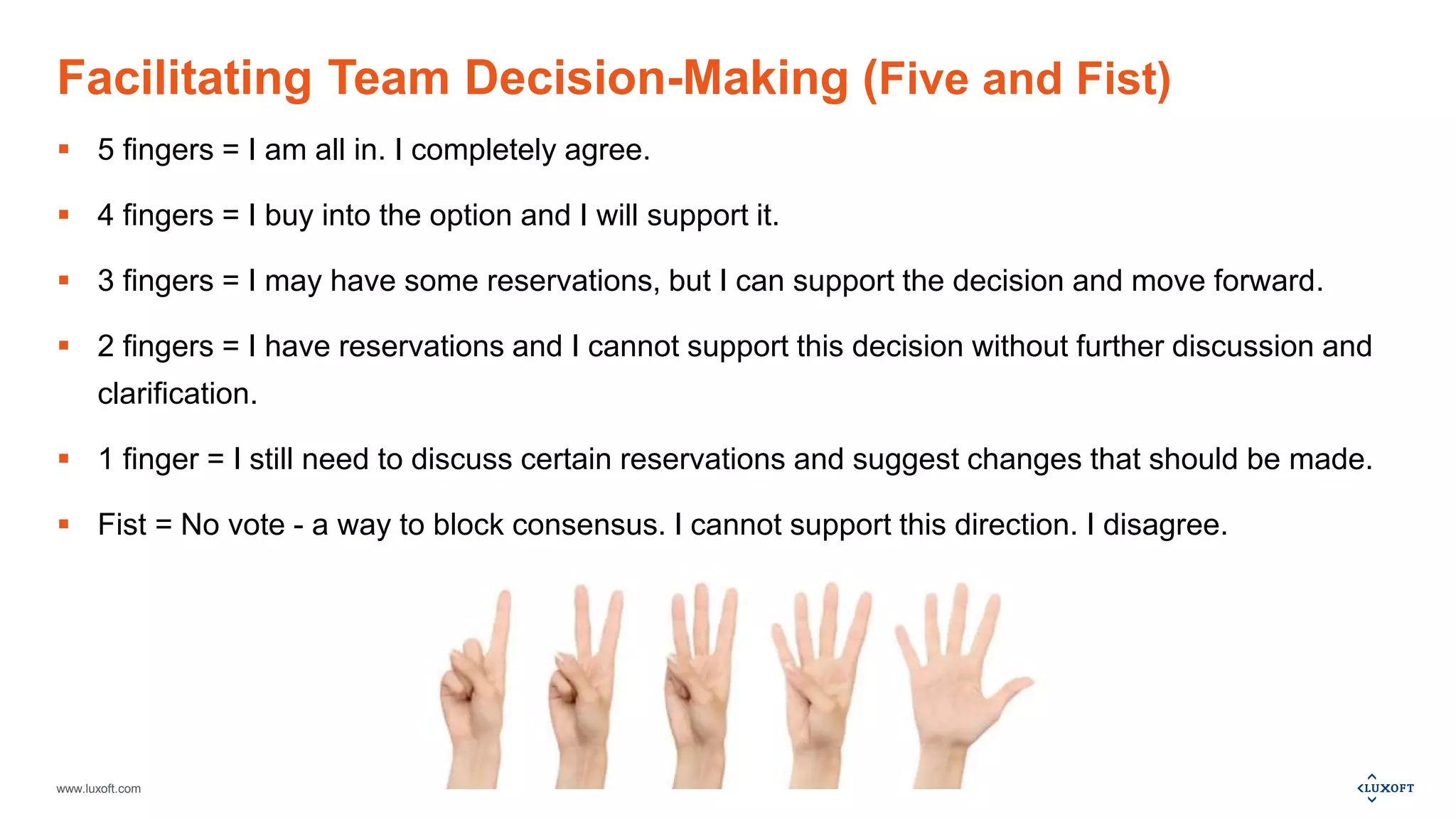
 Five and a fist
 Q/A
 Materials for further reading and watching;
 Attendance code;
www.luxoft.com
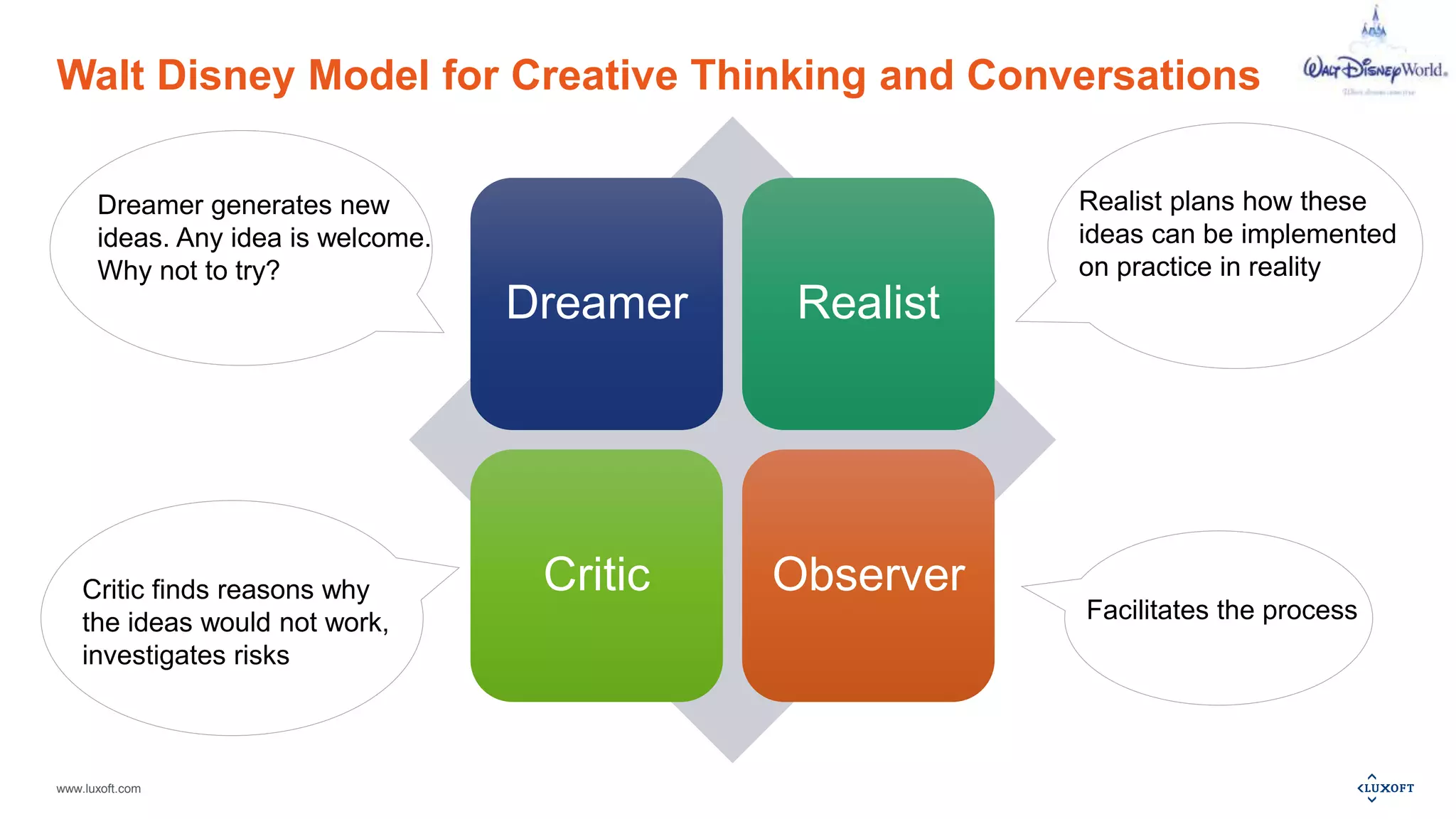
Walt Disney Model for Creative Thinking and Conversations
Dreamer Realist
Critic Observer
Dreamer generates new
ideas. Any idea is welcome.
Why not to try?
Realist plans how these
ideas can be implemented
on practice in reality
Critic finds reasons why
the ideas would not work,
investigates risks
Facilitates the process
www.luxoft.com
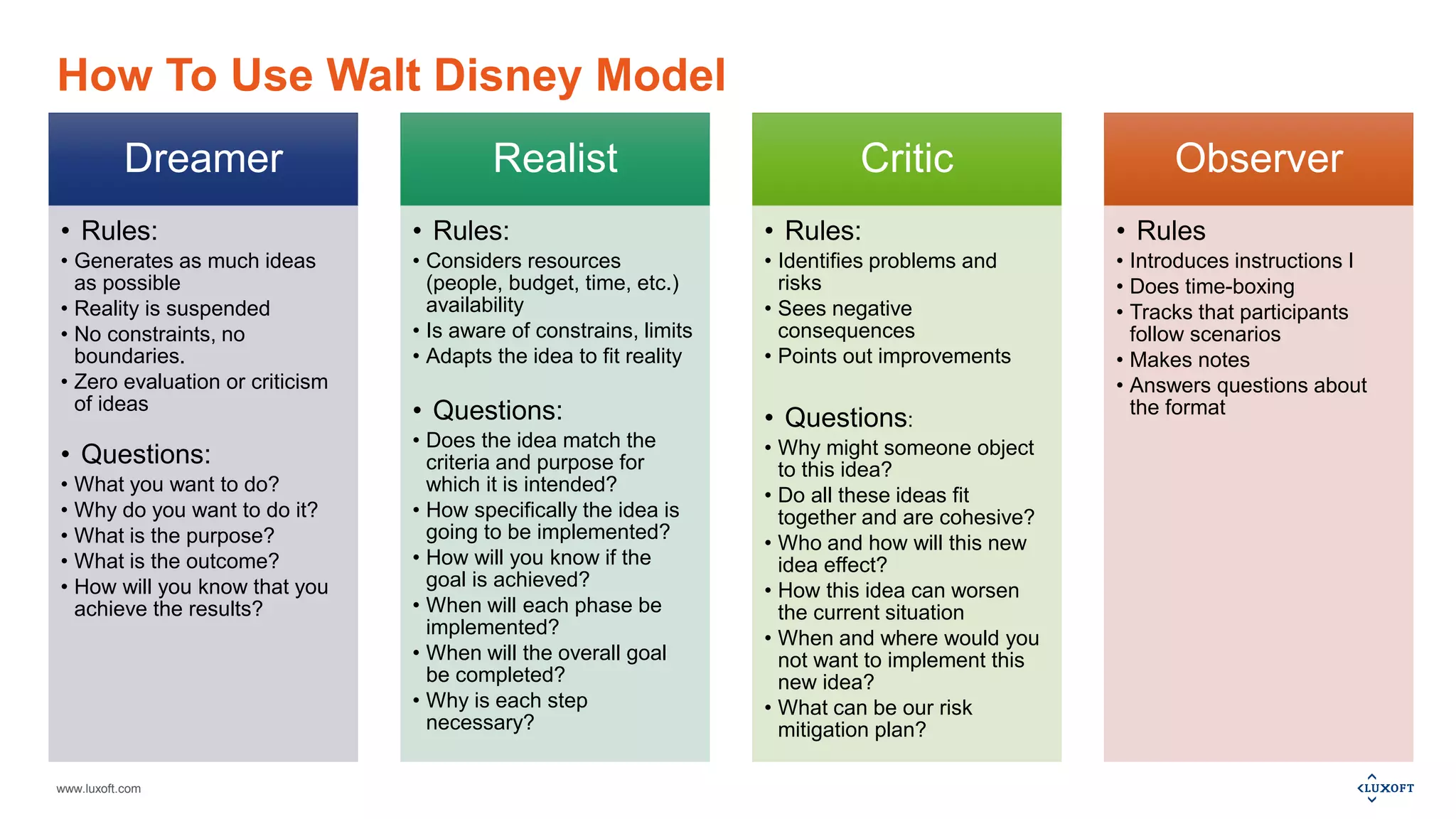
How To Use Walt Disney Model
Dreamer
• Rules:
• Generates as much ideas
as possible
• Reality is suspended
• No constraints, no
boundaries.
• Zero evaluation or criticism
of ideas
• Questions:
• What you want to do?
• Why do you want to do it?
• What is the purpose?
• What is the outcome?
• How will you know that you
achieve the results?
Realist
• Rules:
• Considers resources
(people, budget, time, etc.)
availability
• Is aware of constrains, limits
• Adapts the idea to fit reality
• Questions:
• Does the idea match the
criteria and purpose for
which it is intended?
• How specifically the idea is
going to be implemented?
• How will you know if the
goal is achieved?
• When will each phase be
implemented?
• When will the overall goal
be completed?
• Why is each step
necessary?
Critic
• Rules:
• Identifies problems and
risks
• Sees negative
consequences
• Points out improvements
• Questions:
• Why might someone object
to this idea?
• Do all these ideas fit
together and are cohesive?
• Who and how will this new
idea effect?
• How this idea can worsen
the current situation
• When and where would you
not want to implement this
new idea?
• What can be our risk
mitigation plan?
Observer
• Rules
• Introduces instructions I
• Does time-boxing
• Tracks that participants
follow scenarios
• Makes notes
• Answers questions about
the format
www.luxoft.com
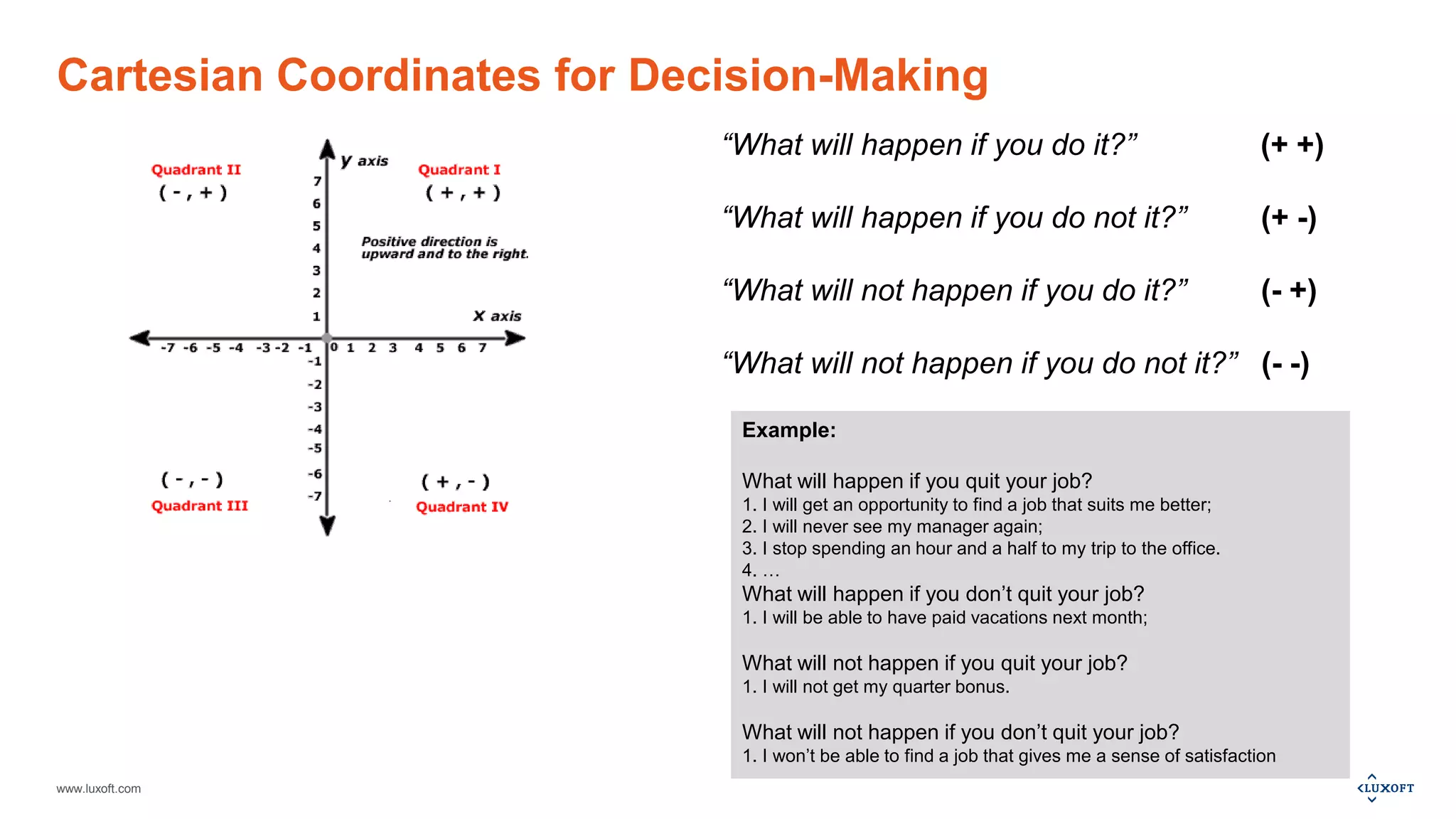
Cartesian Coordinates for Decision-Making
“What will happen if you do it?” (+ +)
“What will happen if you do not it?” (+ -)
“What will not happen if you do it?” (- +)
“What will not happen if you do not it?” (- -)
Example:
What will happen if you quit your job?
1. I will get an opportunity to find a job that suits me better;
2. I will never see my manager again;
3. I stop spending an hour and a half to my trip to the office.
4. …
What will happen if you don’t quit your job?
1. I will be able to have paid vacations next month;
What will not happen if you quit your job?
1. I will not get my quarter bonus.
What will not happen if you don’t quit your job?
1. I won’t be able to find a job that gives me a sense of satisfaction
www.luxoft.com
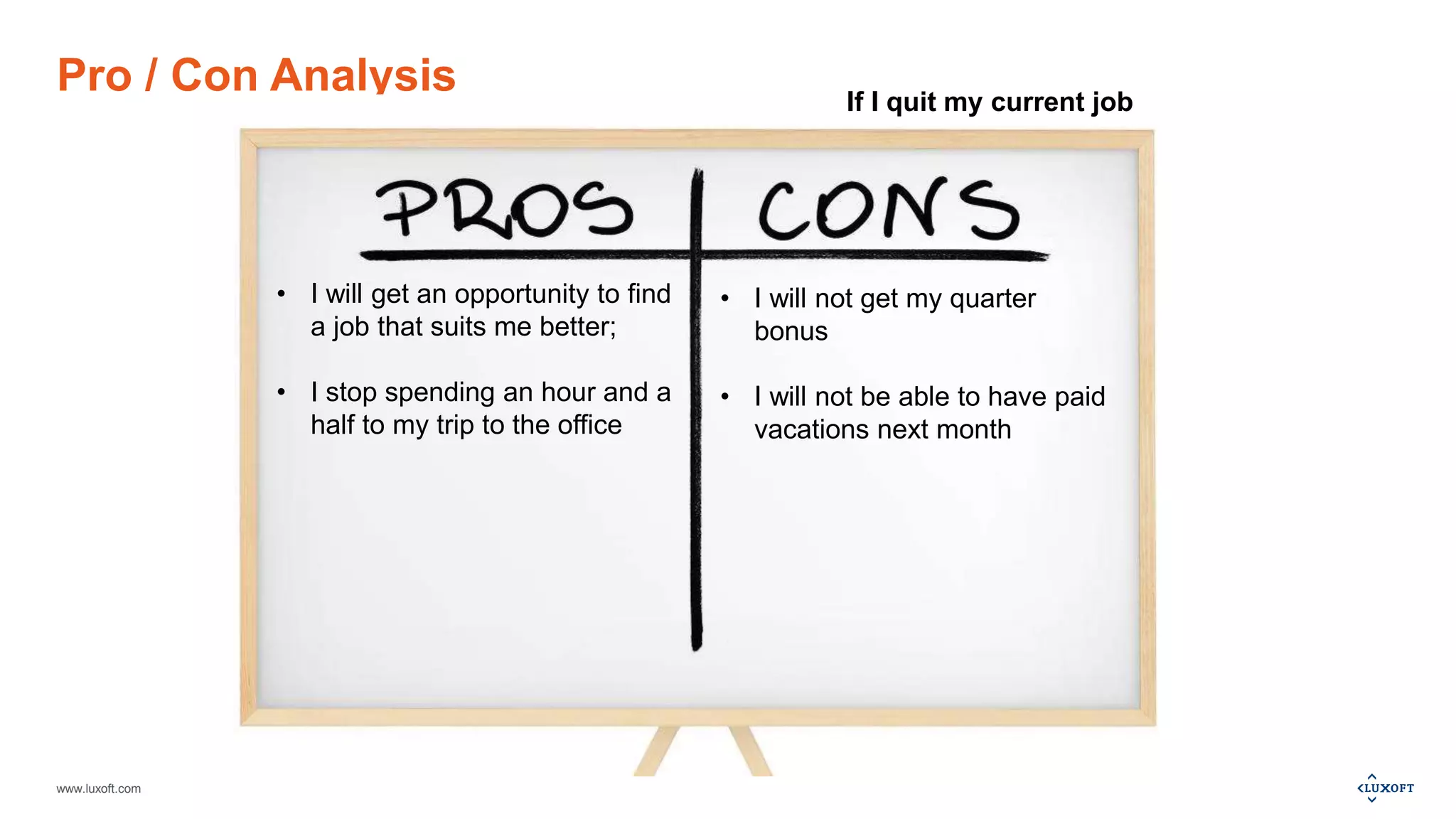
Pro / Con Analysis
• I will get an opportunity to find
a job that suits me better;
• I stop spending an hour and a
half to my trip to the office
• I will not get my quarter
bonus
• I will not be able to have paid
vacations next month
If I quit my current job
www.luxoft.com
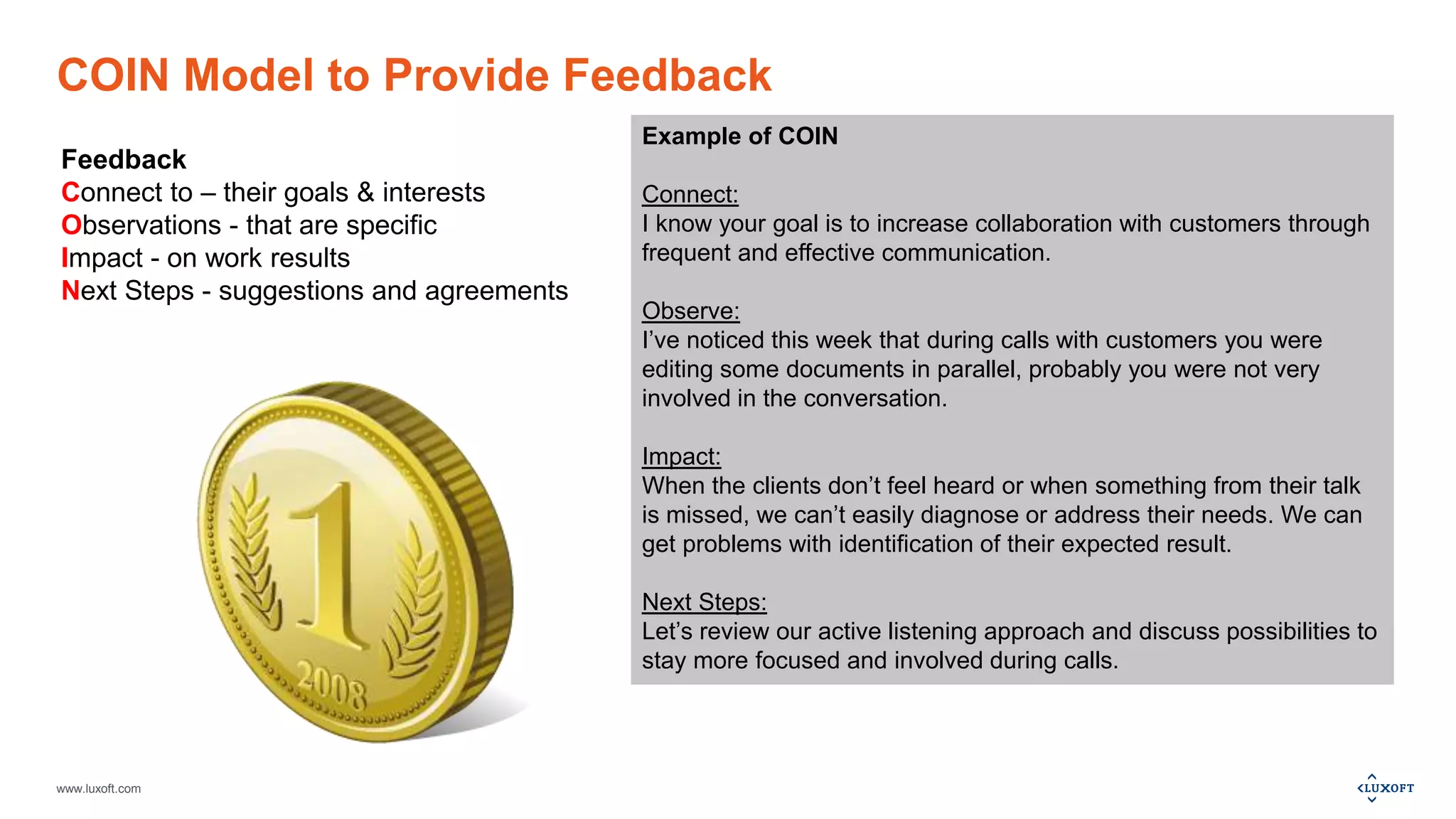
COIN Model to Provide Feedback
Feedback
Connect to – their goals & interests
Observations - that are specific
Impact - on work results
Next Steps - suggestions and agreements
Example of COIN
Connect:
I know your goal is to increase collaboration with customers through
frequent and effective communication.
Observe:
I’ve noticed this week that during calls with customers you were
editing some documents in parallel, probably you were not very
involved in the conversation.
Impact:
When the clients don’t feel heard or when something from their talk
is missed, we can’t easily diagnose or address their needs. We can
get problems with identification of their expected result.
Next Steps:
Let’s review our active listening approach and discuss possibilities to
stay more focused and involved during calls.
www.luxoft.com
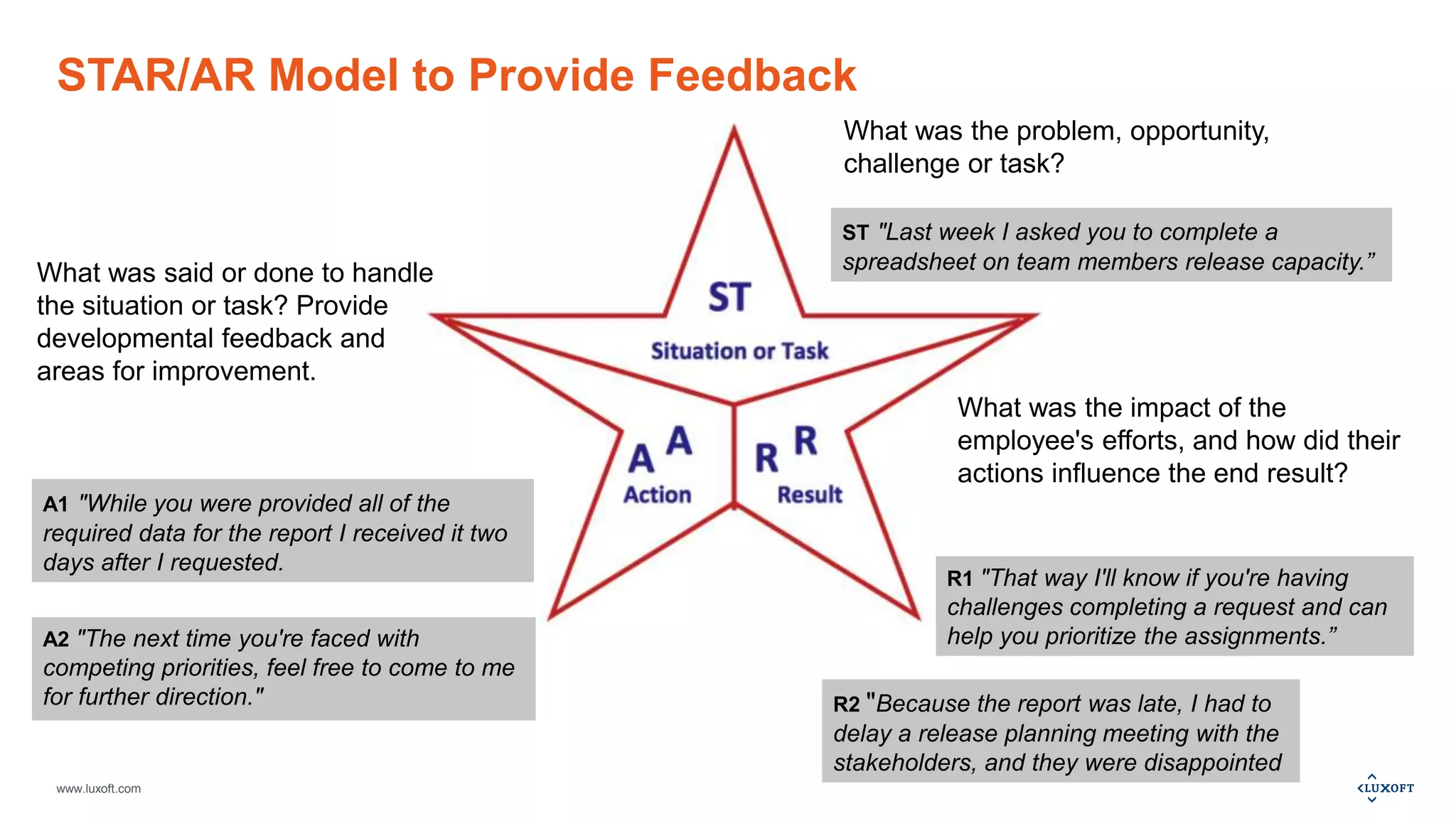
What was the problem, opportunity,
challenge or task?
What was said or done to handle
the situation or task? Provide
developmental feedback and
areas for improvement.
What was the impact of the
employee's efforts, and how did their
actions influence the end result?
ST "Last week I asked you to complete a
spreadsheet on team members release capacity.”
A1 "While you were provided all of the
required data for the report I received it two
days after I requested.
A2 "The next time you're faced with
competing priorities, feel free to come to me
for further direction." R2 "Because the report was late, I had to
delay a release planning meeting with the
stakeholders, and they were disappointed
R1 "That way I'll know if you're having
challenges completing a request and can
help you prioritize the assignments.”
STAR/AR Model to Provide Feedback
www.luxoft.com
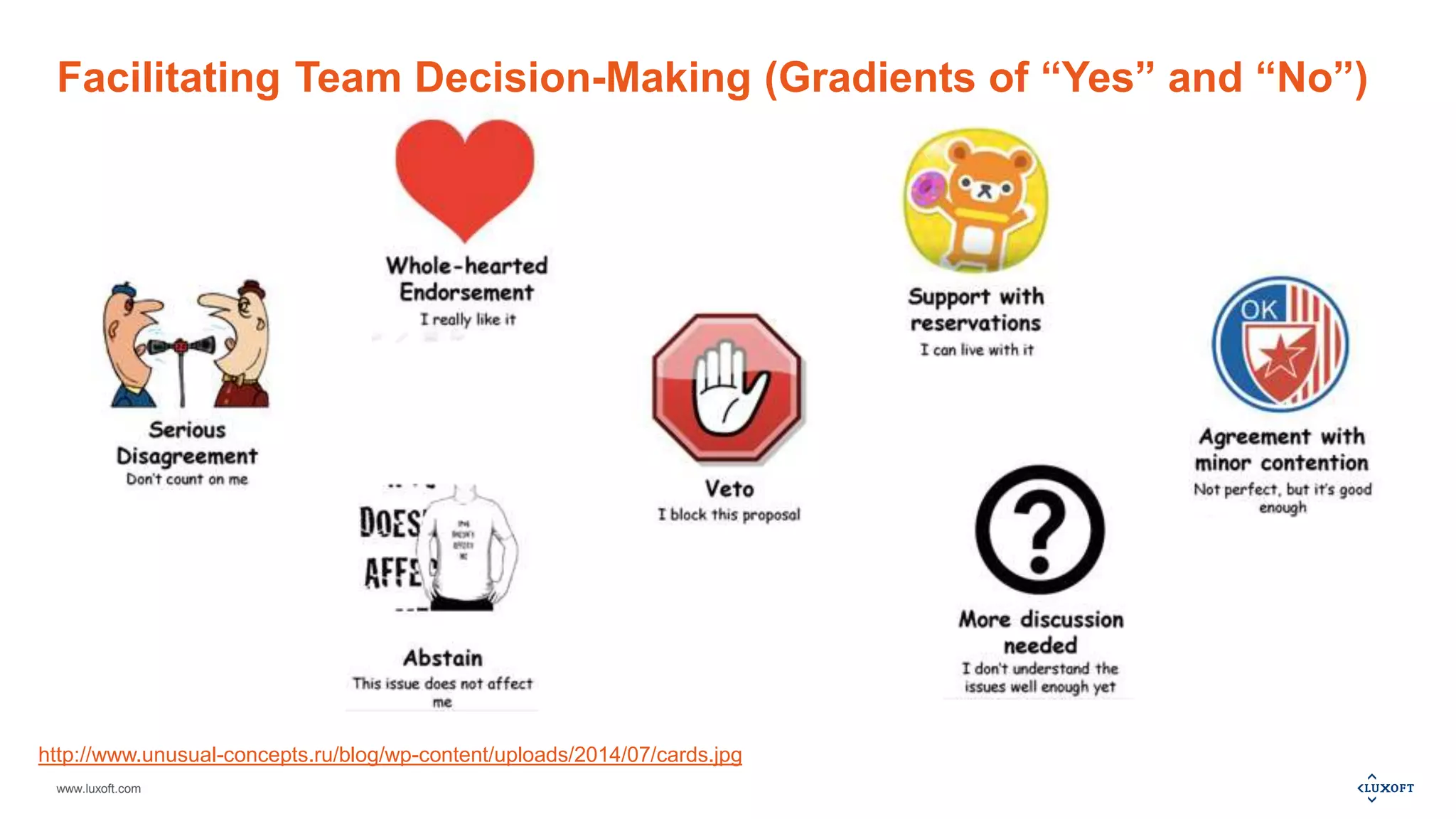
Facilitating Team Decision-Making (Gradients of “Yes” and “No”)
http://www.unusual-concepts.ru/blog/wp-content/uploads/2014/07/cards.jpg
www.luxoft.com
Facilitating Team Decision-Making (Five and Fist)
 5 fingers = I am all in. I completely agree.
 4 fingers = I buy into the option and I will support it.
 3 fingers = I may have some reservations, but I can support the decision and move forward.
 2 fingers = I have reservations and I cannot support this decision without further discussion and
clarification.
 1 finger = I still need to discuss certain reservations and suggest changes that should be made.
 Fist = No vote - a way to block consensus. I cannot support this direction. I disagree.
www.luxoft.com
Recommended Materials
 Greatest book on facilitation, applicable not only for Agile team, it’s #1 to read for any facilitator -
http://www.amazon.com/Facilitators-Guide-Participatory-Decision-Making-Kaner/dp/0787982660
 Retromat – cookbook on Retro facilitation, they provide step-by-step scenarios for Retros facilitation -
http://plans-for-retrospectives.com/
 Video to learn graphic facilitation - https://www.youtube.com/watch?v=S5DJC6LaOCI
 Post about tools (not techniques) for distributed teams
facilitation http://www.luxoft.com/blog/smukhina/tools-for-collaboration-in-distributed-teams/
 Video on empathy that is one of the Servant Leader qualities -
https://www.youtube.com/watch?v=1Evwgu369Jw
 Face2Face training ICAgile Certified Professional - Agile Team Facilitation, apply to it by sending me
email smukhina@luxoft.com [title “Facilitation training”, body “I wish to participate” or/and any
questions ]
www.luxoft.com
Recommended Materials
Recordings and presentations of my webinars on facilitation:
 How to facilitate product backlog refinement sessionshttps://www.linkedin.com/pulse/recording-webinar-how-
facilitate-product-backlog-svetlana
 How to facilitate meetings, Scrum events and group discussions https://www.linkedin.com/pulse/how-facilitate-
meetings-scrum-events-group-svetlana
 Agile Team Facilitator Mindset & Behaviourhttps://www.linkedin.com/pulse/recording-webinar-agile-team-
facilitator-mindset-svetlana
 Facilitation and Facilitator Stancehttps://www.linkedin.com/pulse/recording-webinar-facilitation-facilitator-stance-
svetlana
 The Power on Visualizationhttps://www.linkedin.com/pulse/20141202230246-48371619-follow-up-on-the-webinar-
the-power-on-visualization
 Silent voting technique https://www.linkedin.com/pulse/20140415193826-48371619-easy-way-to-make-a-
discussion-effective
www.luxoft.com
Available Services of Agile Practice
 ICAgile Certified Professional - Agile Fundamentals https://icagile.com/icagile-certified-professional
 ICAgile Certified Professional - Business Value Analysis https://icagile.com/icp-business-value-analysis
 ICAgile Certified Professional - Agile Team Facilitation https://icagile.com/icp-agile-team-facilitation
 Professional Scrum Master https://www.scrum.org/Courses/Professional-Scrum-Master
 Custom Workshops:
• Coaching and self-coaching;
• Agile project management;
• Agile project metrics;
• Motivation models;
• Feedback gathering;
• etc.
www.luxoft.com
How-to-apply for Face-to-Face Trainings and Workshops
 Specify request for Agile Education
 Learning objectives
 Time period
 Location
 Send the request to Agile Practice [smukhina@luxoft.com]
 Follow the instructions provided by Agile Practice on response to your request

Facilitating Conversations and Decision-making

  • 1.
  • 2.
    www.luxoft.com Session Plan  WaltDisney model for creative thinking and effective conversations;  Cartesian Coordinates technique for decision-making;  Pro-Con analysis of the situation;  COIN and STAR feedback models;  Gradients of consensus;  Consensus cards  Five and a fist  Q/A  Materials for further reading and watching;  Attendance code;
  • 3.
    www.luxoft.com Walt Disney Modelfor Creative Thinking and Conversations Dreamer Realist Critic Observer Dreamer generates new ideas. Any idea is welcome. Why not to try? Realist plans how these ideas can be implemented on practice in reality Critic finds reasons why the ideas would not work, investigates risks Facilitates the process
  • 4.
    www.luxoft.com How To UseWalt Disney Model Dreamer • Rules: • Generates as much ideas as possible • Reality is suspended • No constraints, no boundaries. • Zero evaluation or criticism of ideas • Questions: • What you want to do? • Why do you want to do it? • What is the purpose? • What is the outcome? • How will you know that you achieve the results? Realist • Rules: • Considers resources (people, budget, time, etc.) availability • Is aware of constrains, limits • Adapts the idea to fit reality • Questions: • Does the idea match the criteria and purpose for which it is intended? • How specifically the idea is going to be implemented? • How will you know if the goal is achieved? • When will each phase be implemented? • When will the overall goal be completed? • Why is each step necessary? Critic • Rules: • Identifies problems and risks • Sees negative consequences • Points out improvements • Questions: • Why might someone object to this idea? • Do all these ideas fit together and are cohesive? • Who and how will this new idea effect? • How this idea can worsen the current situation • When and where would you not want to implement this new idea? • What can be our risk mitigation plan? Observer • Rules • Introduces instructions I • Does time-boxing • Tracks that participants follow scenarios • Makes notes • Answers questions about the format
  • 5.
    www.luxoft.com Cartesian Coordinates forDecision-Making “What will happen if you do it?” (+ +) “What will happen if you do not it?” (+ -) “What will not happen if you do it?” (- +) “What will not happen if you do not it?” (- -) Example: What will happen if you quit your job? 1. I will get an opportunity to find a job that suits me better; 2. I will never see my manager again; 3. I stop spending an hour and a half to my trip to the office. 4. … What will happen if you don’t quit your job? 1. I will be able to have paid vacations next month; What will not happen if you quit your job? 1. I will not get my quarter bonus. What will not happen if you don’t quit your job? 1. I won’t be able to find a job that gives me a sense of satisfaction
  • 6.
    www.luxoft.com Pro / ConAnalysis • I will get an opportunity to find a job that suits me better; • I stop spending an hour and a half to my trip to the office • I will not get my quarter bonus • I will not be able to have paid vacations next month If I quit my current job
  • 7.
    www.luxoft.com COIN Model toProvide Feedback Feedback Connect to – their goals & interests Observations - that are specific Impact - on work results Next Steps - suggestions and agreements Example of COIN Connect: I know your goal is to increase collaboration with customers through frequent and effective communication. Observe: I’ve noticed this week that during calls with customers you were editing some documents in parallel, probably you were not very involved in the conversation. Impact: When the clients don’t feel heard or when something from their talk is missed, we can’t easily diagnose or address their needs. We can get problems with identification of their expected result. Next Steps: Let’s review our active listening approach and discuss possibilities to stay more focused and involved during calls.
  • 8.
    www.luxoft.com What was theproblem, opportunity, challenge or task? What was said or done to handle the situation or task? Provide developmental feedback and areas for improvement. What was the impact of the employee's efforts, and how did their actions influence the end result? ST "Last week I asked you to complete a spreadsheet on team members release capacity.” A1 "While you were provided all of the required data for the report I received it two days after I requested. A2 "The next time you're faced with competing priorities, feel free to come to me for further direction." R2 "Because the report was late, I had to delay a release planning meeting with the stakeholders, and they were disappointed R1 "That way I'll know if you're having challenges completing a request and can help you prioritize the assignments.” STAR/AR Model to Provide Feedback
  • 9.
    www.luxoft.com Facilitating Team Decision-Making(Gradients of “Yes” and “No”) http://www.unusual-concepts.ru/blog/wp-content/uploads/2014/07/cards.jpg
  • 10.
    www.luxoft.com Facilitating Team Decision-Making(Five and Fist)  5 fingers = I am all in. I completely agree.  4 fingers = I buy into the option and I will support it.  3 fingers = I may have some reservations, but I can support the decision and move forward.  2 fingers = I have reservations and I cannot support this decision without further discussion and clarification.  1 finger = I still need to discuss certain reservations and suggest changes that should be made.  Fist = No vote - a way to block consensus. I cannot support this direction. I disagree.
  • 11.
    www.luxoft.com Recommended Materials  Greatestbook on facilitation, applicable not only for Agile team, it’s #1 to read for any facilitator - http://www.amazon.com/Facilitators-Guide-Participatory-Decision-Making-Kaner/dp/0787982660  Retromat – cookbook on Retro facilitation, they provide step-by-step scenarios for Retros facilitation - http://plans-for-retrospectives.com/  Video to learn graphic facilitation - https://www.youtube.com/watch?v=S5DJC6LaOCI  Post about tools (not techniques) for distributed teams facilitation http://www.luxoft.com/blog/smukhina/tools-for-collaboration-in-distributed-teams/  Video on empathy that is one of the Servant Leader qualities - https://www.youtube.com/watch?v=1Evwgu369Jw  Face2Face training ICAgile Certified Professional - Agile Team Facilitation, apply to it by sending me email smukhina@luxoft.com [title “Facilitation training”, body “I wish to participate” or/and any questions ]
  • 12.
    www.luxoft.com Recommended Materials Recordings andpresentations of my webinars on facilitation:  How to facilitate product backlog refinement sessionshttps://www.linkedin.com/pulse/recording-webinar-how- facilitate-product-backlog-svetlana  How to facilitate meetings, Scrum events and group discussions https://www.linkedin.com/pulse/how-facilitate- meetings-scrum-events-group-svetlana  Agile Team Facilitator Mindset & Behaviourhttps://www.linkedin.com/pulse/recording-webinar-agile-team- facilitator-mindset-svetlana  Facilitation and Facilitator Stancehttps://www.linkedin.com/pulse/recording-webinar-facilitation-facilitator-stance- svetlana  The Power on Visualizationhttps://www.linkedin.com/pulse/20141202230246-48371619-follow-up-on-the-webinar- the-power-on-visualization  Silent voting technique https://www.linkedin.com/pulse/20140415193826-48371619-easy-way-to-make-a- discussion-effective
  • 13.
    www.luxoft.com Available Services ofAgile Practice  ICAgile Certified Professional - Agile Fundamentals https://icagile.com/icagile-certified-professional  ICAgile Certified Professional - Business Value Analysis https://icagile.com/icp-business-value-analysis  ICAgile Certified Professional - Agile Team Facilitation https://icagile.com/icp-agile-team-facilitation  Professional Scrum Master https://www.scrum.org/Courses/Professional-Scrum-Master  Custom Workshops: • Coaching and self-coaching; • Agile project management; • Agile project metrics; • Motivation models; • Feedback gathering; • etc.
  • 14.
    www.luxoft.com How-to-apply for Face-to-FaceTrainings and Workshops  Specify request for Agile Education  Learning objectives  Time period  Location  Send the request to Agile Practice [smukhina@luxoft.com]  Follow the instructions provided by Agile Practice on response to your request

Editor's Notes

  • #4 This techniques works well for Retros 2 possible ways to conduct this conversation format is well describe in How to Manage with NLP by David Molden http://books.google.com.ua/books?id=d0LHPg69Yp8C&lpg=PT146&ots=Bwc54Ng_Bo&dq=observer%20dreamer%20realist&hl=ru&pg=PT143#v=onepage&q=observer%20dreamer%20realist&f=false Read the exercise 9.7 and 9.8 Let’s do it on practice and discuss what techniques and practices that we have learned already can be applied into our daily work, how to apply it, what blockers we see for its implementation, what work around is possible and etc.
  • #8 Example of COIN Connect: “I know your goal is to increase your impact with customers through listening and reflecting back what they said.  You shared with me your view that many who come to us are stressed.” Observe: “I’ve noticed this week that you seem rushed when you talked to our morning customers.  When they come up to your desk, your focus is on the computer screen, with little or no eye contact.  Some may not feel listened to. Impact: “When they don’t feel heard, we can’t easily diagnose or address their needs.  We’d like to have our results on our customer survey reflect our super-caring attitude!” Next Steps: “I’d like to review our active listening approach and let’s practice together in the morning before you start your day.  The two areas I’d like to suggest you work on are: eye contact and reflection of what the customer says. Who would like to practice this feedback model? Who needs to give feedback recently?
  • #9 Who would like to practice this feedback model? Who needs to give feedback recently? ST - The Situation or Task The first part of being able to interpret and use feedback given is to understand the situation or task. What happened that alerted you to the necessity of taking care of this situation? In order to be able to determine the sort of feedback that is appropriate, you'll need to take a minute to define what happened and what that meant in terms of the project. By defining the situation or task that occurred, you can pinpoint exactly what it is you need to address when it comes to the individual to whom you are providing feedback. For example, a situation might involve an employee who has arrived late to work every day for a week. A - The Action What action was taken? Was that action good or bad? What action should have been taken? It's important to identify the action involved with the situation. When the action you are reviewing was positive, note that it was positive. When the action was negative, explain first what should have happened. In keeping with the current example, you would tell the tardy employee that he or she should have arrived on time. If it's a case of an employee who had provided outstanding ideas in a meeting, then point out the exact action that employee took that was worthy of praise. R - The Results Next, you need to look at the results that action lead to. What happened as a result of that action? For example, if the employee provided many good ideas during the brainstorming session that impressed stakeholders, tell her! By acknowledging the situation, action, and results that turned out well for her, you will increase her motivation and commitment to the project. If, on the other hand, the feedback is negative, then you're still working in a counter-factual universe. Just as you explained the action that should have been taken, you need to say what would have happened had the appropriate action been taken. In keeping with the tardy example, you might say "you would have heard your assignments for the week if you had been on time," or something to that effect. (R) and (A) Again While you're done after a first tour of the star after you've explained the desired results when you're giving positive feedback, when you're giving feedback calling for employee improvement, you'll need to revisit the actions and results, only in the reverse order. This second time, you will point out what did happen: "...instead you did not hear what your assignments were for the week, because you arrived late for the meeting." Putting it All Together When you're providing an employee with positive feedback using the STAR model, you'll put everything together and deliver the feedback. For example, the following might be said when giving feedback using this model: The other day, when things went wrong in the software program, you didn't panic. Instead, you kept a calm head and patiently determined what the cause for the bug in the software was. This resulted in keeping other employees calm and helped us to solve the problem much faster. You can see in this example that by acknowledging the situation, identifying the action, and praising the results, that you will be better able to encourage similar action in the future from employees. When it comes to providing negative feedback, make sure you identify both the actual action and result and the desired action and result. For example: When I sent this proposal back to you for adjustments and with questions, you didn't correct the problems or respond to the questions, and therefore I cannot accept the proposal. If you had made the needed adjustments and responded to the questions effectively, then I would have been able to approve the project proposal. In this example, both the undesired and desired actions and results are identified. By doing this, it makes it much easier for employees, stakeholders, and project team members to understand what needs to be done and why it needs to be done. By providing effective feedback on a regular basis, you can improve the productivity and effectiveness of your project team. ###### ST – Situation or Task.  What was the problem, opportunity, challenge or task? A – Action.  What was said or done to handle the situation or task? Remember to provide developmental feedback and areas for improvement. R – Result.  What was the impact of the employee's efforts, and how did their actions influence the end result?   Here's an example of using the STAR model to provide positive feedback. ST – "Thanks for completing the spreadsheet on resource allocation I requested." A – "You provided all of the data I asked for and got it to me on time." R – "I was able to bring the data to a planning meeting with our director, where we used it to create a strong resource plan for next term."   Using the STAR Model to Provide Developmental Feedback At times it's necessary to provide feedback in order to guide a person toward a more effective approach. When you use the STAR model to provide developmental feedback, you should also describe an alternative action – something the person could have done differently – and the result that the alternative action might have produced. Here is an example of using the STAR model to provide developmental feedback: ST – "Last week I asked you to complete a spreadsheet on resource allocation." A – "While you provided all of the data I asked for, I received it two days after I requested, because other priorities came up." R – "Because the report was late, I had to delay a resource planning meeting with our director, and we weren't able to complete our resource plan for next term." A – "The next time you're faced with competing priorities, feel free to come to me for further direction." R – "That way I'll know if you're having challenges completing a request and can help you prioritize your assignments."   Three tips on providing developmental feedback: Focus on facts, not the person. Choose positively phrased statements, such as "Forgetting to do that caused a delay," rather than saying "You're completely disorganized." Share your thoughts on alternative approaches while remembering to seek the other person's ideas. Provide your employee with the necessary support in terms of time, resources or coaching to act on your feedback.
  • #10 The description of this format of consensus - http://www.unusual-concepts.ru/blog/2014/07/cards-for-consensus-gradients/ - Gradients of Consensus Similar topic is discussed in Sam Kaner book on facilitation