CREATIVITY
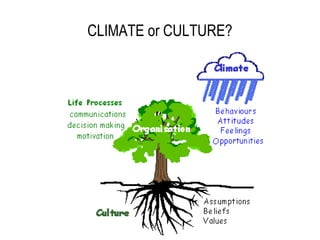
CLIMATE or CULTURE?
CLIMATE or CULTURE?

It is difficult to change a culture.
   Values are cherished
   Challenging values generates out-group attributions
   Beliefs & assumptions sustained by selective perception

It is easier to change the climate. Culture may follow.
   Many staff will mirror behaviours of certain people.
   Attitudes & feelings often change to match behaviour,
                                  in order to avoid dissonance
   The opportunity may be enough, as people enjoy creativity
CLIMATE FOR CREATIVITY             (Ekvall & Isaksen)


Resources:
   Idea Time
   Idea Support
   Challenge and Personal Involvement

Motivation
   Trust and Openness
   Playfulness and Humour
   Conflict Resolution

Exploration:
   Risk-taking
   Debates about the Issues;
   Freedom to respond to challenges
   Dynamism
IDEA TIME

If people are given:
• Time when they are not doing tasks
• Opportunities to discuss
Then they can explore and test suggestions
They can elaborate on alternative approaches

If every minute is booked and measured,
        they can only think within their given routines
IDEA SUPPORT

If people respond to ideas and suggestions with:
                            (managers, peers and subordinates)
• Attentive listening
• Professional respect
• Practical and emotional support for initiatives
Then the atmosphere is positive and constructive
           ways of trying out new ideas are created

If not, people expect the automatic “no”
               faults are found and obstacles raised
CHALLENGE & INVOLVEMENT

If people are involved in:
      • Daily operations
      • Long-term goals and visions
Then they will be motivated, committed, inspired
They will enjoy their work and find it meaningful

If not, they will be detached, alienated, apathetic
TRUST & OPENNESS

If people are given:
• emotional safety in relationships
• personal support and respect
Then they can be genuinely open and frank
They count on each other for professional support

If not, they feel suspicious and are on guard
They avoid revealing their plans or ideas
PLAYFULNESS & HUMOUR

If people are given:
• An easy-going light-hearted atmosphere
• Permission to make good-natured jokes
• Professional attitudes within the humour
Then they can have fun and laugh
They can suggest zany ideas, ‘out of the box’

If the atmosphere is stiff and gloomy
    Jokes are seen as improper, laughter intolerable
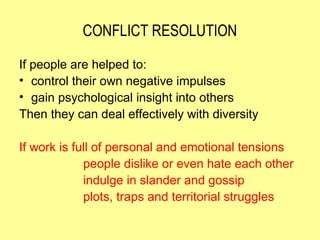
CONFLICT RESOLUTION

If people are helped to:
• control their own negative impulses
• gain psychological insight into others
Then they can deal effectively with diversity

If work is full of personal and emotional tensions
             people dislike or even hate each other
             indulge in slander and gossip
             plots, traps and territorial struggles
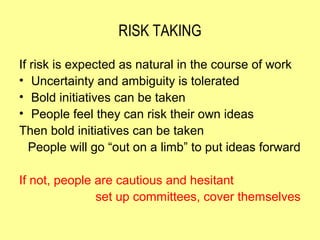
RISK TAKING

If risk is expected as natural in the course of work
• Uncertainty and ambiguity is tolerated
• Bold initiatives can be taken
• People feel they can risk their own ideas
Then bold initiatives can be taken
   People will go “out on a limb” to put ideas forward

If not, people are cautious and hesitant
               set up committees, cover themselves
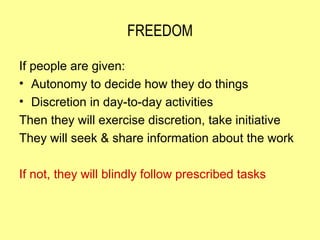
FREEDOM

If people are given:
• Autonomy to decide how they do things
• Discretion in day-to-day activities
Then they will exercise discretion, take initiative
They will seek & share information about the work

If not, they will blindly follow prescribed tasks
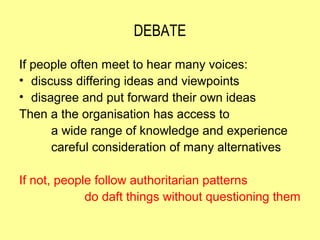
DEBATE

If people often meet to hear many voices:
• discuss differing ideas and viewpoints
• disagree and put forward their own ideas
Then a the organisation has access to
      a wide range of knowledge and experience
      careful consideration of many alternatives

If not, people follow authoritarian patterns
             do daft things without questioning them
DYNAMISM

Organisational life should be eventful
 so that people get experience in adapting

When anything interesting happens,
 tell the story – to everyone
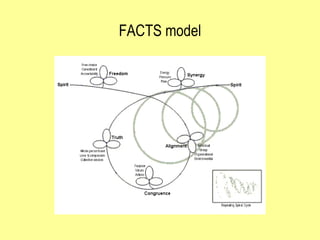
FACTS model
BRAINSTORMING
1.    Review the rules of brainstorming with the entire group:
     – No criticism, no evaluation, no discussion of ideas.
     – There are no stupid ideas. The wilder the better.
     – Record all ideas (if not enough ideas try a fishbone diagram)
     – Piggyback: combine / modify / expanding other peoples’ ideas.
2.    Review the topic or problem to be discussed.
3.    Make sure everyone understands the subject.
4.    Allow two minutes of silence for people to think.
5.    Invite people to call out their ideas. Record all ideas, in words as
      close as possible to those used by the contributor. No discussion
      or evaluation of any kind is permitted.
6.    Continue to generate and record ideas until several minutes’
      silence produces no more.
NOMINAL GROUP TECHNIQUE
NGT is a variant of brainstorming that enables less vocal people.

1. State the subject. Clarify the statement until everyone understands.
2. All silently think and write as many ideas as possible in a set period.
3. Each states one idea aloud. Facilitator records them on the
   flipchart.
4. Continue around the group till done, or for an agreed length of time.
5. Discuss each idea in turn to clarify meaning, explain logic / analysis.
   – Raise and answer questions, .
   – Change wording only when the idea’s originator agrees.
   – Strike ideas from the list only by unanimous agreement.
   – Discussion may or state agreement or disagreement.
6. Prioritize the ideas using multivoting or list reduction.
EDWARD DE BONO – LATERAL THINKING

1. Don’t try harder in the same direction. Change
   direction.
2. Don’t play with the existing pieces. Seek new
   pieces.
3. The brain forms asymmetric patterns. Aim to
   move across these patterns.
4. Aim to escape from the local optimum in order
   to move towards a more global optimum.
EDWARD DE BONO – PARALLEL THINKING
Parallel thinking is opposite of adversarial thinking.
Adversarial only discovers 'truth‘. Doesn’t build anything.
In 'parallel thinking' all sides think in the same direction.
There is co-operative and co-ordinated thinking.
Can change direction to give a full scan of the situation.
At any moment each thinker thinks in parallel with others.
There does not have to be agreement.
Contradictory statements are laid down in parallel.
The way forward is 'designed' from all the parallel thoughts
Use the Six Hats method (see roles).
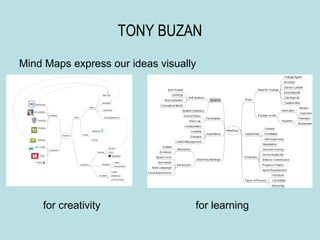
TONY BUZAN
Mind Maps express our ideas visually


    for creativity                 for learning
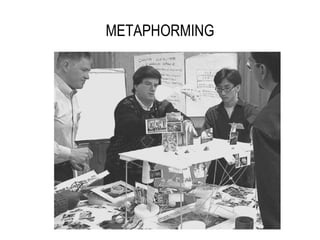
METAPHORMING (Todd Siler, artist)

Associative thinking = creating new connections through:
     metaphors, similes, analogies, figures of speech, symbols, stories, puns,
     visualizations, hypotheses, empathy, models …
Metaphorming is the act of connecting ideas to generate innovations ,
continually transforming meanings + uses by applying them in new contexts
5D symbolic modelling (length, width, height, time/motion, symbols)
Method:
1. Form: a group with a wide variety of skills and experience
2. Connect: brainstorm relationships, connections, associations
3. Discover: develop connections by generating more viewpoints
4. Invent: hypothesise practical uses for the ideas
5. Apply:
METAPHORMING

Creativity

  • 1.
  • 2.
  • 3.
    CLIMATE or CULTURE? Itis difficult to change a culture. Values are cherished Challenging values generates out-group attributions Beliefs & assumptions sustained by selective perception It is easier to change the climate. Culture may follow. Many staff will mirror behaviours of certain people. Attitudes & feelings often change to match behaviour, in order to avoid dissonance The opportunity may be enough, as people enjoy creativity
  • 4.
    CLIMATE FOR CREATIVITY (Ekvall & Isaksen) Resources: Idea Time Idea Support Challenge and Personal Involvement Motivation Trust and Openness Playfulness and Humour Conflict Resolution Exploration: Risk-taking Debates about the Issues; Freedom to respond to challenges Dynamism
  • 5.
    IDEA TIME If peopleare given: • Time when they are not doing tasks • Opportunities to discuss Then they can explore and test suggestions They can elaborate on alternative approaches If every minute is booked and measured, they can only think within their given routines
  • 6.
    IDEA SUPPORT If peoplerespond to ideas and suggestions with: (managers, peers and subordinates) • Attentive listening • Professional respect • Practical and emotional support for initiatives Then the atmosphere is positive and constructive ways of trying out new ideas are created If not, people expect the automatic “no” faults are found and obstacles raised
  • 7.
    CHALLENGE & INVOLVEMENT Ifpeople are involved in: • Daily operations • Long-term goals and visions Then they will be motivated, committed, inspired They will enjoy their work and find it meaningful If not, they will be detached, alienated, apathetic
  • 8.
    TRUST & OPENNESS Ifpeople are given: • emotional safety in relationships • personal support and respect Then they can be genuinely open and frank They count on each other for professional support If not, they feel suspicious and are on guard They avoid revealing their plans or ideas
  • 9.
    PLAYFULNESS & HUMOUR Ifpeople are given: • An easy-going light-hearted atmosphere • Permission to make good-natured jokes • Professional attitudes within the humour Then they can have fun and laugh They can suggest zany ideas, ‘out of the box’ If the atmosphere is stiff and gloomy Jokes are seen as improper, laughter intolerable
  • 10.
    CONFLICT RESOLUTION If peopleare helped to: • control their own negative impulses • gain psychological insight into others Then they can deal effectively with diversity If work is full of personal and emotional tensions people dislike or even hate each other indulge in slander and gossip plots, traps and territorial struggles
  • 11.
    RISK TAKING If riskis expected as natural in the course of work • Uncertainty and ambiguity is tolerated • Bold initiatives can be taken • People feel they can risk their own ideas Then bold initiatives can be taken People will go “out on a limb” to put ideas forward If not, people are cautious and hesitant set up committees, cover themselves
  • 12.
    FREEDOM If people aregiven: • Autonomy to decide how they do things • Discretion in day-to-day activities Then they will exercise discretion, take initiative They will seek & share information about the work If not, they will blindly follow prescribed tasks
  • 13.
    DEBATE If people oftenmeet to hear many voices: • discuss differing ideas and viewpoints • disagree and put forward their own ideas Then a the organisation has access to a wide range of knowledge and experience careful consideration of many alternatives If not, people follow authoritarian patterns do daft things without questioning them
  • 14.
    DYNAMISM Organisational life shouldbe eventful so that people get experience in adapting When anything interesting happens, tell the story – to everyone
  • 15.
  • 16.
    BRAINSTORMING 1. Review the rules of brainstorming with the entire group: – No criticism, no evaluation, no discussion of ideas. – There are no stupid ideas. The wilder the better. – Record all ideas (if not enough ideas try a fishbone diagram) – Piggyback: combine / modify / expanding other peoples’ ideas. 2. Review the topic or problem to be discussed. 3. Make sure everyone understands the subject. 4. Allow two minutes of silence for people to think. 5. Invite people to call out their ideas. Record all ideas, in words as close as possible to those used by the contributor. No discussion or evaluation of any kind is permitted. 6. Continue to generate and record ideas until several minutes’ silence produces no more.
  • 17.
    NOMINAL GROUP TECHNIQUE NGTis a variant of brainstorming that enables less vocal people. 1. State the subject. Clarify the statement until everyone understands. 2. All silently think and write as many ideas as possible in a set period. 3. Each states one idea aloud. Facilitator records them on the flipchart. 4. Continue around the group till done, or for an agreed length of time. 5. Discuss each idea in turn to clarify meaning, explain logic / analysis. – Raise and answer questions, . – Change wording only when the idea’s originator agrees. – Strike ideas from the list only by unanimous agreement. – Discussion may or state agreement or disagreement. 6. Prioritize the ideas using multivoting or list reduction.
  • 18.
    EDWARD DE BONO– LATERAL THINKING 1. Don’t try harder in the same direction. Change direction. 2. Don’t play with the existing pieces. Seek new pieces. 3. The brain forms asymmetric patterns. Aim to move across these patterns. 4. Aim to escape from the local optimum in order to move towards a more global optimum.
  • 19.
    EDWARD DE BONO– PARALLEL THINKING Parallel thinking is opposite of adversarial thinking. Adversarial only discovers 'truth‘. Doesn’t build anything. In 'parallel thinking' all sides think in the same direction. There is co-operative and co-ordinated thinking. Can change direction to give a full scan of the situation. At any moment each thinker thinks in parallel with others. There does not have to be agreement. Contradictory statements are laid down in parallel. The way forward is 'designed' from all the parallel thoughts Use the Six Hats method (see roles).
  • 20.
    TONY BUZAN Mind Mapsexpress our ideas visually for creativity for learning
  • 21.
    METAPHORMING (Todd Siler,artist) Associative thinking = creating new connections through: metaphors, similes, analogies, figures of speech, symbols, stories, puns, visualizations, hypotheses, empathy, models … Metaphorming is the act of connecting ideas to generate innovations , continually transforming meanings + uses by applying them in new contexts 5D symbolic modelling (length, width, height, time/motion, symbols) Method: 1. Form: a group with a wide variety of skills and experience 2. Connect: brainstorm relationships, connections, associations 3. Discover: develop connections by generating more viewpoints 4. Invent: hypothesise practical uses for the ideas 5. Apply:
  • 22.