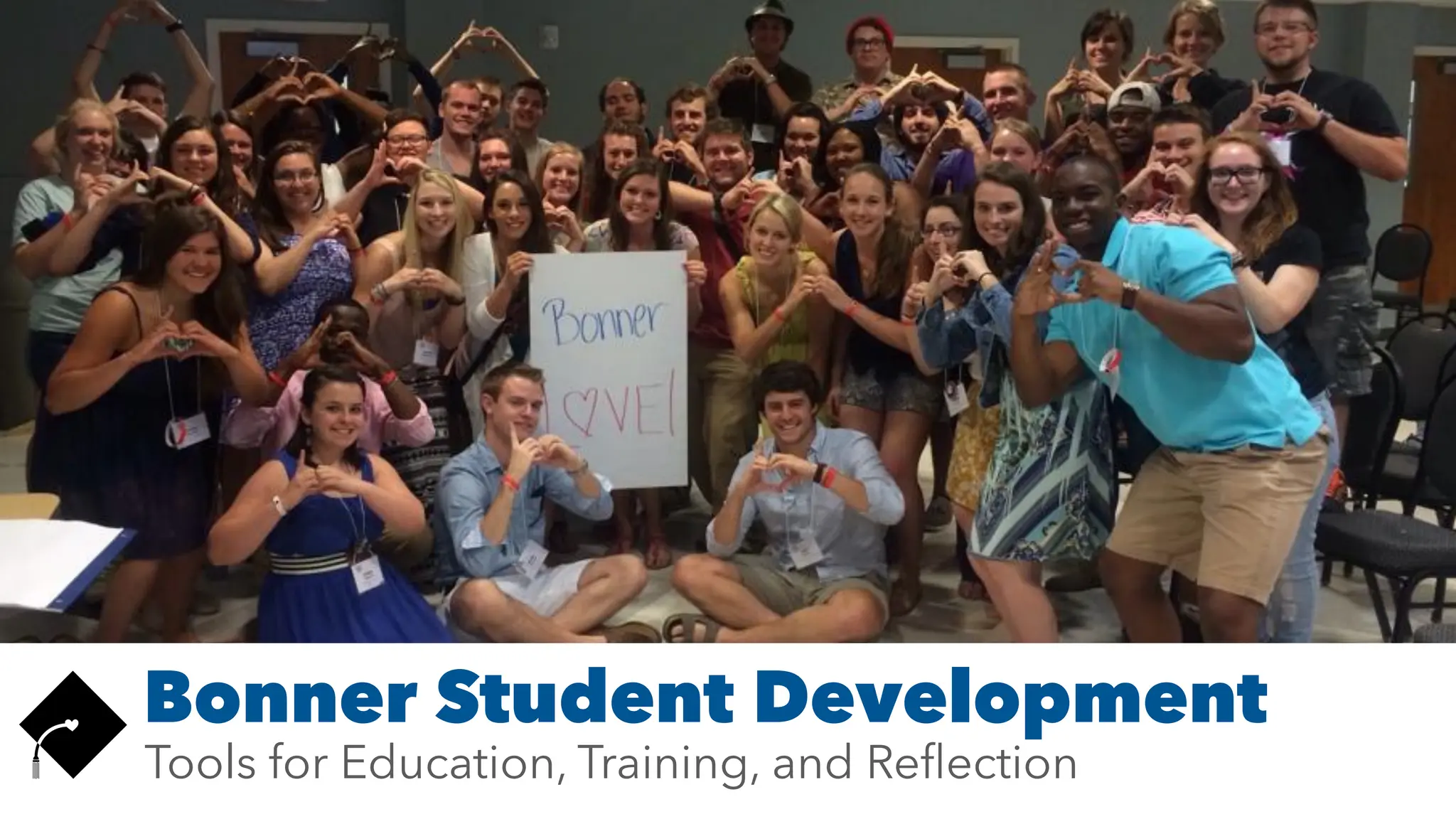
Bonner Student Development
Tools for Education, Training, and Re
fl
ection
Would you rather . . .
Write an annual report
or
Lead a day-long training
with Bonner students?
Would you rather . . .
Meet with community partners
or
Meet with faculty?
Would you rather . . .
Plan 4 meetings, each 7 hours long
or
Co-plan 14 meetings, each 2 hours
long?
What We’ll Cover
• Bonner Student Development Framework
• Why Education and Training Matters
• Bonner Curriculum
• Planning Bonner Meetings
Bonner Student
Development
Framework
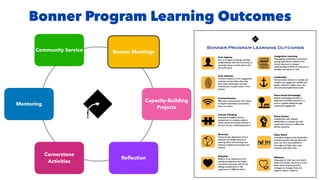
Bonner Meetings
Community Service
Cornerstone
Activities
Re
fl
ection
Mentoring
Capacity-Building
Projects
Bonner Program Learning Outcomes
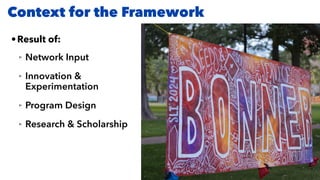
•Result of:
‣ Network Input
‣ Innovation &
Experimentation
‣ Program Design
‣ Research & Scholarship
Context for the Framework
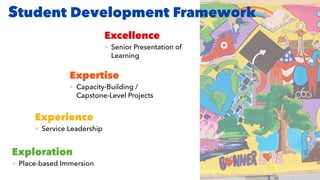
Exploration
• Place-based Immersion
Experience
• Service Leadership
Expertise
• Capacity-Building /
Capstone-Level Projects
Excellence
• Senior Presentation of
Learning
Student Development Framework
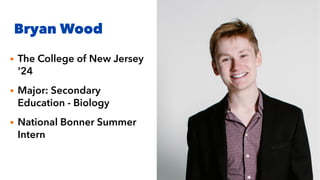
Bryan Wood
• The College of New Jersey
'24
• Major: Secondary
Education - Biology
• National Bonner Summer
Intern
Why Education
& Training
Matters
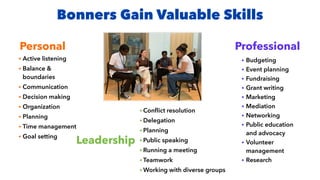
Bonners Gain Valuable Skills
Personal
• Active listening
• Balance &
boundaries
• Communication
• Decision making
• Organization
• Planning
• Time management
• Goal setting
Professional
• Budgeting
• Event planning
• Fundraising
• Grant writing
• Marketing
• Mediation
• Networking
• Public education
and advocacy
• Volunteer
management
• Research
Leadership
• Con
fl
ict resolution
• Delegation
• Planning
• Public speaking
• Running a meeting
• Teamwork
• Working with diverse groups
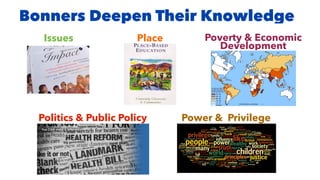
Bonners Deepen Their Knowledge
Place
Politics & Public Policy Power & Privilege
Issues Poverty & Economic
Development
Your program helps students
develop a sense of
belonging / community.
Stand if . . .
Your program offers students
opportunities to examine and
understand diversity of
perspectives.
Stand if . . .
Your program offers mentoring
support in any capacity.
Stand if . . .
Re
fl
ection is an integral part
of your program.
Stand if . . .
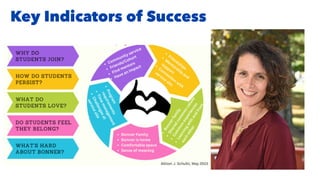
Key Indicators of Success
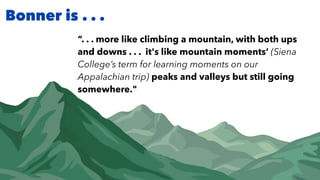
Bonner is . . .
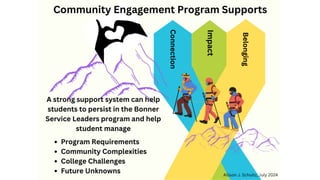
“. . . more like climbing a mountain, with both ups
and downs . . . it's like mountain moments’ (Siena
College’s term for learning moments on our
Appalachian trip) peaks and valleys but still going
somewhere."
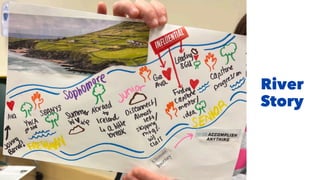
River
Story
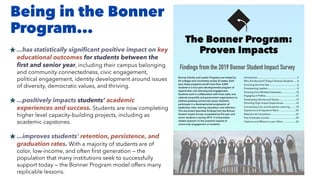
Being in the Bonner
Program...
★ ...has statistically signi
fi
cant positive impact on key
educational outcomes for students between the
fi
rst and senior year, including their campus belonging
and community connectedness, civic engagement,
political engagement, identity development around issues
of diversity, democratic values, and thriving.
★ ...positively impacts students’ academic
experiences and success. Students are now completing
higher level capacity-building projects, including as
academic capstones.
★ ...improves students’ retention, persistence, and
graduation rates. With a majority of students are of
color, low-income, and often
fi
rst generation — the
population that many institutions seek to successfully
support today — the Bonner Program model offers many
replicable lessons.
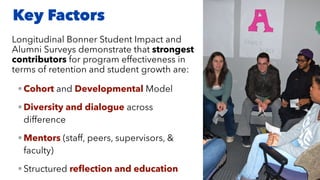
Key Factors
Longitudinal Bonner Student Impact and
Alumni Surveys demonstrate that strongest
contributors for program effectiveness in
terms of retention and student growth are:
•Cohort and Developmental Model
•Diversity and dialogue across
difference
•Mentors (staff, peers, supervisors, &
faculty)
•Structured re
fl
ection and education
Bonner
Curriculum
Bonner Curriculum Resources
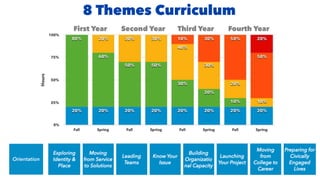
8 Themes Curriculum
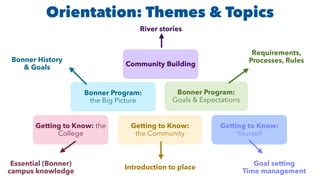
Orientation
Community Building
Bonner Program:
the Big Picture
Bonner Program:
Goals & Expectations
Getting to Know:
Yourself
Getting to Know:
the Community
Getting to Know: the
College
River stories
Bonner History
& Goals
Requirements,
Processes, Rules
Goal setting
Time management
Introduction to place
Essential (Bonner)
campus knowledge
Orientation: Themes & Topics
Group Discussion
Share Orientation Topics
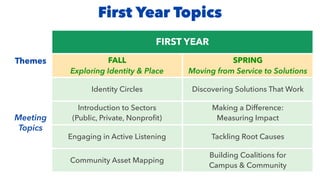
First Year Topics
Themes
Meeting
Topics
FIRST YEAR
FALL
Exploring Identity & Place
SPRING
Moving from Service to Solutions
Identity Circles Discovering Solutions That Work
Introduction to Sectors
(Public, Private, Nonpro
fi
t)
Making a Difference:
Measuring Impact
Engaging in Active Listening Tackling Root Causes
Community Asset Mapping
Building Coalitions for
Campus & Community
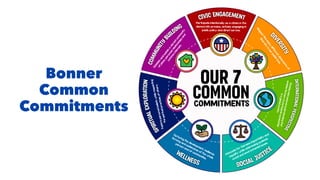
Bonner
Common
Commitments
7
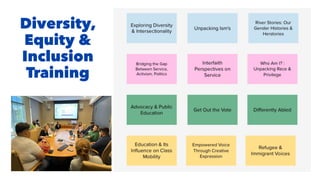
Diversity,
Equity &
Inclusion
Training
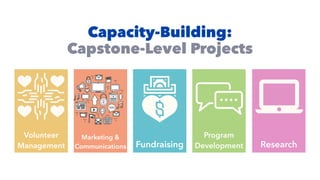
Capacity-Building:
Capstone-Level Projects
Research
Program
Development
Fundraising
Marketing &
Communications
Volunteer
Management
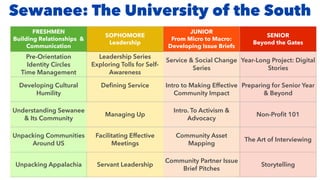
Sewanee: The University of the South
FRESHMEN
Building Relationships &
Communication
SOPHOMORE
Leadership
JUNIOR
From Micro to Macro:
Developing Issue Briefs
SENIOR
Beyond the Gates
Pre-Orientation
Identity Circles
Time Management
Leadership Series
Exploring Tolls for Self-
Awareness
Service & Social Change
Series
Year-Long Project: Digital
Stories
Developing Cultural
Humility
De
fi
ning Service Intro to Making Effective
Community Impact
Preparing for Senior Year
& Beyond
Understanding Sewanee
& Its Community
Managing Up
Intro. To Activism &
Advocacy
Non-Pro
fi
t 101
Unpacking Communities
Around US
Facilitating Effective
Meetings
Community Asset
Mapping
The Art of Interviewing
Unpacking Appalachia Servant Leadership
Community Partner Issue
Brief Pitches
Storytelling
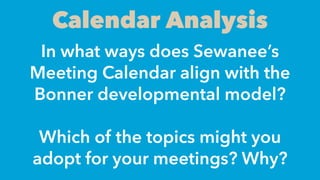
Calendar Analysis
In what ways does Sewanee’s
Meeting Calendar align with the
Bonner developmental model?
Which of the topics might you
adopt for your meetings? Why?
Planning
Bonner Meetings
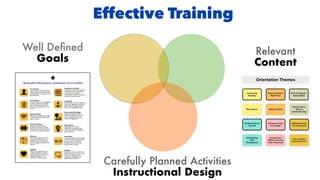
Effective Training
Carefully Planned Activities
Instructional Design
Well De
fi
ned
Goals
Relevant
Content
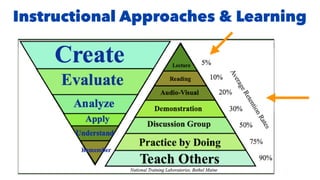
Instructional Approaches & Learning
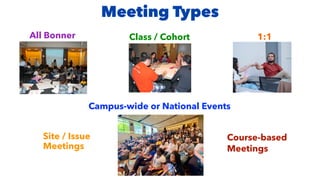
Class / Cohort
Meeting Types
All Bonner
Site / Issue
Meetings
Campus-wide or National Events
Course-based
Meetings
1:1
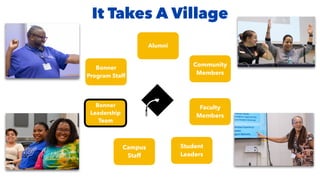
It Takes A Village
Student
Leaders
Bonner
Leadership
Team
Bonner
Program Staff
Campus
Staff
Community
Members
Faculty
Members
Alumni
Pair Share
Who could be the point-person for
each cohort to plan Bonner
Meetings?
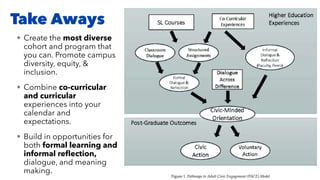
Takeaways
Take Aways
• Create the most diverse
cohort and program that
you can. Promote campus
diversity, equity, &
inclusion.
• Combine co-curricular
and curricular
experiences into your
calendar and
expectations.
• Build in opportunities for
both formal learning and
informal re
fl
ection,
dialogue, and meaning
making.
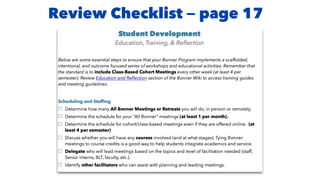
Review Checklist — page 17
Q&A

4 Student Development Education & Training.pdf

  • 1.
    Bonner Student Development Toolsfor Education, Training, and Re fl ection
  • 2.
    Would you rather. . . Write an annual report or Lead a day-long training with Bonner students?
  • 3.
    Would you rather. . . Meet with community partners or Meet with faculty?
  • 4.
    Would you rather. . . Plan 4 meetings, each 7 hours long or Co-plan 14 meetings, each 2 hours long?
  • 5.
    What We’ll Cover •Bonner Student Development Framework • Why Education and Training Matters • Bonner Curriculum • Planning Bonner Meetings
  • 6.
  • 7.
  • 8.
    •Result of: ‣ NetworkInput ‣ Innovation & Experimentation ‣ Program Design ‣ Research & Scholarship Context for the Framework
  • 9.
    Exploration • Place-based Immersion Experience •Service Leadership Expertise • Capacity-Building / Capstone-Level Projects Excellence • Senior Presentation of Learning Student Development Framework
  • 10.
    Bryan Wood • TheCollege of New Jersey '24 • Major: Secondary Education - Biology • National Bonner Summer Intern
  • 11.
  • 12.
    Bonners Gain ValuableSkills Personal • Active listening • Balance & boundaries • Communication • Decision making • Organization • Planning • Time management • Goal setting Professional • Budgeting • Event planning • Fundraising • Grant writing • Marketing • Mediation • Networking • Public education and advocacy • Volunteer management • Research Leadership • Con fl ict resolution • Delegation • Planning • Public speaking • Running a meeting • Teamwork • Working with diverse groups
  • 13.
    Bonners Deepen TheirKnowledge Place Politics & Public Policy Power & Privilege Issues Poverty & Economic Development
  • 14.
    Your program helpsstudents develop a sense of belonging / community. Stand if . . .
  • 15.
    Your program offersstudents opportunities to examine and understand diversity of perspectives. Stand if . . .
  • 16.
    Your program offersmentoring support in any capacity. Stand if . . .
  • 17.
    Re fl ection is anintegral part of your program. Stand if . . .
  • 18.
  • 19.
    Bonner is .. . “. . . more like climbing a mountain, with both ups and downs . . . it's like mountain moments’ (Siena College’s term for learning moments on our Appalachian trip) peaks and valleys but still going somewhere."
  • 20.
  • 22.
    Being in theBonner Program... ★ ...has statistically signi fi cant positive impact on key educational outcomes for students between the fi rst and senior year, including their campus belonging and community connectedness, civic engagement, political engagement, identity development around issues of diversity, democratic values, and thriving. ★ ...positively impacts students’ academic experiences and success. Students are now completing higher level capacity-building projects, including as academic capstones. ★ ...improves students’ retention, persistence, and graduation rates. With a majority of students are of color, low-income, and often fi rst generation — the population that many institutions seek to successfully support today — the Bonner Program model offers many replicable lessons.
  • 23.
    Key Factors Longitudinal BonnerStudent Impact and Alumni Surveys demonstrate that strongest contributors for program effectiveness in terms of retention and student growth are: •Cohort and Developmental Model •Diversity and dialogue across difference •Mentors (staff, peers, supervisors, & faculty) •Structured re fl ection and education
  • 24.
  • 25.
  • 26.
  • 27.
    Community Building Bonner Program: theBig Picture Bonner Program: Goals & Expectations Getting to Know: Yourself Getting to Know: the Community Getting to Know: the College River stories Bonner History & Goals Requirements, Processes, Rules Goal setting Time management Introduction to place Essential (Bonner) campus knowledge Orientation: Themes & Topics
  • 28.
  • 29.
    First Year Topics Themes Meeting Topics FIRSTYEAR FALL Exploring Identity & Place SPRING Moving from Service to Solutions Identity Circles Discovering Solutions That Work Introduction to Sectors (Public, Private, Nonpro fi t) Making a Difference: Measuring Impact Engaging in Active Listening Tackling Root Causes Community Asset Mapping Building Coalitions for Campus & Community
  • 30.
  • 31.
  • 32.
  • 33.
    Sewanee: The Universityof the South FRESHMEN Building Relationships & Communication SOPHOMORE Leadership JUNIOR From Micro to Macro: Developing Issue Briefs SENIOR Beyond the Gates Pre-Orientation Identity Circles Time Management Leadership Series Exploring Tolls for Self- Awareness Service & Social Change Series Year-Long Project: Digital Stories Developing Cultural Humility De fi ning Service Intro to Making Effective Community Impact Preparing for Senior Year & Beyond Understanding Sewanee & Its Community Managing Up Intro. To Activism & Advocacy Non-Pro fi t 101 Unpacking Communities Around US Facilitating Effective Meetings Community Asset Mapping The Art of Interviewing Unpacking Appalachia Servant Leadership Community Partner Issue Brief Pitches Storytelling
  • 34.
    Calendar Analysis In whatways does Sewanee’s Meeting Calendar align with the Bonner developmental model? Which of the topics might you adopt for your meetings? Why?
  • 35.
  • 36.
    Effective Training Carefully PlannedActivities Instructional Design Well De fi ned Goals Relevant Content
  • 37.
  • 38.
    Class / Cohort MeetingTypes All Bonner Site / Issue Meetings Campus-wide or National Events Course-based Meetings 1:1
  • 39.
    It Takes AVillage Student Leaders Bonner Leadership Team Bonner Program Staff Campus Staff Community Members Faculty Members Alumni
  • 40.
    Pair Share Who couldbe the point-person for each cohort to plan Bonner Meetings?
  • 41.
  • 42.
    Take Aways • Createthe most diverse cohort and program that you can. Promote campus diversity, equity, & inclusion. • Combine co-curricular and curricular experiences into your calendar and expectations. • Build in opportunities for both formal learning and informal re fl ection, dialogue, and meaning making.
  • 43.
  • 44.