Thank You for joining
High-Performance Teamwork:
Going to the Next Level
3
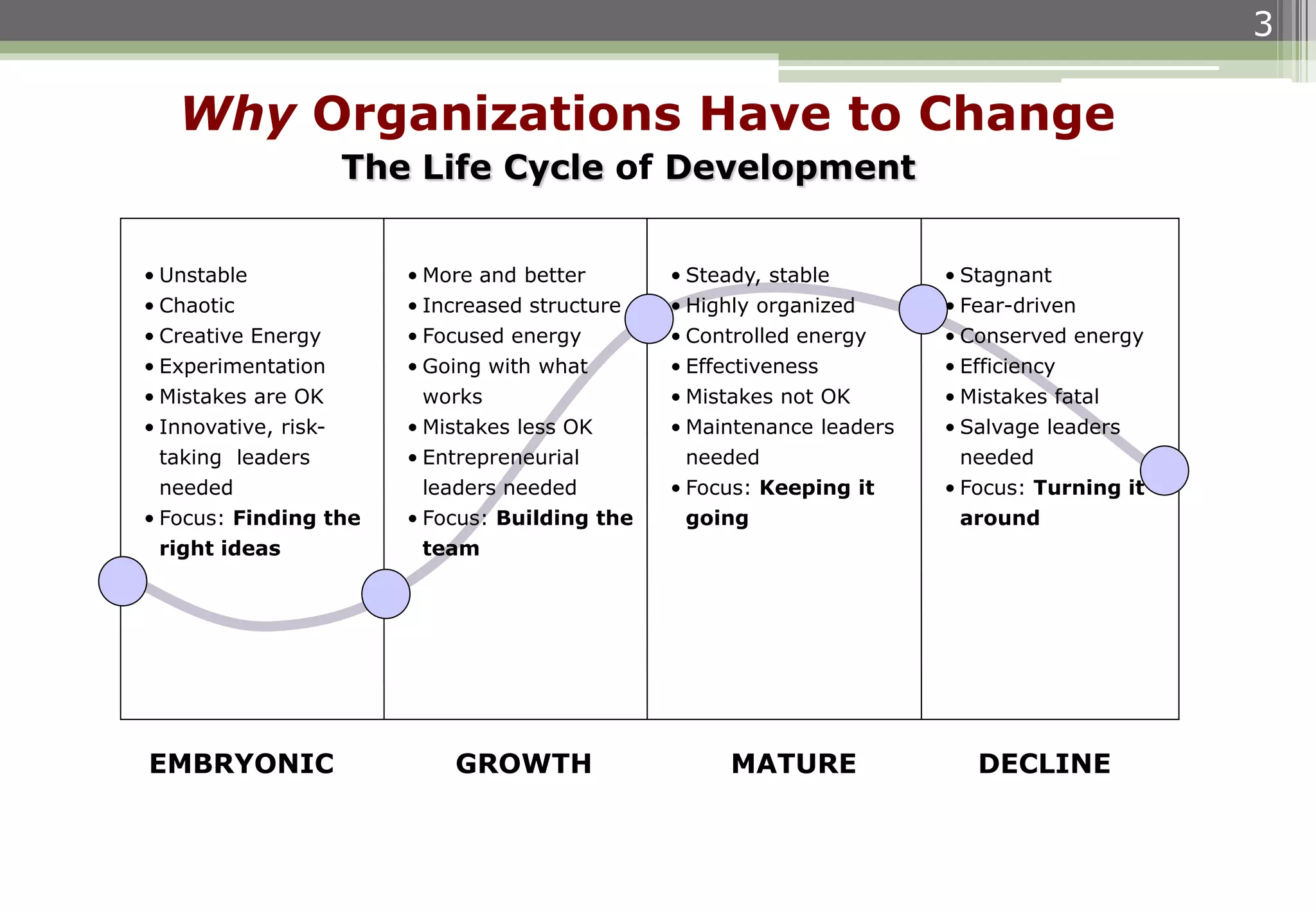
The Life Cycle of Development
EMBRYONIC GROWTH DECLINEMATURE
Why Organizations Have to Change
• Unstable
• Chaotic
• Creative Energy
• Experimentation
• Mistakes are OK
• Innovative, risk-
taking leaders
needed
• Focus: Finding the
right ideas
• More and better
• Increased structure
• Focused energy
• Going with what
works
• Mistakes less OK
• Entrepreneurial
leaders needed
• Focus: Building the
team
• Steady, stable
• Highly organized
• Controlled energy
• Effectiveness
• Mistakes not OK
• Maintenance leaders
needed
• Focus: Keeping it
going
• Stagnant
• Fear-driven
• Conserved energy
• Efficiency
• Mistakes fatal
• Salvage leaders
needed
• Focus: Turning it
around
4
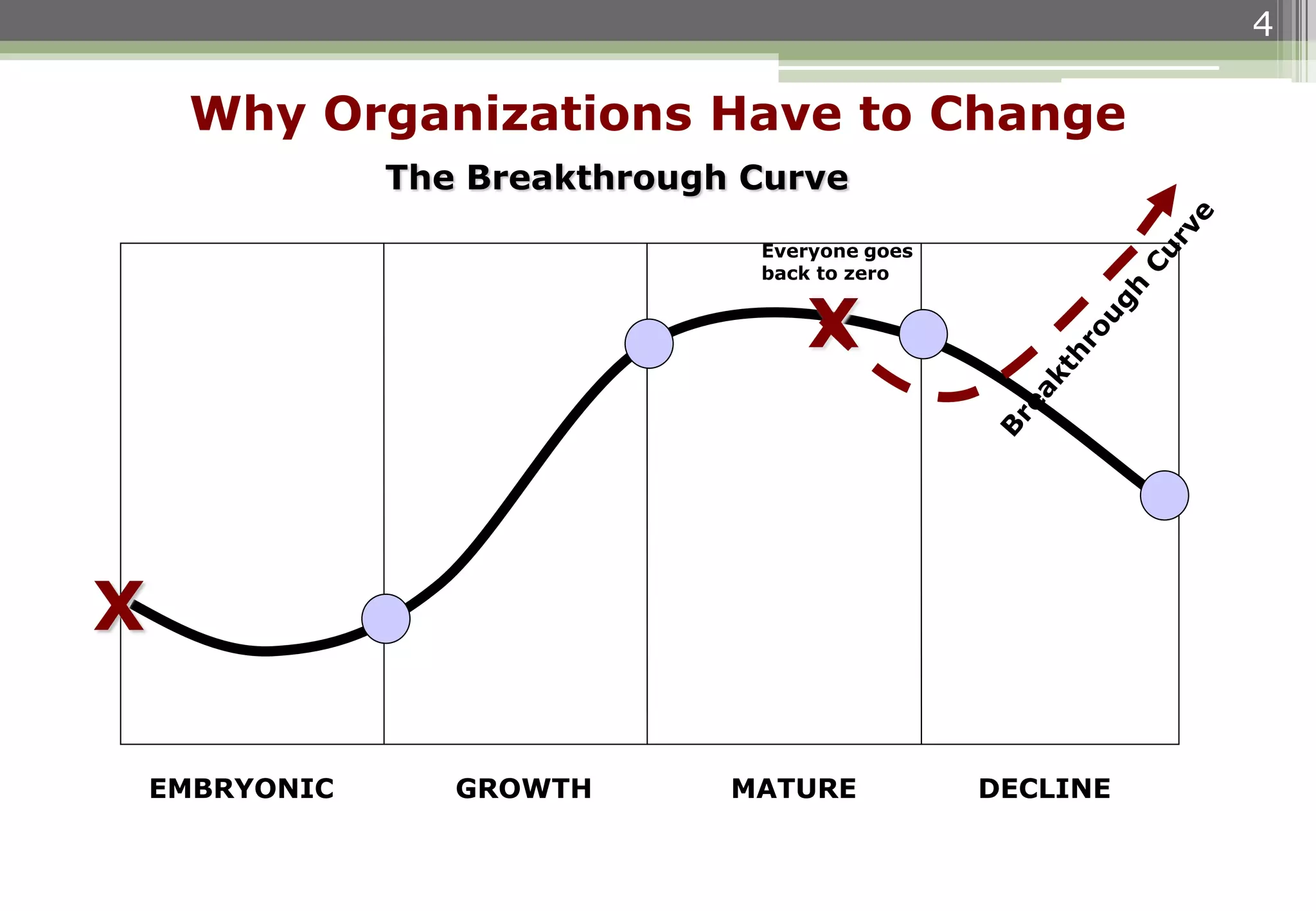
The Breakthrough Curve
EMBRYONIC GROWTH DECLINEMATURE
X
Why Organizations Have to Change
Everyone goes
back to zero
X
The ‘Waterline’
5
6
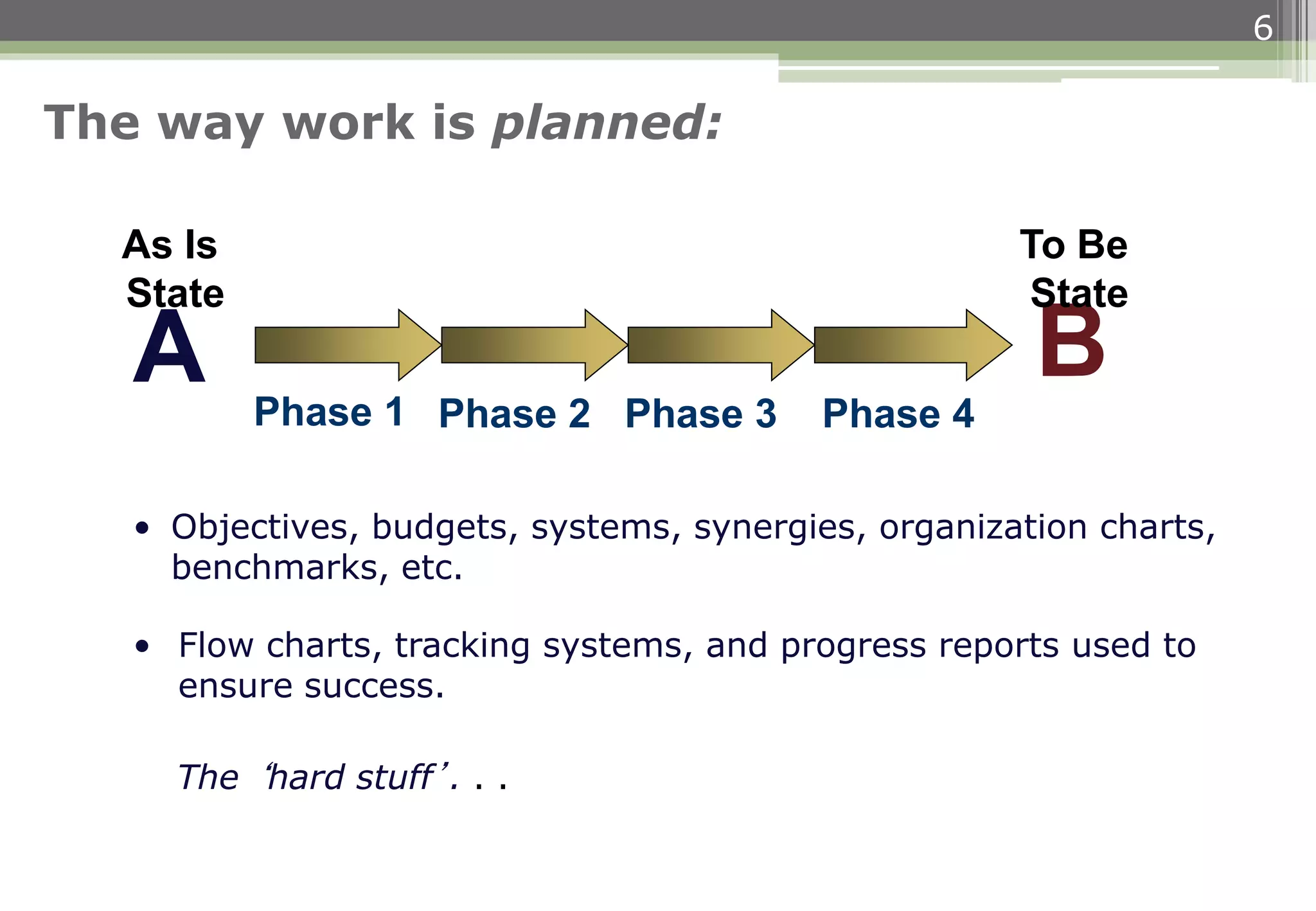
The way work is planned:
A B
• Objectives, budgets, systems, synergies, organization charts,
benchmarks, etc.
Phase 1
As Is
State
To Be
State
Phase 2 Phase 3 Phase 4
• Flow charts, tracking systems, and progress reports used to
ensure success.
The ‘hard stuff’. . .
7
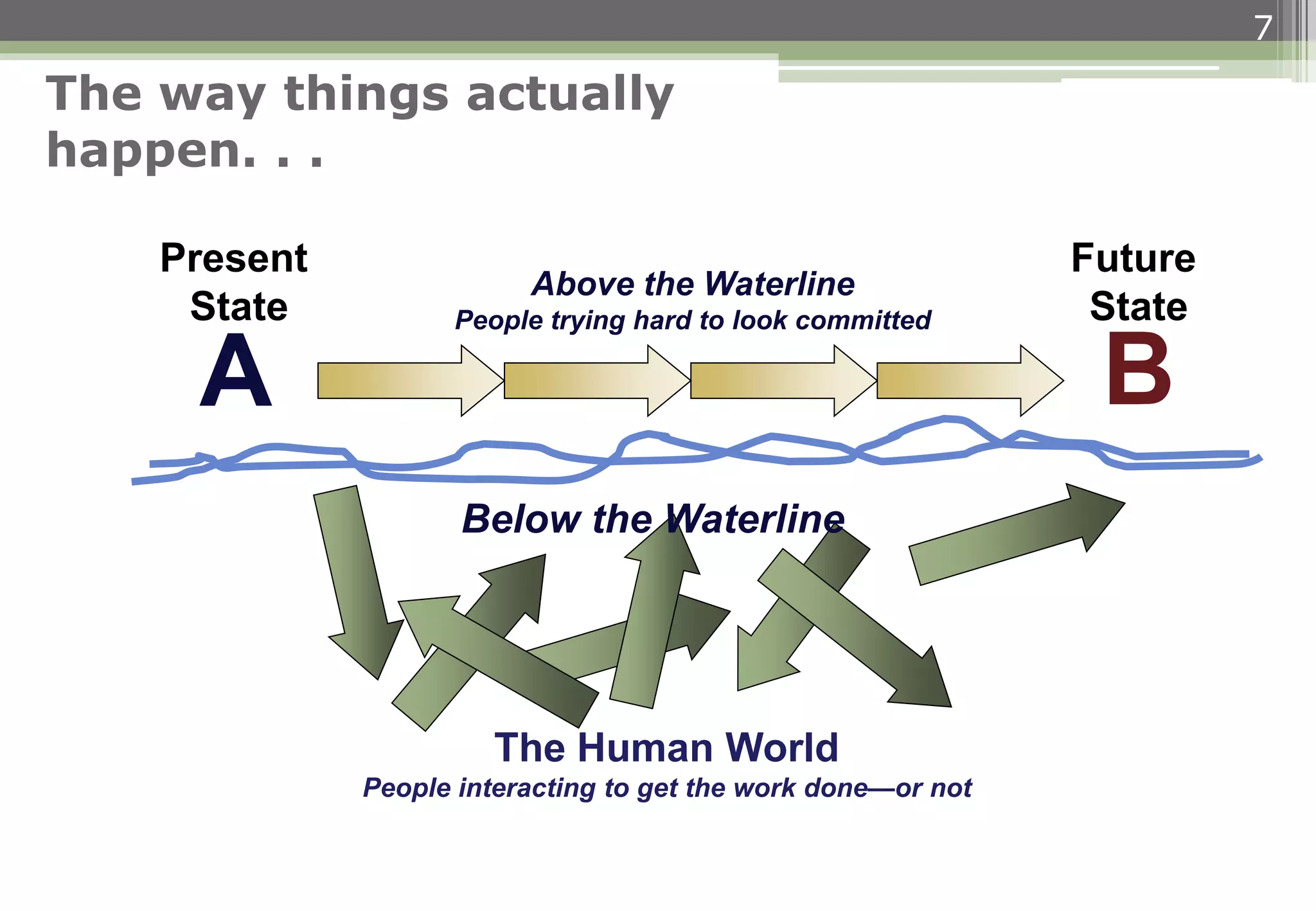
The way things actually
happen. . .
Above the Waterline
People trying hard to look committed
B
Future
State
A
Present
State
The Human World
People interacting to get the work done—or not
Below the Waterline
8
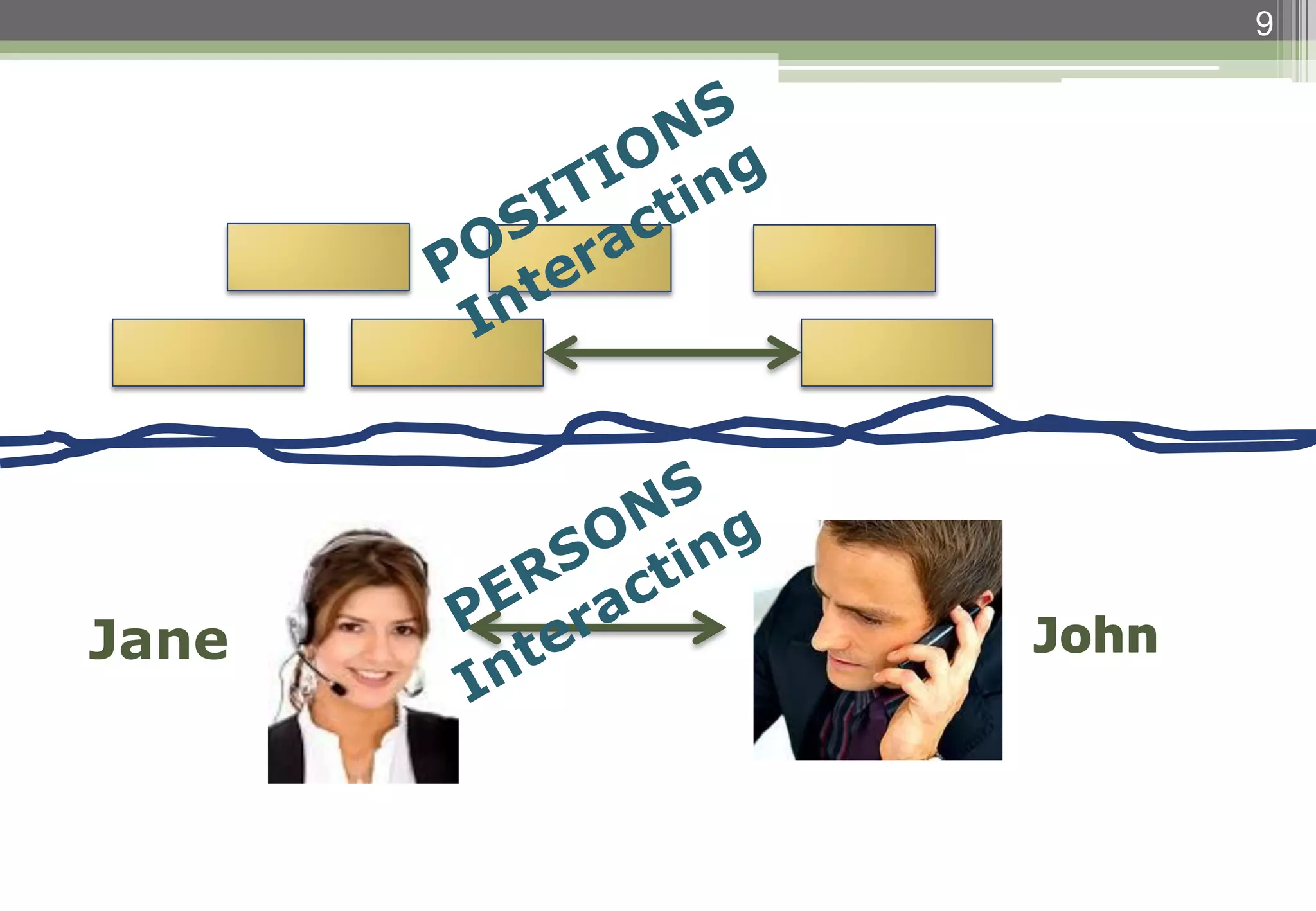
9
Jane
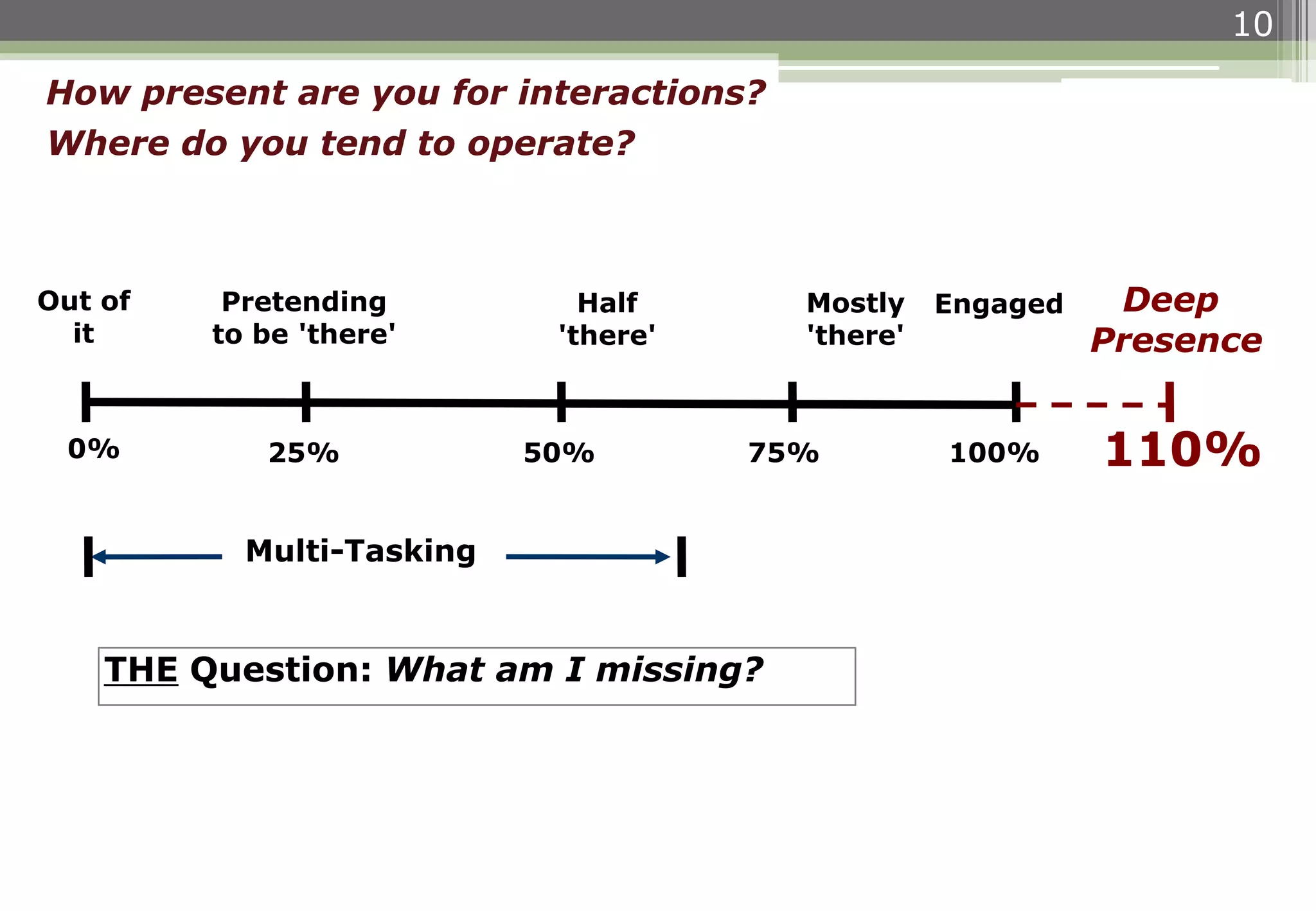
10
How present are you for interactions?
Where do you tend to operate?
0% 25% 50% 75% 100%
THE Question: What am I missing?
Deep
Presence
Half
'there'
Mostly
'there'
Pretending
to be 'there'
Out of
it
Engaged
110%
Multi-Tasking
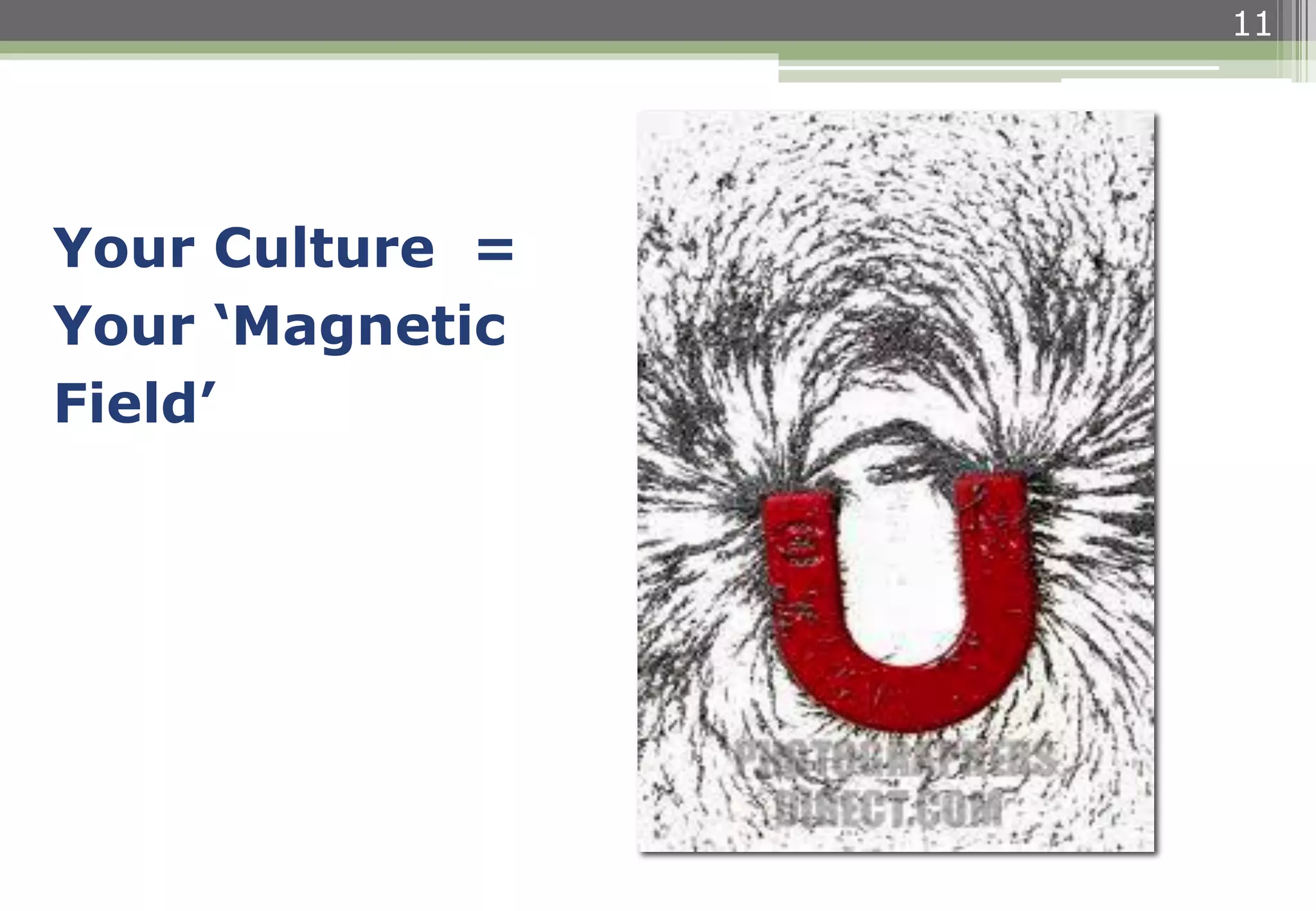
11
Your Culture =
Your ‘Magnetic
Field’
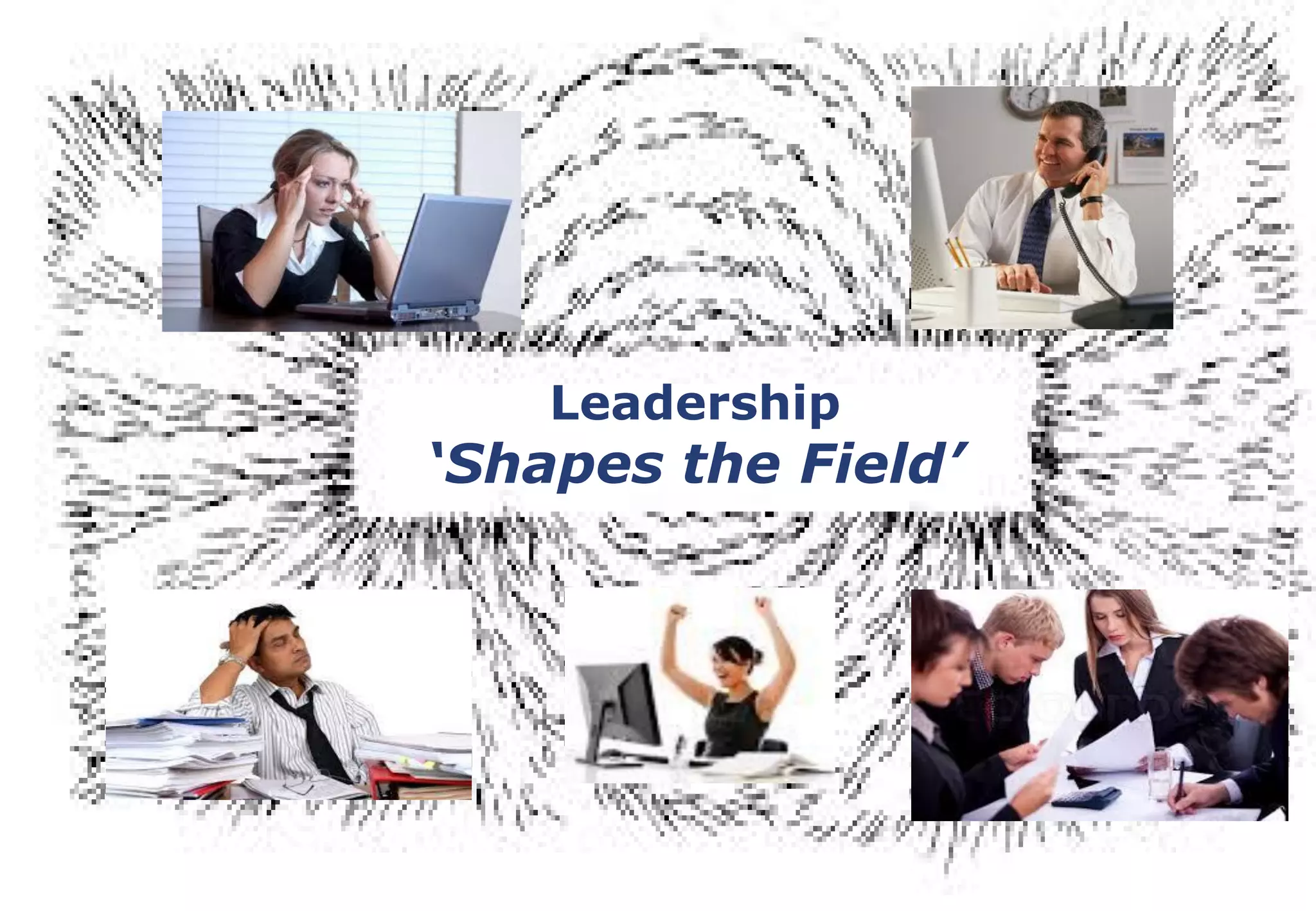
Leadership
‘Shapes the Field’
13
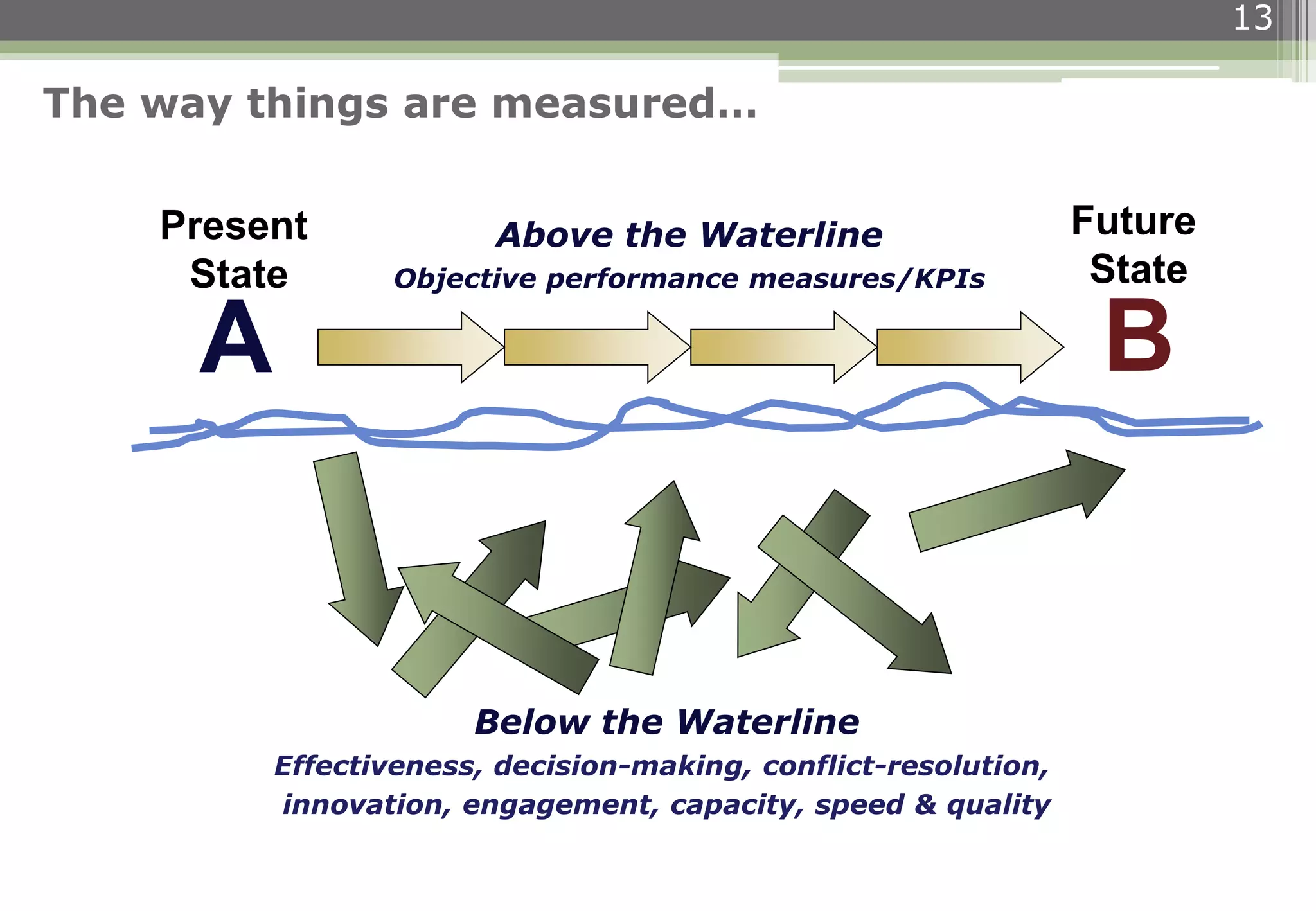
Above the Waterline
Objective performance measures/KPIs
B
Future
State
A
Present
State
Below the Waterline
Effectiveness, decision-making, conflict-resolution,
innovation, engagement, capacity, speed & quality
The way things are measured…
The High-Performance Team
14
What an HP-Team
Looks Like in Action
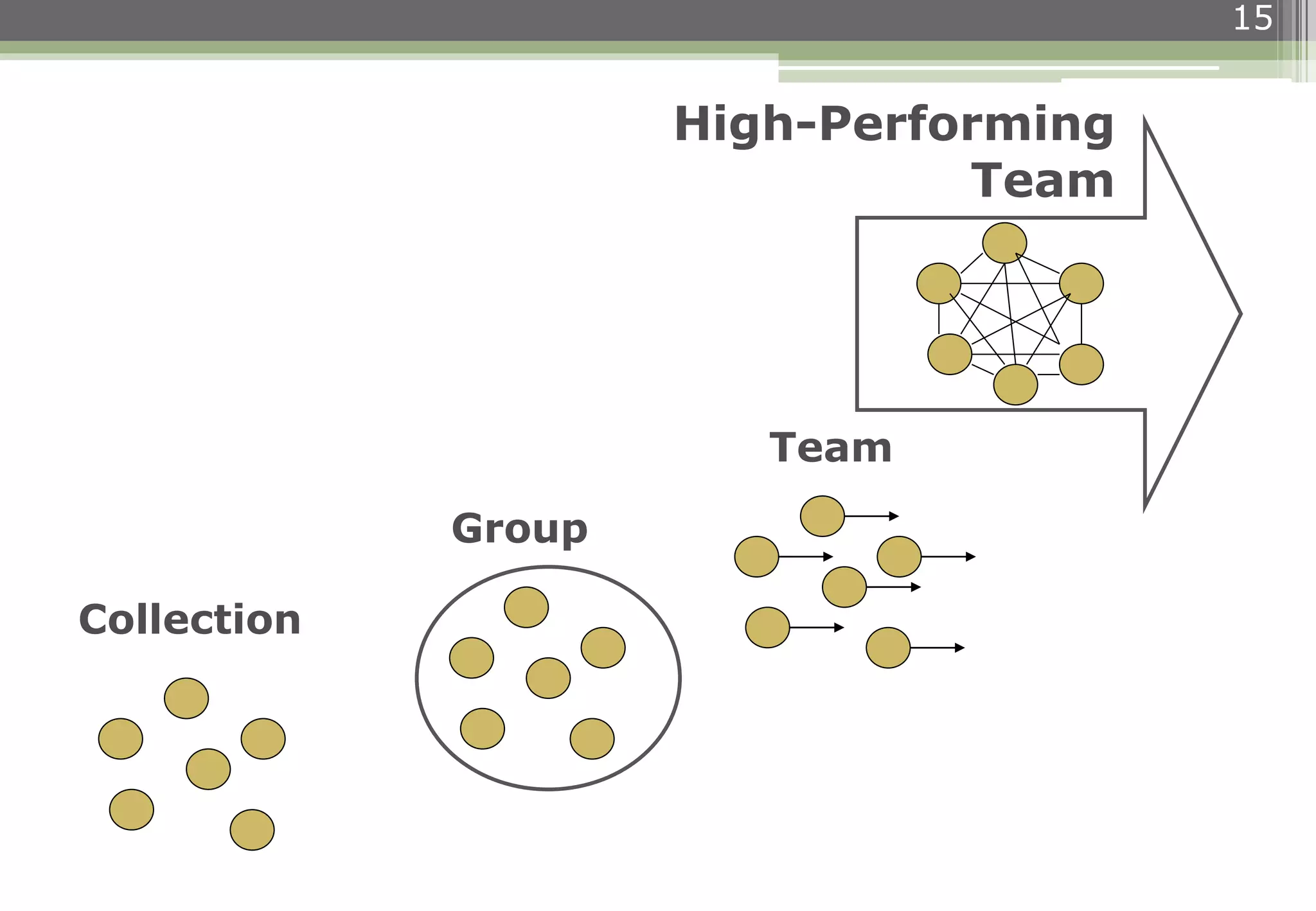
15
Collection
Group
Team
High-Performing
Team
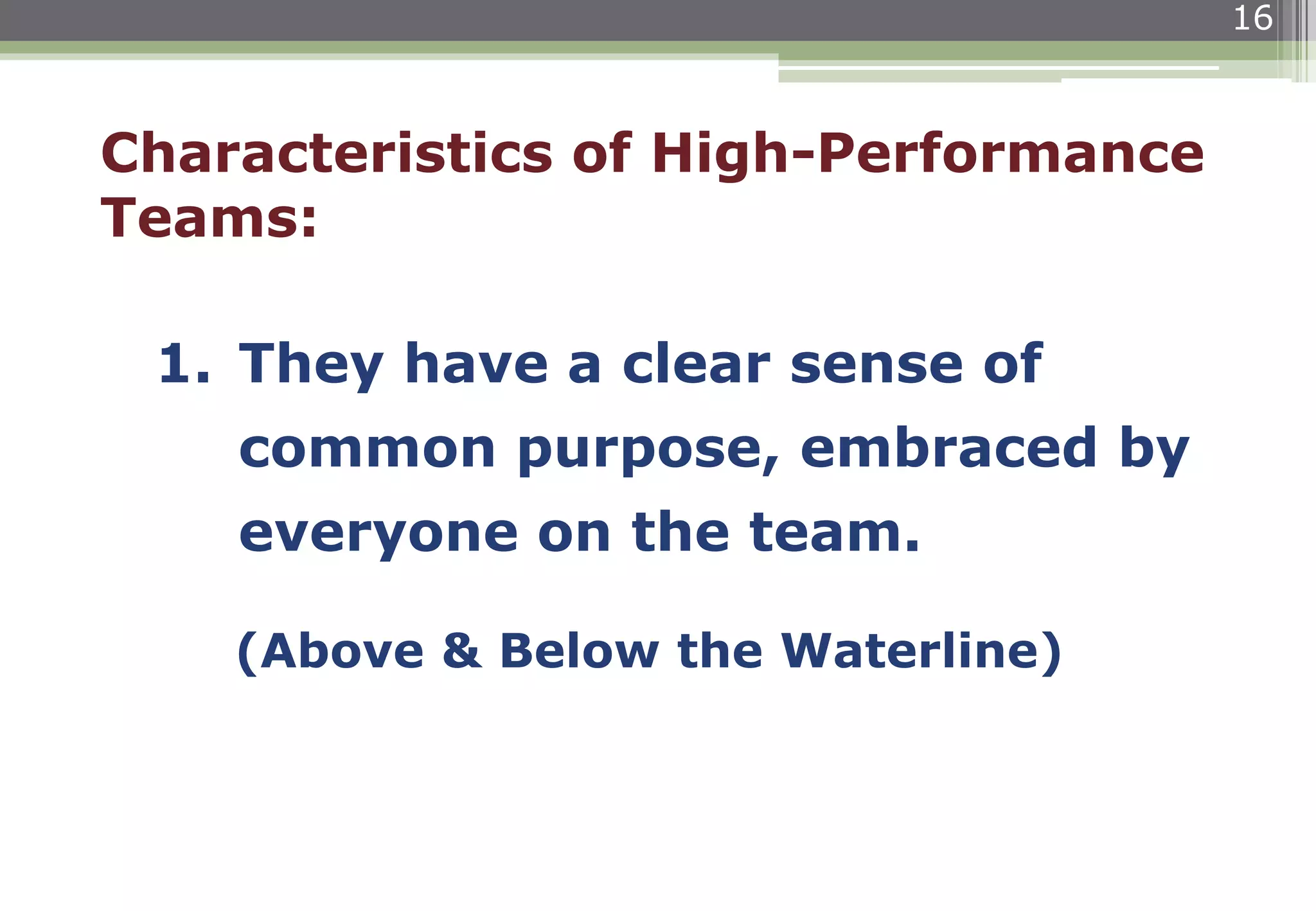
16
Characteristics of High-Performance
Teams:
1. They have a clear sense of
common purpose, embraced by
everyone on the team.
(Above & Below the Waterline)
17
Business
Goal(s):
The Kind of Company
We Want to Create:
18
2. Create a climate that fosters
frank, challenging and respectful
conversations.
(‘Straight Talk’ and ‘Tough Love’)
High-Performance Teams
19
3. Have many differences of
opinion (on HOW) which result
in better decisions and stronger
team spirit.
(Conflict Utilization)
High-Performance Teams
Polarity Management
20
‘Having Your Cake and
Eating it Too’
* Adapted with permission from the brilliant work of good
friend and colleague, Barry Johnson, author of Polarity
Management, HRD Press, 1997.
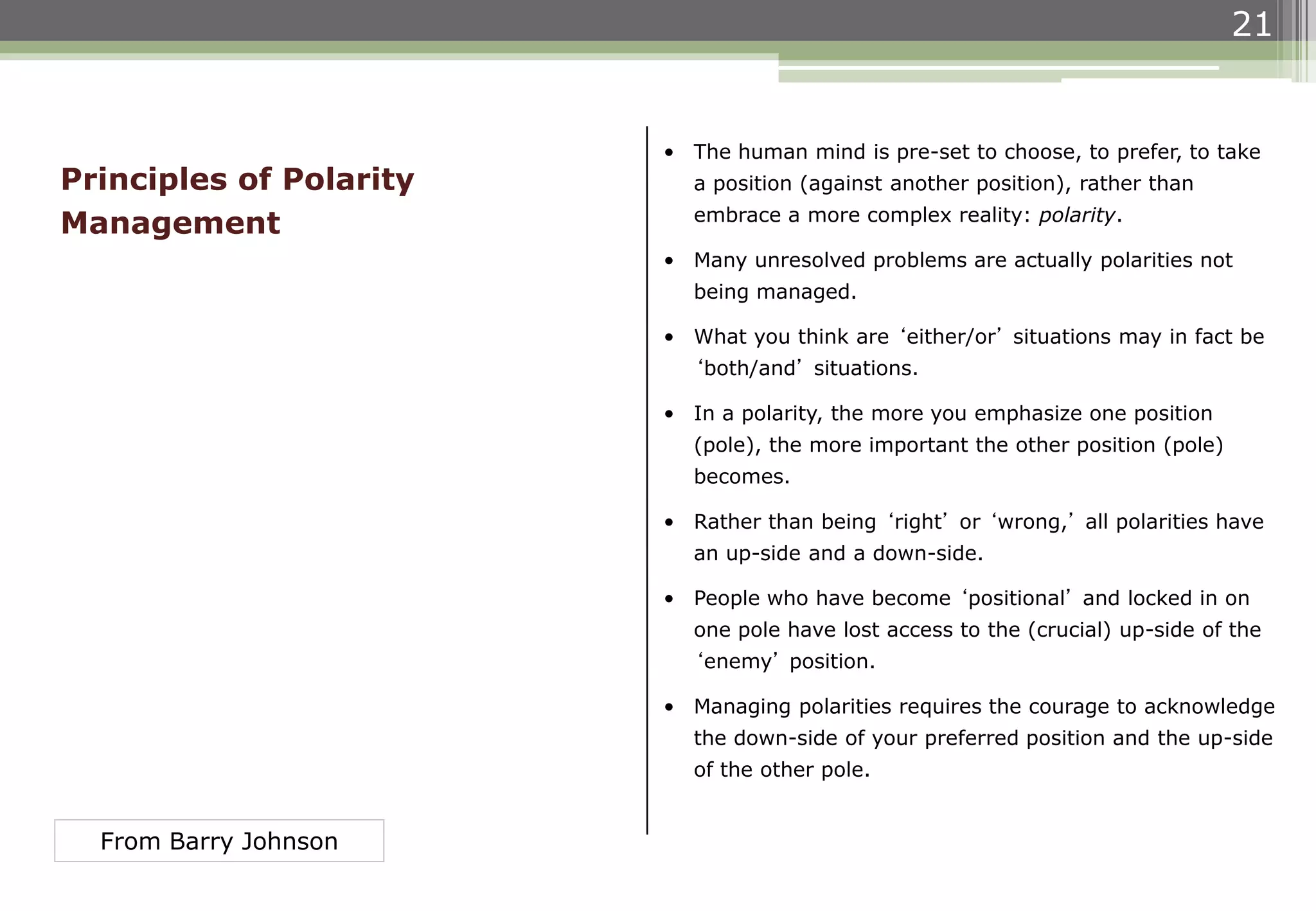
21
• The human mind is pre-set to choose, to prefer, to take
a position (against another position), rather than
embrace a more complex reality: polarity.
• Many unresolved problems are actually polarities not
being managed.
• What you think are ‘either/or’ situations may in fact be
‘both/and’ situations.
• In a polarity, the more you emphasize one position
(pole), the more important the other position (pole)
becomes.
• Rather than being ‘right’ or ‘wrong,’ all polarities have
an up-side and a down-side.
• People who have become ‘positional’ and locked in on
one pole have lost access to the (crucial) up-side of the
‘enemy’ position.
• Managing polarities requires the courage to acknowledge
the down-side of your preferred position and the up-side
of the other pole.
Principles of Polarity
Management
From Barry Johnson
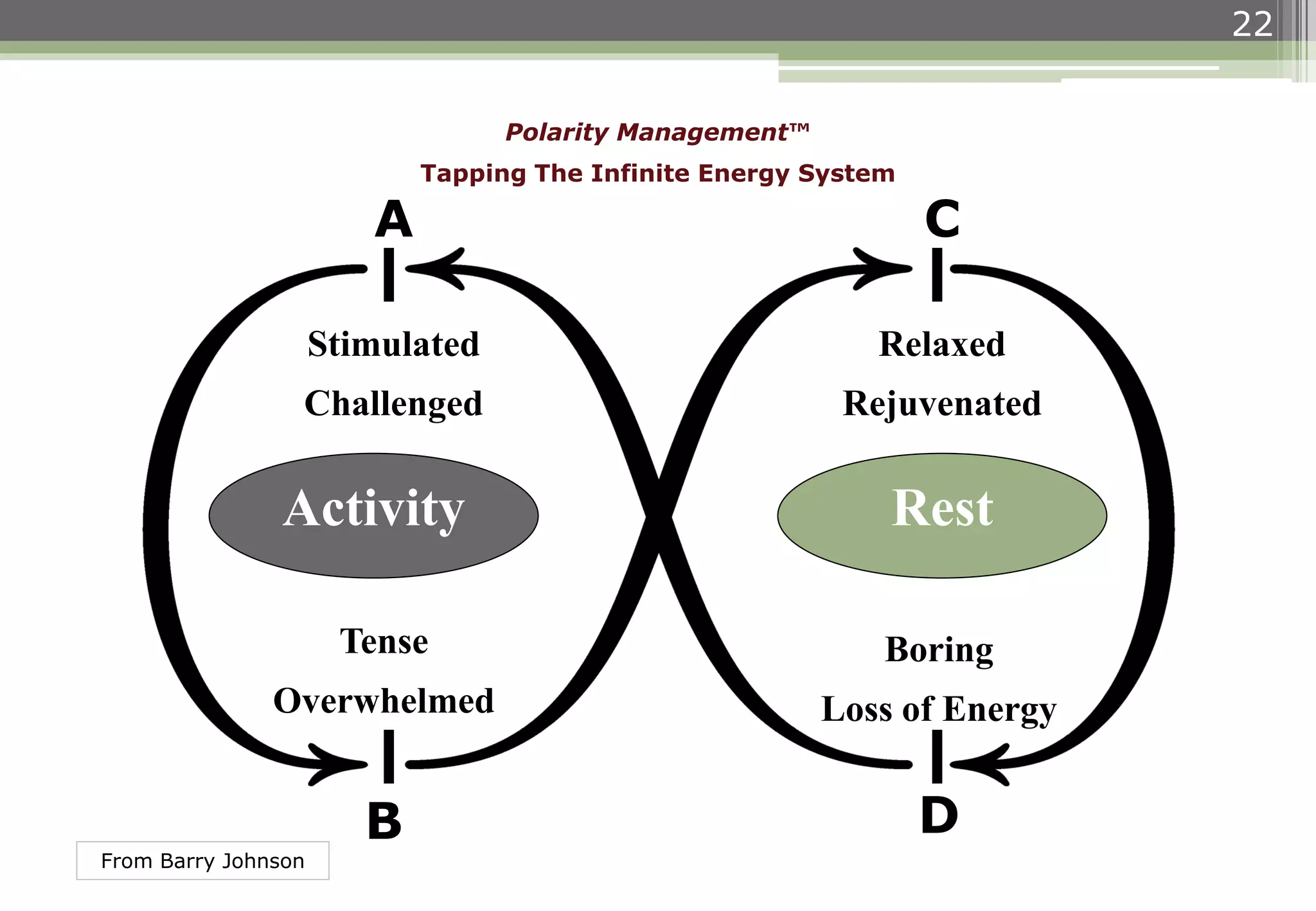
22
RestActivity
C
Relaxed
Rejuvenated
Boring
Loss of Energy
D
A
Stimulated
Challenged
Tense
Overwhelmed
B
Polarity Management™
Tapping The Infinite Energy System
From Barry Johnson
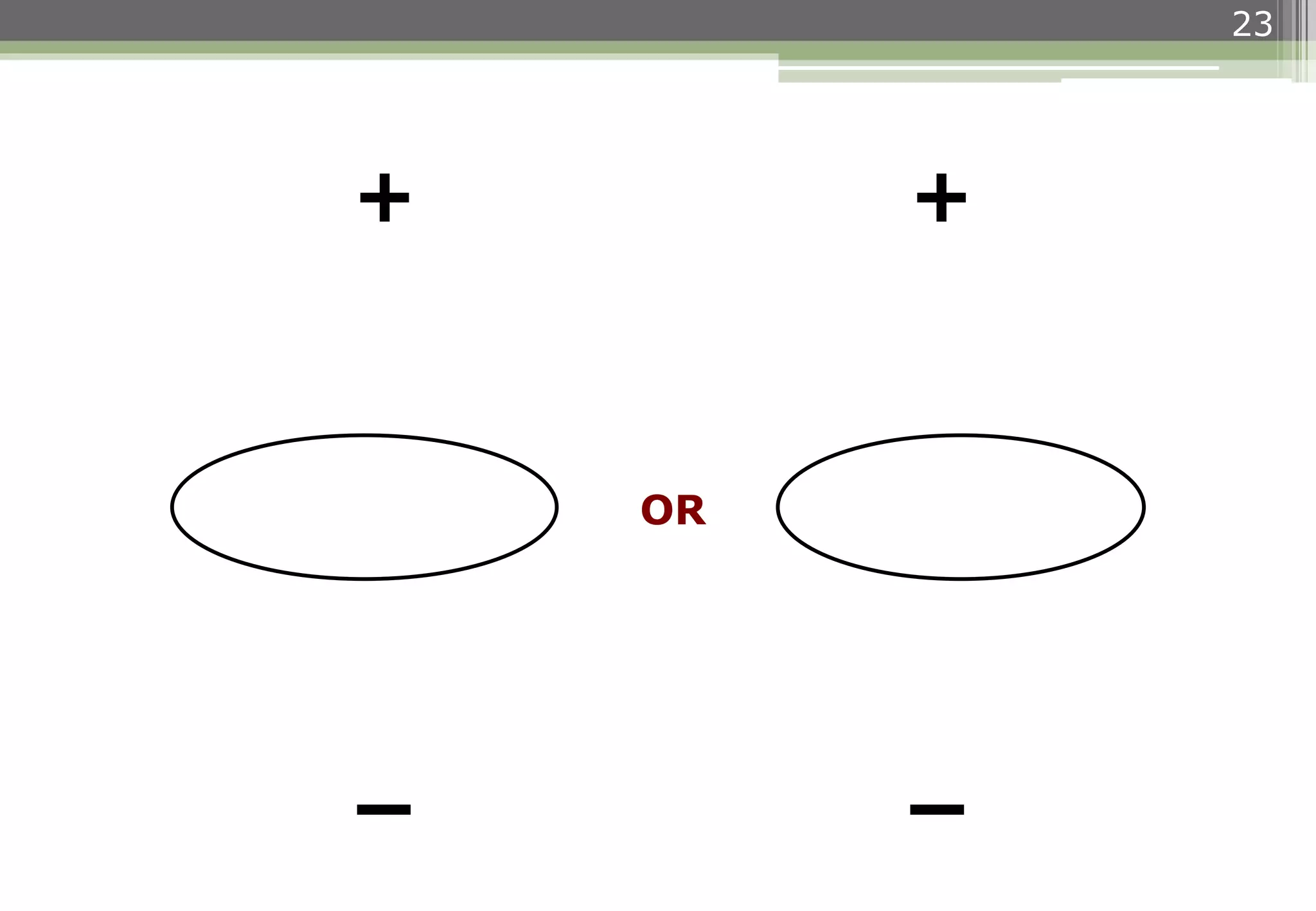
23
RestActivity
+ +
OR
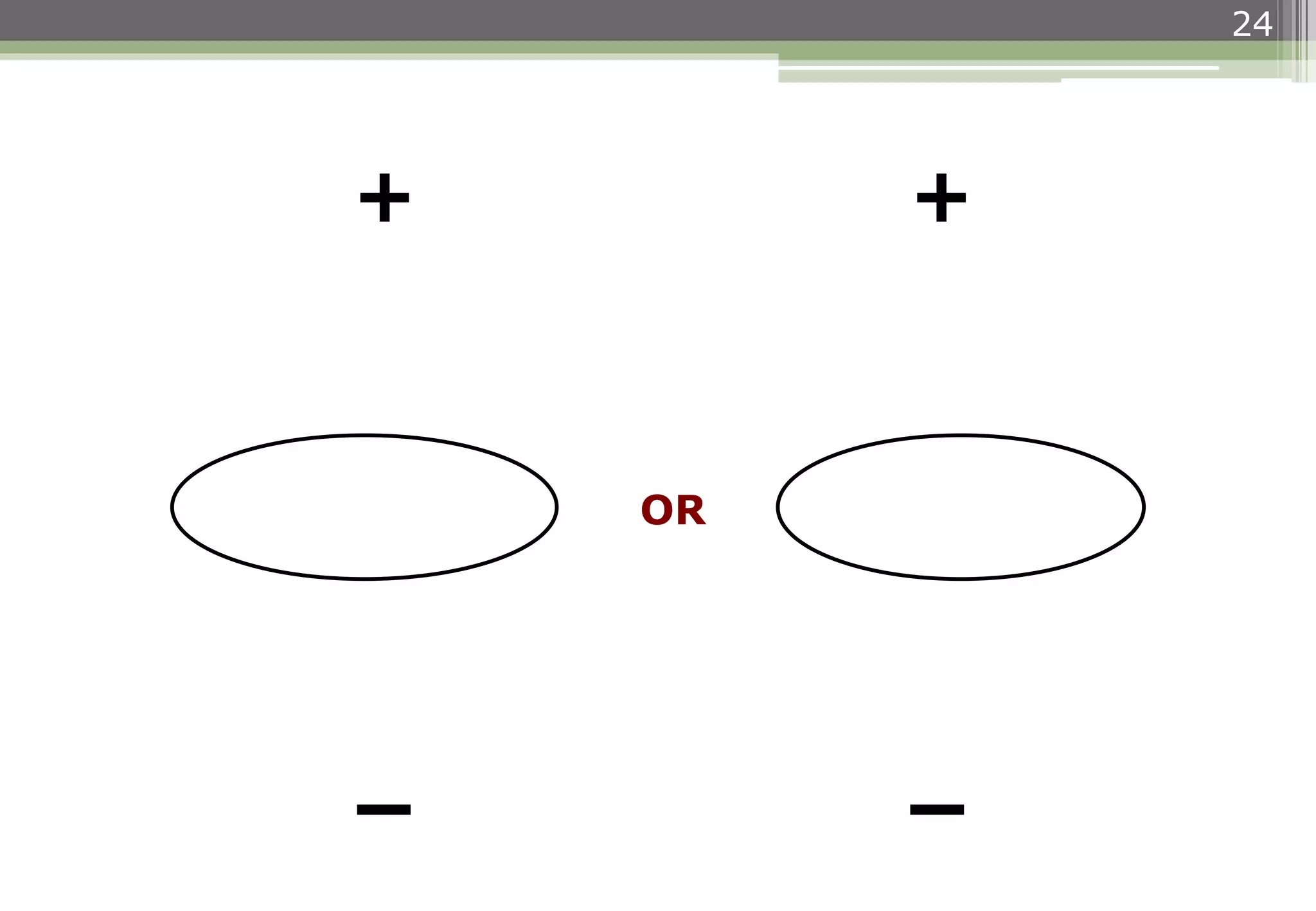
24
RestActivity
+ +
OR
25
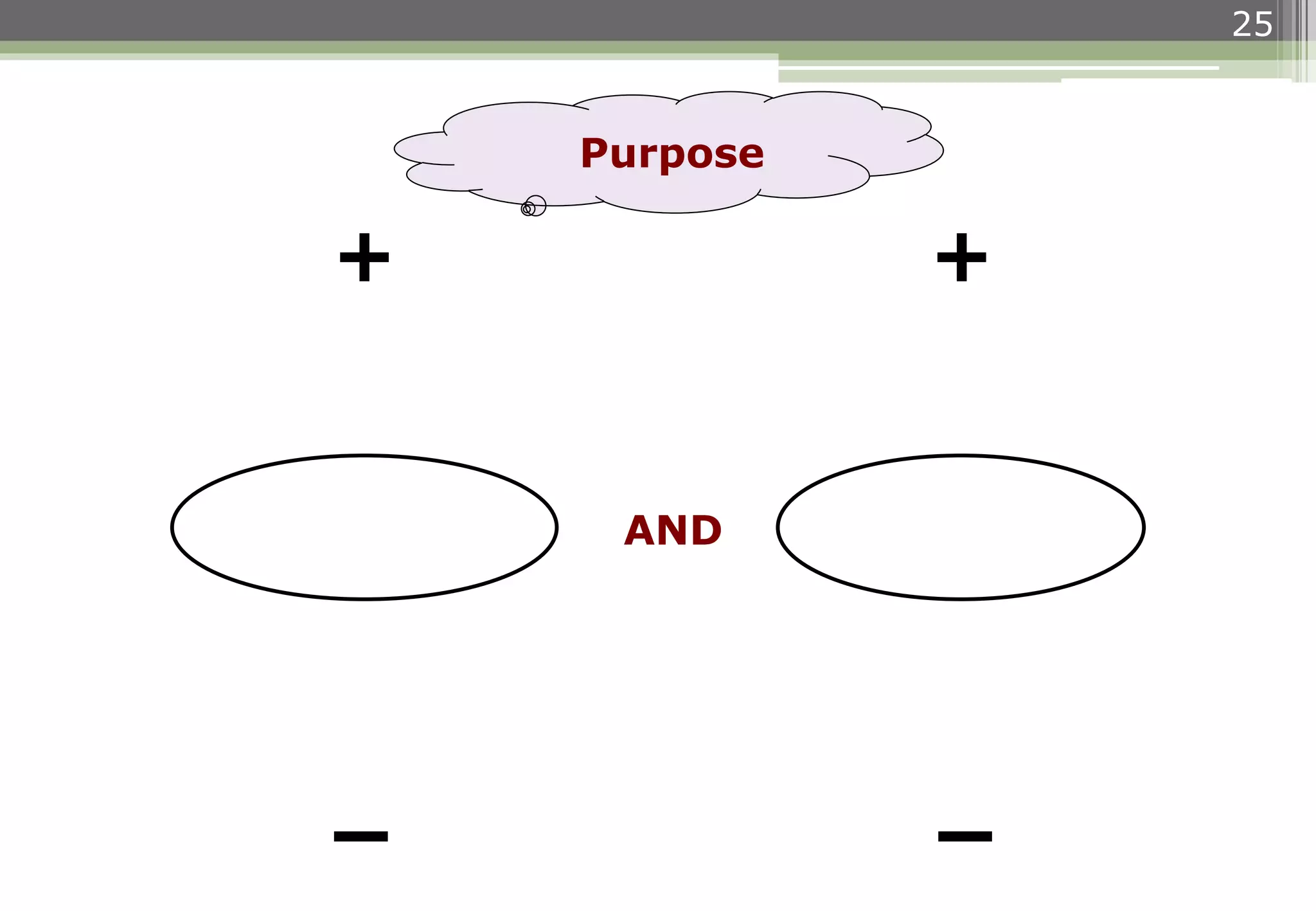
RestActivity
+ +
AND
Purpose
26
4. The senior leader present does
not control the meeting, but
works for consensus whenever
possible.
(The Decision-Making Continuum)
High-Performance Teams
27
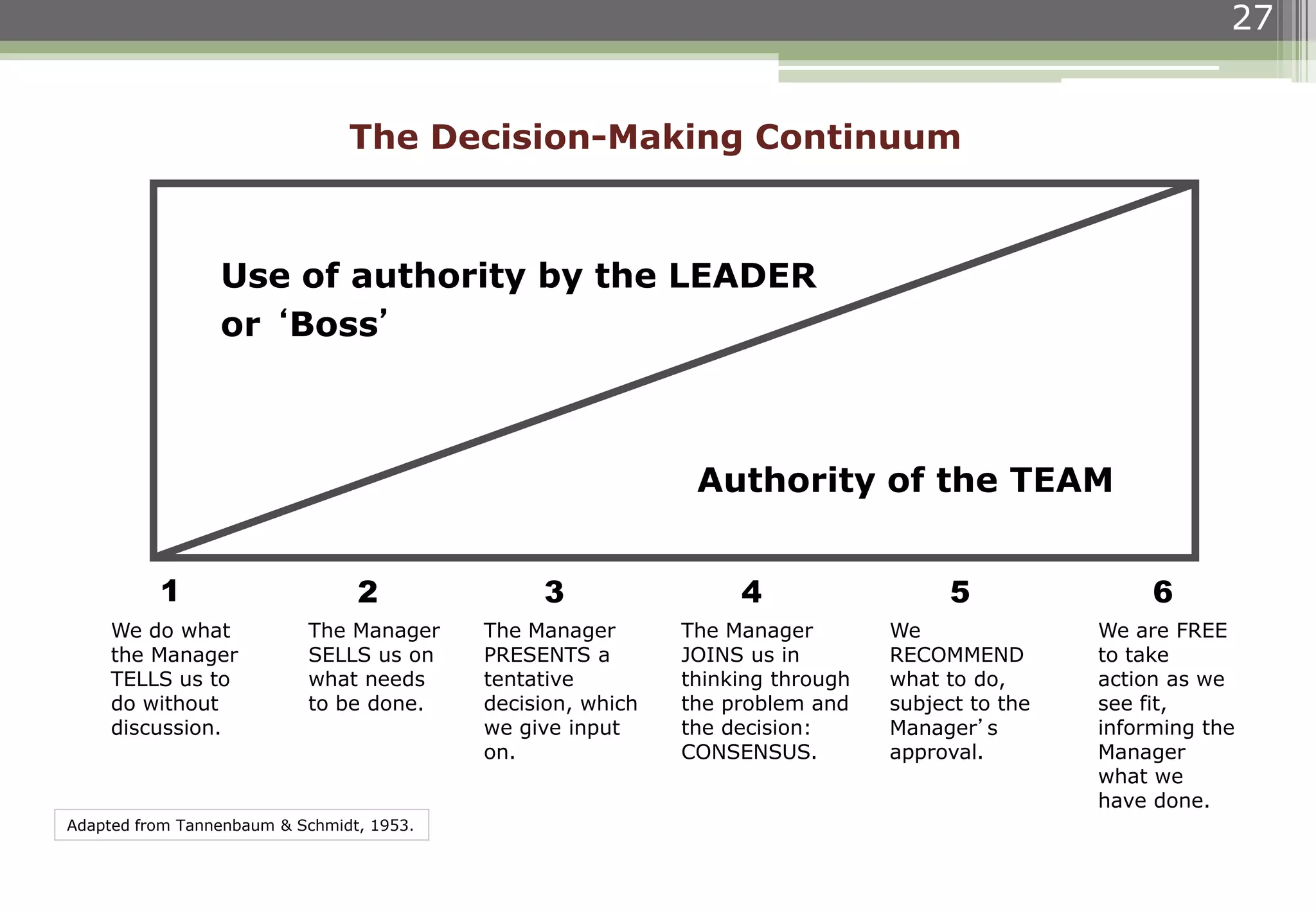
Use of authority by the LEADER
or ‘Boss’
Authority of the TEAM
1 2 3 4 5 6
We do what
the Manager
TELLS us to
do without
discussion.
The Manager
SELLS us on
what needs
to be done.
The Manager
JOINS us in
thinking through
the problem and
the decision:
CONSENSUS.
We
RECOMMEND
what to do,
subject to the
Manager’s
approval.
We are FREE
to take
action as we
see fit,
informing the
Manager
what we
have done.
The Manager
PRESENTS a
tentative
decision, which
we give input
on.
Adapted from Tannenbaum & Schmidt, 1953.
The Decision-Making Continuum
28
5. Designate an SPA (Single Person
Accountable) for all important
decisions, with a ‘By- when’
attached. (‘Who is
going to make sure this happens --
and by when?’)
High-Performance Teams
29
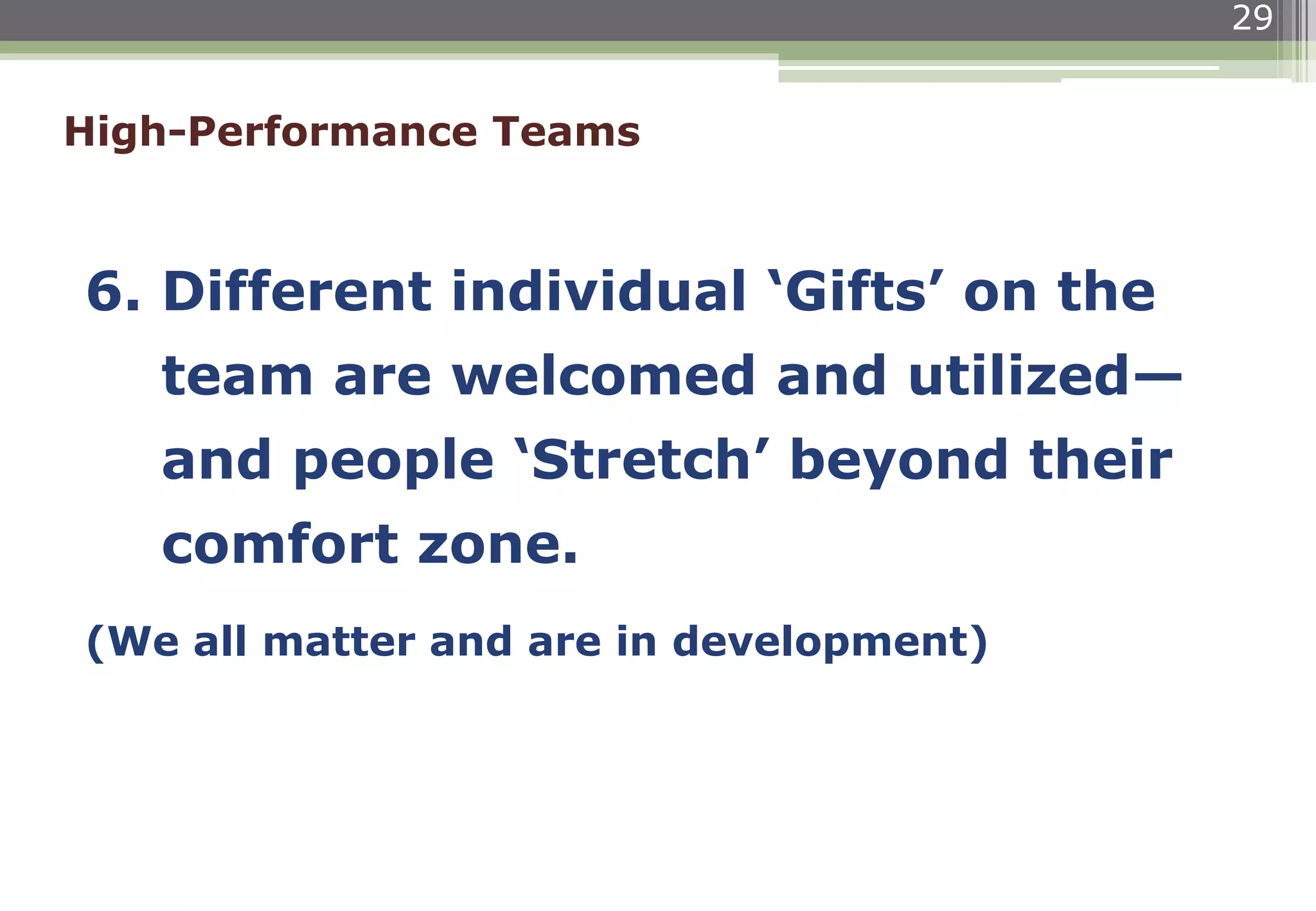
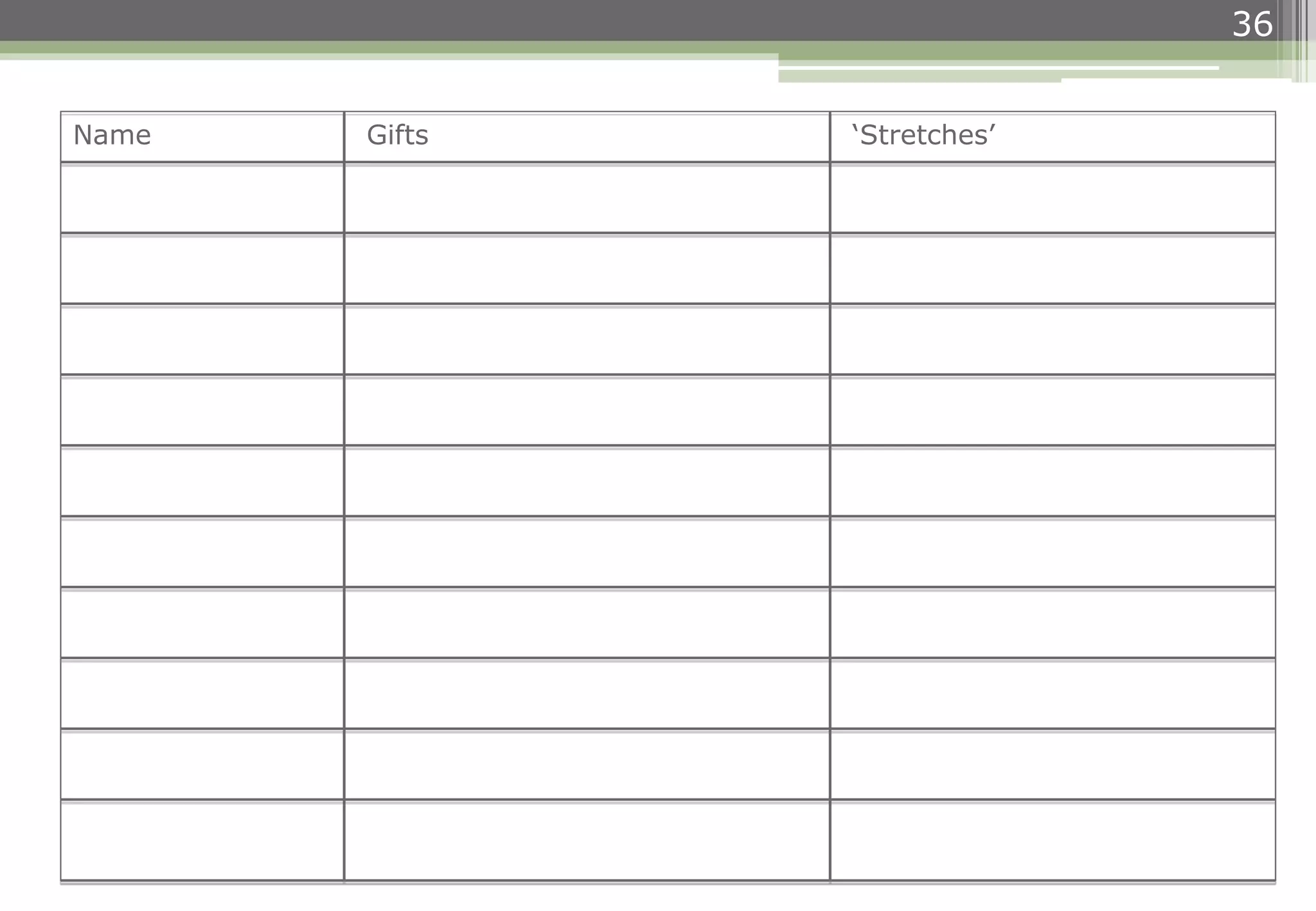
6. Different individual ‘Gifts’ on the
team are welcomed and utilized—
and people ‘Stretch’ beyond their
comfort zone.
(We all matter and are in development)
High-Performance Teams
P A E I: Four Workplace ‘Languages’
30
Worldviews at Work:
Sources of Influence
31
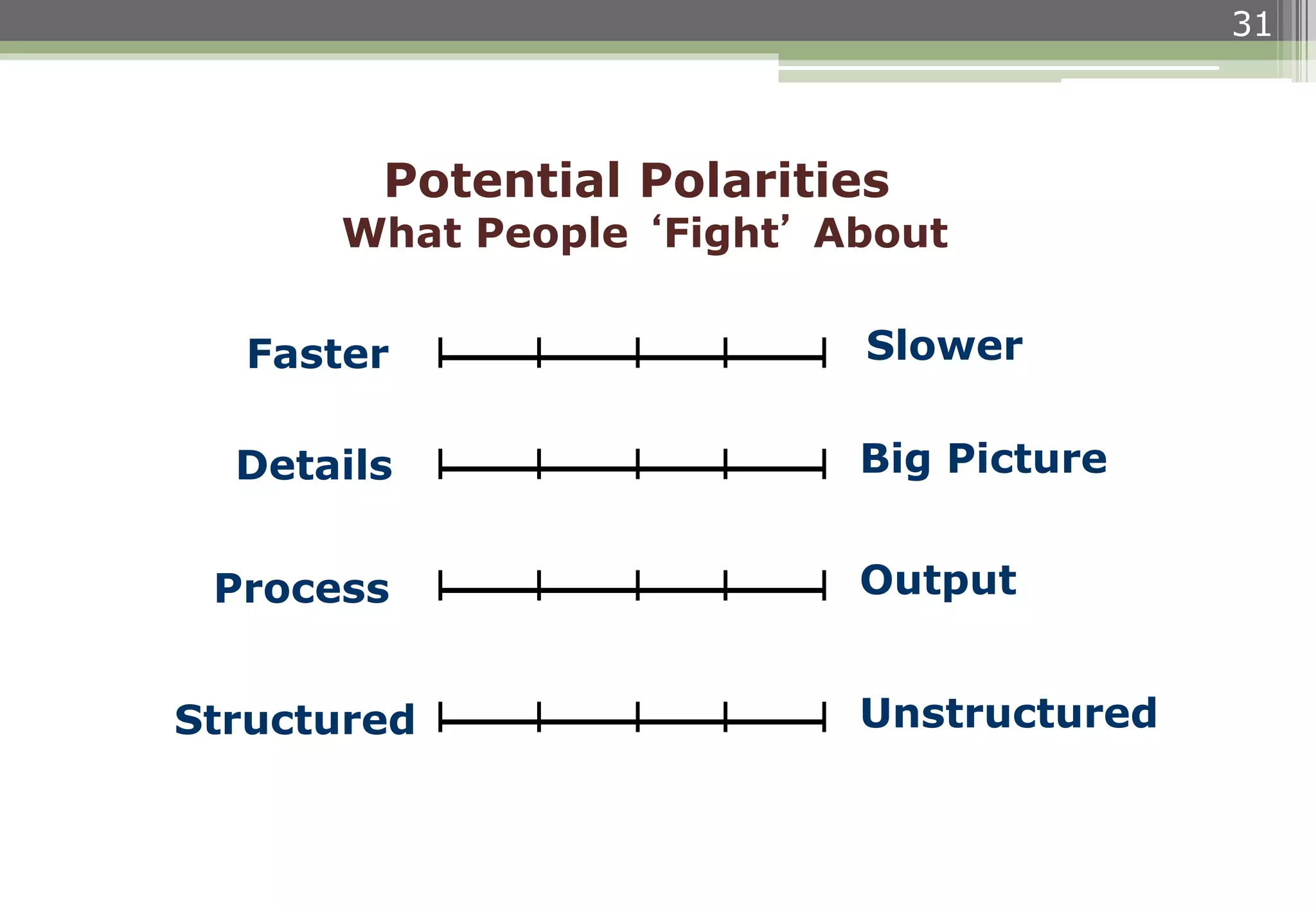
Potential Polarities
What People ‘Fight’ About
Faster Slower
Details Big Picture
Process Output
Structured Unstructured
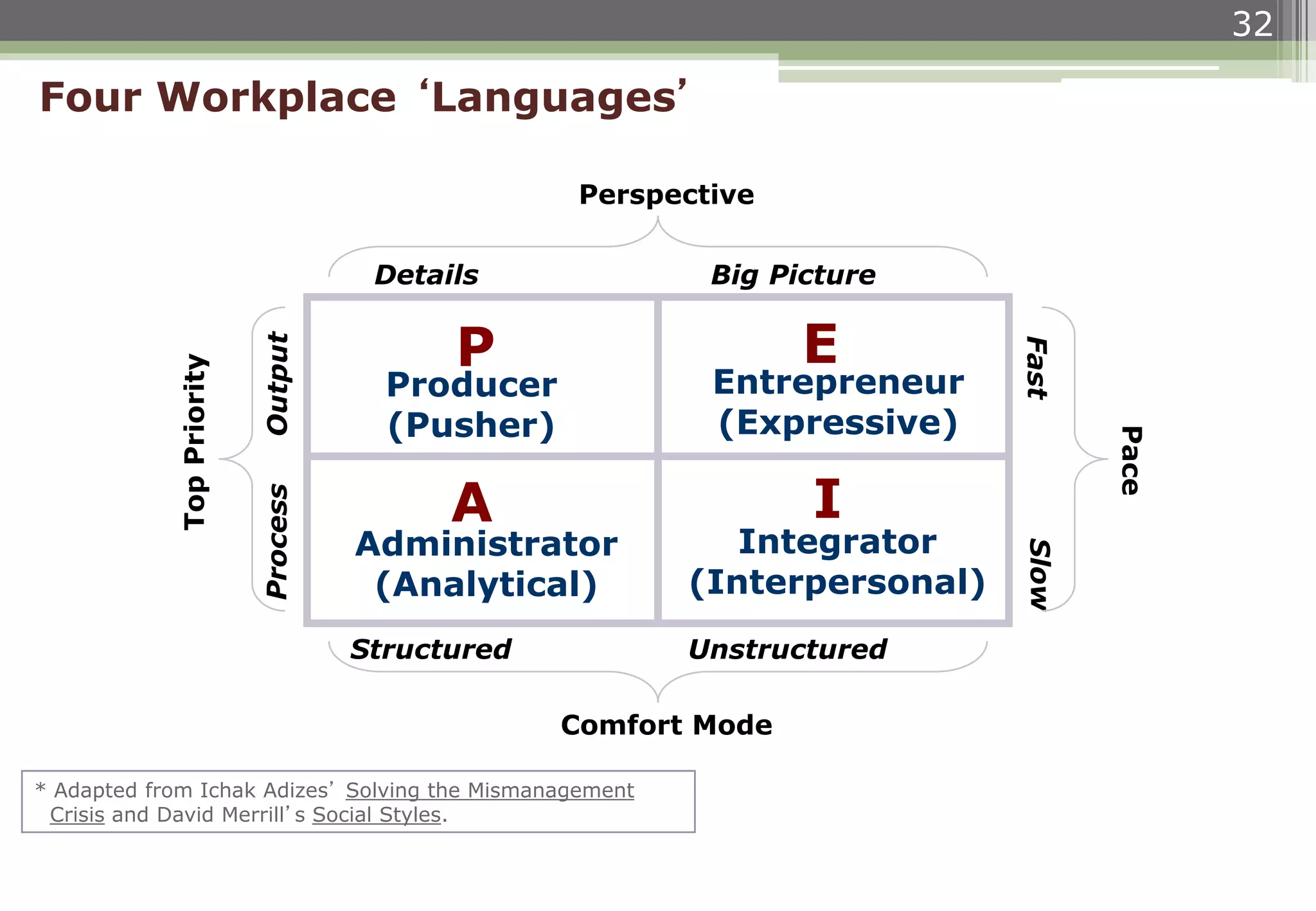
Four Workplace ‘Languages’
32
Producer
(Pusher)
Administrator
(Analytical)
Entrepreneur
(Expressive)
Integrator
(Interpersonal)
Perspective
Details Big Picture
Comfort Mode
Structured Unstructured
TopPriority
Pace
* Adapted from Ichak Adizes’ Solving the Mismanagement
Crisis and David Merrill’s Social Styles.
P E
A I
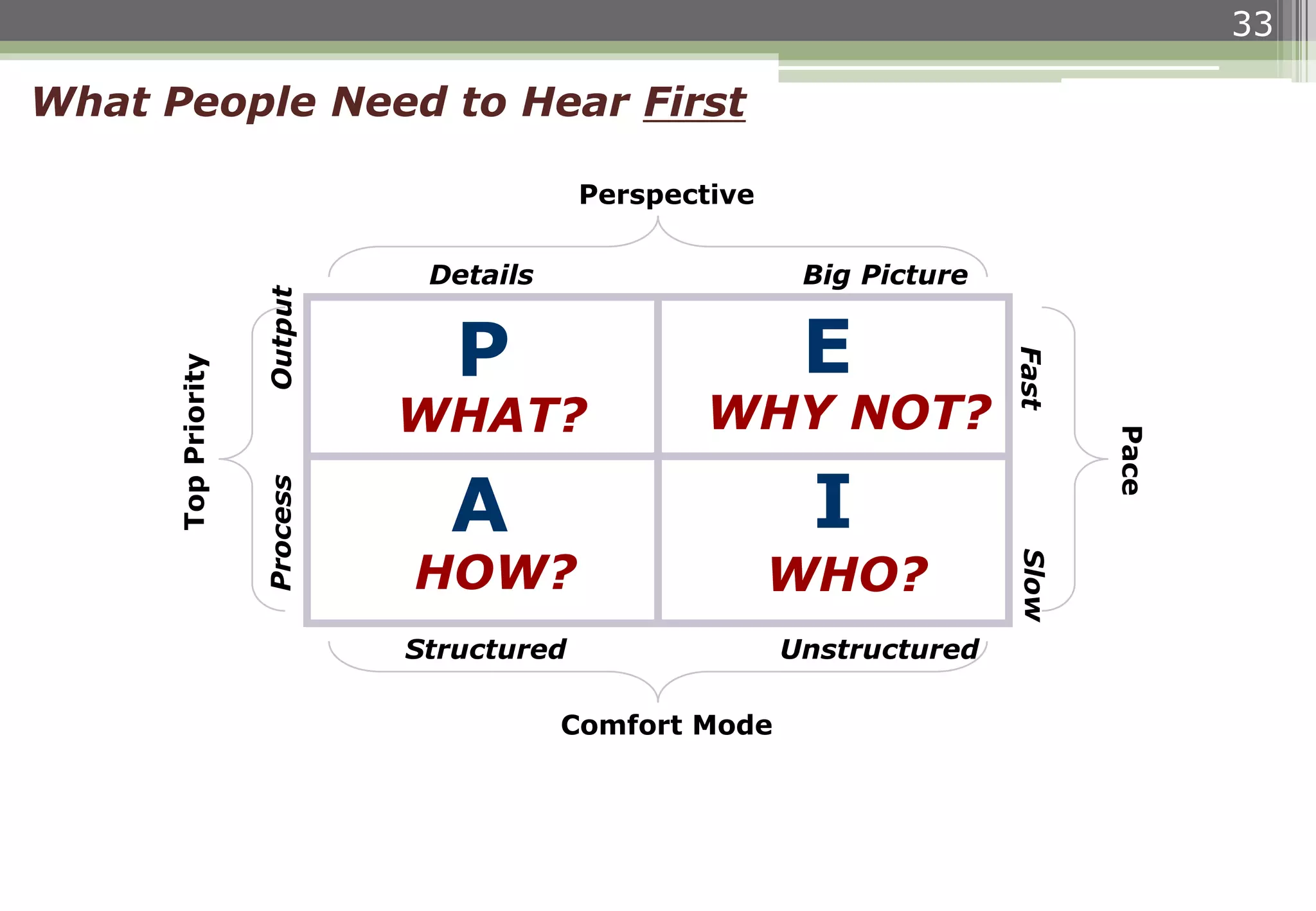
What People Need to Hear First
33
Perspective
Details Big Picture
Comfort Mode
Structured Unstructured
TopPriority
Pace
P E
A I
WHAT? WHY NOT?
HOW? WHO?
34
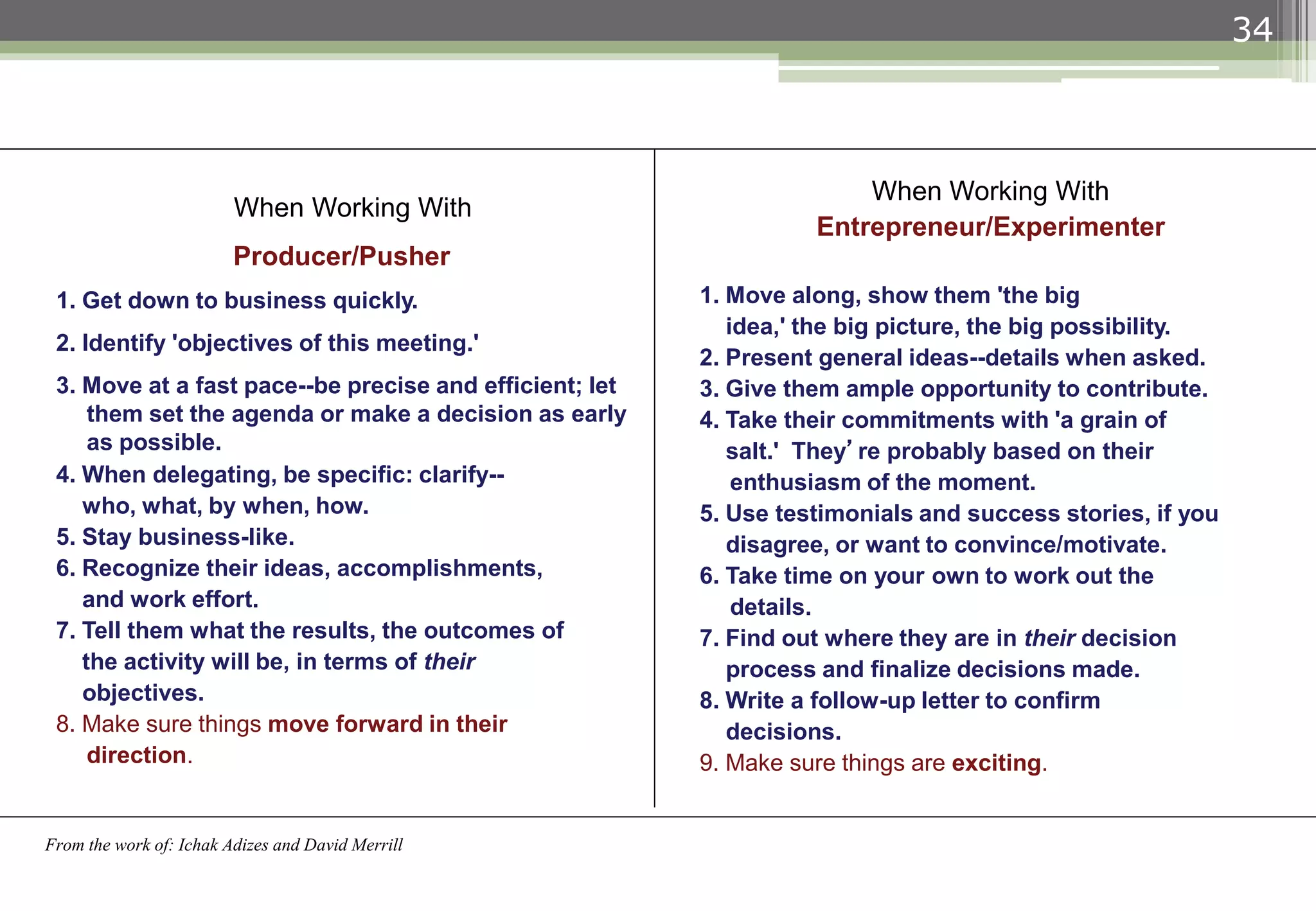
When Working With
Entrepreneur/Experimenter
1. Move along, show them 'the big
idea,' the big picture, the big possibility.
2. Present general ideas--details when asked.
3. Give them ample opportunity to contribute.
4. Take their commitments with 'a grain of
salt.' They’re probably based on their
enthusiasm of the moment.
5. Use testimonials and success stories, if you
disagree, or want to convince/motivate.
6. Take time on your own to work out the
details.
7. Find out where they are in their decision
process and finalize decisions made.
8. Write a follow-up letter to confirm
decisions.
9. Make sure things are exciting.
From the work of: Ichak Adizes and David Merrill
When Working With
Producer/Pusher
1. Get down to business quickly.
2. Identify 'objectives of this meeting.'
3. Move at a fast pace--be precise and efficient; let
them set the agenda or make a decision as early
as possible.
4. When delegating, be specific: clarify--
who, what, by when, how.
5. Stay business-like.
6. Recognize their ideas, accomplishments,
and work effort.
7. Tell them what the results, the outcomes of
the activity will be, in terms of their
objectives.
8. Make sure things move forward in their
direction.
35
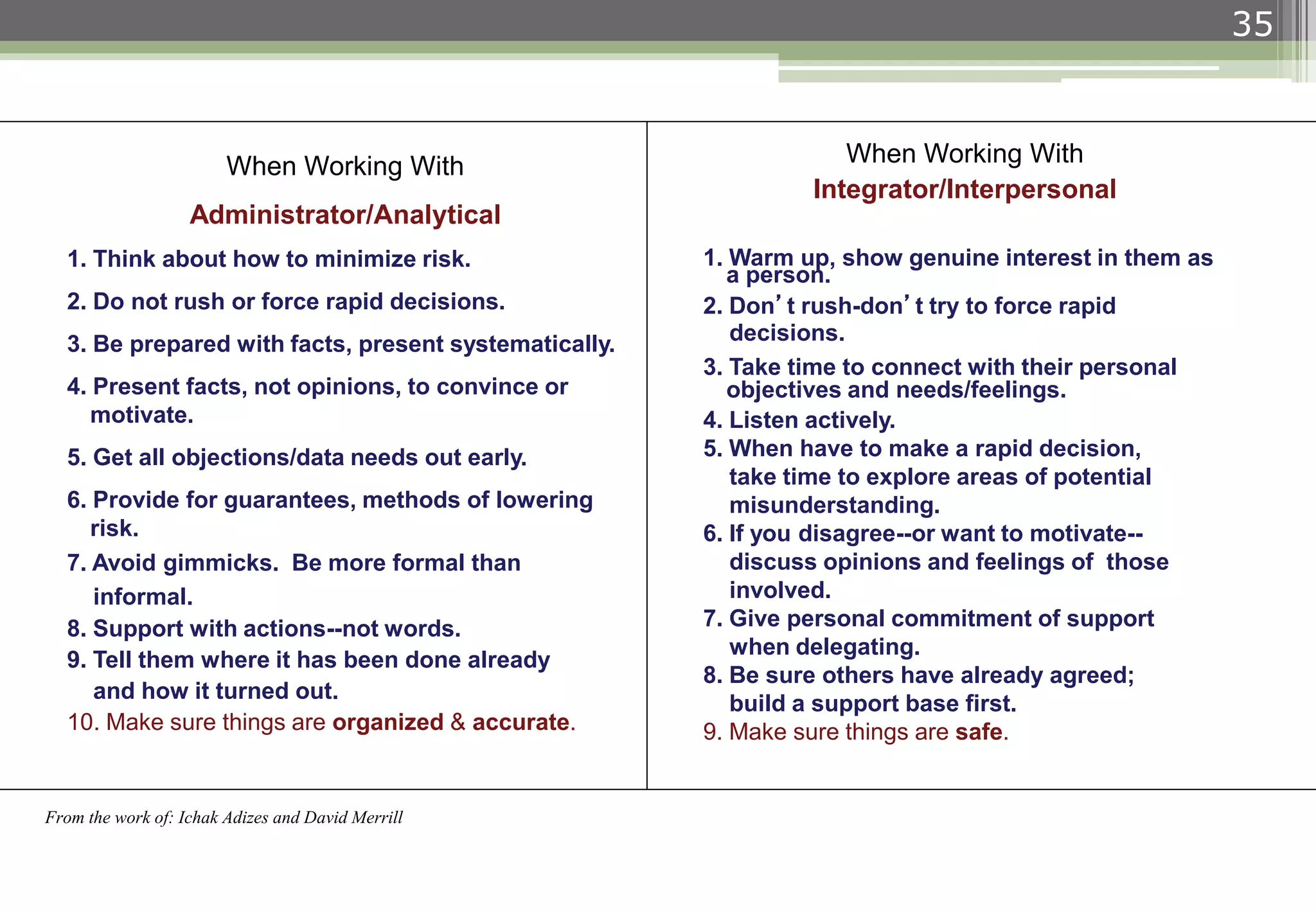
When Working With
Administrator/Analytical
1. Think about how to minimize risk.
2. Do not rush or force rapid decisions.
3. Be prepared with facts, present systematically.
4. Present facts, not opinions, to convince or
motivate.
5. Get all objections/data needs out early.
6. Provide for guarantees, methods of lowering
risk.
7. Avoid gimmicks. Be more formal than
informal.
8. Support with actions--not words.
9. Tell them where it has been done already
and how it turned out.
10. Make sure things are organized & accurate.
From the work of: Ichak Adizes and David Merrill
When Working With
Integrator/Interpersonal
1. Warm up, show genuine interest in them as
a person.
2. Don’t rush-don’t try to force rapid
decisions.
3. Take time to connect with their personal
objectives and needs/feelings.
4. Listen actively.
5. When have to make a rapid decision,
take time to explore areas of potential
misunderstanding.
6. If you disagree--or want to motivate--
discuss opinions and feelings of those
involved.
7. Give personal commitment of support
when delegating.
8. Be sure others have already agreed;
build a support base first.
9. Make sure things are safe.
36
Name Gifts ‘Stretches’
37
7. Look for the ‘nugget’ inside ‘wild
ideas’ to create competitive
advantage.
(Risking ‘Outside the Box’)
High-Performance Teams
38
One ‘wild idea’ we want ‘The Old-Timers’ to adopt:
‘New People’ Group:
39
What do we need to do to make this idea happen/work:
‘Old Timers’ Group:
What is the ‘Golden Nugget’ in this idea we really LIKE:
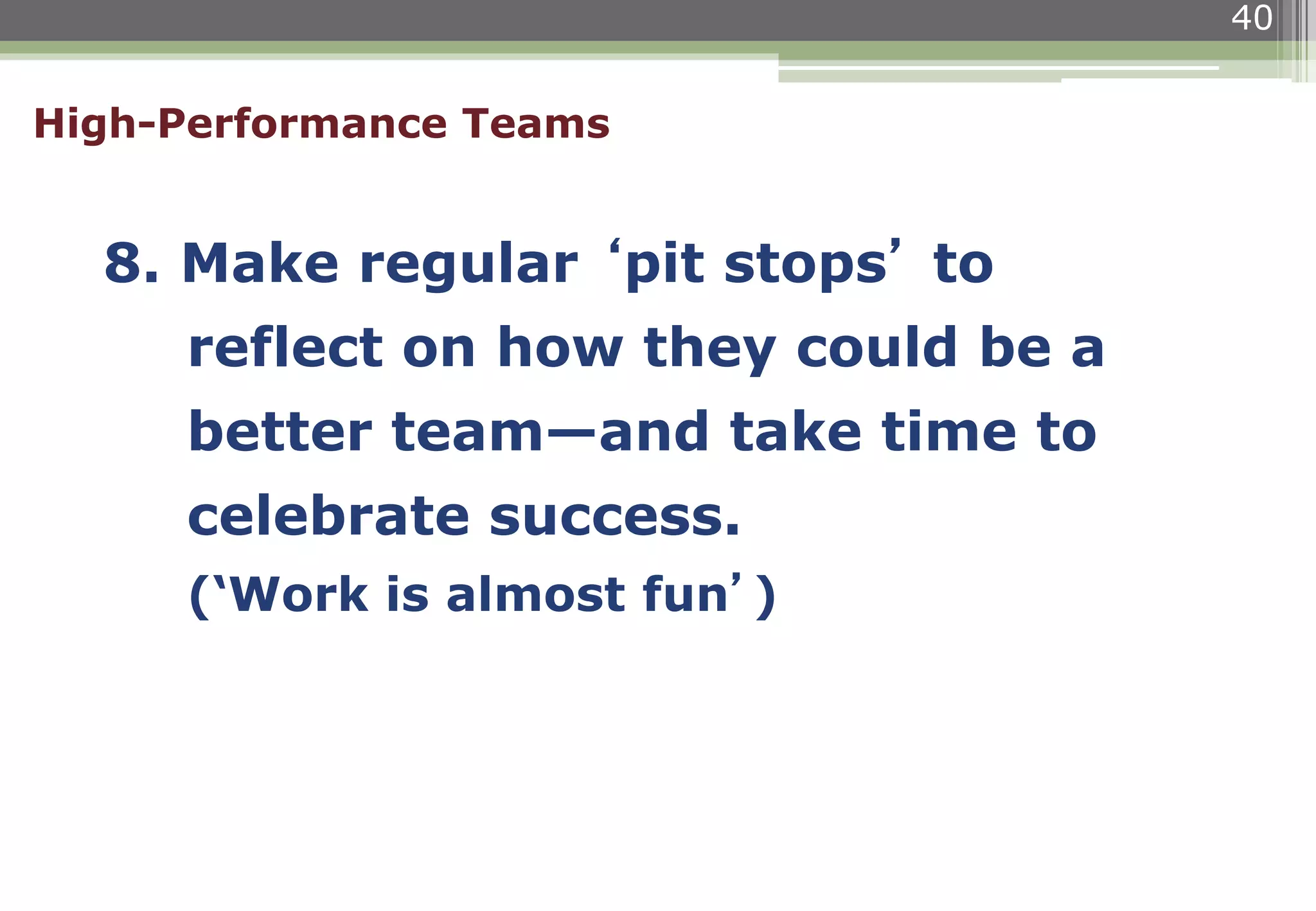
40
High-Performance Teams
8. Make regular ‘pit stops’ to
reflect on how they could be a
better team—and take time to
celebrate success.
(‘Work is almost fun’)
41
One thing we deserve to CELEBRATE:
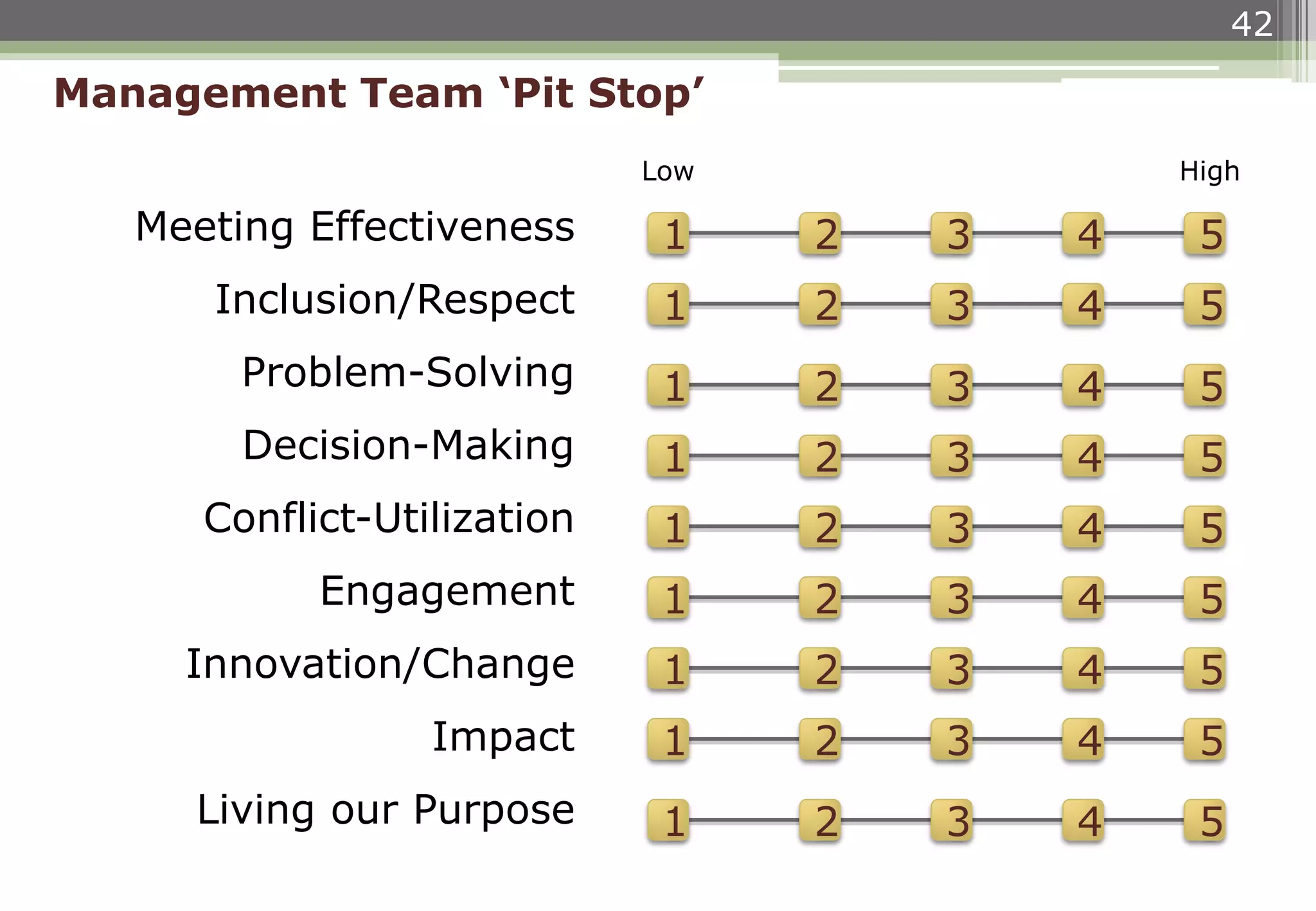
42
Meeting Effectiveness
Inclusion/Respect
Problem-Solving
Decision-Making
Conflict-Utilization
Engagement
Innovation/Change
Impact
Living our Purpose
Management Team ‘Pit Stop’
1 2 3 4 5
Low High
1 2 3 4 5
1 2 3 4 5
1 2 3 4 5
1 2 3 4 5
1 2 3 4 5
1 2 3 4 5
1 2 3 4 5
1 2 3 4 5
43
NOTES:
44
Scherer Leadership International
An international consortium of experienced
clients, consultants, coaches, change facilitators and
leadership development specialists committed to
transforming the world at work.™
John@SchererCenter.com
Amy@SchererCenter.com
Brought to You by Change Leaders
A non-governmental organization bringing together people who
want to change the world for the better, smarter and more beautiful
through business.
contact@change-leaders.org
www.change-leaders.org

John scherer: how to launch changes in a workplace and create better business

  • 1.
  • 2.
  • 3.
    3 The Life Cycleof Development EMBRYONIC GROWTH DECLINEMATURE Why Organizations Have to Change • Unstable • Chaotic • Creative Energy • Experimentation • Mistakes are OK • Innovative, risk- taking leaders needed • Focus: Finding the right ideas • More and better • Increased structure • Focused energy • Going with what works • Mistakes less OK • Entrepreneurial leaders needed • Focus: Building the team • Steady, stable • Highly organized • Controlled energy • Effectiveness • Mistakes not OK • Maintenance leaders needed • Focus: Keeping it going • Stagnant • Fear-driven • Conserved energy • Efficiency • Mistakes fatal • Salvage leaders needed • Focus: Turning it around
  • 4.
    4 The Breakthrough Curve EMBRYONICGROWTH DECLINEMATURE X Why Organizations Have to Change Everyone goes back to zero X
  • 5.
  • 6.
    6 The way workis planned: A B • Objectives, budgets, systems, synergies, organization charts, benchmarks, etc. Phase 1 As Is State To Be State Phase 2 Phase 3 Phase 4 • Flow charts, tracking systems, and progress reports used to ensure success. The ‘hard stuff’. . .
  • 7.
    7 The way thingsactually happen. . . Above the Waterline People trying hard to look committed B Future State A Present State The Human World People interacting to get the work done—or not Below the Waterline
  • 8.
  • 9.
  • 10.
    10 How present areyou for interactions? Where do you tend to operate? 0% 25% 50% 75% 100% THE Question: What am I missing? Deep Presence Half 'there' Mostly 'there' Pretending to be 'there' Out of it Engaged 110% Multi-Tasking
  • 11.
    11 Your Culture = Your‘Magnetic Field’
  • 12.
  • 13.
    13 Above the Waterline Objectiveperformance measures/KPIs B Future State A Present State Below the Waterline Effectiveness, decision-making, conflict-resolution, innovation, engagement, capacity, speed & quality The way things are measured…
  • 14.
    The High-Performance Team 14 Whatan HP-Team Looks Like in Action
  • 15.
  • 16.
    16 Characteristics of High-Performance Teams: 1.They have a clear sense of common purpose, embraced by everyone on the team. (Above & Below the Waterline)
  • 17.
    17 Business Goal(s): The Kind ofCompany We Want to Create:
  • 18.
    18 2. Create aclimate that fosters frank, challenging and respectful conversations. (‘Straight Talk’ and ‘Tough Love’) High-Performance Teams
  • 19.
    19 3. Have manydifferences of opinion (on HOW) which result in better decisions and stronger team spirit. (Conflict Utilization) High-Performance Teams
  • 20.
    Polarity Management 20 ‘Having YourCake and Eating it Too’ * Adapted with permission from the brilliant work of good friend and colleague, Barry Johnson, author of Polarity Management, HRD Press, 1997.
  • 21.
    21 • The humanmind is pre-set to choose, to prefer, to take a position (against another position), rather than embrace a more complex reality: polarity. • Many unresolved problems are actually polarities not being managed. • What you think are ‘either/or’ situations may in fact be ‘both/and’ situations. • In a polarity, the more you emphasize one position (pole), the more important the other position (pole) becomes. • Rather than being ‘right’ or ‘wrong,’ all polarities have an up-side and a down-side. • People who have become ‘positional’ and locked in on one pole have lost access to the (crucial) up-side of the ‘enemy’ position. • Managing polarities requires the courage to acknowledge the down-side of your preferred position and the up-side of the other pole. Principles of Polarity Management From Barry Johnson
  • 22.
  • 23.
  • 24.
  • 25.
  • 26.
    26 4. The seniorleader present does not control the meeting, but works for consensus whenever possible. (The Decision-Making Continuum) High-Performance Teams
  • 27.
    27 Use of authorityby the LEADER or ‘Boss’ Authority of the TEAM 1 2 3 4 5 6 We do what the Manager TELLS us to do without discussion. The Manager SELLS us on what needs to be done. The Manager JOINS us in thinking through the problem and the decision: CONSENSUS. We RECOMMEND what to do, subject to the Manager’s approval. We are FREE to take action as we see fit, informing the Manager what we have done. The Manager PRESENTS a tentative decision, which we give input on. Adapted from Tannenbaum & Schmidt, 1953. The Decision-Making Continuum
  • 28.
    28 5. Designate anSPA (Single Person Accountable) for all important decisions, with a ‘By- when’ attached. (‘Who is going to make sure this happens -- and by when?’) High-Performance Teams
  • 29.
    29 6. Different individual‘Gifts’ on the team are welcomed and utilized— and people ‘Stretch’ beyond their comfort zone. (We all matter and are in development) High-Performance Teams
  • 30.
    P A EI: Four Workplace ‘Languages’ 30 Worldviews at Work: Sources of Influence
  • 31.
    31 Potential Polarities What People‘Fight’ About Faster Slower Details Big Picture Process Output Structured Unstructured
  • 32.
    Four Workplace ‘Languages’ 32 Producer (Pusher) Administrator (Analytical) Entrepreneur (Expressive) Integrator (Interpersonal) Perspective DetailsBig Picture Comfort Mode Structured Unstructured TopPriority Pace * Adapted from Ichak Adizes’ Solving the Mismanagement Crisis and David Merrill’s Social Styles. P E A I
  • 33.
    What People Needto Hear First 33 Perspective Details Big Picture Comfort Mode Structured Unstructured TopPriority Pace P E A I WHAT? WHY NOT? HOW? WHO?
  • 34.
    34 When Working With Entrepreneur/Experimenter 1.Move along, show them 'the big idea,' the big picture, the big possibility. 2. Present general ideas--details when asked. 3. Give them ample opportunity to contribute. 4. Take their commitments with 'a grain of salt.' They’re probably based on their enthusiasm of the moment. 5. Use testimonials and success stories, if you disagree, or want to convince/motivate. 6. Take time on your own to work out the details. 7. Find out where they are in their decision process and finalize decisions made. 8. Write a follow-up letter to confirm decisions. 9. Make sure things are exciting. From the work of: Ichak Adizes and David Merrill When Working With Producer/Pusher 1. Get down to business quickly. 2. Identify 'objectives of this meeting.' 3. Move at a fast pace--be precise and efficient; let them set the agenda or make a decision as early as possible. 4. When delegating, be specific: clarify-- who, what, by when, how. 5. Stay business-like. 6. Recognize their ideas, accomplishments, and work effort. 7. Tell them what the results, the outcomes of the activity will be, in terms of their objectives. 8. Make sure things move forward in their direction.
  • 35.
    35 When Working With Administrator/Analytical 1.Think about how to minimize risk. 2. Do not rush or force rapid decisions. 3. Be prepared with facts, present systematically. 4. Present facts, not opinions, to convince or motivate. 5. Get all objections/data needs out early. 6. Provide for guarantees, methods of lowering risk. 7. Avoid gimmicks. Be more formal than informal. 8. Support with actions--not words. 9. Tell them where it has been done already and how it turned out. 10. Make sure things are organized & accurate. From the work of: Ichak Adizes and David Merrill When Working With Integrator/Interpersonal 1. Warm up, show genuine interest in them as a person. 2. Don’t rush-don’t try to force rapid decisions. 3. Take time to connect with their personal objectives and needs/feelings. 4. Listen actively. 5. When have to make a rapid decision, take time to explore areas of potential misunderstanding. 6. If you disagree--or want to motivate-- discuss opinions and feelings of those involved. 7. Give personal commitment of support when delegating. 8. Be sure others have already agreed; build a support base first. 9. Make sure things are safe.
  • 36.
  • 37.
    37 7. Look forthe ‘nugget’ inside ‘wild ideas’ to create competitive advantage. (Risking ‘Outside the Box’) High-Performance Teams
  • 38.
    38 One ‘wild idea’we want ‘The Old-Timers’ to adopt: ‘New People’ Group:
  • 39.
    39 What do weneed to do to make this idea happen/work: ‘Old Timers’ Group: What is the ‘Golden Nugget’ in this idea we really LIKE:
  • 40.
    40 High-Performance Teams 8. Makeregular ‘pit stops’ to reflect on how they could be a better team—and take time to celebrate success. (‘Work is almost fun’)
  • 41.
    41 One thing wedeserve to CELEBRATE:
  • 42.
    42 Meeting Effectiveness Inclusion/Respect Problem-Solving Decision-Making Conflict-Utilization Engagement Innovation/Change Impact Living ourPurpose Management Team ‘Pit Stop’ 1 2 3 4 5 Low High 1 2 3 4 5 1 2 3 4 5 1 2 3 4 5 1 2 3 4 5 1 2 3 4 5 1 2 3 4 5 1 2 3 4 5 1 2 3 4 5
  • 43.
  • 44.
    44 Scherer Leadership International Aninternational consortium of experienced clients, consultants, coaches, change facilitators and leadership development specialists committed to transforming the world at work.™ John@SchererCenter.com Amy@SchererCenter.com
  • 45.
    Brought to Youby Change Leaders A non-governmental organization bringing together people who want to change the world for the better, smarter and more beautiful through business. contact@change-leaders.org www.change-leaders.org