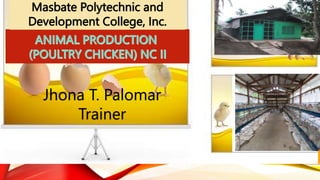
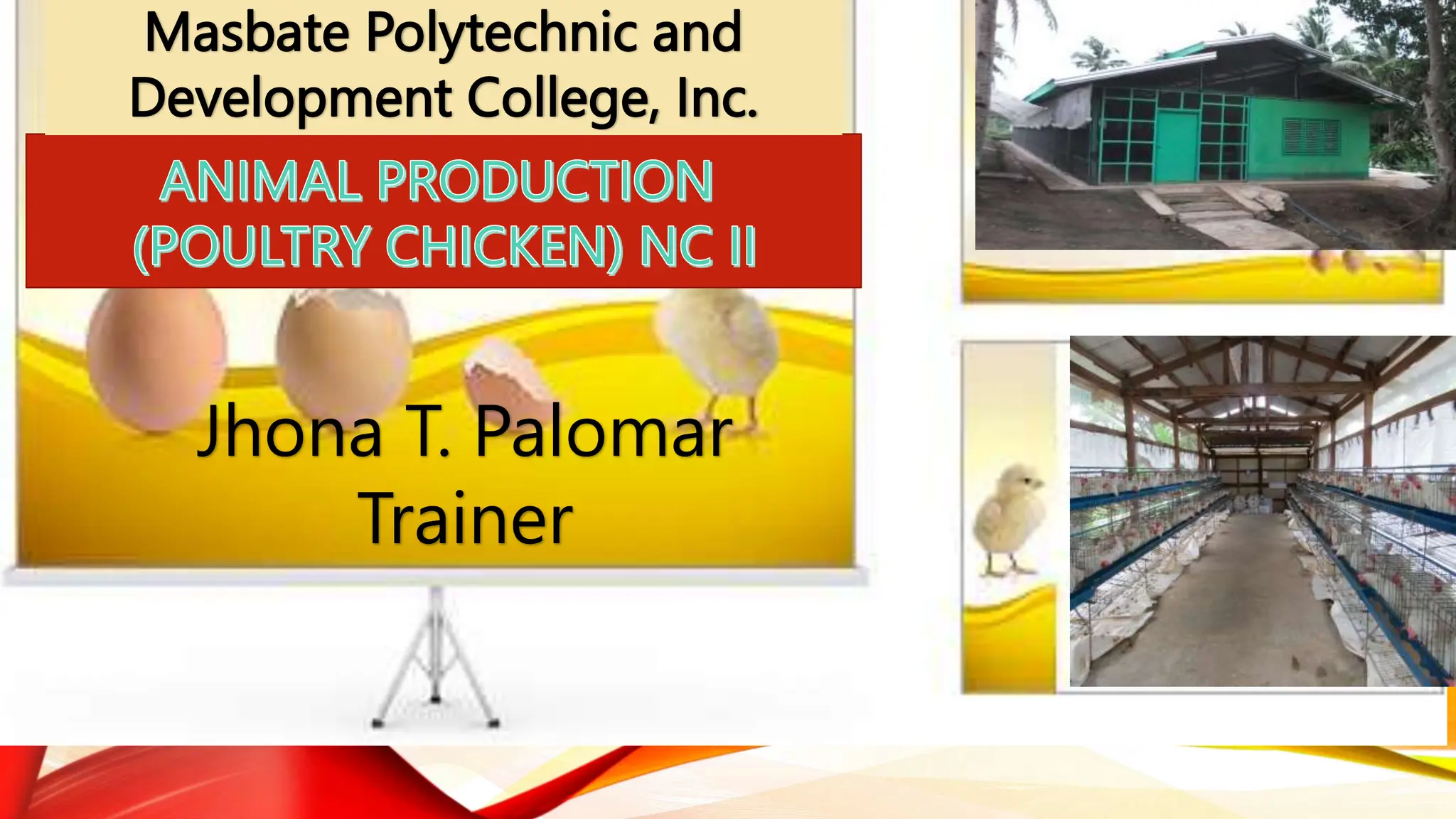
Jhona T. Palomar
Trainer
Masbate Polytechnic and
Development College, Inc.
WELCOME!!!
MASBATE POLYTECHNIC AND
DEVELOPMENT COLLEGE, INC.
Masbate Polytechnic and Development College, formerly, Masbate Polytechnic School was established in 2009 as a non-stock
non-profit educational institution.
Prior to its conception, Zettabyte, the first computer shop in the municipality of Baleno, was conducting computer literacy
training programs to some learners and professionals in the community. The shop owner, an educator, believing that “human
resource is the greatest wealth of the nation and that the best legacy to bequest to them is training and education”, had
partnered with some of his fellow educators in establishing the TechVoc School with its initial TESDA course Computer
Hardware Servicing NC-II. Eventually, Zettabyte was closed and since then computers were used by the school in the conduct of
training and education.
In 2011, the school had faced tough trials, particularly in its financial aspect. Majority of its incorporators became inactive, thus
in 2012 had withdrawn their shares and resigned in their positions.
Family members and friends became instrumental in the continuance of the advocacy and with their encouragement and
support, the school was revitalized and new programs were applied focusing on agriculture and garment sectors.
In 2014, its former name was amended. It was transformed into a college and was granted by the Commission on Higher
Education an initial permit to operate a four-year degree course- Bachelor of Agricultural Technology (BAT) Ladderized, the first
degree course offered in the province of Masbate.
Since its start of operation to the present, the school has been producing and continues to produce tech-voc graduates. Their
knowledge, skills and attitudes learned become their passport in landing jobs, of becoming entrepreneurs and of being
productive citizens of the community. Hence, the school gratefully recognizes those who had helped and contributed and those
who are continuously supporting, sharing their time and talent in the continuance of its advocacy to educate, train and develop
human resources especially the less-privileged ones.
Masbate Polytechnic and Development
College, Inc. continuously produces God-
fearing, value-oriented, competent and
productive citizens. As an educational
institution, it is constantly responsive to
local and global trends and challenges in
education, training and career development.
To provide affordable and quality basic, technical-vocational and tertiary
education in collaboration with government, non-government and private
institutions where:
students learn lifelong competencies, moral and spiritual values in a
motivating environment;
teachers facilitate learning, constantly care for learners and nurture
their potentials;
school managers ensure a safe, supportive and effective learning
environment;
families and communities are proactively involved in developing
life-long learners.
WHAT IS CBT?
•Competency Based Training (CBT) is
a training delivery approach that
focuses on the Competency
development of the learner as a
result of the training
PRINCIPLES OF CBT
PRINCIPLES OF CBT
The training is based on curriculum
developed from the competency
standards
All activities are done towards the attainment
of the assessment criteria set in the
competency based curriculum
Learning is modular in structure
A trainee should be competent in the module
currently being trained before going to other
competency
The CBLM (Competency Based Learning Material)
shall server as main material & guide in training
Training delivery is learner centered and should
accommodate individualized and self paced
learning strategies
Trainees are treated as individual learners with each own
characteristics, learning styles and training needs
Sessions will therefore provide for varied activities, employing diff.
methods of training
Learning materials provides immediate feedback on tasks
accomplished
Training is based on work that must be
performed
Training is always based on actual industry
practices
Training provides for a simulated work
environment
Training materials are directly related to
the competency standards and
curriculum modules
The CBLM used conforms to the competency based
curriculum and competency standards
Trainer periodically and methodologically session’s plan
and CBLMs if it still provide minimum requirements of the
competency
 Room for innovations apply
Assessment is based in the collection of
evidence of the performance of work to the
industry required standard
 Assessment is done to test whether the trainee is able to perform the job based
on the required criteria in the competency standard
 Evaluation tools are used to assess the competency of the trainee
 Graduates are not the basis of a trainees competency rather the satisfaction of
criteria/evidences collected
Training is based both on and off job
components
 Training is done in a simulated work
environment (the laboratory) and/or in
actual work environment
 Training cum production/enterprise based
training/supervised industry/on the job training
Training program allows for recognition of prior
learning (RPL)
Current competencies acquired through training or work
experience are recognized before training
Trainer provides activities to match current needs of
trainee
Paves way to a shortened duration of training and avoid
redundancy
Training allows for multiple entry and exits
Trainees do not need to wait for others to be
competent before he can exit either a competency
of a qualification
Fast learners graduates well ahead that others
Training programs are registered with UTPRAS
UTPRAS (Unified TVET Program Registration and
Accreditation System)
All programs must be registered with UTPRAS
UTPRAS registration assures the quality of training
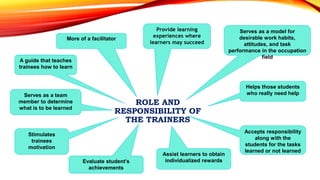
More of a facilitator
A guide that teaches
trainees how to learn
Serves as a team
member to determine
what is to be learned
Stimulates
trainees
motivation
Provide learning
experiences where
learners may succeed
Serves as a model for
desirable work habits,
attitudes, and task
performance in the occupation
field
Helps those students
who really need help
Accepts responsibility
along with the
students for the tasks
learned or not learned
ROLE AND
RESPONSIBILITY OF
THE TRAINERS
Assist learners to obtain
individualized rewards
Evaluate student’s
achievements
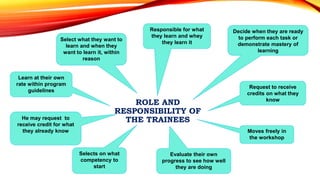
Select what they want to
learn and when they
want to learn it, within
reason
Learn at their own
rate within program
guidelines
He may request to
receive credit for what
they already know
Selects on what
competency to
start
Responsible for what
they learn and whey
they learn it
Decide when they are ready
to perform each task or
demonstrate mastery of
learning
Request to receive
credits on what they
know
Moves freely in
the workshop
ROLE AND
RESPONSIBILITY OF
THE TRAINEES
Evaluate their own
progress to see how well
they are doing
Competencies of
ANIMAL PRODUCTION (POULTRY
CHICKEN NC II)
The ANIMAL PRODUCTION (POULTRY
CHICKEN NC II) Qualification consists of
competencies that a person must achieve to
maintain poultry housing, brood and grow
chicks, perform pre-lay and lay activities and
trim beak.
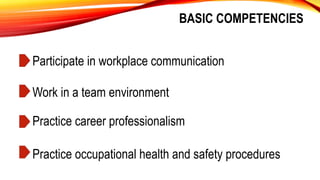
Participate in workplace communication
BASIC COMPETENCIES
Work in a team environment
Practice career professionalism
Practice occupational health and safety procedures
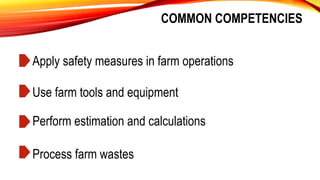
Apply safety measures in farm operations
COMMON COMPETENCIES
Use farm tools and equipment
Perform estimation and calculations
Process farm wastes
Maintain poultry house
CORE COMPETENCIES
Brood and grow chicks
Perform pre-lay and lay activities
Trim beak
Breed chicken
Daily attendance is a must.
Wearing of uniforms.
Wearing of IDs.
No cellphone allowed during training
Participate the class discussion
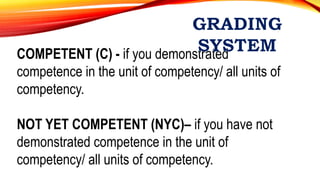
COMPETENT (C) - if you demonstrated
competence in the unit of competency/ all units of
competency.
NOT YET COMPETENT (NYC)– if you have not
demonstrated competence in the unit of
competency/ all units of competency.
It simply a well-designed and
carefully developed learning
materials that give trainees detailed
instructions to guide them through
the learning process.
Competency-Based Learning
Material (CBLM)
Information Sheet 2.4.1a
LIGHTING PROGRAM BASED ON INDUSTRY
STANDARD
Learning Objectives:
1. After reading this INFORMATION SHEET, YOU MUST be
able to:
2. Identify the different light bulb use in brooding, growing
and laying chicken
3. Enumerate the different lighting program based on
industry standard
4. Prepare installation of lighting fixture in brooding,
growing and laying house.
Bird Biology
Poultry Eyesight Sight is the most important
sense for birds, as good eyesight is essential for
safe flight, and birds have several adaptations
that provide superior visual acuity relative to
other vertebrate groups¹.
Lighting Options
Growers must understand the spectral composition of different light
sources to select the best lighting option for their operation. Sunlight,
Sunlight, incandescent lights, compact fluorescent lights, linear
fluorescent lights, or LEDs are all viable options depending on
location and farm design, though recently there has been an
increased interest in LEDs, as they prove to be safer and more energy
efficient.
Facilitate learning Session_ Delivery Learning Session Demonstration Trainers Methodology I

Facilitate learning Session_ Delivery Learning Session Demonstration Trainers Methodology I

  • 1.
    Jhona T. Palomar Trainer MasbatePolytechnic and Development College, Inc.
  • 2.
  • 4.
    Masbate Polytechnic andDevelopment College, formerly, Masbate Polytechnic School was established in 2009 as a non-stock non-profit educational institution. Prior to its conception, Zettabyte, the first computer shop in the municipality of Baleno, was conducting computer literacy training programs to some learners and professionals in the community. The shop owner, an educator, believing that “human resource is the greatest wealth of the nation and that the best legacy to bequest to them is training and education”, had partnered with some of his fellow educators in establishing the TechVoc School with its initial TESDA course Computer Hardware Servicing NC-II. Eventually, Zettabyte was closed and since then computers were used by the school in the conduct of training and education. In 2011, the school had faced tough trials, particularly in its financial aspect. Majority of its incorporators became inactive, thus in 2012 had withdrawn their shares and resigned in their positions. Family members and friends became instrumental in the continuance of the advocacy and with their encouragement and support, the school was revitalized and new programs were applied focusing on agriculture and garment sectors. In 2014, its former name was amended. It was transformed into a college and was granted by the Commission on Higher Education an initial permit to operate a four-year degree course- Bachelor of Agricultural Technology (BAT) Ladderized, the first degree course offered in the province of Masbate. Since its start of operation to the present, the school has been producing and continues to produce tech-voc graduates. Their knowledge, skills and attitudes learned become their passport in landing jobs, of becoming entrepreneurs and of being productive citizens of the community. Hence, the school gratefully recognizes those who had helped and contributed and those who are continuously supporting, sharing their time and talent in the continuance of its advocacy to educate, train and develop human resources especially the less-privileged ones.
  • 5.
    Masbate Polytechnic andDevelopment College, Inc. continuously produces God- fearing, value-oriented, competent and productive citizens. As an educational institution, it is constantly responsive to local and global trends and challenges in education, training and career development.
  • 6.
    To provide affordableand quality basic, technical-vocational and tertiary education in collaboration with government, non-government and private institutions where: students learn lifelong competencies, moral and spiritual values in a motivating environment; teachers facilitate learning, constantly care for learners and nurture their potentials; school managers ensure a safe, supportive and effective learning environment; families and communities are proactively involved in developing life-long learners.
  • 7.
    WHAT IS CBT? •CompetencyBased Training (CBT) is a training delivery approach that focuses on the Competency development of the learner as a result of the training
  • 8.
  • 9.
    PRINCIPLES OF CBT Thetraining is based on curriculum developed from the competency standards All activities are done towards the attainment of the assessment criteria set in the competency based curriculum
  • 10.
    Learning is modularin structure A trainee should be competent in the module currently being trained before going to other competency The CBLM (Competency Based Learning Material) shall server as main material & guide in training
  • 11.
    Training delivery islearner centered and should accommodate individualized and self paced learning strategies Trainees are treated as individual learners with each own characteristics, learning styles and training needs Sessions will therefore provide for varied activities, employing diff. methods of training Learning materials provides immediate feedback on tasks accomplished
  • 12.
    Training is basedon work that must be performed Training is always based on actual industry practices Training provides for a simulated work environment
  • 13.
    Training materials aredirectly related to the competency standards and curriculum modules The CBLM used conforms to the competency based curriculum and competency standards Trainer periodically and methodologically session’s plan and CBLMs if it still provide minimum requirements of the competency  Room for innovations apply
  • 14.
    Assessment is basedin the collection of evidence of the performance of work to the industry required standard  Assessment is done to test whether the trainee is able to perform the job based on the required criteria in the competency standard  Evaluation tools are used to assess the competency of the trainee  Graduates are not the basis of a trainees competency rather the satisfaction of criteria/evidences collected
  • 15.
    Training is basedboth on and off job components  Training is done in a simulated work environment (the laboratory) and/or in actual work environment  Training cum production/enterprise based training/supervised industry/on the job training
  • 16.
    Training program allowsfor recognition of prior learning (RPL) Current competencies acquired through training or work experience are recognized before training Trainer provides activities to match current needs of trainee Paves way to a shortened duration of training and avoid redundancy
  • 17.
    Training allows formultiple entry and exits Trainees do not need to wait for others to be competent before he can exit either a competency of a qualification Fast learners graduates well ahead that others
  • 18.
    Training programs areregistered with UTPRAS UTPRAS (Unified TVET Program Registration and Accreditation System) All programs must be registered with UTPRAS UTPRAS registration assures the quality of training
  • 19.
    More of afacilitator A guide that teaches trainees how to learn Serves as a team member to determine what is to be learned Stimulates trainees motivation Provide learning experiences where learners may succeed Serves as a model for desirable work habits, attitudes, and task performance in the occupation field Helps those students who really need help Accepts responsibility along with the students for the tasks learned or not learned ROLE AND RESPONSIBILITY OF THE TRAINERS Assist learners to obtain individualized rewards Evaluate student’s achievements
  • 20.
    Select what theywant to learn and when they want to learn it, within reason Learn at their own rate within program guidelines He may request to receive credit for what they already know Selects on what competency to start Responsible for what they learn and whey they learn it Decide when they are ready to perform each task or demonstrate mastery of learning Request to receive credits on what they know Moves freely in the workshop ROLE AND RESPONSIBILITY OF THE TRAINEES Evaluate their own progress to see how well they are doing
  • 22.
    Competencies of ANIMAL PRODUCTION(POULTRY CHICKEN NC II)
  • 23.
    The ANIMAL PRODUCTION(POULTRY CHICKEN NC II) Qualification consists of competencies that a person must achieve to maintain poultry housing, brood and grow chicks, perform pre-lay and lay activities and trim beak.
  • 24.
    Participate in workplacecommunication BASIC COMPETENCIES Work in a team environment Practice career professionalism Practice occupational health and safety procedures
  • 25.
    Apply safety measuresin farm operations COMMON COMPETENCIES Use farm tools and equipment Perform estimation and calculations Process farm wastes
  • 26.
    Maintain poultry house CORECOMPETENCIES Brood and grow chicks Perform pre-lay and lay activities Trim beak Breed chicken
  • 27.
    Daily attendance isa must. Wearing of uniforms. Wearing of IDs. No cellphone allowed during training Participate the class discussion
  • 28.
    COMPETENT (C) -if you demonstrated competence in the unit of competency/ all units of competency. NOT YET COMPETENT (NYC)– if you have not demonstrated competence in the unit of competency/ all units of competency.
  • 29.
    It simply awell-designed and carefully developed learning materials that give trainees detailed instructions to guide them through the learning process. Competency-Based Learning Material (CBLM)
  • 30.
    Information Sheet 2.4.1a LIGHTINGPROGRAM BASED ON INDUSTRY STANDARD Learning Objectives: 1. After reading this INFORMATION SHEET, YOU MUST be able to: 2. Identify the different light bulb use in brooding, growing and laying chicken 3. Enumerate the different lighting program based on industry standard 4. Prepare installation of lighting fixture in brooding, growing and laying house.
  • 31.
    Bird Biology Poultry EyesightSight is the most important sense for birds, as good eyesight is essential for safe flight, and birds have several adaptations that provide superior visual acuity relative to other vertebrate groups¹.
  • 32.
    Lighting Options Growers mustunderstand the spectral composition of different light sources to select the best lighting option for their operation. Sunlight, Sunlight, incandescent lights, compact fluorescent lights, linear fluorescent lights, or LEDs are all viable options depending on location and farm design, though recently there has been an increased interest in LEDs, as they prove to be safer and more energy efficient.