ANALYN N. CENITA, MVE
Presenter
BARTENDING NC II
QUALIFICATION
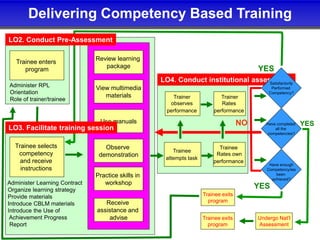
Delivering Competency Based Training
Have enough
Competency/ies
been
achieved?
YES
YES
Trainee exits
program
Trainer
observes
performance
Trainee
attempts task
Trainee
Rates own
performance
Trainer
Rates
performance
Trainee enters
program
Administer RPL
Orientation
Role of trainer/trainee
Trainee selects
competency
and receive
instructions
Administer Learning Contract
Organize learning strategy
Provide materials
Introduce CBLM materials
Introduce the Use of
Achievement Progress
Report
Review learning
package
View multimedia
materials
Use manuals
Observe
demonstration
Practice skills in
workshop
Receive
assistance and
advise
NO YES
Trainee exits
program
Have completed
all the
competencies?
LO2. Conduct Pre-Assessment
LO4. Conduct institutional assessment
LO3. Facilitate training session
Satisfactorily
Performed
Competency?
Undergo Nat’l
Assessment
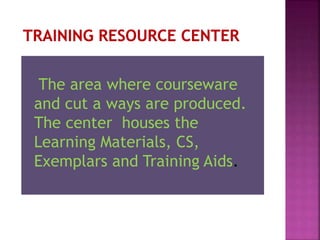
The area where courseware
and cut a ways are produced.
The center houses the
Learning Materials, CS,
Exemplars and Training Aids.
This is the heart of the Training
Delivery where the Learning is expected
to acquire the skills/knowledge of the
competencies prescribed by the
standard. It satisfies the conditions
needed in the provision of specific
learning outcomes. Only the critical
equipment are found in the area.
The facility ensures that the
underpinning knowledge, i.e.
science, math and communication
principles as applied to the
technology are provided to the
learner. It is accessible not only to
the DAC learner but to everyone in
the Center.
This area provides the learner with
the knowledge requirements in the
various modules responding to the
competencies since it has an array of
Multimedia materials that enables
project planning. It is a computer-
aided facility linked to the TRC.
The component provides
value-adding competencies
as per identified
underpinning skill in the
competency.
This component provides
opportunity in the acquisition of
appropriate IT competencies as
prescribed in the CS and the
CBC. The computer units are
ideally in a LAN environment
hooked to an instruments access.
The area ensures that the various
inputs in the delivery of training are
well maintained and in good order.
Various tests are conducted here
including in-process QC. It manages
quality and facilities implementation
of the developed QA System towards
Quality Accreditation.
This area, situated away from the
center, answers the issue of learning
accessibility and flexibility. It enables
the acquisition of competency
regardless of time and space thru
multimedia delivery. It heavily relies
on the institutional assessment and
LRA.
This area is computer-based
facility that provides mechanism
in assessing the completion of
competencies and Recognition
of Prior Learning (RPL).It houses
and managed individual records
in which written and portfolio
assessment are conducted.
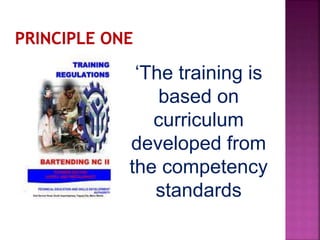
‘The training is
based on
curriculum
developed from
the competency
standards
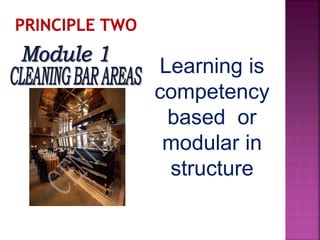
Learning is
competency
based or
modular in
structure
Training delivery is
individualized
and self-paced
Learning is done by the
learner at their own pace
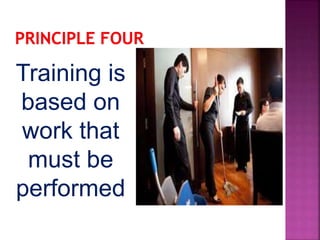
Training is
based on
work that
must be
performed
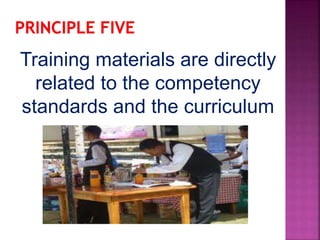
Training materials are directly
related to the competency
standards and the curriculum
Assessment of learners is based in
the collection of evidence of the
performance of work to the industry or
organizational required standards
Students are judged
againts each other
(norm referenced
Assessment)
Each student is
assessed against
the required
standard
Traditional
Students are not judged against each other
Training is based both on and
off the job components
Learners are aware of the activities that
has to be completed based on the
curriculum
The system allows Recognition
of Prior Learning (RPL)
Workers and Students can have prior
skills recognized towards awards
competencies
gained in
life or work
Competencies
assessed
And
Accredited
For
Promotion
and learning
RPL
The system allows for learners to
enter and exit programs at
different times and levels and to
receive an award for modules
(competencies) attained at any
point (Multiple Entry)
There is flexibility for entry
and exit from programs
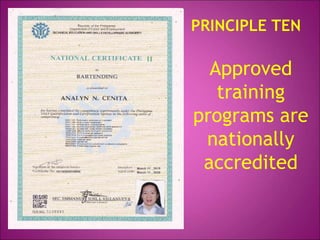
Approved
training
programs are
nationally
accredited
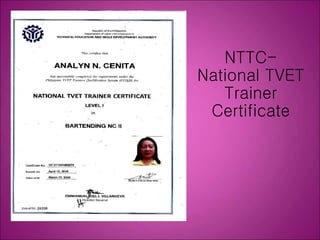
NTTC-
National TVET
Trainer
Certificate
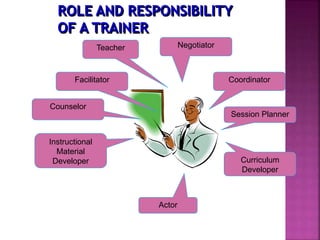
Teacher Negotiator
Facilitator Coordinator
Curriculum
Developer
Instructional
Material
Developer
Counselor
Actor
Session Planner
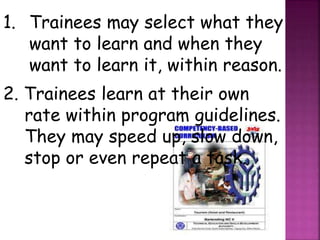
1. Trainees may select what they
want to learn and when they
want to learn it, within reason.
2. Trainees learn at their own
rate within program guidelines.
They may speed up, slow down,
stop or even repeat a task.
5. Trainees are responsible for
what they learn and when
they learn it.
6. Trainees decide when they
are ready to perform each
task or demonstrate mastery
of learning to a job-like level
of proficiency before
receiving credit for the task.
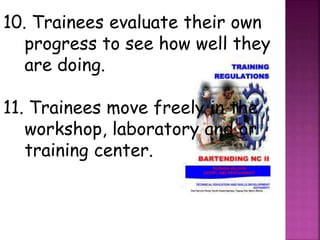
10. Trainees evaluate their own
progress to see how well they
are doing.
11. Trainees move freely in the
workshop, laboratory and or
training center.
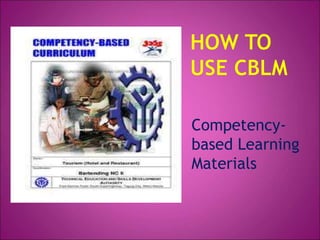
Competency-
based Learning
Materials
Types of Instruction Sheets
Information Sheet
Self-check
Task Sheet
Performance Criteria
Checklist
Job Sheet
Benefits of Instruction Sheets
Useful when students miss a
lesson
Useful when content is not
available in textbook, manuals,
etc.
Helpful in ensuring that the
learners remember the required
information
METHOD OF ASSESSMENT
Observation
Questioning
Third party Report
Demonstration
Portfolio
RESULT OF THE
ASSESSMENT
•C – COMPETENT
• NYC – NOT YET
COMPETENT
Student Name
Unit of Competency/Module Title
Clean Bar
Areas Operate Bar
Prepare/mix
cocktail and
non-alcoholic
drinks
Provide Wine Service
LO1 LO2 LO1 LO2 LO3 LO4 LO5 LO1 LO2 LO3 LO1 LO2 L
O
3
LO
4
LO5
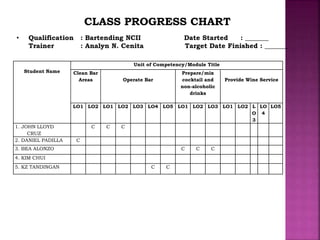
1. JOHN LLOYD
CRUZ
C C C
2. DANIEL PADILLA C
3. BEA ALONZO C C C
4. KIM CHUI
5. KZ TANDINGAN C C
CLASS PROGRESS CHART
• Qualification : Bartending NCII Date Started : _______
Trainer : Analyn N. Cenita Target Date Finished : _______
Republic of the Philippines
Technical Education and Skills Development Authority
CARMELO C. DE LOS CIENTOS SR. NATIONAL TRADE SCHOOL
Padada, Davao del Sur
Telefax -082-272-0295, email address:ccnts11@yahoo.com.ph
IDENTIFI
CATION
GARNISH
SENSORY
FLAIRING
SINGLE
FLAIRING
DOUBLE
MEMORY
MISE
EN
PLACE
MIXING
PRESENT
GLASS
UC
1
UC
2
UC
3
UC
4
OPENING
WINE
W/
CORK
CARRYIN
G
LOADED
BAR
TRAY
Final
Flairing
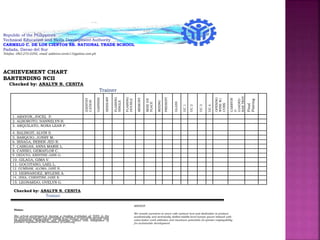
1. ABAYON, JOCEL P.
2. ALBOROTO, HANNELYN B.
3. ARQUILATO, NONA LEAN P.
4. BALINGIT, ALVIN S.
5. BARQUIO, JONRY M.
6. BISAGA, BEBER JED R.
7. CABIGAS, ANNA MARIE L.
8. CANSIO, GEMAFLOR C.
9. DEDUYO, KRISTINE JANE G.
10. GILAGA, GIMA V.
11. GOCOTANO, LAEL L.
12. GUMBAM, ALOMA JANE R.
13. HERNANDEZ, MYLENE A.
14. JERA, CHRISTINE JANE R.
15. LEONARDO, OVELYN G.
ACHIEVEMENT CHART
BARTENDING NCII
Checked by: ANALYN N. CENITA
Trainer
Checked by: ANALYN N. CENITA
Trainer
Vision:
The school envisioned to become a leading institution of TVET in the
Province of Davao del Sur committed to enhance sustainable development
by producing highly-trained middle-level human power endowed with
entrepreneurial inclination and desirable values with integration of
partners cognizant to the mandates of authority.
MISSION
We commit ourselves to serve with outmost love and dedication to produce
academically and technically skilled middle-level human power imbued with
value-laden work attitudes and maximum potentials for greater employability
for sustainable development
Vision:
The school envisioned to
become a leading institution
of TVET in the Province of
Davao del Sur committed to
enhance sustainable
development by producing
highly-trained middle-level
human power endowed with
entrepreneurial inclination
and desirable values with
integration of partners
cognizant to the mandates of
authority.
Mission
We commit ourselves to serve
with utmost love and dedication
to produce academically and
technically skilled middle-level
human power imbued with
value-laden work attitudes and
maximum potentials for greater
employability for sustainable
development
Goals
1. To strengthen the post-
secondary curriculum
ensuring efficient and
effective implementation of
quality TVET programs;
2. To promote and encourage
complimentary roles of
public institutions in the
locality;
3. To widen the areas of
coverage of community-based
training education;
4. To inculcate desirable
values through the upliftment
of moral character with
emphasis on work
values/ethics, self-reliance
and self-discipline to ensure
the employability and
entrepreneurial capability of
graduates;
5. To establish a monitoring
system that would assess the
employment and
entrepreneurial status of
graduates;
BARTENDING NC II QUALIFICATION
BASIC COMPETENCIES
• Participate in workplace
communication
• Work in a team environment
• Practice career professionalism
• Practice occupational health
and safety procedures
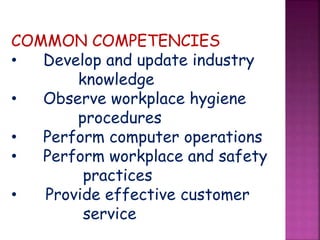
COMMON COMPETENCIES
• Develop and update industry
knowledge
• Observe workplace hygiene
procedures
• Perform computer operations
• Perform workplace and safety
practices
• Provide effective customer
service
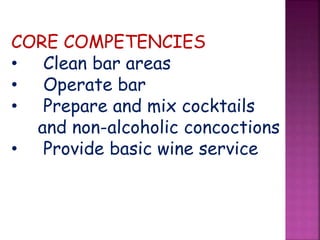
CORE COMPETENCIES
• Clean bar areas
• Operate bar
• Prepare and mix cocktails
and non-alcoholic concoctions
• Provide basic wine service
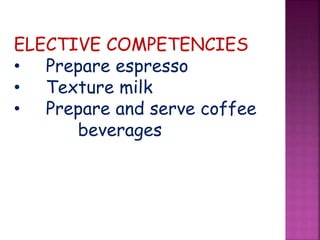
ELECTIVE COMPETENCIES
• Prepare espresso
• Texture milk
• Prepare and serve coffee
beverages
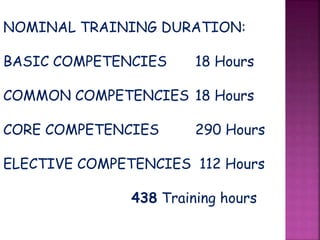
NOMINAL TRAINING DURATION:
BASIC COMPETENCIES 18 Hours
COMMON COMPETENCIES 18 Hours
CORE COMPETENCIES 290 Hours
ELECTIVE COMPETENCIES 112 Hours
438 Training hours
•BARTENDER/BARKEEPER
• BAR UTILITY
Performance Criteria
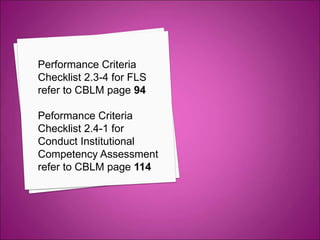
Checklist 2.3-4 for FLS
refer to CBLM page 94
Peformance Criteria
Checklist 2.4-1 for
Conduct Institutional
Competency Assessment
refer to CBLM page 114
GOOD LUCK
and
GOD BLESS

facilitate learning session sample for learners

  • 1.
    ANALYN N. CENITA,MVE Presenter
  • 2.
  • 3.
    Delivering Competency BasedTraining Have enough Competency/ies been achieved? YES YES Trainee exits program Trainer observes performance Trainee attempts task Trainee Rates own performance Trainer Rates performance Trainee enters program Administer RPL Orientation Role of trainer/trainee Trainee selects competency and receive instructions Administer Learning Contract Organize learning strategy Provide materials Introduce CBLM materials Introduce the Use of Achievement Progress Report Review learning package View multimedia materials Use manuals Observe demonstration Practice skills in workshop Receive assistance and advise NO YES Trainee exits program Have completed all the competencies? LO2. Conduct Pre-Assessment LO4. Conduct institutional assessment LO3. Facilitate training session Satisfactorily Performed Competency? Undergo Nat’l Assessment
  • 5.
    The area wherecourseware and cut a ways are produced. The center houses the Learning Materials, CS, Exemplars and Training Aids.
  • 6.
    This is theheart of the Training Delivery where the Learning is expected to acquire the skills/knowledge of the competencies prescribed by the standard. It satisfies the conditions needed in the provision of specific learning outcomes. Only the critical equipment are found in the area.
  • 7.
    The facility ensuresthat the underpinning knowledge, i.e. science, math and communication principles as applied to the technology are provided to the learner. It is accessible not only to the DAC learner but to everyone in the Center.
  • 8.
    This area providesthe learner with the knowledge requirements in the various modules responding to the competencies since it has an array of Multimedia materials that enables project planning. It is a computer- aided facility linked to the TRC.
  • 9.
    The component provides value-addingcompetencies as per identified underpinning skill in the competency.
  • 10.
    This component provides opportunityin the acquisition of appropriate IT competencies as prescribed in the CS and the CBC. The computer units are ideally in a LAN environment hooked to an instruments access.
  • 11.
    The area ensuresthat the various inputs in the delivery of training are well maintained and in good order. Various tests are conducted here including in-process QC. It manages quality and facilities implementation of the developed QA System towards Quality Accreditation.
  • 12.
    This area, situatedaway from the center, answers the issue of learning accessibility and flexibility. It enables the acquisition of competency regardless of time and space thru multimedia delivery. It heavily relies on the institutional assessment and LRA.
  • 13.
    This area iscomputer-based facility that provides mechanism in assessing the completion of competencies and Recognition of Prior Learning (RPL).It houses and managed individual records in which written and portfolio assessment are conducted.
  • 15.
    ‘The training is basedon curriculum developed from the competency standards
  • 16.
  • 17.
    Training delivery is individualized andself-paced Learning is done by the learner at their own pace
  • 18.
    Training is based on workthat must be performed
  • 19.
    Training materials aredirectly related to the competency standards and the curriculum
  • 20.
    Assessment of learnersis based in the collection of evidence of the performance of work to the industry or organizational required standards Students are judged againts each other (norm referenced Assessment) Each student is assessed against the required standard Traditional Students are not judged against each other
  • 21.
    Training is basedboth on and off the job components Learners are aware of the activities that has to be completed based on the curriculum
  • 22.
    The system allowsRecognition of Prior Learning (RPL) Workers and Students can have prior skills recognized towards awards competencies gained in life or work Competencies assessed And Accredited For Promotion and learning RPL
  • 23.
    The system allowsfor learners to enter and exit programs at different times and levels and to receive an award for modules (competencies) attained at any point (Multiple Entry) There is flexibility for entry and exit from programs
  • 24.
  • 25.
  • 27.
  • 29.
    1. Trainees mayselect what they want to learn and when they want to learn it, within reason. 2. Trainees learn at their own rate within program guidelines. They may speed up, slow down, stop or even repeat a task.
  • 30.
    5. Trainees areresponsible for what they learn and when they learn it. 6. Trainees decide when they are ready to perform each task or demonstrate mastery of learning to a job-like level of proficiency before receiving credit for the task.
  • 31.
    10. Trainees evaluatetheir own progress to see how well they are doing. 11. Trainees move freely in the workshop, laboratory and or training center.
  • 32.
  • 33.
    Types of InstructionSheets Information Sheet Self-check Task Sheet Performance Criteria Checklist Job Sheet
  • 34.
    Benefits of InstructionSheets Useful when students miss a lesson Useful when content is not available in textbook, manuals, etc. Helpful in ensuring that the learners remember the required information
  • 35.
    METHOD OF ASSESSMENT Observation Questioning Thirdparty Report Demonstration Portfolio
  • 36.
    RESULT OF THE ASSESSMENT •C– COMPETENT • NYC – NOT YET COMPETENT
  • 37.
    Student Name Unit ofCompetency/Module Title Clean Bar Areas Operate Bar Prepare/mix cocktail and non-alcoholic drinks Provide Wine Service LO1 LO2 LO1 LO2 LO3 LO4 LO5 LO1 LO2 LO3 LO1 LO2 L O 3 LO 4 LO5 1. JOHN LLOYD CRUZ C C C 2. DANIEL PADILLA C 3. BEA ALONZO C C C 4. KIM CHUI 5. KZ TANDINGAN C C CLASS PROGRESS CHART • Qualification : Bartending NCII Date Started : _______ Trainer : Analyn N. Cenita Target Date Finished : _______
  • 38.
    Republic of thePhilippines Technical Education and Skills Development Authority CARMELO C. DE LOS CIENTOS SR. NATIONAL TRADE SCHOOL Padada, Davao del Sur Telefax -082-272-0295, email address:ccnts11@yahoo.com.ph IDENTIFI CATION GARNISH SENSORY FLAIRING SINGLE FLAIRING DOUBLE MEMORY MISE EN PLACE MIXING PRESENT GLASS UC 1 UC 2 UC 3 UC 4 OPENING WINE W/ CORK CARRYIN G LOADED BAR TRAY Final Flairing 1. ABAYON, JOCEL P. 2. ALBOROTO, HANNELYN B. 3. ARQUILATO, NONA LEAN P. 4. BALINGIT, ALVIN S. 5. BARQUIO, JONRY M. 6. BISAGA, BEBER JED R. 7. CABIGAS, ANNA MARIE L. 8. CANSIO, GEMAFLOR C. 9. DEDUYO, KRISTINE JANE G. 10. GILAGA, GIMA V. 11. GOCOTANO, LAEL L. 12. GUMBAM, ALOMA JANE R. 13. HERNANDEZ, MYLENE A. 14. JERA, CHRISTINE JANE R. 15. LEONARDO, OVELYN G. ACHIEVEMENT CHART BARTENDING NCII Checked by: ANALYN N. CENITA Trainer Checked by: ANALYN N. CENITA Trainer Vision: The school envisioned to become a leading institution of TVET in the Province of Davao del Sur committed to enhance sustainable development by producing highly-trained middle-level human power endowed with entrepreneurial inclination and desirable values with integration of partners cognizant to the mandates of authority. MISSION We commit ourselves to serve with outmost love and dedication to produce academically and technically skilled middle-level human power imbued with value-laden work attitudes and maximum potentials for greater employability for sustainable development
  • 39.
    Vision: The school envisionedto become a leading institution of TVET in the Province of Davao del Sur committed to enhance sustainable development by producing highly-trained middle-level human power endowed with entrepreneurial inclination and desirable values with integration of partners cognizant to the mandates of authority.
  • 40.
    Mission We commit ourselvesto serve with utmost love and dedication to produce academically and technically skilled middle-level human power imbued with value-laden work attitudes and maximum potentials for greater employability for sustainable development
  • 41.
    Goals 1. To strengthenthe post- secondary curriculum ensuring efficient and effective implementation of quality TVET programs; 2. To promote and encourage complimentary roles of public institutions in the locality;
  • 42.
    3. To widenthe areas of coverage of community-based training education; 4. To inculcate desirable values through the upliftment of moral character with emphasis on work values/ethics, self-reliance and self-discipline to ensure the employability and
  • 43.
    entrepreneurial capability of graduates; 5.To establish a monitoring system that would assess the employment and entrepreneurial status of graduates;
  • 45.
    BARTENDING NC IIQUALIFICATION BASIC COMPETENCIES • Participate in workplace communication • Work in a team environment • Practice career professionalism • Practice occupational health and safety procedures
  • 46.
    COMMON COMPETENCIES • Developand update industry knowledge • Observe workplace hygiene procedures • Perform computer operations • Perform workplace and safety practices • Provide effective customer service
  • 47.
    CORE COMPETENCIES • Cleanbar areas • Operate bar • Prepare and mix cocktails and non-alcoholic concoctions • Provide basic wine service
  • 48.
    ELECTIVE COMPETENCIES • Prepareespresso • Texture milk • Prepare and serve coffee beverages
  • 49.
    NOMINAL TRAINING DURATION: BASICCOMPETENCIES 18 Hours COMMON COMPETENCIES 18 Hours CORE COMPETENCIES 290 Hours ELECTIVE COMPETENCIES 112 Hours 438 Training hours
  • 50.
  • 51.
    Performance Criteria Checklist 2.3-4for FLS refer to CBLM page 94 Peformance Criteria Checklist 2.4-1 for Conduct Institutional Competency Assessment refer to CBLM page 114
  • 52.

Editor's Notes

  • #4 Flowchart in delivering CBT CONDUCT PRE ASSESSMENT Trainee enters the program. Recognition of prior learning should be administered in-order to determine if he/she needs to undergo all the competencies or he/she should proceed with the assessment. For instance if he has previous work experience and he can provide portfolio and other documents sufficient enough to support his claim, then he can proceed with the assessment. In the orientation, the trainer explains the CBT. The trainees will also be orient to familiarize the locations of different facilities and equipment, know whom to ask for assistance, what are the necessary tools to be used for learning, (tools pertains to different materials such as modules, books as reference, the internet if necessary, hand held gears and others.) WORKSHOP RULES AND REGULATIONS. Explain the role of trainers and trainees. (Explain that the training is competency based and it is self-paced). The trainer is there to guide, facilitate, check his work and evaluate his performance. Training is trainee-centered. FACILITATE TRAINNG SESSION The student selects one competency he wants to undergo first. Then instructions will be given. Trainer will administer learning contract, trainee to read the contract. Trainer and trainee will sign the contract (binding agreement) Strategies for learning should properly organized and explained to the trainee. Provide and explain the use of learning materials needed (curriculum based learning modules). Introduce and explain the use of Achievement Progress Report. The trainer and trainee monitor the progress per Los/Unit of Competency Learning takes place (View multimedia materials, Use manuals, Observe demonstrations, Practice skills in workshop and if necessary receive assistance and advice). CONDUCT INSTITUTIONAL ASSESSMENT Once trainee feels that he is ready to perform the task, then he can proceed. Two ways: While performing, the trainer observes his performance, check if the procedure is correct and appropriate in-order for him not to commit mistakes that will lead to equipment damage or injury to the trainee. Trainee attempts the task and rates himself and then the trainer rates the trainee. OUTPUT Competency 1: competent, selects competency 2 Completed all competencies: Undergo mandatory national assessment Whatever the result of national assessment, the trainee may exit the program Competency 1 and 2 completed: may exit the program (work experience). Enter again to take remaining competencies (may take RPL again) Not yet competent-perform/practice the activities/tasks then undergo institutional assessment
  • #28 Different Role and Responsibility of a Trainer Teacher – a channel for the transfer of KSA Facilitator – a “go-between” with the proper authority and the trainee so as necessary learning environment will be made available Coordinator – a person who ensures that there is proper linkage with industry partners Curriculum Developer – develops curriculum based on the competency standard basically for the purpose of providing a competency-based training Instructional Material Developer – develops learning materials geared towards the acquisition and application of KSA of a certain competency Counselor – gives advices in all aspects of life with the topmost focus is the completion of a unit of competency or a qualification Actor – the trainer becomes an actor when he/she demonstrates the “how-to-do” of a certain task necessary for the acquisition and application of a certain competency Session Planner – designs a session that enables the trainee to acquire the necessary KSA for a unit of competency, the qualification as a whole