K to 12 TECHNOLOGY AND LIVELIHOOD EDUCATION
INDUSTRIAL ARTS - MECHANICAL DRAFTING
(Exploratory)
**TWG on K to 12 Curriculum Guide – version January 31, 2012 1
Content Standard Performance Standard
Learning
Competencies
Projects/Activities Assessment Duration
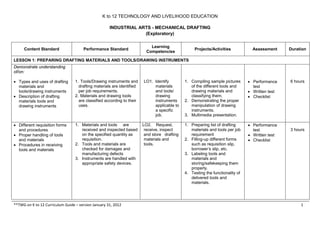
LESSON 1: PREPARING DRAFTING MATERIALS AND TOOLS/DRAWING INSTRUMENTS
Demonstrate understanding
of/on:
• Types and uses of drafting
materials and
tools/drawing instruments
• Description of drafting
materials tools and
drawing instruments
1. Tools/Drawing instruments and
drafting materials are identified
per job requirements.
2. Materials and drawing tools
are classified according to their
uses.
LO1. Identify
materials
and tools/
drawing
instruments
applicable to
a specific
job.
1. Compiling sample pictures
of the different tools and
drawing materials and
classifying them.
2. Demonstrating the proper
manipulation of drawing
instruments.
3. Multimedia presentation.
• Performance
test
• Written test
• Checklist
6 hours
• Different requisition forms
and procedures
• Proper handling of tools
and materials
• Procedures in receiving
tools and materials
1. Materials and tools are
received and inspected based
on the specified quantity as
requisition.
2. Tools and materials are
checked for damages and
manufacturing defects
3. Instruments are handled with
appropriate safety devices.
LO2. Request,
receive, inspect
and store drafting
materials and
tools.
1. Preparing list of drafting
materials and tools per job
requirement
2. Filling-up different forms
such as requisition slip,
borrower’s slip, etc.
3. Labeling tools and
materials and
storing/safekeeping them
properly.
4. Testing the functionality of
delivered tools and
materials.
• Performance
test
• Written test
• Checklist
3 hours
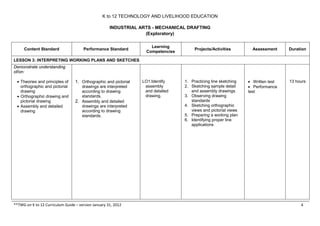
K to 12 TECHNOLOGY AND LIVELIHOOD EDUCATION
INDUSTRIAL ARTS - MECHANICAL DRAFTING
(Exploratory)
**TWG on K to 12 Curriculum Guide – version January 31, 2012 2
Content Standard Performance Standard
Learning
Competencies
Projects/Activities Assessment Duration
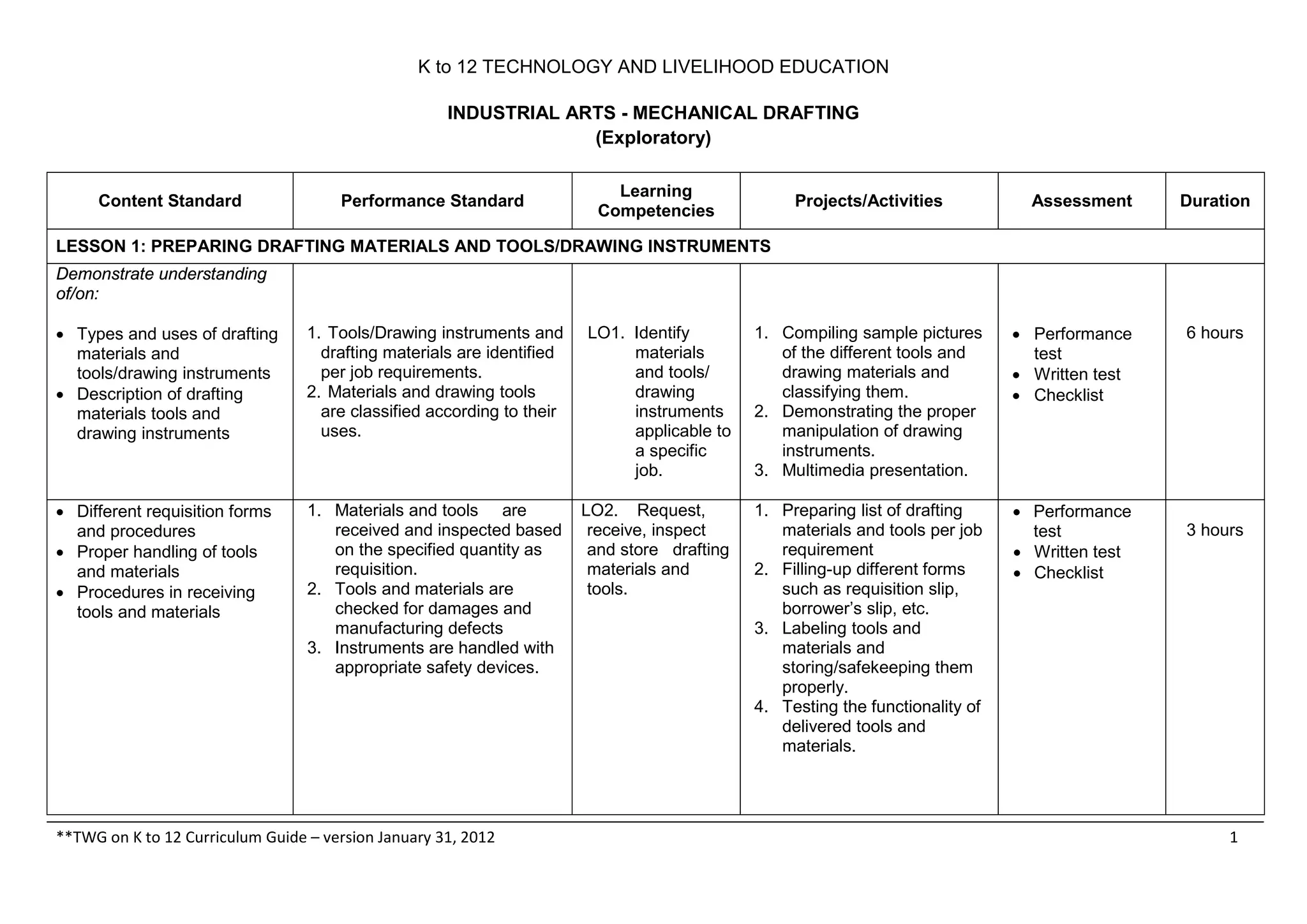
LESSON 2: PERFORMING BASIC MENSURATION AND CALCULATION
Demonstrate understanding
of/on:
• Different measuring
instruments and their
application
1. Measuring instruments are
selected and used according
to the level of accuracy
required.
2. Measurements taken are
accurate to the finest
gradation of the selected
measuring instrument.
3. Measuring techniques used
are correct and appropriate to
the instrument used.
LO1. Select and
use
measuring
instruments.
1. Identifying the different
measuring instruments
2. Observing proper use of
measuring instruments
3. Multimedia presentation
• Self-paced
learning
activities
• Guided
demonstration
(performance
based)
6 hours
• Cleaning and storing
procedure for measuring
instruments
1. Measuring instruments are
cleaned in accordance with
established standards.
2. Measuring instruments are
stored in accordance with
established standards.
LO2. Clean and
store measuring
instruments.
1. Storing/safe keeping
measuring tools properly
2. Multimedia presentation
• Performance test
2 hours
• Conversion of fraction to
decimal or decimal to
fraction
1. Conversion results of fraction
to decimal are accurate up to
2 decimal places.
2. Conversion results of decimal
to fraction are accurate to the
nearest standard
LO3. Convert
fraction to
decimal and
vice versa
1. Solving problems and
exercises correctly in:
a. converting fraction to
decimal or decimal to
fraction
• Written test 2 hours
K to 12 TECHNOLOGY AND LIVELIHOOD EDUCATION
INDUSTRIAL ARTS - MECHANICAL DRAFTING
(Exploratory)
**TWG on K to 12 Curriculum Guide – version January 31, 2012 3
Content Standard Performance Standard
Learning
Competencies
Projects/Activities Assessment Duration
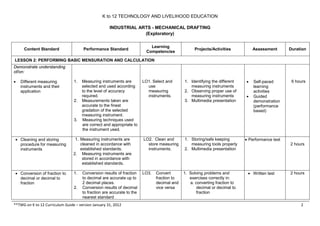
measurement
• Conversion of units of
linear measurement.
• Sample problems in
conversion
3. English and metric
measurements identified.
4. Conversion of English to
metric system or metric to
English system is performed
according to standard
procedure.
LO4. Convert
English to
metric
measureme
nt system
and vice
versa
1. Solving problems and
exercises correctly.
2. Converting units of linear
measurement.
3. Converting decimal to
fraction
• Written test 2 hours
K to 12 TECHNOLOGY AND LIVELIHOOD EDUCATION
INDUSTRIAL ARTS - MECHANICAL DRAFTING
(Exploratory)
**TWG on K to 12 Curriculum Guide – version January 31, 2012 4
Content Standard Performance Standard
Learning
Competencies
Projects/Activities Assessment Duration
LESSON 3: INTERPRETING WORKING PLANS AND SKETCHES
Demonstrate understanding
of/on:
• Theories and principles of
orthographic and pictorial
drawing
• Orthographic drawing and
pictorial drawing
• Assembly and detailed
drawing
1. Orthographic and pictorial
drawings are interpreted
according to drawing
standards.
2. Assembly and detailed
drawings are interpreted
according to drawing
standards.
LO1.Identify
assembly
and detailed
drawing.
1. Practicing line sketching
2. Sketching sample detail
and assembly drawings
3. Observing drawing
standards
4. Sketching orthographic
views and pictorial views
5. Preparing a working plan
6. Identifying proper line
applications
• Written test
• Performance
test
13 hours
K to 12 TECHNOLOGY AND LIVELIHOOD EDUCATION
INDUSTRIAL ARTS - MECHANICAL DRAFTING
(Exploratory)
**TWG on K to 12 Curriculum Guide – version January 31, 2012 5
Content Standard Performance Standard
Learning
Competencies
Projects/Activities Assessment Duration
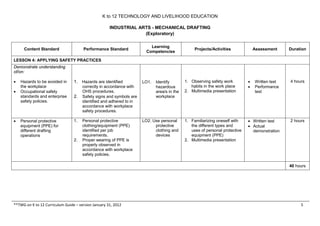
LESSON 4: APPLYING SAFETY PRACTICES
Demonstrate understanding
of/on:
• Hazards to be avoided in
the workplace
• Occupational safety
standards and enterprise
safety policies.
1. Hazards are identified
correctly in accordance with
OHS procedures.
2. Safety signs and symbols are
identified and adhered to in
accordance with workplace
safety procedures.
LO1. Identify
hazardous
area/s in the
workplace
1. Observing safety work
habits in the work place
2. Multimedia presentation
• Written test
• Performance
test
4 hours
• Personal protective
equipment (PPE) for
different drafting
operations
1. Personal protective
clothing/equipment (PPE)
identified per job
requirements.
2. Proper wearing of PPE is
properly observed in
accordance with workplace
safety policies.
LO2. Use personal
protective
clothing and
devices
1. Familiarizing oneself with
the different types and
uses of personal protective
equipment (PPE)
2. Multimedia presentation
• Written test
• Actual
demonstration
2 hours
40 hours

K to 12 TLE Curriculum Guide for Mechanical Drawing

  • 1.
    K to 12TECHNOLOGY AND LIVELIHOOD EDUCATION INDUSTRIAL ARTS - MECHANICAL DRAFTING (Exploratory) **TWG on K to 12 Curriculum Guide – version January 31, 2012 1 Content Standard Performance Standard Learning Competencies Projects/Activities Assessment Duration LESSON 1: PREPARING DRAFTING MATERIALS AND TOOLS/DRAWING INSTRUMENTS Demonstrate understanding of/on: • Types and uses of drafting materials and tools/drawing instruments • Description of drafting materials tools and drawing instruments 1. Tools/Drawing instruments and drafting materials are identified per job requirements. 2. Materials and drawing tools are classified according to their uses. LO1. Identify materials and tools/ drawing instruments applicable to a specific job. 1. Compiling sample pictures of the different tools and drawing materials and classifying them. 2. Demonstrating the proper manipulation of drawing instruments. 3. Multimedia presentation. • Performance test • Written test • Checklist 6 hours • Different requisition forms and procedures • Proper handling of tools and materials • Procedures in receiving tools and materials 1. Materials and tools are received and inspected based on the specified quantity as requisition. 2. Tools and materials are checked for damages and manufacturing defects 3. Instruments are handled with appropriate safety devices. LO2. Request, receive, inspect and store drafting materials and tools. 1. Preparing list of drafting materials and tools per job requirement 2. Filling-up different forms such as requisition slip, borrower’s slip, etc. 3. Labeling tools and materials and storing/safekeeping them properly. 4. Testing the functionality of delivered tools and materials. • Performance test • Written test • Checklist 3 hours
  • 2.
    K to 12TECHNOLOGY AND LIVELIHOOD EDUCATION INDUSTRIAL ARTS - MECHANICAL DRAFTING (Exploratory) **TWG on K to 12 Curriculum Guide – version January 31, 2012 2 Content Standard Performance Standard Learning Competencies Projects/Activities Assessment Duration LESSON 2: PERFORMING BASIC MENSURATION AND CALCULATION Demonstrate understanding of/on: • Different measuring instruments and their application 1. Measuring instruments are selected and used according to the level of accuracy required. 2. Measurements taken are accurate to the finest gradation of the selected measuring instrument. 3. Measuring techniques used are correct and appropriate to the instrument used. LO1. Select and use measuring instruments. 1. Identifying the different measuring instruments 2. Observing proper use of measuring instruments 3. Multimedia presentation • Self-paced learning activities • Guided demonstration (performance based) 6 hours • Cleaning and storing procedure for measuring instruments 1. Measuring instruments are cleaned in accordance with established standards. 2. Measuring instruments are stored in accordance with established standards. LO2. Clean and store measuring instruments. 1. Storing/safe keeping measuring tools properly 2. Multimedia presentation • Performance test 2 hours • Conversion of fraction to decimal or decimal to fraction 1. Conversion results of fraction to decimal are accurate up to 2 decimal places. 2. Conversion results of decimal to fraction are accurate to the nearest standard LO3. Convert fraction to decimal and vice versa 1. Solving problems and exercises correctly in: a. converting fraction to decimal or decimal to fraction • Written test 2 hours
  • 3.
    K to 12TECHNOLOGY AND LIVELIHOOD EDUCATION INDUSTRIAL ARTS - MECHANICAL DRAFTING (Exploratory) **TWG on K to 12 Curriculum Guide – version January 31, 2012 3 Content Standard Performance Standard Learning Competencies Projects/Activities Assessment Duration measurement • Conversion of units of linear measurement. • Sample problems in conversion 3. English and metric measurements identified. 4. Conversion of English to metric system or metric to English system is performed according to standard procedure. LO4. Convert English to metric measureme nt system and vice versa 1. Solving problems and exercises correctly. 2. Converting units of linear measurement. 3. Converting decimal to fraction • Written test 2 hours
  • 4.
    K to 12TECHNOLOGY AND LIVELIHOOD EDUCATION INDUSTRIAL ARTS - MECHANICAL DRAFTING (Exploratory) **TWG on K to 12 Curriculum Guide – version January 31, 2012 4 Content Standard Performance Standard Learning Competencies Projects/Activities Assessment Duration LESSON 3: INTERPRETING WORKING PLANS AND SKETCHES Demonstrate understanding of/on: • Theories and principles of orthographic and pictorial drawing • Orthographic drawing and pictorial drawing • Assembly and detailed drawing 1. Orthographic and pictorial drawings are interpreted according to drawing standards. 2. Assembly and detailed drawings are interpreted according to drawing standards. LO1.Identify assembly and detailed drawing. 1. Practicing line sketching 2. Sketching sample detail and assembly drawings 3. Observing drawing standards 4. Sketching orthographic views and pictorial views 5. Preparing a working plan 6. Identifying proper line applications • Written test • Performance test 13 hours
  • 5.
    K to 12TECHNOLOGY AND LIVELIHOOD EDUCATION INDUSTRIAL ARTS - MECHANICAL DRAFTING (Exploratory) **TWG on K to 12 Curriculum Guide – version January 31, 2012 5 Content Standard Performance Standard Learning Competencies Projects/Activities Assessment Duration LESSON 4: APPLYING SAFETY PRACTICES Demonstrate understanding of/on: • Hazards to be avoided in the workplace • Occupational safety standards and enterprise safety policies. 1. Hazards are identified correctly in accordance with OHS procedures. 2. Safety signs and symbols are identified and adhered to in accordance with workplace safety procedures. LO1. Identify hazardous area/s in the workplace 1. Observing safety work habits in the work place 2. Multimedia presentation • Written test • Performance test 4 hours • Personal protective equipment (PPE) for different drafting operations 1. Personal protective clothing/equipment (PPE) identified per job requirements. 2. Proper wearing of PPE is properly observed in accordance with workplace safety policies. LO2. Use personal protective clothing and devices 1. Familiarizing oneself with the different types and uses of personal protective equipment (PPE) 2. Multimedia presentation • Written test • Actual demonstration 2 hours 40 hours