Technical Education and Skills Development Authority
MAYON CASTILLA SORSOGON
WELCOME
TRAINEES
SORSOGON NATIONAL AGRICULTURAL SCHOOL
CATHERINE J. TAN
OAP TRAINER
CLASS RULES AND REGULATIONS
 Attendance and punctuality.
 Trainees are expected to
maintain the cleanliness and
orderliness of the premises of the
institute.
COMPETENCY-BASED TRAINING
It is a training delivery approach
that focuses on the competency
development of the learner as a
result of the training;
Emphasizes most on what the
learner can actually do;
Evaluation System:
COMPETENT
 NOT YET COMPETENT
10 Principles of CBT
1. The training is based on
curriculum develop from the
competency standard.
2. Learning is modular in structure.
3.Training delivery is individualized
and self paced.
4.Training is based on work that
must be performed.
10.Approved training programs
are nationally accredited.
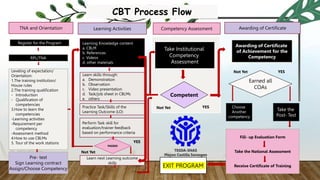
CBT Process Flow
TNA and Orientation Learning Activities Competency Assessment Awarding of Certificate
Register for the Program
RPL/TNA
Leveling of expectation/
Orientation:
1.The training institution/
House rules
2.The training qualification
- Introduction
- Qualification of
competencies
3.How to learn the
competencies
-Learning activities
-Requirement per
competency
-Assessment method
4.How to use CBLMs
5. Tour of the work stations
Pre- test
Sign Learning contract
Assign/Choose Competency
Learning Knowledge content
a. CBLM
b. References
c. Videos
d. other materials
Learn skills through:
a. Demonstration
b. Observation
c. Video presentation
d. Task/job sheet in CBLMs
e. others
Practice Task/Skills of the
Learning Outcome (LO)
Perform Task skill for
evaluation/trainer feedback
based on performance criteria
PASSED
YES
Not Yet
Learn next Learning outcome
skills
Take Institutional
Competency
Assessment
Competent
YES
Not Yet
Awarding of Certificate
of Achievement for the
Competency
YES
Not Yet
Earned all
COAs
Choose
Another
competency
Take the
Post- Test
Fill- up Evaluation Form
Take the National Assessment
Receive Certificate of Training
EXIT PROGRAM
TESDA-SNAS
Mayon Castilla Sorsogon
THE ROLE OF THE TRAINER
 EVALUATOR
 TEAM LEADER
 MOTIVATOR
 MANAGES LEARNING
 ROLE MODEL
 FACILITATOR
THE ROLE OF THE
TRAINEE
1.Trainee may select what they want
to learn and when they want to learn
it within reason.
2. Trainee learn at their own rate
within program guidelines.
ORGANIC AGRICULTURE
PRODUCTION NCII
CORE
COMPETENCIES
(96hours)
BASIC
COMPETENCIES
(18hours)
COMMON
COMPETENCIES
(64hours)
ELECTIVE
COMPETENCIES
(54hours)
PARTS OF CBLM
PRELIMINARY PAGES
FRONTPAGE
TRAINEE’S GUIDE ON HOW TO
USE THE CBLM
LIST OF COMPETENCIES
COMPETENCY SUMMARY
LEARNING OUTCOME SUMMARY
LEARNING EXPERIENCES
 INFORMATION SHEET
 SELF-CHECK
ANSWER KEY
 JOBSHEET
 TASK SHEET
 OPERATION SHEET
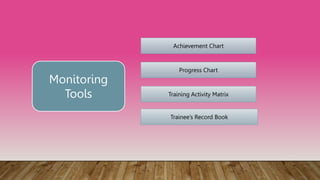
Monitoring
Tools
Achievement Chart
Progress Chart
Training Activity Matrix
Trainee’s Record Book
9 LEARNING ENVIRONMENT
1.PRACTICAL WORK AREA
2.LEARNING REASOURCE AREA
3.INSTITUTIONAL ASSESSMENT AREA
4.CONTEXTUAL LEARNING LABORATORY
5.TRAINING RESOURCE AREA
6.QUALITY CONTROL AREA
7.COMPUTER LABORATORY
8.DISTANCE LEARNING AREA
9.SUPPORT SERVICE AREA
THANK YOU!!

fls-tan.pptx tesda tm1 delivery session plan

  • 1.
    Technical Education andSkills Development Authority MAYON CASTILLA SORSOGON WELCOME TRAINEES SORSOGON NATIONAL AGRICULTURAL SCHOOL
  • 2.
  • 3.
    CLASS RULES ANDREGULATIONS  Attendance and punctuality.  Trainees are expected to maintain the cleanliness and orderliness of the premises of the institute.
  • 4.
    COMPETENCY-BASED TRAINING It isa training delivery approach that focuses on the competency development of the learner as a result of the training; Emphasizes most on what the learner can actually do;
  • 5.
  • 6.
  • 7.
    1. The trainingis based on curriculum develop from the competency standard. 2. Learning is modular in structure. 3.Training delivery is individualized and self paced.
  • 8.
    4.Training is basedon work that must be performed. 10.Approved training programs are nationally accredited.
  • 9.
    CBT Process Flow TNAand Orientation Learning Activities Competency Assessment Awarding of Certificate Register for the Program RPL/TNA Leveling of expectation/ Orientation: 1.The training institution/ House rules 2.The training qualification - Introduction - Qualification of competencies 3.How to learn the competencies -Learning activities -Requirement per competency -Assessment method 4.How to use CBLMs 5. Tour of the work stations Pre- test Sign Learning contract Assign/Choose Competency Learning Knowledge content a. CBLM b. References c. Videos d. other materials Learn skills through: a. Demonstration b. Observation c. Video presentation d. Task/job sheet in CBLMs e. others Practice Task/Skills of the Learning Outcome (LO) Perform Task skill for evaluation/trainer feedback based on performance criteria PASSED YES Not Yet Learn next Learning outcome skills Take Institutional Competency Assessment Competent YES Not Yet Awarding of Certificate of Achievement for the Competency YES Not Yet Earned all COAs Choose Another competency Take the Post- Test Fill- up Evaluation Form Take the National Assessment Receive Certificate of Training EXIT PROGRAM TESDA-SNAS Mayon Castilla Sorsogon
  • 10.
    THE ROLE OFTHE TRAINER  EVALUATOR  TEAM LEADER  MOTIVATOR  MANAGES LEARNING  ROLE MODEL  FACILITATOR
  • 11.
    THE ROLE OFTHE TRAINEE 1.Trainee may select what they want to learn and when they want to learn it within reason. 2. Trainee learn at their own rate within program guidelines.
  • 12.
  • 13.
    PARTS OF CBLM PRELIMINARYPAGES FRONTPAGE TRAINEE’S GUIDE ON HOW TO USE THE CBLM LIST OF COMPETENCIES COMPETENCY SUMMARY LEARNING OUTCOME SUMMARY LEARNING EXPERIENCES  INFORMATION SHEET  SELF-CHECK ANSWER KEY  JOBSHEET  TASK SHEET  OPERATION SHEET
  • 14.
    Monitoring Tools Achievement Chart Progress Chart TrainingActivity Matrix Trainee’s Record Book
  • 15.
    9 LEARNING ENVIRONMENT 1.PRACTICALWORK AREA 2.LEARNING REASOURCE AREA 3.INSTITUTIONAL ASSESSMENT AREA 4.CONTEXTUAL LEARNING LABORATORY 5.TRAINING RESOURCE AREA 6.QUALITY CONTROL AREA 7.COMPUTER LABORATORY 8.DISTANCE LEARNING AREA 9.SUPPORT SERVICE AREA
  • 16.

Editor's Notes

  • #5 Competency based training is based on the application of knowledge skills and attitude you learned. And as a trainee you will be engage in more actual activities. This is a learner centered approach.
  • #6 This is the evaluation system in CBT- you are not going to be rated numerically rather your going to be rated as competent and not yet competent.
  • #8 Trainer should be aware that all training activities are done towards the attainment of the assessment criteria set in cbc.
  • #9 4. Training is based on actual training practices 10. Unified TVET program registration and accreditation systems assures quality of training
  • #10 Which we are conducting right now a while ago I let you take the pre-test As we go along with your training you will be having your learning activities.wherein your going to read cblms, perform different task after that your going to the 3rd phase which is Competency Assessment- you will take institutional competency assessment if you found to be competent you will receive COA. And once you complete all the COA you can know take the post test , fill up evaluation form , take the national assessment , attend the graduation to receive Certificate of Training and exit the Program
  • #11 I will evaluate you work, motivator – I will motivate you to continue what you have started. Facilitator – I will facilitate learning Manage learning – help those student who really need help
  • #12 As a trainee you have your own role please refer to your student Handbook
  • #13 You are enrolled in Organic Agriculture Production NC II, Wherein the time duration is 232 hours and Composed of 4 Competencies, Basic, Common, Core and Elective. Basic and common will be integrated as we go along to the core and elective competencies.
  • #14 All competencies has CBLM or Competency Based Learning Materials- simply a well designed and carefully develop learning materials that gives trainee detailed instruction.
  • #15 These are the monitoring tools the achievement chart , progress, training activity matrix and Trainee’s record book later I will discuss that for know everybody stand and I will tour you to the nine learning areas.