WELCOME
Training
Orientation on
CAREGIVING
NC II
COMPETENCY-BASED TRAINING
(CBT)
CBT – Is a training delivery
approach that focuses on the
competency development of the
learner as a result of the training
THE CBT
PRINCIPLES
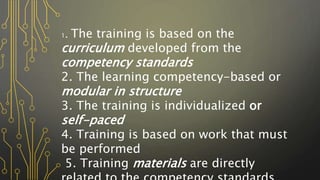
1. The training is based on the
curriculum developed from the
competency standards
2. The learning competency-based or
modular in structure
3. The training is individualized or
self-paced
4. Training is based on work that must
be performed
5. Training materials are directly
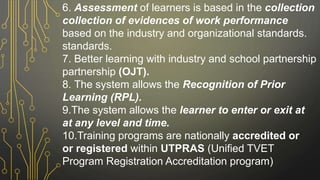
6. Assessment of learners is based in the collection
collection of evidences of work performance
based on the industry and organizational standards.
standards.
7. Better learning with industry and school partnership
partnership (OJT).
8. The system allows the Recognition of Prior
Learning (RPL).
9.The system allows the learner to enter or exit at
at any level and time.
10.Training programs are nationally accredited or
or registered within UTPRAS (Unified TVET
Program Registration Accreditation program)
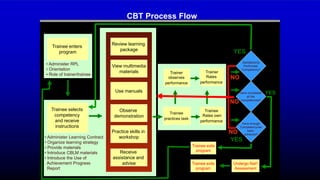
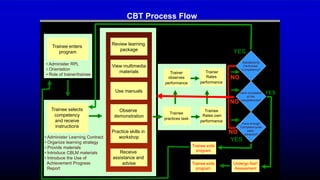
CBT Process Flow
Have enough
Competency/ies
been
achieved?
YES
YES
Trainee exits
program
Trainer
observes
performance
Trainee
practices task
Trainee
Rates own
performance
Trainer
Rates
performance
Trainee enters
program
• Administer RPL
• Orientation
• Role of trainer/trainee
Trainee selects
competency
and receive
instructions
• Administer Learning Contract
• Organize learning strategy
• Provide materials
• Introduce CBLM materials
• Introduce the Use of
Achievement Progress
Report
Review learning
package
View multimedia
materials
Use manuals
Observe
demonstration
Practice skills in
workshop
Receive
assistance and
advise
YES
Trainee exits
program
Have completed
all the
competencies?
Satisfactorily
Performed
Competency?
Undergo Nat’l
Assessment
NO
NO
NO
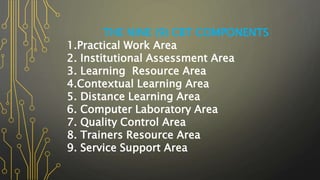
THE NINE (9) CBT COMPONENTS
1.Practical Work Area
2. Institutional Assessment Area
3. Learning Resource Area
4.Contextual Learning Area
5. Distance Learning Area
6. Computer Laboratory Area
7. Quality Control Area
8. Trainers Resource Area
9. Service Support Area
ROLES
OF THE
TRAINER
1. Serve as a team member to determined what is to be learned.
2. 1Manage learning a consultation rather than a provider of
information; a facilitator of the learning
3. Diagnose and solves learning problems
4. Evaluates trainees achievement
5. Assist learners to obtain individualized rewards
6. Assist each trainee in designing a personalized plan for study.
7. Installs confidence in the learner b providing experiences where
learners ma succeed
8. Serves as a model for desirable work habits attitudes and task
performance in the occupational field
9. Spends more time interacting with trainees on a 1:1 small group basis.
11. Helps those trainees who really need help
12. Accepts responsibility along with the trainee for the tasks learned and
not learned.
•TO FACILITATE
•TO PROVIDE
FEEDBACK
•TRAINERS IS A
ROLE MODEL
ROLES
OF THE
TRAINEE
1. Trainees may select what they want to learn and when they want to learn it,
within reason
2. Trainees learn at their own rate within program guidelines. They may speed
up, slow down, step or even repeat a task
3.Trainees may request to receive credit for what the already know
4. Trainees ma choose how the want to learn individually, on a one on one
basis, in small group, in large groups, with audio visuals
5. Trainees are responsible for what they learn and when they learn it
6. Trainees decide when the are ready to perform each task or demonstrate
master of learning to a job like level of proficiency before receiving credit for
the task
7. Trainees helps develop personalized prescription for learning worked out
cooperatively and based upon what the trainees already knows
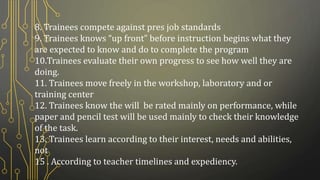
8. Trainees compete against pres job standards
9. Trainees knows “up front” before instruction begins what they
are expected to know and do to complete the program
10.Trainees evaluate their own progress to see how well they are
doing.
11. Trainees move freely in the workshop, laboratory and or
training center
12. Trainees know the will be rated mainly on performance, while
paper and pencil test will be used mainly to check their knowledge
of the task.
13. Trainees learn according to their interest, needs and abilities,
not
15 . According to teacher timelines and expediency.
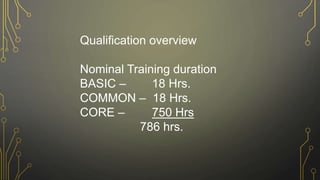
Qualification overview
Nominal Training duration
BASIC – 18 Hrs.
COMMON – 18 Hrs.
CORE – 750 Hrs
786 hrs.
Training
Method
Modular/Self-pace of
learning
Lecture
Viewing of visual
presentation, slides and
videos
Demonstration
COMPETENCIES
BASIC Competencies
COMMON
Competencies
CORE Competencies
Basic Competencies
1. PARTICIPATE IN WORKPLACE COMMUNICATION.
2. WORK IN TEAM ENVIRONMENT.
3. SOLVE/ADDRESS GENERAL WORKPLACE PROBLEMS.
4. DEVELOP CAREER AND LIFE DECISIONS.
5. CONTRIBUTE TO WORKPLACE INNOVATION.
6. PRESENT RELEVANT INFORMATION.
7. PRACTICE OCCUPATIONAL SAFETY AND HEALTH
POLICIES AND PROCEDURES.
8. EXERCISE EFFICIENT AND EFFECTIVE SUSTAINABLE
PRACTICES IN THE WORKPLACE.
9. PRACTICE ENTREPRENEURIAL SKILLS IN THE
WORKPLACE.
COMMON
COMPETENCIES
1. Implement and monitor infection control
policies and procedures
2. Respond effectively to difficult/challenging
behavior
3. Apply basic first aid
4.Maintain high standard of patient services
Core Competencies
1. Provide care and support to infants/toddlers
2. Provide care and support to children
3. Foster social, intellectual, creative and emotional development of children
4. Foster the physical development of children
5. Provide care and support to elderly
6. Provide care and support to people with special needs
7. Maintain healthy and safe environment
8. Respond to emergency
9. Clean living room, dining room, bedrooms, toilet and bathroom
10. Wash and iron clothes, linen and fabric
11. Wash and iron clothes, linen and fabric
CBLM
COMPETENCY BASED LEARNING
MATERIALS
Purpose:
Provide detailed instruction to guide
and help a learner acquire the
necessary knowledge, skills, and
attitude of a specific unit of
competency on a self-paced learning
modality.
Evaluation Tools
• Formative
Assessment
• Summative
Assessment
THANK
YOU!
CBT Process Flow
Have enough
Competency/ies
been
achieved?
YES
YES
Trainee exits
program
Trainer
observes
performance
Trainee
practices task
Trainee
Rates own
performance
Trainer
Rates
performance
Trainee enters
program
• Administer RPL
• Orientation
• Role of trainer/trainee
Trainee selects
competency
and receive
instructions
• Administer Learning Contract
• Organize learning strategy
• Provide materials
• Introduce CBLM materials
• Introduce the Use of
Achievement Progress
Report
Review learning
package
View multimedia
materials
Use manuals
Observe
demonstration
Practice skills in
workshop
Receive
assistance and
advise
YES
Trainee exits
program
Have completed
all the
competencies?
Satisfactorily
Performed
Competency?
Undergo Nat’l
Assessment
NO
NO
NO

Presentation3.pptx1234567890123456789012

  • 1.
  • 3.
    COMPETENCY-BASED TRAINING (CBT) CBT –Is a training delivery approach that focuses on the competency development of the learner as a result of the training
  • 4.
  • 5.
    1. The trainingis based on the curriculum developed from the competency standards 2. The learning competency-based or modular in structure 3. The training is individualized or self-paced 4. Training is based on work that must be performed 5. Training materials are directly
  • 6.
    6. Assessment oflearners is based in the collection collection of evidences of work performance based on the industry and organizational standards. standards. 7. Better learning with industry and school partnership partnership (OJT). 8. The system allows the Recognition of Prior Learning (RPL). 9.The system allows the learner to enter or exit at at any level and time. 10.Training programs are nationally accredited or or registered within UTPRAS (Unified TVET Program Registration Accreditation program)
  • 7.
    CBT Process Flow Haveenough Competency/ies been achieved? YES YES Trainee exits program Trainer observes performance Trainee practices task Trainee Rates own performance Trainer Rates performance Trainee enters program • Administer RPL • Orientation • Role of trainer/trainee Trainee selects competency and receive instructions • Administer Learning Contract • Organize learning strategy • Provide materials • Introduce CBLM materials • Introduce the Use of Achievement Progress Report Review learning package View multimedia materials Use manuals Observe demonstration Practice skills in workshop Receive assistance and advise YES Trainee exits program Have completed all the competencies? Satisfactorily Performed Competency? Undergo Nat’l Assessment NO NO NO
  • 8.
    THE NINE (9)CBT COMPONENTS 1.Practical Work Area 2. Institutional Assessment Area 3. Learning Resource Area 4.Contextual Learning Area 5. Distance Learning Area 6. Computer Laboratory Area 7. Quality Control Area 8. Trainers Resource Area 9. Service Support Area
  • 9.
  • 10.
    1. Serve asa team member to determined what is to be learned. 2. 1Manage learning a consultation rather than a provider of information; a facilitator of the learning 3. Diagnose and solves learning problems 4. Evaluates trainees achievement 5. Assist learners to obtain individualized rewards 6. Assist each trainee in designing a personalized plan for study. 7. Installs confidence in the learner b providing experiences where learners ma succeed 8. Serves as a model for desirable work habits attitudes and task performance in the occupational field 9. Spends more time interacting with trainees on a 1:1 small group basis. 11. Helps those trainees who really need help 12. Accepts responsibility along with the trainee for the tasks learned and not learned.
  • 11.
  • 12.
  • 13.
    1. Trainees mayselect what they want to learn and when they want to learn it, within reason 2. Trainees learn at their own rate within program guidelines. They may speed up, slow down, step or even repeat a task 3.Trainees may request to receive credit for what the already know 4. Trainees ma choose how the want to learn individually, on a one on one basis, in small group, in large groups, with audio visuals 5. Trainees are responsible for what they learn and when they learn it 6. Trainees decide when the are ready to perform each task or demonstrate master of learning to a job like level of proficiency before receiving credit for the task 7. Trainees helps develop personalized prescription for learning worked out cooperatively and based upon what the trainees already knows
  • 14.
    8. Trainees competeagainst pres job standards 9. Trainees knows “up front” before instruction begins what they are expected to know and do to complete the program 10.Trainees evaluate their own progress to see how well they are doing. 11. Trainees move freely in the workshop, laboratory and or training center 12. Trainees know the will be rated mainly on performance, while paper and pencil test will be used mainly to check their knowledge of the task. 13. Trainees learn according to their interest, needs and abilities, not 15 . According to teacher timelines and expediency.
  • 15.
    Qualification overview Nominal Trainingduration BASIC – 18 Hrs. COMMON – 18 Hrs. CORE – 750 Hrs 786 hrs.
  • 16.
    Training Method Modular/Self-pace of learning Lecture Viewing ofvisual presentation, slides and videos Demonstration
  • 17.
  • 18.
    Basic Competencies 1. PARTICIPATEIN WORKPLACE COMMUNICATION. 2. WORK IN TEAM ENVIRONMENT. 3. SOLVE/ADDRESS GENERAL WORKPLACE PROBLEMS. 4. DEVELOP CAREER AND LIFE DECISIONS. 5. CONTRIBUTE TO WORKPLACE INNOVATION. 6. PRESENT RELEVANT INFORMATION. 7. PRACTICE OCCUPATIONAL SAFETY AND HEALTH POLICIES AND PROCEDURES. 8. EXERCISE EFFICIENT AND EFFECTIVE SUSTAINABLE PRACTICES IN THE WORKPLACE. 9. PRACTICE ENTREPRENEURIAL SKILLS IN THE WORKPLACE.
  • 19.
    COMMON COMPETENCIES 1. Implement andmonitor infection control policies and procedures 2. Respond effectively to difficult/challenging behavior 3. Apply basic first aid 4.Maintain high standard of patient services
  • 20.
    Core Competencies 1. Providecare and support to infants/toddlers 2. Provide care and support to children 3. Foster social, intellectual, creative and emotional development of children 4. Foster the physical development of children 5. Provide care and support to elderly 6. Provide care and support to people with special needs 7. Maintain healthy and safe environment 8. Respond to emergency 9. Clean living room, dining room, bedrooms, toilet and bathroom 10. Wash and iron clothes, linen and fabric 11. Wash and iron clothes, linen and fabric
  • 21.
    CBLM COMPETENCY BASED LEARNING MATERIALS Purpose: Providedetailed instruction to guide and help a learner acquire the necessary knowledge, skills, and attitude of a specific unit of competency on a self-paced learning modality.
  • 22.
  • 23.
  • 26.
    CBT Process Flow Haveenough Competency/ies been achieved? YES YES Trainee exits program Trainer observes performance Trainee practices task Trainee Rates own performance Trainer Rates performance Trainee enters program • Administer RPL • Orientation • Role of trainer/trainee Trainee selects competency and receive instructions • Administer Learning Contract • Organize learning strategy • Provide materials • Introduce CBLM materials • Introduce the Use of Achievement Progress Report Review learning package View multimedia materials Use manuals Observe demonstration Practice skills in workshop Receive assistance and advise YES Trainee exits program Have completed all the competencies? Satisfactorily Performed Competency? Undergo Nat’l Assessment NO NO NO