WELCOME
BY: Joann P. Catacutan
Metro Dumaguete College Inc.
EJ Blanco Drive Ext., Dumaguete City
Senior High Bldg
Comfort
Rooms
College Bldg
Open Court
Parking Area
Parking Area
Entrance/ ExitComfort
Rooms/
Wash Area
What is
CBT?
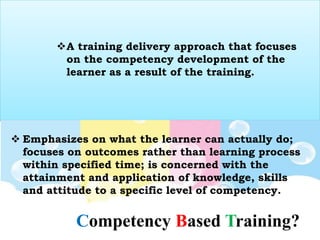
Competency Based Training?
 Emphasizes on what the learner can actually do;
focuses on outcomes rather than learning process
within specified time; is concerned with the
attainment and application of knowledge, skills
and attitude to a specific level of competency.
A training delivery approach that focuses
on the competency development of the
learner as a result of the training.
10 Principles
of CBT
The training
is based on
curriculum
developed
from the
competency
standards
1 2 3
Learning is
modular in its
structure
The training is
based on
curriculum
developed
from the
competency
standards
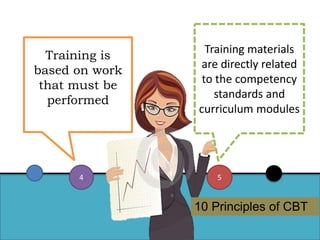
10 Principles of CBT
Training is
based on work
that must be
performed
4 5
Training materials
are directly related
to the competency
standards and
curriculum modules
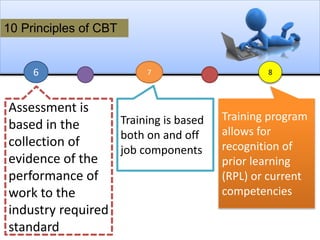
10 Principles of CBT
Assessment is
based in the
collection of
evidence of the
performance of
work to the
industry required
standard
6 7 8
Training is based
both on and off
job components
Training program
allows for
recognition of
prior learning
(RPL) or current
competencies
10 Principles of CBT
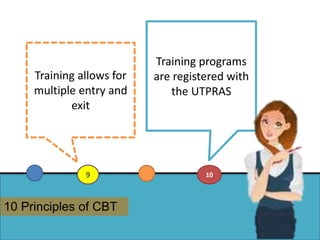
Training allows for
multiple entry and
exit
9 10
Training programs
are registered with
the UTPRAS
10 Principles of CBT
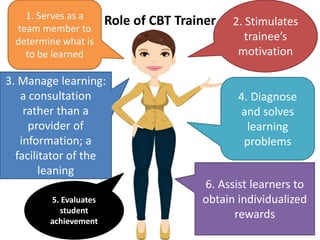
1. Serves as a
team member to
determine what is
to be learned
2. Stimulates
trainee’s
motivation
3. Manage learning:
a consultation
rather than a
provider of
information; a
facilitator of the
leaning
4. Diagnose
and solves
learning
problems
5. Evaluates
student
achievement
6. Assist learners to
obtain individualized
rewards
Role of CBT Trainer
7. Assist each trainee in
designing a personalized
plan of study
8. Installs confidence in
the learner by providing
experiences where
learners may succeed
9. Serves as a model for
desirable work habits,
attitudes and tasks
performance in the
occupational field
10. Spends more time
interacting with
students on a 1:1 or
small group basis
11. Help those students
who really need help
12. Accepts
responsibility along
with the student for the
tasks learned or not
learned
The Role of CBT
Trainee
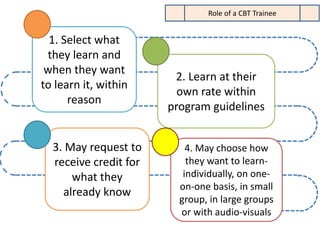
1. Select what
they learn and
when they want
to learn it, within
reason
2. Learn at their
own rate within
program guidelines
3. May request to
receive credit for
what they
already know
4. May choose how
they want to learn-
individually, on one-
on-one basis, in small
group, in large groups
or with audio-visuals
Role of a CBT Trainee
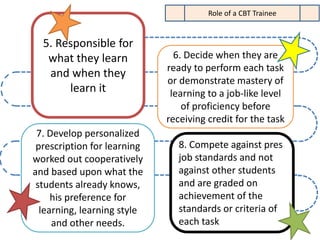
5. Responsible for
what they learn
and when they
learn it
6. Decide when they are
ready to perform each task
or demonstrate mastery of
learning to a job-like level
of proficiency before
receiving credit for the task
7. Develop personalized
prescription for learning
worked out cooperatively
and based upon what the
students already knows,
his preference for
learning, learning style
and other needs.
8. Compete against pres
job standards and not
against other students
and are graded on
achievement of the
standards or criteria of
each task
Role of a CBT Trainee
9. Know “up-front”,
before instruction
begins what they are
expected to know
and do not complete
the program
10. Evaluate their
own progress to see
how well they are
doing.
11. Move freely
in the workshop,
laboratory and or
training center
12. Know they will be rated
mainly on performance,
while paper and pencil
tests will be used mainly to
check their knowledge of
the task
Role of a CBT Trainee
12. Learn according
to their interest,
needs and abilities-
not according to
teacher timelines
and expediency
Role of a CBT Trainee
COMPUTER SYSTEMS
SERVICING NC II
ELECTRONICS SECTOR
The COMPUTER SYSTEMS SERVICING NC II
Qualification consists of competencies that
must possess to enable to install and
configure computers systems, set-up
computer networks and servers and to
maintain and repair computer systems and
networks.
Course Description
Work in a team environment
Practice career professionalism
Practice occupational health and safety
procedures
Participate in workplace communication
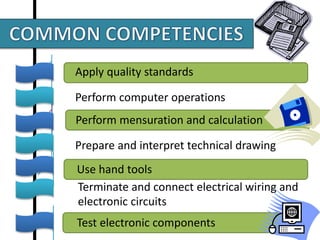
Perform computer operations
Perform mensuration and calculation
Prepare and interpret technical drawing
Apply quality standards
Use hand tools
Terminate and connect electrical wiring and
electronic circuits
Test electronic components
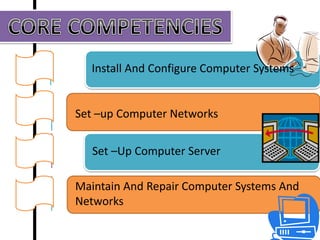
Install And Configure Computer Systems
Set –up Computer Networks
Set –Up Computer Server
Maintain And Repair Computer Systems And
Networks
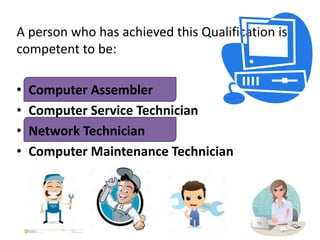
A person who has achieved this Qualification is
competent to be:
• Computer Assembler
• Computer Service Technician
• Network Technician
• Computer Maintenance Technician
Competency Based Training TMC1

Competency Based Training TMC1

  • 1.
  • 2.
    Metro Dumaguete CollegeInc. EJ Blanco Drive Ext., Dumaguete City
  • 3.
    Senior High Bldg Comfort Rooms CollegeBldg Open Court Parking Area Parking Area Entrance/ ExitComfort Rooms/ Wash Area
  • 4.
  • 5.
    Competency Based Training? Emphasizes on what the learner can actually do; focuses on outcomes rather than learning process within specified time; is concerned with the attainment and application of knowledge, skills and attitude to a specific level of competency. A training delivery approach that focuses on the competency development of the learner as a result of the training.
  • 6.
  • 7.
    The training is basedon curriculum developed from the competency standards 1 2 3 Learning is modular in its structure The training is based on curriculum developed from the competency standards 10 Principles of CBT
  • 8.
    Training is based onwork that must be performed 4 5 Training materials are directly related to the competency standards and curriculum modules 10 Principles of CBT
  • 9.
    Assessment is based inthe collection of evidence of the performance of work to the industry required standard 6 7 8 Training is based both on and off job components Training program allows for recognition of prior learning (RPL) or current competencies 10 Principles of CBT
  • 10.
    Training allows for multipleentry and exit 9 10 Training programs are registered with the UTPRAS 10 Principles of CBT
  • 11.
    1. Serves asa team member to determine what is to be learned 2. Stimulates trainee’s motivation 3. Manage learning: a consultation rather than a provider of information; a facilitator of the leaning 4. Diagnose and solves learning problems 5. Evaluates student achievement 6. Assist learners to obtain individualized rewards Role of CBT Trainer
  • 12.
    7. Assist eachtrainee in designing a personalized plan of study 8. Installs confidence in the learner by providing experiences where learners may succeed 9. Serves as a model for desirable work habits, attitudes and tasks performance in the occupational field 10. Spends more time interacting with students on a 1:1 or small group basis 11. Help those students who really need help 12. Accepts responsibility along with the student for the tasks learned or not learned
  • 13.
    The Role ofCBT Trainee
  • 14.
    1. Select what theylearn and when they want to learn it, within reason 2. Learn at their own rate within program guidelines 3. May request to receive credit for what they already know 4. May choose how they want to learn- individually, on one- on-one basis, in small group, in large groups or with audio-visuals Role of a CBT Trainee
  • 15.
    5. Responsible for whatthey learn and when they learn it 6. Decide when they are ready to perform each task or demonstrate mastery of learning to a job-like level of proficiency before receiving credit for the task 7. Develop personalized prescription for learning worked out cooperatively and based upon what the students already knows, his preference for learning, learning style and other needs. 8. Compete against pres job standards and not against other students and are graded on achievement of the standards or criteria of each task Role of a CBT Trainee
  • 16.
    9. Know “up-front”, beforeinstruction begins what they are expected to know and do not complete the program 10. Evaluate their own progress to see how well they are doing. 11. Move freely in the workshop, laboratory and or training center 12. Know they will be rated mainly on performance, while paper and pencil tests will be used mainly to check their knowledge of the task Role of a CBT Trainee
  • 17.
    12. Learn according totheir interest, needs and abilities- not according to teacher timelines and expediency Role of a CBT Trainee
  • 18.
    COMPUTER SYSTEMS SERVICING NCII ELECTRONICS SECTOR
  • 19.
    The COMPUTER SYSTEMSSERVICING NC II Qualification consists of competencies that must possess to enable to install and configure computers systems, set-up computer networks and servers and to maintain and repair computer systems and networks. Course Description
  • 20.
    Work in ateam environment Practice career professionalism Practice occupational health and safety procedures Participate in workplace communication
  • 21.
    Perform computer operations Performmensuration and calculation Prepare and interpret technical drawing Apply quality standards Use hand tools Terminate and connect electrical wiring and electronic circuits Test electronic components
  • 22.
    Install And ConfigureComputer Systems Set –up Computer Networks Set –Up Computer Server Maintain And Repair Computer Systems And Networks
  • 23.
    A person whohas achieved this Qualification is competent to be: • Computer Assembler • Computer Service Technician • Network Technician • Computer Maintenance Technician