Facial expressions and
emotion
Why do we use facial
expressions?
Source: www.scientificamerican.com
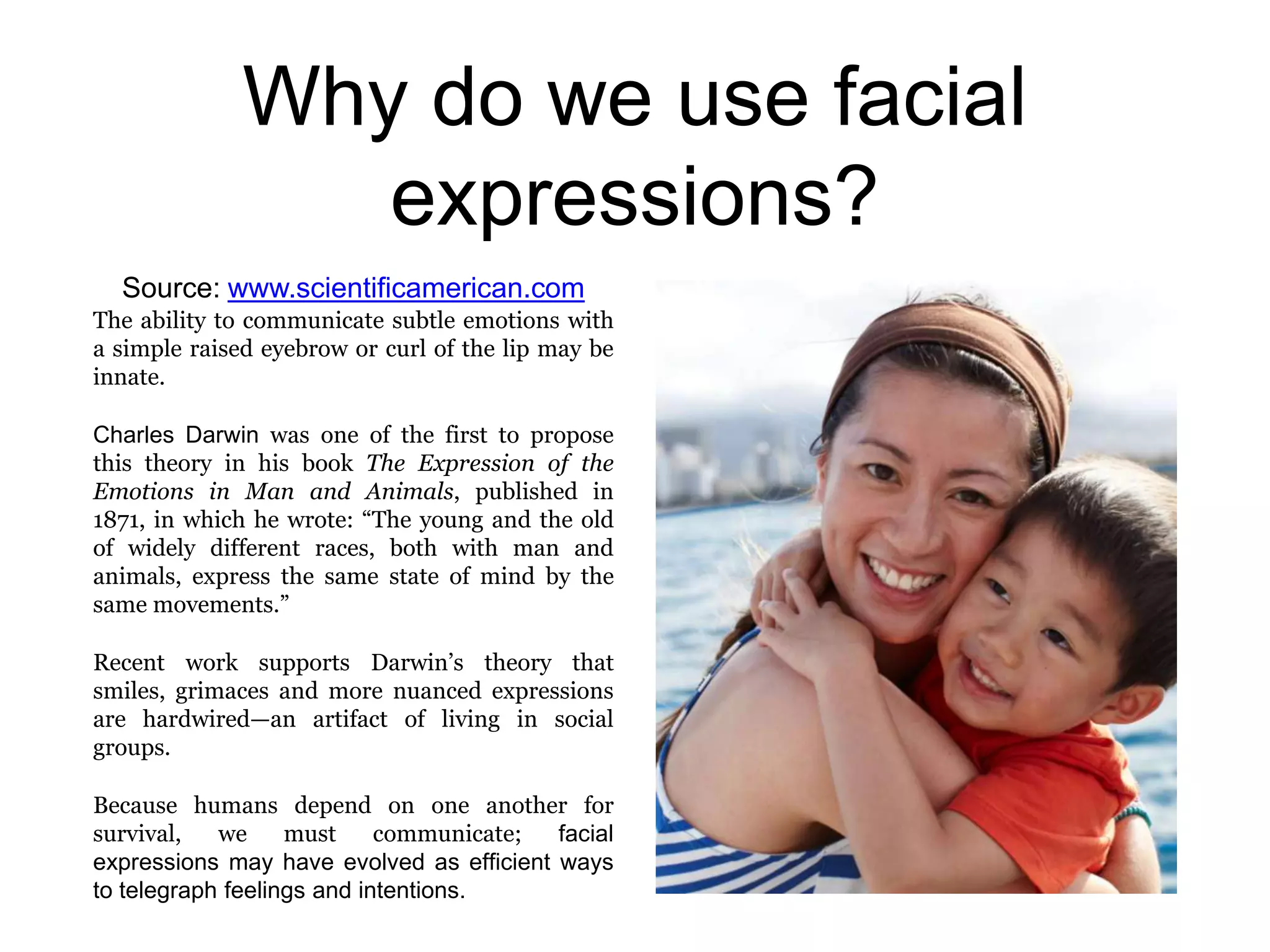
The ability to communicate subtle emotions with
a simple raised eyebrow or curl of the lip may be
innate.
Charles Darwin was one of the first to propose
this theory in his book The Expression of the
Emotions in Man and Animals, published in
1871, in which he wrote: “The young and the old
of widely different races, both with man and
animals, express the same state of mind by the
same movements.”

Recent work supports Darwin’s theory that
smiles, grimaces and more nuanced expressions
are hardwired—an artifact of living in social
groups.
Because humans depend on one another for
survival,
we
must
communicate;
facial
expressions may have evolved as efficient ways
to telegraph feelings and intentions.
Facial Action Coding System
Source: www.face-and-emotion.com
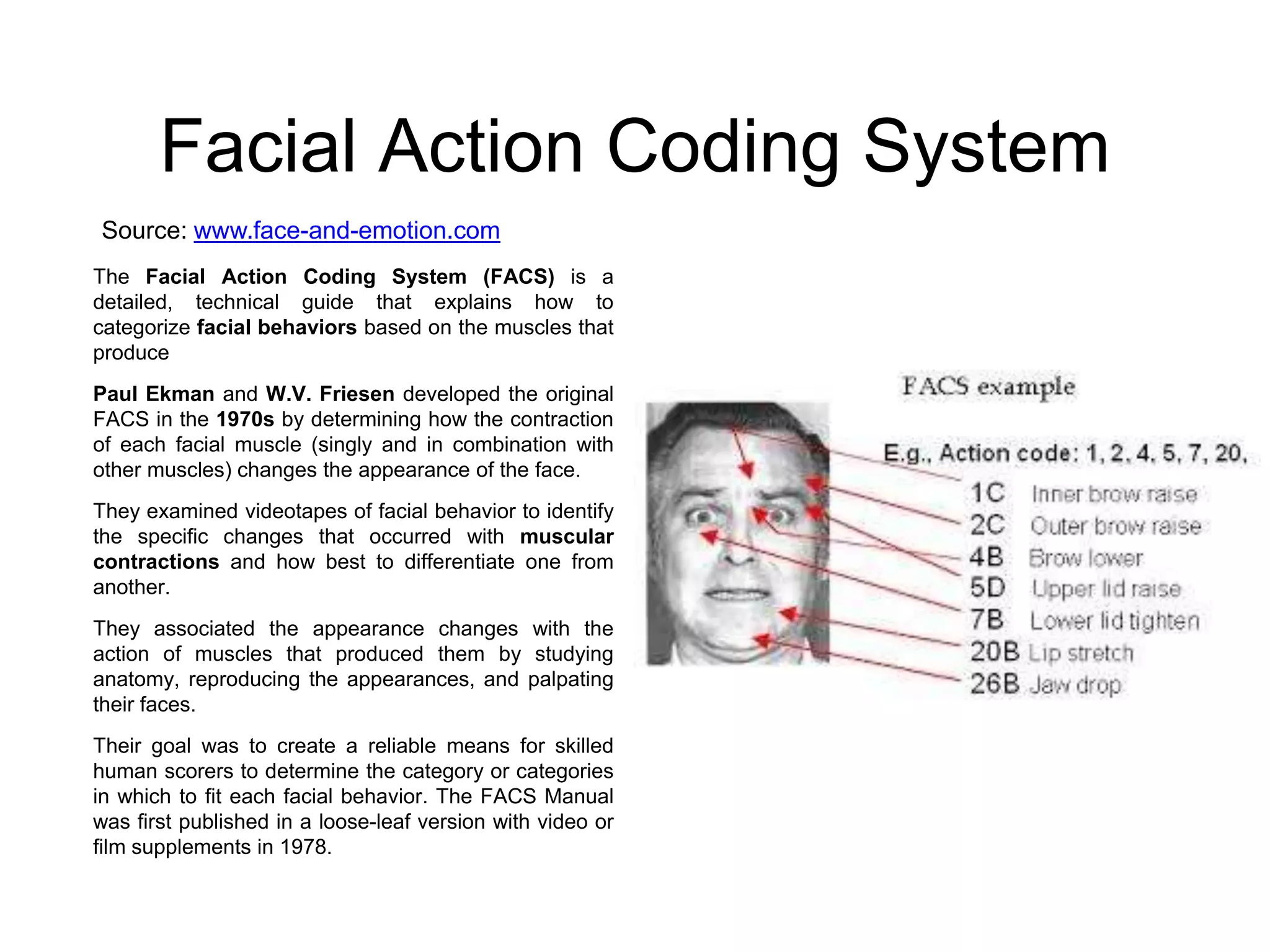
The Facial Action Coding System (FACS) is a
detailed, technical guide that explains how to
categorize facial behaviors based on the muscles that
produce
Paul Ekman and W.V. Friesen developed the original
FACS in the 1970s by determining how the contraction
of each facial muscle (singly and in combination with
other muscles) changes the appearance of the face.
They examined videotapes of facial behavior to identify
the specific changes that occurred with muscular
contractions and how best to differentiate one from
another.
They associated the appearance changes with the
action of muscles that produced them by studying
anatomy, reproducing the appearances, and palpating
their faces.
Their goal was to create a reliable means for skilled
human scorers to determine the category or categories
in which to fit each facial behavior. The FACS Manual
was first published in a loose-leaf version with video or
film supplements in 1978.
Six universal emotions
Source: www.nbb.cornell.edu
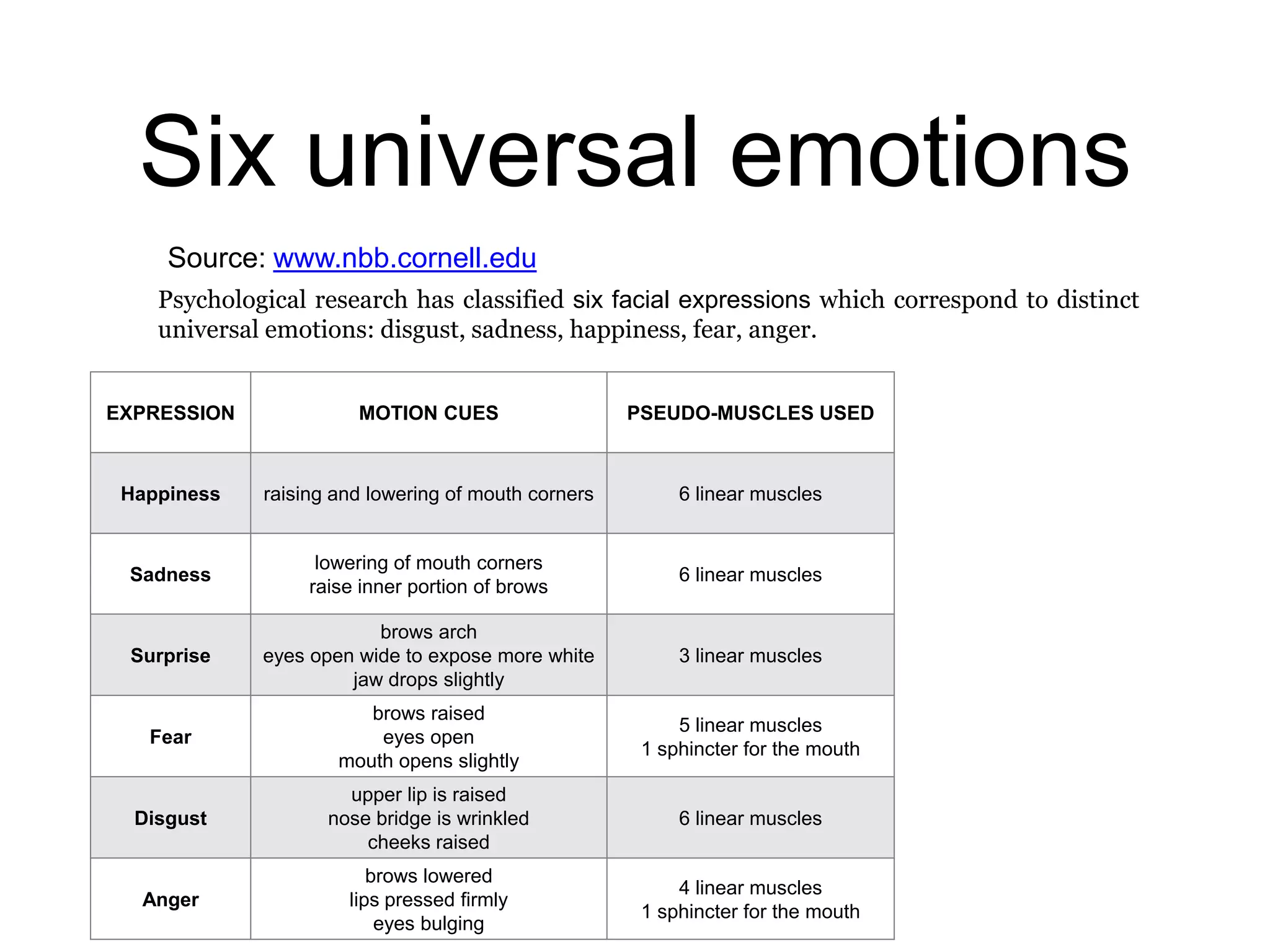
Psychological research has classified six facial expressions which correspond to distinct
universal emotions: disgust, sadness, happiness, fear, anger.

EXPRESSION

MOTION CUES

PSEUDO-MUSCLES USED

Happiness

raising and lowering of mouth corners

6 linear muscles

Sadness

lowering of mouth corners
raise inner portion of brows

6 linear muscles

Surprise

brows arch
eyes open wide to expose more white
jaw drops slightly

3 linear muscles

Fear

brows raised
eyes open
mouth opens slightly

5 linear muscles
1 sphincter for the mouth

Disgust

upper lip is raised
nose bridge is wrinkled
cheeks raised

6 linear muscles

Anger

brows lowered
lips pressed firmly
eyes bulging

4 linear muscles
1 sphincter for the mouth
Canines use expressions to
show their emotions
Source: www.dailymail.co.uk
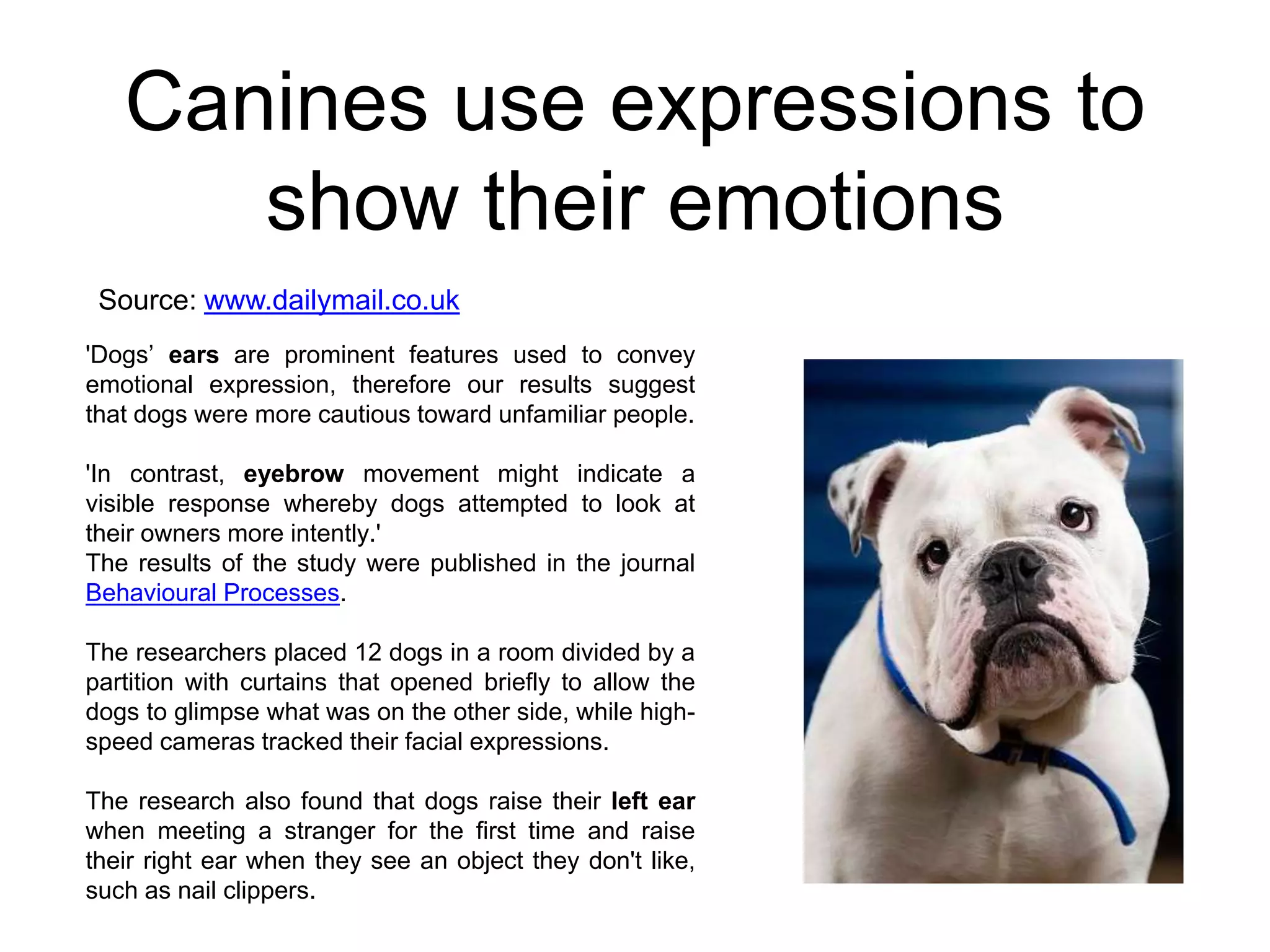
'Dogs’ ears are prominent features used to convey
emotional expression, therefore our results suggest
that dogs were more cautious toward unfamiliar people.
'In contrast, eyebrow movement might indicate a
visible response whereby dogs attempted to look at
their owners more intently.'
The results of the study were published in the journal
Behavioural Processes.
The researchers placed 12 dogs in a room divided by a
partition with curtains that opened briefly to allow the
dogs to glimpse what was on the other side, while highspeed cameras tracked their facial expressions.

The research also found that dogs raise their left ear
when meeting a stranger for the first time and raise
their right ear when they see an object they don't like,
such as nail clippers.
Canines use expressions to
show their emotions
Source: www.dailymail.co.uk
Coloured stickers were placed on the dogs' faces, which
were picked up by the camera when the expression changed.
When the curtain opened, their owner, a stranger, a toy or an
item they did not like was on the other side.
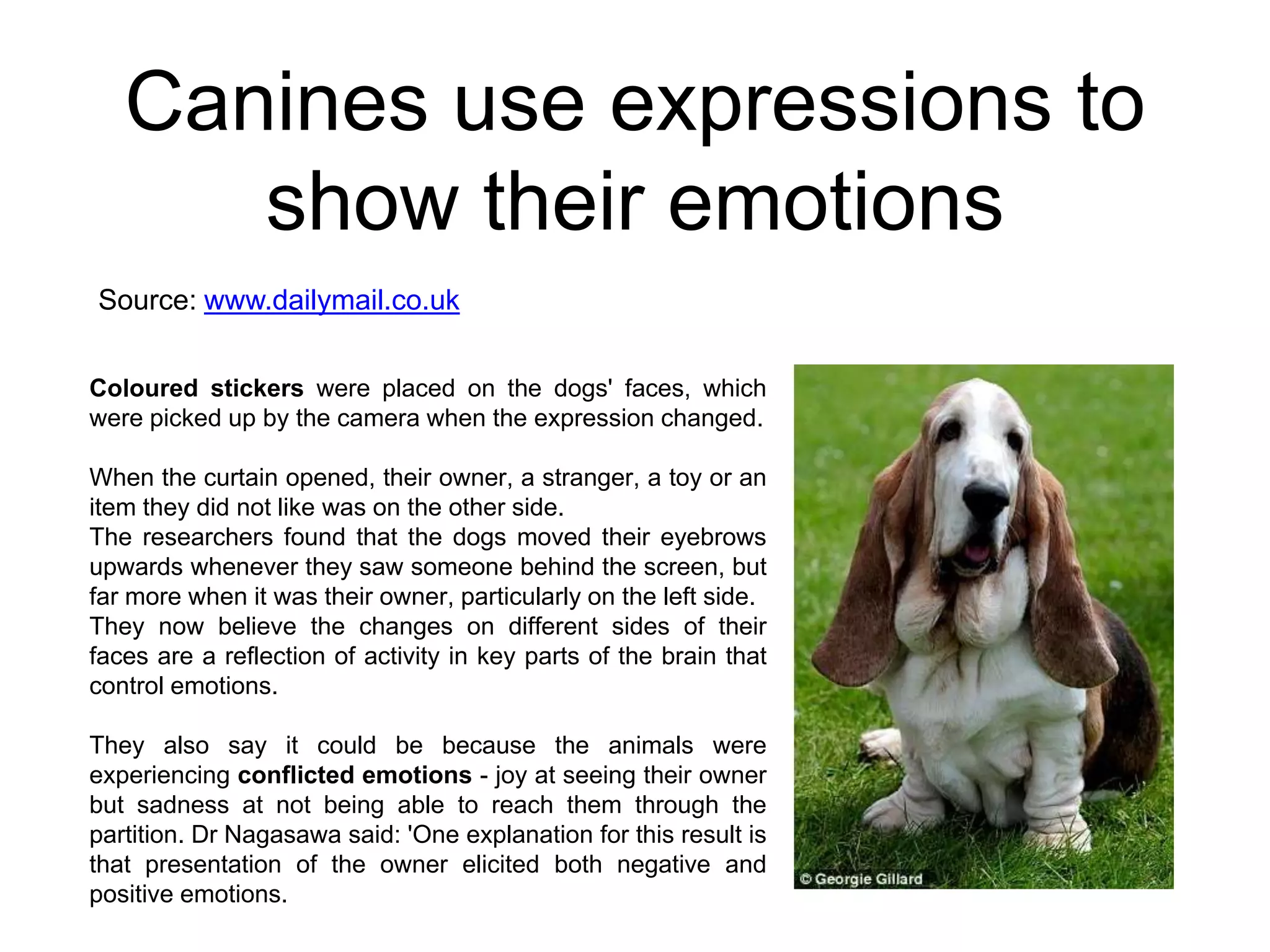
The researchers found that the dogs moved their eyebrows
upwards whenever they saw someone behind the screen, but
far more when it was their owner, particularly on the left side.
They now believe the changes on different sides of their
faces are a reflection of activity in key parts of the brain that
control emotions.
They also say it could be because the animals were
experiencing conflicted emotions - joy at seeing their owner
but sadness at not being able to reach them through the
partition. Dr Nagasawa said: 'One explanation for this result is
that presentation of the owner elicited both negative and
positive emotions.

Facial expression and emotions 1

  • 1.
  • 2.
    Why do weuse facial expressions? Source: www.scientificamerican.com The ability to communicate subtle emotions with a simple raised eyebrow or curl of the lip may be innate. Charles Darwin was one of the first to propose this theory in his book The Expression of the Emotions in Man and Animals, published in 1871, in which he wrote: “The young and the old of widely different races, both with man and animals, express the same state of mind by the same movements.” Recent work supports Darwin’s theory that smiles, grimaces and more nuanced expressions are hardwired—an artifact of living in social groups. Because humans depend on one another for survival, we must communicate; facial expressions may have evolved as efficient ways to telegraph feelings and intentions.
  • 3.
    Facial Action CodingSystem Source: www.face-and-emotion.com The Facial Action Coding System (FACS) is a detailed, technical guide that explains how to categorize facial behaviors based on the muscles that produce Paul Ekman and W.V. Friesen developed the original FACS in the 1970s by determining how the contraction of each facial muscle (singly and in combination with other muscles) changes the appearance of the face. They examined videotapes of facial behavior to identify the specific changes that occurred with muscular contractions and how best to differentiate one from another. They associated the appearance changes with the action of muscles that produced them by studying anatomy, reproducing the appearances, and palpating their faces. Their goal was to create a reliable means for skilled human scorers to determine the category or categories in which to fit each facial behavior. The FACS Manual was first published in a loose-leaf version with video or film supplements in 1978.
  • 4.
    Six universal emotions Source:www.nbb.cornell.edu Psychological research has classified six facial expressions which correspond to distinct universal emotions: disgust, sadness, happiness, fear, anger. EXPRESSION MOTION CUES PSEUDO-MUSCLES USED Happiness raising and lowering of mouth corners 6 linear muscles Sadness lowering of mouth corners raise inner portion of brows 6 linear muscles Surprise brows arch eyes open wide to expose more white jaw drops slightly 3 linear muscles Fear brows raised eyes open mouth opens slightly 5 linear muscles 1 sphincter for the mouth Disgust upper lip is raised nose bridge is wrinkled cheeks raised 6 linear muscles Anger brows lowered lips pressed firmly eyes bulging 4 linear muscles 1 sphincter for the mouth
  • 5.
    Canines use expressionsto show their emotions Source: www.dailymail.co.uk 'Dogs’ ears are prominent features used to convey emotional expression, therefore our results suggest that dogs were more cautious toward unfamiliar people. 'In contrast, eyebrow movement might indicate a visible response whereby dogs attempted to look at their owners more intently.' The results of the study were published in the journal Behavioural Processes. The researchers placed 12 dogs in a room divided by a partition with curtains that opened briefly to allow the dogs to glimpse what was on the other side, while highspeed cameras tracked their facial expressions. The research also found that dogs raise their left ear when meeting a stranger for the first time and raise their right ear when they see an object they don't like, such as nail clippers.
  • 6.
    Canines use expressionsto show their emotions Source: www.dailymail.co.uk Coloured stickers were placed on the dogs' faces, which were picked up by the camera when the expression changed. When the curtain opened, their owner, a stranger, a toy or an item they did not like was on the other side. The researchers found that the dogs moved their eyebrows upwards whenever they saw someone behind the screen, but far more when it was their owner, particularly on the left side. They now believe the changes on different sides of their faces are a reflection of activity in key parts of the brain that control emotions. They also say it could be because the animals were experiencing conflicted emotions - joy at seeing their owner but sadness at not being able to reach them through the partition. Dr Nagasawa said: 'One explanation for this result is that presentation of the owner elicited both negative and positive emotions.