MICROEXPRESSIONS
Savipra Gorospe, CHt, RPm
MICRO EXPRESSIONS
• Micro expressions are very brief facial expressions, lasting only a
fraction of a second.They occur when a person either deliberately or
consciously conceals a feeling. Seven emotions have universal signals:
anger, fear, sadness, disgust, contempt, surprise, and happiness. You can
learn to spot them.
HISTORY
• Haggard and Isaacs were the first to describe micro expressions (calling
them “micro momentary expressions”) in their study of psychotherapeutic
interviews.
• They explained the appearance of “micros” as the result of repression; the
patient did not know how he or she was feeling.
• Haggard and Isaacs also implied that these fleeting expressions could not be
recognized in real time, but Ekman and Friesen later showed that, with
training, anyone could learn to see “micros” when they occurred. Ekman
and Friesen also broadened the explanation of why micros occur.
HISTORY
• Micro expressions happen when people have hidden their feelings from
themselves (repression) or when they deliberately try to conceal their
feelings from others.
• Importantly, both instances look the same; you cannot tell from the
expression itself whether it is the product of suppression (deliberate
concealment) or repression (unconscious concealment).
TYPES
• Macro: normal expressions usually last between ½ second and 4 seconds.They
often repeat, and fit with what is said and the sound of the person’s voice.
• Micro:These are very brief, usually lasting between 1/15 and 1/25 of a second.They
often display a concealed emotion and are the result of suppression or repression.
• False: A deliberately-made stimulation of an emotion not being felt.
• Masked: A false expression made to cover a macro expression.
WHY ARE MICRO EXPRESSIONS
IMPORTANT?
Learning to spot micro expressions can
help you:
• Improve your emotional intelligence
• Develop your capacity for empathy
• Spot Concealed Emotions
• Improve your relationships
• Understand others
• Recognize and better manage your
own emotions
• Develop Social Skills
HOW CANYOU LEARN MICRO
EXPRESSIONS?
• There are many resources to help you learn to spot micro expressions.
• Paul Ekman has developed scientifically-proven training tools:
• Micro ExpressionTrainingTool (METT)
• Subtle ExpressionTrainingTool (SETT)
THE SEVEN UNIVERSAL
FACIAL EXPRESSIONS
ANGER
Eyes:The eyes show an intense look, with or
without white under the eyes.
The upper and lower eyelids are tight.
They eyebrows are low and can bind together.
Mouth:The jaws and lips are pressed
together. The lower lip may be somewhat bigger
as it is pressed. The mouth is narrow.
Body: Body temperature and heart rate are rising.
CONTEMPT
Mouth: Half of the upper lip is tightened
up. To make this half-smile of contempt, we
use the risorius muscle. While we share many
physiological characteristics with primates,
this small, flat muscle is not one of them. It is
located in the cheek, next to the lips.
Head: It is often slightly tilted
back. Contempt is often accompanied by a
sense of superiority
DISGUST
Nose:Wrinkles appear on and
around the nose.
Mouth:The upper lip rises and
the lower lip can be off-axis.
The teeth can be visible, but not
always.
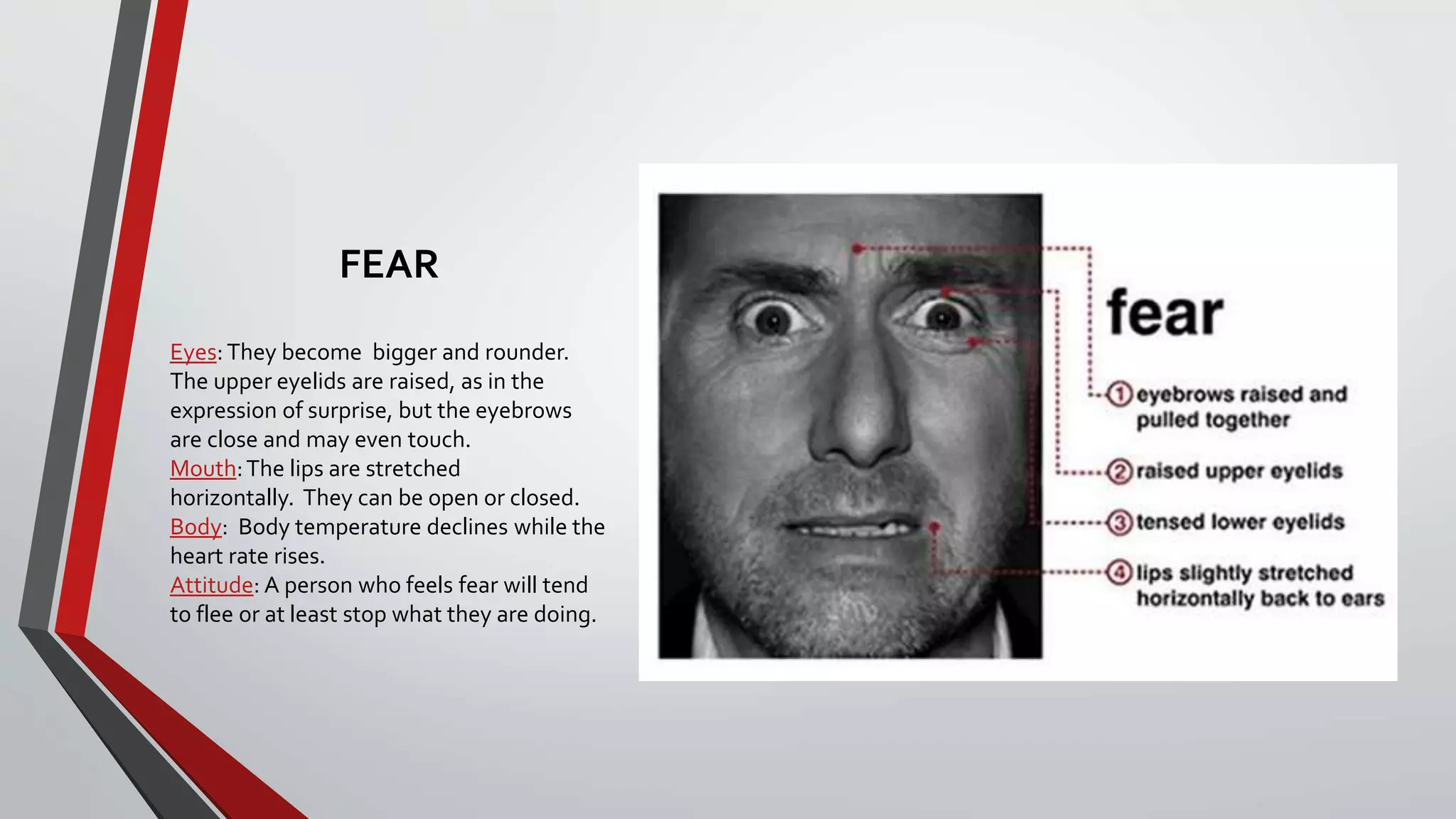
FEAR
Eyes:They become bigger and rounder.
The upper eyelids are raised, as in the
expression of surprise, but the eyebrows
are close and may even touch.
Mouth:The lips are stretched
horizontally. They can be open or closed.
Body: Body temperature declines while the
heart rate rises.
Attitude: A person who feels fear will tend
to flee or at least stop what they are doing.
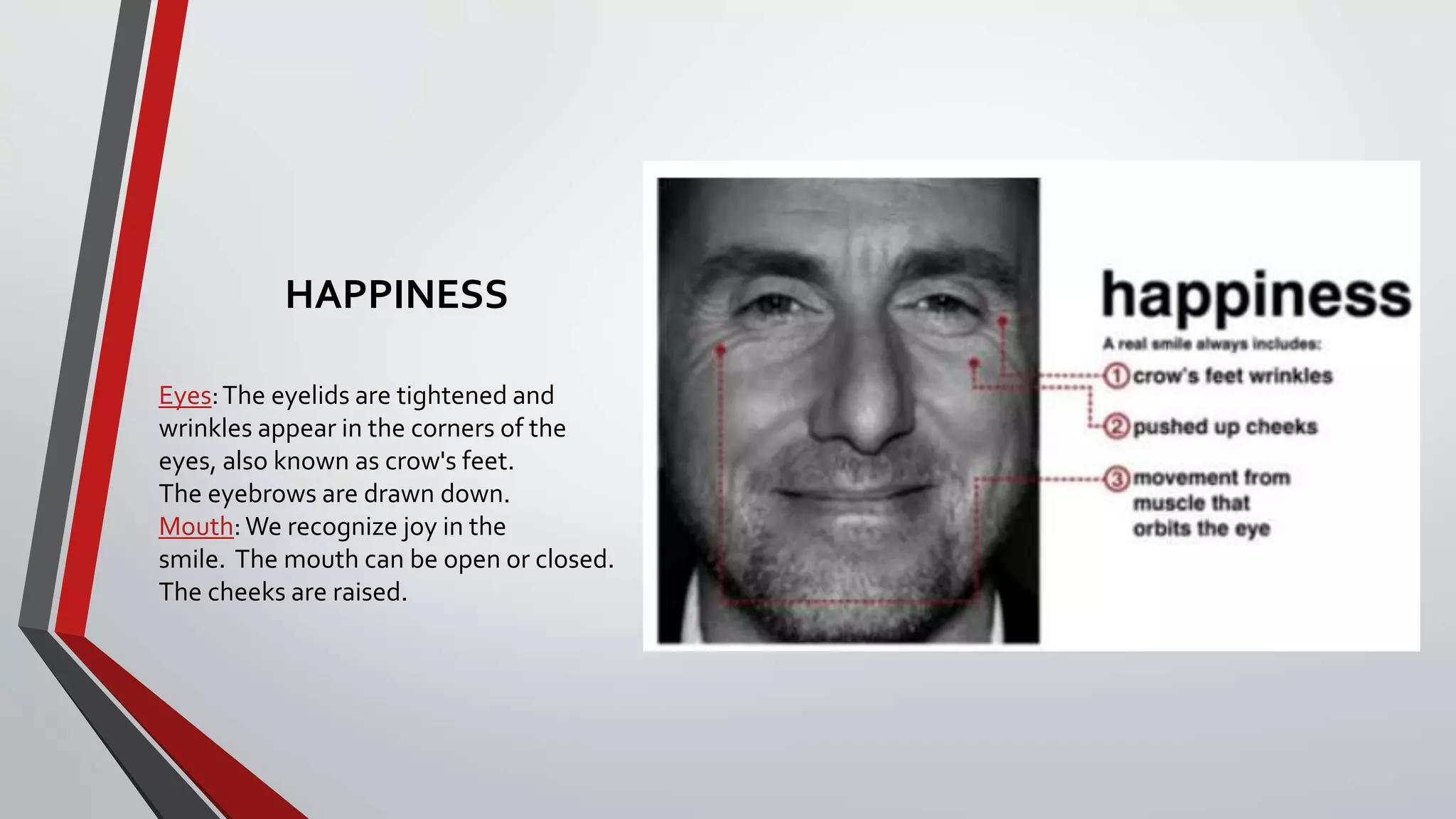
HAPPINESS
Eyes:The eyelids are tightened and
wrinkles appear in the corners of the
eyes, also known as crow's feet.
The eyebrows are drawn down.
Mouth:We recognize joy in the
smile. The mouth can be open or closed.
The cheeks are raised.
SADNESS
Eyes:They seem empty. It is also possible to
observe a contraction of the pupils.
The eyelids droop.
The eyebrows descend to the inside
corners. They can even bind in the case of an
extremely strong sadness.
Mouth:The corners of the lips are facing down.
The lower lip can be transformed into a pout.
Body:The body temperature rises. The heart rate
is faster than in the expression of disgust.
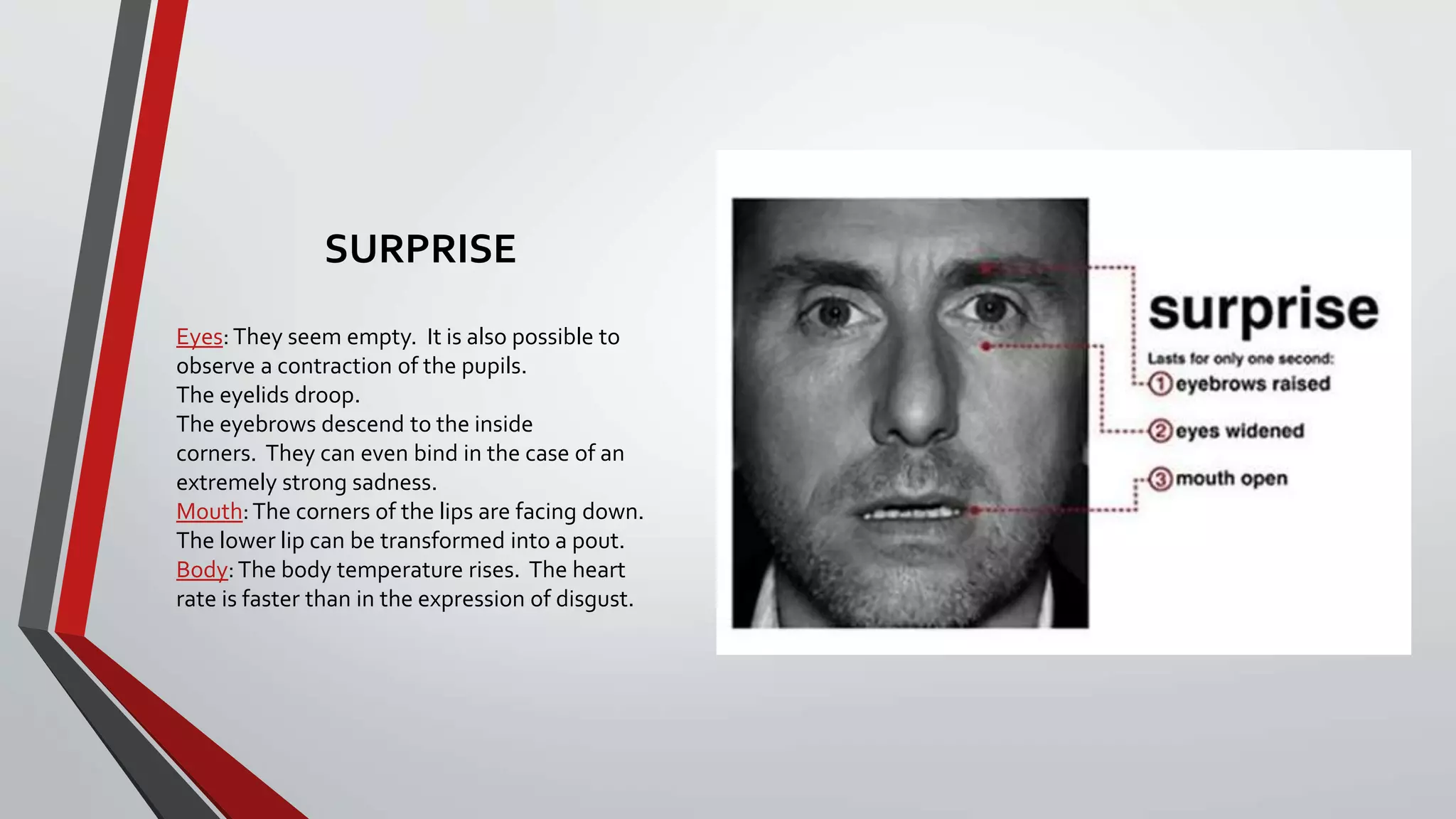
SURPRISE
Eyes:They seem empty. It is also possible to
observe a contraction of the pupils.
The eyelids droop.
The eyebrows descend to the inside
corners. They can even bind in the case of an
extremely strong sadness.
Mouth:The corners of the lips are facing down.
The lower lip can be transformed into a pout.
Body:The body temperature rises. The heart
rate is faster than in the expression of disgust.
REFERENCES
• Ekman, P.
Darwins-Compassionate-View-Of-Human-Nature-2010
JAMA February 10, 2010.Vol. 303 (6): 557-558
• Ekman, P. (2009)
Become-Versed-in-reading-faces
Entrepreneur, 26 March 2009.
• Ekman, P.
Lie Catching and Microexpressions
The Philosophy of Deception, Ed. Clancy Martin, Oxford University Press, 2009
• Frank, M.G., Matsumoto, D., Ekman, P. Sinuk, K., Kurylo,A. (2008)
Improving the Ability to recognize Microexpressions of Emotion
In review

Microexpressions

  • 1.
  • 2.
    MICRO EXPRESSIONS • Microexpressions are very brief facial expressions, lasting only a fraction of a second.They occur when a person either deliberately or consciously conceals a feeling. Seven emotions have universal signals: anger, fear, sadness, disgust, contempt, surprise, and happiness. You can learn to spot them.
  • 3.
    HISTORY • Haggard andIsaacs were the first to describe micro expressions (calling them “micro momentary expressions”) in their study of psychotherapeutic interviews. • They explained the appearance of “micros” as the result of repression; the patient did not know how he or she was feeling. • Haggard and Isaacs also implied that these fleeting expressions could not be recognized in real time, but Ekman and Friesen later showed that, with training, anyone could learn to see “micros” when they occurred. Ekman and Friesen also broadened the explanation of why micros occur.
  • 4.
    HISTORY • Micro expressionshappen when people have hidden their feelings from themselves (repression) or when they deliberately try to conceal their feelings from others. • Importantly, both instances look the same; you cannot tell from the expression itself whether it is the product of suppression (deliberate concealment) or repression (unconscious concealment).
  • 5.
    TYPES • Macro: normalexpressions usually last between ½ second and 4 seconds.They often repeat, and fit with what is said and the sound of the person’s voice. • Micro:These are very brief, usually lasting between 1/15 and 1/25 of a second.They often display a concealed emotion and are the result of suppression or repression. • False: A deliberately-made stimulation of an emotion not being felt. • Masked: A false expression made to cover a macro expression.
  • 6.
    WHY ARE MICROEXPRESSIONS IMPORTANT? Learning to spot micro expressions can help you: • Improve your emotional intelligence • Develop your capacity for empathy • Spot Concealed Emotions • Improve your relationships • Understand others • Recognize and better manage your own emotions • Develop Social Skills
  • 7.
    HOW CANYOU LEARNMICRO EXPRESSIONS? • There are many resources to help you learn to spot micro expressions. • Paul Ekman has developed scientifically-proven training tools: • Micro ExpressionTrainingTool (METT) • Subtle ExpressionTrainingTool (SETT)
  • 8.
  • 9.
    ANGER Eyes:The eyes showan intense look, with or without white under the eyes. The upper and lower eyelids are tight. They eyebrows are low and can bind together. Mouth:The jaws and lips are pressed together. The lower lip may be somewhat bigger as it is pressed. The mouth is narrow. Body: Body temperature and heart rate are rising.
  • 10.
    CONTEMPT Mouth: Half ofthe upper lip is tightened up. To make this half-smile of contempt, we use the risorius muscle. While we share many physiological characteristics with primates, this small, flat muscle is not one of them. It is located in the cheek, next to the lips. Head: It is often slightly tilted back. Contempt is often accompanied by a sense of superiority
  • 11.
    DISGUST Nose:Wrinkles appear onand around the nose. Mouth:The upper lip rises and the lower lip can be off-axis. The teeth can be visible, but not always.
  • 12.
    FEAR Eyes:They become biggerand rounder. The upper eyelids are raised, as in the expression of surprise, but the eyebrows are close and may even touch. Mouth:The lips are stretched horizontally. They can be open or closed. Body: Body temperature declines while the heart rate rises. Attitude: A person who feels fear will tend to flee or at least stop what they are doing.
  • 13.
    HAPPINESS Eyes:The eyelids aretightened and wrinkles appear in the corners of the eyes, also known as crow's feet. The eyebrows are drawn down. Mouth:We recognize joy in the smile. The mouth can be open or closed. The cheeks are raised.
  • 14.
    SADNESS Eyes:They seem empty.It is also possible to observe a contraction of the pupils. The eyelids droop. The eyebrows descend to the inside corners. They can even bind in the case of an extremely strong sadness. Mouth:The corners of the lips are facing down. The lower lip can be transformed into a pout. Body:The body temperature rises. The heart rate is faster than in the expression of disgust.
  • 15.
    SURPRISE Eyes:They seem empty.It is also possible to observe a contraction of the pupils. The eyelids droop. The eyebrows descend to the inside corners. They can even bind in the case of an extremely strong sadness. Mouth:The corners of the lips are facing down. The lower lip can be transformed into a pout. Body:The body temperature rises. The heart rate is faster than in the expression of disgust.
  • 16.
    REFERENCES • Ekman, P. Darwins-Compassionate-View-Of-Human-Nature-2010 JAMAFebruary 10, 2010.Vol. 303 (6): 557-558 • Ekman, P. (2009) Become-Versed-in-reading-faces Entrepreneur, 26 March 2009. • Ekman, P. Lie Catching and Microexpressions The Philosophy of Deception, Ed. Clancy Martin, Oxford University Press, 2009 • Frank, M.G., Matsumoto, D., Ekman, P. Sinuk, K., Kurylo,A. (2008) Improving the Ability to recognize Microexpressions of Emotion In review