The word "emotion"datesbackto1779, whenitwas adaptedfromthe frenchwordémouvoir,which
means"to stirup".Emotionshave beendescribedasdiscrete andconsistentresponsestointernal or
external eventswhichhave aparticularsignificance forthe organism.Emotionsare brief indurationand
consistof a coordinatedsetof responses,whichmayinclude physiological,behavioural,andneural
mechanisms.
CharlesDarwinwasone of the firstscientiststowrite aboutthe existence andnature of emotionsin
animals.Hisobservationalandsometimesanecdotal approachhasdevelopedintoa more robust,
hypothesis-driven,scientificapproach.General hypothesesrelatingtocorrelatesbetweenhumansand
animalsalsosupportthe claimthat animalsmayfeel emotionsandthathumanemotionsevolvedfrom
the same mechanisms.Severaltests,suchas cognitive biastestsandlearnedhelplessnessmodels,have
beendeveloped.Cognitivebiases(feelingsof optimismorpessimism) have beenshowninawide range
of speciesincludingrats,dogs,cats,rhesusmacaques,sheep,chicks,starlings,[5] pigs[6] and
honeybees.[7]
Scientificapproach
In recentyears,the scientificcommunityhasbecome increasinglysupportive of the ideaof emotionsin
animals.Scientificresearchhasprovidedinsightintosimilaritiesof physiological changesbetween
humansand animalswhenexperiencingemotion.[20]
Much supportfor animal emotionanditsexpressionresultsfromthe notionthatfeelingemotions
doesn'trequire significantcognitiveprocesses,[13] rather,theycouldbe motivatedbythe processesto
act in an adaptive way,assuggestedbyDarwin.Recentattemptsinstudyingemotionsinanimalshave
ledto newconstructionsinexperimental andinformationgathering
Cognitive biastest
Usingthis approach,ithas beenfoundthatrats whichare subjectedtoeither handlingorplayful,
experimenter-administeredmanual stimulation(tickling) showeddifferentresponsestothe
intermediate stimulus:ratsexposedtoticklingwere more optimistic.[5]
The authorsstatedthattheyhad
demonstrated"...forthe firsttime alinkbetweenthe directlymeasuredpositive affective state and
decisionmakingunderuncertaintyinananimal model."
Cognitive biaseshave beenshowninawide range of speciesincludingrats,dogs,rhesusmacaques,
sheep,chicks,starlingsandhoneybees
Self-medicationwithpsychoactive drugs
Standardlaboratorycagespreventmice fromperformingseveral natural behavioursforwhichtheyare
highlymotivated.Asaconsequence,laboratorymicesometimesdevelopabnormal behaviours
indicative of emotional disorderssuchasdepressionandanxiety.Toimprove welfare,these cagesare
sometimesenrichedwithitemssuchasnestingmaterial,sheltersandrunningwheels.Sherwinand
Ollson[26] testedwhethersuchenrichmentinfluencedthe consumptionof Midazolam, adrugwidely
usedto treatanxietyinhumans.Mice instandardcages, standardcagesbut withunpredictable
husbandry,orenrichedcages,were givenachoice of drinkingeithernon-druggedwaterora solutionof
the Midazolam.Mice in the standardand unpredictablecagesdranka greaterproportionof the
anxiolyticsolutionthanmice fromenrichedcages,indicatingthatmice fromthe standardand
unpredictablelaboratorycagingmayhave beenexperiencinggreateranxietythanmice fromthe
enrichedcages.
Criticism–
The argumentthat animalsexperienceemotionsissometimesrejecteddue toalack of evidence,and
those[who?]
whodon't believeinthe ideaof animal intelligence,oftenargue
that anthropomorphism playsarole inindividuals'perspectives.Those whorejectthatanimalshave the
capacityto experienceemotiondosomainlybyreferringtoinconsistenciesinstudiesthathave
endorsedthe belief emotionsexist.Havingnolinguisticmeanstocommunicate emotionbeyond
behavioral response interpretation,the difficultyof providinganaccountof emotioninanimalsrelies
heavilyoninterpretiveexperimentation,thatrelies onresultsfromhumansubjects.[22]
Examples
Primates,inparticulargreatapes,are candidatesforbeingable toexperience empathyandtheoryof
mind.Greatapes have complex social systems;youngapesandtheirmothershave strongbondsof
attachmentand whenababy chimpanzee[37] orgorilla[38] dies,the motherwill notuncommonlycarry
the bodyaround forseveral days.Jane Goodall hasdescribedchimpanzeesasexhibitingmournful
behavior.[citationneeded] Koko,agorillatrainedtouse signlanguage,wasreportedtohave expressed
vocalisations indicatingsadnessafterthe deathof herpetcat
Langfordet al.examinedempathyinrodentsusinganapproachbasedinneuroscience.[49] They
reportedthat(1) if twomice experiencedpaintogether,theyexpressedgreaterlevelsof pain-related
behaviorthanif painwasexperiencedindividually,(2) if experiencingdifferentlevelsof paintogether,
the behaviorof eachmouse wasmodulatedbythe level of painexperiencedbyitssocial partner,and(3)
sensitivitytoanoxiousstimuluswasexperiencedto the same degree bythe mouse observinga
conspecificinpainasit wasby the mouse directlyexperiencingthe painful stimulus.
Althoughnotdirectevidence thathorsesexperience emotions,a2016 studyshowedthatdomestic
horsesreact differentlytoseeingphotographsof positive (happy) ornegative(angry) humanfacial
expressions.Whenviewingangryfaces,horseslookmore withtheirlefteye whichisassociatedwith
perceivingnegativestimuli.Theirheartrate alsoincreasesmore quicklyandtheyshow more stress-
relatedbehaviours.
The capacity of domestichenstoexperience empathyhasbeenstudied.veryinterestingencounter
amongfive magpies.Magpiesare corvids,averyintelligentfamilyof birds.One magpie hadobviously
beenhitbya car and was layingdeadonthe side of the road. The four othermagpieswere standing
aroundhim.One approachedthe corpse,gentlypeckedatit-justasan elephantnosesthe carcassof
anotherelephant- andsteppedback.Anothermagpiedidthe same thing.Next, one of the magpiesflew
off,broughtback some grass,and laiditby the corpse.Anothermagpie didthe same.Then,all four
magpiesstoodvigil forafewsecondsandone by one flew off.
A furtherseriesof experimentsshowedthat,similartohumans,underconditionsof long-termintense
psychological stress,aroundone thirdof dogsdonotdeveloplearnedhelplessnessorlongterm
depression.[65][66] Insteadthese animalssomehow managedtofindawayto handle the unpleasant
situationinspite of theirpastexperience.
The existence andnature of personalitytraitsindogshave beenstudied(15,329dogs of 164 different
breeds).Five consistentandstable "narrow traits"were identified,describedasplayfulness,
curiosity/fearlessness,chase-proneness,sociabilityandaggressiveness.A furtherhigherorderaxisfor
shyness–boldnesswasalsoidentified.
It has beenpostulatedthatdomesticcatscan learnto manipulate theirownersthroughvocalizations
that are similartothe criesof human babies.whena particularvocalizationelicitsapositive response
froma human,the probabilityincreasesthatthe catwill use thatvocalizationinthe future
Growlingcan be an expressionof annoyance orfear,similartohumans.Whenannoyedorangry,a cat
wrigglesandthumpsitstail muchmore vigorouslythanwhenina contentedstate.Inlargerfelidssuch
as lions,whatappearstobe irritatingtothemvariesbetweenindividuals.A male lionmaylethiscubs
playwithhismane or tail,or he may hissand hitthemwithhispaws.[78] Domesticmale catsalsohave
variable attitudestowardstheirfamilymembers,forexample,oldermale siblingstendnottogo near
youngeror newsiblingsandmayevenshow hostilitytowardthem.
Honeybees
Crayfish
Horses
Birds
https://en.wikipedia.org/wiki/Emotion_in_animals
Do birdshave feelings?
Corvidsalsoare able to expresspleasureanddothingsforthe fun of it.They alsoseemtounderstand
Schadenfreude, andyankthe tailsof otherbirdsandanimalsjustto see theirreactions.
Alsodon’tpissoff an eagle.They’ll messyouup.It’sverywell knownamongfalconersforaGoldenEagle
whohas missedakill tocome back to herfalconerandfoothim(use her talonson him).If she misses
herkill,falconersknowit’sbesttoletyourgirl siton the groundand cool off her temperbefore youcall
herback.
I’ve seenparrotsgrieve fora lostcompanionora lost human,andsome nevergetoverit.I’ve seenmy
cockatoo take greatoffense atbeinglaughedat.I’ve seenall myparrotsexpressloveandhappinessat
beingoutand playingwithus.WhenIlostmy mother,all of my birdswouldcuddle close andmake
soothingsoundsatme.
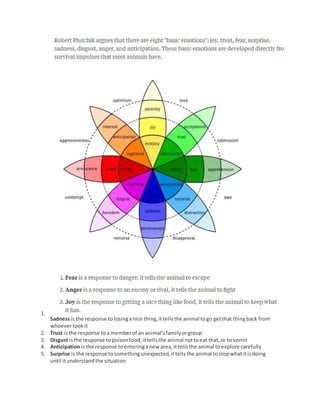
1.
Sadnessis the response to losinganice thing,ittellsthe animal togo getthat thingback from
whoevertookit
2. Trust isthe response toa memberof an animal'sfamilyorgroup
3. Disgust isthe response topoisonfood,ittellsthe animal nottoeat that,or to vomit
4. Anticipationis the response toenteringanew area,ittellsthe animal toexplore carefully
5. Surprise is the response tosomethingunexpected,ittellsthe animal tostopwhatitisdoing
until itunderstandthe situation
https://www.quora.com/Do-animals-have-emotions-and-feelings
Today,most scientistsagree thatall vertebrate animals — mammals,birds,reptiles,amphibiansandfish
— are,to varyingdegrees,sentient
It’simportantto knowwhowe are here onEarth with.We talkabout conservationof animalsby
numbers,butthose are justnumbers.Watchinganimalsmywhole lifeI’ve alwaysbeenstruckbyhow
similartous theyare.I’ve alwaysbeentouchedbytheirbondsandbeenimpressed—occasionally
frightened—bytheiremotions.
Life isveryvividtoanimals.Inmanycases theyknow whotheyare.Theyknow whotheirfriendsare and
whotheirrivalsare.Theyhave ambitionsforhigherstatus. Theycompete.Theirlivesfollowthe arcof a
career,like oursdo.We bothtry to stay alive,getfoodandshelter,andraise some youngforthe next
generation.Animalsare nodifferentfromusinthatregard and I thinkthattheirpresence here onEarth
istremendouslyenriching.
It isincredible to me there isstill adebate overwhetheranimalsare consciousandevenadebate over
whetherhumanbeingscanknowanimalsare conscious.If youwatchmammalsor evenbirds,youwill
see howtheyrespondtothe world.Theyplay.Theyact frightenedwhenthere’sdanger.Theyrelax
whenthingsare good.It seemsillogical forusto thinkthatanimalsmightnotbe havinga conscious
mental experienceof play,sleep,fearorlove.
So why are many scientists adverse to the idea that animals have consciousness?
In the beginningthere was almost no neurology,nothingwas knownof how mental processes
worked.Animal behaviorwas based on fables,like foxesare clever,tortoises are persistent.So
scientistssaid,“All we can know about animalsis based on what they do. We can only describe
what they do. We can’t know anythingabout theirminds.” Unfortunately,that hardenedinto a
straightjacket assumptionthat if we can’t know anythingabout their minds,we can’t confirm
consciousness.
Meanwhile,people have spent decadeswatching wildanimals.People whowatch wildanimals
don’t questionwhetherthey’re consciousor not because we see incredible intricaciesof behavior
and vast ranges of personalities.I’mtalkingabout vertebrates:mammalslike elephantsand cats,
but also birds.
It’s very obviousthat animals are conscious to those whoobserve them. They have to be in order
to do the things theydo and make the choices that theydo, and use the judgmentsthat they use.
However,in laboratoriesthe dogma persists:don’t assume that animalsthink and have emotions–
and many scientistsinsistthat theydo not.
With the public,I think it’squite different.Many people simplyassume that animals act
consciouslyand base their belief ontheirown domesticanimalsor pets. Otherpeople do not want
animalsto be conscious because it makesit easierfor us to do things to animals that wouldbe
hard to do if we knewthey were unhappy and suffering.
National geographic- http://news.nationalgeographic.com/2015/07/150714-animal-dog-thinking-
feelings-brain-science/
Do animalshave emotions?? - Guardian- https://www.theguardian.com/lifeandstyle/2014/nov/13/if-
only-they-could-talk-
Do AnimalsExperience Emotions?
https://www.psychologistworld.com/emotion/do-animals-experience-emotions

Animal emotions

  • 1.
    The word "emotion"datesbackto1779,whenitwas adaptedfromthe frenchwordémouvoir,which means"to stirup".Emotionshave beendescribedasdiscrete andconsistentresponsestointernal or external eventswhichhave aparticularsignificance forthe organism.Emotionsare brief indurationand consistof a coordinatedsetof responses,whichmayinclude physiological,behavioural,andneural mechanisms. CharlesDarwinwasone of the firstscientiststowrite aboutthe existence andnature of emotionsin animals.Hisobservationalandsometimesanecdotal approachhasdevelopedintoa more robust, hypothesis-driven,scientificapproach.General hypothesesrelatingtocorrelatesbetweenhumansand animalsalsosupportthe claimthat animalsmayfeel emotionsandthathumanemotionsevolvedfrom the same mechanisms.Severaltests,suchas cognitive biastestsandlearnedhelplessnessmodels,have beendeveloped.Cognitivebiases(feelingsof optimismorpessimism) have beenshowninawide range of speciesincludingrats,dogs,cats,rhesusmacaques,sheep,chicks,starlings,[5] pigs[6] and honeybees.[7]
  • 2.
    Scientificapproach In recentyears,the scientificcommunityhasbecomeincreasinglysupportive of the ideaof emotionsin animals.Scientificresearchhasprovidedinsightintosimilaritiesof physiological changesbetween humansand animalswhenexperiencingemotion.[20] Much supportfor animal emotionanditsexpressionresultsfromthe notionthatfeelingemotions doesn'trequire significantcognitiveprocesses,[13] rather,theycouldbe motivatedbythe processesto act in an adaptive way,assuggestedbyDarwin.Recentattemptsinstudyingemotionsinanimalshave ledto newconstructionsinexperimental andinformationgathering Cognitive biastest Usingthis approach,ithas beenfoundthatrats whichare subjectedtoeither handlingorplayful, experimenter-administeredmanual stimulation(tickling) showeddifferentresponsestothe intermediate stimulus:ratsexposedtoticklingwere more optimistic.[5] The authorsstatedthattheyhad
  • 3.
    demonstrated"...forthe firsttime alinkbetweenthedirectlymeasuredpositive affective state and decisionmakingunderuncertaintyinananimal model." Cognitive biaseshave beenshowninawide range of speciesincludingrats,dogs,rhesusmacaques, sheep,chicks,starlingsandhoneybees Self-medicationwithpsychoactive drugs Standardlaboratorycagespreventmice fromperformingseveral natural behavioursforwhichtheyare highlymotivated.Asaconsequence,laboratorymicesometimesdevelopabnormal behaviours indicative of emotional disorderssuchasdepressionandanxiety.Toimprove welfare,these cagesare sometimesenrichedwithitemssuchasnestingmaterial,sheltersandrunningwheels.Sherwinand Ollson[26] testedwhethersuchenrichmentinfluencedthe consumptionof Midazolam, adrugwidely usedto treatanxietyinhumans.Mice instandardcages, standardcagesbut withunpredictable husbandry,orenrichedcages,were givenachoice of drinkingeithernon-druggedwaterora solutionof the Midazolam.Mice in the standardand unpredictablecagesdranka greaterproportionof the anxiolyticsolutionthanmice fromenrichedcages,indicatingthatmice fromthe standardand unpredictablelaboratorycagingmayhave beenexperiencinggreateranxietythanmice fromthe enrichedcages. Criticism– The argumentthat animalsexperienceemotionsissometimesrejecteddue toalack of evidence,and those[who?] whodon't believeinthe ideaof animal intelligence,oftenargue that anthropomorphism playsarole inindividuals'perspectives.Those whorejectthatanimalshave the capacityto experienceemotiondosomainlybyreferringtoinconsistenciesinstudiesthathave endorsedthe belief emotionsexist.Havingnolinguisticmeanstocommunicate emotionbeyond behavioral response interpretation,the difficultyof providinganaccountof emotioninanimalsrelies heavilyoninterpretiveexperimentation,thatrelies onresultsfromhumansubjects.[22] Examples Primates,inparticulargreatapes,are candidatesforbeingable toexperience empathyandtheoryof mind.Greatapes have complex social systems;youngapesandtheirmothershave strongbondsof attachmentand whenababy chimpanzee[37] orgorilla[38] dies,the motherwill notuncommonlycarry the bodyaround forseveral days.Jane Goodall hasdescribedchimpanzeesasexhibitingmournful behavior.[citationneeded] Koko,agorillatrainedtouse signlanguage,wasreportedtohave expressed vocalisations indicatingsadnessafterthe deathof herpetcat
  • 4.
    Langfordet al.examinedempathyinrodentsusinganapproachbasedinneuroscience.[49] They reportedthat(1)if twomice experiencedpaintogether,theyexpressedgreaterlevelsof pain-related behaviorthanif painwasexperiencedindividually,(2) if experiencingdifferentlevelsof paintogether, the behaviorof eachmouse wasmodulatedbythe level of painexperiencedbyitssocial partner,and(3) sensitivitytoanoxiousstimuluswasexperiencedto the same degree bythe mouse observinga conspecificinpainasit wasby the mouse directlyexperiencingthe painful stimulus. Althoughnotdirectevidence thathorsesexperience emotions,a2016 studyshowedthatdomestic horsesreact differentlytoseeingphotographsof positive (happy) ornegative(angry) humanfacial expressions.Whenviewingangryfaces,horseslookmore withtheirlefteye whichisassociatedwith perceivingnegativestimuli.Theirheartrate alsoincreasesmore quicklyandtheyshow more stress- relatedbehaviours. The capacity of domestichenstoexperience empathyhasbeenstudied.veryinterestingencounter amongfive magpies.Magpiesare corvids,averyintelligentfamilyof birds.One magpie hadobviously beenhitbya car and was layingdeadonthe side of the road. The four othermagpieswere standing aroundhim.One approachedthe corpse,gentlypeckedatit-justasan elephantnosesthe carcassof anotherelephant- andsteppedback.Anothermagpiedidthe same thing.Next, one of the magpiesflew off,broughtback some grass,and laiditby the corpse.Anothermagpie didthe same.Then,all four magpiesstoodvigil forafewsecondsandone by one flew off. A furtherseriesof experimentsshowedthat,similartohumans,underconditionsof long-termintense psychological stress,aroundone thirdof dogsdonotdeveloplearnedhelplessnessorlongterm depression.[65][66] Insteadthese animalssomehow managedtofindawayto handle the unpleasant situationinspite of theirpastexperience. The existence andnature of personalitytraitsindogshave beenstudied(15,329dogs of 164 different breeds).Five consistentandstable "narrow traits"were identified,describedasplayfulness, curiosity/fearlessness,chase-proneness,sociabilityandaggressiveness.A furtherhigherorderaxisfor shyness–boldnesswasalsoidentified. It has beenpostulatedthatdomesticcatscan learnto manipulate theirownersthroughvocalizations that are similartothe criesof human babies.whena particularvocalizationelicitsapositive response froma human,the probabilityincreasesthatthe catwill use thatvocalizationinthe future Growlingcan be an expressionof annoyance orfear,similartohumans.Whenannoyedorangry,a cat wrigglesandthumpsitstail muchmore vigorouslythanwhenina contentedstate.Inlargerfelidssuch as lions,whatappearstobe irritatingtothemvariesbetweenindividuals.A male lionmaylethiscubs playwithhismane or tail,or he may hissand hitthemwithhispaws.[78] Domesticmale catsalsohave
  • 5.
    variable attitudestowardstheirfamilymembers,forexample,oldermale siblingstendnottogonear youngeror newsiblingsandmayevenshow hostilitytowardthem. Honeybees Crayfish Horses Birds https://en.wikipedia.org/wiki/Emotion_in_animals Do birdshave feelings? Corvidsalsoare able to expresspleasureanddothingsforthe fun of it.They alsoseemtounderstand Schadenfreude, andyankthe tailsof otherbirdsandanimalsjustto see theirreactions. Alsodon’tpissoff an eagle.They’ll messyouup.It’sverywell knownamongfalconersforaGoldenEagle whohas missedakill tocome back to herfalconerandfoothim(use her talonson him).If she misses herkill,falconersknowit’sbesttoletyourgirl siton the groundand cool off her temperbefore youcall herback. I’ve seenparrotsgrieve fora lostcompanionora lost human,andsome nevergetoverit.I’ve seenmy cockatoo take greatoffense atbeinglaughedat.I’ve seenall myparrotsexpressloveandhappinessat beingoutand playingwithus.WhenIlostmy mother,all of my birdswouldcuddle close andmake soothingsoundsatme.
  • 6.
    1. Sadnessis the responseto losinganice thing,ittellsthe animal togo getthat thingback from whoevertookit 2. Trust isthe response toa memberof an animal'sfamilyorgroup 3. Disgust isthe response topoisonfood,ittellsthe animal nottoeat that,or to vomit 4. Anticipationis the response toenteringanew area,ittellsthe animal toexplore carefully 5. Surprise is the response tosomethingunexpected,ittellsthe animal tostopwhatitisdoing until itunderstandthe situation
  • 7.
    https://www.quora.com/Do-animals-have-emotions-and-feelings Today,most scientistsagree thatallvertebrate animals — mammals,birds,reptiles,amphibiansandfish — are,to varyingdegrees,sentient It’simportantto knowwhowe are here onEarth with.We talkabout conservationof animalsby numbers,butthose are justnumbers.Watchinganimalsmywhole lifeI’ve alwaysbeenstruckbyhow similartous theyare.I’ve alwaysbeentouchedbytheirbondsandbeenimpressed—occasionally frightened—bytheiremotions. Life isveryvividtoanimals.Inmanycases theyknow whotheyare.Theyknow whotheirfriendsare and whotheirrivalsare.Theyhave ambitionsforhigherstatus. Theycompete.Theirlivesfollowthe arcof a career,like oursdo.We bothtry to stay alive,getfoodandshelter,andraise some youngforthe next generation.Animalsare nodifferentfromusinthatregard and I thinkthattheirpresence here onEarth istremendouslyenriching. It isincredible to me there isstill adebate overwhetheranimalsare consciousandevenadebate over whetherhumanbeingscanknowanimalsare conscious.If youwatchmammalsor evenbirds,youwill see howtheyrespondtothe world.Theyplay.Theyact frightenedwhenthere’sdanger.Theyrelax whenthingsare good.It seemsillogical forusto thinkthatanimalsmightnotbe havinga conscious mental experienceof play,sleep,fearorlove. So why are many scientists adverse to the idea that animals have consciousness? In the beginningthere was almost no neurology,nothingwas knownof how mental processes worked.Animal behaviorwas based on fables,like foxesare clever,tortoises are persistent.So scientistssaid,“All we can know about animalsis based on what they do. We can only describe what they do. We can’t know anythingabout theirminds.” Unfortunately,that hardenedinto a straightjacket assumptionthat if we can’t know anythingabout their minds,we can’t confirm consciousness. Meanwhile,people have spent decadeswatching wildanimals.People whowatch wildanimals don’t questionwhetherthey’re consciousor not because we see incredible intricaciesof behavior and vast ranges of personalities.I’mtalkingabout vertebrates:mammalslike elephantsand cats, but also birds.
  • 8.
    It’s very obviousthatanimals are conscious to those whoobserve them. They have to be in order to do the things theydo and make the choices that theydo, and use the judgmentsthat they use. However,in laboratoriesthe dogma persists:don’t assume that animalsthink and have emotions– and many scientistsinsistthat theydo not. With the public,I think it’squite different.Many people simplyassume that animals act consciouslyand base their belief ontheirown domesticanimalsor pets. Otherpeople do not want animalsto be conscious because it makesit easierfor us to do things to animals that wouldbe hard to do if we knewthey were unhappy and suffering. National geographic- http://news.nationalgeographic.com/2015/07/150714-animal-dog-thinking- feelings-brain-science/ Do animalshave emotions?? - Guardian- https://www.theguardian.com/lifeandstyle/2014/nov/13/if- only-they-could-talk- Do AnimalsExperience Emotions? https://www.psychologistworld.com/emotion/do-animals-experience-emotions