2.2 EMOTION IN THE FACE
E
The face is the “mind’s canvas” and communicates certain universal emotions.
People can be very adept at concealing/deceiving with facial cues, which is
why it is important to cluster observations. The trained eye looks for “micro-
gestures” which are subtle, but “leak” information.
All people have an intuitive foundation for interpreting nonverbal
communication. However, non-verbal acuity is a learned ability that grows as
people articulate the connection between observation and manifesting
emotion.
Working with nonverbal acuity helps the care provider to recognize emotions
in themselves and other people. This creates a more consistent and intentional
non-verbal presentation as well as encouraging empathy.
Section 2.2 of the Aegis System™ comes from the work credited to Paul
Ekman who developed the Facial Action Coding System. Ekman has
empirically shown consistencies within these universal emotional signatures
that have been scientifically proven and documented all over the world.
THERE ARE SEVEN UNIVERSAL FACIAL EXPRESSIONS
THAT UNITE ALL PEOPLE
Anger
Fear
Sadness
Disgust
Happiness
Surprise
Contempt
When these emotions register on the face, they range from subtle (also referred
to as micro-expressions) to obvious. They may present as leakage from
suppression or even present themselves before a person is cognitively
experiencing the emotion within themselves.
Each of these expressions may appear in a facial cluster or completely isolated
from other facial feature activation. To the trained observer, subtle “micro-
expressions” are often the most telling because of their difficulty to conceal.
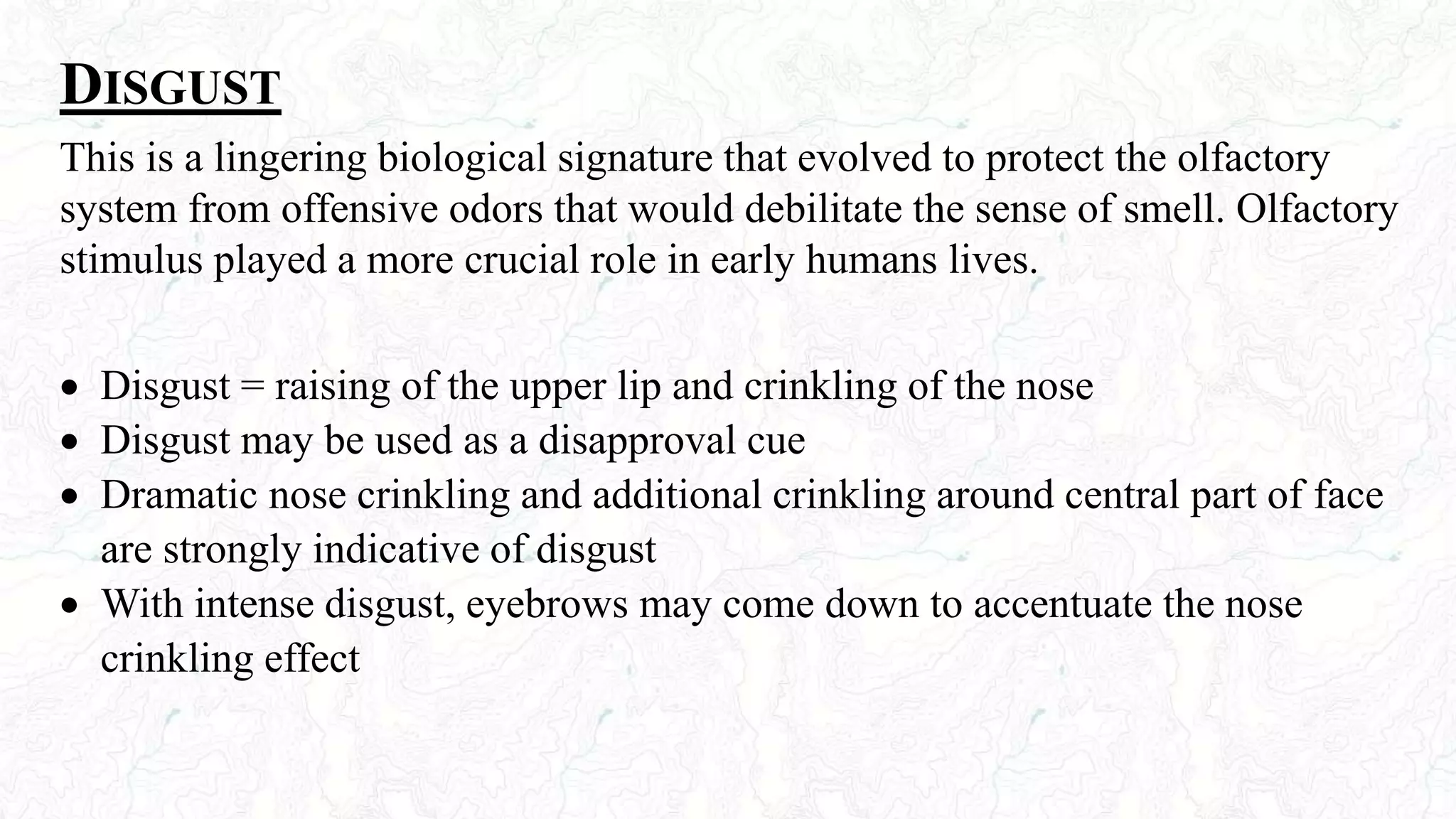
We are looking for movement from
someone’s baseline or resting face.
© Dr. Paul
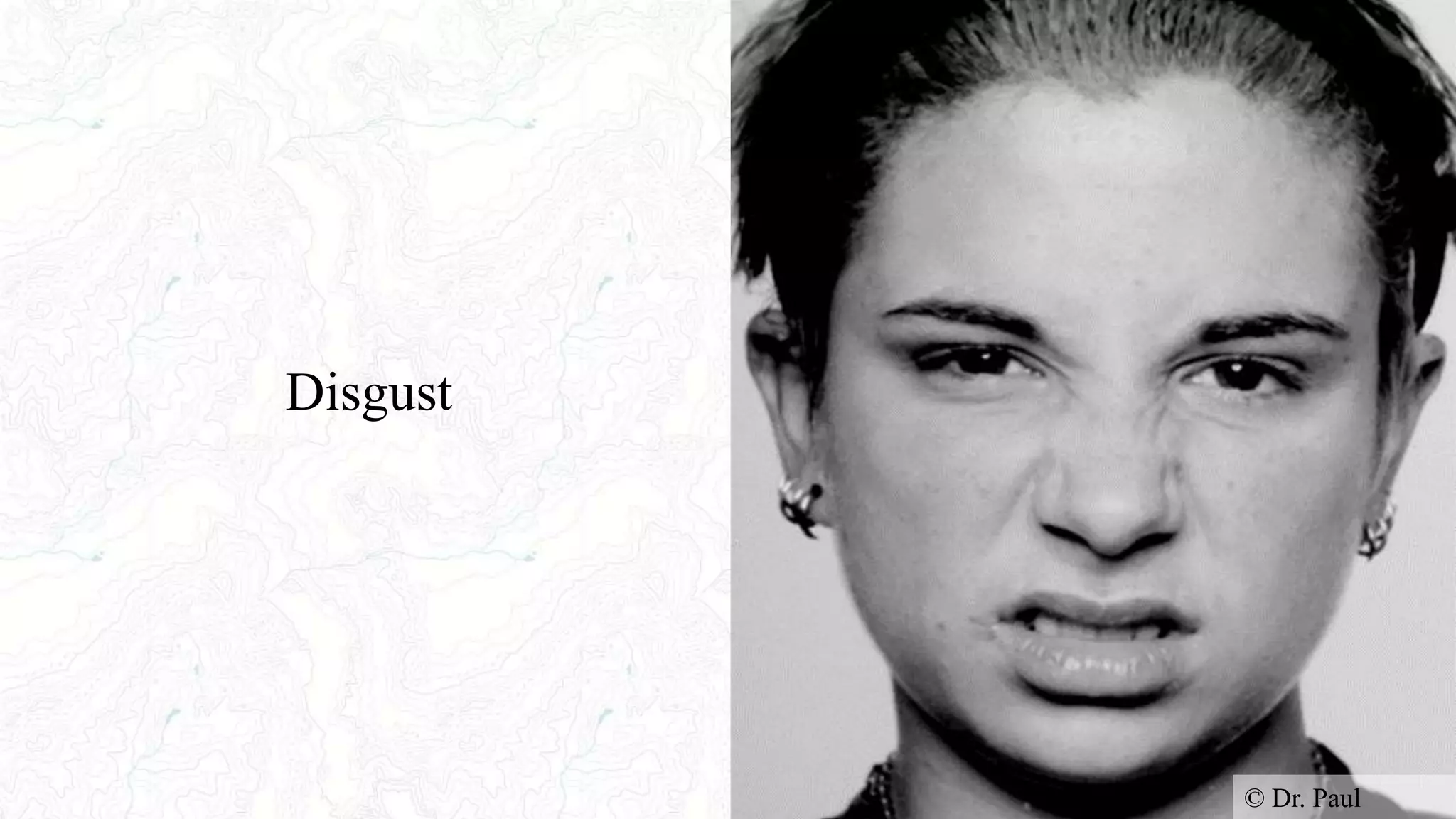
DISGUST
This is a lingering biological signature that evolved to protect the olfactory
system from offensive odors that would debilitate the sense of smell. Olfactory
stimulus played a more crucial role in early humans lives.
 Disgust = raising of the upper lip and crinkling of the nose
 Disgust may be used as a disapproval cue
 Dramatic nose crinkling and additional crinkling around central part of face
are strongly indicative of disgust
 With intense disgust, eyebrows may come down to accentuate the nose
crinkling effect
Disgust
© Dr. Paul
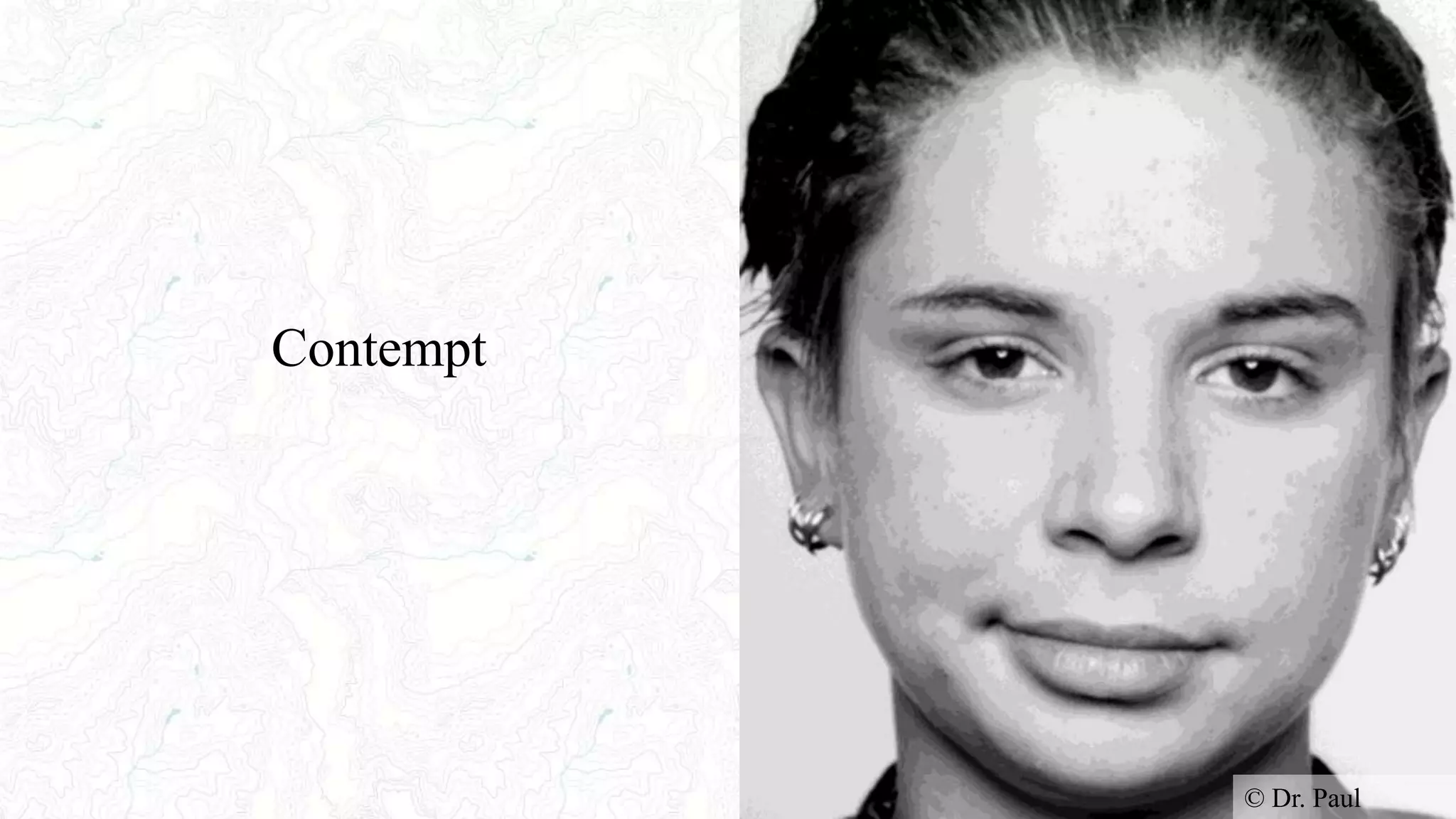
CONTEMPT
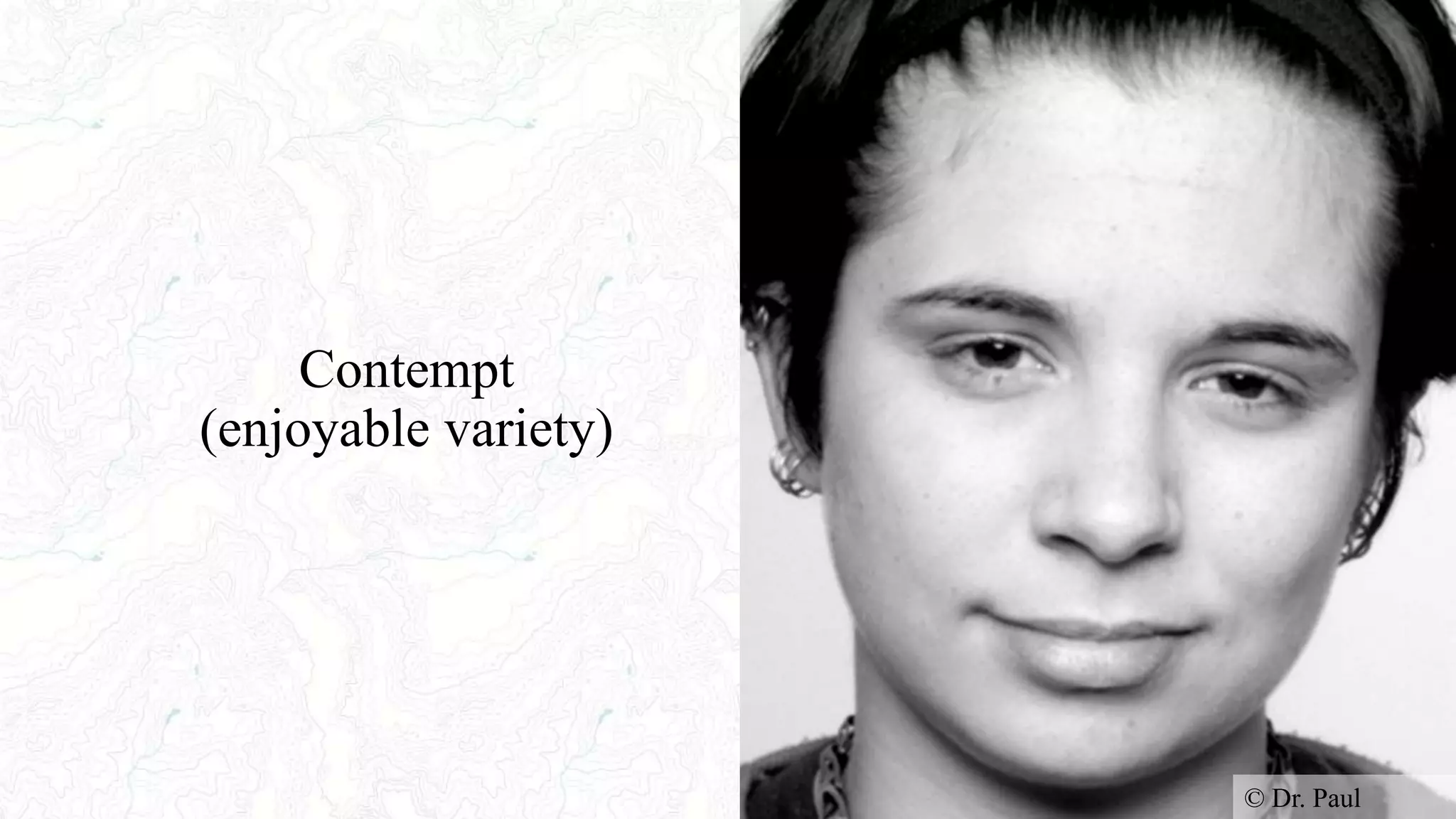
Contempt activates face muscles that tighten and draw the corner of the mouth
into the face. This expression may appear with a slight smile; it is not
uncommon for people to enjoy the feeling of superiority that comes with
contempt.
 May pair with the impulse to look down on an object or person, similar to a
disproval cue
 Contempt is the only asymmetrical (one sided) facial expression considered
to be universal
Contempt
© Dr. Paul
Contempt
(enjoyable variety)
© Dr. Paul
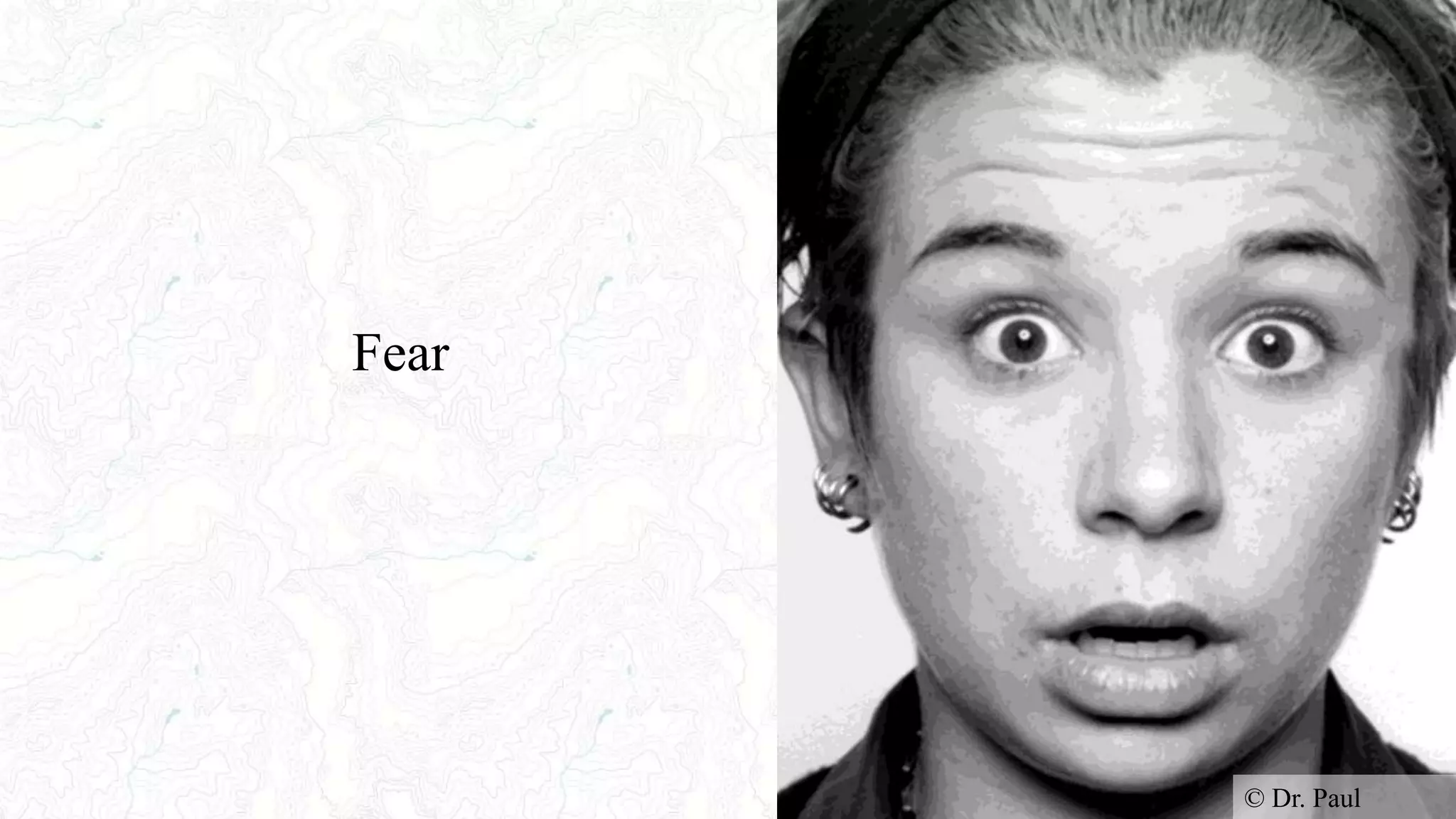
FEAR
In fear, people’s upper eyelid/eyebrows raise and their eyes get big. Fear and
surprise may be difficult to differentiate but fortunately, in the context of real-
time observation, surprise is brief and will often quickly transition.
 Fear can occur subtly with no eyebrow movement, just a raising of the upper
eyelid
 Fear creates a distinct set of horizontal wrinkles, or furrows, in center of
forehead as eyebrows draw up and together into the middle of the forehead
 Lips pull out in a pronounced horizontal fashion, which is an important
differentiator from surprise which has lips that are less tensed
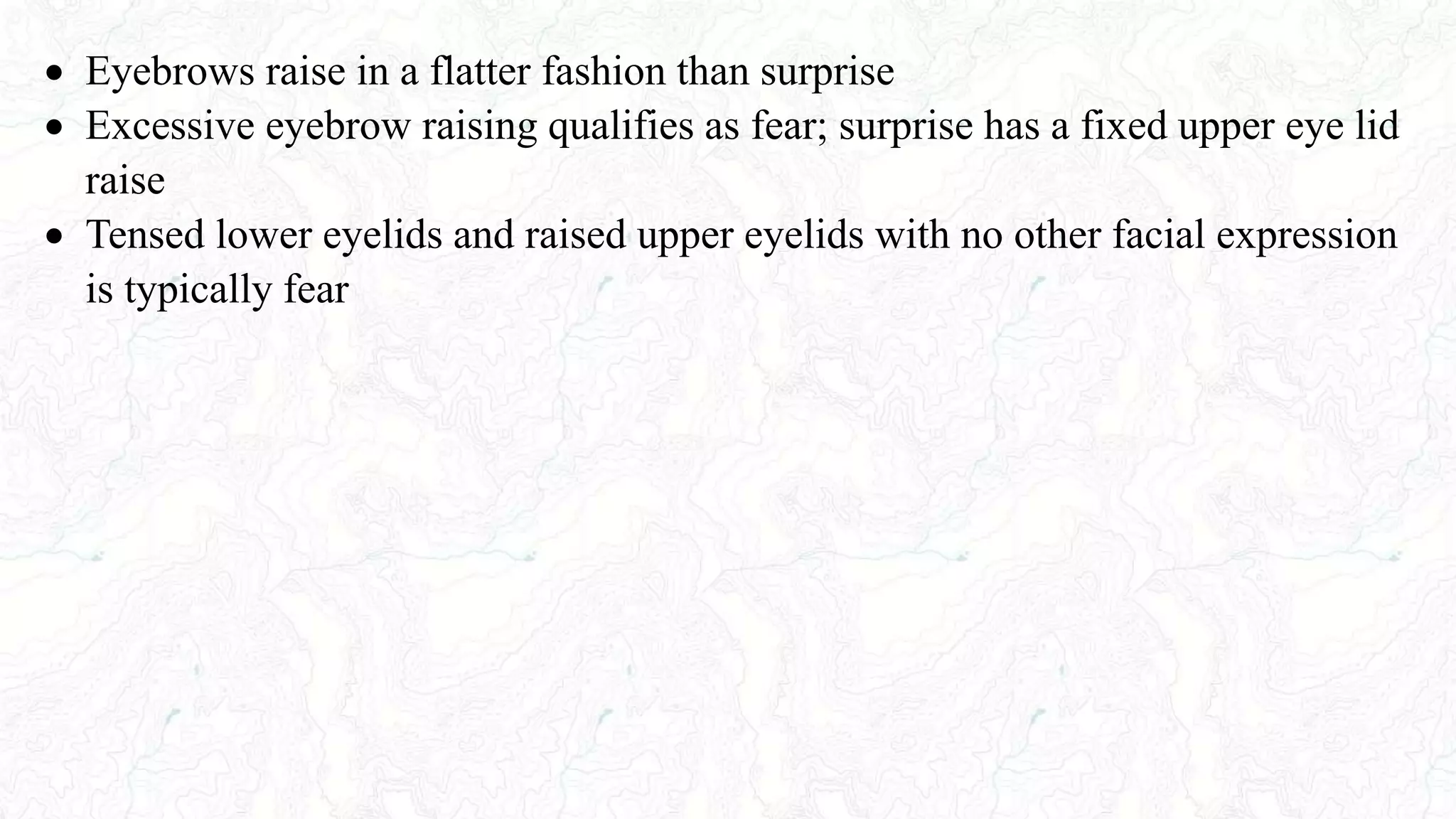
 Eyebrows raise in a flatter fashion than surprise
 Excessive eyebrow raising qualifies as fear; surprise has a fixed upper eye lid
raise
 Tensed lower eyelids and raised upper eyelids with no other facial expression
is typically fear
Fear
© Dr. Paul
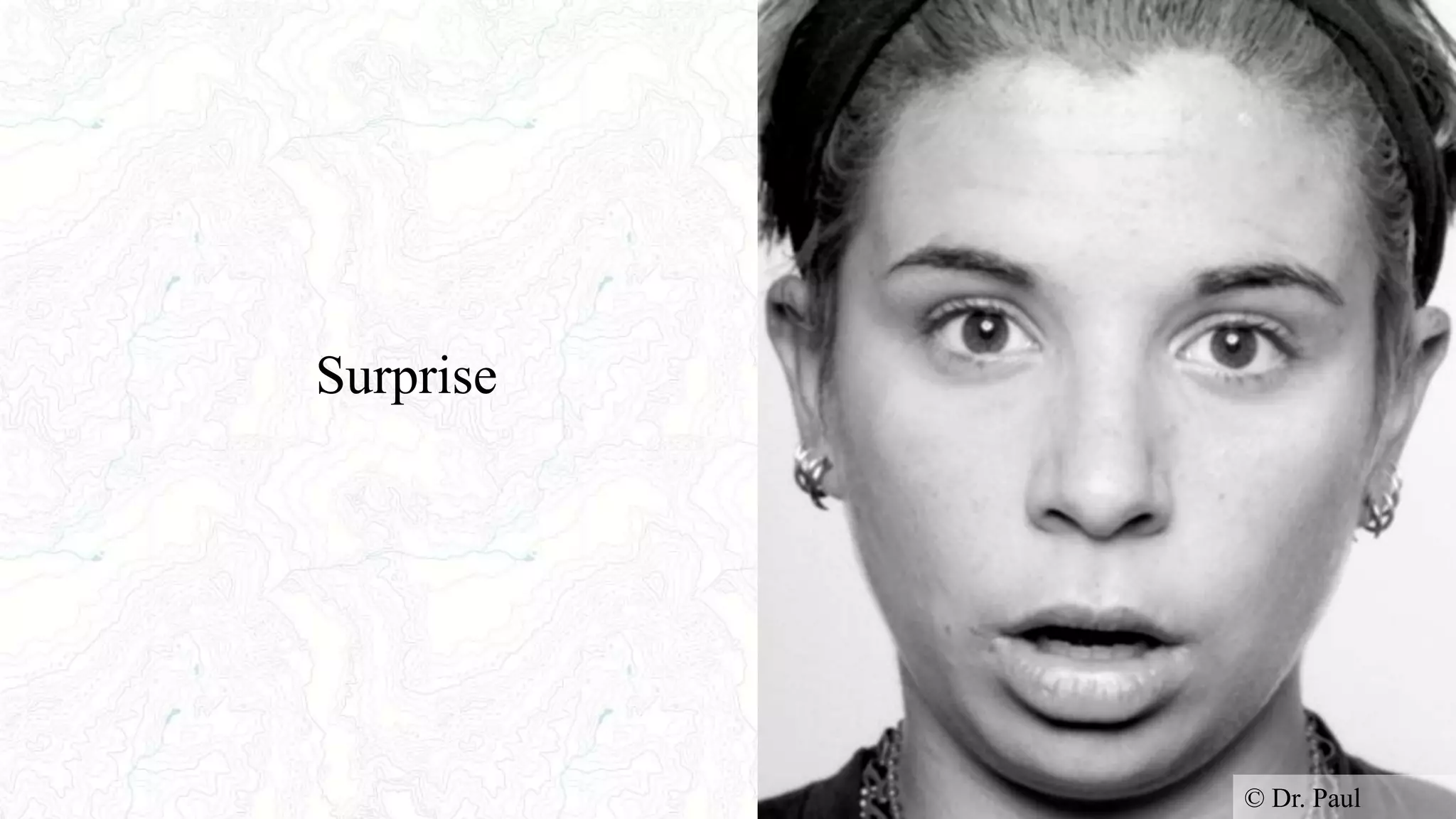
SURPRISE
With surprise (similar to fear), the upper eyelid/eyebrows raise and eyes get big.
Surprise is the briefest of all emotions, which helps to differentiate it from fear
in observation. In its true form, surprise does not last long. Surprise is a call to
action.
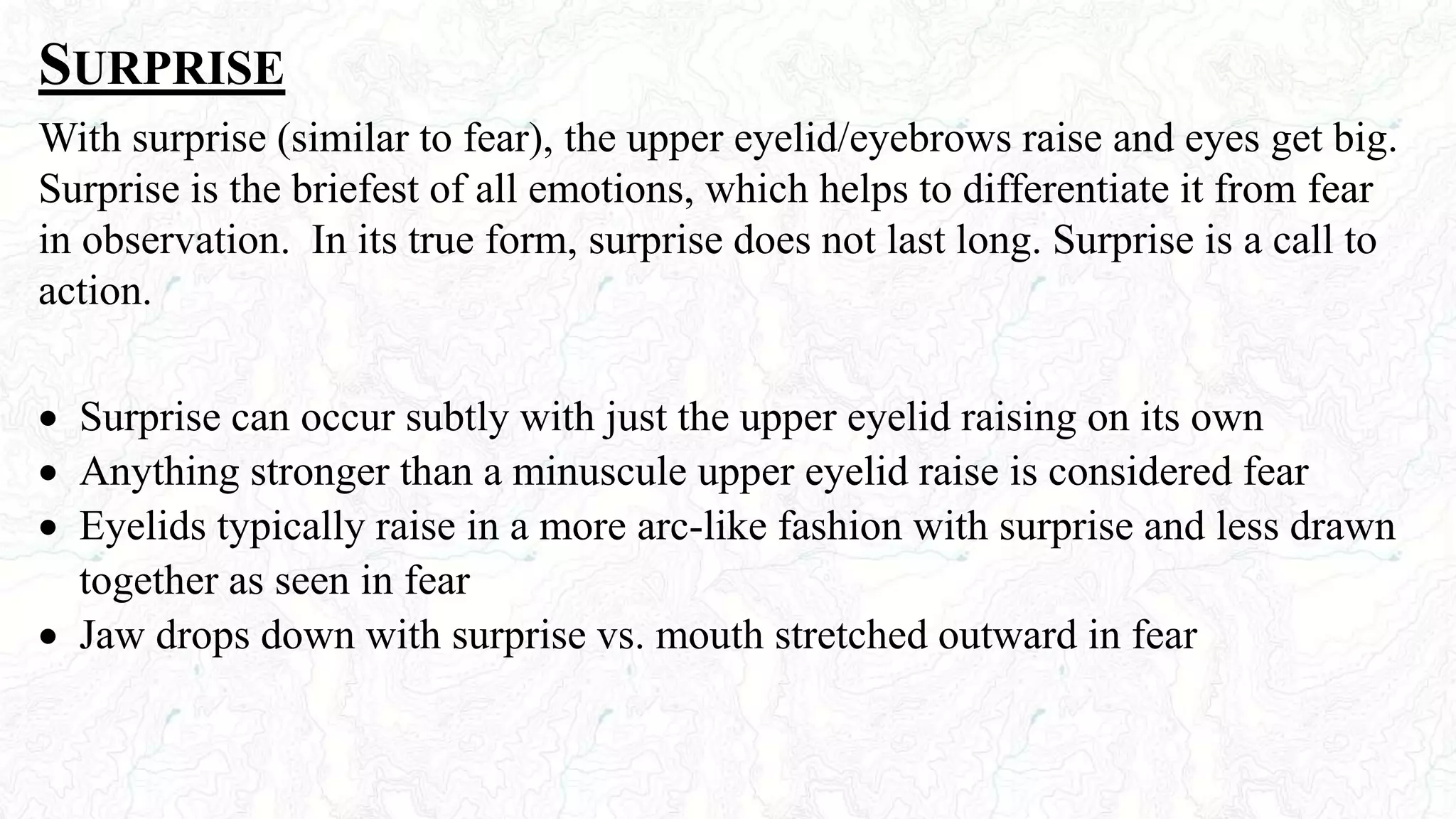
 Surprise can occur subtly with just the upper eyelid raising on its own
 Anything stronger than a minuscule upper eyelid raise is considered fear
 Eyelids typically raise in a more arc-like fashion with surprise and less drawn
together as seen in fear
 Jaw drops down with surprise vs. mouth stretched outward in fear
Surprise
© Dr. Paul
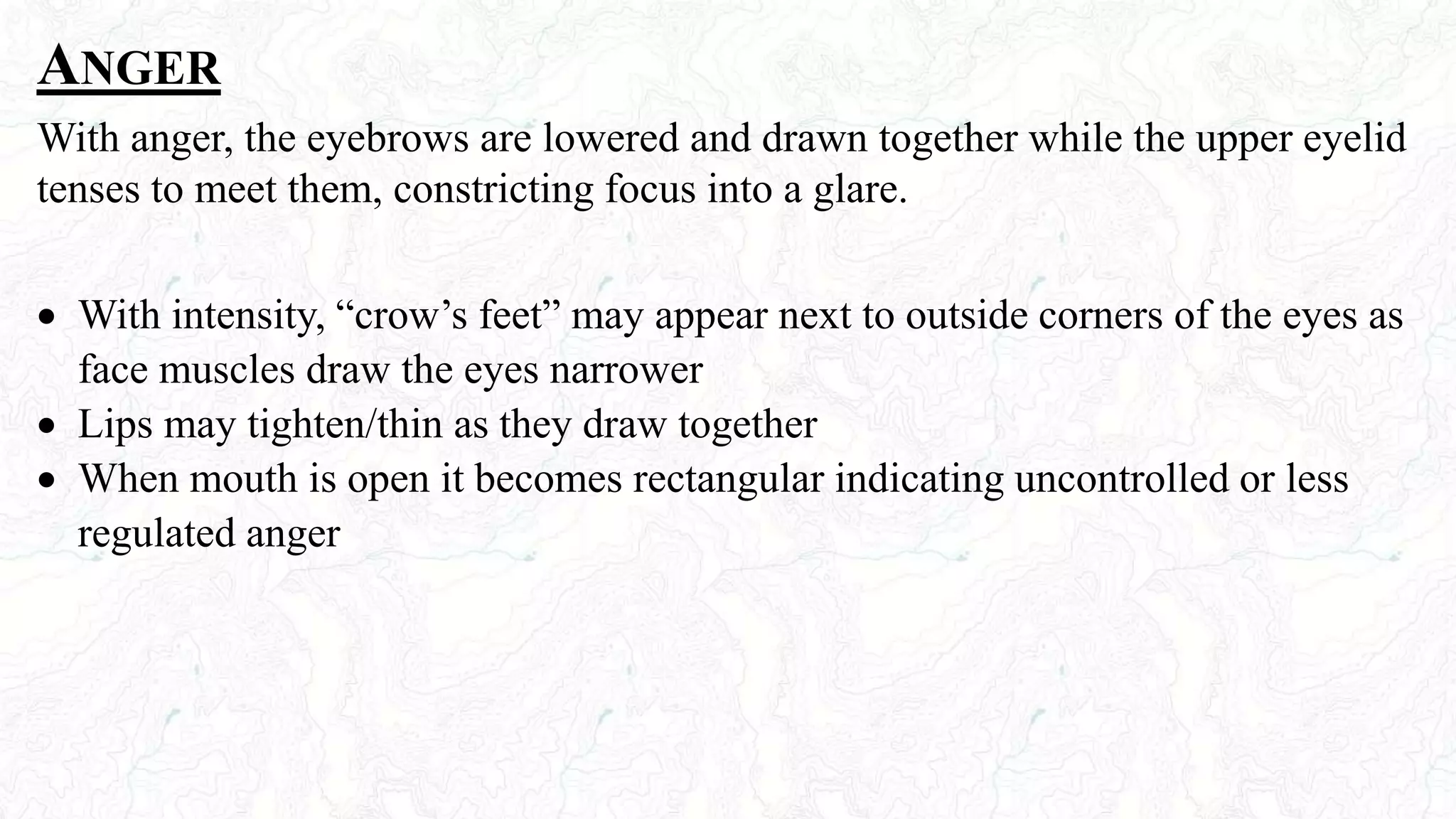
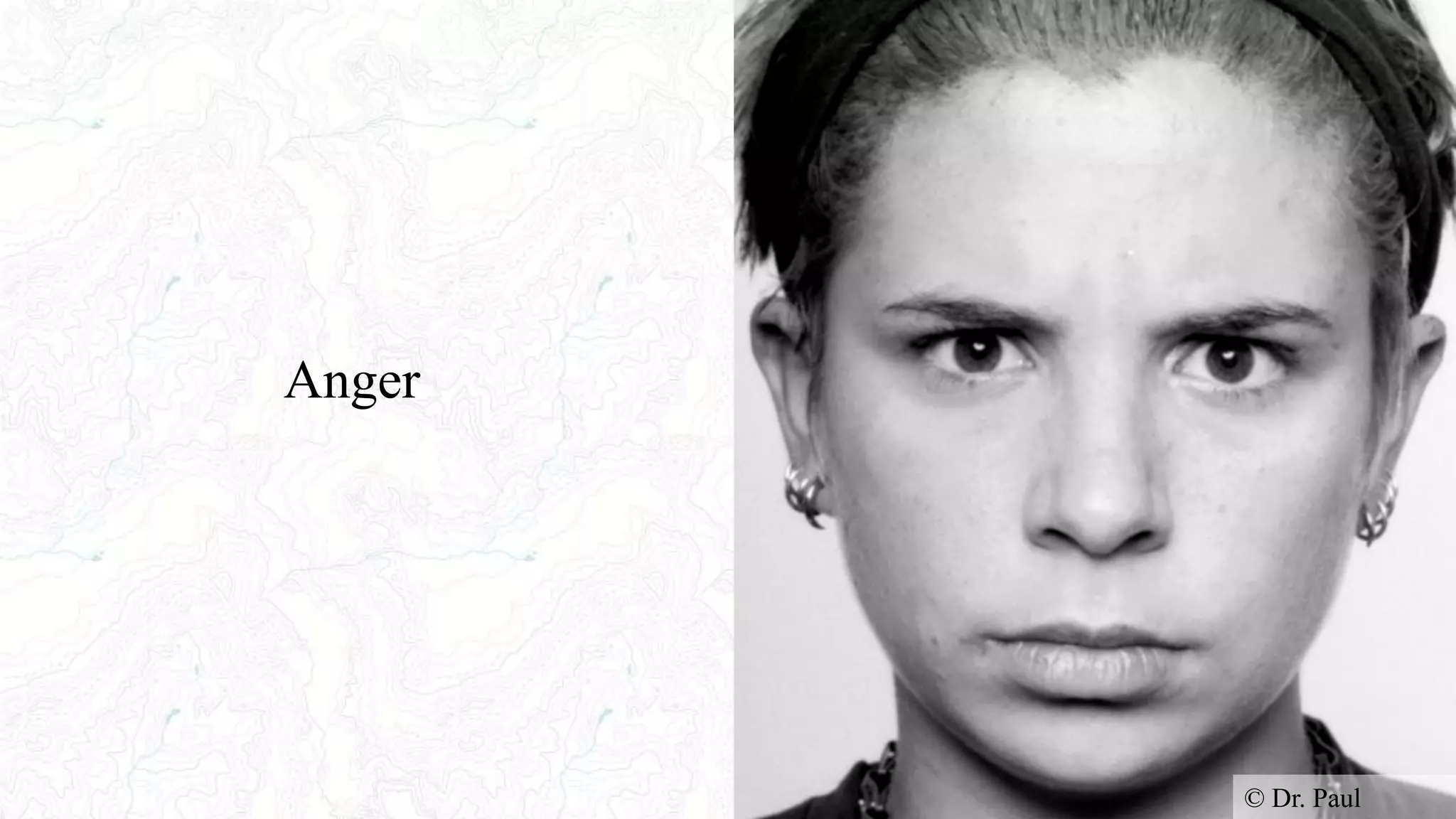
ANGER
With anger, the eyebrows are lowered and drawn together while the upper eyelid
tenses to meet them, constricting focus into a glare.
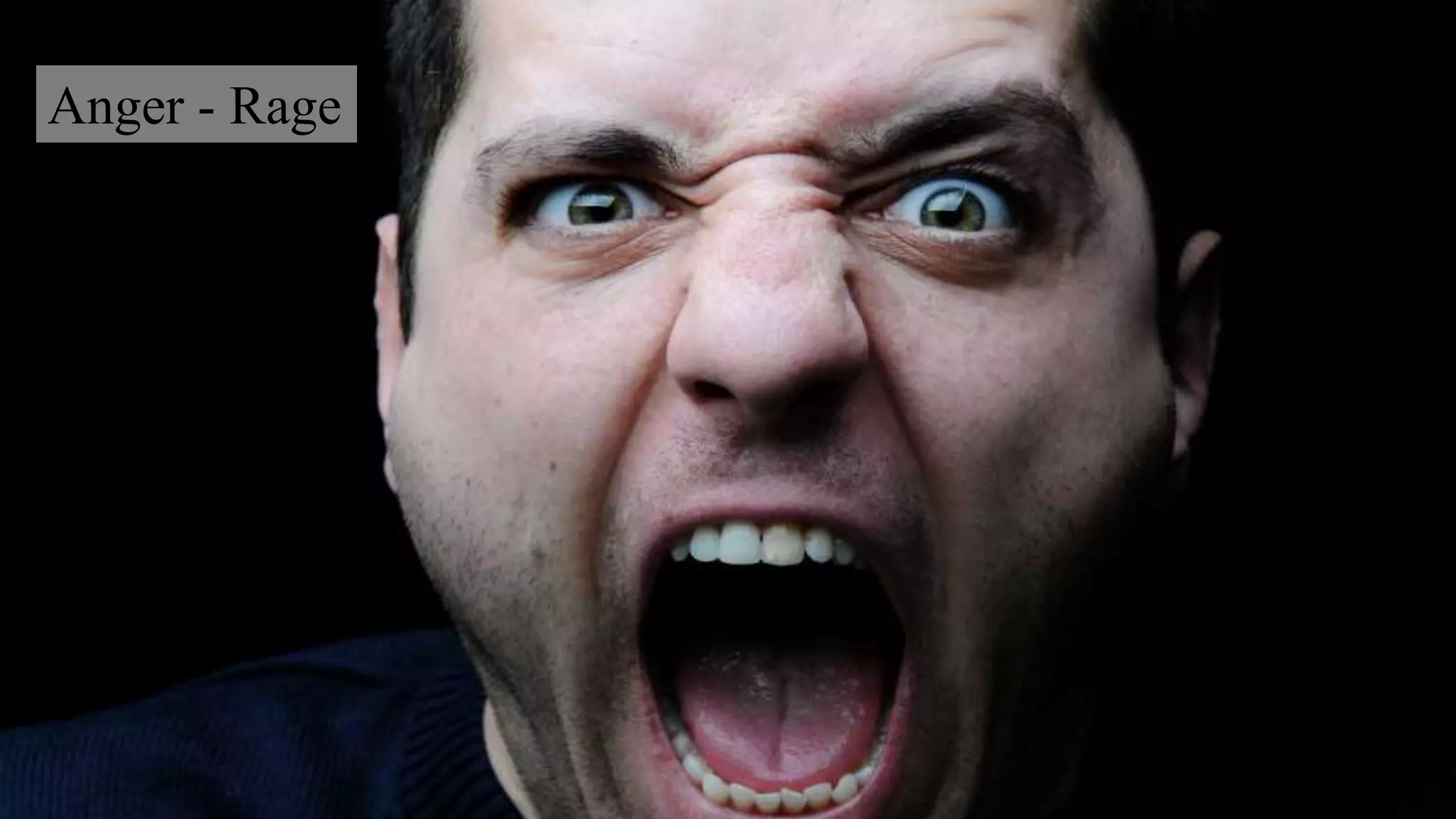
 With intensity, “crow’s feet” may appear next to outside corners of the eyes as
face muscles draw the eyes narrower
 Lips may tighten/thin as they draw together
 When mouth is open it becomes rectangular indicating uncontrolled or less
regulated anger
Anger
© Dr. Paul
©2016 Aegis Training Solutions, LLC
Anger - Rage
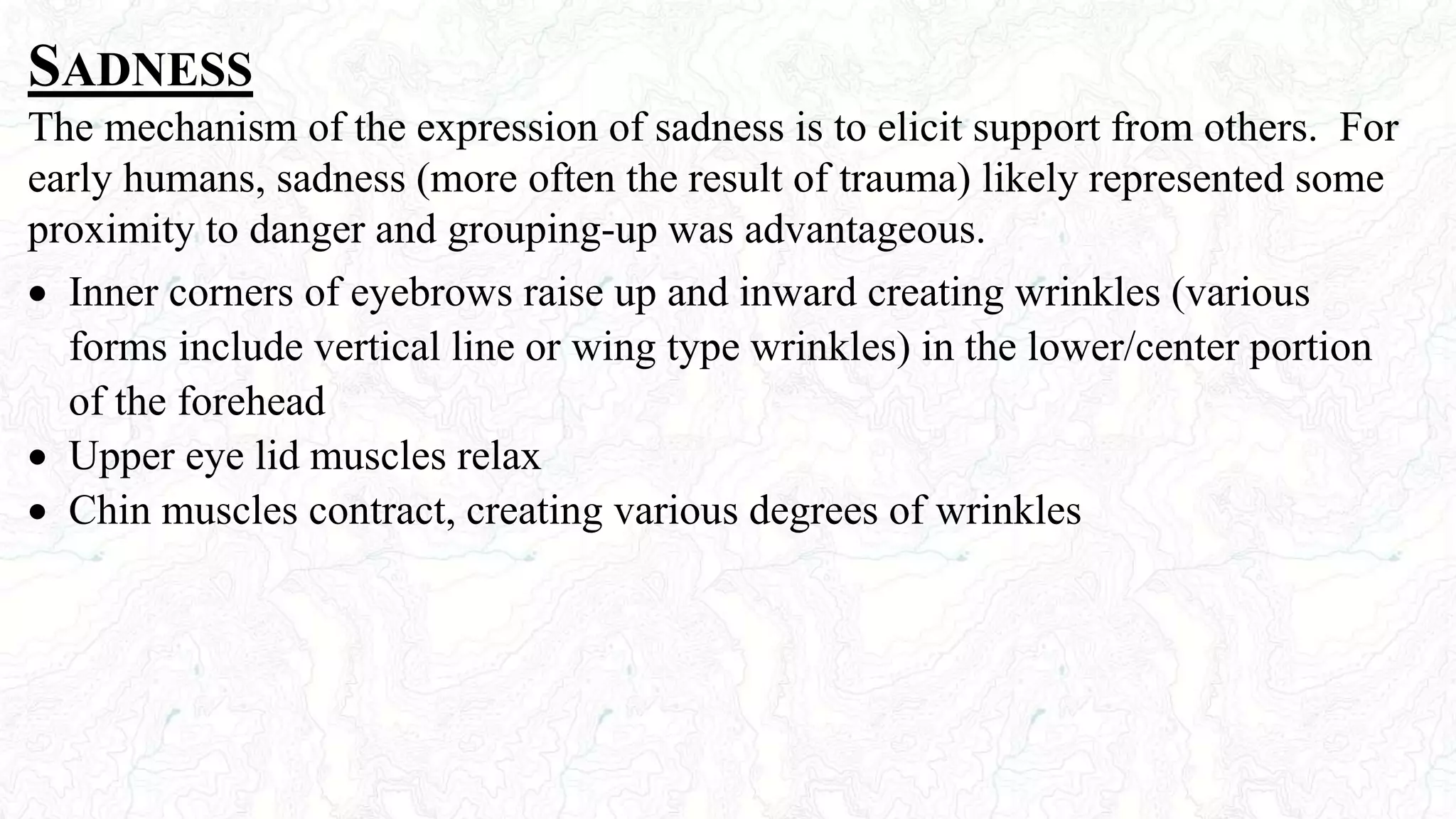
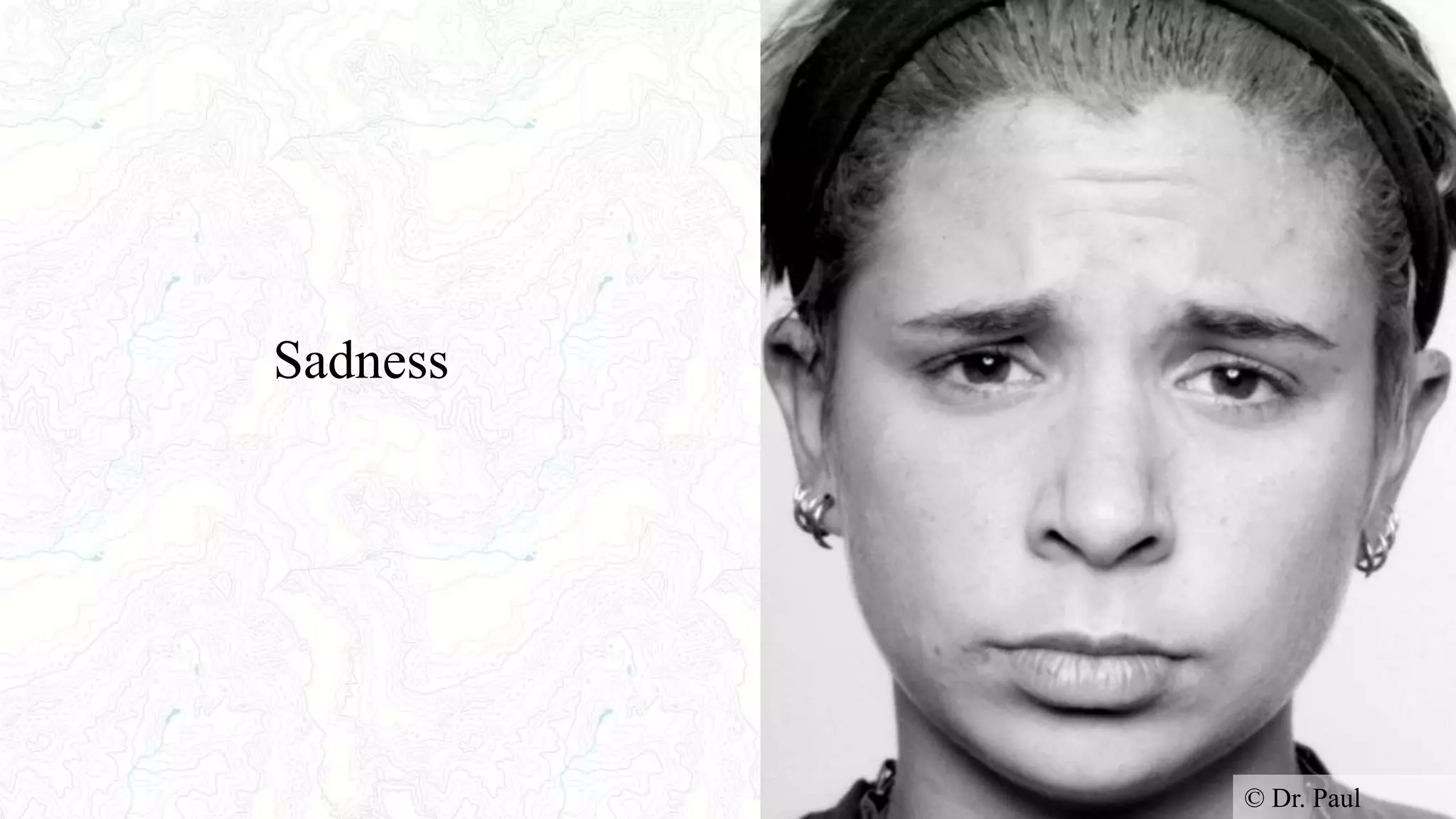
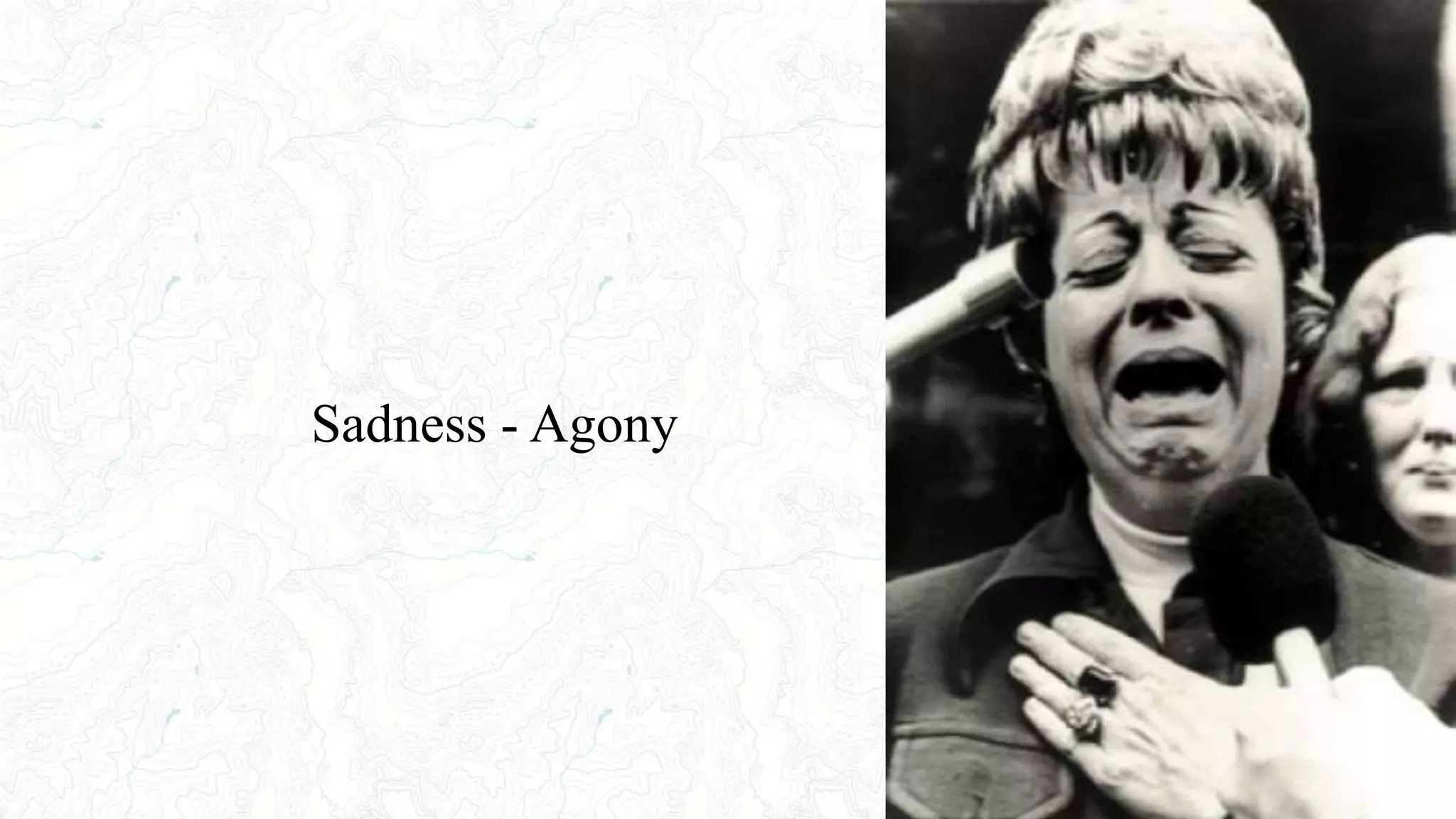
SADNESS
The mechanism of the expression of sadness is to elicit support from others. For
early humans, sadness (more often the result of trauma) likely represented some
proximity to danger and grouping-up was advantageous.
 Inner corners of eyebrows raise up and inward creating wrinkles (various
forms include vertical line or wing type wrinkles) in the lower/center portion
of the forehead
 Upper eye lid muscles relax
 Chin muscles contract, creating various degrees of wrinkles
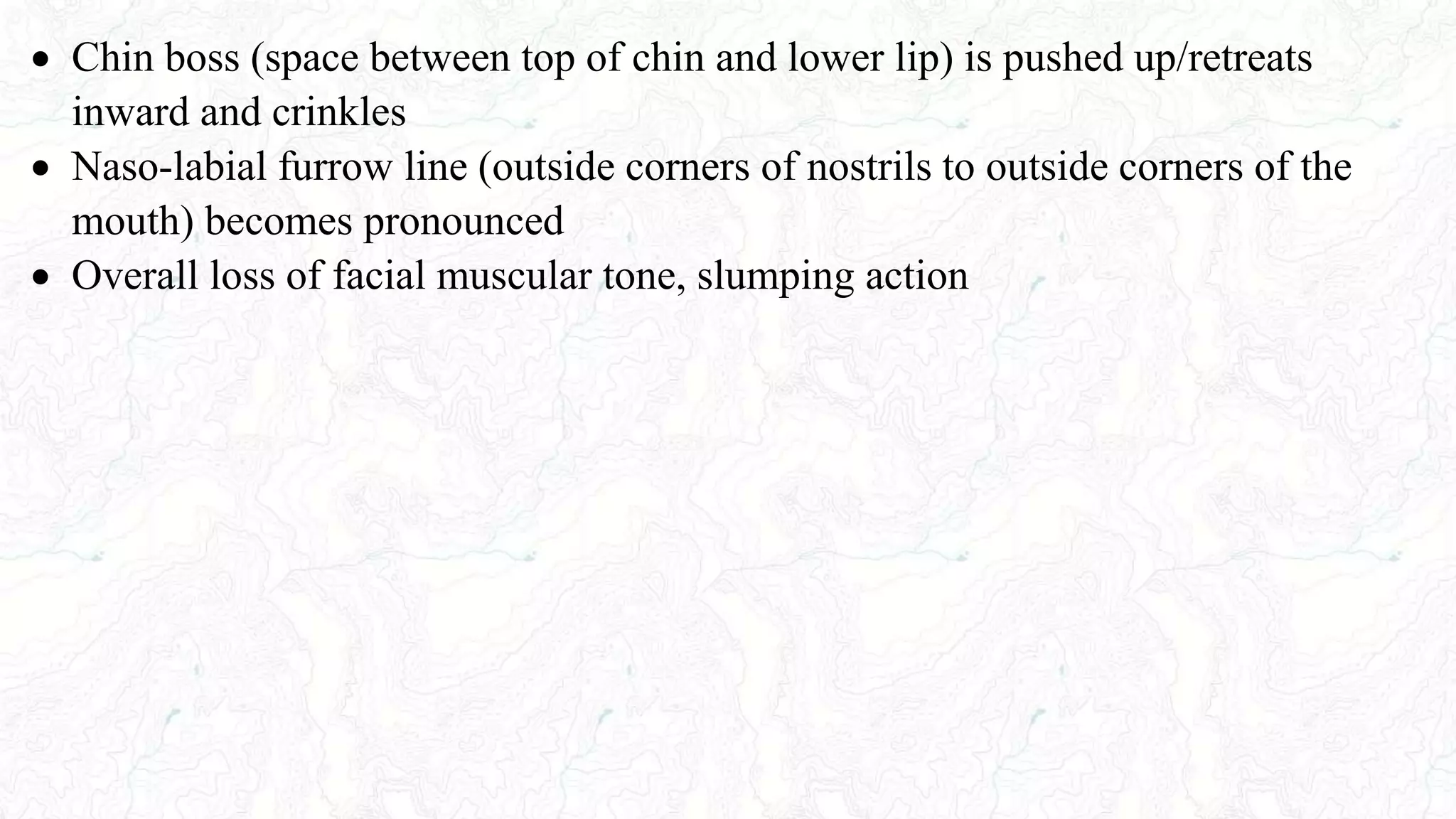
 Chin boss (space between top of chin and lower lip) is pushed up/retreats
inward and crinkles
 Naso-labial furrow line (outside corners of nostrils to outside corners of the
mouth) becomes pronounced
 Overall loss of facial muscular tone, slumping action
Sadness
© Dr. Paul
Sadness - Agony
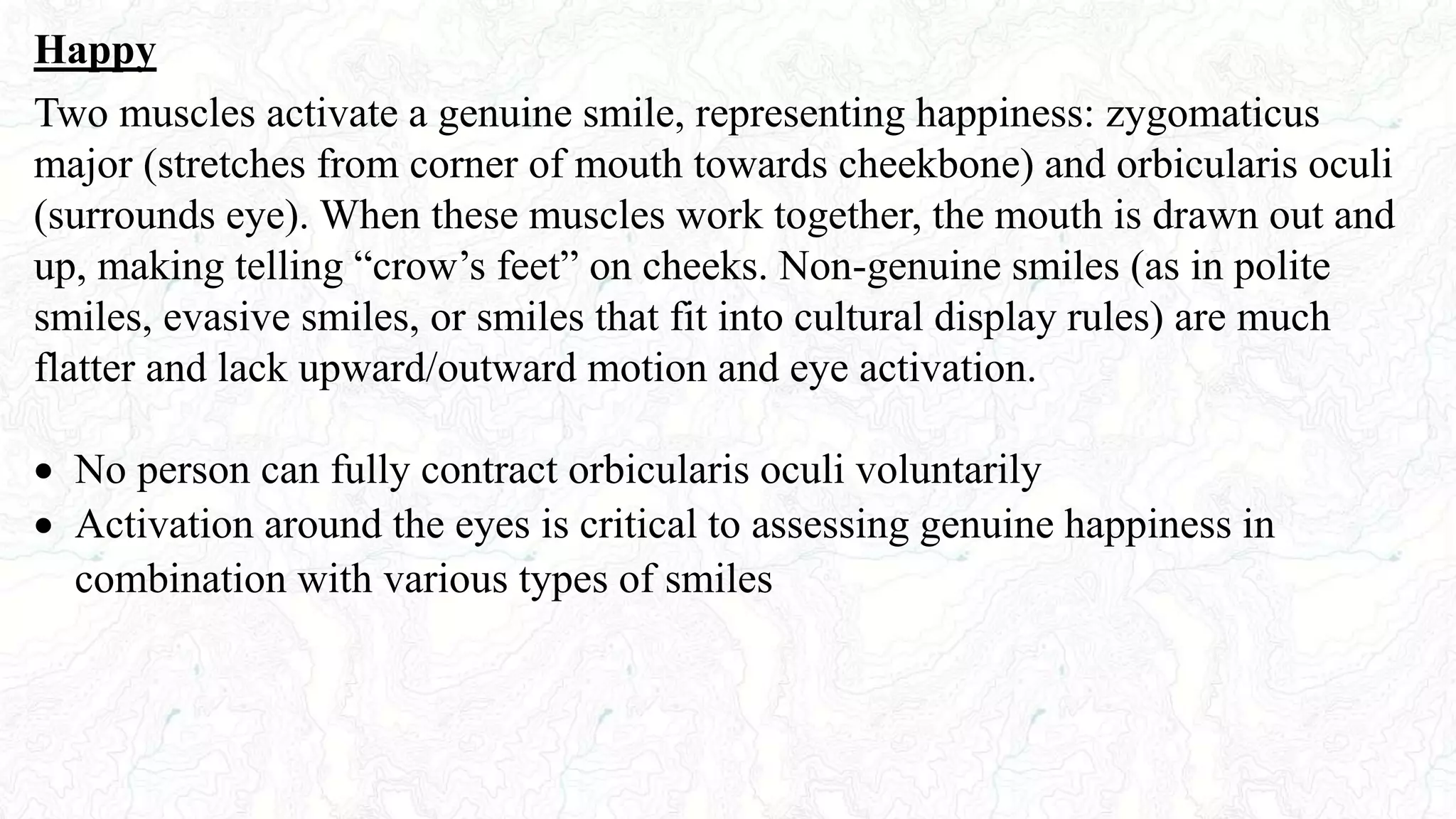
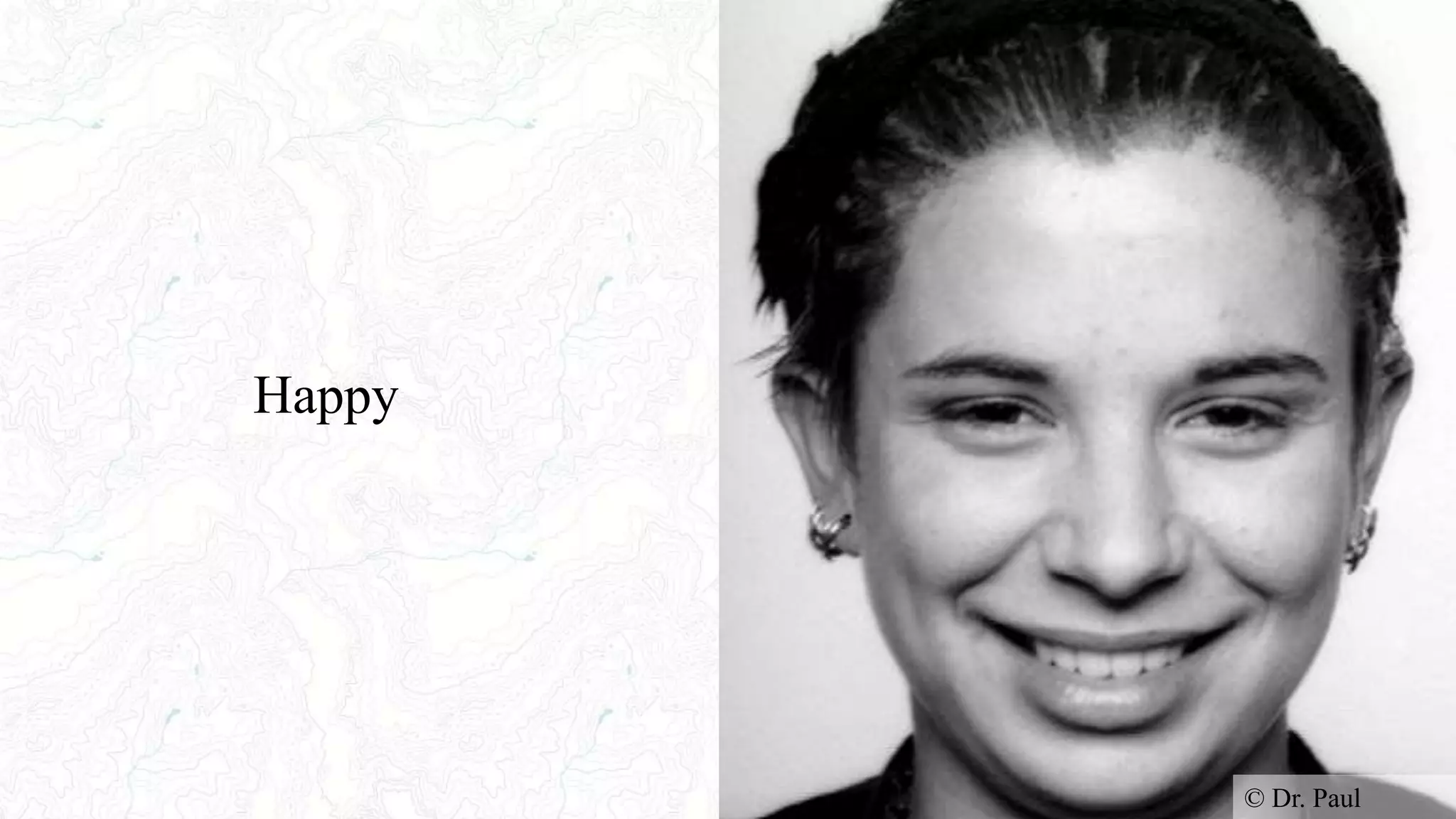
Happy
Two muscles activate a genuine smile, representing happiness: zygomaticus
major (stretches from corner of mouth towards cheekbone) and orbicularis oculi
(surrounds eye). When these muscles work together, the mouth is drawn out and
up, making telling “crow’s feet” on cheeks. Non-genuine smiles (as in polite
smiles, evasive smiles, or smiles that fit into cultural display rules) are much
flatter and lack upward/outward motion and eye activation.
 No person can fully contract orbicularis oculi voluntarily
 Activation around the eyes is critical to assessing genuine happiness in
combination with various types of smiles
 Obvious loosening or relaxing of furrowed lines on the forehead may present
with this emotion
 Facial muscles relax and “full lips” emerge
 Head tilts are associated with happy/comfort displays and are very rarely
manufactured as false positives
Happy
© Dr. Paul

Section 2.2 pp_3.7

  • 1.
    2.2 EMOTION INTHE FACE E
  • 2.
    The face isthe “mind’s canvas” and communicates certain universal emotions. People can be very adept at concealing/deceiving with facial cues, which is why it is important to cluster observations. The trained eye looks for “micro- gestures” which are subtle, but “leak” information. All people have an intuitive foundation for interpreting nonverbal communication. However, non-verbal acuity is a learned ability that grows as people articulate the connection between observation and manifesting emotion.
  • 3.
    Working with nonverbalacuity helps the care provider to recognize emotions in themselves and other people. This creates a more consistent and intentional non-verbal presentation as well as encouraging empathy. Section 2.2 of the Aegis System™ comes from the work credited to Paul Ekman who developed the Facial Action Coding System. Ekman has empirically shown consistencies within these universal emotional signatures that have been scientifically proven and documented all over the world.
  • 4.
    THERE ARE SEVENUNIVERSAL FACIAL EXPRESSIONS THAT UNITE ALL PEOPLE Anger Fear Sadness Disgust Happiness Surprise Contempt
  • 5.
    When these emotionsregister on the face, they range from subtle (also referred to as micro-expressions) to obvious. They may present as leakage from suppression or even present themselves before a person is cognitively experiencing the emotion within themselves. Each of these expressions may appear in a facial cluster or completely isolated from other facial feature activation. To the trained observer, subtle “micro- expressions” are often the most telling because of their difficulty to conceal.
  • 6.
    We are lookingfor movement from someone’s baseline or resting face. © Dr. Paul
  • 7.
    DISGUST This is alingering biological signature that evolved to protect the olfactory system from offensive odors that would debilitate the sense of smell. Olfactory stimulus played a more crucial role in early humans lives.  Disgust = raising of the upper lip and crinkling of the nose  Disgust may be used as a disapproval cue  Dramatic nose crinkling and additional crinkling around central part of face are strongly indicative of disgust  With intense disgust, eyebrows may come down to accentuate the nose crinkling effect
  • 8.
  • 9.
    CONTEMPT Contempt activates facemuscles that tighten and draw the corner of the mouth into the face. This expression may appear with a slight smile; it is not uncommon for people to enjoy the feeling of superiority that comes with contempt.  May pair with the impulse to look down on an object or person, similar to a disproval cue  Contempt is the only asymmetrical (one sided) facial expression considered to be universal
  • 10.
  • 11.
  • 12.
    FEAR In fear, people’supper eyelid/eyebrows raise and their eyes get big. Fear and surprise may be difficult to differentiate but fortunately, in the context of real- time observation, surprise is brief and will often quickly transition.  Fear can occur subtly with no eyebrow movement, just a raising of the upper eyelid  Fear creates a distinct set of horizontal wrinkles, or furrows, in center of forehead as eyebrows draw up and together into the middle of the forehead  Lips pull out in a pronounced horizontal fashion, which is an important differentiator from surprise which has lips that are less tensed
  • 13.
     Eyebrows raisein a flatter fashion than surprise  Excessive eyebrow raising qualifies as fear; surprise has a fixed upper eye lid raise  Tensed lower eyelids and raised upper eyelids with no other facial expression is typically fear
  • 14.
  • 15.
    SURPRISE With surprise (similarto fear), the upper eyelid/eyebrows raise and eyes get big. Surprise is the briefest of all emotions, which helps to differentiate it from fear in observation. In its true form, surprise does not last long. Surprise is a call to action.  Surprise can occur subtly with just the upper eyelid raising on its own  Anything stronger than a minuscule upper eyelid raise is considered fear  Eyelids typically raise in a more arc-like fashion with surprise and less drawn together as seen in fear  Jaw drops down with surprise vs. mouth stretched outward in fear
  • 16.
  • 17.
    ANGER With anger, theeyebrows are lowered and drawn together while the upper eyelid tenses to meet them, constricting focus into a glare.  With intensity, “crow’s feet” may appear next to outside corners of the eyes as face muscles draw the eyes narrower  Lips may tighten/thin as they draw together  When mouth is open it becomes rectangular indicating uncontrolled or less regulated anger
  • 18.
  • 19.
    ©2016 Aegis TrainingSolutions, LLC Anger - Rage
  • 20.
    SADNESS The mechanism ofthe expression of sadness is to elicit support from others. For early humans, sadness (more often the result of trauma) likely represented some proximity to danger and grouping-up was advantageous.  Inner corners of eyebrows raise up and inward creating wrinkles (various forms include vertical line or wing type wrinkles) in the lower/center portion of the forehead  Upper eye lid muscles relax  Chin muscles contract, creating various degrees of wrinkles
  • 21.
     Chin boss(space between top of chin and lower lip) is pushed up/retreats inward and crinkles  Naso-labial furrow line (outside corners of nostrils to outside corners of the mouth) becomes pronounced  Overall loss of facial muscular tone, slumping action
  • 22.
  • 23.
  • 24.
    Happy Two muscles activatea genuine smile, representing happiness: zygomaticus major (stretches from corner of mouth towards cheekbone) and orbicularis oculi (surrounds eye). When these muscles work together, the mouth is drawn out and up, making telling “crow’s feet” on cheeks. Non-genuine smiles (as in polite smiles, evasive smiles, or smiles that fit into cultural display rules) are much flatter and lack upward/outward motion and eye activation.  No person can fully contract orbicularis oculi voluntarily  Activation around the eyes is critical to assessing genuine happiness in combination with various types of smiles
  • 25.
     Obvious looseningor relaxing of furrowed lines on the forehead may present with this emotion  Facial muscles relax and “full lips” emerge  Head tilts are associated with happy/comfort displays and are very rarely manufactured as false positives
  • 26.