Cosmetic surgery
Technologies of the Gendered Body
Brought to you by
What is cosmetic surgery?
(Healthcare Commission 2004: 12)
“[…] operations and other procedures that revise or
change the appearance, colour, texture, structure or
position of bodily features, which most would
consider otherwise to be within the broad range of
‘normal’ for that person.”
Brought to you by
Statistics (2009)
British Association of Plastic Surgeons (
www.baaps.org.uk)
36,482 procedures (up 6.7% from 2008)
90% of procedures carried out on women
Procedures on men up 21% (to 3623)
Male breast reduction up from 323 to 581 (81%
increase)
Facelifts for women down by 8%
Brought to you by
Statistics (2006)
Top five procedures for men:
Top 5 procedures for women:
Brought to you by
Rajiv Grover
(consultant plastic surgeon)
“This year, we have recorded a dramatic rise in a
number of male surgical procedures, probably due to
heightened media attention, which has allowed men
to realise the positive outcomes that can be achieved.
The continued popularity of brow lifts and eyelid
surgery may mean that patients still keen to have
rejuvenating treatments despite the recession, are
choosing more cost-effective measures such as
targeting one particular feature, rather than having a
whole facelift.”
Brought to you by
Douglas McGeorge
(Consultant plastic surgeon)
“Those considering an aesthetic surgery
should always be aware that no procedure
is without risk. When performed under the
right circumstances, cosmetic surgery can
have a positive psychological impact and
improve quality of life.”
Brought to you by
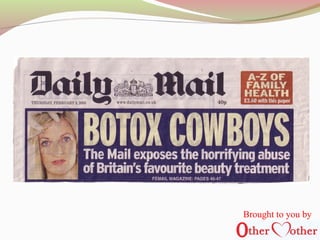
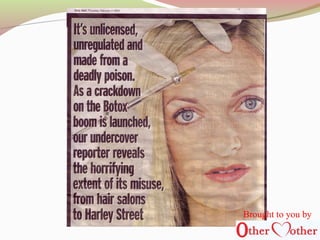
Representations of cosmetic
surgery
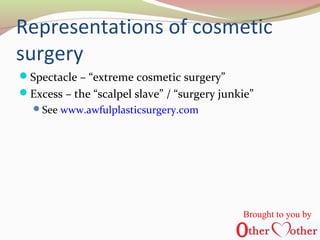
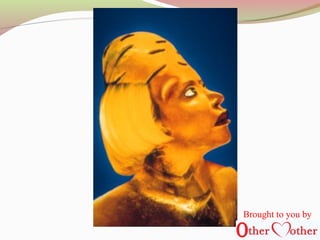
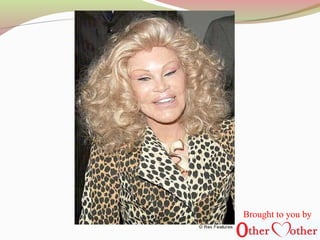
Spectacle – “extreme cosmetic surgery”
Excess – the “scalpel slave” / “surgery junkie”
See www.awfulplasticsurgery.com
Brought to you by
Brought to you by
Brought to you by
Brought to you by
Brought to you by
Representations of cosmetic
surgery
Spectacle – “extreme cosmetic surgery
Excess – the “scalpel slave” / “surgery junkie”
See www.awfulplasticsurgery.com
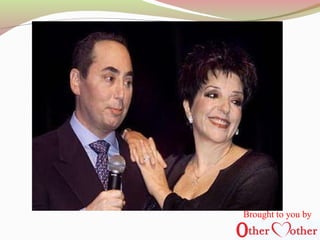
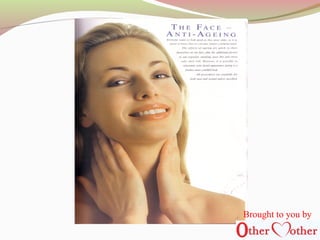
Celebrity
The seeking of perfection / youth
Brought to you by
Brought to you by
Representations of cosmetic
surgery
Spectacle – “extreme cosmetic surgery
Excess – the “scalpel slave” / “surgery junkie”
See www.awfulplasticsurgery.com
Celebrity
The seeking of perfection / youth
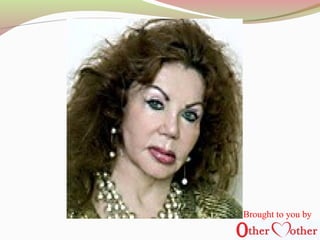
The “quick fix”; “nips and tucks”
Brought to you by
Brought to you by
Brought to you by
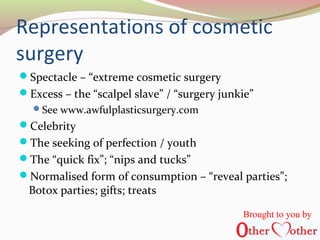
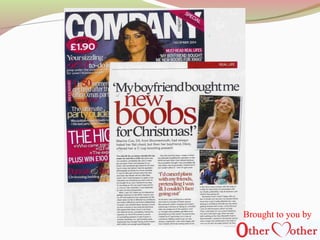
Representations of cosmetic
surgery
Spectacle – “extreme cosmetic surgery
Excess – the “scalpel slave” / “surgery junkie”
See www.awfulplasticsurgery.com
Celebrity
The seeking of perfection / youth
The “quick fix”; “nips and tucks”
Normalised form of consumption – “reveal parties”;
Botox parties; gifts; treats
Brought to you by
Brought to you by
Feminist resistance to cosmetic
surgery
Brought to you by
Rethinking cosmetic surgery
Cosmetic surgery as a “dilemma rather than a form of
self-inflicted subordination” (Kathy Davis 1995: 180) -
Surgery is both desirable and problematic
Women are seeking normal bodies, rather than
beautiful ones – women are negotiating “the
differences between their own bodies and ideal female
beauty” (Gimlin 2002: 7)
Women do not return for repeated surgeries
(focussed body project)
Brought to you by
Rethinking cosmetic surgery
“Cosmetic surgery transforms more than a woman’s
appearance; it transforms her identity as well” (Davis
2003: 75)
But – places women in a double bind – the “taint of
inauthenticity” (Gimlin 2002: 104); the problem of
passing.
Surgery always requires a defence: (a) that they
deserve surgery; and (b) convincing themselves that
the revised appearance is connected to the self.
Brought to you by
Rethinking cosmetic surgery
Decisions are undoubtedly shaped by ideas about
what constitutes beauty / the measuring of women’s
value by their appearance. But…
“[…] to portray the women I talked to as cultural
dupes, as passively submitting to the demands of
beauty, is to misrepresent them badly. A more
appropriate image, I would suggest, is to present
them as savvy cultural negotiators, attempting to
make out as best they can within a culture that limits
their options.” (Gimlin 2002: 106)
Brought to you by
Cosmetic surgery as the
eradication of difference
Racial / ethnic surgeries – makes us uneasy socially /
culturally in a way that other surgeries do not.
Surgery on people with Down’s Syndrome (see Davis 2003:
Epilogue):
“This particular case made me stop thinking about the
people who have cosmetic surgery or the practitioners who
perform it or even the media that promote it and, instead,
to start wondering why the world I live in prefers to
disguise difference rather than confront it.” (Davis 2003:
143)
Brought to you by
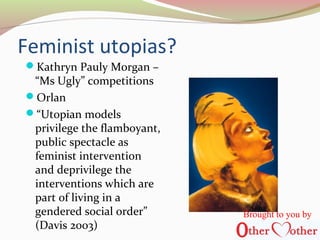
Feminist utopias?
Kathryn Pauly Morgan –
“Ms Ugly” competitions
Orlan
“Utopian models
privilege the flamboyant,
public spectacle as
feminist intervention
and deprivilege the
interventions which are
part of living in a
gendered social order”
(Davis 2003)
Brought to you by
Conclusions
Surgery is growing in popularity, but remains controversial.
Feminists such as Debra Gimlin and Kathy Davis have
argued against outright rejection of cosmetic surgery,
however problematic it is. Instead, they suggest that we
should see surgery as a dilemma for women, and as a means
of negotiating identity.
Those undergoing surgery are aiming to be “normal”, not
beautiful.
Surgery can be understood as the attempt to eradicate
difference – this reflects (and potentially problematises) the
ways we conceptualise “others”
Brought to you by
This platform has been started by
Parveen Kumar Chadha with the vision
that nobody should suffer the way he has
suffered because of lack and improper
healthcare facilities in India. We need
lots of funds manpower etc. to make this
vision a reality please contact us. Join us
as a member for a noble cause.
Brought to you by
Our views have increased the
mark of the 20,000
 Thank you viewers
 Looking forward for franchise,
collaboration, partners.
Brought to you by
011-25464531,011-41425180,011-
66217387+91-9818308353+,91-
9818569476othermotherindia@gmail.com
www.other-mother.in
https://www.facebook.com/pages/Other-Mother-Nursing-Crusade/224235031114989?
ref=hl
http://www.linkedin.com/profile/view?
id=326103341&trk=nav_responsive_tab_profile
https://twitter.com/othermotherind
i
https://cparveen.wix.com/other-mother
A WORLDWIDE MISSITION
Contact Us:-
JOIN US
Saxbee Consultants Details :-www.parveenchadha.com
Brought to you by

Cosmetic surgery

  • 1.
    Cosmetic surgery Technologies ofthe Gendered Body Brought to you by
  • 2.
    What is cosmeticsurgery? (Healthcare Commission 2004: 12) “[…] operations and other procedures that revise or change the appearance, colour, texture, structure or position of bodily features, which most would consider otherwise to be within the broad range of ‘normal’ for that person.” Brought to you by
  • 3.
    Statistics (2009) British Associationof Plastic Surgeons ( www.baaps.org.uk) 36,482 procedures (up 6.7% from 2008) 90% of procedures carried out on women Procedures on men up 21% (to 3623) Male breast reduction up from 323 to 581 (81% increase) Facelifts for women down by 8% Brought to you by
  • 4.
    Statistics (2006) Top fiveprocedures for men: Top 5 procedures for women: Brought to you by
  • 5.
    Rajiv Grover (consultant plasticsurgeon) “This year, we have recorded a dramatic rise in a number of male surgical procedures, probably due to heightened media attention, which has allowed men to realise the positive outcomes that can be achieved. The continued popularity of brow lifts and eyelid surgery may mean that patients still keen to have rejuvenating treatments despite the recession, are choosing more cost-effective measures such as targeting one particular feature, rather than having a whole facelift.” Brought to you by
  • 6.
    Douglas McGeorge (Consultant plasticsurgeon) “Those considering an aesthetic surgery should always be aware that no procedure is without risk. When performed under the right circumstances, cosmetic surgery can have a positive psychological impact and improve quality of life.” Brought to you by
  • 7.
    Representations of cosmetic surgery Spectacle– “extreme cosmetic surgery” Excess – the “scalpel slave” / “surgery junkie” See www.awfulplasticsurgery.com Brought to you by
  • 8.
  • 9.
  • 10.
  • 11.
  • 12.
    Representations of cosmetic surgery Spectacle– “extreme cosmetic surgery Excess – the “scalpel slave” / “surgery junkie” See www.awfulplasticsurgery.com Celebrity The seeking of perfection / youth Brought to you by
  • 13.
  • 14.
    Representations of cosmetic surgery Spectacle– “extreme cosmetic surgery Excess – the “scalpel slave” / “surgery junkie” See www.awfulplasticsurgery.com Celebrity The seeking of perfection / youth The “quick fix”; “nips and tucks” Brought to you by
  • 15.
  • 16.
  • 17.
    Representations of cosmetic surgery Spectacle– “extreme cosmetic surgery Excess – the “scalpel slave” / “surgery junkie” See www.awfulplasticsurgery.com Celebrity The seeking of perfection / youth The “quick fix”; “nips and tucks” Normalised form of consumption – “reveal parties”; Botox parties; gifts; treats Brought to you by
  • 18.
  • 19.
    Feminist resistance tocosmetic surgery Brought to you by
  • 20.
    Rethinking cosmetic surgery Cosmeticsurgery as a “dilemma rather than a form of self-inflicted subordination” (Kathy Davis 1995: 180) - Surgery is both desirable and problematic Women are seeking normal bodies, rather than beautiful ones – women are negotiating “the differences between their own bodies and ideal female beauty” (Gimlin 2002: 7) Women do not return for repeated surgeries (focussed body project) Brought to you by
  • 21.
    Rethinking cosmetic surgery “Cosmeticsurgery transforms more than a woman’s appearance; it transforms her identity as well” (Davis 2003: 75) But – places women in a double bind – the “taint of inauthenticity” (Gimlin 2002: 104); the problem of passing. Surgery always requires a defence: (a) that they deserve surgery; and (b) convincing themselves that the revised appearance is connected to the self. Brought to you by
  • 22.
    Rethinking cosmetic surgery Decisionsare undoubtedly shaped by ideas about what constitutes beauty / the measuring of women’s value by their appearance. But… “[…] to portray the women I talked to as cultural dupes, as passively submitting to the demands of beauty, is to misrepresent them badly. A more appropriate image, I would suggest, is to present them as savvy cultural negotiators, attempting to make out as best they can within a culture that limits their options.” (Gimlin 2002: 106) Brought to you by
  • 23.
    Cosmetic surgery asthe eradication of difference Racial / ethnic surgeries – makes us uneasy socially / culturally in a way that other surgeries do not. Surgery on people with Down’s Syndrome (see Davis 2003: Epilogue): “This particular case made me stop thinking about the people who have cosmetic surgery or the practitioners who perform it or even the media that promote it and, instead, to start wondering why the world I live in prefers to disguise difference rather than confront it.” (Davis 2003: 143) Brought to you by
  • 24.
    Feminist utopias? Kathryn PaulyMorgan – “Ms Ugly” competitions Orlan “Utopian models privilege the flamboyant, public spectacle as feminist intervention and deprivilege the interventions which are part of living in a gendered social order” (Davis 2003) Brought to you by
  • 25.
    Conclusions Surgery is growingin popularity, but remains controversial. Feminists such as Debra Gimlin and Kathy Davis have argued against outright rejection of cosmetic surgery, however problematic it is. Instead, they suggest that we should see surgery as a dilemma for women, and as a means of negotiating identity. Those undergoing surgery are aiming to be “normal”, not beautiful. Surgery can be understood as the attempt to eradicate difference – this reflects (and potentially problematises) the ways we conceptualise “others” Brought to you by
  • 26.
    This platform hasbeen started by Parveen Kumar Chadha with the vision that nobody should suffer the way he has suffered because of lack and improper healthcare facilities in India. We need lots of funds manpower etc. to make this vision a reality please contact us. Join us as a member for a noble cause. Brought to you by
  • 27.
    Our views haveincreased the mark of the 20,000  Thank you viewers  Looking forward for franchise, collaboration, partners. Brought to you by
  • 28.