EYE-GAZE
COMMUNICATION
Abstract
•The Eye gaze System is a communication
 system for people with complex physical
 disabilities.

•This operates with eyes by looking at
 control keys displayed on a screen.

•With this system a person can synthesize
 speech, control his environment , operate
 a telephone, run computer software,
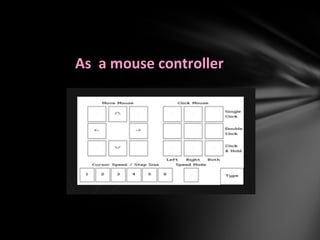
 operate a computer mouse, and access
 the Internet and e-mail.
Contents
           Introduction
           Users of the eye gaze system
           Working
           Running
           Functionalities
           Operational environment
           Advancements
           Future Work
           Conclusion
Introduction
The Eye gaze System is a direct-select vision-
controlled communication and control system.
• Edmund Huey built an early eye tracker, using
a sort of contact lens with a hole for the pupil.
The lens was connected to an aluminum
pointer that moved in response to the
movement of the eye

•It was developed in Fairfax, Virginia, by LC
 Technologies, Inc.,

•With the help of an eye gaze system,
 people whose communication abilities are
 impaired can still express their feelings and
 needs with a limitless vocabulary.
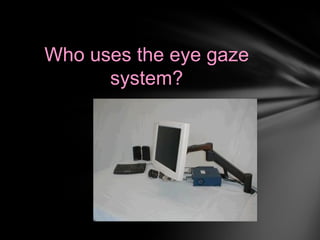
Who uses the eye gaze
      system?
•This system is mainly developed for those who lack the
use of their hands or voice
•Its users are adults and children with cerebral palsy,
spinal cord injuries, brain injuries, ALS, multiple sclerosis,
brainstem strokes
Skills needed by the users

 • Good control of one eye

 • Adequate vision
 • Ability to maintain a position in
  front of the Eye gaze monitor
Parts of the eye gaze system
Working of the eye gaze system
How can we run this
    eye gaze?
The Basic Eye gaze can

  •Calibrate
  •Typewrite
  •Read Text
  •Entertain with games
  •Teach Screens
With Options The Eye gaze Can

  •BE AT TWO SITES!!
  •BE A KEYBOARD
  •SPEAK through a speech synthesizer
  •CONTROL appliances
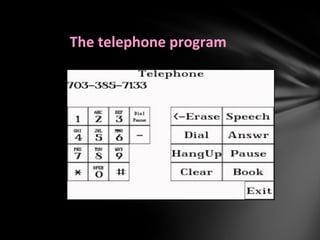
  •DIAL and answer a phone
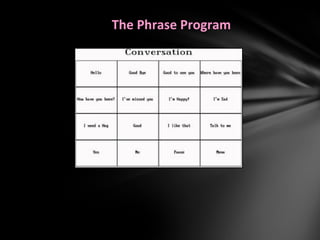
The Phrase Program
The telephone program
Run Second PC

As a keyboard
As a mouse controller
The Lights & appliances Program
Operational environment
•The Eyegaze System must be
 operated in an environment
 where there is limited of
 infrared light.

•The System works best away
 from windows, and in a room
 lit with fluorescent or mercury-
 vapor lights, which are low in
 infrared.
SOME OF THE PRESENT DAY EYE GAZE
        TRACKING TECHNIQUES

•Offer an unobstructed field of view with good access to
the face and head.
•Make no contact with the subject.
•Be easily extended to binocular recording
•Be compatible with head and body recordings
•Be easy to use on a variety of subjects.
Advancements
•New portable eye gaze systems
IntelliGaze IG-30
•It is a sophisticated system with a high tracking rate and
  excellent working range.
• It can accommodate rapid or involuntary head
   movements
•Intelligaze uses the latest camera
  technology, very sophisticated image
  processing and calibration methods
For people with limited eye control
Scanning Keyboard is the new row/column
keyboard with an on- screen eye "switch" for
people with limited eye movement.
Some of the common eye movement problems
that interfere with Eyegaze use are

•Nystagmus - constant, involuntary movement of
the eyeball

•Alternating strabismus - eyes cannot be directed
to the same object, either one deviates
The common vision problems are

     •Inadequate Visual acuity
     •Diplopia (double vision)
     •Blurred vision
     •Cataracts (clouding of the
       lens of the eye)
Mental abilities that improve the
probability for successful Eyegaze use

          •Ability to read
          •Cognition
          •Memory
Applications
•Neurosciences /Neuropsychology
•Vision Research
•Experimental Psychology
•Cognitive Psychology
•Psycholinguistics
•Psychiatry /Mental Health
•Transportation: Flight simulators /driving simulators
•Robotics - remote vision control
•Video and arcade games
FUTURE WORK
The Eye gaze System’s Eyefollower2.0
   •Totally Free Head Motion
   •Automatic Eye Acquisition
   •Binocular Eye tracking
   •High Gaze point Tracking Accuracy
   •Easy User Calibration
CONCLUSION
•Today, the human eye-gaze can be recorded by
relatively unremarkable techniques. This thesis argues
that it is possible to use the eye-gaze of a computer user
in the interface to aid the control of the application.

•Care must be taken, though, that eye-gaze tracking data
is used in a sensible way, since the nature of human
eye-movements is a combination of several voluntary
and involuntary cognitive processes.
Eye gaze2

Eye gaze2

  • 1.
  • 2.
    Abstract •The Eye gazeSystem is a communication system for people with complex physical disabilities. •This operates with eyes by looking at control keys displayed on a screen. •With this system a person can synthesize speech, control his environment , operate a telephone, run computer software, operate a computer mouse, and access the Internet and e-mail.
  • 3.
    Contents Introduction Users of the eye gaze system Working Running Functionalities Operational environment Advancements Future Work Conclusion
  • 4.
    Introduction The Eye gazeSystem is a direct-select vision- controlled communication and control system.
  • 5.
    • Edmund Hueybuilt an early eye tracker, using a sort of contact lens with a hole for the pupil. The lens was connected to an aluminum pointer that moved in response to the movement of the eye •It was developed in Fairfax, Virginia, by LC Technologies, Inc., •With the help of an eye gaze system, people whose communication abilities are impaired can still express their feelings and needs with a limitless vocabulary.
  • 6.
    Who uses theeye gaze system?
  • 7.
    •This system ismainly developed for those who lack the use of their hands or voice •Its users are adults and children with cerebral palsy, spinal cord injuries, brain injuries, ALS, multiple sclerosis, brainstem strokes
  • 8.
    Skills needed bythe users • Good control of one eye • Adequate vision • Ability to maintain a position in front of the Eye gaze monitor
  • 9.
    Parts of theeye gaze system
  • 10.
    Working of theeye gaze system
  • 11.
    How can werun this eye gaze?
  • 12.
    The Basic Eyegaze can •Calibrate •Typewrite •Read Text •Entertain with games •Teach Screens
  • 13.
    With Options TheEye gaze Can •BE AT TWO SITES!! •BE A KEYBOARD •SPEAK through a speech synthesizer •CONTROL appliances •DIAL and answer a phone
  • 15.
  • 16.
  • 17.
    Run Second PC Asa keyboard
  • 18.
    As a mousecontroller
  • 19.
    The Lights &appliances Program
  • 20.
    Operational environment •The EyegazeSystem must be operated in an environment where there is limited of infrared light. •The System works best away from windows, and in a room lit with fluorescent or mercury- vapor lights, which are low in infrared.
  • 21.
    SOME OF THEPRESENT DAY EYE GAZE TRACKING TECHNIQUES •Offer an unobstructed field of view with good access to the face and head. •Make no contact with the subject. •Be easily extended to binocular recording •Be compatible with head and body recordings •Be easy to use on a variety of subjects.
  • 22.
  • 23.
    IntelliGaze IG-30 •It isa sophisticated system with a high tracking rate and excellent working range. • It can accommodate rapid or involuntary head movements •Intelligaze uses the latest camera technology, very sophisticated image processing and calibration methods
  • 24.
    For people withlimited eye control Scanning Keyboard is the new row/column keyboard with an on- screen eye "switch" for people with limited eye movement.
  • 25.
    Some of thecommon eye movement problems that interfere with Eyegaze use are •Nystagmus - constant, involuntary movement of the eyeball •Alternating strabismus - eyes cannot be directed to the same object, either one deviates
  • 26.
    The common visionproblems are •Inadequate Visual acuity •Diplopia (double vision) •Blurred vision •Cataracts (clouding of the lens of the eye)
  • 27.
    Mental abilities thatimprove the probability for successful Eyegaze use •Ability to read •Cognition •Memory
  • 28.
    Applications •Neurosciences /Neuropsychology •Vision Research •ExperimentalPsychology •Cognitive Psychology •Psycholinguistics •Psychiatry /Mental Health •Transportation: Flight simulators /driving simulators •Robotics - remote vision control •Video and arcade games
  • 29.
    FUTURE WORK The Eyegaze System’s Eyefollower2.0 •Totally Free Head Motion •Automatic Eye Acquisition •Binocular Eye tracking •High Gaze point Tracking Accuracy •Easy User Calibration
  • 30.
    CONCLUSION •Today, the humaneye-gaze can be recorded by relatively unremarkable techniques. This thesis argues that it is possible to use the eye-gaze of a computer user in the interface to aid the control of the application. •Care must be taken, though, that eye-gaze tracking data is used in a sensible way, since the nature of human eye-movements is a combination of several voluntary and involuntary cognitive processes.