The eye ball
Introduction
Peripheral organs of vision
Lens produces images-fall on retina-cells of
retina convert light image to nervous
impulses- that pass through optic nerve-
visual pathway- cerebral cortex- visual areas
location
Anterior half of orbital cavity
Shape and size
Spherical
Diameter of 24mm
Shape
Spherical in posterior 5/6
Diameter – 24 mm
Anterior1/5 th convex
Diameter-15 mm
Eyeball – tunics or layers
3 layers
Outer- fibrous coat consisting of sclera
&cornea
Middle – vascular coat consisting of
choroid,ciliary body,iris
Inner- nervous coat containing retina
Outer Fibrous layer
It consists of the sclera and cornea,
which are continuous with each other.
 Their main functions are to provide shape to
the eye and support the deeper structures.
sclera
posterior 5/6 forms thick white opaque
membrane of the outer fibrous coat
It is visible as the white part of the eye
Formed of dense fibrous tissue
sclera
.
 Continuous with the cornea anteriorly
 Sclero corneal junction s called as limbus
 scleral spur-Behind the limbus a triangular mass projects into cornea
 Sinus venosus sclerae – circular channel located in sclera just behind
the limbus
 External surface s covered with ocular conjunctiva
Structures piercing sclera
Optic nerve
Posterior ciliary vessels and nerves
Ant ciliary arteries
4 choroidal veins
sclera
Functions
Maintain shape of eyeball
Protects internal structures
Provides attachment that move eyeball (extra
ocular muscles)
cornea
 Forms the anterior 1/6 th of outer fibrous layer
 transparent and positioned centrally at the front of the eye.
 Avascular and nourished by capillaries of limbus
 Highly sensitive
 Supplied by ophthalmic division of trigeminal nerve
 It permits the entry of Light & refracts the entering light.
 Junction of cornea to sclera s marked on exterior of eyeball- sulcus sclerae
Vascular middle coat/ uveal tract
The vascular layer of the eye lies underneath the fibrous
layer.
It contains most of blood vessels of eye ball
It consists of from behind forwards
choroid,
ciliary body
Iris
Choroid
 Highly vascular with blood vessels
 Larger posterior part of vascular coat
Lines inner surface of sclera
Anteriorly connected to iris by ciliary body
 pierced by optic nerve posteriorly
 Containing pigment cells – gives dark brown colour
 It prevents reflection of light with in the eyeball
Layers
 Outer to inner
 Supra choroid lamina
 Separates the sclera by supra choroid lamina
 outer vascular layer with arteries and veins
 Arteries –short ciliary arteries
 Veins-Presence of veins - 4/5 venae verticosae
 Inner capillary lamina-consist of fine net work of capillaries
 basal laminae membrane of Bruch-Separates from retina
 Diffusion occurs though this membrane
 It provides nourishment to the outer layers of the retina.
Ciliary body
 Anterior thickened continuation of choroid
 Continuous with iris in front
 They suspends the lens via suspensory ligaments
 – comprised of3 parts –ciliary ring, the ciliary muscle and ciliary
processes.
 Ciliary ring- outer fibrous ring, continuous with choroid
 Ciliary processes -60-90 folds at inner aspect of ciliary body, formed of
complex capillaries, secretes aqueous humour
 The ciliary muscle- consists of a collection of smooth muscles fibres.
 Radially arranged fibres and inner circular fibres
 Main function to focuss the lens for near vision
Iris
– contractile diaphragm
Between cornea and lens
an aperture /opening at the centre -the pupil
 Structure
 4 layers
 Anterior mesothelial lining
 Connective tissue stroma (pigmented cells and blood
vessels)
 Smooth muscle layer
 Constrictor pupillae
 Dialator pupillae
 Layer of pigment cells
Inner nervous coat/retina
 its light detecting component.
From retina nerve fibres arises from ganglion
layer to form optic nerve
That attach to posterior pole of eye bole
optic disc- Region through which area fibres
moves out
No photoreceptors present in optic disc –
known as blind spot
Optic disc pierced by central artery and vein
The optic part of the retina can be viewed
during ophthalmoscopy.
The centre of the retina -macula.
yellowish in colour, and highly pigmented.
The macula contains a depression called- fovea
centralis,
which has a high concentration of light detecting
cells.
 It is the area responsible for high acuity vision.
The area that the optic nerve enters the retina is
known as the optic disc
– it contains no light detecting cells.
Pigmented (outer) layer –
formed by a single layer of cells.
It is attached to the choroid and supports the
choroid in absorbing light (preventing
scattering of light within the eyeball).
It continues around the whole inner surface of
the eye.
Neural /sensory(inner) layer –
 consists of photoreceptors, the light detecting
cells of the retina.
 It is located posteriorly and laterally in the
eye.
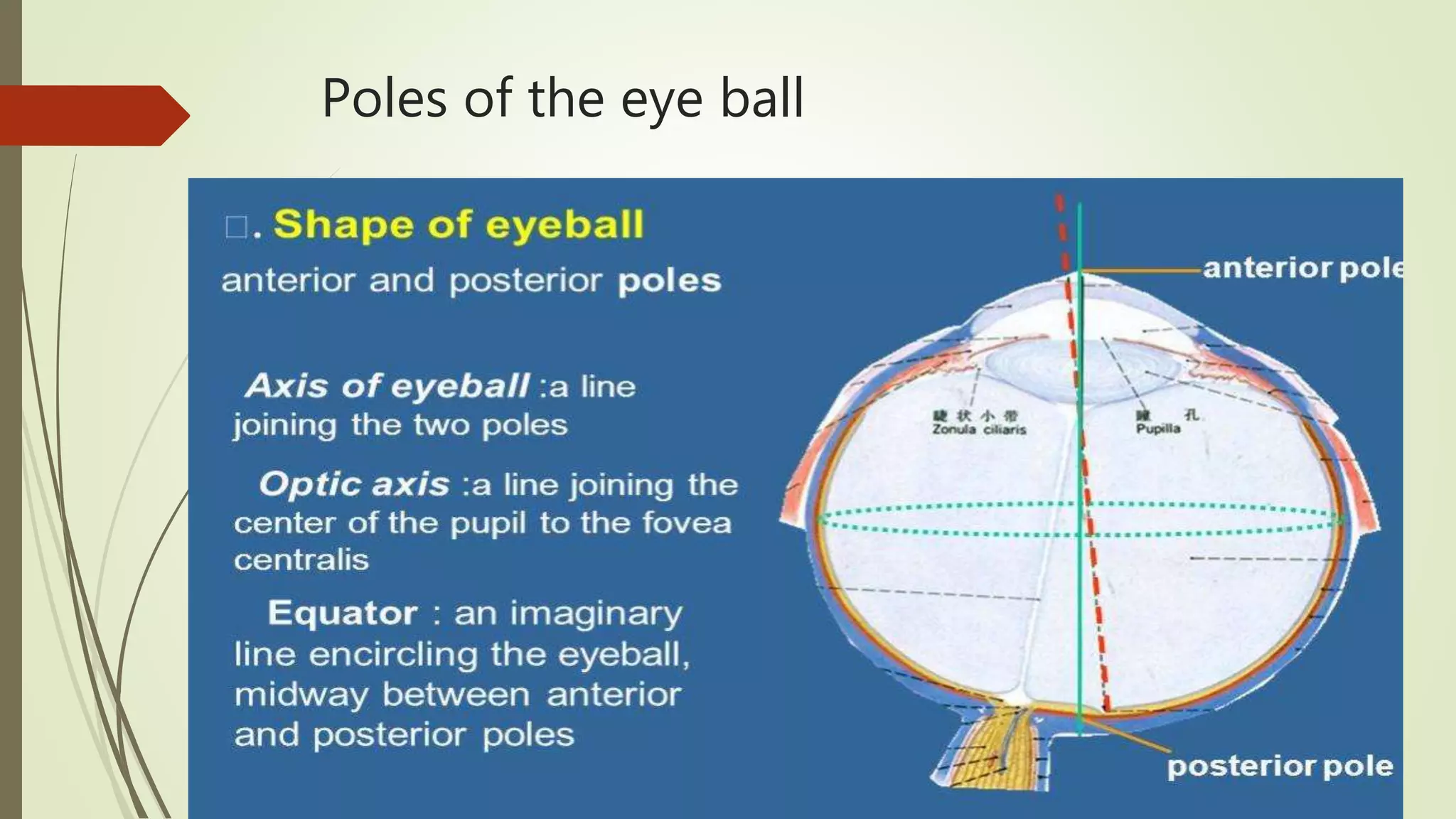
Poles of the eye ball
Structures of the Eyeball
Vitreous Body
a transparent gel which fills the posterior segment of
the eyeball (the area posterior to the lens).
 is marked by a narrow canal which runs from the
optic disc to the lens – the hyaloid canal.
The vitreous body has three main functions:
Contributes to the magnifying power of the eye
Supports the lens
Holds the layers of the retina in place
Lens
Biconvex.
Attached to ciliary body by suspensory
ligament
Behind the iris
Posterior surface lies in a depression if vitrous
body –hyaloid fossa
Anterior and Posterior Chambers
 two fluid filled areas in the eye – anterior and posterior
chambers.
 The anterior chamber is located between the cornea and the iris,
 and the posterior chamber between the iris and ciliary
processes.
 chambers are filled with aqueous homour –
 a clear plasma-like fluid that nourishes and protects the eye.
 The aqueous humour is produced constantly, and drains via the
trabecular meshwork, an area of tissue at the base of the
cornea, near the anterior chamber.
 If the drainage of aqueous humour is obstructed, a condition
known as glaucoma can result.
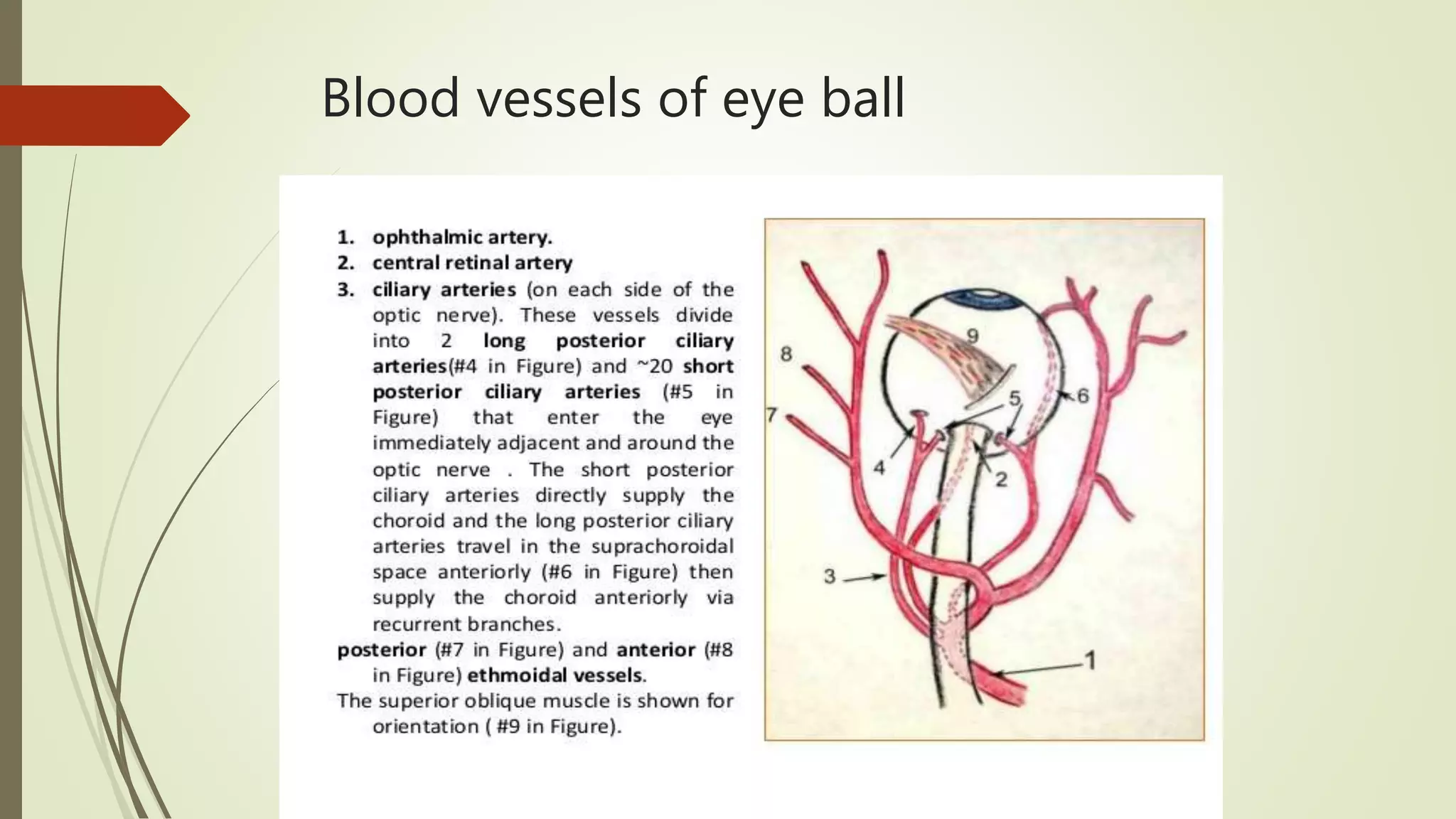
Blood vessels of eye ball
Nerve supply
Six cranial nerves innervate motor, sensory, and autonomic
structures in the eyes. The six cranial nerves are the
optic nerve (CN II), oculomotor nerve (CN III),
trochlear nerve (CN IV), trigeminal nerve (CN
V),abducent nerve (CN VI), and facial nerve (CN VII).
The eye ball
The eye ball
The eye ball
The eye ball
The eye ball

The eye ball

  • 1.
  • 2.
    Introduction Peripheral organs ofvision Lens produces images-fall on retina-cells of retina convert light image to nervous impulses- that pass through optic nerve- visual pathway- cerebral cortex- visual areas
  • 3.
    location Anterior half oforbital cavity Shape and size Spherical Diameter of 24mm
  • 4.
    Shape Spherical in posterior5/6 Diameter – 24 mm Anterior1/5 th convex Diameter-15 mm
  • 6.
    Eyeball – tunicsor layers 3 layers Outer- fibrous coat consisting of sclera &cornea Middle – vascular coat consisting of choroid,ciliary body,iris Inner- nervous coat containing retina
  • 8.
    Outer Fibrous layer Itconsists of the sclera and cornea, which are continuous with each other.  Their main functions are to provide shape to the eye and support the deeper structures.
  • 9.
    sclera posterior 5/6 formsthick white opaque membrane of the outer fibrous coat It is visible as the white part of the eye Formed of dense fibrous tissue
  • 10.
    sclera .  Continuous withthe cornea anteriorly  Sclero corneal junction s called as limbus  scleral spur-Behind the limbus a triangular mass projects into cornea  Sinus venosus sclerae – circular channel located in sclera just behind the limbus  External surface s covered with ocular conjunctiva
  • 12.
    Structures piercing sclera Opticnerve Posterior ciliary vessels and nerves Ant ciliary arteries 4 choroidal veins
  • 13.
    sclera Functions Maintain shape ofeyeball Protects internal structures Provides attachment that move eyeball (extra ocular muscles)
  • 14.
    cornea  Forms theanterior 1/6 th of outer fibrous layer  transparent and positioned centrally at the front of the eye.  Avascular and nourished by capillaries of limbus  Highly sensitive  Supplied by ophthalmic division of trigeminal nerve  It permits the entry of Light & refracts the entering light.  Junction of cornea to sclera s marked on exterior of eyeball- sulcus sclerae
  • 16.
    Vascular middle coat/uveal tract The vascular layer of the eye lies underneath the fibrous layer. It contains most of blood vessels of eye ball It consists of from behind forwards choroid, ciliary body Iris
  • 18.
    Choroid  Highly vascularwith blood vessels  Larger posterior part of vascular coat Lines inner surface of sclera Anteriorly connected to iris by ciliary body  pierced by optic nerve posteriorly  Containing pigment cells – gives dark brown colour  It prevents reflection of light with in the eyeball
  • 19.
    Layers  Outer toinner  Supra choroid lamina  Separates the sclera by supra choroid lamina  outer vascular layer with arteries and veins  Arteries –short ciliary arteries  Veins-Presence of veins - 4/5 venae verticosae  Inner capillary lamina-consist of fine net work of capillaries  basal laminae membrane of Bruch-Separates from retina  Diffusion occurs though this membrane  It provides nourishment to the outer layers of the retina.
  • 20.
    Ciliary body  Anteriorthickened continuation of choroid  Continuous with iris in front  They suspends the lens via suspensory ligaments  – comprised of3 parts –ciliary ring, the ciliary muscle and ciliary processes.  Ciliary ring- outer fibrous ring, continuous with choroid  Ciliary processes -60-90 folds at inner aspect of ciliary body, formed of complex capillaries, secretes aqueous humour  The ciliary muscle- consists of a collection of smooth muscles fibres.  Radially arranged fibres and inner circular fibres  Main function to focuss the lens for near vision
  • 21.
    Iris – contractile diaphragm Betweencornea and lens an aperture /opening at the centre -the pupil
  • 22.
     Structure  4layers  Anterior mesothelial lining  Connective tissue stroma (pigmented cells and blood vessels)  Smooth muscle layer  Constrictor pupillae  Dialator pupillae  Layer of pigment cells
  • 24.
    Inner nervous coat/retina its light detecting component. From retina nerve fibres arises from ganglion layer to form optic nerve That attach to posterior pole of eye bole optic disc- Region through which area fibres moves out No photoreceptors present in optic disc – known as blind spot Optic disc pierced by central artery and vein
  • 26.
    The optic partof the retina can be viewed during ophthalmoscopy. The centre of the retina -macula. yellowish in colour, and highly pigmented. The macula contains a depression called- fovea centralis, which has a high concentration of light detecting cells.  It is the area responsible for high acuity vision. The area that the optic nerve enters the retina is known as the optic disc – it contains no light detecting cells.
  • 28.
    Pigmented (outer) layer– formed by a single layer of cells. It is attached to the choroid and supports the choroid in absorbing light (preventing scattering of light within the eyeball). It continues around the whole inner surface of the eye. Neural /sensory(inner) layer –  consists of photoreceptors, the light detecting cells of the retina.  It is located posteriorly and laterally in the eye.
  • 30.
    Poles of theeye ball
  • 31.
    Structures of theEyeball Vitreous Body a transparent gel which fills the posterior segment of the eyeball (the area posterior to the lens).  is marked by a narrow canal which runs from the optic disc to the lens – the hyaloid canal. The vitreous body has three main functions: Contributes to the magnifying power of the eye Supports the lens Holds the layers of the retina in place
  • 33.
    Lens Biconvex. Attached to ciliarybody by suspensory ligament Behind the iris Posterior surface lies in a depression if vitrous body –hyaloid fossa
  • 35.
    Anterior and PosteriorChambers  two fluid filled areas in the eye – anterior and posterior chambers.  The anterior chamber is located between the cornea and the iris,  and the posterior chamber between the iris and ciliary processes.  chambers are filled with aqueous homour –  a clear plasma-like fluid that nourishes and protects the eye.  The aqueous humour is produced constantly, and drains via the trabecular meshwork, an area of tissue at the base of the cornea, near the anterior chamber.  If the drainage of aqueous humour is obstructed, a condition known as glaucoma can result.
  • 37.
  • 44.
    Nerve supply Six cranialnerves innervate motor, sensory, and autonomic structures in the eyes. The six cranial nerves are the optic nerve (CN II), oculomotor nerve (CN III), trochlear nerve (CN IV), trigeminal nerve (CN V),abducent nerve (CN VI), and facial nerve (CN VII).