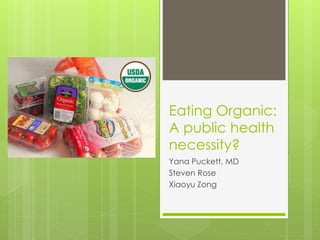
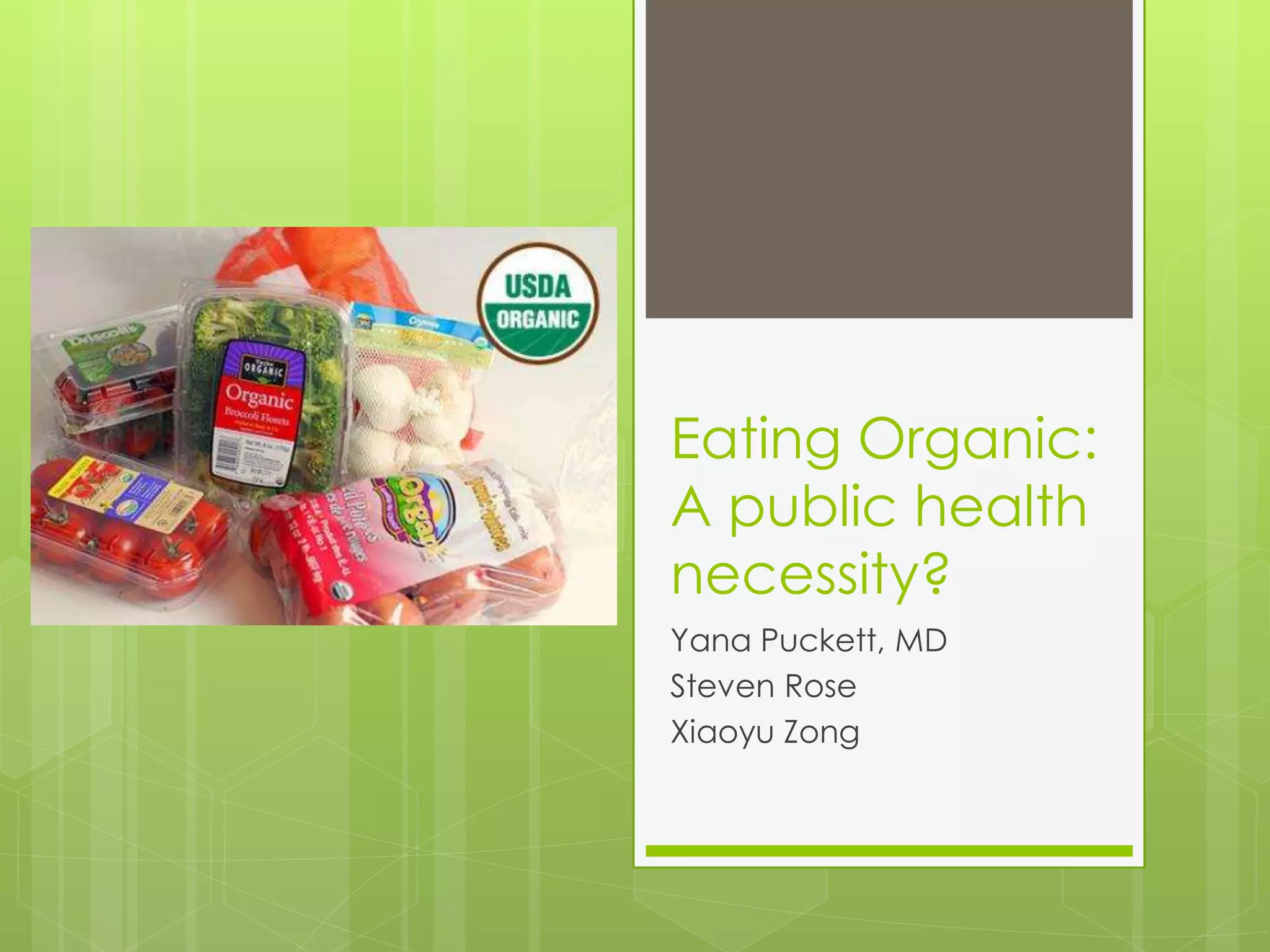

Eating Organic: 
A public health 
necessity? 
Yana Puckett, MD 
Steven Rose 
Xiaoyu Zong
Introduction 
 Regulations 
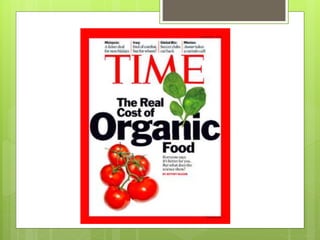
 Cost-effectiveness: Safe at any Price? 
 Health benefits? 
 Pesticides 
 Organic: Hype? 
 Genetically Modified, Irradiated 
 Politics 
 Labels 
 Future of Organic?
What is organic? 
 According to the United States 
Environmental Protection Agency: 
 “"Organically grown" food is food grown and processed using no 
synthetic fertilizers or pesticides. Pesticides derived from natural 
sources (e.g., biological pesticides) may also be used in producing 
organically grown food. Increasingly, some consumers are 
purchasing organically grown and processed foods as a way to 
reduce their exposure to synthetic pesticides and fertilizers.”
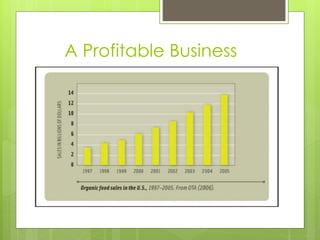
A Profitable Business
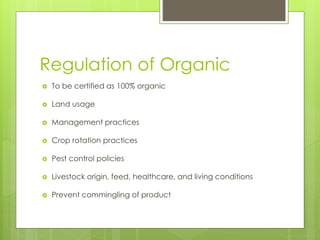
Regulation of Organic 
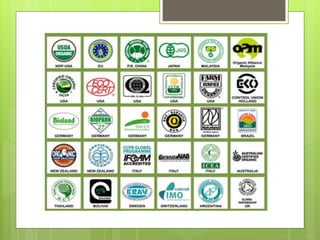
 To be certified as 100% organic 
 Land usage 
 Management practices 
 Crop rotation practices 
 Pest control policies 
 Livestock origin, feed, healthcare, and living conditions 
 Prevent commingling of product
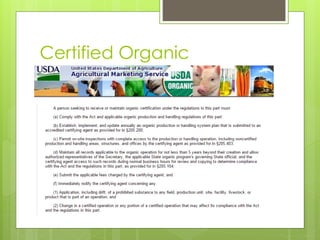
Certified Organic
Cost Effectiveness 
 Must pay certification costs up to $2000 annually 
 Cost between 50-100% more than traditional farm 
products 
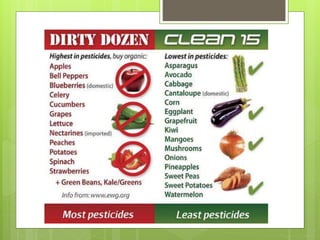
 EWG determined produce worth vs those not worth 
spending the extra money on. 
 2012 – $35 billion industry 
 Stanford study 
 Mandatory labeling
Health Benefits of Organic 
Foods 
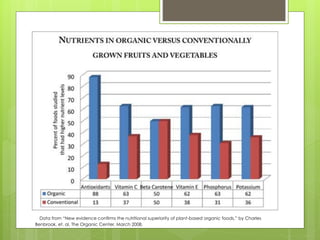
 More nutritional value 
 Claim: Pesticides may limit nutrition 
absorption properties of produce 
 Benefits of no pesticides
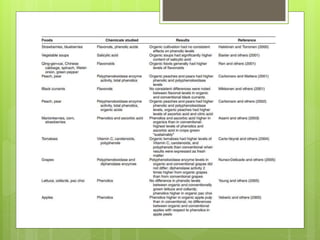
What are phenols? 
 Cancer chemopreventive – flavonoids! 
 Capture free radicals before DNA 
damage can occur. 
 Free-radical theory of aging
Data from “New evidence confirms the nutritional superiority of plant-based organic foods,” by Charles 
Benbrook, et. al. The Organic Center, March 2008.
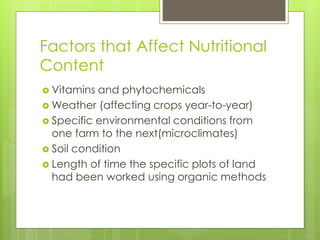
Factors that Affect Nutritional 
Content 
 Vitamins and phytochemicals 
Weather (affecting crops year-to-year) 
 Specific environmental conditions from 
one farm to the next(microclimates) 
 Soil condition 
 Length of time the specific plots of land 
had been worked using organic methods
Soil Quality and Style of 
Farming 
 ~Six recent studies of nutrient content of 
organic tomatoes, only one showed no 
significant differences between organic 
and conventional farms (3).
Weather 
 Burbank tomato study. 
 Quercetin? 
 Kaempferol?
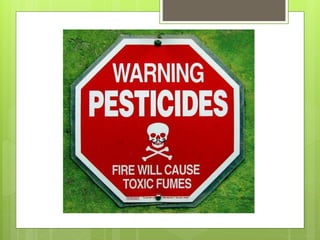
Pesticides 
World pesticide use exceeded 5.0 billion 
lbs in both 2000 and 2001. (5). 
 Both the amount of pesticide residue on 
foodstuff and the amount released into 
the atmosphere are factors that should be 
considered when purchase organically 
raised food.
Pesticides 
 Organic foods were much less likely than 
non-organic produce (by a factor of 10) 
to have two or more residues. (1) 
 Only 2.6% of organic foods had 
detectable multiple residues compared 
to 26% of conventionally grown foods. (6)
Pesticides 
 Organically raised foods had one-third 
the amount of chemical residues found in 
conventionally raised foods (1). 
 Compared to produce grown with 
integrated pest management techniques, 
the organic produce had one-half the 
amount of residue (1),
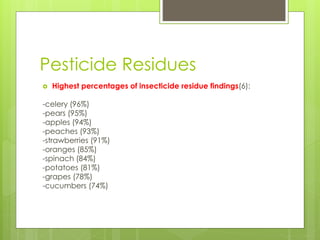
Pesticide Residues 
 Highest percentages of insecticide residue findings(6): 
-celery (96%) 
-pears (95%) 
-apples (94%) 
-peaches (93%) 
-strawberries (91%) 
-oranges (85%) 
-spinach (84%) 
-potatoes (81%) 
-grapes (78%) 
-cucumbers (74%)
Organic Farming 
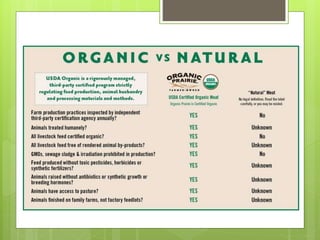
 Terms like “all natural,” “non-toxic,” “earth-friendly,” 
or containing “natural botanicals,” 
but the ingredients list chemical after 
chemical. 
 At face value, these products look more 
natural. In reality, there is no regulating 
agency to verify whether any of the claims 
are true. 
 That means that marketing claims can be 
very misleading.
Organic Farming 
 Cruelty Free farming 
 Organic chicken 
 The Happy Egg company 
 http://youtu.be/AHsvetb6nXU 
 http://youtu.be/tloxthQu7vQ
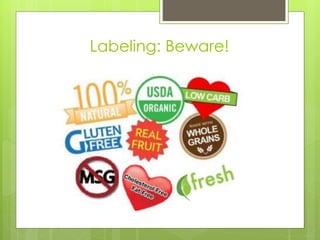
Labeling: Beware!
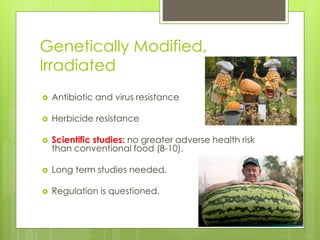
Genetically Modified, 
Irradiated 
 Antibiotic and virus resistance 
 Herbicide resistance 
 Scientific studies: no greater adverse health risk 
than conventional food (8-10). 
 Long term studies needed. 
 Regulation is questioned.
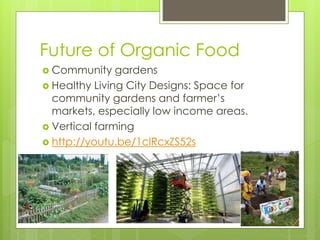
Future of Organic Food 
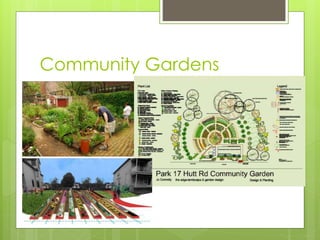
 Community gardens 
 Healthy Living City Designs: Space for 
community gardens and farmer’s 
markets, especially low income areas. 
 Vertical farming 
 http://youtu.be/1clRcxZS52s
Community Gardens
Vertical Farming
Vertical Farming 
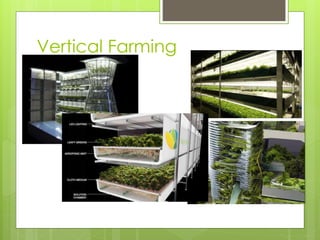
 Glass space, vertical + artificial lighting. 
 Ken Yeang and Dickson D. Despommier 
 Feeding the world in the 21st century 
 Eliminate world hunger
Proponents for Vertical 
Farming 
 Preparation for future 
 Crop production year round 
 Protection of crops from pests and 
weather 
 Animal extinction stopped 
 Methane energy production 
 Organic crops! Easier regulation! Impact 
human health.
Criticism of Vertical Farming 
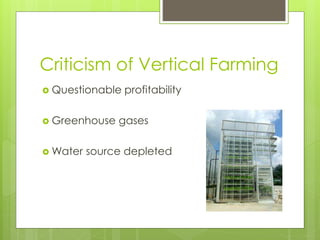
 Questionable profitability 
 Greenhouse gases 
Water source depleted
Conclusion 
 Growing business, surpassed $13.8 billion 
in 2005 (Organic Trade Assn. 2006). 
 Health benefits exist 
 If you can afford, buy! If not, no big deal! 
 Vertical farming
References 
 1 Baker BP, Benbrook CM, Groth E 3rd,Lutz Benbrook K. Pesticide residues in conventional, integrated pest 
management (IPM)-grown and organic foods: insights from three US data sets. Food Addit Contam 2002;19:427- 
446. 
 2 Chassy AW, Bui L, Renaud EN, et al. Three-year comparison of the content of antioxidant microconstituents and 
several quality characteristics in organic and conventionally managed tomatoes and bell peppers. J Agric Food 
Chem 2006;54:8244-8252. 
 3 Juroszek P, Lumpkin HM, Yang RY, et al. Fruit quality and bioactive compounds with antioxidant activity of 
tomatoes grown on-farm: comparison of organic and conventional management systems. J Agric Food Chem 
2009;57:1188-1194. 
 4 Mitchell AE, Hong YJ, Hoh E, et al. Ten-year comparison of the influence of organic and conventional crop 
management practices on the content of flavonoids in tomatoes. J Agric Food Chem 2007;55:6154-6159. 
 5 Pesticides industry sales and usage. 2000 and 2001 market estimates. 
http://www.epa.gov/pesticides/pestsales/01pestsales/market_estimates2001.pdf [Accessed October 23, 2014] 
 6 U.S. Food and Drug Administration. Pesticide residue monitoring program 2000. 
http://www.fda.gov/Food/FoodborneIllnessContaminants/Pesticides/ucm125171.htm [Accessed October 23, 
2014] 
 7 American Medical Association (2012). Report 2 of the Council on Science and Public Health: Labeling of 
Bioengineered Foods 
 8 United States Institute of Medicine and National Research Council (2004). Safety of Genetically Engineered 
Foods: Approaches to Assessing Unintended Health Effects. National Academies Press. Free full-text. National 
Academies Press. See pp11ff on need for better standards and tools to evaluate GM food. 
 9 Key S, Ma JK, Drake PM (June 2008). "Genetically modified plants and human health". J R Soc Med 101 (6): 
290–8. doi:10.1258/jrsm.2008.070372. PMC 2408621. PMID 18515776.

Organic Food

  • 1.
    Eating Organic: Apublic health necessity? Yana Puckett, MD Steven Rose Xiaoyu Zong
  • 2.
    Introduction  Regulations  Cost-effectiveness: Safe at any Price?  Health benefits?  Pesticides  Organic: Hype?  Genetically Modified, Irradiated  Politics  Labels  Future of Organic?
  • 3.
    What is organic?  According to the United States Environmental Protection Agency:  “"Organically grown" food is food grown and processed using no synthetic fertilizers or pesticides. Pesticides derived from natural sources (e.g., biological pesticides) may also be used in producing organically grown food. Increasingly, some consumers are purchasing organically grown and processed foods as a way to reduce their exposure to synthetic pesticides and fertilizers.”
  • 5.
  • 6.
    Regulation of Organic  To be certified as 100% organic  Land usage  Management practices  Crop rotation practices  Pest control policies  Livestock origin, feed, healthcare, and living conditions  Prevent commingling of product
  • 7.
  • 9.
    Cost Effectiveness Must pay certification costs up to $2000 annually  Cost between 50-100% more than traditional farm products  EWG determined produce worth vs those not worth spending the extra money on.  2012 – $35 billion industry  Stanford study  Mandatory labeling
  • 10.
    Health Benefits ofOrganic Foods  More nutritional value  Claim: Pesticides may limit nutrition absorption properties of produce  Benefits of no pesticides
  • 11.
    What are phenols?  Cancer chemopreventive – flavonoids!  Capture free radicals before DNA damage can occur.  Free-radical theory of aging
  • 13.
    Data from “Newevidence confirms the nutritional superiority of plant-based organic foods,” by Charles Benbrook, et. al. The Organic Center, March 2008.
  • 14.
    Factors that AffectNutritional Content  Vitamins and phytochemicals Weather (affecting crops year-to-year)  Specific environmental conditions from one farm to the next(microclimates)  Soil condition  Length of time the specific plots of land had been worked using organic methods
  • 15.
    Soil Quality andStyle of Farming  ~Six recent studies of nutrient content of organic tomatoes, only one showed no significant differences between organic and conventional farms (3).
  • 16.
    Weather  Burbanktomato study.  Quercetin?  Kaempferol?
  • 18.
    Pesticides World pesticideuse exceeded 5.0 billion lbs in both 2000 and 2001. (5).  Both the amount of pesticide residue on foodstuff and the amount released into the atmosphere are factors that should be considered when purchase organically raised food.
  • 19.
    Pesticides  Organicfoods were much less likely than non-organic produce (by a factor of 10) to have two or more residues. (1)  Only 2.6% of organic foods had detectable multiple residues compared to 26% of conventionally grown foods. (6)
  • 20.
    Pesticides  Organicallyraised foods had one-third the amount of chemical residues found in conventionally raised foods (1).  Compared to produce grown with integrated pest management techniques, the organic produce had one-half the amount of residue (1),
  • 22.
    Pesticide Residues Highest percentages of insecticide residue findings(6): -celery (96%) -pears (95%) -apples (94%) -peaches (93%) -strawberries (91%) -oranges (85%) -spinach (84%) -potatoes (81%) -grapes (78%) -cucumbers (74%)
  • 25.
    Organic Farming Terms like “all natural,” “non-toxic,” “earth-friendly,” or containing “natural botanicals,” but the ingredients list chemical after chemical.  At face value, these products look more natural. In reality, there is no regulating agency to verify whether any of the claims are true.  That means that marketing claims can be very misleading.
  • 26.
    Organic Farming Cruelty Free farming  Organic chicken  The Happy Egg company  http://youtu.be/AHsvetb6nXU  http://youtu.be/tloxthQu7vQ
  • 27.
  • 29.
    Genetically Modified, Irradiated  Antibiotic and virus resistance  Herbicide resistance  Scientific studies: no greater adverse health risk than conventional food (8-10).  Long term studies needed.  Regulation is questioned.
  • 30.
    Future of OrganicFood  Community gardens  Healthy Living City Designs: Space for community gardens and farmer’s markets, especially low income areas.  Vertical farming  http://youtu.be/1clRcxZS52s
  • 31.
  • 32.
  • 33.
    Vertical Farming Glass space, vertical + artificial lighting.  Ken Yeang and Dickson D. Despommier  Feeding the world in the 21st century  Eliminate world hunger
  • 34.
    Proponents for Vertical Farming  Preparation for future  Crop production year round  Protection of crops from pests and weather  Animal extinction stopped  Methane energy production  Organic crops! Easier regulation! Impact human health.
  • 35.
    Criticism of VerticalFarming  Questionable profitability  Greenhouse gases Water source depleted
  • 36.
    Conclusion  Growingbusiness, surpassed $13.8 billion in 2005 (Organic Trade Assn. 2006).  Health benefits exist  If you can afford, buy! If not, no big deal!  Vertical farming
  • 37.
    References  1Baker BP, Benbrook CM, Groth E 3rd,Lutz Benbrook K. Pesticide residues in conventional, integrated pest management (IPM)-grown and organic foods: insights from three US data sets. Food Addit Contam 2002;19:427- 446.  2 Chassy AW, Bui L, Renaud EN, et al. Three-year comparison of the content of antioxidant microconstituents and several quality characteristics in organic and conventionally managed tomatoes and bell peppers. J Agric Food Chem 2006;54:8244-8252.  3 Juroszek P, Lumpkin HM, Yang RY, et al. Fruit quality and bioactive compounds with antioxidant activity of tomatoes grown on-farm: comparison of organic and conventional management systems. J Agric Food Chem 2009;57:1188-1194.  4 Mitchell AE, Hong YJ, Hoh E, et al. Ten-year comparison of the influence of organic and conventional crop management practices on the content of flavonoids in tomatoes. J Agric Food Chem 2007;55:6154-6159.  5 Pesticides industry sales and usage. 2000 and 2001 market estimates. http://www.epa.gov/pesticides/pestsales/01pestsales/market_estimates2001.pdf [Accessed October 23, 2014]  6 U.S. Food and Drug Administration. Pesticide residue monitoring program 2000. http://www.fda.gov/Food/FoodborneIllnessContaminants/Pesticides/ucm125171.htm [Accessed October 23, 2014]  7 American Medical Association (2012). Report 2 of the Council on Science and Public Health: Labeling of Bioengineered Foods  8 United States Institute of Medicine and National Research Council (2004). Safety of Genetically Engineered Foods: Approaches to Assessing Unintended Health Effects. National Academies Press. Free full-text. National Academies Press. See pp11ff on need for better standards and tools to evaluate GM food.  9 Key S, Ma JK, Drake PM (June 2008). "Genetically modified plants and human health". J R Soc Med 101 (6): 290–8. doi:10.1258/jrsm.2008.070372. PMC 2408621. PMID 18515776.

Editor's Notes

  • #12 Some phenolic compounds are believed to be cancer chemopreventives, may decrease your risk of developing cancer; according to a review in the "British Journal of Nutrition," there is evidence to suggest many flavonoids like anthocyanins may have anticancer effects. Many phenolic compounds found in plants may have antioxidant effects, meaning they react with and capture dangerously reactive compounds called free radicals before the radicals can react with other biomolecules and cause serious damage.  Promote healthy aging by minimizing DNA damage caused by free radicals. As noted in a 2002 review in the journal "Free Radical Biology and Medicine," there is evidence to suggest some of the deterioration associated with aging is caused by oxidative damage to DNA; this hypothesis is called the oxidative stress or free-radical theory of aging.
  • #16 This study found that while there was no difference in lycopene levels between the types of farms, farm management skills and site-specific effects affected lycopene levels.
  • #17 A three year study, found that organically raised Burbank tomatoes were found to have significantly higher levels of ascorbic acid (26% higher) and the flavonoids quercetin (30% higher) and kaempferol (17%)(2). Over a 10-year period, organic tomatoes averaged 79-percent more quercetin and 97-percent more kaempferol than the conventionally grown tomatoes (4).
  • #30 Specific changes introduced into food DNA using the methods of genetic engineering. Antibiotic and virus resistance: Papaya Herbicide resistance: about 90% of corn grown in US. Scientific studies: no greater adverse health risk than conventional food (8-10).
  • #34 Ken Yeang (born 1948) is a Malaysian architect in the 1990s, published several books
  • #35 By the year 2050, close to 80% of the world’s population will live in urban areas and the total population of the world will increase by 3 billion people The controlled growing environment reduces the need for pesticides, namely herbicides and fungicides. Advocates claim that producing organic crops in vertical farms is practical and the most likely production Traditional agriculture is highly disruptive to wild animal populations that live in and around farmland and some argue it becomes unethical when there is a viable alternative. One study showed that wood mouse populations dropped from 25 per hectare to 5 per hectare after harvest, estimating 10 animals killed per hectare each year with conventional farming