
Vaibhav Kumar Maurya
PhD Research Fellow
NIFTEM
Haryana, India
study of slowing down or reversing
the processes of aging to extend both
the maximum and average lifespan
•Life extension is a controversial topic due to fear
of overpopulation and possible effects on society
•Biogerontologist Aubrey De Grey counters the
overpopulation critique by pointing out that the
therapy could postpone or eliminate menopause,
allowing women to space out their pregnancies over
more years and thus decreasing the yearly population
growth rate.
Continued------
Moreover, the philosopher and futurist Max More
contends that, given current and projected global
fertility rates, “human life extension” would be
unlikely to contribute to overpopulation.
A research poll(2013) in the United States found that
38% of Americans would want life extension
treatments, and 56% would reject it. However it also
found that only 4 percent consider an "ideal lifespan"
to be more than 120 years.
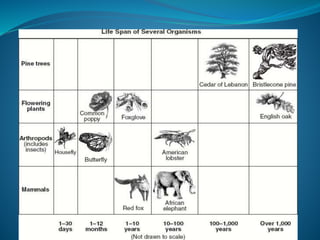
•The longest a human has ever been
proven to live is 122 years, the case
of Jeanne Calment who was born in 1875
and died in 1997.
• In case of wild mouse, Maximum
lifespan commonly used as a model in
research on aging, is about three years.
Continued---
• Genetic differences between humans
and mice that may account for these
different aging rates include differences
in efficiency of DNA
repair, antioxidant defences, energy
metabolism, and recycling mechanisms
such as autophagy
Autophagy : a normal physiological process in the body that deals with destruction of cells in the body. It maintains
homeostasis or normal functioning by protein degradation and turnover of the destroyed cell organelles for new cell
formation.
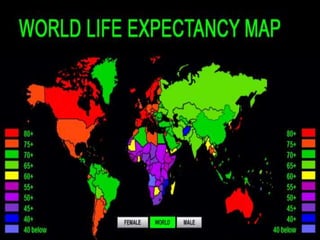
Average lifespan in a population is lowered by:
- Infants and child mortality, which are frequently linked
to infectious diseases or nutrition problems.
-Later in life, vulnerability to accidents and Age related
chronic disease; cancer or cardiovascular disease play an
increasing role in mortality.
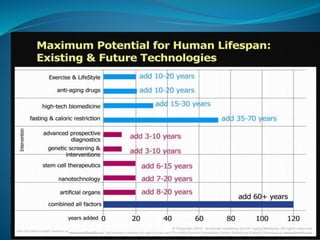
Extension of expected lifespan can often be
achieved by access to improved medical
care, vaccinations, good diet, exercise and
avoidance of hazards such as smoking.
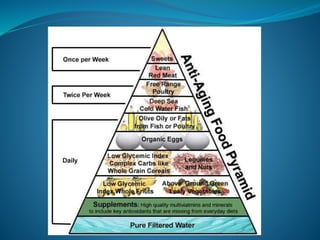
Much life extension research focuses on
nutrition—diets or supplements—as a means to
extend lifespan.
Extension of expected lifespan can often be
achieved by access to improved medical
care, vaccinations, good diet, exercise and
avoidance of hazards such as smoking.
Much life extension research focuses on
nutrition—diets or supplements—as a means to
extend lifespan.
•Anti-aging drugs/ Products
• Nanotechnology
• Cloning and body part replacement
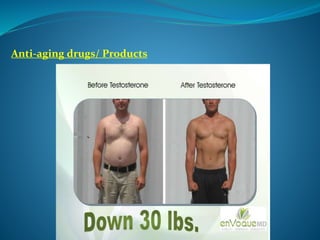
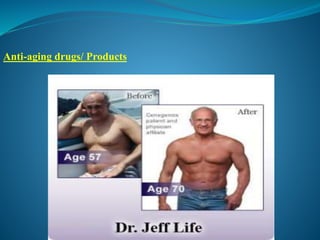
Anti-aging drugs/ Products
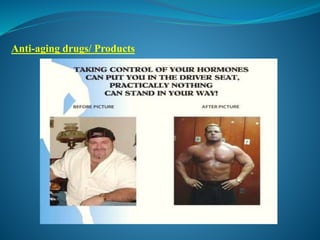
# There are a number of drugs intended to slow the aging
process currently being researched.
Research by Sobh and Martin (2011) suggests that people buy anti-
aging products to obtain a hoped-for self (e.g., keeping a youthful
skin) or to avoid a feared-self (e.g., looking old).
Anti-aging drugs/ Products
•Nanotechnology
Future advances in nanomedicine could give rise to life extension
through the repair of many processes thought to be responsible for
aging.
K. Eric Drexler, one of the founders of nanotechnology, postulated
cell repair machines, including ones operating within cells and
utilizing as yet hypothetical molecular computers.
Raymond Kurzweil, a futurist and transhumanist, stated in his
book The Singularity Is Near that he believes that advanced
medical nanorobotics could completely remedy the effects of aging
by 2030
Cloning and body part replacement
Some life extensionists suggest that therapeutic cloning and stem
cell research could one day provide a way to generate cells, body
parts, or even entire bodies (generally referred to as reproductive
cloning) that would be genetically identical to a prospective
patient.
THANK YOU
Give your opinion about life
extension whether it is good or bad
for society?
What are the Safety issue linked
with the use of anti-aging creams ?

Extended life span

  • 1.
    Vaibhav Kumar Maurya PhDResearch Fellow NIFTEM Haryana, India
  • 2.
    study of slowingdown or reversing the processes of aging to extend both the maximum and average lifespan
  • 3.
    •Life extension isa controversial topic due to fear of overpopulation and possible effects on society •Biogerontologist Aubrey De Grey counters the overpopulation critique by pointing out that the therapy could postpone or eliminate menopause, allowing women to space out their pregnancies over more years and thus decreasing the yearly population growth rate. Continued------
  • 4.
    Moreover, the philosopherand futurist Max More contends that, given current and projected global fertility rates, “human life extension” would be unlikely to contribute to overpopulation. A research poll(2013) in the United States found that 38% of Americans would want life extension treatments, and 56% would reject it. However it also found that only 4 percent consider an "ideal lifespan" to be more than 120 years.
  • 7.
    •The longest ahuman has ever been proven to live is 122 years, the case of Jeanne Calment who was born in 1875 and died in 1997. • In case of wild mouse, Maximum lifespan commonly used as a model in research on aging, is about three years. Continued---
  • 8.
    • Genetic differencesbetween humans and mice that may account for these different aging rates include differences in efficiency of DNA repair, antioxidant defences, energy metabolism, and recycling mechanisms such as autophagy Autophagy : a normal physiological process in the body that deals with destruction of cells in the body. It maintains homeostasis or normal functioning by protein degradation and turnover of the destroyed cell organelles for new cell formation.
  • 9.
    Average lifespan ina population is lowered by: - Infants and child mortality, which are frequently linked to infectious diseases or nutrition problems. -Later in life, vulnerability to accidents and Age related chronic disease; cancer or cardiovascular disease play an increasing role in mortality.
  • 10.
    Extension of expectedlifespan can often be achieved by access to improved medical care, vaccinations, good diet, exercise and avoidance of hazards such as smoking. Much life extension research focuses on nutrition—diets or supplements—as a means to extend lifespan.
  • 14.
    Extension of expectedlifespan can often be achieved by access to improved medical care, vaccinations, good diet, exercise and avoidance of hazards such as smoking. Much life extension research focuses on nutrition—diets or supplements—as a means to extend lifespan.
  • 15.
    •Anti-aging drugs/ Products •Nanotechnology • Cloning and body part replacement Anti-aging drugs/ Products # There are a number of drugs intended to slow the aging process currently being researched. Research by Sobh and Martin (2011) suggests that people buy anti- aging products to obtain a hoped-for self (e.g., keeping a youthful skin) or to avoid a feared-self (e.g., looking old).
  • 16.
  • 17.
  • 18.
  • 19.
    •Nanotechnology Future advances innanomedicine could give rise to life extension through the repair of many processes thought to be responsible for aging. K. Eric Drexler, one of the founders of nanotechnology, postulated cell repair machines, including ones operating within cells and utilizing as yet hypothetical molecular computers. Raymond Kurzweil, a futurist and transhumanist, stated in his book The Singularity Is Near that he believes that advanced medical nanorobotics could completely remedy the effects of aging by 2030
  • 20.
    Cloning and bodypart replacement Some life extensionists suggest that therapeutic cloning and stem cell research could one day provide a way to generate cells, body parts, or even entire bodies (generally referred to as reproductive cloning) that would be genetically identical to a prospective patient.
  • 22.
  • 23.
    Give your opinionabout life extension whether it is good or bad for society? What are the Safety issue linked with the use of anti-aging creams ?