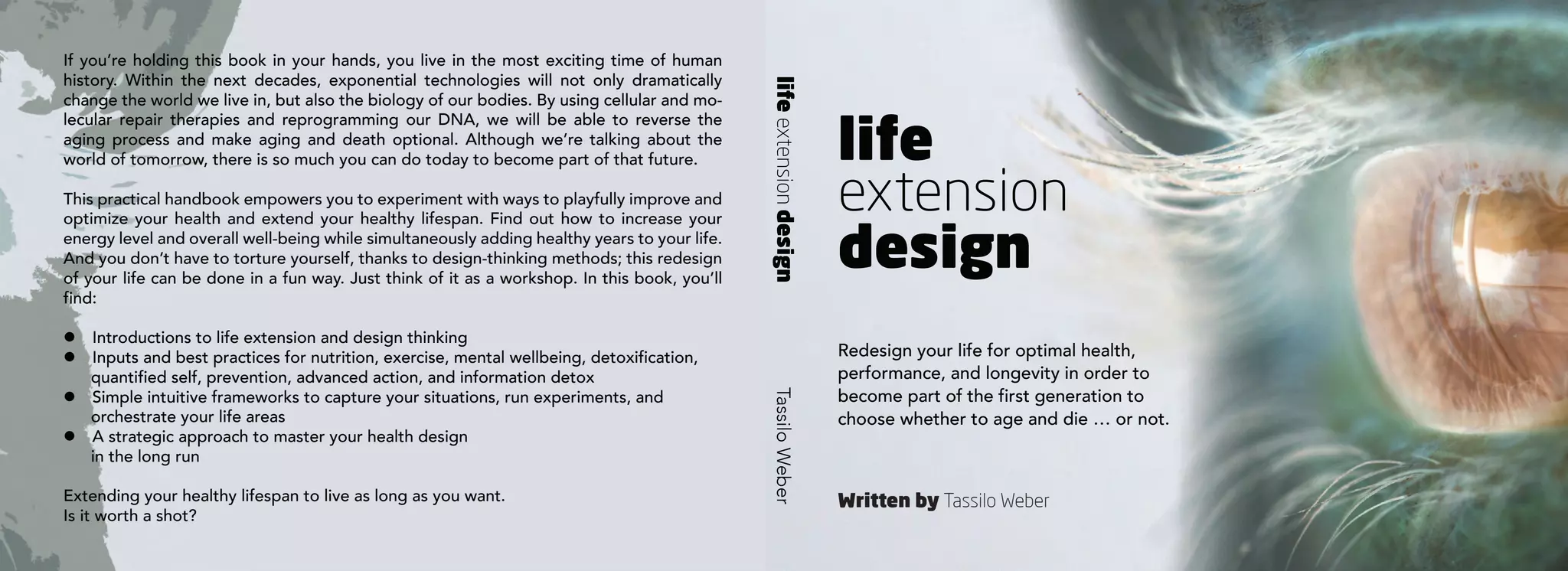
life
extension
design
Redesign your life for optimal health,
performance, and longevity in order to
become part of the first generation to
choose whether to age and die … or not.
lifeextensiondesignTassiloWeber
If you’re holding this book in your hands, you live in the most exciting time of human
history. Within the next decades, exponential technologies will not only dramatically
change the world we live in, but also the biology of our bodies. By using cellular and mo-
lecular repair therapies and reprogramming our DNA, we will be able to reverse the
aging process and make aging and death optional. Although we’re talking about the
world of tomorrow, there is so much you can do today to become part of that future.
This practical handbook empowers you to experiment with ways to playfully improve and
optimize your health and extend your healthy lifespan. Find out how to increase your
energy level and overall well-being while simultaneously adding healthy years to your life.
And you don’t have to torture yourself, thanks to design-thinking methods; this redesign
of your life can be done in a fun way. Just think of it as a workshop. In this book, you’ll
find:
 Introductions to life extension and design thinking
 Inputs and best practices for nutrition, exercise, mental wellbeing, detoxification,
quantified self, prevention, advanced action, and information detox
 Simple intuitive frameworks to capture your situations, run experiments, and
orchestrate your life areas
 A strategic approach to master your health design
in the long run
Extending your healthy lifespan to live as long as you want.
Is it worth a shot?
Written by Tassilo Weber
life extension design
Copyright © 2017 by Tassilo Weber
All rights reserved.
This book was self-published by the author Tassilo
Weber. No part of this book may be reproduced in any
form by any means without the express permission of the
author. This includes reprints, excerpts, photocopying,
recording, or any future means of reproducing text.
This book is not intended as a substitute for the medical
advice of physicians. The reader should regularly consult
a physician in matters relating to his/her health and par-
ticularly with respect to any symptoms that may require
diagnosis or medical attention.
ISBN 978-1545158593
life
extension
design
Redesign your life for optimal
health, performance, and longevity
in order to become part of the first
generation to choose whether to
age and die ... or not.
written l designed l published
by Tassilo Weber
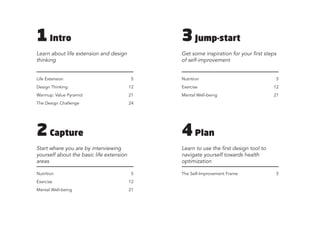
1Intro
Learn about life extension and design
thinking
Life Extension
Design Thinking
Warmup: Value Pyramid
The Design Challenge
5
12
21
24
2Capture
Start where you are by interviewing
yourself about the basic life extension
areas
Nutrition
Exercise
Mental Well-being
5
12
21
3Jump-start
Get some inspiration for your first steps
of self-improvement
Nutrition
Exercise
Mental Well-being
5
12
21
4Plan
Learn to use the first design tool to
navigate yourself towards health
optimization
The Self-Improvement Frame 5
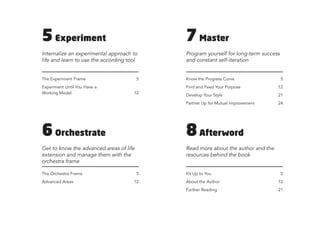
5Experiment
Internalize an experimental approach to
life and learn to use the according tool
The Experiment Frame
Experiment Until You Have a
Working Model
5
12
6Orchestrate
Get to know the advanced areas of life
extension and manage them with the
orchestra frame
The Orchestra Frame
Advanced Areas
5
12
7Master
Program yourself for long-term success
and constant self-iteration
Know the Progress Curve
Find and Feed Your Purpose
Develop Your Style
Partner Up for Mutual Improvement
5
12
21
24
8Afterword
Read more about the author and the
resources behind the book
It’s Up to You
About the Author
Further Reading
5
12
21
1
IntroLearn about life extension and
design thinking
life extension
A silent revolution
9
There is a silent revolution going on that causes ex-
treme reactions among people wherever the issue is
broached. It touches on many people’s suppressed
fears and hopes, and it will make you rethink your
lifestyle, the meaning of your life, and your respon-
sibility to this planet. The growing wave of exponen-
tial technologies such as genome sequencing and
AI point to this secret, and it won’t stay silent much
longer. Soon it will disrupt industries, provoke pro
and counter movements, and rearrange societies.
The revolution I’m speaking of is called Life Exten-
sion, and its objective is as simple as it is striking:
to radically extend a person’s healthy lifespan and,
finally, to end aging.
Even though this may sound like a bad joke, an es-
oteric scam, or science fiction to most readers, it’s
none of those things. This is a reality of science. Ag-
ing is not inevitable, but rather a damaging process
that can be slowed down and even reversed. Natu-
ral evolution had to genetically program complete
health only until a propagable age to ensure survival
of the human race. The subsequent decline (aging)
and death are casualties due to the irrelevance of
optimal health for later phases of life. It’s nothing but
unsustainable programming.
In a nutshell, aging can de defined as damage and
loss of healthy cells through accumulated cell junk,
mutations, and incomplete reproduction. As such,
aging works principally similar to major diseases like
cancer, cardiovascular diseases, diabetes, or Alzhei-
mer’s. In fact, it is the common cause of all these
illnesses in most cases—the root disease. The two
major approaches to cure it are gene therapies to re-
duce the cell pollution and repair therapies to repair
and reverse it. As the causes of aging are identified,
it is only a matter of time until the therapies to ad-
dress these causes are developed and made acces-
sible to the public—at first at a high price for a few,
then affordable for many, and in the end probably
for free and in much higher quality. The estimated
time for this future reality lies between two to four
decades. And the only reason it will take that long
is the lack of public funding, since aging is not offi-
cially considered a disease yet. In the private sector,
however, companies and institutions are vigorously
working on solutions.
The SENS Research Foundation works exclusively
on rejuvenation biotechnologies and successfully
promotes the issue. Following and excelling Peter
Thiel’s example, German Internet entrepreneur and
founder of web.de and the Forever Healthy Foun-
10
dation, Michael Greve, donated 10 Million USD to
SENS in addition to funding many other promising
biotech start-ups with similar approaches.
As these examples become more public, many oth-
er progressive companies and entrepreneurs start
seeing the business opportunity of reversing aging:
whoever will be the first to provide a validated meth-
od will open one of the biggest consumer demands
of the decade, probably the century. The industry
will kick-start and change society like nothing else
before. In 2015, biotech billionaire Osman Kibar an-
nounced reversing aging as his major entrepreneur-
ial challenge. BioViva’s CEO, Liz Parrish, became
patient zero for their own gene therapy to set an
outstanding example. Google started to do its bit in
2013 by founding Calico, an R&D company to com-
bat aging. Craig Venter’s Human Longevity, Inc. has
a similar approach. Amazon’s founder and CEO, Jeff
Bezos, just backed the anti-aging start-up Unity Bio-
technologies with 116 million USD. These are only a
few of many such examples. The game is on.
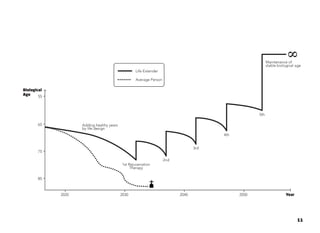
In this context, every healthy year you add to your
lifespan gives you an increasingly higher chance of
being part of the first generation of people who
won’t involuntarily die from aging. Of course, aging
won’t be curable at first from one day to another.
Each therapy addressing different aspects of age-
ing will provide you with some additional healthy
years, which will get you to the moment when the
next life-extending therapy is available, and so on.
Among life extenders, this strategy is called the lon-
gevity escape velocity. Live long enough to live as
long as you want.
Nevertheless, apart from the still uncertain point of
time and cost of their availability, the therapies will
never provide a complete measure for life extension,
as they cannot compensate for an unhealthy, fatal-
istic lifestyle. No cellular repair therapy will remove
the tar from your lungs; no stem cell therapy will
transform you from an obese, diabetic couch potato
into a healthy exerciser with a high metabolic rate.
To fully reverse aging, the therapies must be com-
plemented by a progressive, healthy lifestyle. There-
fore, life extension is also the practice of optimiz-
ing health and extending the healthy lifespan using
a holistic catalogue of actions, habit management,
and use of products and services in the fields of nu-
trition, exercise, detoxification, mental well-being,
prevention, and advanced action. It requires a mind-
set ruled by the desire to know about your current
11
Biological
Age
Year
Life Extender
Average Person
2020 205020402030
65
75
85
55
Adding healthy years
by life design
1st Rejuvenation
Therapy
2nd
3rd
4th
5th
Maintenance of
stable biological age
12
and potential health, take action accordingly, and
stick to it while at the same time being ready and
willing to iterate on it. It is ideal for individuals who
enjoy competing with themselves in order to design
the life they want. In other words: it takes work. But
it’s the most rewarding work there is. The bridge you
build to the age of agelessness is made of a con-
stant increase in quality of life.
To gradually optimize your health is to unleash your
potential. It is to wake up. And I have good news for
you: the work to be done doesn’t have to be hard.
There is a playful, joyful, positively addictive way to
accomplish and cultivate all areas of life extension.
It is the way of design thinking.
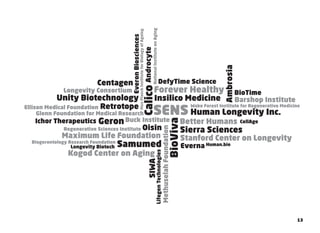
A selection of startups and re-
search centers and founda-
tions currently working on or ex-
clusively funding the development
of rejuvenation therapies. For an
updated, interactive version, visit
my website www.reju.tech
13
SENS
Unity Biotechnology
Calico
Forever Healthy
Maximum Life Foundation
Oisin
MethuselahFoundation
Glenn Foundation for Medical Research
MaxPlanckInstituteforBiologyofAgeing
Centagen
EveronBiosciences
Geron
Human Longevity Inc.
Ichor Therapeutics
LifegenTechnologies
Longevity Biotech
SIWA
Androcyte
Insilico Medicine
Sierra Sciences
Ambrosia
BioTime
BioViva
CellAge
Human.bio
Retrotope
DefyTime Science
Biogerontology Research Foundation
NationalInstituteonAging
Regenerative Sciences Institute
Buck Institute
Ellison Medical Foundation
Barshop Institute
Longevity Consortium
Stanford Center on Longevity
Wake Forest Institute for Regenerative Medicine
Better Humans
Kogod Center on Aging
Samumed Everna
design thinking
Human-centered prototyping
15
Take a look around. Almost everything you see has

been designed by a person or group of people. Not
only objects, also services, infrastructures, and expe-
riences. When you enter certain stores, rent a car, vis-
it a website, or stroll through the preserved historic
part of a city, the way you feel during that experience
is no coincidence. And even if these spaces weren’t
designed with intention, still most experiences can
be seen as products of design and, therefore, some-
thing that can be redesigned.
Design thinking gives you the key to accomplish this.
It is a human-centric innovation method to redesign
experiences of any kind toward more desirability ac-
cording to the needs of the people involved. Devel-
oped in the early nineties in Stanford, design think-
ing was generated in opposition to the approach of
creating perfect ready-made solutions that nobody
wants.
Design thinkers say: we don’t know what works, we
can only assume. The true inspiration is out there to
be found through qualitative interviews, observation,
and prototype testing. Therefore, they go into the
field and in contact with the user as soon and often
as possible. The goal is to learn about the real needs
and problems to address, and to integrate learning
in order to come up with customized, desirable, and
working solutions.
Design thinking is highly intuitive and—with the right
instruction—can be applied immediately. As a pro-
cess, it covers different phases that can be tackled in
a linear or more iterative order. The original process
has undergone various formings, specifications, and
enhancements. For life extension design, the phases
will be Capture, Plan, Experiment, Orchestrate, and
Master. We’ll discuss each of these phases through-
out the book.
Developed as a process-based approach to make
the way designers generate ideas accessible to
non-designers, design thinking has blazed its trail
through all kinds of organizations and also led to the
discipline of life design—the theory and practice of
using design-thinking tools and principles to build a
life that works for you and creates a personal future
that lets your true potential unfold.
Take a look around again, this time from a third-par-
ty, you-centric perspective (which, by the way, is al-
ways a helpful perspective to get yourself unstuck).
The situation you’re in, your according role, your
way of reacting, thinking, feeling, and evaluating
16
your appearance—everything can be seen as part of
your very own life design. Largely self-determined or
not, you are living an interplay of designed, experi-
mental self-experiences. Or is there any part of your
life right now where a choice of yours couldn’t have
made a difference?
If your life can be seen as an interaction of expe-
riences of yourself, others, and the world, why not
redesign it toward higher fulfillment, joy, meaning,
happiness, thriving, or whatever matters most to
you? You are more in charge than you think. And
that’s nothing to be afraid of. It’s just a question of
right activation.
The same applies to the experience of your health,
performance, even of your aging process. In other
words: to your life extension experience.
Life extension design means using design thinking
to constantly and playfully redesign your life to-
ward optimal health and performance, an extended
healthy lifespan, and an ever-slowing (and eventually
reversed) aging process.
As ambitious as this sounds, it doesn’t require any
prearrangements, just the willingness to make more
of your life and reprogram your mindset and habits.
Design thinking always starts with an unbiased look
at what is there now, what are the problems to be
solved, and what is the potential to be unleashed.
Afterward, customized solutions are created, proto-
typed, and tested. What works is further implement-
ed and refined; what doesn’t work is transformed
into learning in order to come up with a better start-
ing point for a new design-thinking process.
Thus, wherever you are in your life—in regard to
age, health, commitments, or lifestyle—it’s good.
Every situation in the categories of nutrition, exer-
cise, mental well-being, detoxification, prevention,
quantified self, supplementation, advanced action,
or information detox (more on these in the following
pages) that contains an actionable problem serves
as a starting point for a life extension design pro-
cess. Moreover, every step you take will contribute
to a higher quality of life because it is not only about
the outcome—it’s also about the way to get there.
The mere approach and subsequent action makes
for a more creative, evolving, and surprising life: a
magic formula for sustainable happiness.
With optimizing health and performance as a first
objective of that approach, you constantly work on
the fundamentals, the hardware to take even more
17
creative action for designing your life. The reali-
ty that what you do for your health can allow you
to stay in that healthy state for a much longer time
makes that approach irresistible to me. That’s why I
couldn’t help but share it with you.
This handbook teaches you how to use design think-
ing to effectively practice life extension. The follow-
ing pages will empower you by taking creative con-
trol over your life as well as advance and cultivate
your body potential by adjusting the life extension
categories to your needs. The tools are frameworks,
design methods, and inputs. The book itself is de-
signed like a workshop that equips you with the skill
of self-entrepreneurship: the ability and passion to
add more value to your life and to other people’s
lives by design. Skill acquisition is a process you must
learn by doing. Therefore, you will be encouraged to
interact and co-create, to fill out the frameworks and
blank spaces with your personal content. So prepare
yourself not for mere literary consumption, but for
active participation. It’s a workshop, and it’s just for
you.
However, since life extension is a fairly new approach
without a conventional method and with its true un-
folding yet to come, I couldn’t exclusively focus on
design tools and methods; I also added a jump-start
section to each life extension area that will provide
you with some basic knowledge and concrete ac-
tions you can take. Bear in mind that those actions,
information, and examples are not all-embracing.
They only serve as a starting point. For further re-
search, see the reading list at the end of this book.
But now, enough from my side. It’s your turn.
18
Warmup: Value Pyramid
Every workshop begins with a warm-up. In real-time,
I let participants play games involving physical activi-
ties to unlock the mind via the body. As you read this,
you might be sitting in public transport, a library, or
just at home drinking tea on a sofa. No worries, you
can stay where you are. All you need is a free mind
and a pencil. It’s a mental warm-up called the Value
Pyramid.
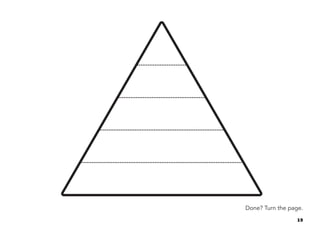
Inspired by Maslow’s hierarchy of needs, the Val-
ue Pyramid is an orientation framework for you to
become clear about what are the most important,
valuable elements, areas, and themes in your life.
Those can be family, friends, career, health, money,
self-expression, fun, adventure, love, knowledge,
spiritual growth—whatever comes to your mind that
you can’t and don’t want to live without. Make a list
of these items. Then think about which ones are the
most basic and put them at the bottom of the pyr-
amid. “Basic” means: being fundamental, a prereq-
uisite for the one above it. So if a life area comes to
your mind, ask yourself: Is there another area that
needs to be at least okay first? The one at the very
bottom should be the element you need for a min-
imum viable life, the starting point from where you
could rebuild all the other elements.
19
Done? Turn the page.
20
If Health is among the first two fundamental lay-
ers of your pyramid, read on. This book helps
you to constantly and playfully improve your
health to make you thrive easier in all other areas
of your life.
If it’s not, this book makes for a nice present for
one of your friends’ next birthdays!
21
22
The Design Challenge
Every design thinking project starts with a design
challenge that targets a certain situation or experi-
ence to be redesigned according to the needs of the
people involved in it. The challenge this book aims
to provide a solution for is this:
Redesign the life extension experience for
health-conscious self-improvers.
Being part of that target group myself, I initially for-
mulated the challenge to improve and extend my
own life in a better way. This book is not a prof-
it-driven intellectual toy for pleasant distraction. It is
written out of necessity. For me, life extension is the
most important thing in my life. From a life design
perspective, it is logically the smartest thing in which
to invest my time and effort. Therefore, I wrote this
book to create for others what I wanted the most
for myself: a design toolkit to facilitate not only an
individual life extension flow experience, but also to
create a common language for a life extension tribe
that shares a passion through mutual improvement
and help. Why was that necessary? Because these
are the problems I stumbled upon during my first
steps of life extension:
For the health care system, healthy people are invisi-
ble, and some individuals have the same way of per-
ceiving their health: there are only health problems.
The doctor’s persona per se is characterized by cer-
tain maladies. Health is the lack of health. The con-
cept of health optimization doesn’t exist. The same
applies to the geriatric care system whose radar en-
compasses you only as soon as you show symptoms
of advanced aging. Therefore, the health and geri-
atric care system’s medical apparatus is not available
for the purposes of life extension.
All aspects of life extension become a matter of per-
sonal care, of the individual in the open market. Ma-
jor pains include disorientation, being overwhelmed
by information, falling for quacks, and loss of mo-
tivation. To find your own way of life extension is a
matter of continuous trial and error. However, unlike
23
sickness treatment, it is not clear what to address
and where to start.
If maladies are the cause for treatments, the cause
for health optimization is self-improvement. If you
want to challenge the status quo of your health, you
need the mindset of challenging the status quo of
your person in general to give you directions, self-
set points of reference, and a motivation engine.
That’s why I designed the profile frameworks with an
emphasis on self-improvement and personal growth.
In everyday life, your body is mostly a black box.
From a scientific perspective, the human body is
a phenomenon too complex to be controlled and
adjusted directly by a single person’s mind facing
daily routine challenges. Operating with extremely
simplified problem-solution patterns, the conscious
mind can only indirectly influence that complexity. It
is forced to constantly experiment with inputs and
interpret outcomes, whereas it is blind to the entire
causality in between. Because this constant exper-
imenting and interpreting in an unstructured way
is exhausting, many people give up consciousness
about their body, giving in to poorly conceived or
impersonal ready-made solutions while waiting for
the next malady to trigger personalized action.
Design thinking provides the most effective and
fastest methods for problem analysis, solution in-
novation, testing experiments, outcome interpreta-
tion, and iteration. As such it is an excellent comple-
menting toolkit to the scientific approach that most
life extensionists use for mastering the half-blind
mind-body-interaction.
You will have to deal a lot with scientific data, espe-
cially your own biological data, to make reasonable
life extension decisions. This book will help you to
do so in a different way: by human-centered, play-
fully experimental, and visual tools—using design
tools, methods, and techniques.
Note: The design challenge is just a first step. While
you go through the process, you will iterate it and
formulate more personalized sub-challenges accord-
ing to your experience, learning, and style.
2
Capture
Start where you are by interviewing yourself about
the basic life extension areas
26
To practice life extension means to take friendly
control over your life in order to not only clean your
body, but also yourself as a person. I say friendly con-
trol because it is not about torturing and restricting,
but rather liberating yourself from traits and habits
you won’t miss in the long run. Still, you don’t know
that yet. There is an essential part of you whose only
objective is to reestablish the status quo. It resists
change, whether good or bad, to keep your system
stable, to keep you alive. You would be dead with-
out it, but you will surely die if you let it define you.
That property of yours is called homeostasis. In gen-
eral, it can be defined as the regulatory principle and
activity of a system to keep a certain equilibrium.
You find it in every stable ecosystem, but also with-
in your own body as well as in your social environ-
ment. Whenever you change something in an area
of your life (e.g., nutrition), no matter whether it’s for
the worse or for the better, at some point you cause
a disequilibrium on a biological level in your body
and/or sociological level in your environment. The
subsequent reaction, though, is neither immediate
nor direct.
Homeostasis strikes in a sneaky way. It will let you
make changes and experiments freely and even
make you feel good about it. Then, suddenly, after a
while you find yourself back in your old behavior, and
you don’t even know how it happened. It is when the
initial enthusiasm fades, and you have to establish
a new routine, investing energy out of pure reason
without feeling the immediate reward anymore. It’s
then when you backslide, just because it feels so
good, so right. Why? Because all the already estab-
lished programs supporting your old routine get re-
activated after lying idle through your time of exper-
imenting. Endorphins make you feel alive and full of
joy, until you find yourself where you were before.
As life extension is about constantly challenging your
status quo, your inner temptation—often backed by
your social surroundings—will be your ever-lasting
sparring partner. Don’t make the mistake of waging
war against it. The more drastic and forceful your
changes, the more likely you are to backslide, as the
reactivation of your old programs feels even better
by contrast.
A more sustainable approach is to understand and
identify your status-quo-self and to deal with it in an
empathetic way. To know your inner temptation and
weaknesses is to be aware of and prepared for its
backsliding techniques.
27
In the long run, you will beat it with its own soft weap-
ons. Have a hands-off approach. Let it take you back
into your old habits. Don’t take it as a defeat; enjoy
it intentionally, as a vacation for relaxation and rein-
forcement, as a temporary role play of your obsolete
self for old times’ sake. Don’t react with punishment
but with compromises for gradual dehabituation. It’s
not about single victories; it’s about taking over your
life long term. He who laughs last laughs longest.
If you take a look at all the different sporting activ-
ities, physiological shapes, and achievements, you
see that the human body is perhaps the most versa-
tile, alterable organism on this planet, with its trans-
human potential still widely untouched. Given such
versatility, homeostasis is a necessity for survival, in
order not to develop in every possible direction at
the same time. Learning how to deal with homeo-
stasis empowers you to develop in the direction of
your choice.
And the good news is that there is a structured way
to do so. It’s to live your life in experiments. But be-
fore you can conduct such experiments you have to
do a little self-stocktaking. You can only plan and
guide you own evolution, if you empathize with your
status quo.
So let’s just start with where and who you are now
in terms of personal healthcare and health optimi-
zation. You probably won’t be able to break it down
into a single sentence, as your life is not a single
activity. It is amazingly manifold the more you think
about it; it is a world. And you are not one person—
you are many, one for every role you fulfill. The same
applies to your healthcare identity, for it is a holis-
tic, manifold activity that interferes with several as-
pects of your life and can be divided into different
sub-identities, helpers, and enemies whose frames
I have sketched out for you to fill them with your
personality.
The exercise to get you there is an open self-inter-
view from which you will later extract your identities
and their weaknesses, strengths, and potentials. It is
important that you are absolutely honest and don’t
confuse what you intend to do with do. The goal is
to start your health improvement in an effective way,
and that can only work if you transform your dreams
into visions, reality-based starting points, and action
plans to bridge them.
You will start capturing the fields of nutrition, exer-
cise, and mental well-being, as these are the basic
levels you should tackle before the other areas of
28
detoxification, quantified self, prevention, advanced
action, and information detox that I will get to later
on.
29
30
Nutrition
Nutrition is the most popular topic in conversations
about healthy living and health optimization. With
an ever-hungry body in front of an endless variety
of food and diet options, the vast majority of peo-
ple are forced to make or maintain decisions in this
regard. At the same time it is a phenomenon repre-
sentative of human contrariness including inner con-
flicts between joy, self-control, and passivity, general
beliefs and philosophies, social aspects and group
memberships.
For life extension designers, it cannot be overrated,
for it is not only a basic element for healthy lifespan
extension and short-term experiments through its
immediate impacts, but also a recurring experience
to learn about yourself.
Let’s forget about everything you think you or any-
body else should do in terms of nutrition and take
a moment to reflect on what you actually do. Take a
separate sheet of paper if your answers exceed the
provided space.
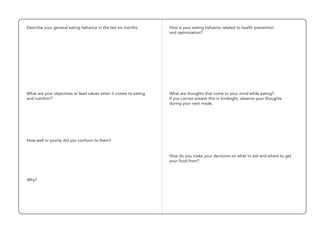
Describe your general eating behavior in the last six months.
What are your objectives or lead values when it comes to eating
and nutrition?
How well or poorly did you conform to them?
Why?
How is your eating behavior related to health prevention
and optimization?
What are thoughts that come to your mind while eating?
If you cannot answer this in hindsight, observe your thoughts
during your next meals.
How do you make your decisions on what to eat and where to get
your food from?
32
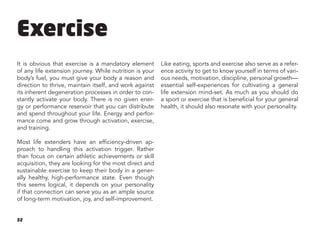
Exercise
It is obvious that exercise is a mandatory element
of any life extension journey. While nutrition is your
body’s fuel, you must give your body a reason and
direction to thrive, maintain itself, and work against
its inherent degeneration processes in order to con-
stantly activate your body. There is no given ener-
gy or performance reservoir that you can distribute
and spend throughout your life. Energy and perfor-
mance come and grow through activation, exercise,
and training.
Most life extenders have an efficiency-driven ap-
proach to handling this activation trigger. Rather
than focus on certain athletic achievements or skill
acquisition, they are looking for the most direct and
sustainable exercise to keep their body in a gener-
ally healthy, high-performance state. Even though
this seems logical, it depends on your personality
if that connection can serve you as an ample source
of long-term motivation, joy, and self-improvement.
Like eating, sports and exercise also serve as a refer-
ence activity to get to know yourself in terms of vari-
ous needs, motivation, discipline, personal growth—
essential self-experiences for cultivating a general
life extension mind-set. As much as you should do
a sport or exercise that is beneficial for your general
health, it should also resonate with your personality.
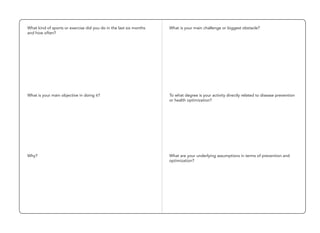
What kind of sports or exercise did you do in the last six months
and how often?
What is your main objective in doing it?
Why?
What is your main challenge or biggest obstacle?
To what degree is your activity directly related to disease prevention
or health optimization?
What are your underlying assumptions in terms of prevention and
optimization?
34
Mental Well-being
To design your healthy life is not only handy, but also
essential to tackling the aspects of mental well-be-
ing. Stress and exceedingly negative emotions are
major adversaries of life extension, as they do not
only harm your health directly on a biological level,
but also make you indulge in a mind-set contrary to
the one that leads you to a life you consider worth
extending.
Negative stress and emotions as well as the cir-
cumstances that foster them are often the result of
perspective, of a self-image and worldview that is
predominantly fatalistic (i.e., focusing on what you
cannot change) and pessimistic (i.e., focusing on de-
velopments toward degeneration of any kind).
The challenge is to realize that perspective is a
choice. Moreover, to opt for a proactive, optimistic
mind-set is to choose a life of making conscious de-
cisions and enjoying to do so. To lose fear and re-
luctance against such a mind-set and lifestyle is also
a matter of training and supportive activities, a pro-
cess that starts best with another self-examination.
In general, how would you describe yourself in terms of prevailing
emotional states in percentage of time?
Take a normal (work) week as scale.
How stressed are you (from 1 to 10)? What percentage of that stress is
positive (self-imposed, goal-oriented) and how much is negative (forced
upon you)? What are the major sources and drivers of this stress?
What makes you feel in a flow state (i.e., when you are fully immersed
in an activity with energized focus?)
How do you see the future of the world?
If you could choose to live healthy for an indefinite time span,
what would be your main reason for that?
My mantra—a simple combination of up to five words that guides
me—is “Always iterate yourself.” Guy Kawasaki’s mantra is “Empower
people.” What’s yours?
What kind of a sleeper are you?
Where do you see yourself in that future?
36
By now you have gone through the first phase of
the design process. If you feel insecure and unsat-
isfied with yourself as you put everything to paper,
let me remind you that there is no right or wrong
about where you are in that phase. Every situation is
a starting point. The only important thing is that you
are honest with yourself so that you have real facts
to work with.
I want to empower you to design your own life ex-
tension journey, but I also want to make sure that it
will be one. There is a thin red line, as many mea-
sures and practices of life extension are taken from
other health improvement approaches. The essen-
tial difference to keep in mind is that whatever you
do and cultivate contributes to the greater purpose
of slowing down and reversing your aging process.
It’s not about losing weight or building muscle or
quantifying yourself just for the sake of it. You will
get various benefits on the way, but in the end, you
work on getting them in order to slow down and
reverse the aging process. All practices from other
approaches collude and are evaluated under this ho-
listic purpose.
In the following jump-start section, I will provide you
with some basic knowledge and actions to start with,
so that you have a better picture of the life extension
way of dealing with the areas of nutrition, exercise,
and mental well-being.
37
3
Jump-start
Get some inspiration for your first steps of
self-improvement
40
The function of nutrition is to provide your body
with fuel that is broken down to energy, so that it
can grow, reproduce itself, maintain its structure,
and remain resilient to environmental influences.
This process is called metabolism, put together from
the two aspects of catabolism, breaking down of
organic matter, and anabolism, building up of cells.
Aging (also) happens as a consequence of cell pol-
lution while cells reproduce, so that from a certain
point, they cannot reproduce themselves anymore.
Nutrition, as the fuel for that reproduction, has an
enormous impact on its quality. Think about a car
engine that is either fueled with diesel or electricity.
The level of pollution and, therefore, its durability is
different.
Nutrients can be grouped into micronutrients—like
vitamins and minerals—that you take in small (micro)
amounts, and macronutrients that you take in big
(macro) amounts.
On a macro level, your body can get its energy from
three different sources: carbohydrates, proteins, and
fats.
For certain reasons, many people still believe that
carbohydrates from bread, pasta, and cereals should
be the main source of energy, with sugar as the he-
donistic add-on. Forget that. Carbohydrates are your
body’s diesel. To be converted into energy, carbohy-
drates require insulin and glucose, which is only okay
up to a certain level before it gets messy and leads
to cell damage (i.e., accelerated aging and a high
probability for related major diseases such as cancer
or type 2 diabetes).
Protein consumption, mostly from meat and fish, is
an indirect and cleaner way to use carbohydrates as
fuel, since the proteins are broken down to carbs in
order to serve as your energy source. This ability of
your body includes the emergency plan to consume
your own muscle for energy in case of food shortage.
Jump-start: Nutrition
41
The clean e-mobility way to fuel your body is through
fats. Converting good fats (e.g., from lean meat, co-
conut and olive oil, avocados, etc.) into energy only
requires oxygen and no insulin or glucose. It is the
healthiest way to fuel your body. However, bad fats
like artificial trans fats from deep-fried food or pack-
aged baked food are a completely different story. It’s
often stated that saturated fats are bad and unsat-
urated fats are good. Of course, it’s not that easy.
Whether saturated fats are good for you or not, for
example, depends on your genetic code (more on
that in the jump-start section for quantified self). I
could keep on writing about this topic, but I’d rather
encourage you to do your own research to dig into
the details.
Now, what does that mean for the choice of your
diet? In general, you should internalize that with your
diet you can control your body’s metabolism and
choose what kind of engine it should be, as it has the
potential for all and can quickly be transformed from
one to another. This not only affects on your long-
term health, but also other actions. For example, if
you fast when your body is tuned to using carbs and
proteins as fuel rather than fats, you will lose muscle
instead of fat, which is unhealthy and probably unde-
sired, if you’re not a resigning bodybuilder.
There is a growing number of people who take these
facts very seriously, jumping right into the Tesla ver-
sion of nutrition in the form of a low-carb, ketogenic
diet. Acting on the results of a two-year long inquiry
with 16,000 studies, Sweden declared the ketogenic
diet as the healthiest and most effective diet to fight
obesity and diabetes.
It is possible to live on a ketogenic diet, and it’s defi-
nitely the best way to lose body fat, as your body
switches to using fat as fuel and, therefore, also
starts to break down your body fat if you keep your
consumption at a reasonable level. This state of ke-
tosis is experienced by many as an enormous energy
boost.
However, a ketogenic diet also has its downside, as
it can mess with your hormones. It also requires high
maintenance because there are very few places to
eat with low-carb meals, even if you live in the hip-
pest district. It can become a struggle to survive if
your body fat percentage is low, as you painstakingly
have to take care of your good fat consumption to
not cannibalize yourself. Thus, it also becomes a life-
style question—can this diet work for you?
42
Another diet that claims to have a scientific approach
is paleo. And it’s definitely not the worst choice. Your
body is the product of 2.6 million years of evolution
(i.e., adaption to nutrient sources. Therefore, paleo
dieters only eat what could have been eaten during
the Paleolithic Age, as it is the nutrient source our
body is adapted to. They avoid any industrial, pro-
cessed food as well as any kind of agricultural prod-
uct that has been cultivated in the last 10,000 years
ago. Don’ts include any kind of cereal products,
dairy, and legumes, while a lot of meat, vegetables,
and nuts land on the plate.
	
Sounds too good to be true? It is. If you take a look
at the evolution of vegetables and fruits, you will
see that none of them exist as such anymore. The
excessive meat consumption of many paleo dieters
doesn’t find its equivalent in our ancestor’s lifestyle
either—neither in quantity nor in the nutritional con-
stitution of animals. Apart from that, the local avail-
ability aspect for things like coconut oil or avocados
is very likely to be ignored. Real paleo dieters would
have to starve.
	
Nevertheless, if you refrain from the pseudoscientific
justification to eat unhealthy and unethical amounts
of meat, the paleo approach brings about a lot of
benefits in terms of avoiding modern toxins from
processed and non-organic food. Once you start
looking for non-enhanced flavor of vegetables, you
will soon end up with the organic version that still
has some nutritional value. Meat from grass-fed an-
imals will control the amount of your consumption
via your purse, with the same effect from freshwater
fish. Some also value the avoidance of soft-inflam-
mation from gluten or the possible negative effects
from dairy.
Another famous diet is vegetarian or vegan. While
most people do it out of ethical reasons—for exam-
ple, cows do not only suffer from their domestica-
tion, they are also forced to be the second largest
source of CO2 emission. Avoiding red meat reduces
the risk for cancer.
Following a vegetarian or vegan diet only makes
sense from a life extension perspective, if you add
the paleo aspect of avoiding processed food and
non-organic vegetables and fruits. You will have to
supplement vitamin B12, vitamin D, iodine, calcium,
iron, and omega. As for micronutrients, no matter
which diet you are on, at least there is consensus
what you need.
43
The commonly approved base of all these diets is or-
ganic vegetables. When preparing them, make sure
you don’t deprive them of nutrients by deep-frying
them. The most nutrient-effective way besides eat-
ing them raw in smoothies is to steam them. The no-
tion that vegetables and fruits have mostly lost their
nutritional value nowadays is a myth. Plants need
micronutrients too for their metabolism and photo-
synthesis. Without them, the plants simply wouldn’t
exist. Nevertheless, organic should be your choice to
avoid pesticides and additives.
I hope this will give you a little overview of some
of the diet options available. There are many more
diets and thousands of pros and cons for each. Stay
reasonable and flexible.
Without telling you what to do, I will briefly tell you
what I do in terms of nutrition, with the disclaimer
that it’s just the current state of experimentation. My
body is not a Tesla, but a hybrid engine that drives
on half fats, half proteins and carbs. I only buy or-
ganic stuff with vegetables as my main ingredient
and fish, meat, tofu, and eggs as add-ons. I get my
carbs mostly from brown rice and sweet potatoes. I
try to live low-gluten and low-sugar with erythritol as
my substitute of choice. When I’m too lazy or busy
to cook, and there is no good place to eat, I make
myself a Joylent shake, which is as far from paleo
as it can get, but certainly better than any kind of
fast food—and it’s faster. I start my day with a green
smoothie made out of vegetables and fruits, en-
hanced with chia seeds, goji berries, collagen, whey,
matcha, and MCT oil. I’ve conditioned myself to eat
super dark chocolate as sweets and can probably
never go back. I really enjoy all this, not only in terms
of health, but also of taste. Sometimes, though, I
have to open some space for my inner temptation,
eating a burger or pizza with friends to avoid a gen-
eral backslide or missing out completely on these
moments that I count under life quality as well. My
main beverage of choice is lemon water (i.e., filtered
tap water with juice from organic lemons).
This is my current formula. To figure out yours, I will
provide you with helpful tools in the next section of
this book.
44
Whatever you choose to do for exercise, it should
be backed by customized goals and progress that
can provide you with long-term joy and motivation.
For life extenders, these are derived from a more
functional point of view (i.e., in how far the exercise
serves their general state of health). And even if you
don’t follow such a strictly functional approach, the
following explanations can help you choose your
sport or way of practicing it.
The main benefit of exercise for your health is to
train and support your cardiovascular system that
lets blood circulate through your body to transport
nutrients, oxygen, carbon dioxide, hormones, and
blood cells, as well as to carry away waste materials
from all body tissues. As such, it plays a major role
for the advancement of the aging process in terms of
nourishment, fuelling and waste management, and
disease prevention.
Now the main assumption is that aerobic exercise
such as jogging, cycling, or swimming is the best
activity to support your cardiovascular system. That
might be true for the time you’re doing the aero-
bic exercise (which, therefore, deserves its synonym
“cardio”) when your body gets the required ener-
gy from oxygen. When you complete such exercise
on a regular basis, your body adjusts to only being
in a cardio training mode while doing the exercise,
whereas it doesn’t maintain that mode during rest.
Another effect of regular aerobic exercise is that your
body starts to reduce unnecessary muscle mass to
support your aerobic efficiency. And that, paradoxi-
cally, is the most inefficient strategy for your cardio-
vascular system.
Why? Because muscle mass is the most energy-de-
manding tissue in your body. To maintain a certain
amount of muscle mass means that your body per-
forms aerobic exercise all the time, even when you
sleep.
Jump-start: Exercise
45
Whilst working out to build muscle or doing high-in-
tensity training, however, your body has to switch
to anaerobic energy generation because it needs
more oxygen than it can deliver to itself. Instead, it
produces a substance called lactic acid that allows
energy production through glucose breakdown. At
the same time, lactic acid leads to rapidly slowed
down muscle contraction after a short peak exercise
of about three minutes to prevent excess damage.
That’s the moment when suddenly the last push-up
is just not possible anymore.
When the high-intensity training is over, the follow-
ing phase is characterized by lactic acid being con-
verted to pyruvate, which leads to a continued aero-
bic metabolism and energy for the body to recover.
Thus, when you rest after intense workout or inten-
sity training like sprinting or kettlebell swings, your
body gets into a mode of aerobic exercise, except
that it is up to seven times as effective as the active
aerobic exercise, and that it supports muscle mass,
which puts your body into the mode of constant aer-
obic exercise.
To remember this relation, you can use the meta-
phor of a freelancer and an entrepreneur. A freelanc-
er (aerobic exerciser) only gets paid (aerobic me-
tabolism) while performing (i.e., per working hour).
An entrepreneur works on a start-up (muscle) that is
supposed to work for him and pay him continuously,
even when he sleeps. But he doesn’t get paid (initial-
ly) when he works on it.
The lean start-up way in this regard is to work on
your muscles only once or twice a week. The more
the better is not essentially true when it comes to ex-
ercise. Excessive aerobic exercise leads to unhealthy
muscle loss, which even can increase your body fat,
as your major energy requiring tissues fade. Exces-
sive muscle building without enough recovery time,
on the other hand, leads to muscle damage rath-
er than growth. Nevertheless, you can train certain
muscle groups more frequently than others, as their
recovery time varies from a few minutes to a whole
week. Educate yourself to find the right exercise in
the right frequency. In general, keep in mind: short
and intense is more effective than long, especially
from an aerobic perspective.
The message from all these facts is not that you
should quit what you do for sports and just go to
the gym or opt for CrossFit. The elements of muscle
training, aerobic exercise, and high-intensity interval
training exist in almost every kind of sport—it only
46
depends on how you do them and where you put
your focus.
47
48
The importance of mental well-being in your life de-
pends on your psychosomatic sensitivity (i.e., in how
far stress and emotional states affect your body and
your health, both in a negative and in a positive way).
This sensitivity doesn’t coincide with you being an
“emotional person.” Emotions and stress are basi-
cally physiological states with a psychological equiv-
alent. The more you suppress them in your mind and
behavior, even though you’re sensitive, the more ef-
fectual they become on your physiology. That’s why
some people who expose themselves to constant
stressful, burdening circumstances may seem to be
emotionally untouched, but suddenly end up with a
stomach ulcer or worse.
Wherever you position yourself in that equation, it
pays off to do something about it. It might seem eas-
ier for certain groups or individuals due to circum-
stances like culture, upbringing, and experiences;
but in the end, it is something you can work on.
Well-being results from a healthy, conscious con-
nection to your emotions and stress states in their
psychological and physiological interplay, as well as
from a constant work on their triggers, in your envi-
ronment and within your own mind. It’s not the cir-
cumstances that make you burn out, it’s how you re-
act to them. Here are some basic fields to start with
to increase your general capacity of healthy reaction.
The most holistic way to foster mental well-being is
meditation. It is the practice of focusing your mind
on one thing without being distracted and carried
away by random thoughts and influences, in order
to raise your general awareness and mindfulness
and get your attention under control. This is an in-
dispensable skill to have in an ever more connect-
ed world. Practiced on a regular basis, meditation
creates a quiet, unaffected place for your ego to
evaluate situations from an empathetic third-person
perspective. You rise above the issues and step out
of yourself to increase reflection and reduce stress,
Jump-start: MentalWell-being
49
which has the direct effect of boosting your immune
system and lowering inflammation and blood pres-
sure. As an exercise for the brain, it slows down its
aging process.
Start with a daily Zen meditation for twenty min-
utes in a quiet place without any possible outside
distractions. Try to exclusively focus on your breath.
Thoughts will come up in abundance. The trick is to
not be carried away by them and just let them go.
Nothing matters within those twenty minutes ex-
cept your breath. This simple instruction is one of
the hardest things to do, but also one of the most
rewarding. Just keep on doing it, and you will soon
feel the effects in your daily life. I’ve been meditating
for around nine years now, and it has helped me a
great deal at transforming myself from an emotional-
ly unstable person into a more balanced, passionate,
efficient, and profoundly happier one.
Yoga builds on the meditative mind-set and broad-
ens the field of attention from the breath to the
whole body in motion and unusual positions. By
doing so, you get a generally better feeling and re-
sponsiveness for your body’s issues and emotional
states. Apart from that, it’s also beneficial on an ex-
ercise level, as it improves the body’s flexibility, mus-
cle strength, respiration, general vitality and metab-
olism, weight reduction, and cardiovascular health.
It is up to you to decide if you want to practice only
from this functional point of view, or if you include
all the esoteric philosophy around chakras, atman,
and karma.
Yoga is extremely hyped at the moment, and you
won’t have a problem finding a way to learn it. Just
be sure to choose the right style for you. If you’re not
sure, opt for hatha yoga, as it is the most well-known
branch.
Another fundamental field to optimize in order to
drastically reduce your general stress level and emo-
tional instability is sleep. It may sound obvious, but
most people don’t care enough about it, whereas
some simple rituals can dramatically increase your
quality of sleep and, therefore, your quality of life.
First of all, try to cultivate a stable circadian rhythm
(i.e., go to bed at around the same time and when
it’s dark outside, and keep your sleeping time be-
tween seven and nine hours).
Form the habit of doing a certain calming ritual be-
fore going to bed to signal to your body’s pineal
50
gland that it can start producing melatonin, the sleep
hormone, which contains antioxidant, supports the
immune system, and protects against cancer; it plays
a fundamental role in slowing down the aging pro-
cess by protecting the mitochondria.
	
During this pre-sleep phase, be sure to avoid blue
light from your computer screen, as it makes your
body think it’s still daylight and, accordingly, blocks
your melatonin production. Install the free program
f.lux that filters out the blue light during the hours
before you go to sleep.
Also keep your mind and body unchallenged during
that phase. Don’t eat during this time. While sleep-
ing, your body lowers its metabolic rate to focus
on cellular repair and waste reduction. Food intake
close to bedtime increases that rate instead and hin-
ders your body’s efforts to regenerate, resulting in a
higher risk for age-related diseases. Don’t exercise
before bed either, since it will suddenly revitalize you
in the middle of the night. Don’t confront your mind
with problems at work or in your private life. Medi-
tate yourself into the art of letting go and calling it a
day in gratefulness. It sounds cheesy, but this prac-
tice can have a profound impact on your sleep and
overall quality of life.
Shade your bedroom as much as possible and reg-
ulate the room temperature around the optimum of
17°C/63°F.
	
If these hacks still can’t tame your mind and body,
you can also supplement with melatonin or GABA,
an amino acid that works as the chief inhibitory neu-
rotransmitter in your brain. Both are considered safe.
Less advanced versions include magnesium, zinc,
and vitamin D3.
On a more general life design level, it is of vital im-
portance for your mental well-being (and for the pur-
suit of life extension as a whole) to come up with
and work on your purpose in life. That work happens
on three levels: a positive outlook on the future, a
vision for yourself within that future, and constantly
conducting life experiments toward that vision. That
said, I will now go into more detail in the chapters on
experiments, information detox, and mastery.
The four action fields of meditation, yoga, sleep op-
timization, and purpose generation can serve you
as inspirational starting points to work on your men-
tal well-being. Two obvious life areas, which I won’t
go into detail about here, that you have to man-
age well are your close relationships and your job
Pages 52-170 are missing in this preview. For a full
version order the book on:
Amazon.com
Amazon.de
Amazon.uk
...or search for it on your country's Amazon page.

Tassilo Weber - Life Extension Design - Preview

  • 1.
    life extension design Redesign your lifefor optimal health, performance, and longevity in order to become part of the first generation to choose whether to age and die … or not. lifeextensiondesignTassiloWeber If you’re holding this book in your hands, you live in the most exciting time of human history. Within the next decades, exponential technologies will not only dramatically change the world we live in, but also the biology of our bodies. By using cellular and mo- lecular repair therapies and reprogramming our DNA, we will be able to reverse the aging process and make aging and death optional. Although we’re talking about the world of tomorrow, there is so much you can do today to become part of that future. This practical handbook empowers you to experiment with ways to playfully improve and optimize your health and extend your healthy lifespan. Find out how to increase your energy level and overall well-being while simultaneously adding healthy years to your life. And you don’t have to torture yourself, thanks to design-thinking methods; this redesign of your life can be done in a fun way. Just think of it as a workshop. In this book, you’ll find:  Introductions to life extension and design thinking  Inputs and best practices for nutrition, exercise, mental wellbeing, detoxification, quantified self, prevention, advanced action, and information detox  Simple intuitive frameworks to capture your situations, run experiments, and orchestrate your life areas  A strategic approach to master your health design in the long run Extending your healthy lifespan to live as long as you want. Is it worth a shot? Written by Tassilo Weber
  • 2.
  • 3.
    Copyright © 2017by Tassilo Weber All rights reserved. This book was self-published by the author Tassilo Weber. No part of this book may be reproduced in any form by any means without the express permission of the author. This includes reprints, excerpts, photocopying, recording, or any future means of reproducing text. This book is not intended as a substitute for the medical advice of physicians. The reader should regularly consult a physician in matters relating to his/her health and par- ticularly with respect to any symptoms that may require diagnosis or medical attention. ISBN 978-1545158593
  • 4.
    life extension design Redesign your lifefor optimal health, performance, and longevity in order to become part of the first generation to choose whether to age and die ... or not. written l designed l published by Tassilo Weber
  • 5.
    1Intro Learn about lifeextension and design thinking Life Extension Design Thinking Warmup: Value Pyramid The Design Challenge 5 12 21 24 2Capture Start where you are by interviewing yourself about the basic life extension areas Nutrition Exercise Mental Well-being 5 12 21 3Jump-start Get some inspiration for your first steps of self-improvement Nutrition Exercise Mental Well-being 5 12 21 4Plan Learn to use the first design tool to navigate yourself towards health optimization The Self-Improvement Frame 5
  • 6.
    5Experiment Internalize an experimentalapproach to life and learn to use the according tool The Experiment Frame Experiment Until You Have a Working Model 5 12 6Orchestrate Get to know the advanced areas of life extension and manage them with the orchestra frame The Orchestra Frame Advanced Areas 5 12 7Master Program yourself for long-term success and constant self-iteration Know the Progress Curve Find and Feed Your Purpose Develop Your Style Partner Up for Mutual Improvement 5 12 21 24 8Afterword Read more about the author and the resources behind the book It’s Up to You About the Author Further Reading 5 12 21
  • 7.
  • 8.
    IntroLearn about lifeextension and design thinking
  • 9.
  • 10.
    9 There is asilent revolution going on that causes ex- treme reactions among people wherever the issue is broached. It touches on many people’s suppressed fears and hopes, and it will make you rethink your lifestyle, the meaning of your life, and your respon- sibility to this planet. The growing wave of exponen- tial technologies such as genome sequencing and AI point to this secret, and it won’t stay silent much longer. Soon it will disrupt industries, provoke pro and counter movements, and rearrange societies. The revolution I’m speaking of is called Life Exten- sion, and its objective is as simple as it is striking: to radically extend a person’s healthy lifespan and, finally, to end aging. Even though this may sound like a bad joke, an es- oteric scam, or science fiction to most readers, it’s none of those things. This is a reality of science. Ag- ing is not inevitable, but rather a damaging process that can be slowed down and even reversed. Natu- ral evolution had to genetically program complete health only until a propagable age to ensure survival of the human race. The subsequent decline (aging) and death are casualties due to the irrelevance of optimal health for later phases of life. It’s nothing but unsustainable programming. In a nutshell, aging can de defined as damage and loss of healthy cells through accumulated cell junk, mutations, and incomplete reproduction. As such, aging works principally similar to major diseases like cancer, cardiovascular diseases, diabetes, or Alzhei- mer’s. In fact, it is the common cause of all these illnesses in most cases—the root disease. The two major approaches to cure it are gene therapies to re- duce the cell pollution and repair therapies to repair and reverse it. As the causes of aging are identified, it is only a matter of time until the therapies to ad- dress these causes are developed and made acces- sible to the public—at first at a high price for a few, then affordable for many, and in the end probably for free and in much higher quality. The estimated time for this future reality lies between two to four decades. And the only reason it will take that long is the lack of public funding, since aging is not offi- cially considered a disease yet. In the private sector, however, companies and institutions are vigorously working on solutions. The SENS Research Foundation works exclusively on rejuvenation biotechnologies and successfully promotes the issue. Following and excelling Peter Thiel’s example, German Internet entrepreneur and founder of web.de and the Forever Healthy Foun-
  • 11.
    10 dation, Michael Greve,donated 10 Million USD to SENS in addition to funding many other promising biotech start-ups with similar approaches. As these examples become more public, many oth- er progressive companies and entrepreneurs start seeing the business opportunity of reversing aging: whoever will be the first to provide a validated meth- od will open one of the biggest consumer demands of the decade, probably the century. The industry will kick-start and change society like nothing else before. In 2015, biotech billionaire Osman Kibar an- nounced reversing aging as his major entrepreneur- ial challenge. BioViva’s CEO, Liz Parrish, became patient zero for their own gene therapy to set an outstanding example. Google started to do its bit in 2013 by founding Calico, an R&D company to com- bat aging. Craig Venter’s Human Longevity, Inc. has a similar approach. Amazon’s founder and CEO, Jeff Bezos, just backed the anti-aging start-up Unity Bio- technologies with 116 million USD. These are only a few of many such examples. The game is on. In this context, every healthy year you add to your lifespan gives you an increasingly higher chance of being part of the first generation of people who won’t involuntarily die from aging. Of course, aging won’t be curable at first from one day to another. Each therapy addressing different aspects of age- ing will provide you with some additional healthy years, which will get you to the moment when the next life-extending therapy is available, and so on. Among life extenders, this strategy is called the lon- gevity escape velocity. Live long enough to live as long as you want. Nevertheless, apart from the still uncertain point of time and cost of their availability, the therapies will never provide a complete measure for life extension, as they cannot compensate for an unhealthy, fatal- istic lifestyle. No cellular repair therapy will remove the tar from your lungs; no stem cell therapy will transform you from an obese, diabetic couch potato into a healthy exerciser with a high metabolic rate. To fully reverse aging, the therapies must be com- plemented by a progressive, healthy lifestyle. There- fore, life extension is also the practice of optimiz- ing health and extending the healthy lifespan using a holistic catalogue of actions, habit management, and use of products and services in the fields of nu- trition, exercise, detoxification, mental well-being, prevention, and advanced action. It requires a mind- set ruled by the desire to know about your current
  • 12.
    11 Biological Age Year Life Extender Average Person 2020205020402030 65 75 85 55 Adding healthy years by life design 1st Rejuvenation Therapy 2nd 3rd 4th 5th Maintenance of stable biological age
  • 13.
    12 and potential health,take action accordingly, and stick to it while at the same time being ready and willing to iterate on it. It is ideal for individuals who enjoy competing with themselves in order to design the life they want. In other words: it takes work. But it’s the most rewarding work there is. The bridge you build to the age of agelessness is made of a con- stant increase in quality of life. To gradually optimize your health is to unleash your potential. It is to wake up. And I have good news for you: the work to be done doesn’t have to be hard. There is a playful, joyful, positively addictive way to accomplish and cultivate all areas of life extension. It is the way of design thinking. A selection of startups and re- search centers and founda- tions currently working on or ex- clusively funding the development of rejuvenation therapies. For an updated, interactive version, visit my website www.reju.tech
  • 14.
    13 SENS Unity Biotechnology Calico Forever Healthy MaximumLife Foundation Oisin MethuselahFoundation Glenn Foundation for Medical Research MaxPlanckInstituteforBiologyofAgeing Centagen EveronBiosciences Geron Human Longevity Inc. Ichor Therapeutics LifegenTechnologies Longevity Biotech SIWA Androcyte Insilico Medicine Sierra Sciences Ambrosia BioTime BioViva CellAge Human.bio Retrotope DefyTime Science Biogerontology Research Foundation NationalInstituteonAging Regenerative Sciences Institute Buck Institute Ellison Medical Foundation Barshop Institute Longevity Consortium Stanford Center on Longevity Wake Forest Institute for Regenerative Medicine Better Humans Kogod Center on Aging Samumed Everna
  • 15.
  • 16.
    15 Take a lookaround. Almost everything you see has been designed by a person or group of people. Not only objects, also services, infrastructures, and expe- riences. When you enter certain stores, rent a car, vis- it a website, or stroll through the preserved historic part of a city, the way you feel during that experience is no coincidence. And even if these spaces weren’t designed with intention, still most experiences can be seen as products of design and, therefore, some- thing that can be redesigned. Design thinking gives you the key to accomplish this. It is a human-centric innovation method to redesign experiences of any kind toward more desirability ac- cording to the needs of the people involved. Devel- oped in the early nineties in Stanford, design think- ing was generated in opposition to the approach of creating perfect ready-made solutions that nobody wants. Design thinkers say: we don’t know what works, we can only assume. The true inspiration is out there to be found through qualitative interviews, observation, and prototype testing. Therefore, they go into the field and in contact with the user as soon and often as possible. The goal is to learn about the real needs and problems to address, and to integrate learning in order to come up with customized, desirable, and working solutions. Design thinking is highly intuitive and—with the right instruction—can be applied immediately. As a pro- cess, it covers different phases that can be tackled in a linear or more iterative order. The original process has undergone various formings, specifications, and enhancements. For life extension design, the phases will be Capture, Plan, Experiment, Orchestrate, and Master. We’ll discuss each of these phases through- out the book. Developed as a process-based approach to make the way designers generate ideas accessible to non-designers, design thinking has blazed its trail through all kinds of organizations and also led to the discipline of life design—the theory and practice of using design-thinking tools and principles to build a life that works for you and creates a personal future that lets your true potential unfold. Take a look around again, this time from a third-par- ty, you-centric perspective (which, by the way, is al- ways a helpful perspective to get yourself unstuck). The situation you’re in, your according role, your way of reacting, thinking, feeling, and evaluating
  • 17.
    16 your appearance—everything canbe seen as part of your very own life design. Largely self-determined or not, you are living an interplay of designed, experi- mental self-experiences. Or is there any part of your life right now where a choice of yours couldn’t have made a difference? If your life can be seen as an interaction of expe- riences of yourself, others, and the world, why not redesign it toward higher fulfillment, joy, meaning, happiness, thriving, or whatever matters most to you? You are more in charge than you think. And that’s nothing to be afraid of. It’s just a question of right activation. The same applies to the experience of your health, performance, even of your aging process. In other words: to your life extension experience. Life extension design means using design thinking to constantly and playfully redesign your life to- ward optimal health and performance, an extended healthy lifespan, and an ever-slowing (and eventually reversed) aging process. As ambitious as this sounds, it doesn’t require any prearrangements, just the willingness to make more of your life and reprogram your mindset and habits. Design thinking always starts with an unbiased look at what is there now, what are the problems to be solved, and what is the potential to be unleashed. Afterward, customized solutions are created, proto- typed, and tested. What works is further implement- ed and refined; what doesn’t work is transformed into learning in order to come up with a better start- ing point for a new design-thinking process. Thus, wherever you are in your life—in regard to age, health, commitments, or lifestyle—it’s good. Every situation in the categories of nutrition, exer- cise, mental well-being, detoxification, prevention, quantified self, supplementation, advanced action, or information detox (more on these in the following pages) that contains an actionable problem serves as a starting point for a life extension design pro- cess. Moreover, every step you take will contribute to a higher quality of life because it is not only about the outcome—it’s also about the way to get there. The mere approach and subsequent action makes for a more creative, evolving, and surprising life: a magic formula for sustainable happiness. With optimizing health and performance as a first objective of that approach, you constantly work on the fundamentals, the hardware to take even more
  • 18.
    17 creative action fordesigning your life. The reali- ty that what you do for your health can allow you to stay in that healthy state for a much longer time makes that approach irresistible to me. That’s why I couldn’t help but share it with you. This handbook teaches you how to use design think- ing to effectively practice life extension. The follow- ing pages will empower you by taking creative con- trol over your life as well as advance and cultivate your body potential by adjusting the life extension categories to your needs. The tools are frameworks, design methods, and inputs. The book itself is de- signed like a workshop that equips you with the skill of self-entrepreneurship: the ability and passion to add more value to your life and to other people’s lives by design. Skill acquisition is a process you must learn by doing. Therefore, you will be encouraged to interact and co-create, to fill out the frameworks and blank spaces with your personal content. So prepare yourself not for mere literary consumption, but for active participation. It’s a workshop, and it’s just for you. However, since life extension is a fairly new approach without a conventional method and with its true un- folding yet to come, I couldn’t exclusively focus on design tools and methods; I also added a jump-start section to each life extension area that will provide you with some basic knowledge and concrete ac- tions you can take. Bear in mind that those actions, information, and examples are not all-embracing. They only serve as a starting point. For further re- search, see the reading list at the end of this book. But now, enough from my side. It’s your turn.
  • 19.
    18 Warmup: Value Pyramid Everyworkshop begins with a warm-up. In real-time, I let participants play games involving physical activi- ties to unlock the mind via the body. As you read this, you might be sitting in public transport, a library, or just at home drinking tea on a sofa. No worries, you can stay where you are. All you need is a free mind and a pencil. It’s a mental warm-up called the Value Pyramid. Inspired by Maslow’s hierarchy of needs, the Val- ue Pyramid is an orientation framework for you to become clear about what are the most important, valuable elements, areas, and themes in your life. Those can be family, friends, career, health, money, self-expression, fun, adventure, love, knowledge, spiritual growth—whatever comes to your mind that you can’t and don’t want to live without. Make a list of these items. Then think about which ones are the most basic and put them at the bottom of the pyr- amid. “Basic” means: being fundamental, a prereq- uisite for the one above it. So if a life area comes to your mind, ask yourself: Is there another area that needs to be at least okay first? The one at the very bottom should be the element you need for a min- imum viable life, the starting point from where you could rebuild all the other elements.
  • 20.
  • 21.
    20 If Health isamong the first two fundamental lay- ers of your pyramid, read on. This book helps you to constantly and playfully improve your health to make you thrive easier in all other areas of your life. If it’s not, this book makes for a nice present for one of your friends’ next birthdays!
  • 22.
  • 23.
    22 The Design Challenge Everydesign thinking project starts with a design challenge that targets a certain situation or experi- ence to be redesigned according to the needs of the people involved in it. The challenge this book aims to provide a solution for is this: Redesign the life extension experience for health-conscious self-improvers. Being part of that target group myself, I initially for- mulated the challenge to improve and extend my own life in a better way. This book is not a prof- it-driven intellectual toy for pleasant distraction. It is written out of necessity. For me, life extension is the most important thing in my life. From a life design perspective, it is logically the smartest thing in which to invest my time and effort. Therefore, I wrote this book to create for others what I wanted the most for myself: a design toolkit to facilitate not only an individual life extension flow experience, but also to create a common language for a life extension tribe that shares a passion through mutual improvement and help. Why was that necessary? Because these are the problems I stumbled upon during my first steps of life extension: For the health care system, healthy people are invisi- ble, and some individuals have the same way of per- ceiving their health: there are only health problems. The doctor’s persona per se is characterized by cer- tain maladies. Health is the lack of health. The con- cept of health optimization doesn’t exist. The same applies to the geriatric care system whose radar en- compasses you only as soon as you show symptoms of advanced aging. Therefore, the health and geri- atric care system’s medical apparatus is not available for the purposes of life extension. All aspects of life extension become a matter of per- sonal care, of the individual in the open market. Ma- jor pains include disorientation, being overwhelmed by information, falling for quacks, and loss of mo- tivation. To find your own way of life extension is a matter of continuous trial and error. However, unlike
  • 24.
    23 sickness treatment, itis not clear what to address and where to start. If maladies are the cause for treatments, the cause for health optimization is self-improvement. If you want to challenge the status quo of your health, you need the mindset of challenging the status quo of your person in general to give you directions, self- set points of reference, and a motivation engine. That’s why I designed the profile frameworks with an emphasis on self-improvement and personal growth. In everyday life, your body is mostly a black box. From a scientific perspective, the human body is a phenomenon too complex to be controlled and adjusted directly by a single person’s mind facing daily routine challenges. Operating with extremely simplified problem-solution patterns, the conscious mind can only indirectly influence that complexity. It is forced to constantly experiment with inputs and interpret outcomes, whereas it is blind to the entire causality in between. Because this constant exper- imenting and interpreting in an unstructured way is exhausting, many people give up consciousness about their body, giving in to poorly conceived or impersonal ready-made solutions while waiting for the next malady to trigger personalized action. Design thinking provides the most effective and fastest methods for problem analysis, solution in- novation, testing experiments, outcome interpreta- tion, and iteration. As such it is an excellent comple- menting toolkit to the scientific approach that most life extensionists use for mastering the half-blind mind-body-interaction. You will have to deal a lot with scientific data, espe- cially your own biological data, to make reasonable life extension decisions. This book will help you to do so in a different way: by human-centered, play- fully experimental, and visual tools—using design tools, methods, and techniques. Note: The design challenge is just a first step. While you go through the process, you will iterate it and formulate more personalized sub-challenges accord- ing to your experience, learning, and style.
  • 25.
  • 26.
    Capture Start where youare by interviewing yourself about the basic life extension areas
  • 27.
    26 To practice lifeextension means to take friendly control over your life in order to not only clean your body, but also yourself as a person. I say friendly con- trol because it is not about torturing and restricting, but rather liberating yourself from traits and habits you won’t miss in the long run. Still, you don’t know that yet. There is an essential part of you whose only objective is to reestablish the status quo. It resists change, whether good or bad, to keep your system stable, to keep you alive. You would be dead with- out it, but you will surely die if you let it define you. That property of yours is called homeostasis. In gen- eral, it can be defined as the regulatory principle and activity of a system to keep a certain equilibrium. You find it in every stable ecosystem, but also with- in your own body as well as in your social environ- ment. Whenever you change something in an area of your life (e.g., nutrition), no matter whether it’s for the worse or for the better, at some point you cause a disequilibrium on a biological level in your body and/or sociological level in your environment. The subsequent reaction, though, is neither immediate nor direct. Homeostasis strikes in a sneaky way. It will let you make changes and experiments freely and even make you feel good about it. Then, suddenly, after a while you find yourself back in your old behavior, and you don’t even know how it happened. It is when the initial enthusiasm fades, and you have to establish a new routine, investing energy out of pure reason without feeling the immediate reward anymore. It’s then when you backslide, just because it feels so good, so right. Why? Because all the already estab- lished programs supporting your old routine get re- activated after lying idle through your time of exper- imenting. Endorphins make you feel alive and full of joy, until you find yourself where you were before. As life extension is about constantly challenging your status quo, your inner temptation—often backed by your social surroundings—will be your ever-lasting sparring partner. Don’t make the mistake of waging war against it. The more drastic and forceful your changes, the more likely you are to backslide, as the reactivation of your old programs feels even better by contrast. A more sustainable approach is to understand and identify your status-quo-self and to deal with it in an empathetic way. To know your inner temptation and weaknesses is to be aware of and prepared for its backsliding techniques.
  • 28.
    27 In the longrun, you will beat it with its own soft weap- ons. Have a hands-off approach. Let it take you back into your old habits. Don’t take it as a defeat; enjoy it intentionally, as a vacation for relaxation and rein- forcement, as a temporary role play of your obsolete self for old times’ sake. Don’t react with punishment but with compromises for gradual dehabituation. It’s not about single victories; it’s about taking over your life long term. He who laughs last laughs longest. If you take a look at all the different sporting activ- ities, physiological shapes, and achievements, you see that the human body is perhaps the most versa- tile, alterable organism on this planet, with its trans- human potential still widely untouched. Given such versatility, homeostasis is a necessity for survival, in order not to develop in every possible direction at the same time. Learning how to deal with homeo- stasis empowers you to develop in the direction of your choice. And the good news is that there is a structured way to do so. It’s to live your life in experiments. But be- fore you can conduct such experiments you have to do a little self-stocktaking. You can only plan and guide you own evolution, if you empathize with your status quo. So let’s just start with where and who you are now in terms of personal healthcare and health optimi- zation. You probably won’t be able to break it down into a single sentence, as your life is not a single activity. It is amazingly manifold the more you think about it; it is a world. And you are not one person— you are many, one for every role you fulfill. The same applies to your healthcare identity, for it is a holis- tic, manifold activity that interferes with several as- pects of your life and can be divided into different sub-identities, helpers, and enemies whose frames I have sketched out for you to fill them with your personality. The exercise to get you there is an open self-inter- view from which you will later extract your identities and their weaknesses, strengths, and potentials. It is important that you are absolutely honest and don’t confuse what you intend to do with do. The goal is to start your health improvement in an effective way, and that can only work if you transform your dreams into visions, reality-based starting points, and action plans to bridge them. You will start capturing the fields of nutrition, exer- cise, and mental well-being, as these are the basic levels you should tackle before the other areas of
  • 29.
    28 detoxification, quantified self,prevention, advanced action, and information detox that I will get to later on.
  • 30.
  • 31.
    30 Nutrition Nutrition is themost popular topic in conversations about healthy living and health optimization. With an ever-hungry body in front of an endless variety of food and diet options, the vast majority of peo- ple are forced to make or maintain decisions in this regard. At the same time it is a phenomenon repre- sentative of human contrariness including inner con- flicts between joy, self-control, and passivity, general beliefs and philosophies, social aspects and group memberships. For life extension designers, it cannot be overrated, for it is not only a basic element for healthy lifespan extension and short-term experiments through its immediate impacts, but also a recurring experience to learn about yourself. Let’s forget about everything you think you or any- body else should do in terms of nutrition and take a moment to reflect on what you actually do. Take a separate sheet of paper if your answers exceed the provided space.
  • 32.
    Describe your generaleating behavior in the last six months. What are your objectives or lead values when it comes to eating and nutrition? How well or poorly did you conform to them? Why? How is your eating behavior related to health prevention and optimization? What are thoughts that come to your mind while eating? If you cannot answer this in hindsight, observe your thoughts during your next meals. How do you make your decisions on what to eat and where to get your food from?
  • 33.
    32 Exercise It is obviousthat exercise is a mandatory element of any life extension journey. While nutrition is your body’s fuel, you must give your body a reason and direction to thrive, maintain itself, and work against its inherent degeneration processes in order to con- stantly activate your body. There is no given ener- gy or performance reservoir that you can distribute and spend throughout your life. Energy and perfor- mance come and grow through activation, exercise, and training. Most life extenders have an efficiency-driven ap- proach to handling this activation trigger. Rather than focus on certain athletic achievements or skill acquisition, they are looking for the most direct and sustainable exercise to keep their body in a gener- ally healthy, high-performance state. Even though this seems logical, it depends on your personality if that connection can serve you as an ample source of long-term motivation, joy, and self-improvement. Like eating, sports and exercise also serve as a refer- ence activity to get to know yourself in terms of vari- ous needs, motivation, discipline, personal growth— essential self-experiences for cultivating a general life extension mind-set. As much as you should do a sport or exercise that is beneficial for your general health, it should also resonate with your personality.
  • 34.
    What kind ofsports or exercise did you do in the last six months and how often? What is your main objective in doing it? Why? What is your main challenge or biggest obstacle? To what degree is your activity directly related to disease prevention or health optimization? What are your underlying assumptions in terms of prevention and optimization?
  • 35.
    34 Mental Well-being To designyour healthy life is not only handy, but also essential to tackling the aspects of mental well-be- ing. Stress and exceedingly negative emotions are major adversaries of life extension, as they do not only harm your health directly on a biological level, but also make you indulge in a mind-set contrary to the one that leads you to a life you consider worth extending. Negative stress and emotions as well as the cir- cumstances that foster them are often the result of perspective, of a self-image and worldview that is predominantly fatalistic (i.e., focusing on what you cannot change) and pessimistic (i.e., focusing on de- velopments toward degeneration of any kind). The challenge is to realize that perspective is a choice. Moreover, to opt for a proactive, optimistic mind-set is to choose a life of making conscious de- cisions and enjoying to do so. To lose fear and re- luctance against such a mind-set and lifestyle is also a matter of training and supportive activities, a pro- cess that starts best with another self-examination.
  • 36.
    In general, howwould you describe yourself in terms of prevailing emotional states in percentage of time? Take a normal (work) week as scale. How stressed are you (from 1 to 10)? What percentage of that stress is positive (self-imposed, goal-oriented) and how much is negative (forced upon you)? What are the major sources and drivers of this stress? What makes you feel in a flow state (i.e., when you are fully immersed in an activity with energized focus?) How do you see the future of the world? If you could choose to live healthy for an indefinite time span, what would be your main reason for that? My mantra—a simple combination of up to five words that guides me—is “Always iterate yourself.” Guy Kawasaki’s mantra is “Empower people.” What’s yours? What kind of a sleeper are you? Where do you see yourself in that future?
  • 37.
    36 By now youhave gone through the first phase of the design process. If you feel insecure and unsat- isfied with yourself as you put everything to paper, let me remind you that there is no right or wrong about where you are in that phase. Every situation is a starting point. The only important thing is that you are honest with yourself so that you have real facts to work with. I want to empower you to design your own life ex- tension journey, but I also want to make sure that it will be one. There is a thin red line, as many mea- sures and practices of life extension are taken from other health improvement approaches. The essen- tial difference to keep in mind is that whatever you do and cultivate contributes to the greater purpose of slowing down and reversing your aging process. It’s not about losing weight or building muscle or quantifying yourself just for the sake of it. You will get various benefits on the way, but in the end, you work on getting them in order to slow down and reverse the aging process. All practices from other approaches collude and are evaluated under this ho- listic purpose. In the following jump-start section, I will provide you with some basic knowledge and actions to start with, so that you have a better picture of the life extension way of dealing with the areas of nutrition, exercise, and mental well-being.
  • 38.
  • 39.
  • 40.
    Jump-start Get some inspirationfor your first steps of self-improvement
  • 41.
    40 The function ofnutrition is to provide your body with fuel that is broken down to energy, so that it can grow, reproduce itself, maintain its structure, and remain resilient to environmental influences. This process is called metabolism, put together from the two aspects of catabolism, breaking down of organic matter, and anabolism, building up of cells. Aging (also) happens as a consequence of cell pol- lution while cells reproduce, so that from a certain point, they cannot reproduce themselves anymore. Nutrition, as the fuel for that reproduction, has an enormous impact on its quality. Think about a car engine that is either fueled with diesel or electricity. The level of pollution and, therefore, its durability is different. Nutrients can be grouped into micronutrients—like vitamins and minerals—that you take in small (micro) amounts, and macronutrients that you take in big (macro) amounts. On a macro level, your body can get its energy from three different sources: carbohydrates, proteins, and fats. For certain reasons, many people still believe that carbohydrates from bread, pasta, and cereals should be the main source of energy, with sugar as the he- donistic add-on. Forget that. Carbohydrates are your body’s diesel. To be converted into energy, carbohy- drates require insulin and glucose, which is only okay up to a certain level before it gets messy and leads to cell damage (i.e., accelerated aging and a high probability for related major diseases such as cancer or type 2 diabetes). Protein consumption, mostly from meat and fish, is an indirect and cleaner way to use carbohydrates as fuel, since the proteins are broken down to carbs in order to serve as your energy source. This ability of your body includes the emergency plan to consume your own muscle for energy in case of food shortage. Jump-start: Nutrition
  • 42.
    41 The clean e-mobilityway to fuel your body is through fats. Converting good fats (e.g., from lean meat, co- conut and olive oil, avocados, etc.) into energy only requires oxygen and no insulin or glucose. It is the healthiest way to fuel your body. However, bad fats like artificial trans fats from deep-fried food or pack- aged baked food are a completely different story. It’s often stated that saturated fats are bad and unsat- urated fats are good. Of course, it’s not that easy. Whether saturated fats are good for you or not, for example, depends on your genetic code (more on that in the jump-start section for quantified self). I could keep on writing about this topic, but I’d rather encourage you to do your own research to dig into the details. Now, what does that mean for the choice of your diet? In general, you should internalize that with your diet you can control your body’s metabolism and choose what kind of engine it should be, as it has the potential for all and can quickly be transformed from one to another. This not only affects on your long- term health, but also other actions. For example, if you fast when your body is tuned to using carbs and proteins as fuel rather than fats, you will lose muscle instead of fat, which is unhealthy and probably unde- sired, if you’re not a resigning bodybuilder. There is a growing number of people who take these facts very seriously, jumping right into the Tesla ver- sion of nutrition in the form of a low-carb, ketogenic diet. Acting on the results of a two-year long inquiry with 16,000 studies, Sweden declared the ketogenic diet as the healthiest and most effective diet to fight obesity and diabetes. It is possible to live on a ketogenic diet, and it’s defi- nitely the best way to lose body fat, as your body switches to using fat as fuel and, therefore, also starts to break down your body fat if you keep your consumption at a reasonable level. This state of ke- tosis is experienced by many as an enormous energy boost. However, a ketogenic diet also has its downside, as it can mess with your hormones. It also requires high maintenance because there are very few places to eat with low-carb meals, even if you live in the hip- pest district. It can become a struggle to survive if your body fat percentage is low, as you painstakingly have to take care of your good fat consumption to not cannibalize yourself. Thus, it also becomes a life- style question—can this diet work for you?
  • 43.
    42 Another diet thatclaims to have a scientific approach is paleo. And it’s definitely not the worst choice. Your body is the product of 2.6 million years of evolution (i.e., adaption to nutrient sources. Therefore, paleo dieters only eat what could have been eaten during the Paleolithic Age, as it is the nutrient source our body is adapted to. They avoid any industrial, pro- cessed food as well as any kind of agricultural prod- uct that has been cultivated in the last 10,000 years ago. Don’ts include any kind of cereal products, dairy, and legumes, while a lot of meat, vegetables, and nuts land on the plate. Sounds too good to be true? It is. If you take a look at the evolution of vegetables and fruits, you will see that none of them exist as such anymore. The excessive meat consumption of many paleo dieters doesn’t find its equivalent in our ancestor’s lifestyle either—neither in quantity nor in the nutritional con- stitution of animals. Apart from that, the local avail- ability aspect for things like coconut oil or avocados is very likely to be ignored. Real paleo dieters would have to starve. Nevertheless, if you refrain from the pseudoscientific justification to eat unhealthy and unethical amounts of meat, the paleo approach brings about a lot of benefits in terms of avoiding modern toxins from processed and non-organic food. Once you start looking for non-enhanced flavor of vegetables, you will soon end up with the organic version that still has some nutritional value. Meat from grass-fed an- imals will control the amount of your consumption via your purse, with the same effect from freshwater fish. Some also value the avoidance of soft-inflam- mation from gluten or the possible negative effects from dairy. Another famous diet is vegetarian or vegan. While most people do it out of ethical reasons—for exam- ple, cows do not only suffer from their domestica- tion, they are also forced to be the second largest source of CO2 emission. Avoiding red meat reduces the risk for cancer. Following a vegetarian or vegan diet only makes sense from a life extension perspective, if you add the paleo aspect of avoiding processed food and non-organic vegetables and fruits. You will have to supplement vitamin B12, vitamin D, iodine, calcium, iron, and omega. As for micronutrients, no matter which diet you are on, at least there is consensus what you need.
  • 44.
    43 The commonly approvedbase of all these diets is or- ganic vegetables. When preparing them, make sure you don’t deprive them of nutrients by deep-frying them. The most nutrient-effective way besides eat- ing them raw in smoothies is to steam them. The no- tion that vegetables and fruits have mostly lost their nutritional value nowadays is a myth. Plants need micronutrients too for their metabolism and photo- synthesis. Without them, the plants simply wouldn’t exist. Nevertheless, organic should be your choice to avoid pesticides and additives. I hope this will give you a little overview of some of the diet options available. There are many more diets and thousands of pros and cons for each. Stay reasonable and flexible. Without telling you what to do, I will briefly tell you what I do in terms of nutrition, with the disclaimer that it’s just the current state of experimentation. My body is not a Tesla, but a hybrid engine that drives on half fats, half proteins and carbs. I only buy or- ganic stuff with vegetables as my main ingredient and fish, meat, tofu, and eggs as add-ons. I get my carbs mostly from brown rice and sweet potatoes. I try to live low-gluten and low-sugar with erythritol as my substitute of choice. When I’m too lazy or busy to cook, and there is no good place to eat, I make myself a Joylent shake, which is as far from paleo as it can get, but certainly better than any kind of fast food—and it’s faster. I start my day with a green smoothie made out of vegetables and fruits, en- hanced with chia seeds, goji berries, collagen, whey, matcha, and MCT oil. I’ve conditioned myself to eat super dark chocolate as sweets and can probably never go back. I really enjoy all this, not only in terms of health, but also of taste. Sometimes, though, I have to open some space for my inner temptation, eating a burger or pizza with friends to avoid a gen- eral backslide or missing out completely on these moments that I count under life quality as well. My main beverage of choice is lemon water (i.e., filtered tap water with juice from organic lemons). This is my current formula. To figure out yours, I will provide you with helpful tools in the next section of this book.
  • 45.
    44 Whatever you chooseto do for exercise, it should be backed by customized goals and progress that can provide you with long-term joy and motivation. For life extenders, these are derived from a more functional point of view (i.e., in how far the exercise serves their general state of health). And even if you don’t follow such a strictly functional approach, the following explanations can help you choose your sport or way of practicing it. The main benefit of exercise for your health is to train and support your cardiovascular system that lets blood circulate through your body to transport nutrients, oxygen, carbon dioxide, hormones, and blood cells, as well as to carry away waste materials from all body tissues. As such, it plays a major role for the advancement of the aging process in terms of nourishment, fuelling and waste management, and disease prevention. Now the main assumption is that aerobic exercise such as jogging, cycling, or swimming is the best activity to support your cardiovascular system. That might be true for the time you’re doing the aero- bic exercise (which, therefore, deserves its synonym “cardio”) when your body gets the required ener- gy from oxygen. When you complete such exercise on a regular basis, your body adjusts to only being in a cardio training mode while doing the exercise, whereas it doesn’t maintain that mode during rest. Another effect of regular aerobic exercise is that your body starts to reduce unnecessary muscle mass to support your aerobic efficiency. And that, paradoxi- cally, is the most inefficient strategy for your cardio- vascular system. Why? Because muscle mass is the most energy-de- manding tissue in your body. To maintain a certain amount of muscle mass means that your body per- forms aerobic exercise all the time, even when you sleep. Jump-start: Exercise
  • 46.
    45 Whilst working outto build muscle or doing high-in- tensity training, however, your body has to switch to anaerobic energy generation because it needs more oxygen than it can deliver to itself. Instead, it produces a substance called lactic acid that allows energy production through glucose breakdown. At the same time, lactic acid leads to rapidly slowed down muscle contraction after a short peak exercise of about three minutes to prevent excess damage. That’s the moment when suddenly the last push-up is just not possible anymore. When the high-intensity training is over, the follow- ing phase is characterized by lactic acid being con- verted to pyruvate, which leads to a continued aero- bic metabolism and energy for the body to recover. Thus, when you rest after intense workout or inten- sity training like sprinting or kettlebell swings, your body gets into a mode of aerobic exercise, except that it is up to seven times as effective as the active aerobic exercise, and that it supports muscle mass, which puts your body into the mode of constant aer- obic exercise. To remember this relation, you can use the meta- phor of a freelancer and an entrepreneur. A freelanc- er (aerobic exerciser) only gets paid (aerobic me- tabolism) while performing (i.e., per working hour). An entrepreneur works on a start-up (muscle) that is supposed to work for him and pay him continuously, even when he sleeps. But he doesn’t get paid (initial- ly) when he works on it. The lean start-up way in this regard is to work on your muscles only once or twice a week. The more the better is not essentially true when it comes to ex- ercise. Excessive aerobic exercise leads to unhealthy muscle loss, which even can increase your body fat, as your major energy requiring tissues fade. Exces- sive muscle building without enough recovery time, on the other hand, leads to muscle damage rath- er than growth. Nevertheless, you can train certain muscle groups more frequently than others, as their recovery time varies from a few minutes to a whole week. Educate yourself to find the right exercise in the right frequency. In general, keep in mind: short and intense is more effective than long, especially from an aerobic perspective. The message from all these facts is not that you should quit what you do for sports and just go to the gym or opt for CrossFit. The elements of muscle training, aerobic exercise, and high-intensity interval training exist in almost every kind of sport—it only
  • 47.
    46 depends on howyou do them and where you put your focus.
  • 48.
  • 49.
    48 The importance ofmental well-being in your life de- pends on your psychosomatic sensitivity (i.e., in how far stress and emotional states affect your body and your health, both in a negative and in a positive way). This sensitivity doesn’t coincide with you being an “emotional person.” Emotions and stress are basi- cally physiological states with a psychological equiv- alent. The more you suppress them in your mind and behavior, even though you’re sensitive, the more ef- fectual they become on your physiology. That’s why some people who expose themselves to constant stressful, burdening circumstances may seem to be emotionally untouched, but suddenly end up with a stomach ulcer or worse. Wherever you position yourself in that equation, it pays off to do something about it. It might seem eas- ier for certain groups or individuals due to circum- stances like culture, upbringing, and experiences; but in the end, it is something you can work on. Well-being results from a healthy, conscious con- nection to your emotions and stress states in their psychological and physiological interplay, as well as from a constant work on their triggers, in your envi- ronment and within your own mind. It’s not the cir- cumstances that make you burn out, it’s how you re- act to them. Here are some basic fields to start with to increase your general capacity of healthy reaction. The most holistic way to foster mental well-being is meditation. It is the practice of focusing your mind on one thing without being distracted and carried away by random thoughts and influences, in order to raise your general awareness and mindfulness and get your attention under control. This is an in- dispensable skill to have in an ever more connect- ed world. Practiced on a regular basis, meditation creates a quiet, unaffected place for your ego to evaluate situations from an empathetic third-person perspective. You rise above the issues and step out of yourself to increase reflection and reduce stress, Jump-start: MentalWell-being
  • 50.
    49 which has thedirect effect of boosting your immune system and lowering inflammation and blood pres- sure. As an exercise for the brain, it slows down its aging process. Start with a daily Zen meditation for twenty min- utes in a quiet place without any possible outside distractions. Try to exclusively focus on your breath. Thoughts will come up in abundance. The trick is to not be carried away by them and just let them go. Nothing matters within those twenty minutes ex- cept your breath. This simple instruction is one of the hardest things to do, but also one of the most rewarding. Just keep on doing it, and you will soon feel the effects in your daily life. I’ve been meditating for around nine years now, and it has helped me a great deal at transforming myself from an emotional- ly unstable person into a more balanced, passionate, efficient, and profoundly happier one. Yoga builds on the meditative mind-set and broad- ens the field of attention from the breath to the whole body in motion and unusual positions. By doing so, you get a generally better feeling and re- sponsiveness for your body’s issues and emotional states. Apart from that, it’s also beneficial on an ex- ercise level, as it improves the body’s flexibility, mus- cle strength, respiration, general vitality and metab- olism, weight reduction, and cardiovascular health. It is up to you to decide if you want to practice only from this functional point of view, or if you include all the esoteric philosophy around chakras, atman, and karma. Yoga is extremely hyped at the moment, and you won’t have a problem finding a way to learn it. Just be sure to choose the right style for you. If you’re not sure, opt for hatha yoga, as it is the most well-known branch. Another fundamental field to optimize in order to drastically reduce your general stress level and emo- tional instability is sleep. It may sound obvious, but most people don’t care enough about it, whereas some simple rituals can dramatically increase your quality of sleep and, therefore, your quality of life. First of all, try to cultivate a stable circadian rhythm (i.e., go to bed at around the same time and when it’s dark outside, and keep your sleeping time be- tween seven and nine hours). Form the habit of doing a certain calming ritual be- fore going to bed to signal to your body’s pineal
  • 51.
    50 gland that itcan start producing melatonin, the sleep hormone, which contains antioxidant, supports the immune system, and protects against cancer; it plays a fundamental role in slowing down the aging pro- cess by protecting the mitochondria. During this pre-sleep phase, be sure to avoid blue light from your computer screen, as it makes your body think it’s still daylight and, accordingly, blocks your melatonin production. Install the free program f.lux that filters out the blue light during the hours before you go to sleep. Also keep your mind and body unchallenged during that phase. Don’t eat during this time. While sleep- ing, your body lowers its metabolic rate to focus on cellular repair and waste reduction. Food intake close to bedtime increases that rate instead and hin- ders your body’s efforts to regenerate, resulting in a higher risk for age-related diseases. Don’t exercise before bed either, since it will suddenly revitalize you in the middle of the night. Don’t confront your mind with problems at work or in your private life. Medi- tate yourself into the art of letting go and calling it a day in gratefulness. It sounds cheesy, but this prac- tice can have a profound impact on your sleep and overall quality of life. Shade your bedroom as much as possible and reg- ulate the room temperature around the optimum of 17°C/63°F. If these hacks still can’t tame your mind and body, you can also supplement with melatonin or GABA, an amino acid that works as the chief inhibitory neu- rotransmitter in your brain. Both are considered safe. Less advanced versions include magnesium, zinc, and vitamin D3. On a more general life design level, it is of vital im- portance for your mental well-being (and for the pur- suit of life extension as a whole) to come up with and work on your purpose in life. That work happens on three levels: a positive outlook on the future, a vision for yourself within that future, and constantly conducting life experiments toward that vision. That said, I will now go into more detail in the chapters on experiments, information detox, and mastery. The four action fields of meditation, yoga, sleep op- timization, and purpose generation can serve you as inspirational starting points to work on your men- tal well-being. Two obvious life areas, which I won’t go into detail about here, that you have to man- age well are your close relationships and your job
  • 52.
    Pages 52-170 aremissing in this preview. For a full version order the book on: Amazon.com Amazon.de Amazon.uk ...or search for it on your country's Amazon page.