

THEORY OF DESIGN
EXPRESSIONISM INFLUENCE IN ARCHITECTURE
Expressionist architecture was an architectural movement that developed in Europe during
the first decades of the 20th century in parallel with the expressionist visual and performing
arts that especially developed and dominated in Germany.
CHARACTERISTICS OF EXPRESSIONIST ARCHITECTURE
1. Distortion of form for an emotional effect.
2. Subordination of realism to symbolic .
3. Importance of concepts than pragmatic finished products
4. Often hybrid solutions, irreducible to a single concept.
5. Use of creative potential of artisan craftsmanship.
6. Conception of architecture as a work of art.
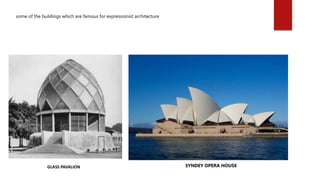
some of the buildings which are famous for expressionist architecture
GLASS PAVALION SYNDEY OPERA HOUSE
Example
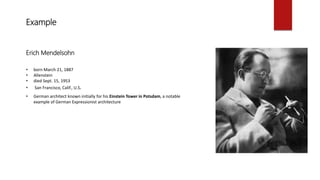
Erich Mendelsohn
• born March 21, 1887
• Allenstein
• died Sept. 15, 1953
• San Francisco, Calif., U.S.
• German architect known initially for his Einstein Tower in Potsdam, a notable
example of German Expressionist architecture
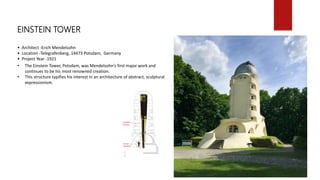
EINSTEIN TOWER
• Architect -Erich Mendelsohn
• Location -Telegrafenberg, 14473 Potsdam, Germany
• Project Year -1921
.• The Einstein Tower, Potsdam, was Mendelsohn’s first major work and
continues to be his most renowned creation.
• This structure typifies his interest in an architecture of abstract, sculptural
expressionism.
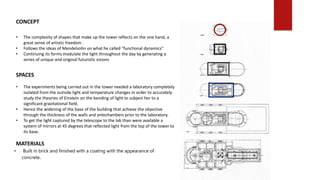
CONCEPT
• The complexity of shapes that make up the tower reflects on the one hand, a
great sense of artistic freedom .
• Follows the ideas of Mendelsohn on what he called "functional dynamics“
• Continuing its forms modulate the light throughout the day by generating a
series of unique and original futuristic visions
SPACES
• The experiments being carried out in the tower needed a laboratory completely
isolated from the outside light and temperature changes in order to accurately
study the theories of Einstein on the bending of light to subject her to a
significant gravitational field.
• Hence the widening of the base of the building that achieve the objective
through the thickness of the walls and antechambers prior to the laboratory.
• To get the light captured by the telescope to the lab than were available a
system of mirrors at 45 degrees that reflected light from the top of the tower to
its base.
MATERIALS
• Built in brick and finished with a coating with the appearance of
concrete.
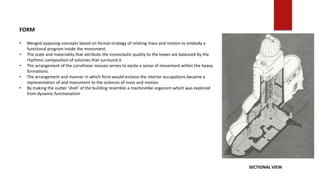
FORM
• Merged opposing concepts based on formal strategy of relating mass and motion to embody a
functional program inside the monument.
• The scale and materiality that attribute the iconoclastic quality to the tower are balanced by the
rhythmic composition of volumes that surround it.
• The arrangement of the curvilinear masses serves to excite a sense of movement within the heavy
formations.
• The arrangement and manner in which form would enclose the interior occupations became a
representation of and monument to the sciences of mass and motion
• By making the outter ‘shell’ of the building resemble a machinelike organism which was explored
from dynamic functionalism
SECTIONAL VIEW
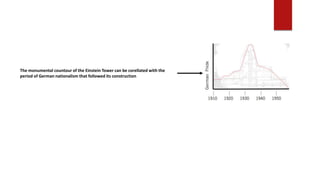
The monumental countour of the Einstein Tower can be corellated with the
period of German nationalism that followed its construction

EXPRESSIONISM

  • 1.
  • 2.
    EXPRESSIONISM INFLUENCE INARCHITECTURE Expressionist architecture was an architectural movement that developed in Europe during the first decades of the 20th century in parallel with the expressionist visual and performing arts that especially developed and dominated in Germany. CHARACTERISTICS OF EXPRESSIONIST ARCHITECTURE 1. Distortion of form for an emotional effect. 2. Subordination of realism to symbolic . 3. Importance of concepts than pragmatic finished products 4. Often hybrid solutions, irreducible to a single concept. 5. Use of creative potential of artisan craftsmanship. 6. Conception of architecture as a work of art.
  • 4.
    some of thebuildings which are famous for expressionist architecture GLASS PAVALION SYNDEY OPERA HOUSE
  • 5.
    Example Erich Mendelsohn • bornMarch 21, 1887 • Allenstein • died Sept. 15, 1953 • San Francisco, Calif., U.S. • German architect known initially for his Einstein Tower in Potsdam, a notable example of German Expressionist architecture
  • 6.
    EINSTEIN TOWER • Architect-Erich Mendelsohn • Location -Telegrafenberg, 14473 Potsdam, Germany • Project Year -1921 .• The Einstein Tower, Potsdam, was Mendelsohn’s first major work and continues to be his most renowned creation. • This structure typifies his interest in an architecture of abstract, sculptural expressionism.
  • 7.
    CONCEPT • The complexityof shapes that make up the tower reflects on the one hand, a great sense of artistic freedom . • Follows the ideas of Mendelsohn on what he called "functional dynamics“ • Continuing its forms modulate the light throughout the day by generating a series of unique and original futuristic visions SPACES • The experiments being carried out in the tower needed a laboratory completely isolated from the outside light and temperature changes in order to accurately study the theories of Einstein on the bending of light to subject her to a significant gravitational field. • Hence the widening of the base of the building that achieve the objective through the thickness of the walls and antechambers prior to the laboratory. • To get the light captured by the telescope to the lab than were available a system of mirrors at 45 degrees that reflected light from the top of the tower to its base. MATERIALS • Built in brick and finished with a coating with the appearance of concrete.
  • 8.
    FORM • Merged opposingconcepts based on formal strategy of relating mass and motion to embody a functional program inside the monument. • The scale and materiality that attribute the iconoclastic quality to the tower are balanced by the rhythmic composition of volumes that surround it. • The arrangement of the curvilinear masses serves to excite a sense of movement within the heavy formations. • The arrangement and manner in which form would enclose the interior occupations became a representation of and monument to the sciences of mass and motion • By making the outter ‘shell’ of the building resemble a machinelike organism which was explored from dynamic functionalism SECTIONAL VIEW
  • 11.
    The monumental countourof the Einstein Tower can be corellated with the period of German nationalism that followed its construction