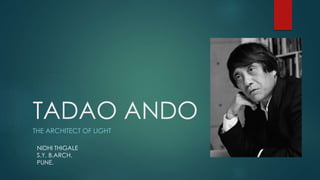
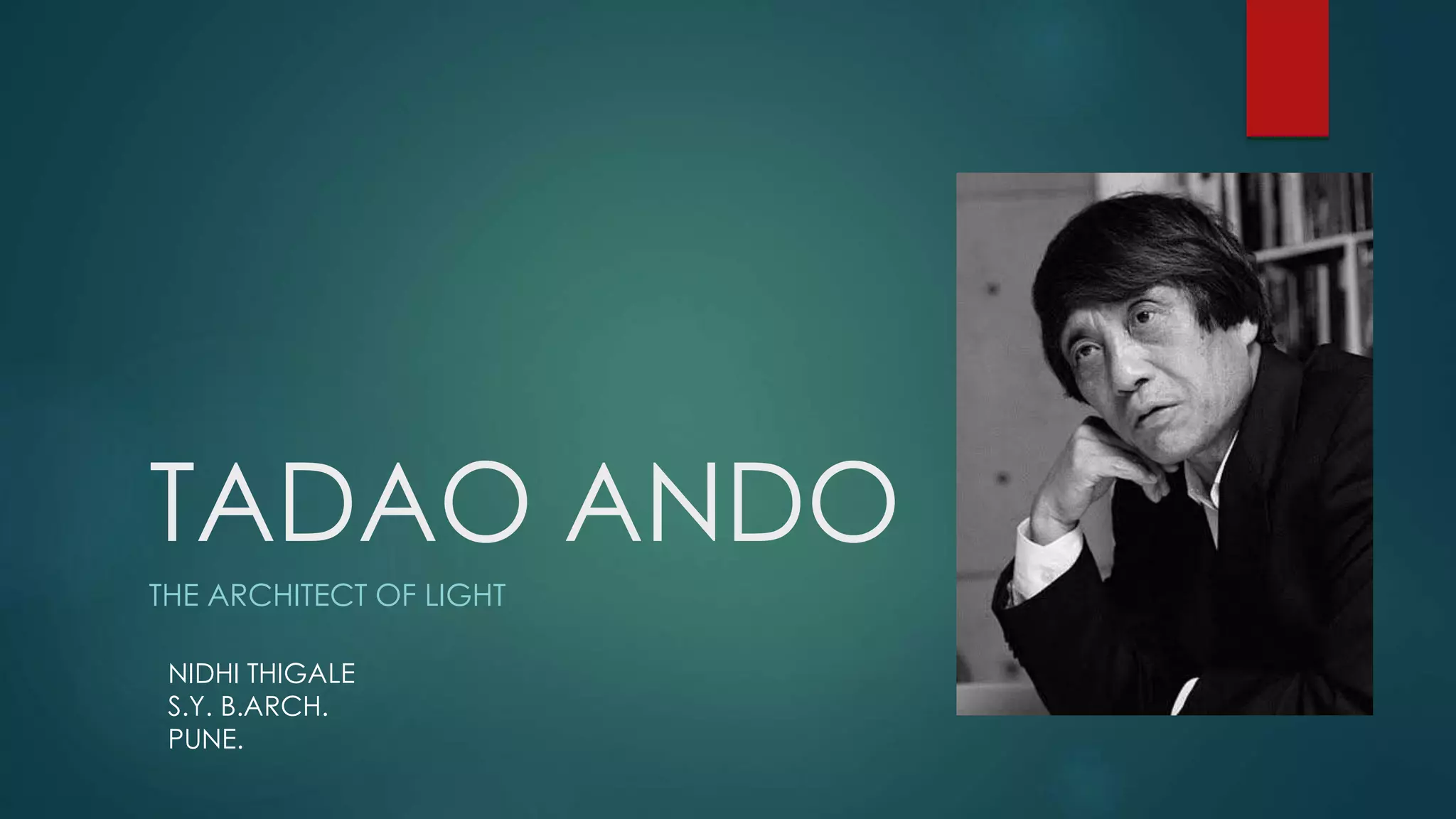

TADAO ANDO
THE ARCHITECT OF LIGHT
NIDHI THIGALE
S.Y. B.ARCH.
PUNE.
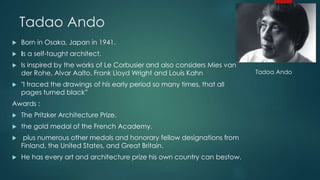
Tadao Ando
 Born in Osaka, Japan in 1941.
 Is a self-taught architect.
 Is inspired by the works of Le Corbusier and also considers Mies van
der Rohe, Alvar Aalto, Frank Lloyd Wright and Louis Kahn
 "I traced the drawings of his early period so many times, that all
pages turned black”
Awards :
 The Pritzker Architecture Prize.
 the gold medal of the French Academy.
 plus numerous other medals and honorary fellow designations from
Finland, the United States, and Great Britain.
 He has every art and architecture prize his own country can bestow.
Tadoa Ando
Philosophy
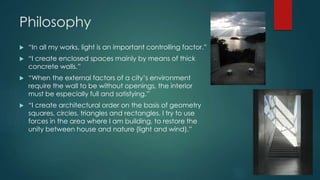
 “In all my works, light is an important controlling factor.”
 “I create enclosed spaces mainly by means of thick
concrete walls.”
 “When the external factors of a city’s environment
require the wall to be without openings, the interior
must be especially full and satisfying.”
 “I create architectural order on the basis of geometry
squares, circles, triangles and rectangles. I try to use
forces in the area where I am building, to restore the
unity between house and nature (light and wind).”
Philosophy
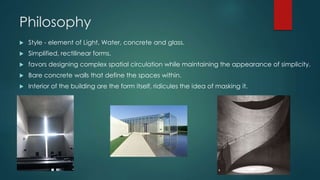
 Style - element of Light, Water, concrete and glass.
 Simplified, rectilinear forms.
 favors designing complex spatial circulation while maintaining the appearance of simplicity.
 Bare concrete walls that define the spaces within.
 Interior of the building are the form itself, ridicules the idea of masking it.
Church of the Light, 1999.
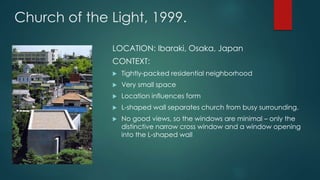
LOCATION: Ibaraki, Osaka, Japan
CONTEXT:
 Tightly-packed residential neighborhood
 Very small space
 Location influences form
 L-shaped wall separates church from busy surrounding.
 No good views, so the windows are minimal – only the
distinctive narrow cross window and a window opening
into the L-shaped wall
Church of the Light
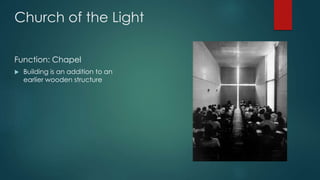
Function: Chapel
 Building is an addition to an
earlier wooden structure
Church of the Light
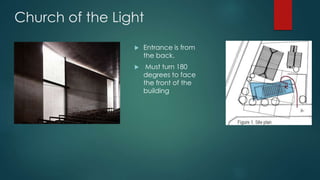
 Entrance is from
the back.
 Must turn 180
degrees to face
the front of the
building
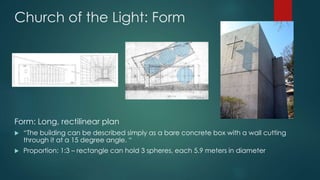
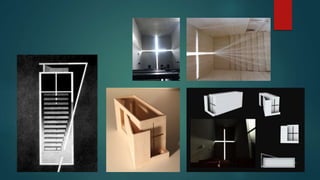
Church of the Light: Form
Form: Long, rectilinear plan
 “The building can be described simply as a bare concrete box with a wall cutting
through it at a 15 degree angle. “
 Proportion: 1:3 – rectangle can hold 3 spheres, each 5.9 meters in diameter
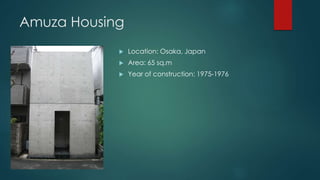
Amuza Housing
 Location: Osaka, Japan
 Area: 65 sq.m
 Year of construction: 1975-1976
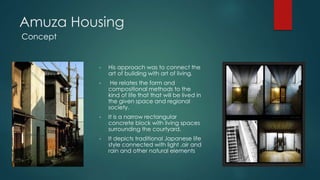
Amuza Housing
• His approach was to connect the
art of building with art of living.
• He relates the form and
compositional methods to the
kind of life that that will be lived in
the given space and regional
society.
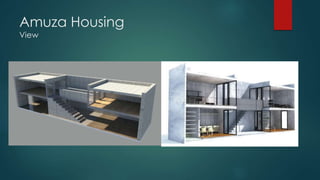
• It is a narrow rectangular
concrete block with living spaces
surrounding the courtyard.
• It depicts traditional Japanese life
style connected with light ,air and
rain and other natural elements
Concept
Amuza Housing
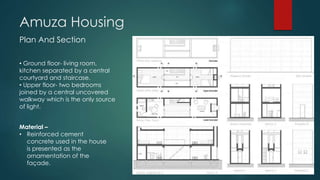
Plan And Section
• Ground floor- living room,
kitchen separated by a central
courtyard and staircase.
• Upper floor- two bedrooms
joined by a central uncovered
walkway which is the only source
of light.
Material –
• Reinforced cement
concrete used in the house
is presented as the
ornamentation of the
façade.
Amuza Housing
View
The Chichu Art Museum
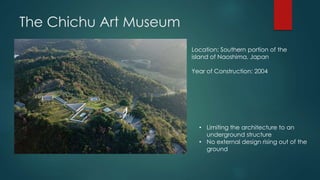
Location: Southern portion of the
island of Naoshima, Japan
Year of Construction: 2004
• Limiting the architecture to an
underground structure
• No external design rising out of the
ground
The Chichu Art Museum
Concept
 Why underground? The site is a place where national
forest abounds and was a former salt field. Hence to
preserve the existing atmosphere and beauty of the
site the museum is wisely buried underground.
 It is possible to create almost any form underground as
there are no axes or directions as exist above ground,
on earth
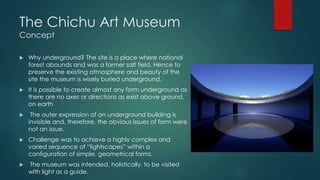
 The outer expression of an underground building is
invisible and, therefore, the obvious issues of form were
not an issue.
 Challenge was to achieve a highly complex and
varied sequence of “lightscapes” within a
configuration of simple, geometrical forms.
 The museum was intended, holistically, to be visited
with light as a guide.
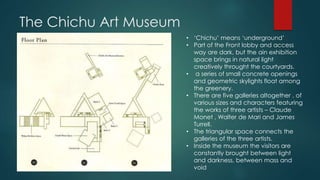
The Chichu Art Museum
• ‘Chichu’ means ‘underground’
• Part of the Front lobby and access
way are dark, but the ain exhibition
space brings in natural light
creatively throught the courtyards.
• a series of small concrete openings
and geometric skylights float among
the greenery.
• There are five galleries altogether , of
various sizes and characters featuring
the works of three artists – Claude
Monet , Walter de Mari and James
Turrell.
• The triangular space connects the
galleries of the three artists.
• Inside the museum the visitors are
constantly brought between light
and darkness, between mass and
void
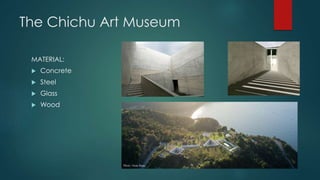
The Chichu Art Museum
MATERIAL:
 Concrete
 Steel
 Glass
 Wood
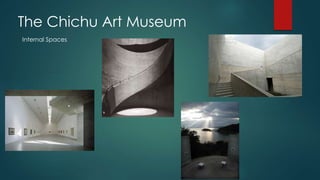
The Chichu Art Museum
Internal Spaces
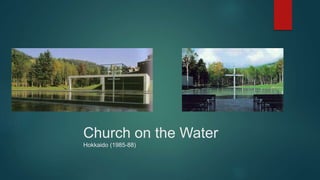
Church on the Water
Hokkaido (1985-88)
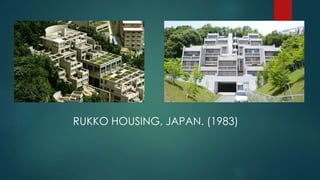
RUKKO HOUSING, JAPAN. (1983)
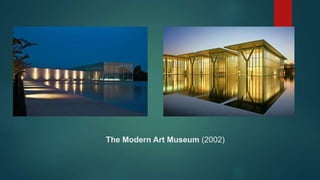
The Modern Art Museum (2002)
“What I have sought to achieve is a
spatiality that stimulates the human
spirit, awakens the sensitivity and
communicates with the deeper soul.”
– Tadao Ando
THANKYOU.

TADAO ANDO - ARCHITECT OF LIGHT

  • 1.
    TADAO ANDO THE ARCHITECTOF LIGHT NIDHI THIGALE S.Y. B.ARCH. PUNE.
  • 2.
    Tadao Ando  Bornin Osaka, Japan in 1941.  Is a self-taught architect.  Is inspired by the works of Le Corbusier and also considers Mies van der Rohe, Alvar Aalto, Frank Lloyd Wright and Louis Kahn  "I traced the drawings of his early period so many times, that all pages turned black” Awards :  The Pritzker Architecture Prize.  the gold medal of the French Academy.  plus numerous other medals and honorary fellow designations from Finland, the United States, and Great Britain.  He has every art and architecture prize his own country can bestow. Tadoa Ando
  • 3.
    Philosophy  “In allmy works, light is an important controlling factor.”  “I create enclosed spaces mainly by means of thick concrete walls.”  “When the external factors of a city’s environment require the wall to be without openings, the interior must be especially full and satisfying.”  “I create architectural order on the basis of geometry squares, circles, triangles and rectangles. I try to use forces in the area where I am building, to restore the unity between house and nature (light and wind).”
  • 4.
    Philosophy  Style -element of Light, Water, concrete and glass.  Simplified, rectilinear forms.  favors designing complex spatial circulation while maintaining the appearance of simplicity.  Bare concrete walls that define the spaces within.  Interior of the building are the form itself, ridicules the idea of masking it.
  • 5.
    Church of theLight, 1999. LOCATION: Ibaraki, Osaka, Japan CONTEXT:  Tightly-packed residential neighborhood  Very small space  Location influences form  L-shaped wall separates church from busy surrounding.  No good views, so the windows are minimal – only the distinctive narrow cross window and a window opening into the L-shaped wall
  • 6.
    Church of theLight Function: Chapel  Building is an addition to an earlier wooden structure
  • 7.
    Church of theLight  Entrance is from the back.  Must turn 180 degrees to face the front of the building
  • 8.
    Church of theLight: Form Form: Long, rectilinear plan  “The building can be described simply as a bare concrete box with a wall cutting through it at a 15 degree angle. “  Proportion: 1:3 – rectangle can hold 3 spheres, each 5.9 meters in diameter
  • 10.
    Amuza Housing  Location:Osaka, Japan  Area: 65 sq.m  Year of construction: 1975-1976
  • 11.
    Amuza Housing • Hisapproach was to connect the art of building with art of living. • He relates the form and compositional methods to the kind of life that that will be lived in the given space and regional society. • It is a narrow rectangular concrete block with living spaces surrounding the courtyard. • It depicts traditional Japanese life style connected with light ,air and rain and other natural elements Concept
  • 12.
    Amuza Housing Plan AndSection • Ground floor- living room, kitchen separated by a central courtyard and staircase. • Upper floor- two bedrooms joined by a central uncovered walkway which is the only source of light. Material – • Reinforced cement concrete used in the house is presented as the ornamentation of the façade.
  • 13.
  • 14.
    The Chichu ArtMuseum Location: Southern portion of the island of Naoshima, Japan Year of Construction: 2004 • Limiting the architecture to an underground structure • No external design rising out of the ground
  • 15.
    The Chichu ArtMuseum Concept  Why underground? The site is a place where national forest abounds and was a former salt field. Hence to preserve the existing atmosphere and beauty of the site the museum is wisely buried underground.  It is possible to create almost any form underground as there are no axes or directions as exist above ground, on earth  The outer expression of an underground building is invisible and, therefore, the obvious issues of form were not an issue.  Challenge was to achieve a highly complex and varied sequence of “lightscapes” within a configuration of simple, geometrical forms.  The museum was intended, holistically, to be visited with light as a guide.
  • 16.
    The Chichu ArtMuseum • ‘Chichu’ means ‘underground’ • Part of the Front lobby and access way are dark, but the ain exhibition space brings in natural light creatively throught the courtyards. • a series of small concrete openings and geometric skylights float among the greenery. • There are five galleries altogether , of various sizes and characters featuring the works of three artists – Claude Monet , Walter de Mari and James Turrell. • The triangular space connects the galleries of the three artists. • Inside the museum the visitors are constantly brought between light and darkness, between mass and void
  • 17.
    The Chichu ArtMuseum MATERIAL:  Concrete  Steel  Glass  Wood
  • 18.
    The Chichu ArtMuseum Internal Spaces
  • 19.
    Church on theWater Hokkaido (1985-88)
  • 20.
  • 21.
    The Modern ArtMuseum (2002)
  • 22.
    “What I havesought to achieve is a spatiality that stimulates the human spirit, awakens the sensitivity and communicates with the deeper soul.” – Tadao Ando
  • 23.