The Birth of Modernism, Jugendstil, and ExpressionismJoanna Nixon
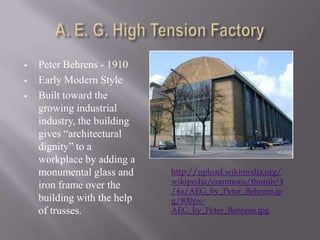
A. E. G. High Tension FactoryPeter Behrens - 1910
Early Modern Style
Built toward the growing industrial industry, the building gives “architectural dignity” to a workplace by adding a monumental glass and iron frame over the building with the help of trusses.http://upload.wikimedia.org/wikipedia/commons/thumb/4/4a/AEG_by_Peter_Behrens.jpg/800px-AEG_by_Peter_Behrens.jpg
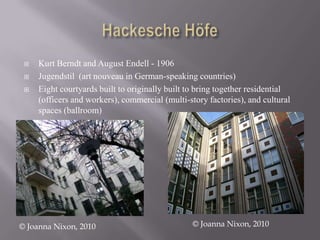
HackescheHöfeKurt Berndt and August Endell - 1906Jugendstil  (art nouveau in German-speaking countries) Eight courtyards built to originally built to bring together residential (officers and workers), commercial (multi-story factories), and cultural spaces (ballroom)© Joanna Nixon, 2010© Joanna Nixon, 2010
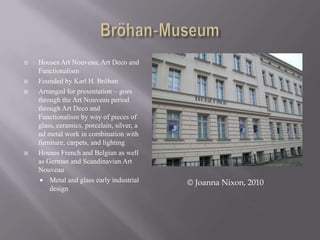
Bröhan‐MuseumHouses Art Nouveau, Art Deco and FunctionalismFounded by Karl H. BröhanArranged for presentation – goes through the Art Nouveau period through Art Deco and Functionalism by way of pieces of glass, ceramics, porcelain, silver, and metal work in combination with furniture, carpets, and lightingHouses French and Belgian as well as German and Scandinavian Art Nouveau Metal and glass early industrial design© Joanna Nixon, 2010
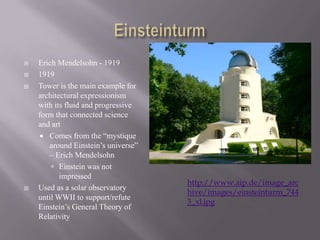
EinsteinturmErich Mendelsohn - 19191919Tower is the main example for architectural expressionism with its fluid and progressive form that connected science and artComes from the “mystique around Einstein’s universe” – Erich MendelsohnEinstein was not impressedUsed as a solar observatory until WWII to support/refute Einstein’s General Theory of Relativityhttp://www.aip.de/image_archive/images/einsteinturm_7443_xl.jpg
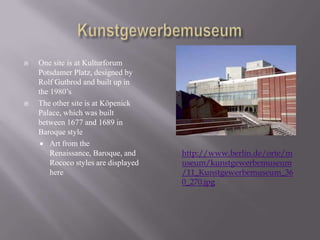
KunstgewerbemuseumOne site is at KulturforumPotsdamerPlatz, designed by Rolf Gutbrod and built up in the 1980’sThe other site is at Köpenick Palace, which was built between 1677 and 1689 in Baroque styleArt from the Renaissance, Baroque, and Rococo styles are displayed herehttp://www.berlin.de/orte/museum/kunstgewerbemuseum/11_Kunstgewerbemuseum_360_270.jpg
Works Citedhttp://www.greatbuildings.com/buildings/A._E._G._High_Tension_Fac.html
http://www.german-architecture.info/BER-001.htm
http://www.aviewoncities.com/berlin/hackeschehofe.htm
http://www.berlin.de/stadttouren/360/hackesche_hoefe/index.en.php
http://www.broehan-museum.de/en_museum.html
http://www.broehan-museum.de/infoseiten/a_en_artdeco.html
http://www.aip.de/einsteinturm/
http://atlasobscura.com/places/einsteinturm-0
http://www.smb.spk-berlin.de/smb/sammlungen/details.php?lang=en&objID=7
http://www.smb.museum/smb/standorte/index.php?lang=en&p=2&objID=6369&n=2&r=1
http://www.smb.spk-berlin.de/smb/sammlungen/details.php?lang=en&objID=18812
http://www.smb.spk-berlin.de/smb/kalender/details.php?objID=17482&lang=en&typeId=10
http://dictionary.reference.com/browse/faience+The Bauhaus and International StyleRicky Mastropole
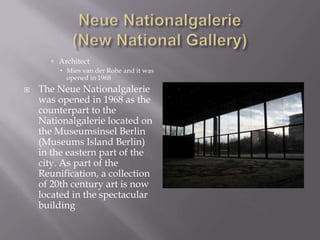
NeueNationalgalerie(New National Gallery) Architect Mies van derRohe and it was opened in 1968The NeueNationalgalerie was opened in 1968 as the counterpart to the Nationalgalerie located on the Museumsinsel Berlin (Museums Island Berlin) in the eastern part of the city. As part of the Reunification, a collection of 20th century art is now located in the spectacular building
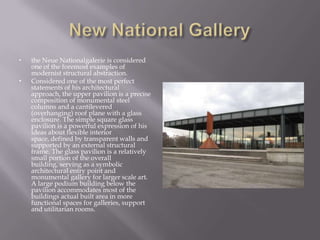
New National Gallerythe NeueNationalgalerie is considered one of the foremost examples of modernist structural abstraction.Considered one of the most perfect statements of his architectural approach, the upper pavilion is a precise composition of monumental steel columns and a cantilevered (overhanging) roof plane with a glass enclosure. The simple square glass pavilion is a powerful expression of his ideas about flexible interior space, defined by transparent walls and supported by an external structural frame. The glass pavilion is a relatively small portion of the overall building, serving as a symbolic architectural entry point and monumental gallery for larger scale art. A large podium building below the pavilion accommodates most of the buildings actual built area in more functional spaces for galleries, support and utilitarian rooms.
The Bauhaus Founded by Walter Gropius who was an architect, but nothing seems to say whether or not he actually designed the buildingAlthough neither the Nazi Party nor Hitler himself had a cohesive architectural policy before they came to power in 1933, Nazi writers like Wilhelm Frick and Alfred Rosenberg had already labeled the Bauhaus "un-German" and criticized its modernist styles, deliberately generating public controversy over issues like flat roofs. Increasingly through the early 1930s, they characterized the Bauhaus as a front for communists and social liberals. Indeed, a number of communist students loyal to Meyer moved to the Soviet Union when he was fired in 1930.Even before the Nazis came to power, political pressure on Bauhaus had increased. But the Nazi regime was determined to crack down on what it saw as the foreign, probably Jewish influences of "cosmopolitan modernism." Despite Gropius's protestations that as a war veteran and a patriot his work had no subversive political intent, the Berlin Bauhaus was pressured to close in April 1933.
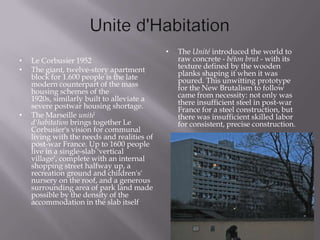
However, the most important influence on Bauhaus was modernism, a cultural movement whose origins lay as far back as the 1880s, and which had already made its presence felt in Germany  before the World War, despite the prevailing conservatism. The design innovations commonly associated with Gropius and the Bauhaus—the radically simplified forms, the rationality and functionality, and the idea that mass-production was reconcilable with the individual artistic spirit—were already partly developed in Germany before the Bauhaus was founded. Unite d'HabitationLe Corbusier 1952

Modernism And Post Modernism

  • 1.
    The Birth ofModernism, Jugendstil, and ExpressionismJoanna Nixon
  • 2.
    A. E. G.High Tension FactoryPeter Behrens - 1910
  • 3.
  • 4.
    Built toward thegrowing industrial industry, the building gives “architectural dignity” to a workplace by adding a monumental glass and iron frame over the building with the help of trusses.http://upload.wikimedia.org/wikipedia/commons/thumb/4/4a/AEG_by_Peter_Behrens.jpg/800px-AEG_by_Peter_Behrens.jpg
  • 5.
    HackescheHöfeKurt Berndt andAugust Endell - 1906Jugendstil (art nouveau in German-speaking countries) Eight courtyards built to originally built to bring together residential (officers and workers), commercial (multi-story factories), and cultural spaces (ballroom)© Joanna Nixon, 2010© Joanna Nixon, 2010
  • 6.
    Bröhan‐MuseumHouses Art Nouveau,Art Deco and FunctionalismFounded by Karl H. BröhanArranged for presentation – goes through the Art Nouveau period through Art Deco and Functionalism by way of pieces of glass, ceramics, porcelain, silver, and metal work in combination with furniture, carpets, and lightingHouses French and Belgian as well as German and Scandinavian Art Nouveau Metal and glass early industrial design© Joanna Nixon, 2010
  • 7.
    EinsteinturmErich Mendelsohn -19191919Tower is the main example for architectural expressionism with its fluid and progressive form that connected science and artComes from the “mystique around Einstein’s universe” – Erich MendelsohnEinstein was not impressedUsed as a solar observatory until WWII to support/refute Einstein’s General Theory of Relativityhttp://www.aip.de/image_archive/images/einsteinturm_7443_xl.jpg
  • 8.
    KunstgewerbemuseumOne site isat KulturforumPotsdamerPlatz, designed by Rolf Gutbrod and built up in the 1980’sThe other site is at Köpenick Palace, which was built between 1677 and 1689 in Baroque styleArt from the Renaissance, Baroque, and Rococo styles are displayed herehttp://www.berlin.de/orte/museum/kunstgewerbemuseum/11_Kunstgewerbemuseum_360_270.jpg
  • 9.
  • 10.
  • 11.
  • 12.
  • 13.
  • 14.
  • 15.
  • 16.
  • 17.
  • 18.
  • 19.
  • 20.
  • 21.
  • 22.
    NeueNationalgalerie(New National Gallery)Architect Mies van derRohe and it was opened in 1968The NeueNationalgalerie was opened in 1968 as the counterpart to the Nationalgalerie located on the Museumsinsel Berlin (Museums Island Berlin) in the eastern part of the city. As part of the Reunification, a collection of 20th century art is now located in the spectacular building
  • 23.
    New National GallerytheNeueNationalgalerie is considered one of the foremost examples of modernist structural abstraction.Considered one of the most perfect statements of his architectural approach, the upper pavilion is a precise composition of monumental steel columns and a cantilevered (overhanging) roof plane with a glass enclosure. The simple square glass pavilion is a powerful expression of his ideas about flexible interior space, defined by transparent walls and supported by an external structural frame. The glass pavilion is a relatively small portion of the overall building, serving as a symbolic architectural entry point and monumental gallery for larger scale art. A large podium building below the pavilion accommodates most of the buildings actual built area in more functional spaces for galleries, support and utilitarian rooms.
  • 24.
    The Bauhaus Foundedby Walter Gropius who was an architect, but nothing seems to say whether or not he actually designed the buildingAlthough neither the Nazi Party nor Hitler himself had a cohesive architectural policy before they came to power in 1933, Nazi writers like Wilhelm Frick and Alfred Rosenberg had already labeled the Bauhaus "un-German" and criticized its modernist styles, deliberately generating public controversy over issues like flat roofs. Increasingly through the early 1930s, they characterized the Bauhaus as a front for communists and social liberals. Indeed, a number of communist students loyal to Meyer moved to the Soviet Union when he was fired in 1930.Even before the Nazis came to power, political pressure on Bauhaus had increased. But the Nazi regime was determined to crack down on what it saw as the foreign, probably Jewish influences of "cosmopolitan modernism." Despite Gropius's protestations that as a war veteran and a patriot his work had no subversive political intent, the Berlin Bauhaus was pressured to close in April 1933.
  • 25.
    However, the mostimportant influence on Bauhaus was modernism, a cultural movement whose origins lay as far back as the 1880s, and which had already made its presence felt in Germany  before the World War, despite the prevailing conservatism. The design innovations commonly associated with Gropius and the Bauhaus—the radically simplified forms, the rationality and functionality, and the idea that mass-production was reconcilable with the individual artistic spirit—were already partly developed in Germany before the Bauhaus was founded. Unite d'HabitationLe Corbusier 1952