INTERNATIONAL BUSINESS
INTRODUCTION, NATURE AND SCOPE
Submitted By:
Deepak Tushir (30615210001)
Dheeraj Rawal (30615210002)
Gaurav Saroha (30615210003)
BBA (IIIrd Year)
Submitted To:
Mrs. Deepshikha Sharma
Assistant Professor
OVERVIEW
• INTRODUCTION
• NATURE OF INTERNATIONAL BUSINES
• BENEFITS OF INTERNATIONAL BUSINESS
• PROBLEMS IN INTERNATIONAL BUSINESS
• WHY INTERNATIONAL BUSINESS?
• SCOPE OF INTERNATIONAL BUSINESS
• ENTRY STRATEGY
INTRODUCTION
Ordinary,
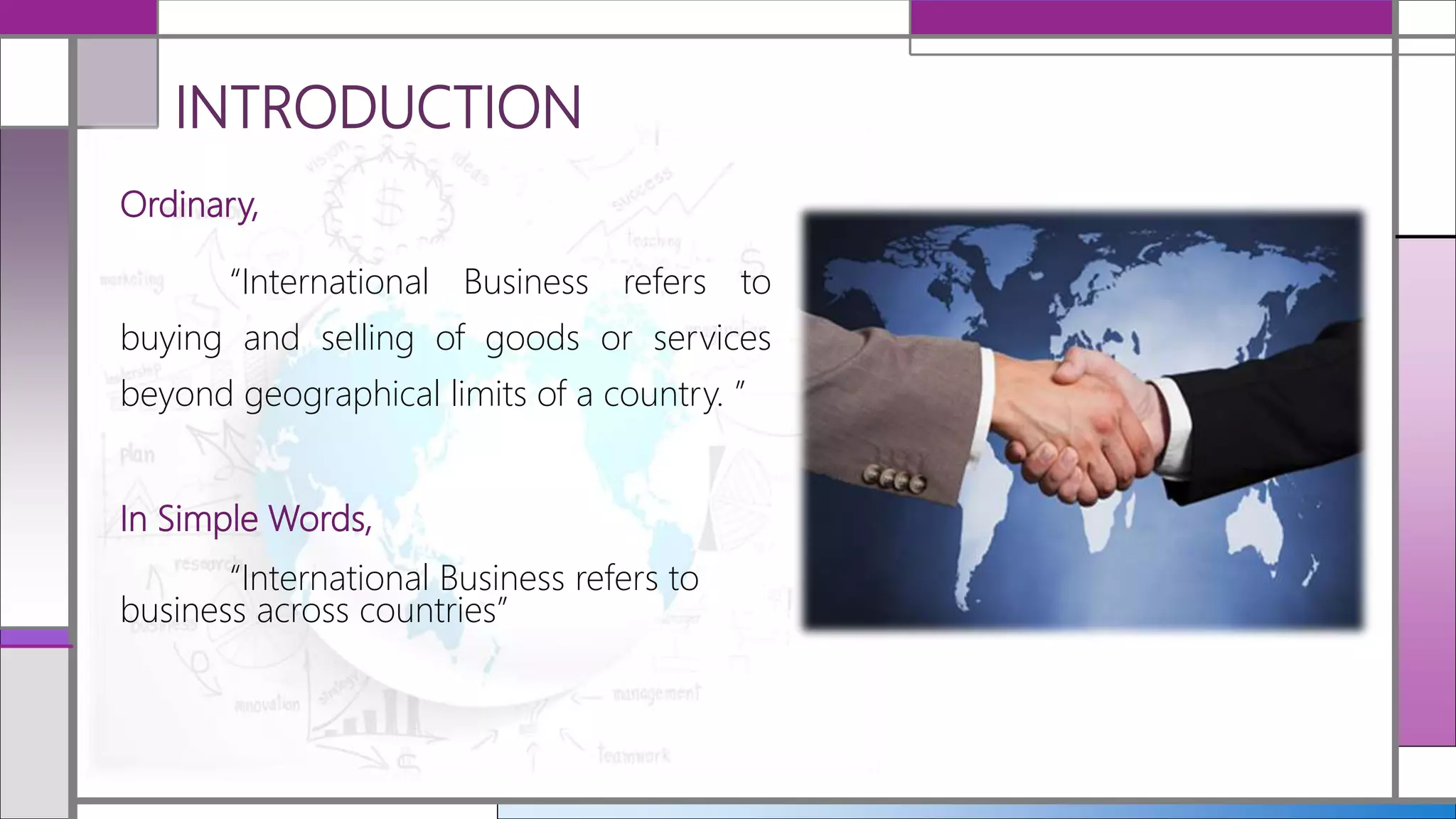
“International Business refers to
buying and selling of goods or services
beyond geographical limits of a country. ”
In Simple Words,
“International Business refers to
business across countries”
NATURE OF INTERNATIONAL BUSINESS
Accurate and Timely Information Available
The Size of International Business
Market Segmentation
International Market have more potential then Domestic Market
OPTIONS FOR DOING INTERNATIONAL BUSINESS
 Exporting goods and services.
 Giving license to produce goods in
the host country.
 Starting a joint venture with a
company.
 Opening a branch for producing &
distributing goods in the host
country.
 Providing managerial services to
companies in the host country.
BENEFITS OF INTERNATIONAL BUSINESS
Large Scale Operations
Integration of Economies of Many Countries
Keen Competition
Dominated by Developed Countries & MNC’s
Benefits to Participating Countries
Special Role of Science and Technology
PROBLEMS IN INTERNATIONAL BUSINESS
Different Currencies, Languages and Culture
High Foreign Investment and High Cost
Corruption and Bureaucracy
Entry Requirements Laws and Regulations
Tariff, Quotas, Varying Trade Policies etc.
Exchange Instability
WHY INTERNATIONAL BUSINESS
To Export Surplus Stock
To Explore Growth Opportunity
To Increase Profitability
To Reduce Cost of Inputs
To Achieve Economies of Scale
To Overcome Competition
To Circumvent Rigid Laws
To Secure Advanced Technology
To Obtain much Needed Foreign Capital
To Generate Employment
To Spur Innovation
To Raise Standards of Living
SCOPE
OF
INTERNATIONAL
BUSINESS
Export Business
• Domestic Firms which produce entirely in the home country and export a part of their output directly or through
in International County.
International Firm
• Such a firm, decides to exploit business opportunities outside the home country. It locates its branch in foreign market and
uses the domestic marketing mix abroad.
Multinational Firm
• An international firm turns into a multinational firm when it responds to specific needs of foreign markets in terms of
product, promotion and distribution. Different Strategies for different markets.
Global Firm
• A global firm also has business operations in several countries but there is coordination between different subsidiaries
operate under a common strategy. The subsidiaries are bound by global strategy decided by the parent company.
Transnational Firm
• A transnational firm produces, markets, invest and operates across the globe. It is an integrated global enterprise which
thinks globally but acts locally.
Into International Business
1. LICENSING
For Example:
In the global strategy, a firm (Licensor) allows a
foreign company (Licensee) to produce its product in
exchange for a fee(loyalty). The licensor usually helps
the licensee in setting up production and also in
distribution and promotion.
Licensing enables the firm to earn revenues which
could not be generated in home market.
Corporation entered the Indian
Market initially through licensing.
2. EXPORTING
A firm may export directly or through export house.
An export house matches importers and exporters
and also deals with customs office, documentation
etc.
Exporting requires no investment abroad.
It is a low cost and low risk of doing international
business.
Exports face tariff and non tariff barriers.
Intensive Marketing is needed to succeed in exports.
The exports gets payment quickly.
3. FRANCHISING
For Example:
Franchising is a contractual agreement under which
one party(franchiser) sells the other party(franchisee)
the right to use the former’s business name and sell
the product service in a given territory in a specified
manner.
Franchising enables a firm to enter foreign market
without making investment and without assuming
huge risk. The franchisee bears the cost of
operations. The franchisor gets royalty.
Jubilant Food works is the franchisee of
in India.
4. CONTRACT MANUFACTURING
For Example:
In contract manufacturing the company attaches its brand
name or trade make to goods produced by a foreign
company.
Company manufacturing enables a company to enter a
foreign market without investing in manufacturing or
marketing.
The company can also use contract manufacturing to
meet a temporary increase in sales
Labour costs are low.
has more than 700 contract factories
around the world that manufacture its
footwear and apparel.
5. JOINT VENTURES AND STRATEGIC ALLIANCES
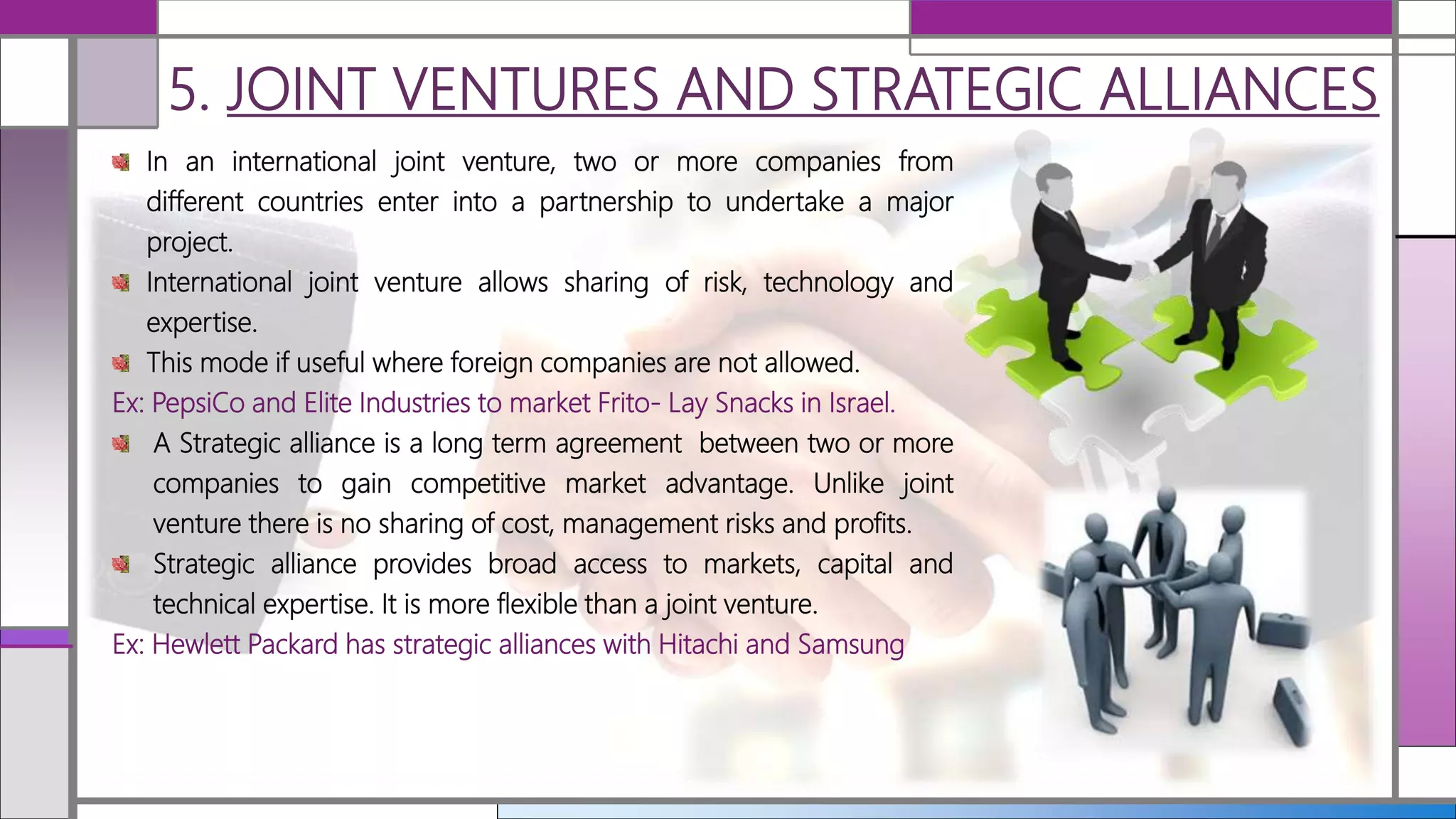
In an international joint venture, two or more companies from
different countries enter into a partnership to undertake a major
project.
International joint venture allows sharing of risk, technology and
expertise.
This mode if useful where foreign companies are not allowed.
Ex: PepsiCo and Elite Industries to market Frito- Lay Snacks in Israel.
A Strategic alliance is a long term agreement between two or more
companies to gain competitive market advantage. Unlike joint
venture there is no sharing of cost, management risks and profits.
Strategic alliance provides broad access to markets, capital and
technical expertise. It is more flexible than a joint venture.
Ex: Hewlett Packard has strategic alliances with Hitachi and Samsung
6. FOREIGN DIRECT INVESTMENT (FDI)
FDI is the buying of property and business in foreign
countries.
The most common form of FDI is a foreign subsidiary.
The subsidiary operates like a domestic firm with
production and distribution functions.
It has to observe the laws of both home country and
host country.
Foreign Subsidiary allows complete control over
technology and expertise.
It requires high investment and involves risk.
Thank you……
Presented By:
Dheeraj Rawal
30615210002
Bachelor of Business Administration

International Business Introduction, Nature and Scope

  • 1.
    INTERNATIONAL BUSINESS INTRODUCTION, NATUREAND SCOPE Submitted By: Deepak Tushir (30615210001) Dheeraj Rawal (30615210002) Gaurav Saroha (30615210003) BBA (IIIrd Year) Submitted To: Mrs. Deepshikha Sharma Assistant Professor
  • 2.
    OVERVIEW • INTRODUCTION • NATUREOF INTERNATIONAL BUSINES • BENEFITS OF INTERNATIONAL BUSINESS • PROBLEMS IN INTERNATIONAL BUSINESS • WHY INTERNATIONAL BUSINESS? • SCOPE OF INTERNATIONAL BUSINESS • ENTRY STRATEGY
  • 3.
    INTRODUCTION Ordinary, “International Business refersto buying and selling of goods or services beyond geographical limits of a country. ” In Simple Words, “International Business refers to business across countries”
  • 4.
    NATURE OF INTERNATIONALBUSINESS Accurate and Timely Information Available The Size of International Business Market Segmentation International Market have more potential then Domestic Market
  • 5.
    OPTIONS FOR DOINGINTERNATIONAL BUSINESS  Exporting goods and services.  Giving license to produce goods in the host country.  Starting a joint venture with a company.  Opening a branch for producing & distributing goods in the host country.  Providing managerial services to companies in the host country.
  • 6.
    BENEFITS OF INTERNATIONALBUSINESS Large Scale Operations Integration of Economies of Many Countries Keen Competition Dominated by Developed Countries & MNC’s Benefits to Participating Countries Special Role of Science and Technology
  • 7.
    PROBLEMS IN INTERNATIONALBUSINESS Different Currencies, Languages and Culture High Foreign Investment and High Cost Corruption and Bureaucracy Entry Requirements Laws and Regulations Tariff, Quotas, Varying Trade Policies etc. Exchange Instability
  • 8.
    WHY INTERNATIONAL BUSINESS ToExport Surplus Stock To Explore Growth Opportunity To Increase Profitability To Reduce Cost of Inputs To Achieve Economies of Scale To Overcome Competition To Circumvent Rigid Laws To Secure Advanced Technology To Obtain much Needed Foreign Capital To Generate Employment To Spur Innovation To Raise Standards of Living
  • 9.
  • 10.
    Export Business • DomesticFirms which produce entirely in the home country and export a part of their output directly or through in International County. International Firm • Such a firm, decides to exploit business opportunities outside the home country. It locates its branch in foreign market and uses the domestic marketing mix abroad. Multinational Firm • An international firm turns into a multinational firm when it responds to specific needs of foreign markets in terms of product, promotion and distribution. Different Strategies for different markets. Global Firm • A global firm also has business operations in several countries but there is coordination between different subsidiaries operate under a common strategy. The subsidiaries are bound by global strategy decided by the parent company. Transnational Firm • A transnational firm produces, markets, invest and operates across the globe. It is an integrated global enterprise which thinks globally but acts locally.
  • 11.
  • 12.
    1. LICENSING For Example: Inthe global strategy, a firm (Licensor) allows a foreign company (Licensee) to produce its product in exchange for a fee(loyalty). The licensor usually helps the licensee in setting up production and also in distribution and promotion. Licensing enables the firm to earn revenues which could not be generated in home market. Corporation entered the Indian Market initially through licensing.
  • 13.
    2. EXPORTING A firmmay export directly or through export house. An export house matches importers and exporters and also deals with customs office, documentation etc. Exporting requires no investment abroad. It is a low cost and low risk of doing international business. Exports face tariff and non tariff barriers. Intensive Marketing is needed to succeed in exports. The exports gets payment quickly.
  • 14.
    3. FRANCHISING For Example: Franchisingis a contractual agreement under which one party(franchiser) sells the other party(franchisee) the right to use the former’s business name and sell the product service in a given territory in a specified manner. Franchising enables a firm to enter foreign market without making investment and without assuming huge risk. The franchisee bears the cost of operations. The franchisor gets royalty. Jubilant Food works is the franchisee of in India.
  • 15.
    4. CONTRACT MANUFACTURING ForExample: In contract manufacturing the company attaches its brand name or trade make to goods produced by a foreign company. Company manufacturing enables a company to enter a foreign market without investing in manufacturing or marketing. The company can also use contract manufacturing to meet a temporary increase in sales Labour costs are low. has more than 700 contract factories around the world that manufacture its footwear and apparel.
  • 16.
    5. JOINT VENTURESAND STRATEGIC ALLIANCES In an international joint venture, two or more companies from different countries enter into a partnership to undertake a major project. International joint venture allows sharing of risk, technology and expertise. This mode if useful where foreign companies are not allowed. Ex: PepsiCo and Elite Industries to market Frito- Lay Snacks in Israel. A Strategic alliance is a long term agreement between two or more companies to gain competitive market advantage. Unlike joint venture there is no sharing of cost, management risks and profits. Strategic alliance provides broad access to markets, capital and technical expertise. It is more flexible than a joint venture. Ex: Hewlett Packard has strategic alliances with Hitachi and Samsung
  • 17.
    6. FOREIGN DIRECTINVESTMENT (FDI) FDI is the buying of property and business in foreign countries. The most common form of FDI is a foreign subsidiary. The subsidiary operates like a domestic firm with production and distribution functions. It has to observe the laws of both home country and host country. Foreign Subsidiary allows complete control over technology and expertise. It requires high investment and involves risk.
  • 18.
    Thank you…… Presented By: DheerajRawal 30615210002 Bachelor of Business Administration