Introduction to Measurement
Developing Standard and Metric
Measuring Skills
Why Learn to Measure?
Valuable skill for a job
Valuable skill for hobbies
Valuable skill for every day life
Measurement Systems
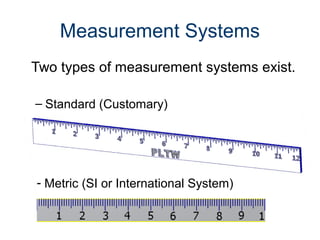
Two types of measurement systems exist.
– Standard (Customary)
- Metric (SI or International System)
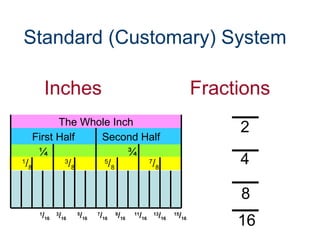
Standard (Customary) System
Inches Fractions
2
4
8
16
¼ ¾
The Whole Inch
First Half Second Half
1
/8
3
/8
5
/8
7
/8
1
/16
3
/16
5
/16
7
/16
9
/16
11
/16
13
/16
15
/16
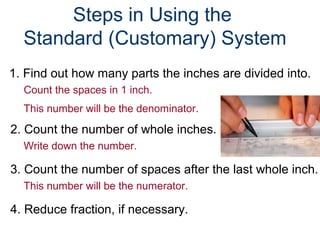
1. Find out how many parts the inches are divided into.
Count the spaces in 1 inch.
This number will be the denominator.
2. Count the number of whole inches.
Write down the number.
3. Count the number of spaces after the last whole inch.
This number will be the numerator.
4. Reduce fraction, if necessary.
Steps in Using the
Standard (Customary) System
Step 1
Step 2
Step 3
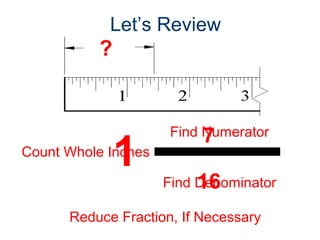
Find Denominator
Count Whole Inches
Find Numerator
Step 4Reduce Fraction, If Necessary
Let’s Review
16
7
1
Let’s Practice
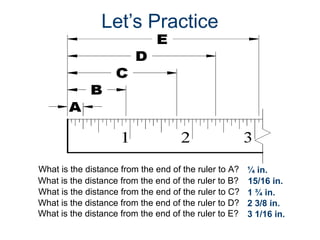
What is the distance from the end of the ruler to A?
What is the distance from the end of the ruler to E?
What is the distance from the end of the ruler to D?
What is the distance from the end of the ruler to C?
What is the distance from the end of the ruler to B?
¼ in.
15/16 in.
1 ¾ in.
2 3/8 in.
3 1/16 in.
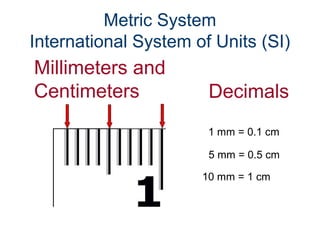
Metric System
International System of Units (SI)
Millimeters and
Centimeters Decimals
1 mm = 0.1 cm
5 mm = 0.5 cm
10 mm = 1 cm
Steps in Using the
Metric (SI) System
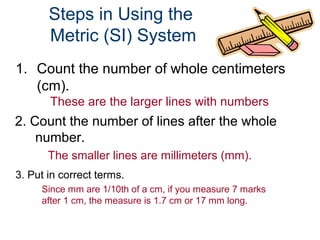
1. Count the number of whole centimeters
(cm).
These are the larger lines with numbers
2. Count the number of lines after the whole
number.
The smaller lines are millimeters (mm).
3. Put in correct terms.
Since mm are 1/10th of a cm, if you measure 7 marks
after 1 cm, the measure is 1.7 cm or 17 mm long.
Let’s Practice
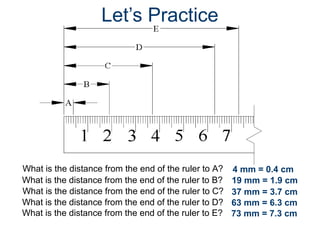
What is the distance from the end of the ruler to A?
What is the distance from the end of the ruler to E?
What is the distance from the end of the ruler to D?
What is the distance from the end of the ruler to C?
What is the distance from the end of the ruler to B?
4 mm = 0.4 cm
19 mm = 1.9 cm
37 mm = 3.7 cm
63 mm = 6.3 cm
73 mm = 7.3 cm
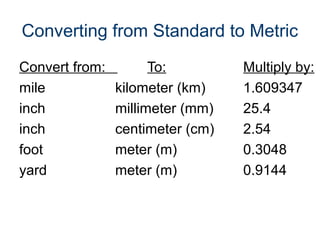
Converting from Standard to Metric
Convert from: To: Multiply by:
mile kilometer (km) 1.609347
inch millimeter (mm) 25.4
inch centimeter (cm) 2.54
foot meter (m) 0.3048
yard meter (m) 0.9144
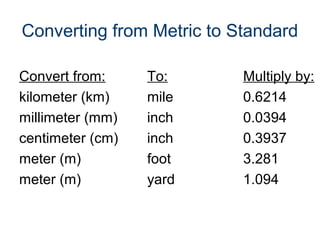
Converting from Metric to Standard
Convert from: To: Multiply by:
kilometer (km) mile 0.6214
millimeter (mm) inch 0.0394
centimeter (cm) inch 0.3937
meter (m) foot 3.281
meter (m) yard 1.094
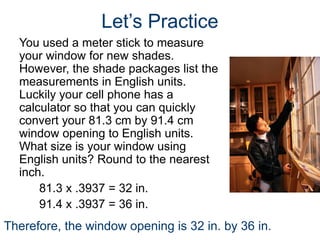
Let’s Practice
You used a meter stick to measure
your window for new shades.
However, the shade packages list the
measurements in English units.
Luckily your cell phone has a
calculator so that you can quickly
convert your 81.3 cm by 91.4 cm
window opening to English units.
What size is your window using
English units? Round to the nearest
inch.
81.3 x .3937 = 32 in.
91.4 x .3937 = 36 in.
Therefore, the window opening is 32 in. by 36 in.
Image Resources
Microsoft, Inc. (2008). Clip Art. Retrieved October 7, 2008, from
http://office.microsoft.com/en-us/clipart/default.aspx

Standard and-metric-measurement-power point

  • 1.
    Introduction to Measurement DevelopingStandard and Metric Measuring Skills
  • 2.
    Why Learn toMeasure? Valuable skill for a job Valuable skill for hobbies Valuable skill for every day life
  • 3.
    Measurement Systems Two typesof measurement systems exist. – Standard (Customary) - Metric (SI or International System)
  • 4.
    Standard (Customary) System InchesFractions 2 4 8 16 ¼ ¾ The Whole Inch First Half Second Half 1 /8 3 /8 5 /8 7 /8 1 /16 3 /16 5 /16 7 /16 9 /16 11 /16 13 /16 15 /16
  • 5.
    1. Find outhow many parts the inches are divided into. Count the spaces in 1 inch. This number will be the denominator. 2. Count the number of whole inches. Write down the number. 3. Count the number of spaces after the last whole inch. This number will be the numerator. 4. Reduce fraction, if necessary. Steps in Using the Standard (Customary) System
  • 6.
    Step 1 Step 2 Step3 Find Denominator Count Whole Inches Find Numerator Step 4Reduce Fraction, If Necessary Let’s Review 16 7 1
  • 7.
    Let’s Practice What isthe distance from the end of the ruler to A? What is the distance from the end of the ruler to E? What is the distance from the end of the ruler to D? What is the distance from the end of the ruler to C? What is the distance from the end of the ruler to B? ¼ in. 15/16 in. 1 ¾ in. 2 3/8 in. 3 1/16 in.
  • 8.
    Metric System International Systemof Units (SI) Millimeters and Centimeters Decimals 1 mm = 0.1 cm 5 mm = 0.5 cm 10 mm = 1 cm
  • 9.
    Steps in Usingthe Metric (SI) System 1. Count the number of whole centimeters (cm). These are the larger lines with numbers 2. Count the number of lines after the whole number. The smaller lines are millimeters (mm). 3. Put in correct terms. Since mm are 1/10th of a cm, if you measure 7 marks after 1 cm, the measure is 1.7 cm or 17 mm long.
  • 10.
    Let’s Practice What isthe distance from the end of the ruler to A? What is the distance from the end of the ruler to E? What is the distance from the end of the ruler to D? What is the distance from the end of the ruler to C? What is the distance from the end of the ruler to B? 4 mm = 0.4 cm 19 mm = 1.9 cm 37 mm = 3.7 cm 63 mm = 6.3 cm 73 mm = 7.3 cm
  • 11.
    Converting from Standardto Metric Convert from: To: Multiply by: mile kilometer (km) 1.609347 inch millimeter (mm) 25.4 inch centimeter (cm) 2.54 foot meter (m) 0.3048 yard meter (m) 0.9144
  • 12.
    Converting from Metricto Standard Convert from: To: Multiply by: kilometer (km) mile 0.6214 millimeter (mm) inch 0.0394 centimeter (cm) inch 0.3937 meter (m) foot 3.281 meter (m) yard 1.094
  • 13.
    Let’s Practice You useda meter stick to measure your window for new shades. However, the shade packages list the measurements in English units. Luckily your cell phone has a calculator so that you can quickly convert your 81.3 cm by 91.4 cm window opening to English units. What size is your window using English units? Round to the nearest inch. 81.3 x .3937 = 32 in. 91.4 x .3937 = 36 in. Therefore, the window opening is 32 in. by 36 in.
  • 14.
    Image Resources Microsoft, Inc.(2008). Clip Art. Retrieved October 7, 2008, from http://office.microsoft.com/en-us/clipart/default.aspx

Editor's Notes

  • #3 “Although you are probably familiar with rulers, yard sticks, tape rules, folding rules, and tape measures, you will also find rulers on many machines that you use such as saws, sewing machines, photocopiers, and computer scanners. Computer programs like Microsoft Word and Adobe PhotoShop have electronic rulers that you can turn on to help you with the exact placement of items. As you can tell, reading a ruler is a valuable skill that you will use almost every day both on and off the job.” http://www.rickyspears.com/rulergame/
  • #4 Three countries have not officially adopted the International System of Units as their primary or sole system of measurement: Liberia, Myanmar, and the United States. The U. S. has switched to Metric with Sporting Events - Olympics Military Medicine Scientific studies At this time, Manufacturing; Transportation; and Construction Industries; are primarily using the U.S. Customary system. In certain sectors, the conversion is obvious (i.e. – Automobiles). However, in these industry areas the changes have not been as complete. This is the reasoning for studying both measurement systems used in the United States.
  • #5 Notice that all denominators are even numbers. Therefore, if your numerator is also even, then your fraction can be reduced.
  • #9 The metric system is much easier to use than the English system because it was based on a decimal system (powers of ten). Therefore, you don't have to remember all the different conversions (16 ounces in a pound, 12 inches in a foot, and so on). You only have to remember a short list of prefixes that represent powers of ten. Common units for length, width, distance, thickness, girth, etc. are: Millimeter mm 10-3 10 mm = 1 cm Centimeter cm 10-2 100 cm = 10 dm = 1 m Decimeterdm 10-1 10 dm = 1 m    Kilometer km 103 1 km = 1000 m