Exploring open educational practices of first year
students at a South African university
Tabisa Mayisela
PhD candidate
AND
Digital literacy Coordinator
University of Cape Town
Outline
• Study background
• Problem statement
• Research approach
• Findings
• Conclusion and recommendations
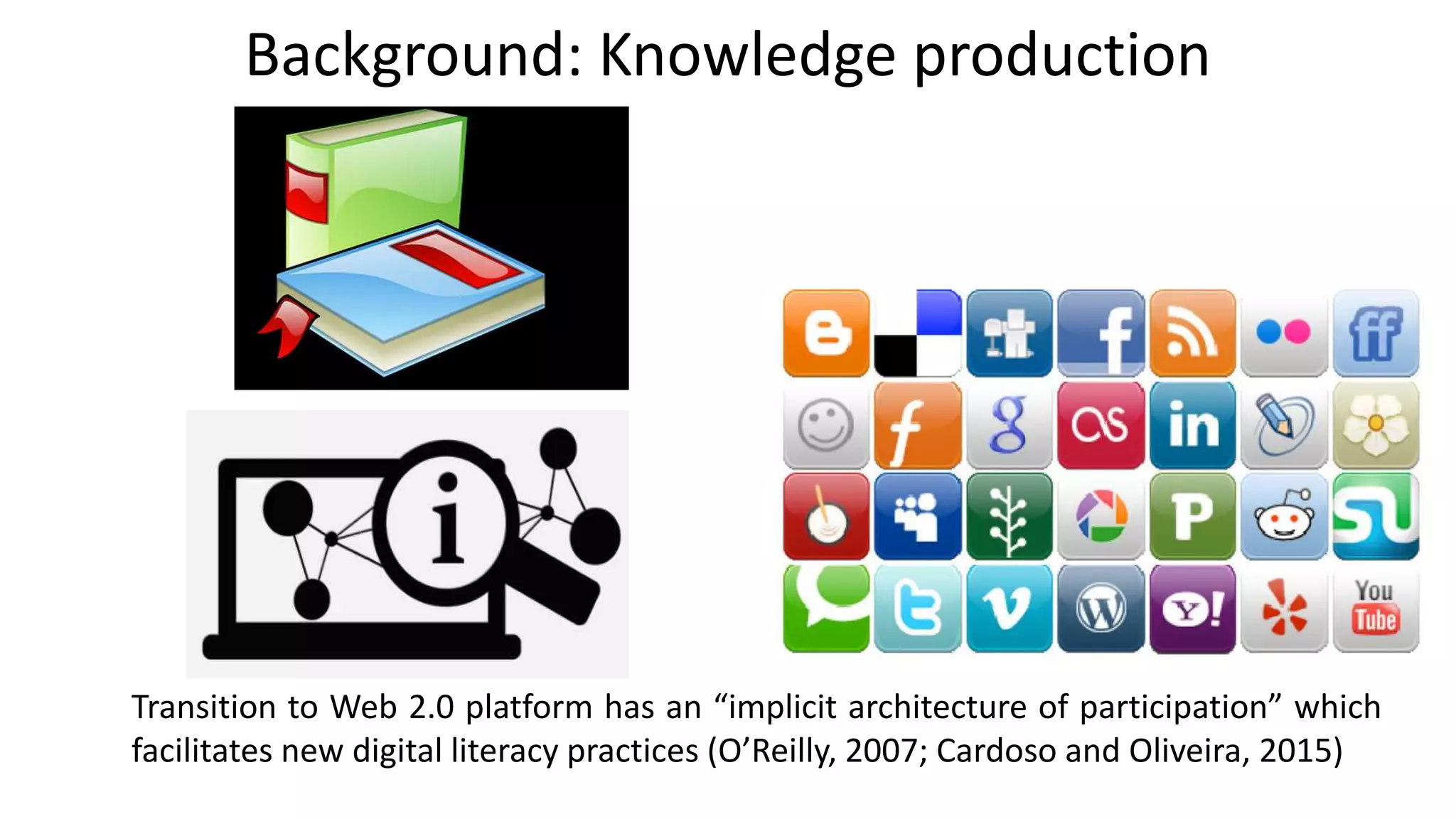
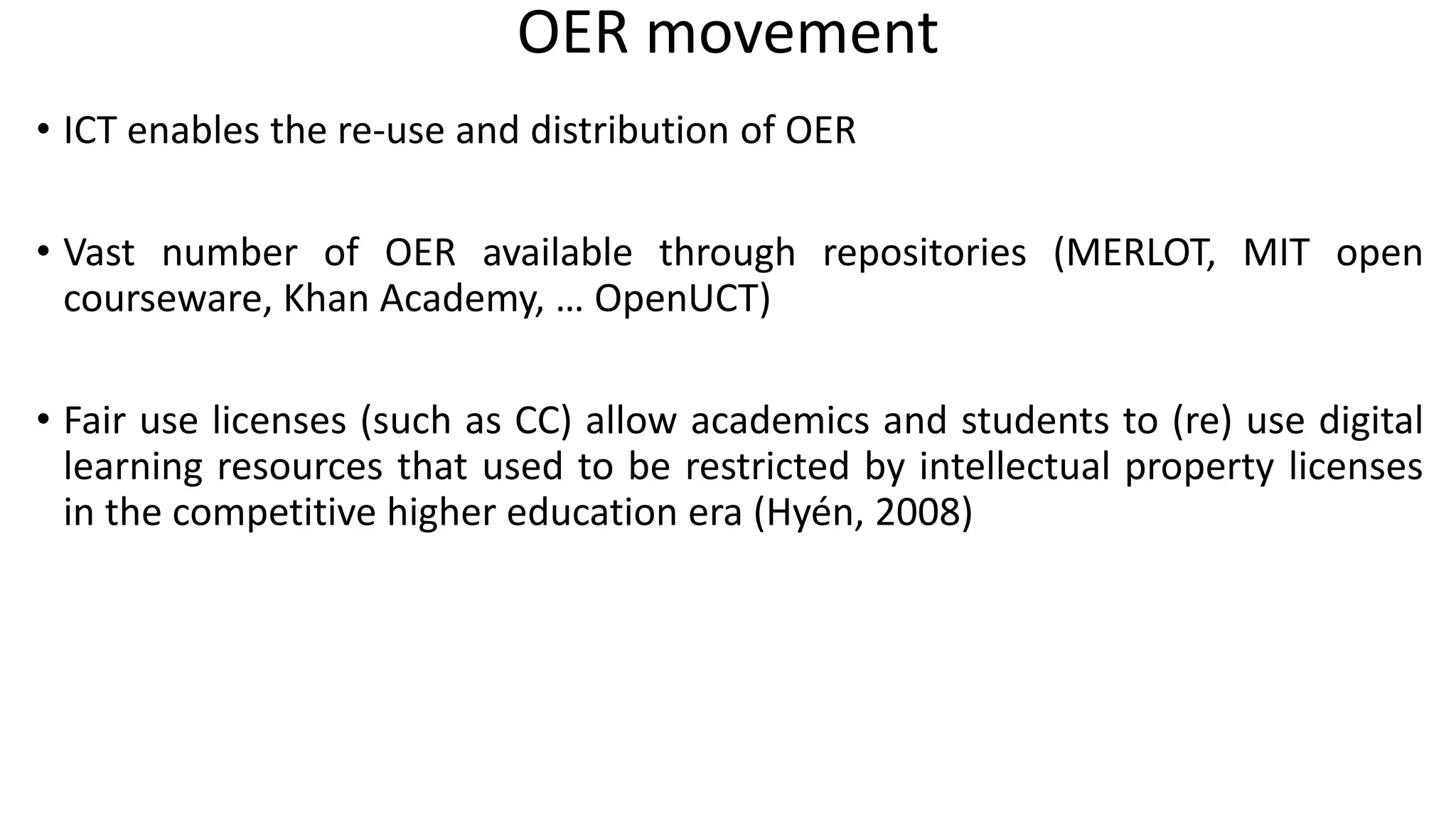
Transition to Web 2.0 platform has an “implicit architecture of participation” which
facilitates new digital literacy practices (O’Reilly, 2007; Cardoso and Oliveira, 2015)
Background: Knowledge production
OER movement
• ICT enables the re-use and distribution of OER
• Vast number of OER available through repositories (MERLOT, MIT open
courseware, Khan Academy, … OpenUCT)
• Fair use licenses (such as CC) allow academics and students to (re) use digital
learning resources that used to be restricted by intellectual property licenses
in the competitive higher education era (Hyén, 2008)
Statement of problem
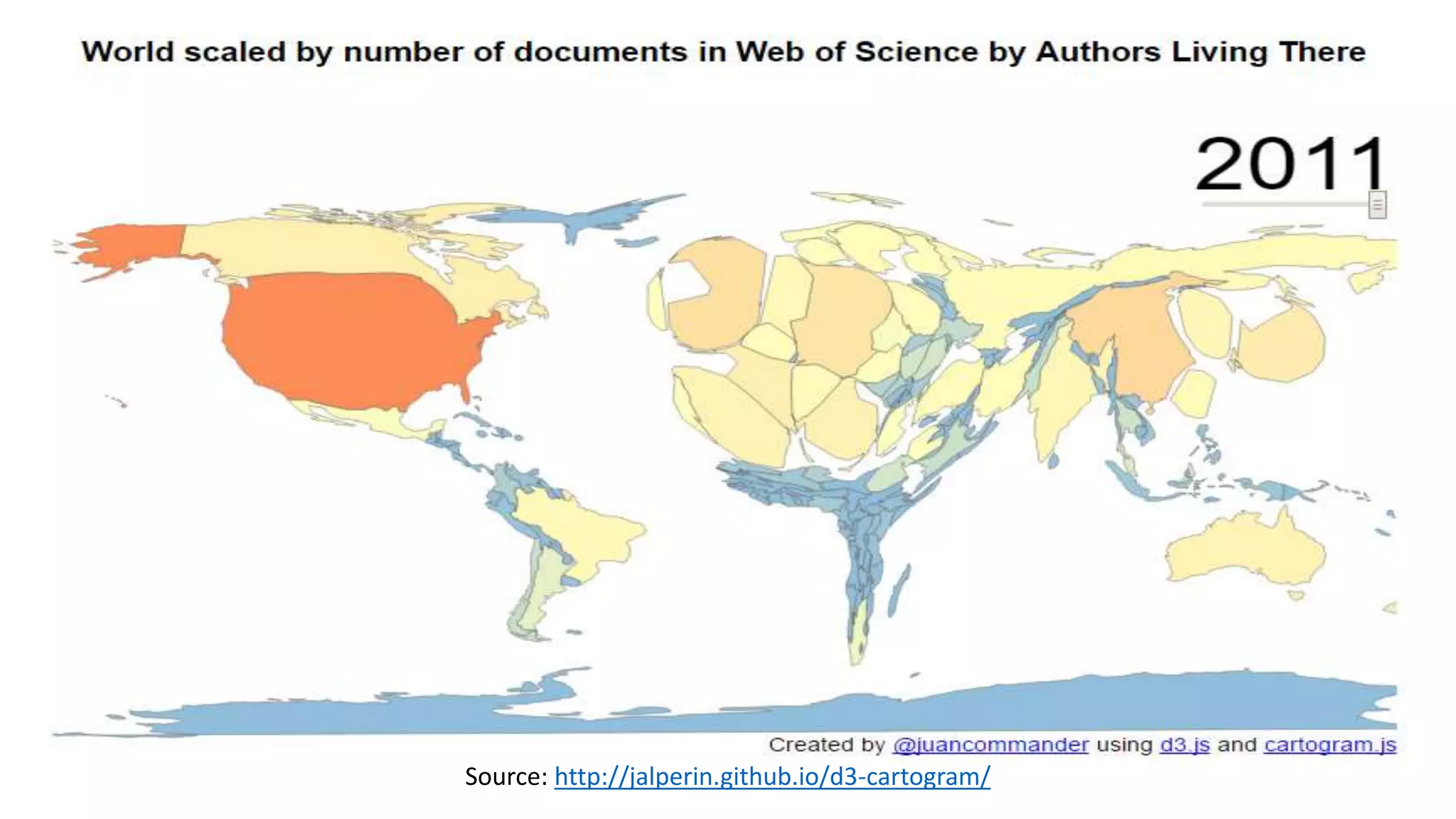
• South-North divide of knowledge publication where the global South
publishes less knowledge than the global North (Bautista, Duran-Martinez,
Sierra, & Snyder, 2013)
• Network analysis of shared global traffic between 1000 most popular
websites revealed that most were developed in the global North (Wu &
Taneja, 2016)
• Over the three intervals of study (2009, 2011 and 2013), users in the Global
South were primarily consuming rather than producing content (Wu & Taneja,
2016)
Source: http://jalperin.github.io/d3-cartogram/
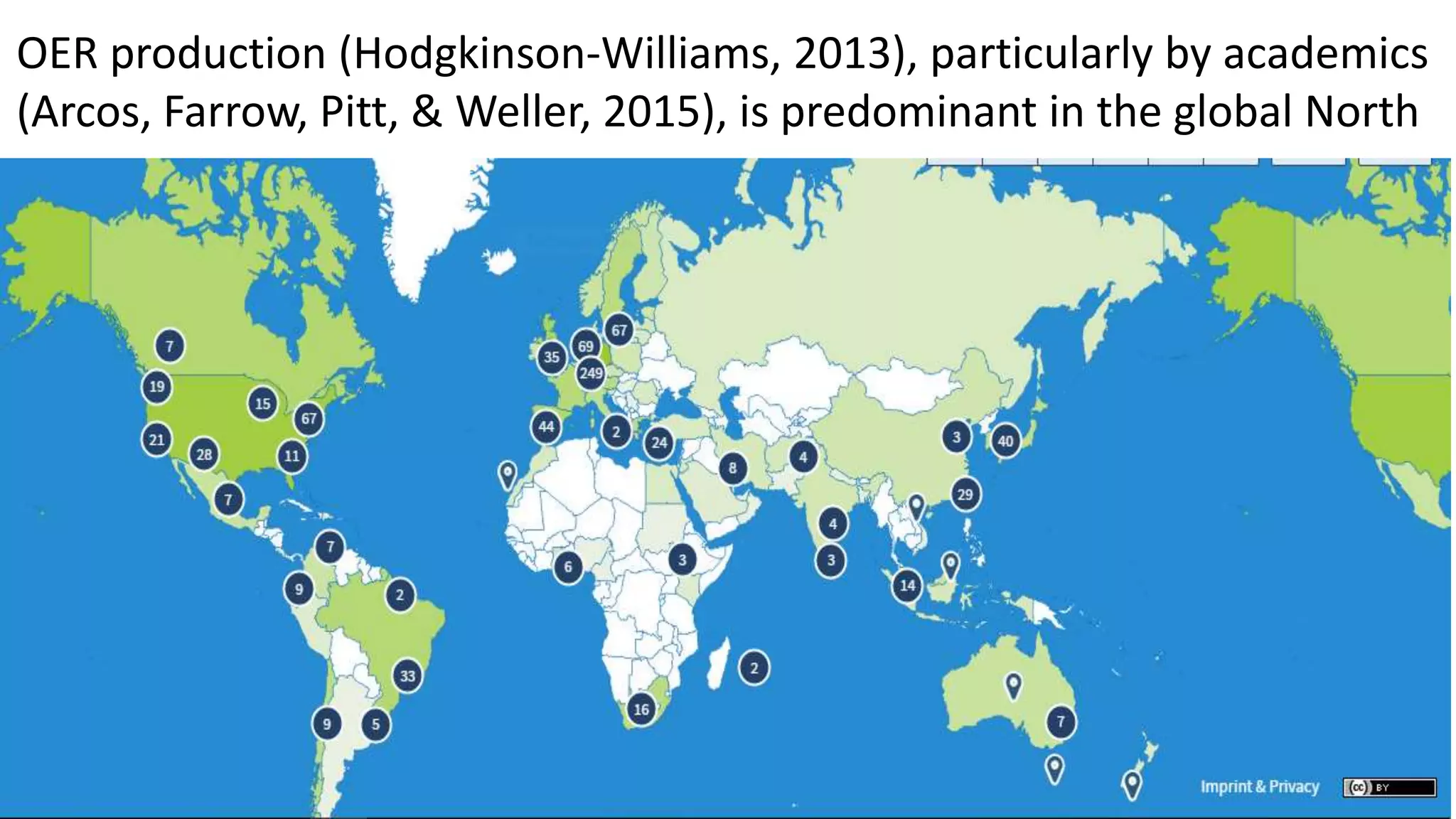
OER production (Hodgkinson-Williams, 2013), particularly by academics
(Arcos, Farrow, Pitt, & Weller, 2015), is predominant in the global North
Open educational practices
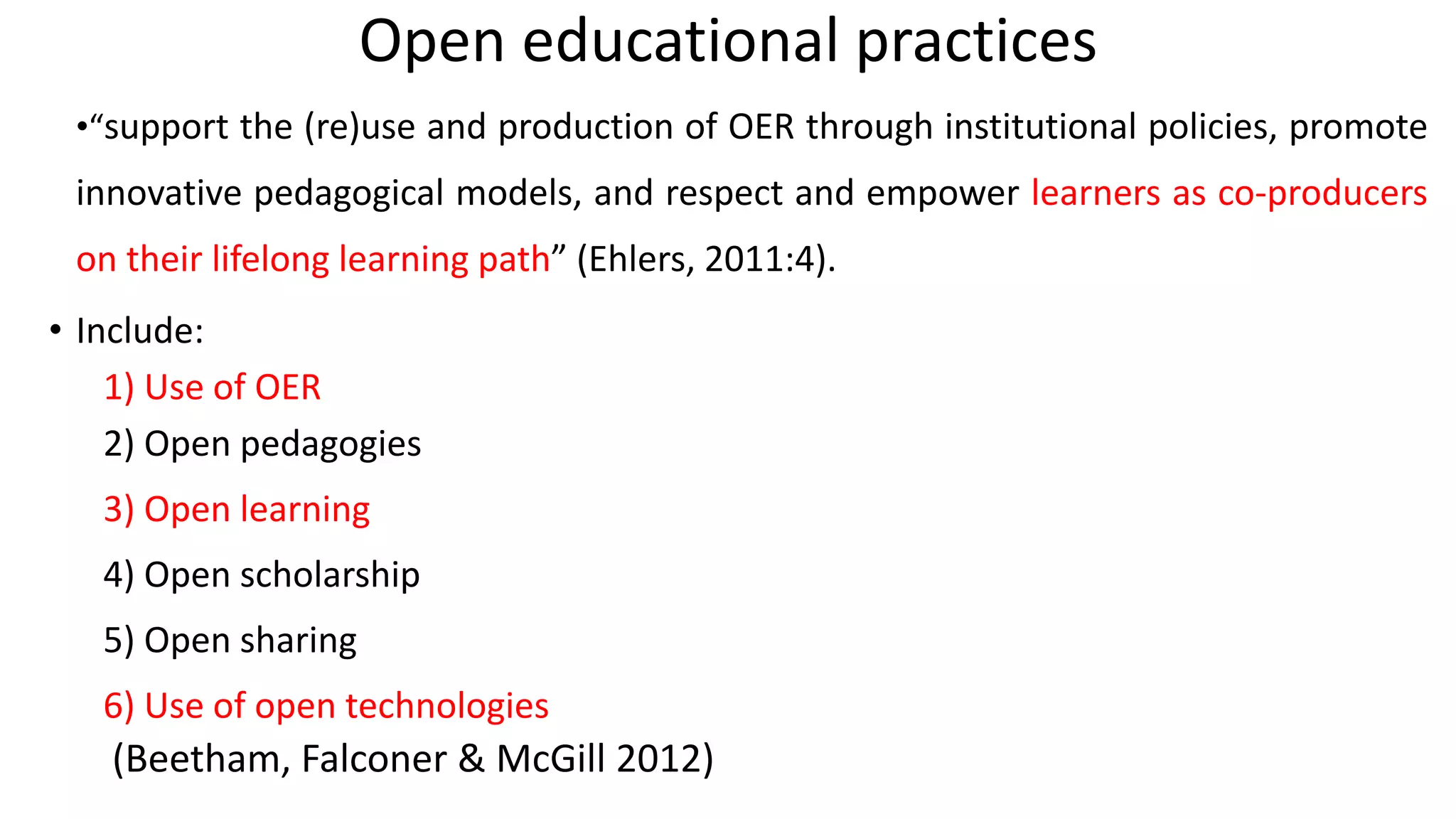
•“support the (re)use and production of OER through institutional policies, promote
innovative pedagogical models, and respect and empower learners as co-producers
on their lifelong learning path” (Ehlers, 2011:4).
• Include:
1) Use of OER
2) Open pedagogies
3) Open learning
4) Open scholarship
5) Open sharing
6) Use of open technologies
(Beetham, Falconer & McGill 2012)
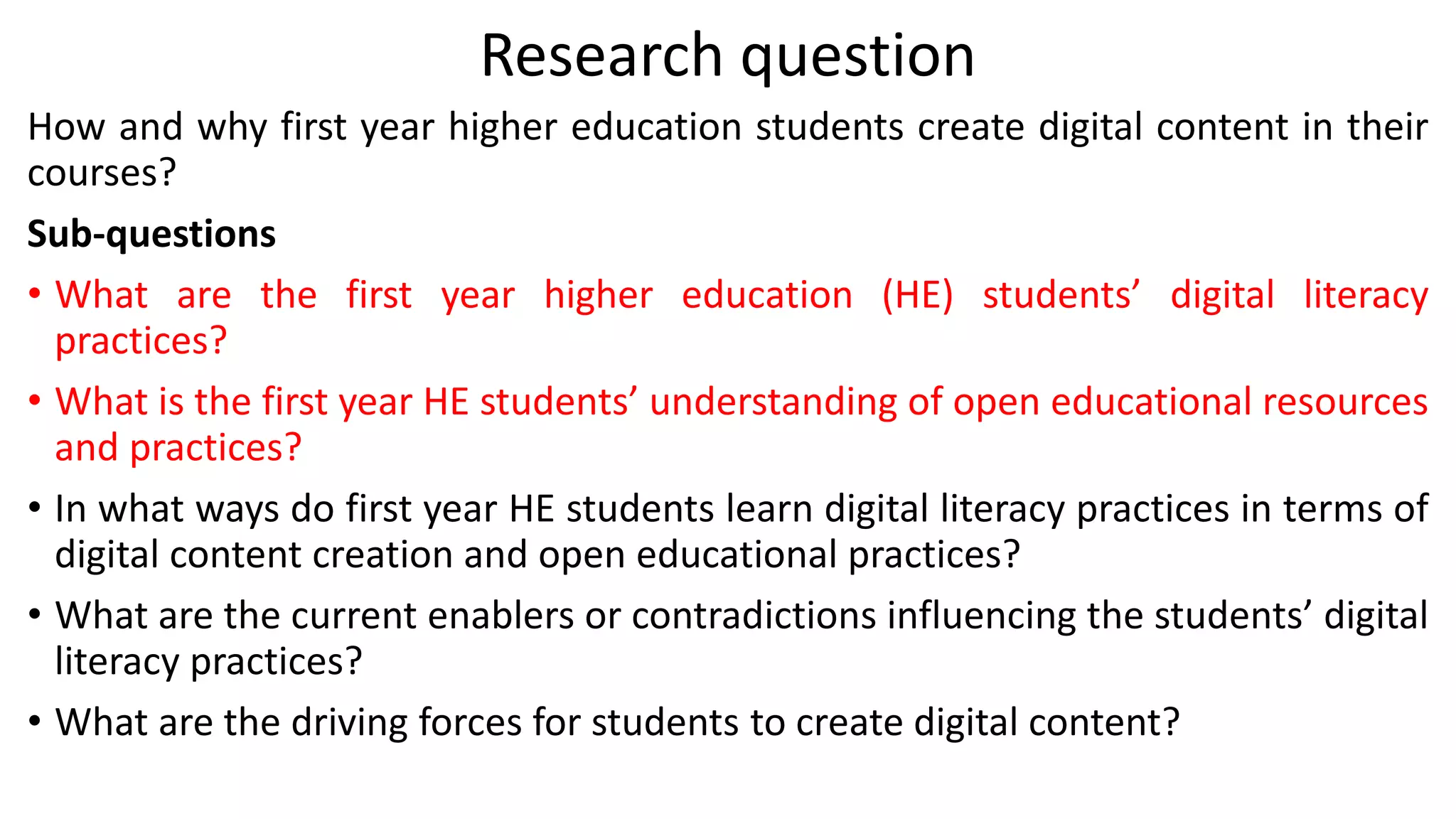
Research question
How and why first year higher education students create digital content in their
courses?
Sub-questions
• What are the first year higher education (HE) students’ digital literacy
practices?
• What is the first year HE students’ understanding of open educational resources
and practices?
• In what ways do first year HE students learn digital literacy practices in terms of
digital content creation and open educational practices?
• What are the current enablers or contradictions influencing the students’ digital
literacy practices?
• What are the driving forces for students to create digital content?
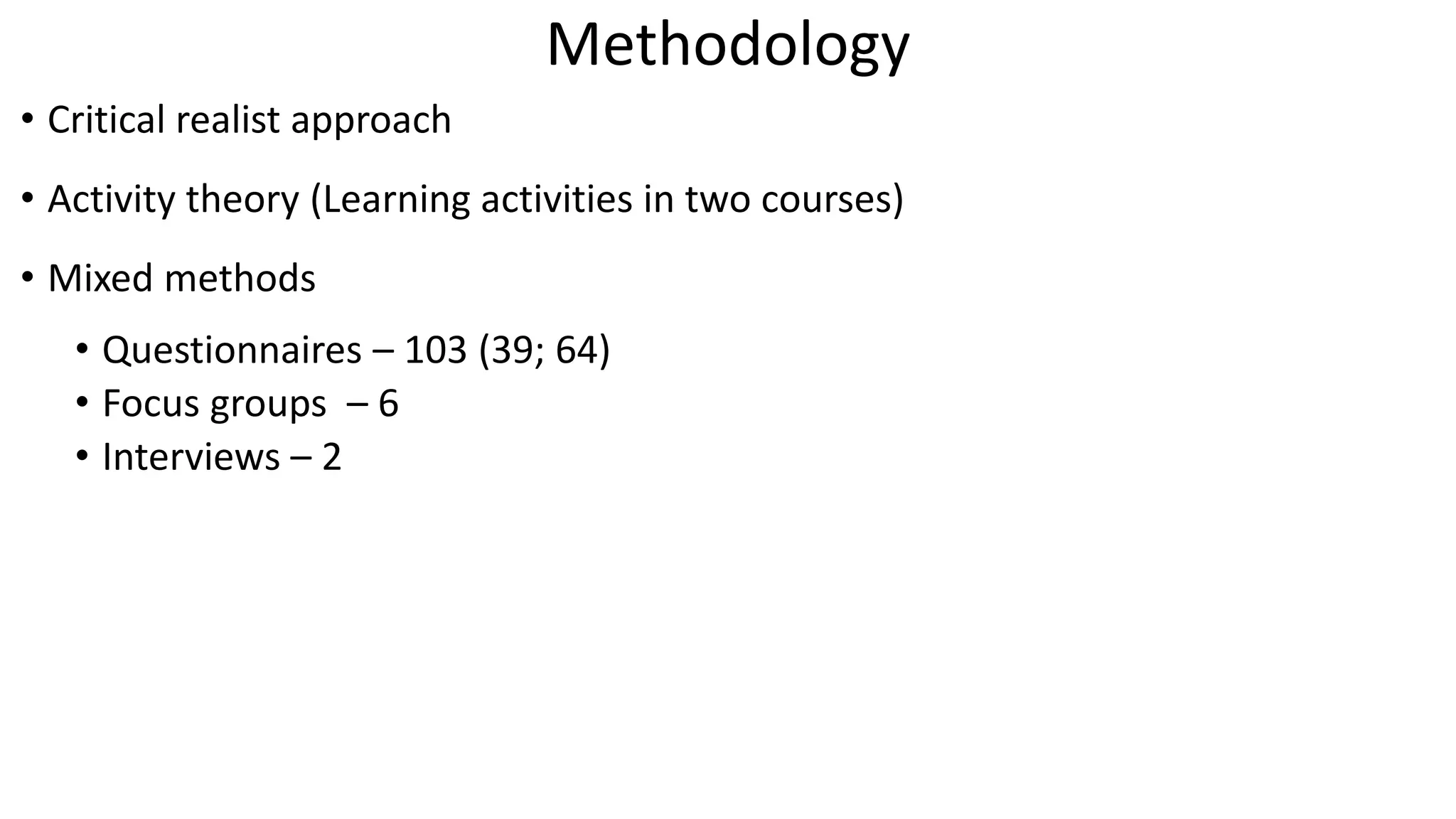
Methodology
• Critical realist approach
• Activity theory (Learning activities in two courses)
• Mixed methods
• Questionnaires – 103 (39; 64)
• Focus groups – 6
• Interviews – 2
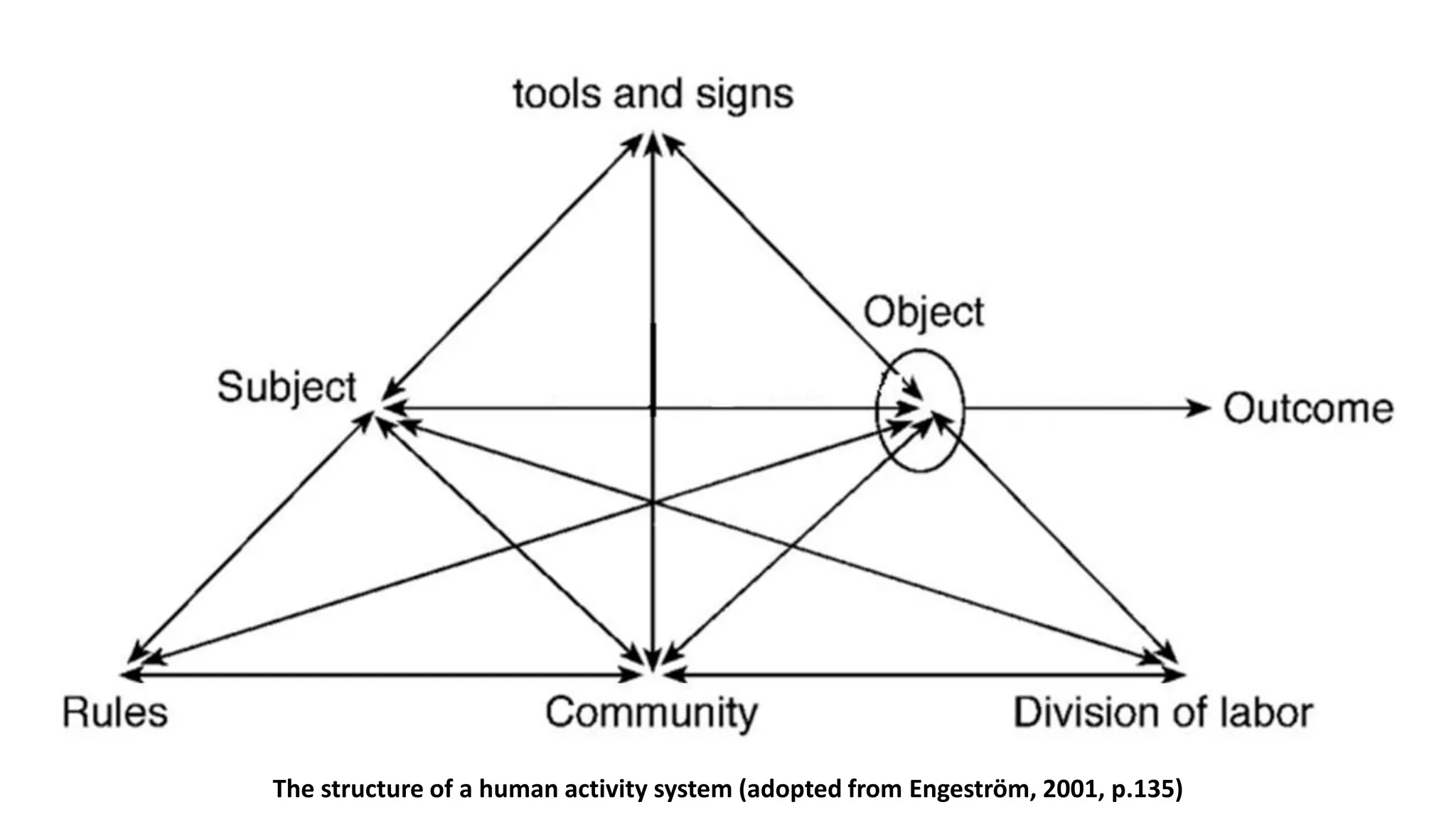
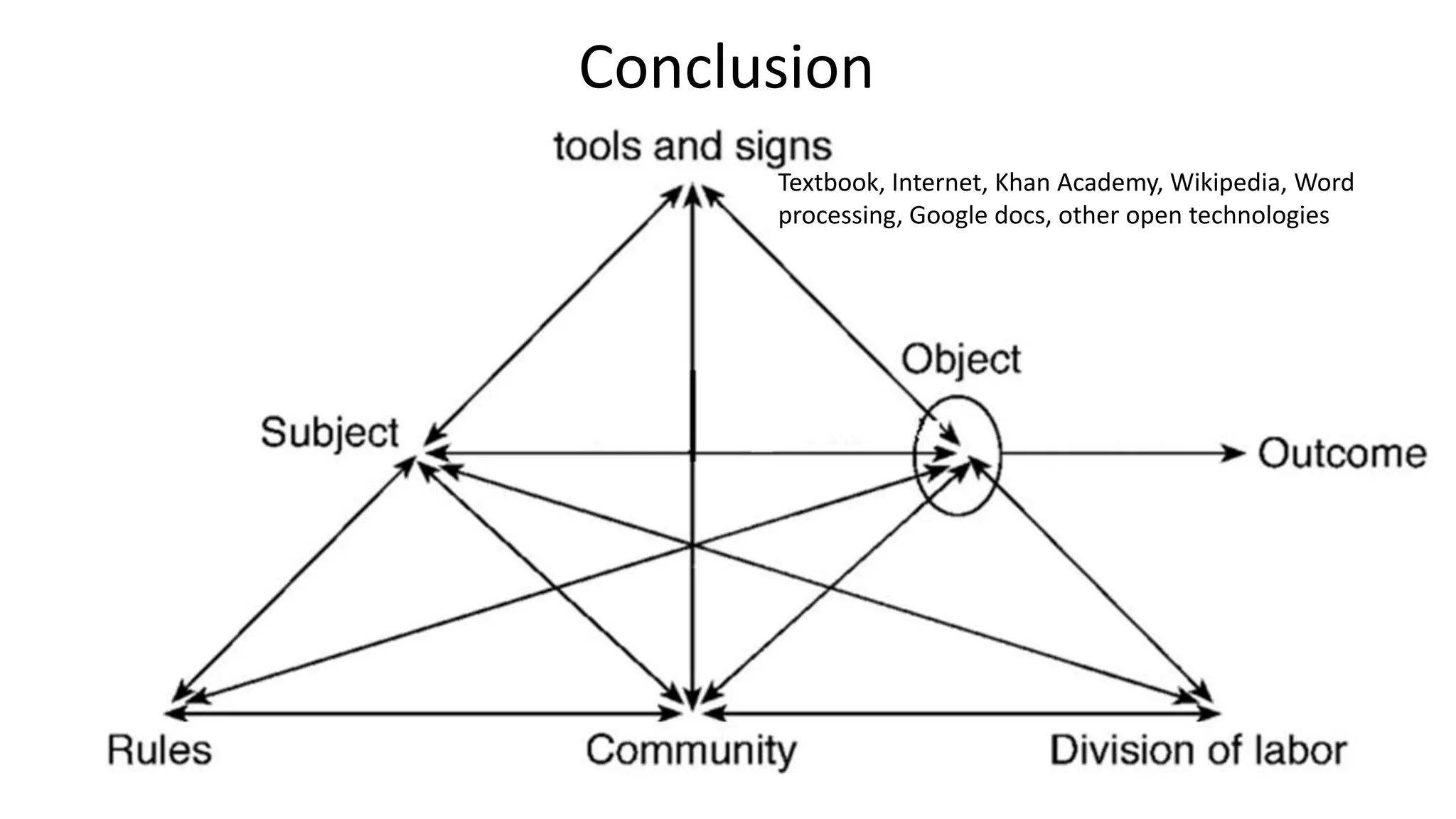
The structure of a human activity system (adopted from Engeström, 2001, p.135)
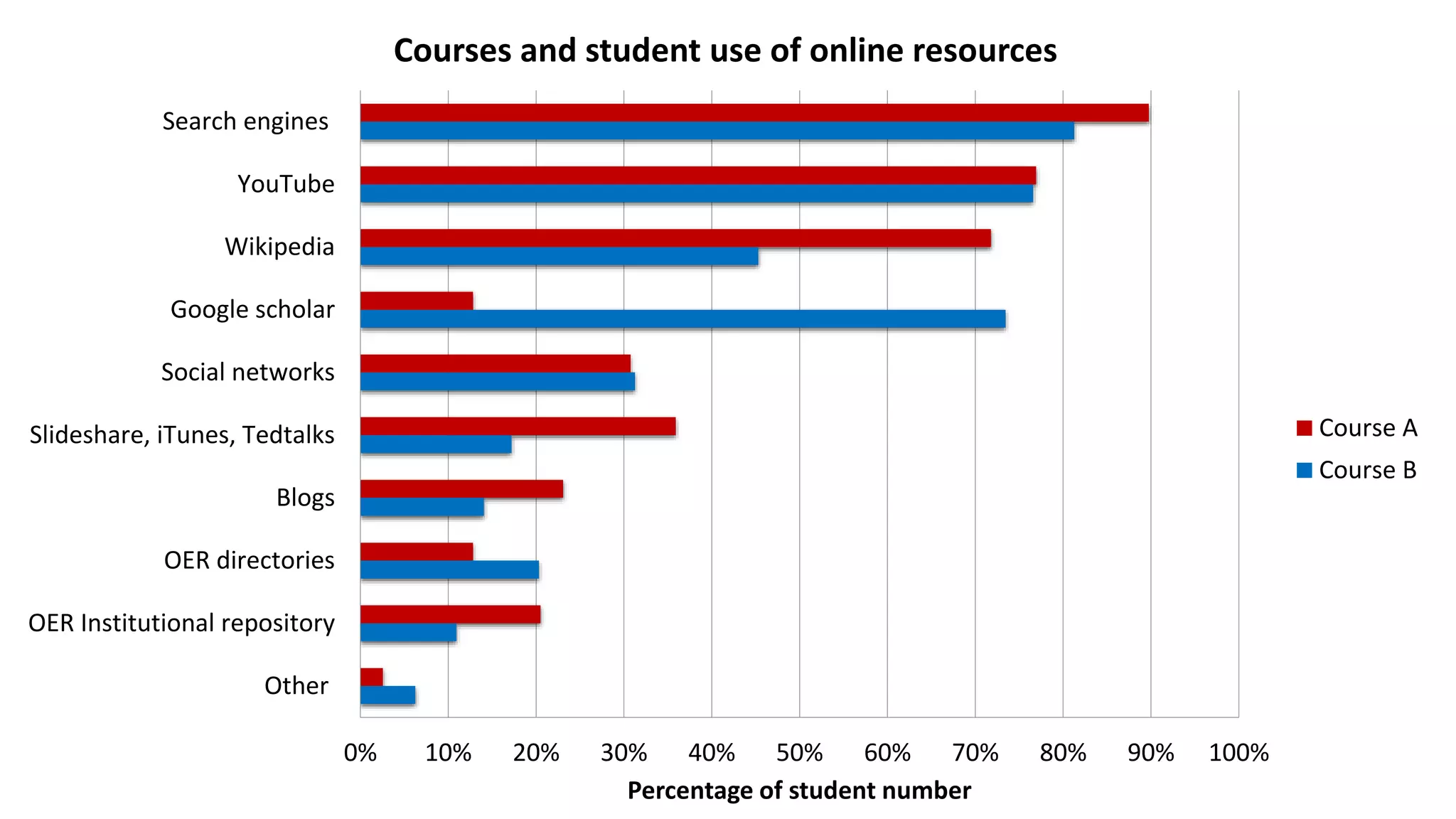
0% 10% 20% 30% 40% 50% 60% 70% 80% 90% 100%
Other
OER Institutional repository
OER directories
Blogs
Slideshare, iTunes, Tedtalks
Social networks
Google scholar
Wikipedia
YouTube
Search engines
Percentage of student number
Courses and student use of online resources
Course A
Course B
0
10
20
30
40
50
60
70
80
90
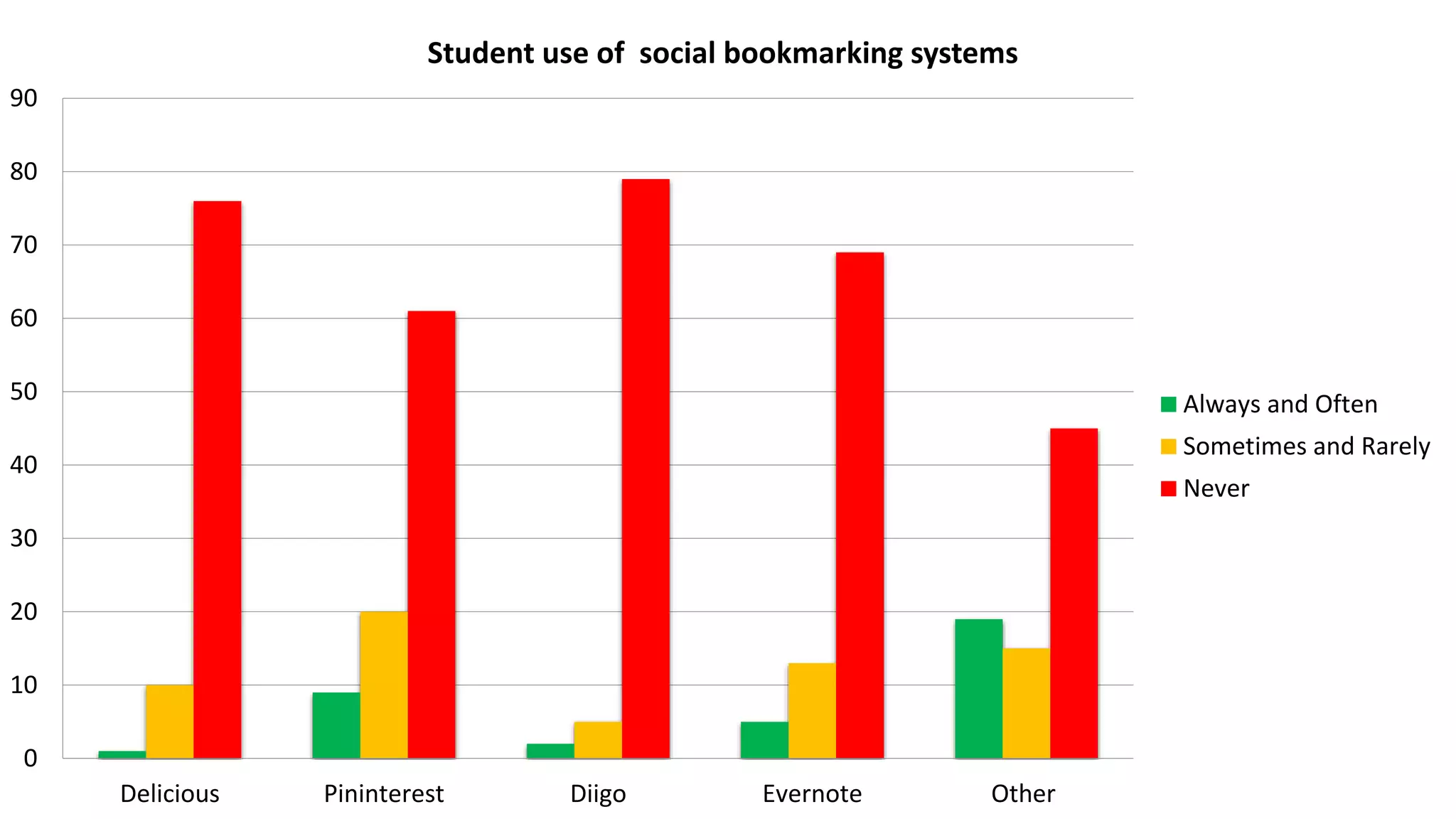
Delicious Pininterest Diigo Evernote Other
Student use of social bookmarking systems
Always and Often
Sometimes and Rarely
Never
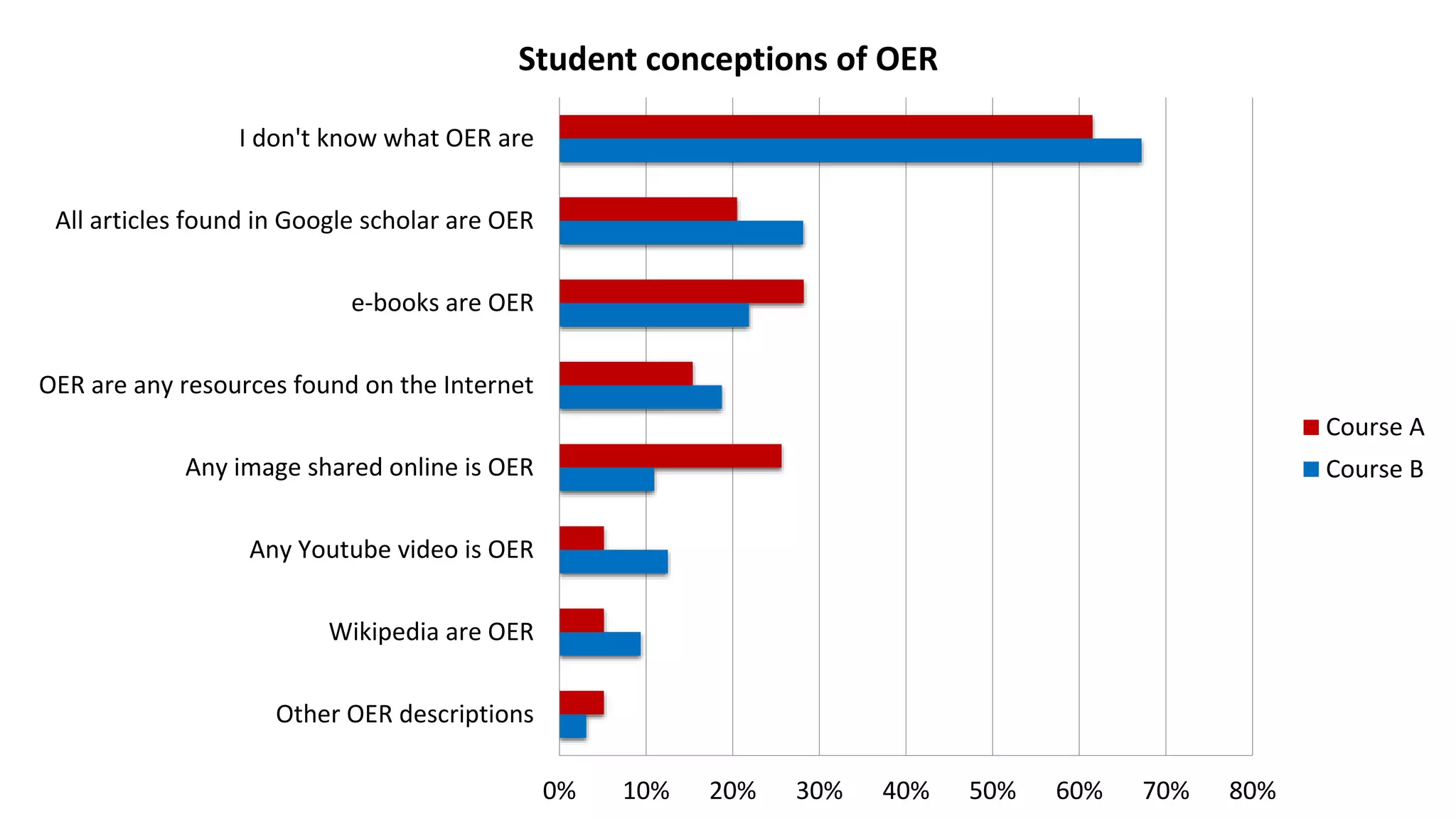
0% 10% 20% 30% 40% 50% 60% 70% 80%
Other OER descriptions
Wikipedia are OER
Any Youtube video is OER
Any image shared online is OER
OER are any resources found on the Internet
e-books are OER
All articles found in Google scholar are OER
I don't know what OER are
Student conceptions of OER
Course A
Course B
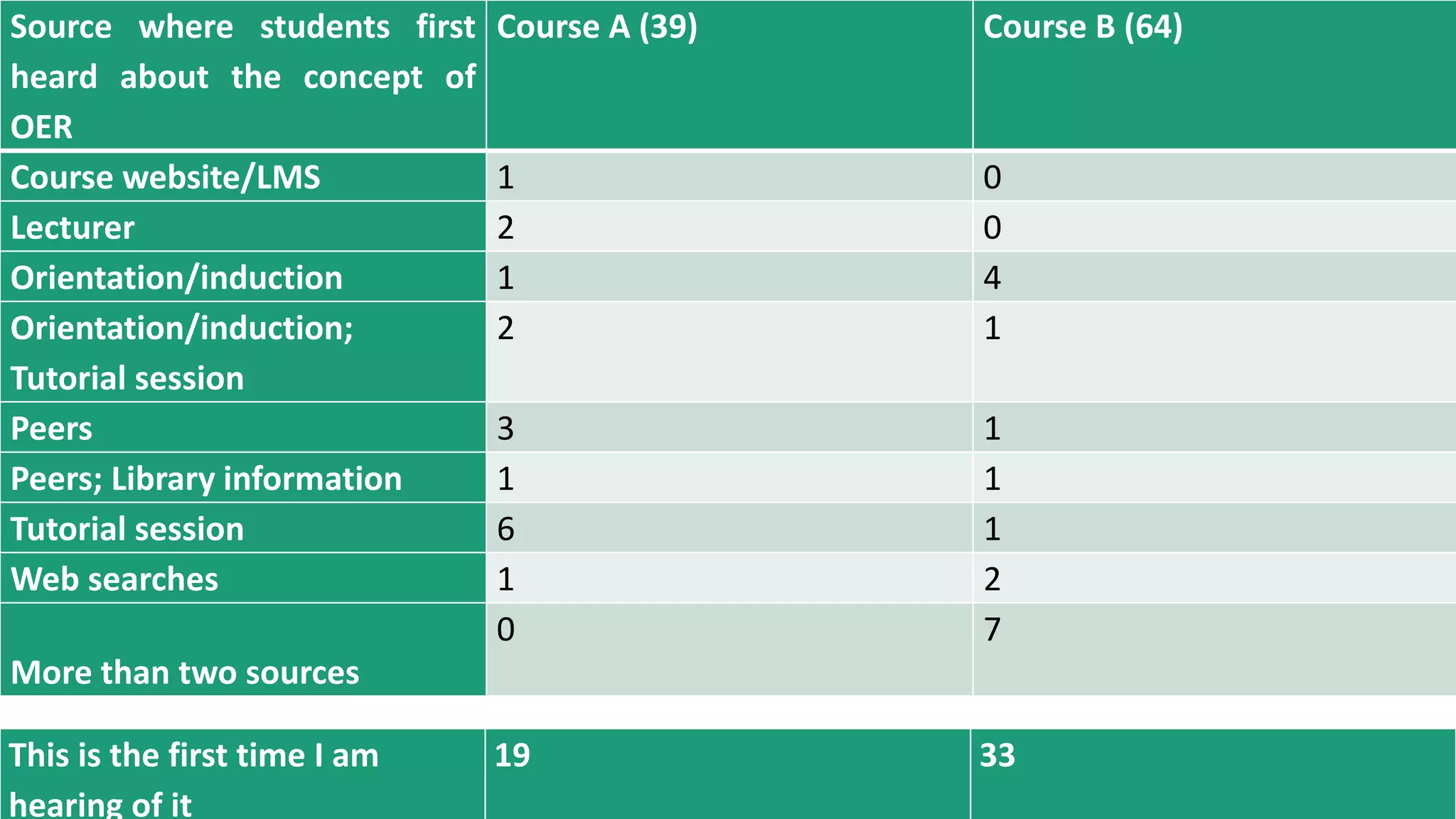
Source where students first
heard about the concept of
OER
Course A (39) Course B (64)
Course website/LMS 1 0
Lecturer 2 0
Orientation/induction 1 4
Orientation/induction;
Tutorial session
2 1
Peers 3 1
Peers; Library information 1 1
Tutorial session 6 1
Web searches 1 2
More than two sources
0 7
This is the first time I am
hearing of it
19 33
How students learnt that OER were used in their courses
• It was a link we could access to get more information
• Through a lecturer
• Through notes posted on Vula
• You could access it for free on the Internet, it's not copyright
• We were told that OpenUCT was
• Logic
• I was told to look for it
• Everyone could access it
Use of Wikipedia
• Students from both courses expressed that they used it to acquire an understanding
of course related concepts:
I have used it before. I usually use it when I don’t understand stuff… just to get an
idea. … I would look at it [content from Wikipedia] and then compare to the textbook
… because Wikipedia puts things into perspective whereas textbooks just explain
concepts in isolation. Wikipedia also gives examples so it kind of helps with the
understanding [Course A, G3, line 161-165].
I check Wikipedia for everything and then understand it and then I check what
scholars say because … ok, sometimes you find that something that is there … on
Google Scholar or JSTOR; any academic writing, … if I don’t understand it, I just go to
Wikipedia and read then I understand the academic writing easily [Course B, G2, line 31-
35].
• Another Course B respondent expressed that she used Wikipedia to read up on
authors’ backgrounds because she believes that any author’s writing is influenced
by his or her background in one way or another.
Non-use of Wikipedia
• They did not remix content from Wikipedia, in their essays or learning
activities.
• They were told at high school that they could not trust Wikipedia content
because anybody could edit it.
• Three Course A respondents:
• One of them heard about Khan Academy in passing while she was at high
school and then again here at UCT so she tried it out
• The other two said that they used it because “it is an international site”
that is “legit” [Course A, G1, Line 203; line 98].
• A Course B respondent indicated that Khan Academy was recommended to
her by a friend from another course. She said:
I understand the videos in Khan Academy more than the lecturer because I can
pause the video and if I don’t understand I can play it repeatedly. If I don’t
understand in the lecture theatre, there are few chances that I will understand
again because the pace is fast [Course B, G2, line 138-140].
Use of Khan Academy
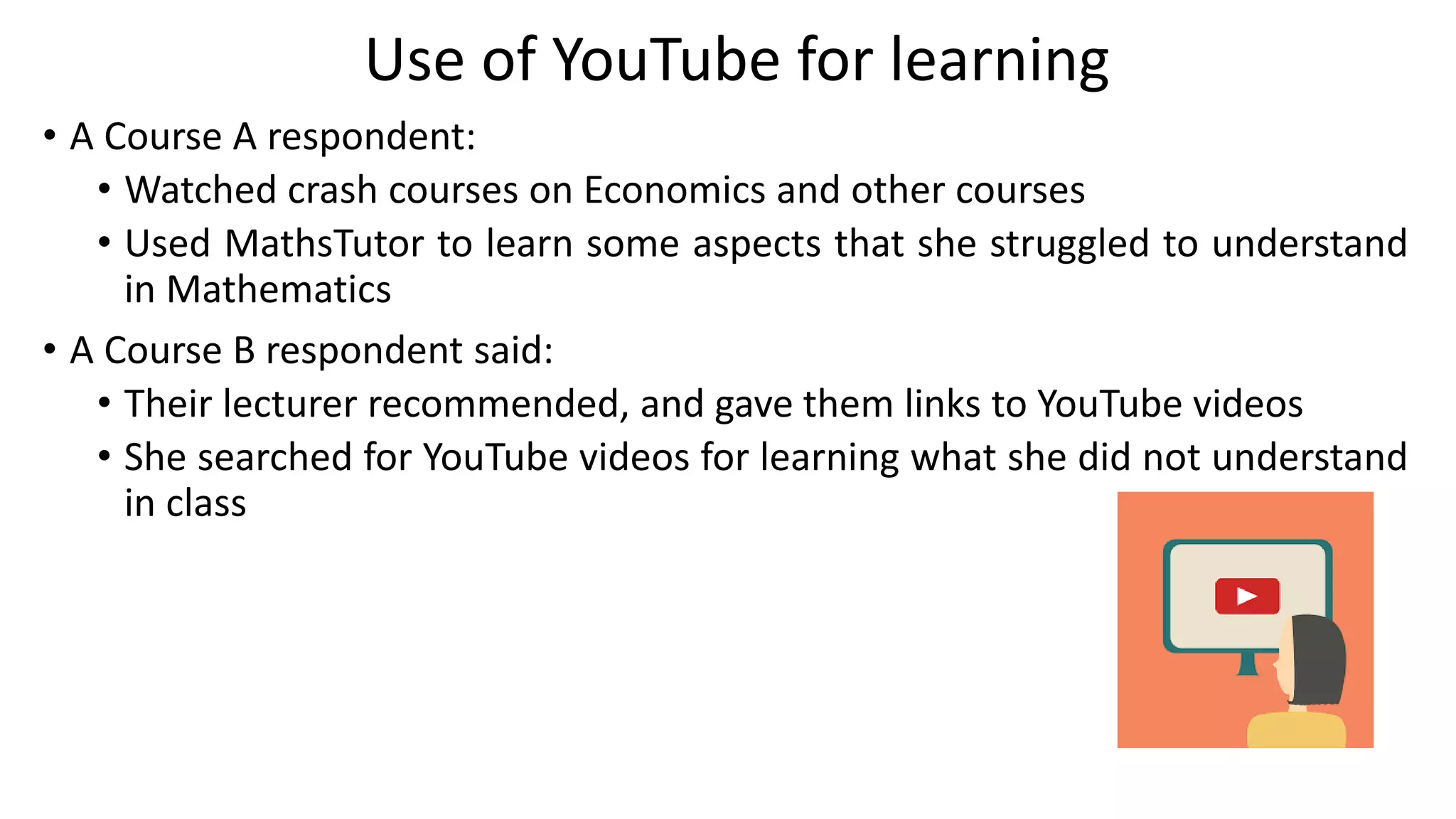
Use of YouTube for learning
• A Course A respondent:
• Watched crash courses on Economics and other courses
• Used MathsTutor to learn some aspects that she struggled to understand
in Mathematics
• A Course B respondent said:
• Their lecturer recommended, and gave them links to YouTube videos
• She searched for YouTube videos for learning what she did not understand
in class
0%
10%
20%
30%
40%
50%
60%
70%
80%
90%
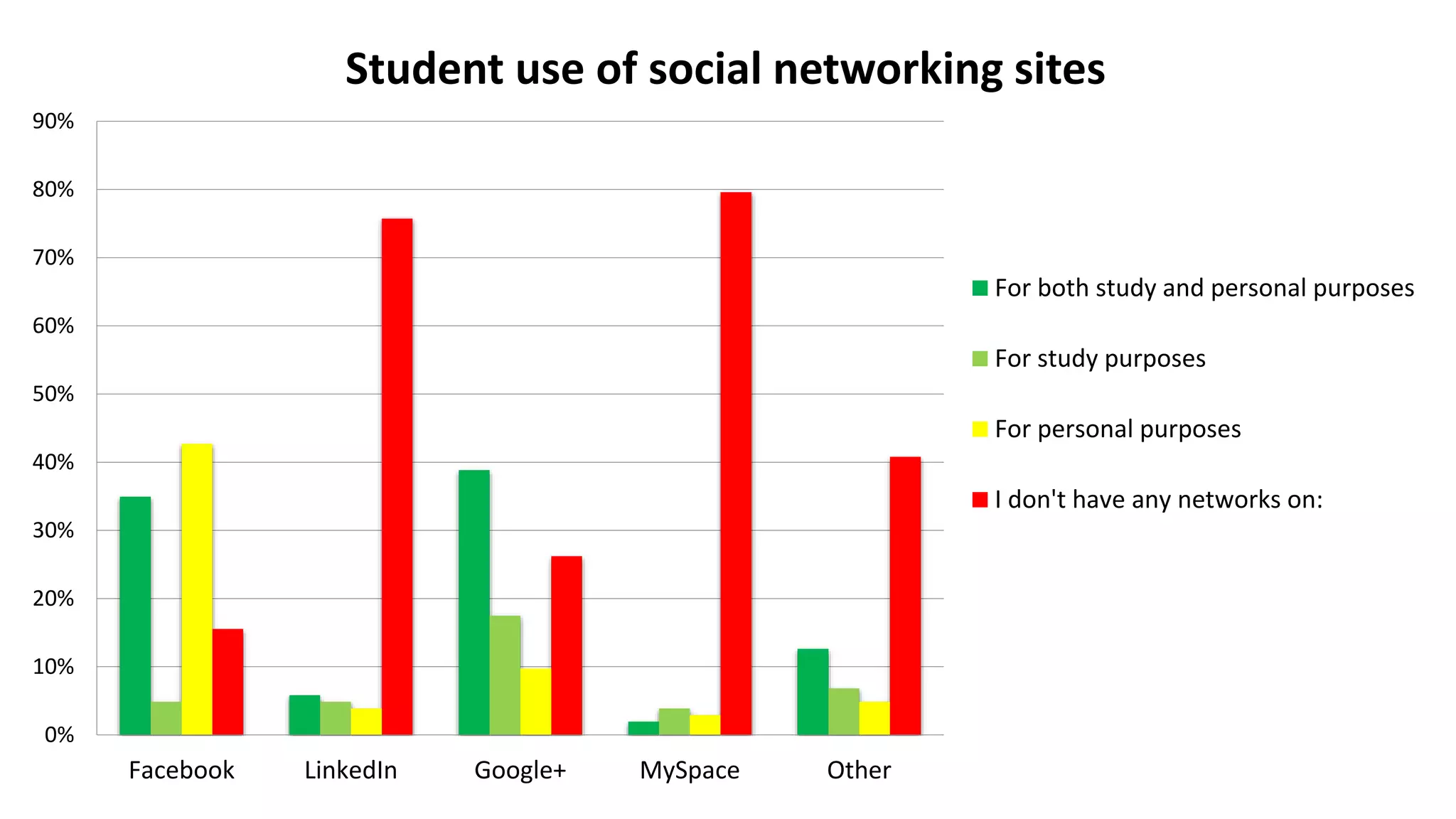
Facebook LinkedIn Google+ MySpace Other
Student use of social networking sites
For both study and personal purposes
For study purposes
For personal purposes
I don't have any networks on:
0%
10%
20%
30%
40%
50%
60%
70%
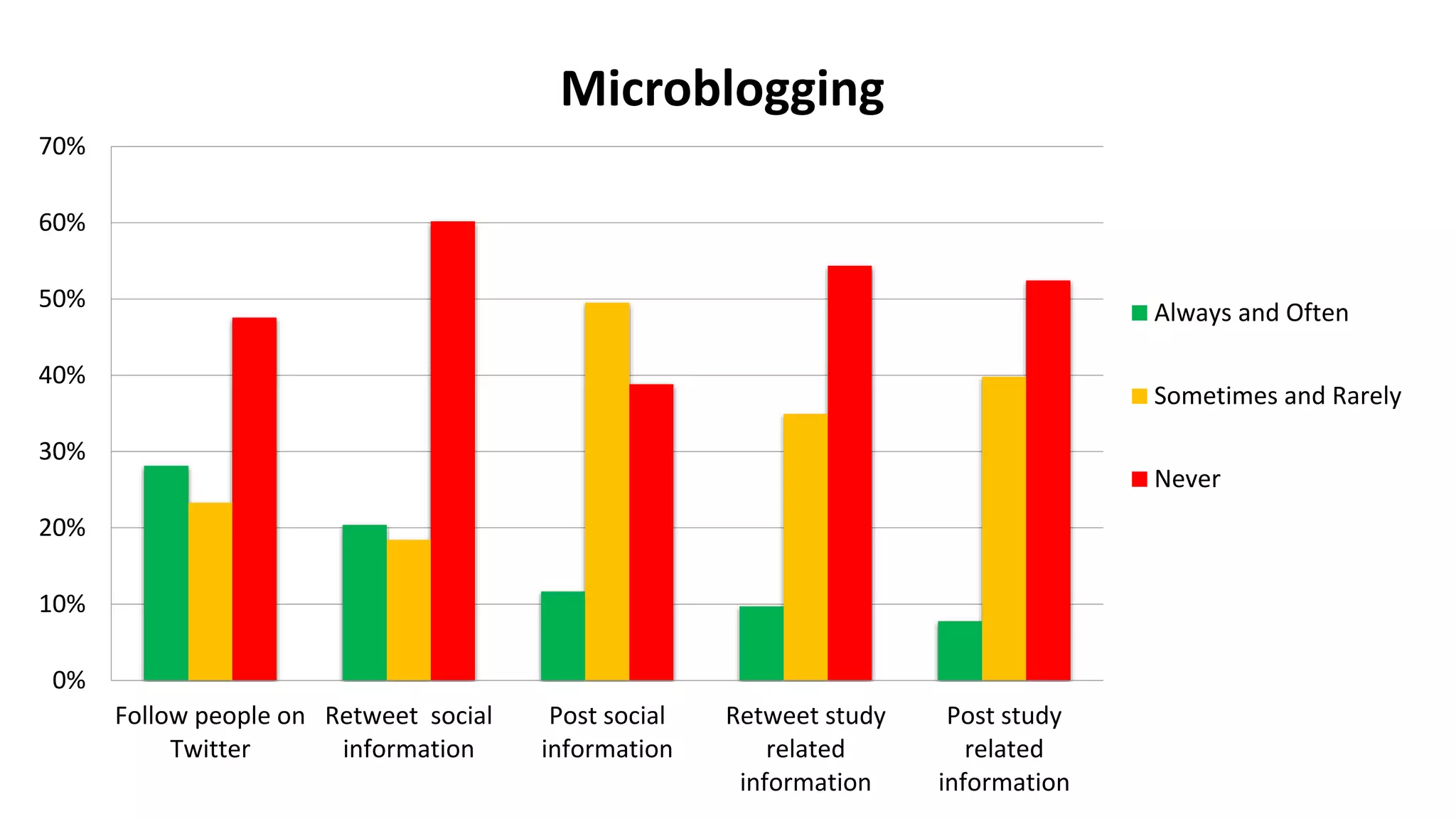
Follow people on
Twitter
Retweet social
information
Post social
information
Retweet study
related
information
Post study
related
information
Microblogging
Always and Often
Sometimes and Rarely
Never
Use of Twitter for learning
• Two students from Course A said that they followed experts in
their fields and so they did not contribute to the tweets, as one
of them said:
I also use Twitter but do not contribute because the content is
way above my head … I follow people who are experts in my field
so I just learn from them [Course A, G2, line 380-381]
Use of WhatsApp for learning
• Groups were structured differently:
• Course A students formed WhatsApp groups based on their
course tasks
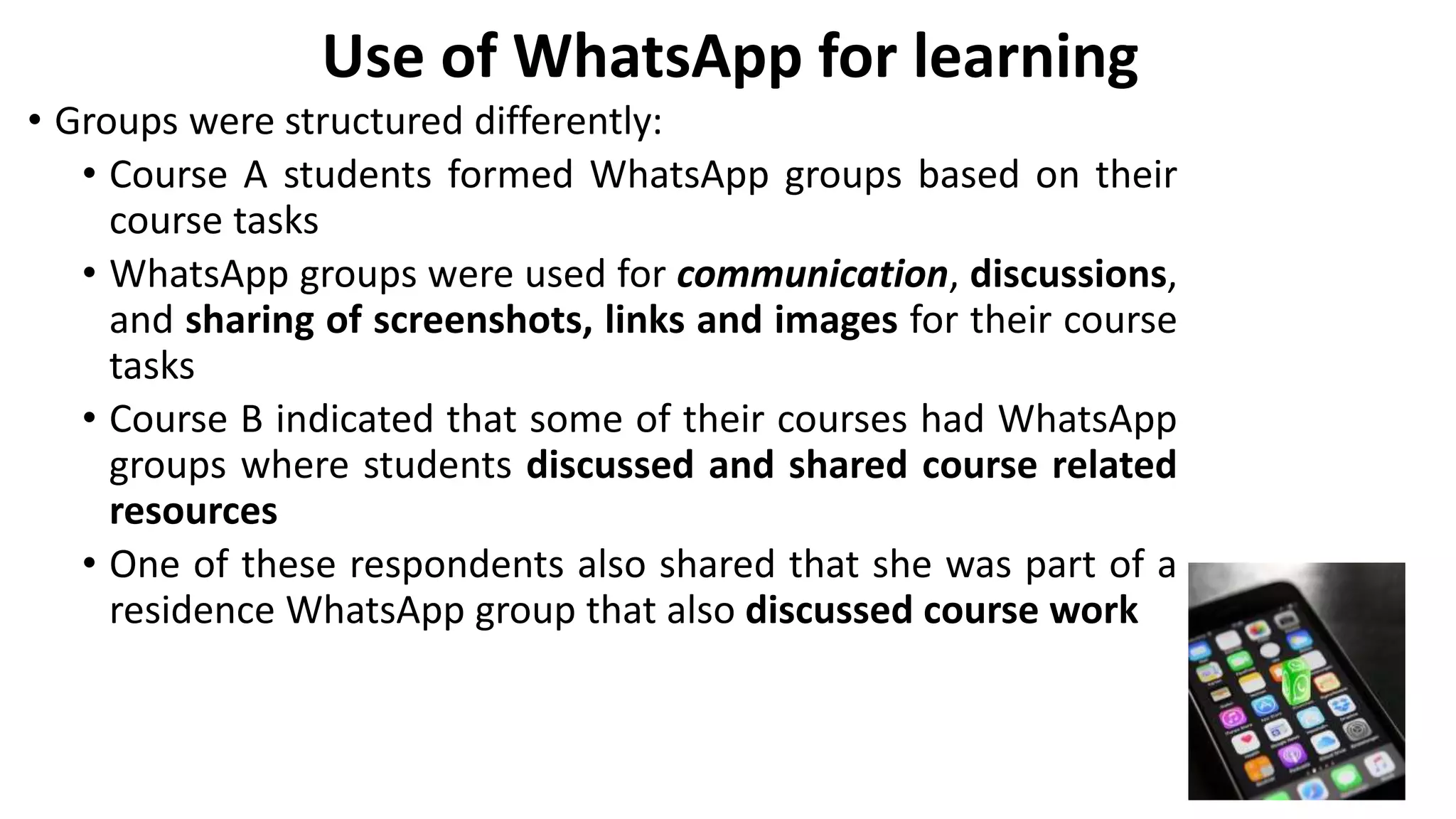
• WhatsApp groups were used for communication, discussions,
and sharing of screenshots, links and images for their course
tasks
• Course B indicated that some of their courses had WhatsApp
groups where students discussed and shared course related
resources
• One of these respondents also shared that she was part of a
residence WhatsApp group that also discussed course work
Use of LinkedIn to start building own professional identity
I don’t know LinkedIn very much but what I use it for … I
normally view people’s profiles … maybe COOs, academics
or people who give you strength when you read their
stories … like COOs of companies or a person who holds a
post that I would like to hold in the future … I get their
views in LinkedIn [Course B, G1, line 159-162]
For career-focused stuff, maybe if I want to follow KPMG and
see what they are doing …career paths to follow and stuff like
that [Course A, G1, line 273-274]
Use of open technologies for personal purposes
(Open practices)
Awareness of CC licenses and OER
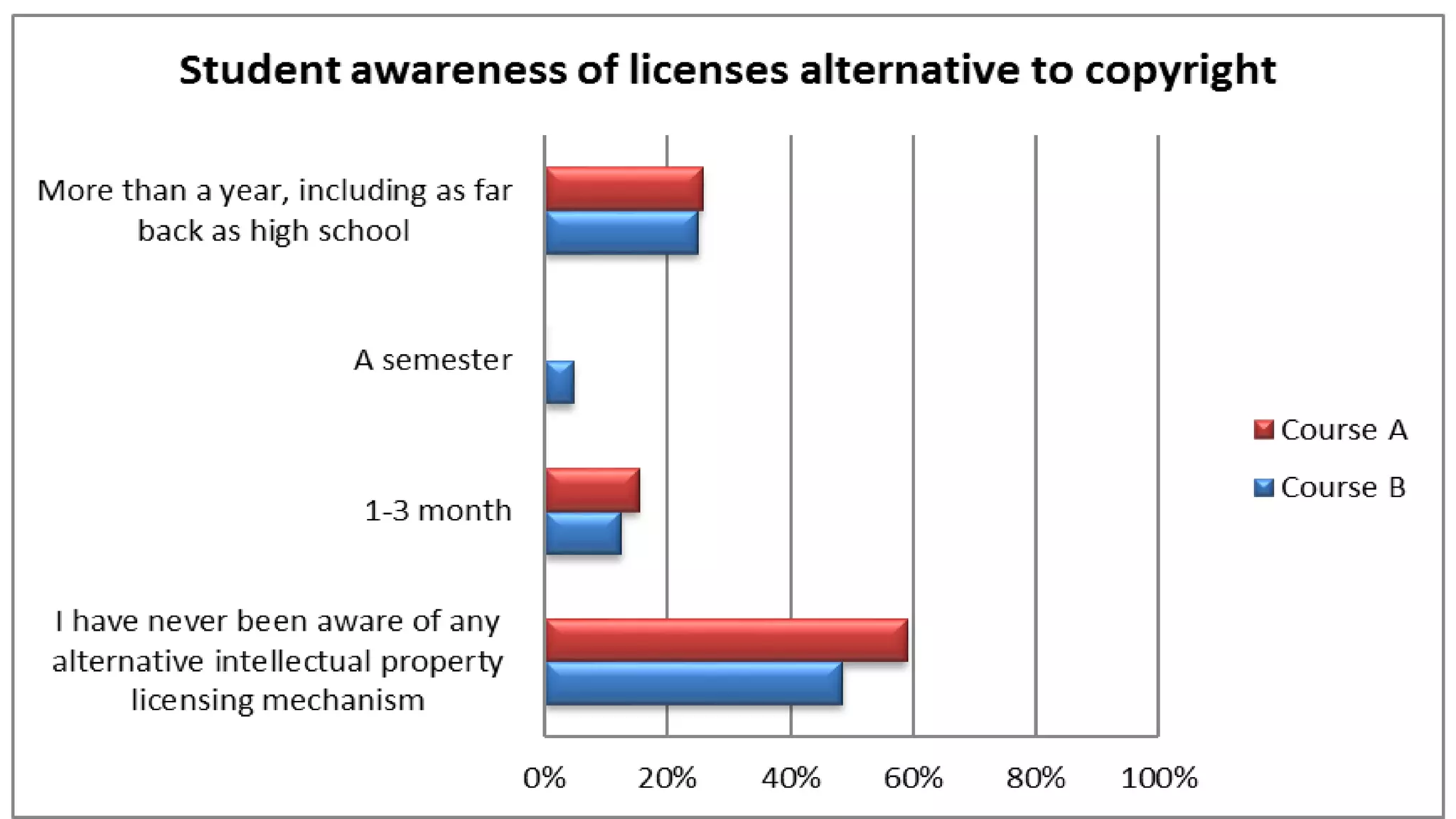
• All were not aware of Creative Commons licenses
• One of the Course B respondents who had used Khan Academy said: “Maybe,
in my case, I wouldn’t even see it, …even if it was written in big because … I
wasn’t looking for it” [Course B, G2, line 275-276].
• All were not aware that Wikipedia and Khan Academy were an OER and OER
repository, respectively.
Textbook, Internet, Khan Academy, Wikipedia, Word
processing, Google docs, other open technologies
Conclusion
Conclusion and recommendations
• Students found resources on the Internet although they didn’t intentionally
search OER repositories (open learning)
• Students used open technologies for learning (OEP) and personal purposes (OP)
• Despite a very small group (from both courses) engaging in OEP, the majority of
the participants were still unaware what CC licensing and OER are
• These findings suggest:
• Pedagogy that encourages students to be producers of digital content
• A need for collaboration between lecturers and information literacy
personnel in an attempt to create student awareness about OER and OEP

Exploring open educational practices of first year students at a South African university

  • 1.
    Exploring open educationalpractices of first year students at a South African university Tabisa Mayisela PhD candidate AND Digital literacy Coordinator University of Cape Town
  • 2.
    Outline • Study background •Problem statement • Research approach • Findings • Conclusion and recommendations
  • 3.
    Transition to Web2.0 platform has an “implicit architecture of participation” which facilitates new digital literacy practices (O’Reilly, 2007; Cardoso and Oliveira, 2015) Background: Knowledge production
  • 4.
    OER movement • ICTenables the re-use and distribution of OER • Vast number of OER available through repositories (MERLOT, MIT open courseware, Khan Academy, … OpenUCT) • Fair use licenses (such as CC) allow academics and students to (re) use digital learning resources that used to be restricted by intellectual property licenses in the competitive higher education era (Hyén, 2008)
  • 5.
    Statement of problem •South-North divide of knowledge publication where the global South publishes less knowledge than the global North (Bautista, Duran-Martinez, Sierra, & Snyder, 2013) • Network analysis of shared global traffic between 1000 most popular websites revealed that most were developed in the global North (Wu & Taneja, 2016) • Over the three intervals of study (2009, 2011 and 2013), users in the Global South were primarily consuming rather than producing content (Wu & Taneja, 2016)
  • 6.
  • 7.
    OER production (Hodgkinson-Williams,2013), particularly by academics (Arcos, Farrow, Pitt, & Weller, 2015), is predominant in the global North
  • 8.
    Open educational practices •“supportthe (re)use and production of OER through institutional policies, promote innovative pedagogical models, and respect and empower learners as co-producers on their lifelong learning path” (Ehlers, 2011:4). • Include: 1) Use of OER 2) Open pedagogies 3) Open learning 4) Open scholarship 5) Open sharing 6) Use of open technologies (Beetham, Falconer & McGill 2012)
  • 9.
    Research question How andwhy first year higher education students create digital content in their courses? Sub-questions • What are the first year higher education (HE) students’ digital literacy practices? • What is the first year HE students’ understanding of open educational resources and practices? • In what ways do first year HE students learn digital literacy practices in terms of digital content creation and open educational practices? • What are the current enablers or contradictions influencing the students’ digital literacy practices? • What are the driving forces for students to create digital content?
  • 10.
    Methodology • Critical realistapproach • Activity theory (Learning activities in two courses) • Mixed methods • Questionnaires – 103 (39; 64) • Focus groups – 6 • Interviews – 2
  • 11.
    The structure ofa human activity system (adopted from Engeström, 2001, p.135)
  • 12.
    0% 10% 20%30% 40% 50% 60% 70% 80% 90% 100% Other OER Institutional repository OER directories Blogs Slideshare, iTunes, Tedtalks Social networks Google scholar Wikipedia YouTube Search engines Percentage of student number Courses and student use of online resources Course A Course B
  • 13.
    0 10 20 30 40 50 60 70 80 90 Delicious Pininterest DiigoEvernote Other Student use of social bookmarking systems Always and Often Sometimes and Rarely Never
  • 14.
    0% 10% 20%30% 40% 50% 60% 70% 80% Other OER descriptions Wikipedia are OER Any Youtube video is OER Any image shared online is OER OER are any resources found on the Internet e-books are OER All articles found in Google scholar are OER I don't know what OER are Student conceptions of OER Course A Course B
  • 16.
    Source where studentsfirst heard about the concept of OER Course A (39) Course B (64) Course website/LMS 1 0 Lecturer 2 0 Orientation/induction 1 4 Orientation/induction; Tutorial session 2 1 Peers 3 1 Peers; Library information 1 1 Tutorial session 6 1 Web searches 1 2 More than two sources 0 7 This is the first time I am hearing of it 19 33
  • 17.
    How students learntthat OER were used in their courses • It was a link we could access to get more information • Through a lecturer • Through notes posted on Vula • You could access it for free on the Internet, it's not copyright • We were told that OpenUCT was • Logic • I was told to look for it • Everyone could access it
  • 18.
    Use of Wikipedia •Students from both courses expressed that they used it to acquire an understanding of course related concepts: I have used it before. I usually use it when I don’t understand stuff… just to get an idea. … I would look at it [content from Wikipedia] and then compare to the textbook … because Wikipedia puts things into perspective whereas textbooks just explain concepts in isolation. Wikipedia also gives examples so it kind of helps with the understanding [Course A, G3, line 161-165]. I check Wikipedia for everything and then understand it and then I check what scholars say because … ok, sometimes you find that something that is there … on Google Scholar or JSTOR; any academic writing, … if I don’t understand it, I just go to Wikipedia and read then I understand the academic writing easily [Course B, G2, line 31- 35]. • Another Course B respondent expressed that she used Wikipedia to read up on authors’ backgrounds because she believes that any author’s writing is influenced by his or her background in one way or another.
  • 19.
    Non-use of Wikipedia •They did not remix content from Wikipedia, in their essays or learning activities. • They were told at high school that they could not trust Wikipedia content because anybody could edit it.
  • 20.
    • Three CourseA respondents: • One of them heard about Khan Academy in passing while she was at high school and then again here at UCT so she tried it out • The other two said that they used it because “it is an international site” that is “legit” [Course A, G1, Line 203; line 98]. • A Course B respondent indicated that Khan Academy was recommended to her by a friend from another course. She said: I understand the videos in Khan Academy more than the lecturer because I can pause the video and if I don’t understand I can play it repeatedly. If I don’t understand in the lecture theatre, there are few chances that I will understand again because the pace is fast [Course B, G2, line 138-140]. Use of Khan Academy
  • 21.
    Use of YouTubefor learning • A Course A respondent: • Watched crash courses on Economics and other courses • Used MathsTutor to learn some aspects that she struggled to understand in Mathematics • A Course B respondent said: • Their lecturer recommended, and gave them links to YouTube videos • She searched for YouTube videos for learning what she did not understand in class
  • 22.
    0% 10% 20% 30% 40% 50% 60% 70% 80% 90% Facebook LinkedIn Google+MySpace Other Student use of social networking sites For both study and personal purposes For study purposes For personal purposes I don't have any networks on:
  • 23.
    0% 10% 20% 30% 40% 50% 60% 70% Follow people on Twitter Retweetsocial information Post social information Retweet study related information Post study related information Microblogging Always and Often Sometimes and Rarely Never
  • 24.
    Use of Twitterfor learning • Two students from Course A said that they followed experts in their fields and so they did not contribute to the tweets, as one of them said: I also use Twitter but do not contribute because the content is way above my head … I follow people who are experts in my field so I just learn from them [Course A, G2, line 380-381]
  • 25.
    Use of WhatsAppfor learning • Groups were structured differently: • Course A students formed WhatsApp groups based on their course tasks • WhatsApp groups were used for communication, discussions, and sharing of screenshots, links and images for their course tasks • Course B indicated that some of their courses had WhatsApp groups where students discussed and shared course related resources • One of these respondents also shared that she was part of a residence WhatsApp group that also discussed course work
  • 26.
    Use of LinkedInto start building own professional identity I don’t know LinkedIn very much but what I use it for … I normally view people’s profiles … maybe COOs, academics or people who give you strength when you read their stories … like COOs of companies or a person who holds a post that I would like to hold in the future … I get their views in LinkedIn [Course B, G1, line 159-162] For career-focused stuff, maybe if I want to follow KPMG and see what they are doing …career paths to follow and stuff like that [Course A, G1, line 273-274]
  • 27.
    Use of opentechnologies for personal purposes (Open practices)
  • 28.
    Awareness of CClicenses and OER • All were not aware of Creative Commons licenses • One of the Course B respondents who had used Khan Academy said: “Maybe, in my case, I wouldn’t even see it, …even if it was written in big because … I wasn’t looking for it” [Course B, G2, line 275-276]. • All were not aware that Wikipedia and Khan Academy were an OER and OER repository, respectively.
  • 29.
    Textbook, Internet, KhanAcademy, Wikipedia, Word processing, Google docs, other open technologies Conclusion
  • 30.
    Conclusion and recommendations •Students found resources on the Internet although they didn’t intentionally search OER repositories (open learning) • Students used open technologies for learning (OEP) and personal purposes (OP) • Despite a very small group (from both courses) engaging in OEP, the majority of the participants were still unaware what CC licensing and OER are • These findings suggest: • Pedagogy that encourages students to be producers of digital content • A need for collaboration between lecturers and information literacy personnel in an attempt to create student awareness about OER and OEP

Editor's Notes

  • #4 The rapid development of ICT has revolutionized how knowledge in the higher education context is produced and communicated (Altbach, Reisberg & Rumbley, 2009) such as: social networking, content creation, collaborative production of knowledge, content sharing (e.g. folksonomy, social bookmarking, media sharing)
  • #6 Students from the south do… this is an indication of digital knowledge consumption OER divide Some global studies reveal a knowledge gap between the developed (which happen to be in the global North) and developing countries (in the global South) where the global South produces less knowledge than the global North (Bautista, Duran-Martinez, Sierra, & Snyder, 2013; UNESCO, 2014). Although Bautista et al.'s (2013) study focused on knowledge produced in the form of books, it is common knowledge that the global South also produces relatively less digital knowledge and information (content) than the global North. For instance a network analysis of shared global traffic between 1000 most popular websites, conducted by Wu and Taneja (n.d.), revealed that most of these popular websites were developed in the global North. The findings also revealed that, although there was an increase in internet usage in the global South, over the three intervals of study (2009, 2011 and 2013), users were primarily consuming content on these websites (Wu & Taneja, n.d.). These authors suggest that this is due to political and socio-economic challenges prevailing in the global South. The implication of this digital knowledge/information/content gap is that the global South tends to consume digital knowledge/information/content produced in the global North.
  • #8 https://oerworldmap.org/ This tendency is exacerbated by the ubiquitous use of ICT and more specifically, the internet, for digital content distribution and access.
  • #9 Am using a broad definition of OEP, more than just the use of OER
  • #11 Activities and tools - learning resources, technologies
  • #14 “Bookmarks” which was not shared
  • #17 The source from where they first heard of OER…
  • #20 These students, together with most of those who chose not to use Wikipedia for learning, reported that they were told at high school that they could not trust Wikipedia content because anybody could edit it.
  • #21 Three Course A respondents reported that they used the open content repository, Khan Academy.
  • #22 Respondents from both courses expressed that they also used YouTube to enhance learning of other courses.
  • #26 Some respondents, more particularly, the Course A respondents expressed that they used WhatsApp for learning.
  • #29 When students were asked whether they had been aware of any intellectual property mechanism licensing (such as Creative Commons) alternative to copyright, all respondents said that they knew nothing about Creative Commons licensing. When asked whether they were aware what OER are, they all said: ‘no’. When probed by naming Wikipedia and Khan Academy, the respondents confirmed that they were not aware that Wikipedia and Khan Academy were an OER and OER repository, respectively.