Online Learning
         Kathryn Gazso
    English Department Chair
     School of the Holy Child
         February 2012
A LOOK AT ONLINE
       LEARNING
What is online learning? Who takes online classes? Why teach them?
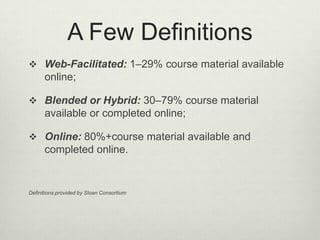
A Few Definitions
 Web-Facilitated: 1–29% course material available
      online;

 Blended or Hybrid: 30–79% course material
      available or completed online;

 Online: 80%+course material available and
      completed online.


Definitions provided by Sloan Consortium
Who takes online
           classes?
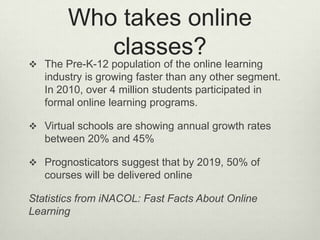
 The Pre-K-12 population of the online learning
   industry is growing faster than any other segment.
   In 2010, over 4 million students participated in
   formal online learning programs.

 Virtual schools are showing annual growth rates
   between 20% and 45%

 Prognosticators suggest that by 2019, 50% of
   courses will be delivered online

Statistics from iNACOL: Fast Facts About Online
Learning
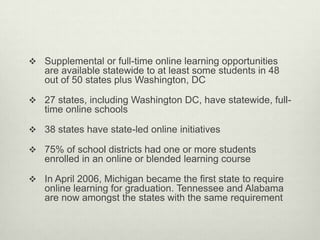
 Supplemental or full-time online learning opportunities
   are available statewide to at least some students in 48
   out of 50 states plus Washington, DC

 27 states, including Washington DC, have statewide, full-
   time online schools

 38 states have state-led online initiatives

 75% of school districts had one or more students
   enrolled in an online or blended learning course

 In April 2006, Michigan became the first state to require
   online learning for graduation. Tennessee and Alabama
   are now amongst the states with the same requirement
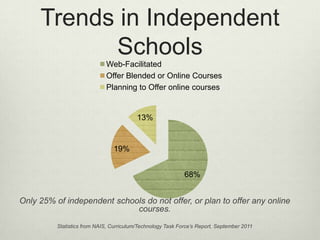
Trends in Independent
           Schools
                             Web-Facilitated
                             Offer Blended or Online Courses
                             Planning to Offer online courses


                                          13%


                                19%


                                                             68%


Only 25% of independent schools do not offer, or plan to offer any online
                             courses.
          Statistics from NAIS, Curriculum/Technology Task Force’s Report, September 2011
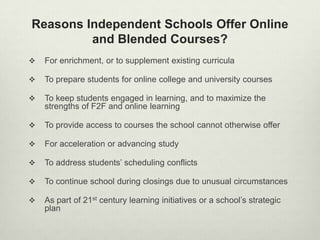
Reasons Independent Schools Offer Online
         and Blended Courses?
   For enrichment, or to supplement existing curricula

   To prepare students for online college and university courses

   To keep students engaged in learning, and to maximize the
    strengths of F2F and online learning

   To provide access to courses the school cannot otherwise offer

   For acceleration or advancing study

   To address students’ scheduling conflicts

   To continue school during closings due to unusual circumstances

   As part of 21st century learning initiatives or a school’s strategic
    plan
DESIGNING THE
ONLINE COURSE
   Madness in Literature
 What challenges do you anticipate in designing and
   implementing an online course?

 Any fears or concerns?
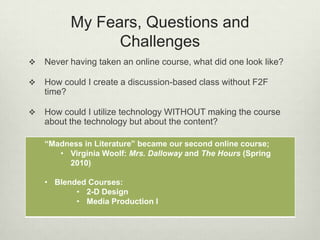
My Fears, Questions and
                Challenges
   Never having taken an online course, what did one look like?

   How could I create a discussion-based class without F2F
    time?

   How could I utilize technology WITHOUT making the course
    about the technology but about the content?

    “Madness in Literature” became our second online course;
       • Virginia Woolf: Mrs. Dalloway and The Hours (Spring
         2010)

    • Blended Courses:
           • 2-D Design
           • Media Production I
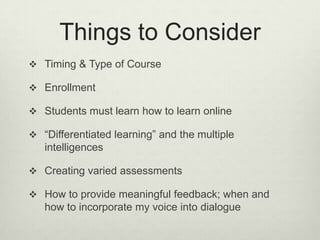
Things to Consider
 Timing & Type of Course

 Enrollment

 Students must learn how to learn online

 “Differentiated learning” and the multiple
   intelligences

 Creating varied assessments

 How to provide meaningful feedback; when and
   how to incorporate my voice into dialogue
What I Did Not Anticipate/Consider Before
       Beginning (and Should Have)
 Students who were unable to utilize certain
   applications (and therefore unable to complete
   certain assessments!) due to older operating
   systems

 Student-access to the internet outside of school
Madness in Literature
 Spring trimester elective

 Juniors and seniors only, all whom carried a full
   course load already (including APs in some
   instances)

 Only interacted with students online

 Director of Instructional Technology available for
   tech assistance

 Selected two novels, one short story and one
   painting to complete a comparative study of the
   representation of female madness in literature
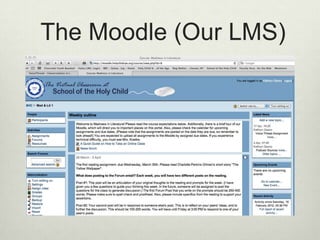
The Moodle (Our LMS)
Creating Community of Learners
 Online Group Chats             Voicethread
 Used several times       Opportunity to respond
   throughout the            to one another using a
   trimester                 vehicle other than
                             discussion forum
 Time selected in
   evening when            Used for initial
   everyone expected to      introductions as well
   be available              as responses to
                             art, selected passages
 Participation in
   conversations were
   graded
Assessments
                       Discussion Forums

Our weekly forums asked students to consider several essential
questions regarding the text.

   Post #1: This post would be an articulation of student’s original
    thoughts to the reading and prompts for the week. The first
    Forum Post that students write on the prompts should be 250-
    400 words. Students must adhere to the elements of grammar.
    Students must include specific references from the reading to
    support their assertions.

   Post #2: The second post would be in response to someone
    else's post. The purpose is to reflect on their peers' ideas and
    to further the discussion. This should be 100-200 words.
    Students would have until Friday at 3:00 PM to respond to one
    of their peer's posts.
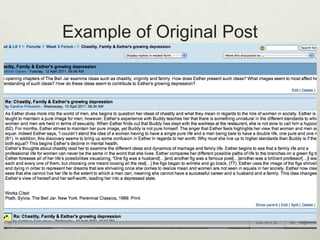
Example of Original Post
Assessments: Projects
   Podcast
    By gaining a general understanding of Plath’s life and world, we will be
    able to examine the text through the historical and gender lenses, in
    addition to the reader response lens.

   Blog Project
    A blog is a public way to reflect upon one’s inner life. Construct a blog
    in which you consider what it means to be uniquely feminine, and how
    any diversion from that which is feminine might be viewed as a
    rejection of femininity, or even madness. Draw upon the texts we
    studied this trimester, “The Yellow-Wallpaper”, The Bell Jar, and Wide
    Sargasso Sea, to complete your blog. For each blog entry, use a quote
    from one of our three texts to springboard your discussion of femininity
    and acceptance (or rejection) of societal norms and mores. You must
    complete 7 sizable blog entries.

   Film Project
    Create a film trailer with director’s statement for the novel.
Advantages
 Students can take a course of interest to them
   despite limitations of a schedule

 Students learn how to work independently and
   manage time
What I learned…
 Timing and pacing is everything; it is essential to
   spend time learning how to learn (and therefore
   teach!) online

 How to use technology to further content rather than
   to use technology

 That a good online teacher is the same as a good
   F2F teacher – she must still work to establish a
   community of learners that fosters mutual respect
   and encourages diligence
QUESTIONS?

T ech conferencepresentation

  • 1.
    Online Learning Kathryn Gazso English Department Chair School of the Holy Child February 2012
  • 2.
    A LOOK ATONLINE LEARNING What is online learning? Who takes online classes? Why teach them?
  • 3.
    A Few Definitions Web-Facilitated: 1–29% course material available online;  Blended or Hybrid: 30–79% course material available or completed online;  Online: 80%+course material available and completed online. Definitions provided by Sloan Consortium
  • 4.
    Who takes online classes?  The Pre-K-12 population of the online learning industry is growing faster than any other segment. In 2010, over 4 million students participated in formal online learning programs.  Virtual schools are showing annual growth rates between 20% and 45%  Prognosticators suggest that by 2019, 50% of courses will be delivered online Statistics from iNACOL: Fast Facts About Online Learning
  • 5.
     Supplemental orfull-time online learning opportunities are available statewide to at least some students in 48 out of 50 states plus Washington, DC  27 states, including Washington DC, have statewide, full- time online schools  38 states have state-led online initiatives  75% of school districts had one or more students enrolled in an online or blended learning course  In April 2006, Michigan became the first state to require online learning for graduation. Tennessee and Alabama are now amongst the states with the same requirement
  • 6.
    Trends in Independent Schools Web-Facilitated Offer Blended or Online Courses Planning to Offer online courses 13% 19% 68% Only 25% of independent schools do not offer, or plan to offer any online courses. Statistics from NAIS, Curriculum/Technology Task Force’s Report, September 2011
  • 7.
    Reasons Independent SchoolsOffer Online and Blended Courses?  For enrichment, or to supplement existing curricula  To prepare students for online college and university courses  To keep students engaged in learning, and to maximize the strengths of F2F and online learning  To provide access to courses the school cannot otherwise offer  For acceleration or advancing study  To address students’ scheduling conflicts  To continue school during closings due to unusual circumstances  As part of 21st century learning initiatives or a school’s strategic plan
  • 8.
    DESIGNING THE ONLINE COURSE Madness in Literature
  • 9.
     What challengesdo you anticipate in designing and implementing an online course?  Any fears or concerns?
  • 10.
    My Fears, Questionsand Challenges  Never having taken an online course, what did one look like?  How could I create a discussion-based class without F2F time?  How could I utilize technology WITHOUT making the course about the technology but about the content? “Madness in Literature” became our second online course; • Virginia Woolf: Mrs. Dalloway and The Hours (Spring 2010) • Blended Courses: • 2-D Design • Media Production I
  • 11.
    Things to Consider Timing & Type of Course  Enrollment  Students must learn how to learn online  “Differentiated learning” and the multiple intelligences  Creating varied assessments  How to provide meaningful feedback; when and how to incorporate my voice into dialogue
  • 12.
    What I DidNot Anticipate/Consider Before Beginning (and Should Have)  Students who were unable to utilize certain applications (and therefore unable to complete certain assessments!) due to older operating systems  Student-access to the internet outside of school
  • 13.
    Madness in Literature Spring trimester elective  Juniors and seniors only, all whom carried a full course load already (including APs in some instances)  Only interacted with students online  Director of Instructional Technology available for tech assistance  Selected two novels, one short story and one painting to complete a comparative study of the representation of female madness in literature
  • 14.
  • 15.
    Creating Community ofLearners Online Group Chats Voicethread  Used several times  Opportunity to respond throughout the to one another using a trimester vehicle other than discussion forum  Time selected in evening when  Used for initial everyone expected to introductions as well be available as responses to art, selected passages  Participation in conversations were graded
  • 16.
    Assessments Discussion Forums Our weekly forums asked students to consider several essential questions regarding the text.  Post #1: This post would be an articulation of student’s original thoughts to the reading and prompts for the week. The first Forum Post that students write on the prompts should be 250- 400 words. Students must adhere to the elements of grammar. Students must include specific references from the reading to support their assertions.  Post #2: The second post would be in response to someone else's post. The purpose is to reflect on their peers' ideas and to further the discussion. This should be 100-200 words. Students would have until Friday at 3:00 PM to respond to one of their peer's posts.
  • 17.
  • 18.
    Assessments: Projects  Podcast By gaining a general understanding of Plath’s life and world, we will be able to examine the text through the historical and gender lenses, in addition to the reader response lens.  Blog Project A blog is a public way to reflect upon one’s inner life. Construct a blog in which you consider what it means to be uniquely feminine, and how any diversion from that which is feminine might be viewed as a rejection of femininity, or even madness. Draw upon the texts we studied this trimester, “The Yellow-Wallpaper”, The Bell Jar, and Wide Sargasso Sea, to complete your blog. For each blog entry, use a quote from one of our three texts to springboard your discussion of femininity and acceptance (or rejection) of societal norms and mores. You must complete 7 sizable blog entries.  Film Project Create a film trailer with director’s statement for the novel.
  • 19.
    Advantages  Students cantake a course of interest to them despite limitations of a schedule  Students learn how to work independently and manage time
  • 20.
    What I learned… Timing and pacing is everything; it is essential to spend time learning how to learn (and therefore teach!) online  How to use technology to further content rather than to use technology  That a good online teacher is the same as a good F2F teacher – she must still work to establish a community of learners that fosters mutual respect and encourages diligence
  • 21.