120 Minutes
of Messy Exploration
March 9, 2017
Cape Town, South Africa
Twitter @jennihayman #OEGlobal17
jlhayman@asu.edu
About me...
Online
Learning
Designer
Global
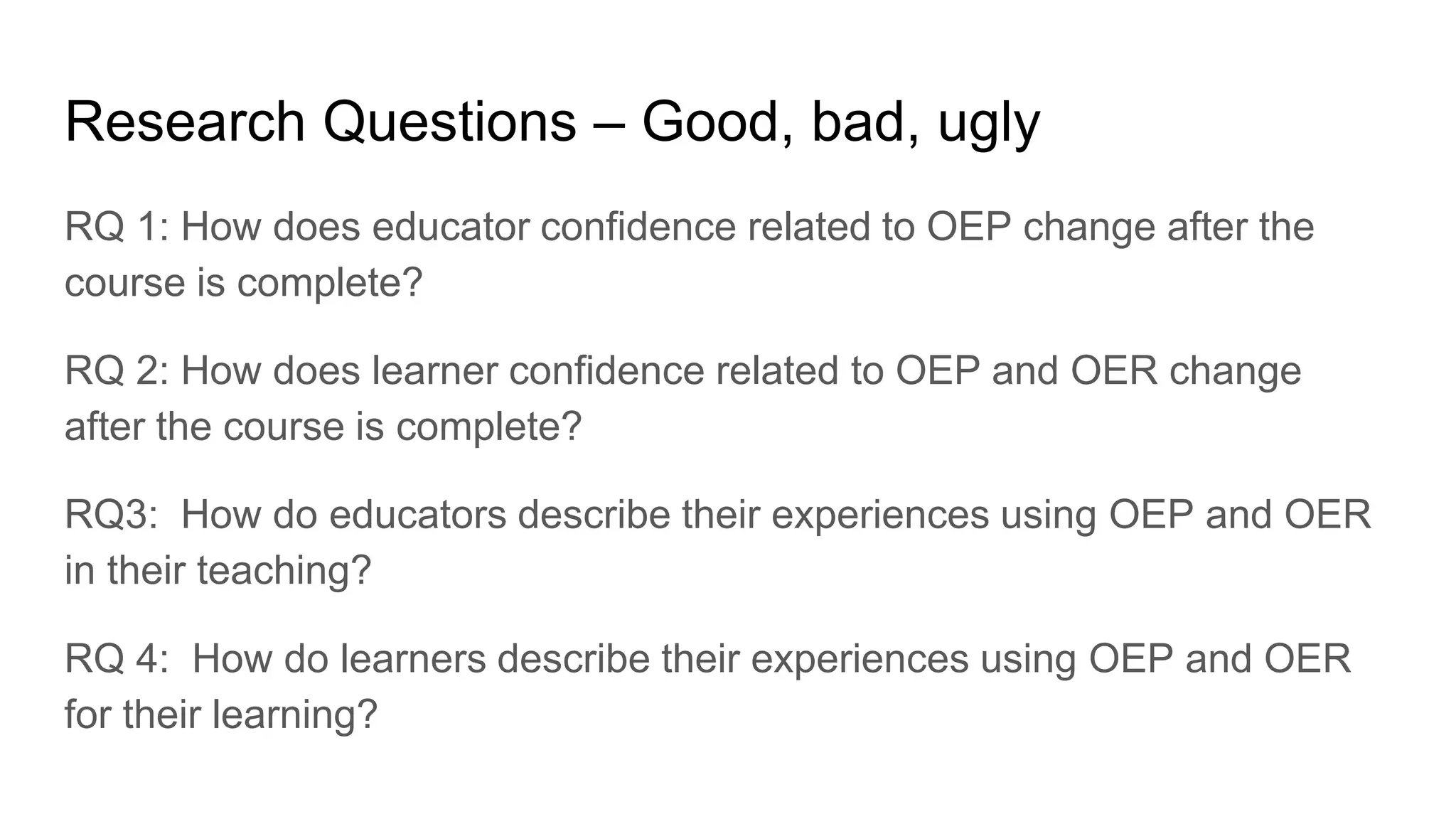
Research Questions – Good, bad, ugly
RQ 1: How does educator confidence related to OEP change after the
course is complete?
RQ 2: How does learner confidence related to OEP and OER change
after the course is complete?
RQ3: How do educators describe their experiences using OEP and OER
in their teaching?
RQ 4: How do learners describe their experiences using OEP and OER
for their learning?
pen Educational Practices
Collaborative practices that include the creation, use,
and reuse of OER and pedagogical practices
employing participatory technologies and social
networks for interaction, peer-learning, knowledge
creation and sharing, and empowerment of learners.
(Cronin, 2016)
Sustainable Development Goals (SDGs)
The Learning Design
You are seated at a table that
has a number from 1-4. This is
so you don’t have to move, but
you can if you want to.
Cloud Spaces...
Cloud options for group work and to post
any links you’d like to share:
Google Spreadsheet http://bit.ly/2mFk3Eq
jlhayman@asu.edu
Activity 1 – Group 1 (or individually)
Draw the bee
Using whatever resource you for the Cape Honey Bee
Anatomy. Draw and label the basic important anatomical
features of the bee.
You can use small paper, or large paper on the walls to
complete your drawing.
Please photograph and share on the Shared Doc you
prefer
Activity 2 – Group 2 (or individually)
Incorporate at least three of the plants you have
found that are part of the Cape Honey Bee’s food
chain and write a Haiku about them…
Reminder, Basic Haiku is
5 syllables
7 syllables
5 syllables
Activity 3 – Group 3 (or individually)
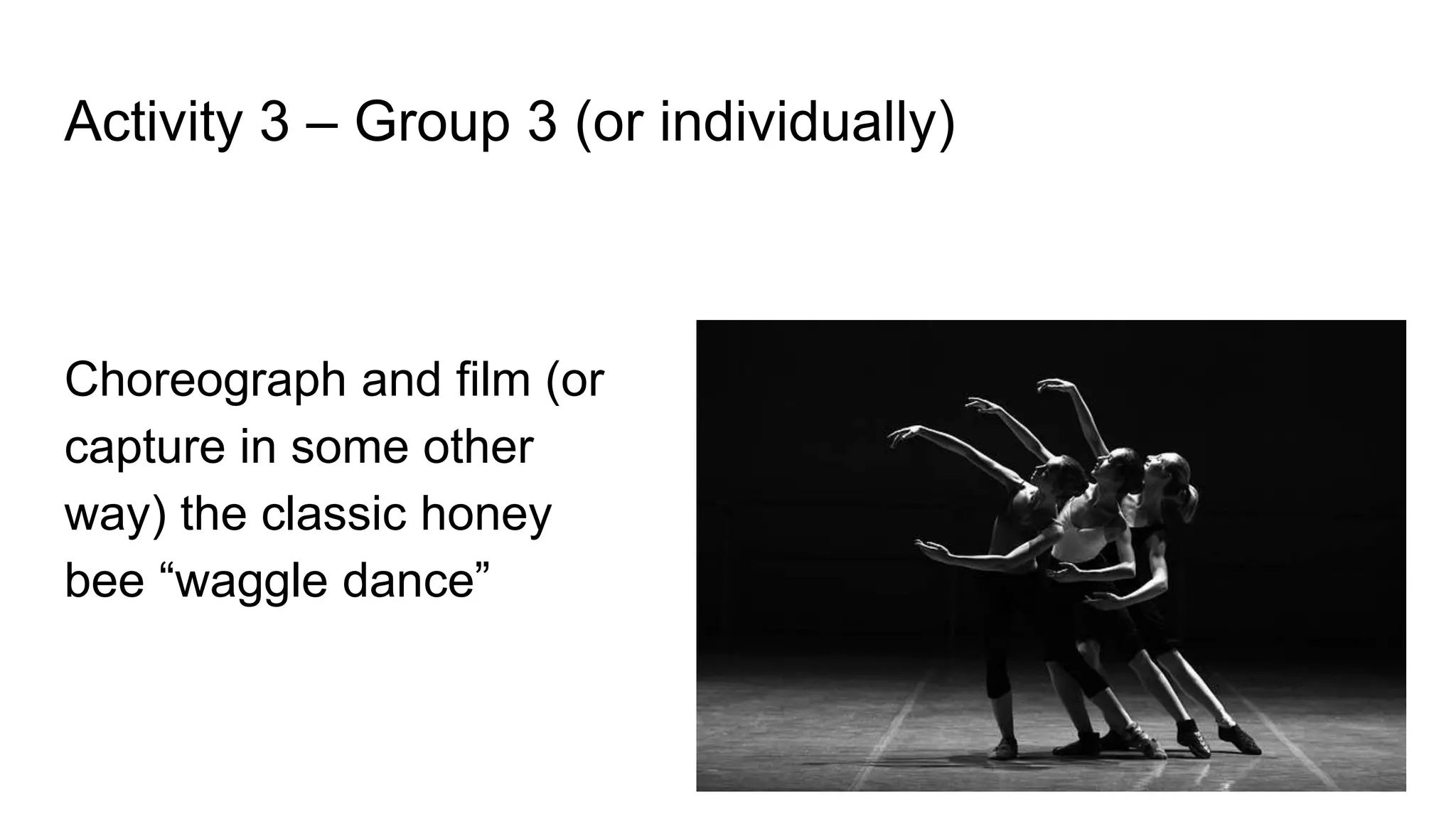
Choreograph and film (or
capture in some other
way) the classic honey
bee “waggle dance”
Activity 4 – Group 4 (or individually)
Create (draw, use your computer, or other creative
expression) an artefact that describes the natural
environment and related economic environment of the
Western Cape that might have a positive effect for recovery
of Cape Honey Bee populations.
Study Break
Explore all of the resources that have been developed by others thus far, study a
bit, then accomplish the Final Project using your group’s Google Doc as a working
space.
Activity 5 – Everyone must accomplish this one…
Develop an OER communication piece that lists several
strategies that might contribute to the recovery of the Cape
Honey Bee population.
Bee Jokes
What’s a
bee line?
The
distance
between 2
buzz stops
Standing in stakeholder shoes
Learner Shoes
What might work well, what might not work well for
you as an online learner with collaborative problem
solving tasks using open and Internet available
resources?
Educator Shoes
What might work well, what might not work well for
you as a facilitator of learning in this style? What are
your concerns?
Administrator Shoes
What might you be concerned about related to
instructors using these types of teaching and course
design strategies?
JLHayman@ASU.EDU
References:
Cronin, C. (2016). Openness and praxis (at #SRHE). Retrieved from
https://catherinecronin.wordpress.com/2016/11/28/openness-and-praxis/
Ehlers, U.-D. (2011). Extending the territory: From open educational resources to open educational
practices. Journal of Open, Flexible, and Distance Learning, 15(2), 1-10. Retrieved from
http://www.jofdl.nz/index.php/JOFDL/article/view/64/46
United Nations Educational, Scientific and Cultural Organization (UNESCO). (n.d.). Open educational
resources. Retrieved from http://www.unesco.org/new/en/communication-and-information/access-to-
knowledge/open-educational-resources/
Wikipedia. (n.d.). Cape honey bee. Retrieved from (put link here)
All images are Pixabay.com Public Domain

120 Minutes of Messy Exploration

  • 1.
    120 Minutes of MessyExploration March 9, 2017 Cape Town, South Africa Twitter @jennihayman #OEGlobal17 jlhayman@asu.edu
  • 2.
  • 4.
    Research Questions –Good, bad, ugly RQ 1: How does educator confidence related to OEP change after the course is complete? RQ 2: How does learner confidence related to OEP and OER change after the course is complete? RQ3: How do educators describe their experiences using OEP and OER in their teaching? RQ 4: How do learners describe their experiences using OEP and OER for their learning?
  • 6.
    pen Educational Practices Collaborativepractices that include the creation, use, and reuse of OER and pedagogical practices employing participatory technologies and social networks for interaction, peer-learning, knowledge creation and sharing, and empowerment of learners. (Cronin, 2016)
  • 7.
  • 8.
    The Learning Design Youare seated at a table that has a number from 1-4. This is so you don’t have to move, but you can if you want to.
  • 10.
    Cloud Spaces... Cloud optionsfor group work and to post any links you’d like to share: Google Spreadsheet http://bit.ly/2mFk3Eq jlhayman@asu.edu
  • 11.
    Activity 1 –Group 1 (or individually) Draw the bee Using whatever resource you for the Cape Honey Bee Anatomy. Draw and label the basic important anatomical features of the bee. You can use small paper, or large paper on the walls to complete your drawing. Please photograph and share on the Shared Doc you prefer
  • 12.
    Activity 2 –Group 2 (or individually) Incorporate at least three of the plants you have found that are part of the Cape Honey Bee’s food chain and write a Haiku about them… Reminder, Basic Haiku is 5 syllables 7 syllables 5 syllables
  • 13.
    Activity 3 –Group 3 (or individually) Choreograph and film (or capture in some other way) the classic honey bee “waggle dance”
  • 14.
    Activity 4 –Group 4 (or individually) Create (draw, use your computer, or other creative expression) an artefact that describes the natural environment and related economic environment of the Western Cape that might have a positive effect for recovery of Cape Honey Bee populations.
  • 15.
    Study Break Explore allof the resources that have been developed by others thus far, study a bit, then accomplish the Final Project using your group’s Google Doc as a working space.
  • 16.
    Activity 5 –Everyone must accomplish this one… Develop an OER communication piece that lists several strategies that might contribute to the recovery of the Cape Honey Bee population.
  • 17.
    Bee Jokes What’s a beeline? The distance between 2 buzz stops
  • 18.
  • 19.
    Learner Shoes What mightwork well, what might not work well for you as an online learner with collaborative problem solving tasks using open and Internet available resources?
  • 20.
    Educator Shoes What mightwork well, what might not work well for you as a facilitator of learning in this style? What are your concerns?
  • 21.
    Administrator Shoes What mightyou be concerned about related to instructors using these types of teaching and course design strategies?
  • 22.
  • 23.
    References: Cronin, C. (2016).Openness and praxis (at #SRHE). Retrieved from https://catherinecronin.wordpress.com/2016/11/28/openness-and-praxis/ Ehlers, U.-D. (2011). Extending the territory: From open educational resources to open educational practices. Journal of Open, Flexible, and Distance Learning, 15(2), 1-10. Retrieved from http://www.jofdl.nz/index.php/JOFDL/article/view/64/46 United Nations Educational, Scientific and Cultural Organization (UNESCO). (n.d.). Open educational resources. Retrieved from http://www.unesco.org/new/en/communication-and-information/access-to- knowledge/open-educational-resources/ Wikipedia. (n.d.). Cape honey bee. Retrieved from (put link here) All images are Pixabay.com Public Domain

Editor's Notes

  • #2 Welcome and thank you for joining me in this bit of craziness. Thank you to the Global OER Graduate Network for an amazing experience here in Cape Town and the opportunity to be a member of this talented network.
  • #3 I am a graduate student at Arizona State University working my doctor of education (year 2 of 3). I am an online learning designer (there’s an acronym for that) And with gratitude to Sarah Lambert for this great idea, if I add in Global, I am now GOLD…and this is why I love my networks.
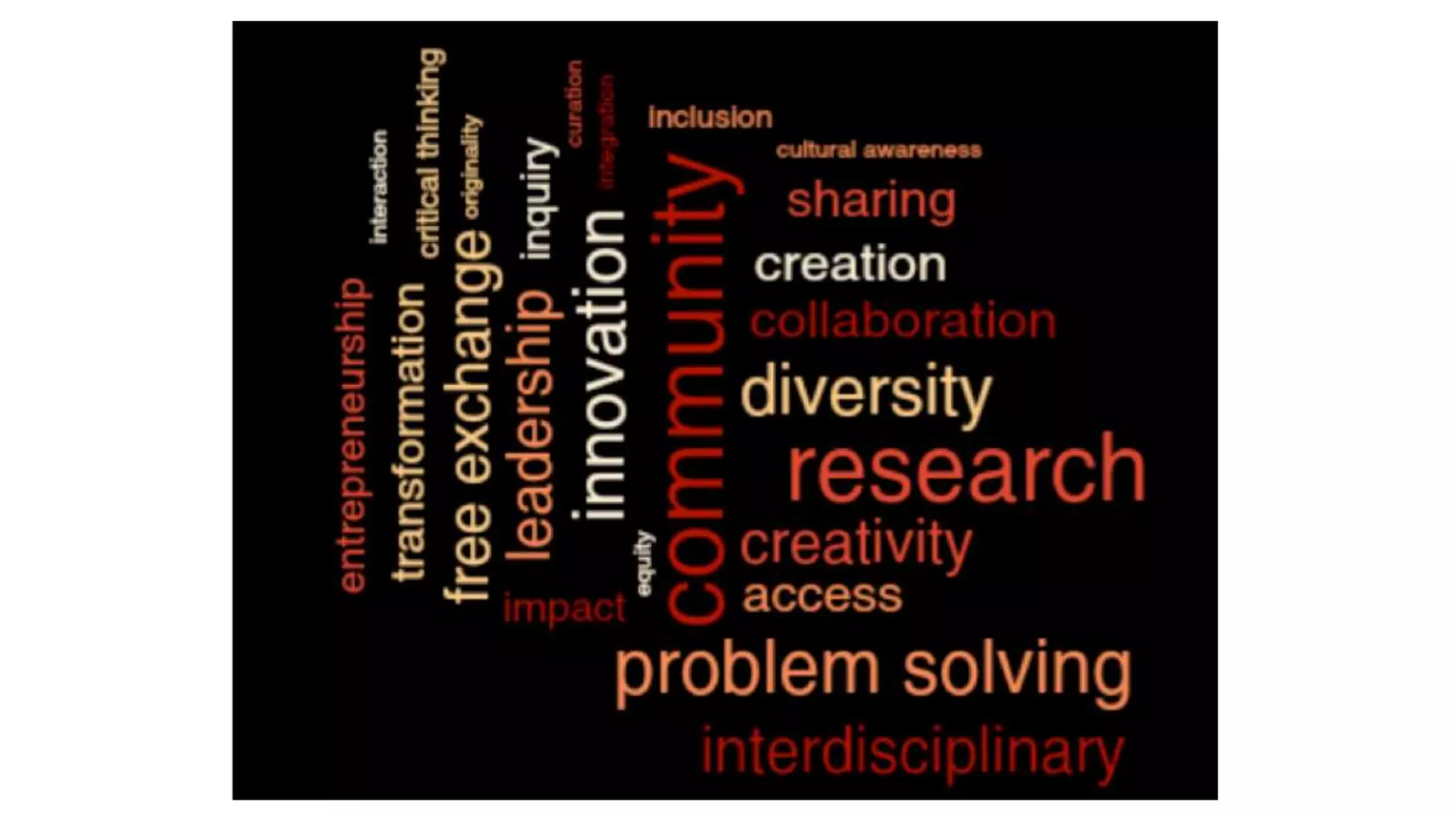
  • #4 This image represents a word cloud generated from a quick analysis of the mission and vision statements of 30 international universities. These are the skills universities wish to encourage in undergraduate learners. What I perceive as a problem is that I don’t believe we are creating learning experiences that help foster these skills. In my online context, and as part of my passion about open education, open resources and open pedaagogy it makes me ask the question… How might learner-centred online design using open educational practices and learner-discovered OER challenge the status quo and help empower learners for lifelong success? First question of the day for you…What words or skills might be missing from this word cloud that may be valuable in today’s global, connected contexts? What about generosity? Courageousness, Fearlessness, Kindness, Inclusion? How might learner-centred, collaborative designs help foster those skills? As you may have read in the introduction for this session, I am asking your permission to collect data from you today as part of our work. First let me explain my research briefly. Purpose: The purpose of my mixed-method action research study will be to examine the potential of open, collaborative online learning designs to expand the use of open educational practices (OEP) and open educational resources (OER) use among global educators and learners. Specifically: I will seek an interested online educator, partner with them to design an online learning experience based on OEP and OER and collect both quantitative and qualitative data from the educator and learners. I will include assessments that are aligned with stated learning outcomes to help demonstrate the learning design’s potential for accredited online teaching and learning. I will use a survey instrument to measure pre- and post-intervention perceptions of self-efficacy (confidence in skills) for educators and learners with respect to digital literacy (finding, adapting, and sharing OER), collaborative learning processes, and problem solving skills.
  • #5 Research Questions – I have no idea how things will turn out, but I’m looking forward to the journey.
  • #6 Research Consent - As part of my ongoing cycles of action research, I would like your permission to collect your data at today’s session, data may include your spoken word, any artifacts you create, and any digital files you wish to share with me. Participation is voluntary and any personally identifying information in the data will not be used in any part of my dissertation, other publications or future presentations. I will keep all data secure and confidential and once transcribed audio data will be deleted. I have permission to use an anonymous consent method, so a show of hands will suffice. Who will give permission for me to collect data. If your hand is not up, no problem, I will sort that out with you, please let me know when I come around, so I’ll be certain to make arrangements. Thank you so much! I have my iPhone here, and I will set it to record, please pass it around from time to time so I can pick up snippets from each table. My primary purpose in collecting data today is to receive your feedback on the learning design we’re going to explore so I can improve it for formal data collection in a complete Winter 2018 undergraduate course.
  • #7 With gratitude to Catharine Cronin, I would like to use her definition of OEP as mine is under construction.
  • #8 Learning Design – as I have not yet landed on my formal project, I’m exploring with you today a concept for an online Biology 100 undergraduate course. The course would be designed with an emphasis on learners finding resources to begin to solve some of the problems associated with achieving the UN Sustainable Development Goals. For the module you’ll be working on, the focus is on quality education, supporting learners to achieve digital literacy skills among other things. And Life on Land, in particular issues of biodiversity and endangered species. To focus your work today I’m proposing just one module about biodiversity with a local connection. I had initially said that we would be exploring 3 different learning designs, but things change, and that was one of the things that changed. So here’s the Scenario: as part of a first-year undergraduate Biology 100 course, an online module is designed to focus on a local issue of concern. This module is about the Cape Honey Bee, native to the Western Cape region of South Africa. On your table and in the link that follows shortly there is a description of the scenario, the problem, the learning outcomes and activities by Group. You will notice that at each table you have a group number, and this is so you can share the workload so that everyone achieves the learning outcomes.
  • #9 Explain the Learning Design and Outcomes….Whatever number you have, you are now part of a working group on the learning activities I’m about to describe. As part of being an inclusive task master, those that are not comfortable working in groups may work independently on the tasks assigned to your number. You are always welcome to shift work modes as we go. You will have a reminder sheet on your table about the tasks and the learning outcomes. My copy capacity was limited by a twitchy printer so you may have to share, the documents are also available electronically.
  • #10 So without further ado, let’s get messy.
  • #11 The one Google Spreadsheet contains links to Google Working Docs (no sign in needed) and Padlet docs. You are also invited to use all the paper, markers, index cards, sticky notes, and wall space sticky flip charts to conduct your work.
  • #12 Research the anatomy of the Cape Honey Bee and draw and label diagrams for your peers.
  • #13 Group two your task is to research the plants of the Western Cape, particularly the types of flowers that Cape Honey Bees use for their food supply. You will then write a Haiku (as a group, or individually), the more the better probably.
  • #14 Group 3, your task is to view a video (your choice, although you have a place to start), about the honey bee waggle dance, and choreograph a teaching moment for your peers.
  • #15 Group 4 – your task is to research the natural and economic environment of Cape Town and surrounding areas and draw, or design, an artifact that describes strategies related to those environments that might support Cape Honey Bee Recovery. You can work any way you wish in your groups, some suggestions might be, select a leader and divvy up tasks, work collectively (independently but coming together at the end), or anything in between. You don’t have a lot of time to negotiate, this is a rapid prototype kind of workshop.
  • #18 Study Time…
  • #23 Thank you! Please email me with any feedback or other ideas that you would like to share! If you are interested in a 30 minute interview with me by Skype next week or the week after I would love to talk with you about your experience.