Types of Research Design
and Exploratory Research
Transparency 5.1
Research design
RESEARCH DESIGN
The framework or plan for a study that guides the
collection and analysis of the data.
The detailed blueprint used to guide a research study
toward its objectives.
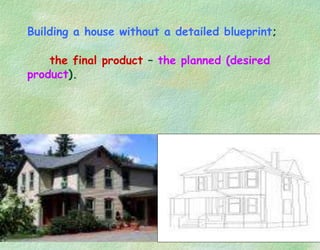
Building a house without a detailed blueprint;
the final product – the planned (desired
product).
Conducting a marketing research
without a detailed blueprint resembles
building a house without a plan.
In this situation, research findings
may differ widely from what was
desired by user of research.
Possible lament :
“These results are interesting, but
they don’t solve the basic problem”
Thus the research design ensures that
the study;
ď‚§ will be relevant to the problem
and
ď‚§ will use economical procedures
In research design efforts,
the most significant decision is the
choice of research approach, because it
determines how the information will be
obtained. Typical questions:
ď‚§ Should we rely on secondary sources such as the
census
ď‚§ What is more appropriate, an exploratory approach
with group discussions or a survey?
ď‚§ Is a mail, telephone, or personal interview survey
better for this problem?
Transparency 5.2
Types of research designs
Copyright © 2001 by Harcourt, Inc.
All Rights Reserved
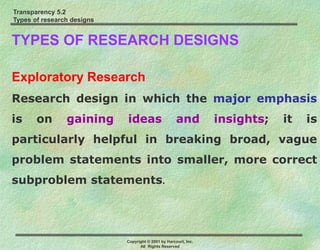
TYPES OF RESEARCH DESIGNS
Exploratory Research
Research design in which the major emphasis
is on gaining ideas and insights; it is
particularly helpful in breaking broad, vague
problem statements into smaller, more correct
subproblem statements.
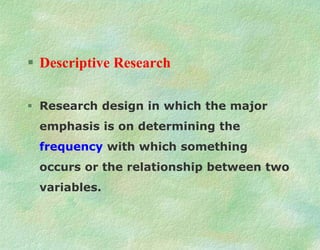
ď‚§ Descriptive Research
ď‚§ Research design in which the major
emphasis is on determining the
frequency with which something
occurs or the relationship between two
variables.
Transparency 5.3
Casual research
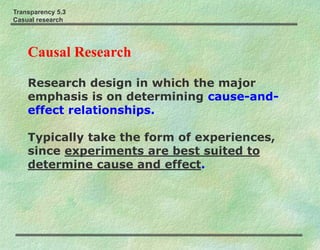
Causal Research
Research design in which the major
emphasis is on determining cause-and-
effect relationships.
Typically take the form of experiences,
since experiments are best suited to
determine cause and effect.
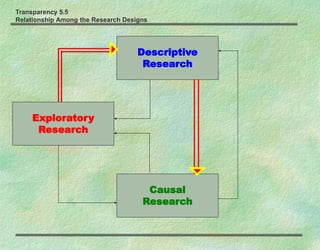
Transparency 5.5
Relationship Among the Research Designs
Descriptive
Research
Exploratory
Research
Causal
Research
Example: Disposable Diaper market
 Brand X’s share of disposable diaper market is
slipping. Why? (explatory study)
ď‚§ Brand X is an economy-priced diaper and it is
designed to compete with low-cost-store brand
diapers. Families with children have more money
than when the brand was first introduced and are
willing to pay that our market share would
decrease. (descriptive study)
ď‚§ Why parents are willing to pay more for higher-
quality diapers if so what features such as better
fit or greater absorbency were most important
them. (causal study)
ď‚§ In the early stages of research, companies
usually lack sufficient understanding of the
problem to formulate specific hypotheses. There
may be several tentative explanations for a
given marketing phenomenon.
 Ex : sales are off because the company’s price is
too high, company’s dealers are not doing the job
as they should, or advertisements are weak, and
so on.
ď‚§ Exploratory research is used to establish priorities in
studying these competing explanations and their influence
on
Transparency 5.4
Hypothesis
HYPOTHESIS
A statement that specifies how two or
more measurable variables are related.
ď‚§ Exploratory study is often an initial step. When
researchers begin an investigation, it stands to reason
that they lack a great deal of knowledge about the
problem. Consider ;
mavi’s share of unisex shirts market is slipping. Why?
This statement is too broad to serve as a guide for
research. To narrow and refine it would logically be
accomplished with exploratory research , in which the
emphasis would be on finding possible
explanations for the sales decrease.
The tentative explanations would then serve as specific
guides for descriptive or causal studies.
ď‚§ Exploratory research is useful for establishing
priorities among research questions and for
learning about the practical problems of carrying
out the research.
ď‚§ What kinds of questions will respondents be able to
answer?
ď‚§ What are the barriers to contacting the
appropriate respondents?
ď‚§ When should the study be conducted?
In sum, Exploratory Research is used any or all of
the following purposes:
ď‚§ Formulating a problem for more precise
investigation,
ď‚§ Developing hypothesis,
ď‚§ Establishing priorities for several competing
explanations.
ď‚§ Increasing the researcher's familiarity with the
problem,
ď‚§ Gathering information about practical problems of
carrying out research on particular issues
ď‚§ Clarifying concepts
Exploratory study may be used to clarify concepts.
ď‚§ For instance, if marketing management is planning
a change in service policy to increase dealer
satisfaction, an exploratory study may be used
1 ) to clarify what is meant by dealer satisfaction
2 ) to develop a method by which dealer
satisfaction could be measured.
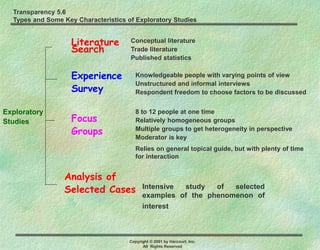
Types of exploratory research
ď‚§ Literature search
ď‚§ Experience survey
ď‚§ Focus groups
ď‚§ Analysis of selected cases
Transparency 5.6
Types and Some Key Characteristics of Exploratory Studies
Conceptual literature
Trade literature
Published statistics
Knowledgeable people with varying points of view
Unstructured and informal interviews
Respondent freedom to choose factors to be discussed
8 to 12 people at one time
Relatively homogeneous groups
Multiple groups to get heterogeneity in perspective
Moderator is key
Relies on general topical guide, but with plenty of time
for interaction
Exploratory
Studies
Literature
Search
Experience
Survey
Focus
Groups
Analysis of
Selected Cases
Copyright © 2001 by Harcourt, Inc.
All Rights Reserved
Intensive study of selected
examples of the phenomenon of
interest
Transparency 5.7
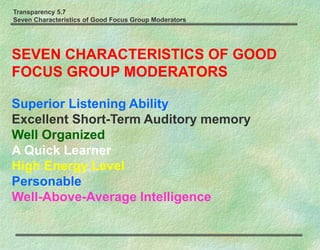
Seven Characteristics of Good Focus Group Moderators
SEVEN CHARACTERISTICS OF GOOD
FOCUS GROUP MODERATORS
Superior Listening Ability
Excellent Short-Term Auditory memory
Well Organized
A Quick Learner
High Energy Level
Personable
Well-Above-Average Intelligence
Transparency 5.9
Analysis of selected cases
ANALYSIS OF SELECTED CASES
Intensive study of selected examples of the
phenomenon of interest.

Research design.ppt

  • 1.
    Types of ResearchDesign and Exploratory Research
  • 2.
    Transparency 5.1 Research design RESEARCHDESIGN The framework or plan for a study that guides the collection and analysis of the data. The detailed blueprint used to guide a research study toward its objectives.
  • 3.
    Building a housewithout a detailed blueprint; the final product – the planned (desired product).
  • 4.
    Conducting a marketingresearch without a detailed blueprint resembles building a house without a plan. In this situation, research findings may differ widely from what was desired by user of research.
  • 5.
    Possible lament : “Theseresults are interesting, but they don’t solve the basic problem”
  • 6.
    Thus the researchdesign ensures that the study; ď‚§ will be relevant to the problem and ď‚§ will use economical procedures
  • 7.
    In research designefforts, the most significant decision is the choice of research approach, because it determines how the information will be obtained. Typical questions: ď‚§ Should we rely on secondary sources such as the census ď‚§ What is more appropriate, an exploratory approach with group discussions or a survey? ď‚§ Is a mail, telephone, or personal interview survey better for this problem?
  • 8.
    Transparency 5.2 Types ofresearch designs Copyright © 2001 by Harcourt, Inc. All Rights Reserved TYPES OF RESEARCH DESIGNS Exploratory Research Research design in which the major emphasis is on gaining ideas and insights; it is particularly helpful in breaking broad, vague problem statements into smaller, more correct subproblem statements.
  • 9.
    ď‚§ Descriptive Research ď‚§Research design in which the major emphasis is on determining the frequency with which something occurs or the relationship between two variables.
  • 10.
    Transparency 5.3 Casual research CausalResearch Research design in which the major emphasis is on determining cause-and- effect relationships. Typically take the form of experiences, since experiments are best suited to determine cause and effect.
  • 11.
    Transparency 5.5 Relationship Amongthe Research Designs Descriptive Research Exploratory Research Causal Research
  • 12.
    Example: Disposable Diapermarket  Brand X’s share of disposable diaper market is slipping. Why? (explatory study)  Brand X is an economy-priced diaper and it is designed to compete with low-cost-store brand diapers. Families with children have more money than when the brand was first introduced and are willing to pay that our market share would decrease. (descriptive study)  Why parents are willing to pay more for higher- quality diapers if so what features such as better fit or greater absorbency were most important them. (causal study)
  • 13.
     In theearly stages of research, companies usually lack sufficient understanding of the problem to formulate specific hypotheses. There may be several tentative explanations for a given marketing phenomenon.  Ex : sales are off because the company’s price is too high, company’s dealers are not doing the job as they should, or advertisements are weak, and so on.  Exploratory research is used to establish priorities in studying these competing explanations and their influence on
  • 14.
    Transparency 5.4 Hypothesis HYPOTHESIS A statementthat specifies how two or more measurable variables are related.
  • 15.
     Exploratory studyis often an initial step. When researchers begin an investigation, it stands to reason that they lack a great deal of knowledge about the problem. Consider ; mavi’s share of unisex shirts market is slipping. Why? This statement is too broad to serve as a guide for research. To narrow and refine it would logically be accomplished with exploratory research , in which the emphasis would be on finding possible explanations for the sales decrease. The tentative explanations would then serve as specific guides for descriptive or causal studies.
  • 16.
    ď‚§ Exploratory researchis useful for establishing priorities among research questions and for learning about the practical problems of carrying out the research. ď‚§ What kinds of questions will respondents be able to answer? ď‚§ What are the barriers to contacting the appropriate respondents? ď‚§ When should the study be conducted?
  • 17.
    In sum, ExploratoryResearch is used any or all of the following purposes: ď‚§ Formulating a problem for more precise investigation, ď‚§ Developing hypothesis, ď‚§ Establishing priorities for several competing explanations. ď‚§ Increasing the researcher's familiarity with the problem, ď‚§ Gathering information about practical problems of carrying out research on particular issues ď‚§ Clarifying concepts
  • 18.
    Exploratory study maybe used to clarify concepts. ď‚§ For instance, if marketing management is planning a change in service policy to increase dealer satisfaction, an exploratory study may be used 1 ) to clarify what is meant by dealer satisfaction 2 ) to develop a method by which dealer satisfaction could be measured.
  • 19.
    Types of exploratoryresearch ď‚§ Literature search ď‚§ Experience survey ď‚§ Focus groups ď‚§ Analysis of selected cases
  • 20.
    Transparency 5.6 Types andSome Key Characteristics of Exploratory Studies Conceptual literature Trade literature Published statistics Knowledgeable people with varying points of view Unstructured and informal interviews Respondent freedom to choose factors to be discussed 8 to 12 people at one time Relatively homogeneous groups Multiple groups to get heterogeneity in perspective Moderator is key Relies on general topical guide, but with plenty of time for interaction Exploratory Studies Literature Search Experience Survey Focus Groups Analysis of Selected Cases Copyright © 2001 by Harcourt, Inc. All Rights Reserved Intensive study of selected examples of the phenomenon of interest
  • 21.
    Transparency 5.7 Seven Characteristicsof Good Focus Group Moderators SEVEN CHARACTERISTICS OF GOOD FOCUS GROUP MODERATORS Superior Listening Ability Excellent Short-Term Auditory memory Well Organized A Quick Learner High Energy Level Personable Well-Above-Average Intelligence
  • 22.
    Transparency 5.9 Analysis ofselected cases ANALYSIS OF SELECTED CASES Intensive study of selected examples of the phenomenon of interest.