Business Research
Design
Plan for a study
Blue print to carry out the study
Types of Research design
•Exploratory
•Descriptive
•Causal research
Exploratory Research
• Converting broad, vague problem statements into
small, precise problem statements
• Early stages of research
• To formulate hypothesis
Characteristics of Exploratory Reserach
• It is flexible and versatile
• Data collection structured forms are not used
• Experimentation is not a requirement
• Cost is low
• Possibility of exploration of views
What circumstances is exploratory study ideal?
• To gain insight into the problem
• To generate new product ideas
• To assess the various alternatives
• To develop hypothesis
• To clarify concepts and formulating precise problems
• To pretest a draft questionnaire
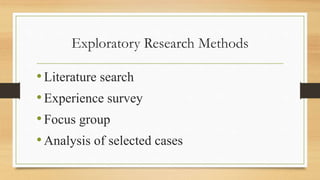
Exploratory Research Methods
•Literature search
•Experience survey
•Focus group
•Analysis of selected cases
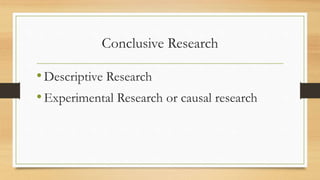
Conclusive Research
•Descriptive Research
•Experimental Research or causal research
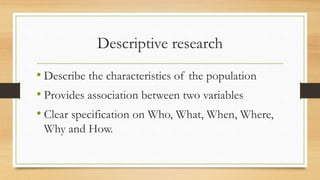
Descriptive research
• Describe the characteristics of the population
• Provides association between two variables
• Clear specification on Who, What, When, Where,
Why and How.
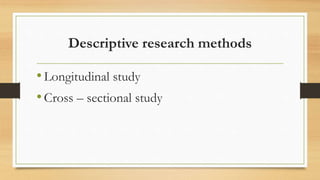
Descriptive research methods
•Longitudinal study
•Cross – sectional study
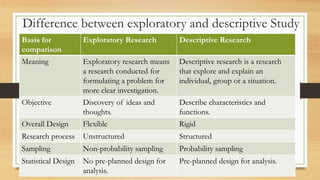
Difference between exploratory and descriptive Study
Basis for
comparison
Exploratory Research Descriptive Research
Meaning Exploratory research means
a research conducted for
formulating a problem for
more clear investigation.
Descriptive research is a research
that explore and explain an
individual, group or a situation.
Objective Discovery of ideas and
thoughts.
Describe characteristics and
functions.
Overall Design Flexible Rigid
Research process Unstructured Structured
Sampling Non-probability sampling Probability sampling
Statistical Design No pre-planned design for
analysis.
Pre-planned design for analysis.

RM_2.pptx

  • 1.
    Business Research Design Plan fora study Blue print to carry out the study
  • 2.
    Types of Researchdesign •Exploratory •Descriptive •Causal research
  • 3.
    Exploratory Research • Convertingbroad, vague problem statements into small, precise problem statements • Early stages of research • To formulate hypothesis
  • 4.
    Characteristics of ExploratoryReserach • It is flexible and versatile • Data collection structured forms are not used • Experimentation is not a requirement • Cost is low • Possibility of exploration of views
  • 5.
    What circumstances isexploratory study ideal? • To gain insight into the problem • To generate new product ideas • To assess the various alternatives • To develop hypothesis • To clarify concepts and formulating precise problems • To pretest a draft questionnaire
  • 6.
    Exploratory Research Methods •Literaturesearch •Experience survey •Focus group •Analysis of selected cases
  • 7.
  • 8.
    Descriptive research • Describethe characteristics of the population • Provides association between two variables • Clear specification on Who, What, When, Where, Why and How.
  • 9.
    Descriptive research methods •Longitudinalstudy •Cross – sectional study
  • 10.
    Difference between exploratoryand descriptive Study Basis for comparison Exploratory Research Descriptive Research Meaning Exploratory research means a research conducted for formulating a problem for more clear investigation. Descriptive research is a research that explore and explain an individual, group or a situation. Objective Discovery of ideas and thoughts. Describe characteristics and functions. Overall Design Flexible Rigid Research process Unstructured Structured Sampling Non-probability sampling Probability sampling Statistical Design No pre-planned design for analysis. Pre-planned design for analysis.