“Extraordinary claims
require extraordinary
evidence.”
– Carl Sagan
Reading
Critical
the reader analyzes and interprets the reading
material
to understand the text’s deeper meaning; a way
of knowing how the writer thinks
going beyond what the words say and getting at
the important message of the text
INTERPRETING
finding a deeper meaning than
what is explicitly stated in the text
Example:
In this world tinted with envy and deception,
she’s the modern-day Maria Clara.
What does the author mean with Maria Clara?
INFERRING
“reading between the line”
putting together the author’s ideas and coming up with an implicitly
stated idea based on those given ideas.
Example:
I am certain it was Tuesday.
I walked straight into a fancy “turo-turo” near my place to grab lunch.
When I arrived, a small commotion caused some of the customers to
glance at the ruckus. I never paid attention, I was hungry and that’s
what mattered to me.
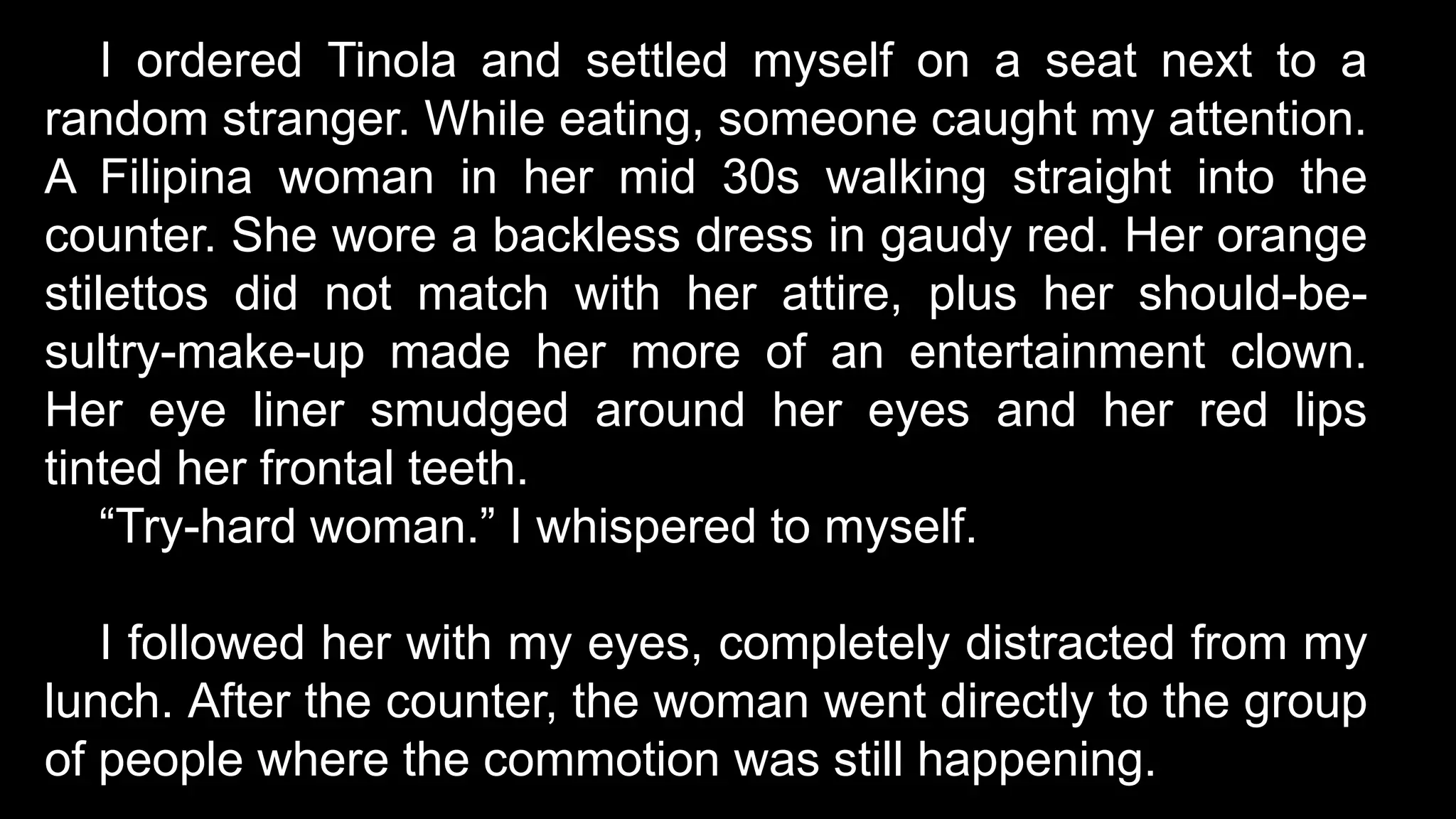
I ordered Tinola and settled myself on a seat next to a
random stranger. While eating, someone caught my attention.
A Filipina woman in her mid 30s walking straight into the
counter. She wore a backless dress in gaudy red. Her orange
stilettos did not match with her attire, plus her should-be-
sultry-make-up made her more of an entertainment clown.
Her eye liner smudged around her eyes and her red lips
tinted her frontal teeth.
“Try-hard woman.” I whispered to myself.
I followed her with my eyes, completely distracted from my
lunch. After the counter, the woman went directly to the group
of people where the commotion was still happening.
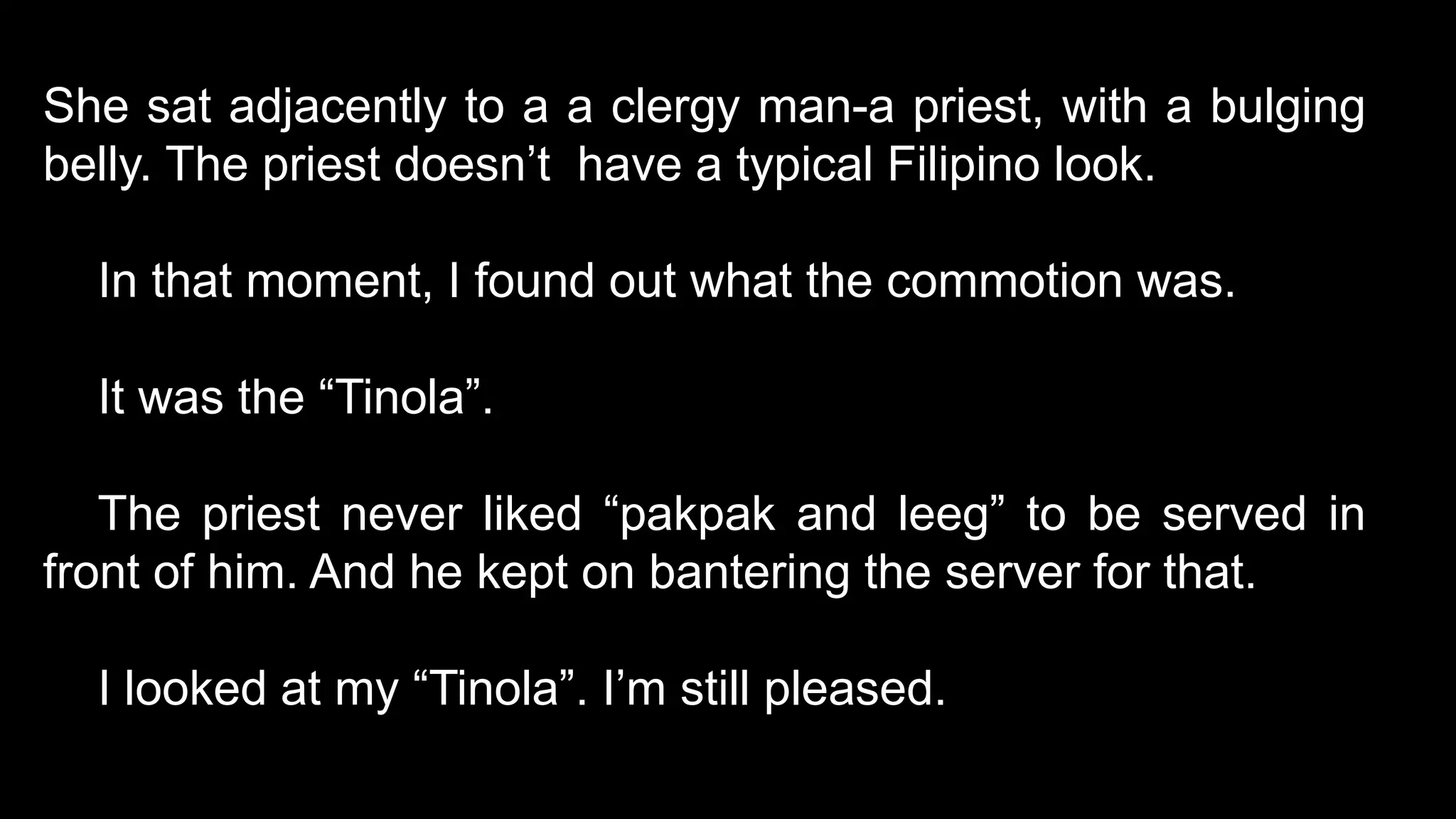
She sat adjacently to a a clergy man-a priest, with a bulging
belly. The priest doesn’t have a typical Filipino look.
In that moment, I found out what the commotion was.
It was the “Tinola”.
The priest never liked “pakpak and leeg” to be served in
front of him. And he kept on bantering the server for that.
I looked at my “Tinola”. I’m still pleased.
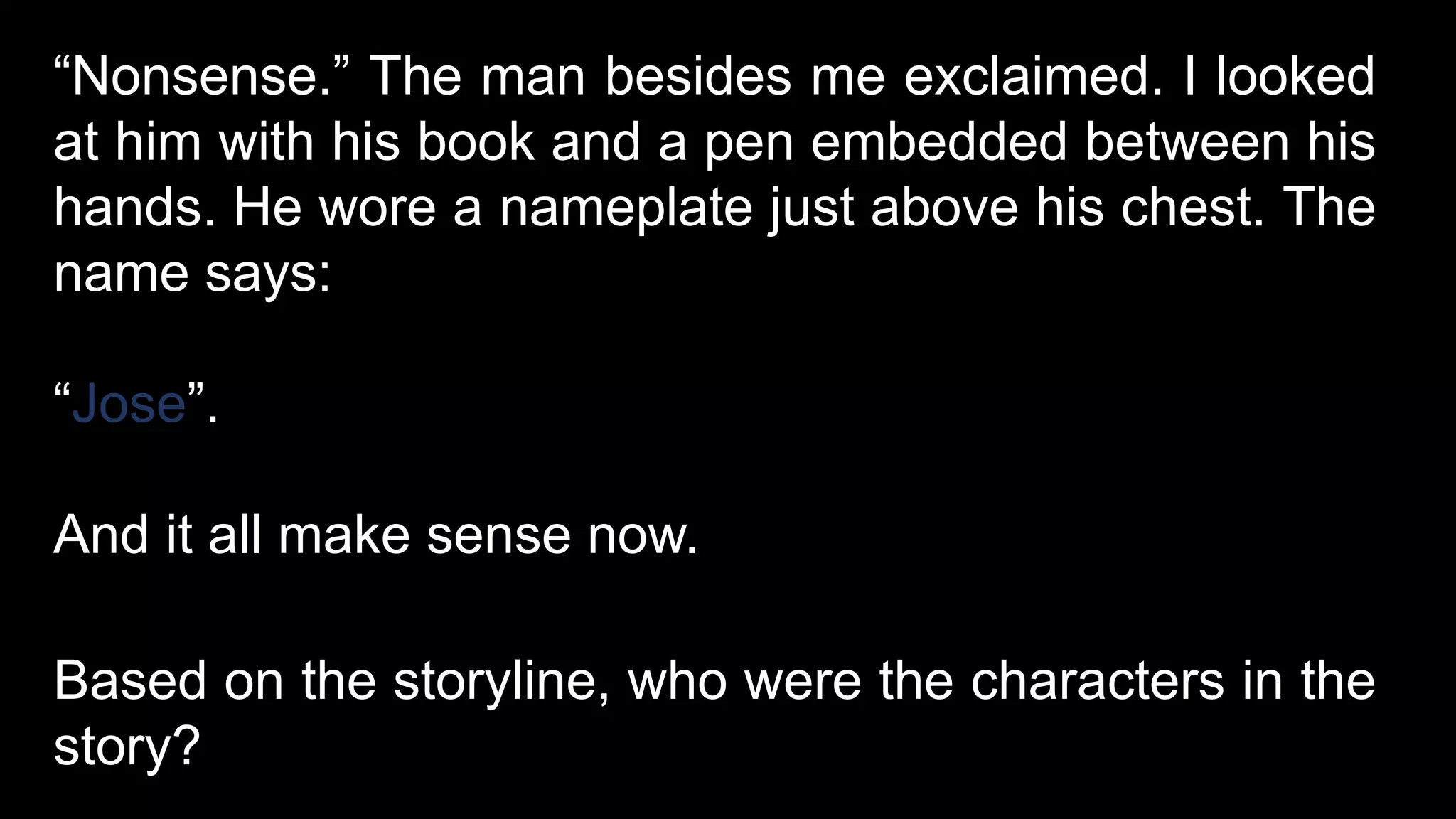
“Nonsense.” The man besides me exclaimed. I looked
at him with his book and a pen embedded between his
hands. He wore a nameplate just above his chest. The
name says:
“Jose”.
And it all make sense now.
Based on the storyline, who were the characters in the
story?
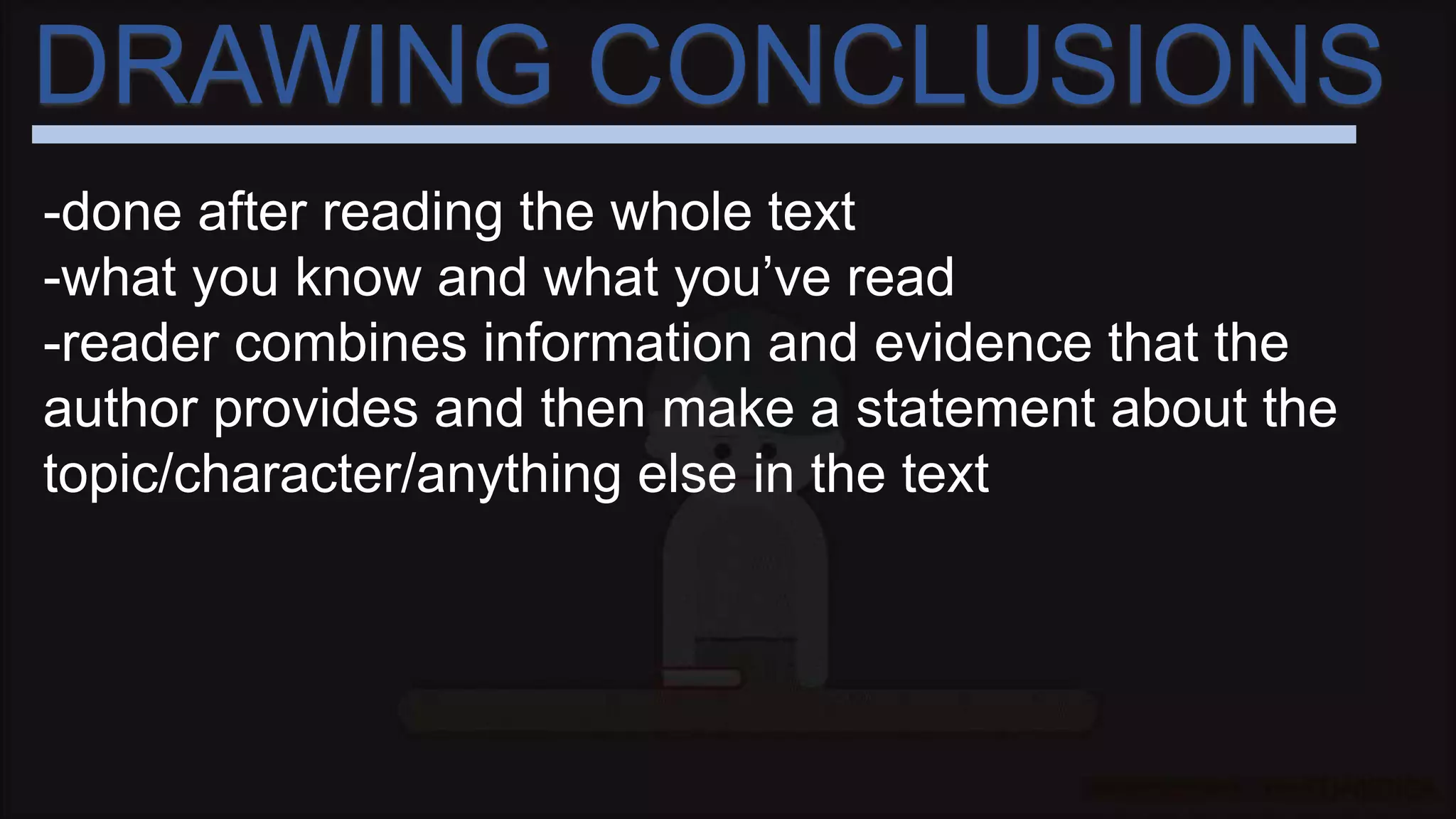
DRAWING CONCLUSIONS
-done after reading the whole text
-what you know and what you’ve read
-reader combines information and evidence that the
author provides and then make a statement about the
topic/character/anything else in the text
ANALYZING
looking at separate, detailed parts of the text to understand
the entire text.
taking apart the ideas and see how they connect with each
other to support the main idea of the text.
Example:
A doctor making a diagnosis based on her patient’s condition.
DISTINGUISHING FACT FROM
OPINION
• Facts = statements that can be proved true or false by
using reliable sources such as encyclopedia
• Opinions = beliefs or judgments
• Fact = idea that is already proven and is obviously true.
• Opinion = an unverified idea; may or may not be true
EVALUATING
forming an opinion or making a judgment about
something being read
Example:
Reviews
PREDICTING
making intelligent guess about what will happen
next in a text
Example:
Making Investigatory Projects
SYNTHESIZING
combining/connecting ideas to form a coherent
whole which serves as your new understanding.
Example:
Making a Research Paper
“Explicit and Implicit
Claims in a Text.”
CLAIMS
a statement that is not considered accepted by
all
may be unverified or controversial to a certain
degree
usually related to one side of an issue
 also called a position
CLAIMS of
• FACT
• VALUE
• POLICY
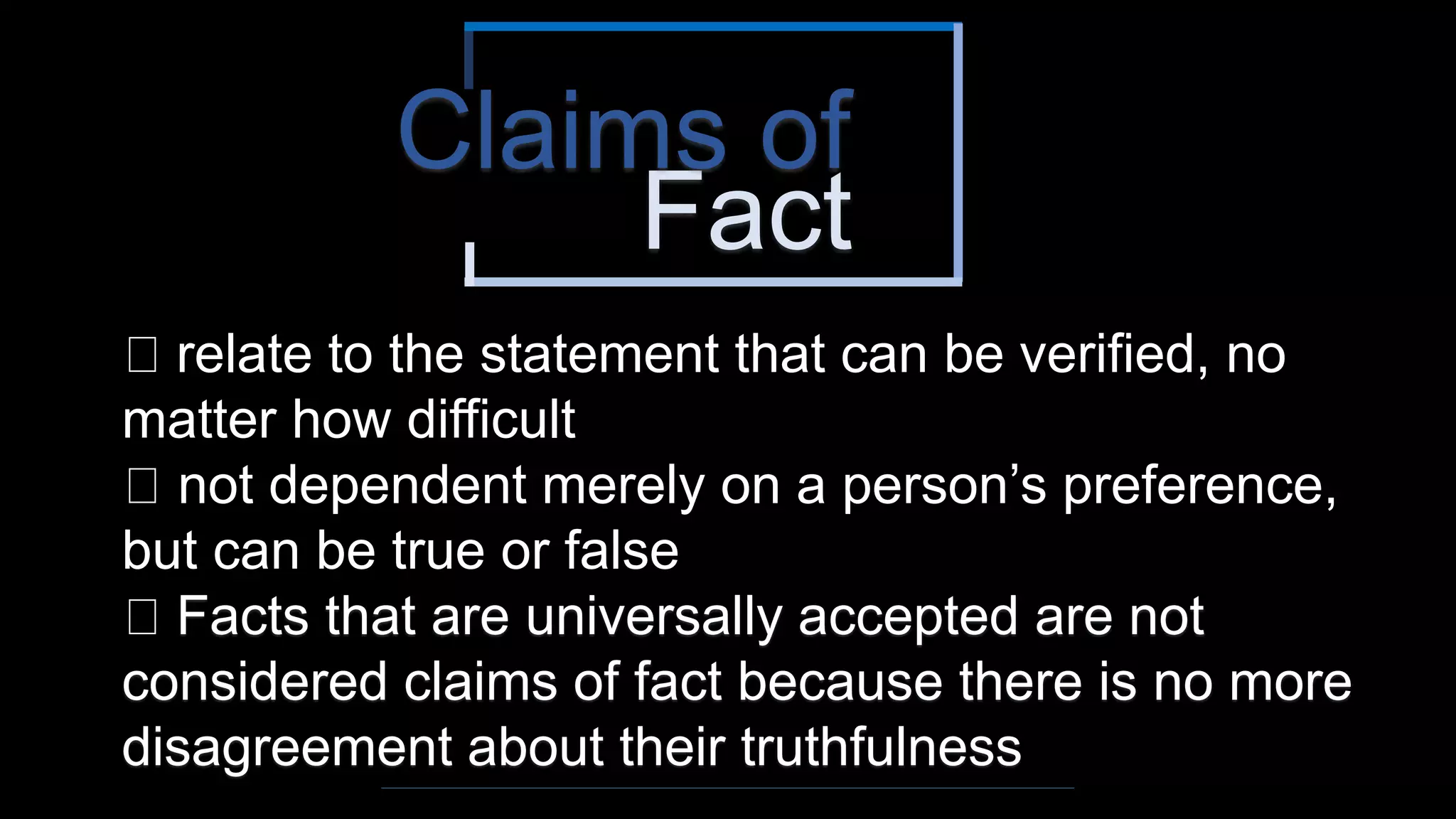
Fact
Claims of
relate to the statement that can be verified, no
matter how difficult
not dependent merely on a person’s preference,
but can be true or false
Facts that are universally accepted are not
considered claims of fact because there is no more
disagreement about their truthfulness
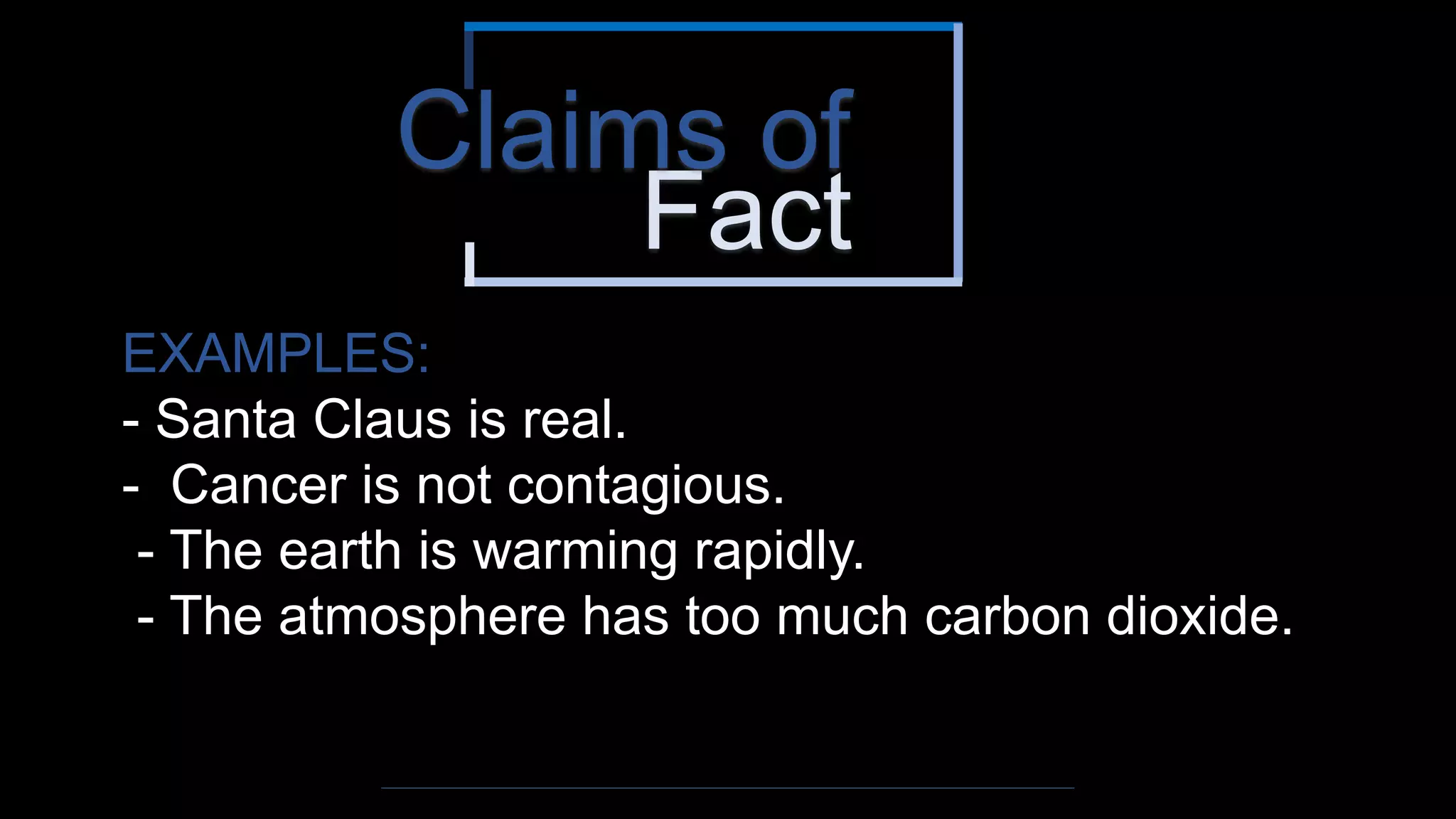
Fact
Claims of
EXAMPLES:
- Santa Claus is real.
- Cancer is not contagious.
- The earth is warming rapidly.
- The atmosphere has too much carbon dioxide.
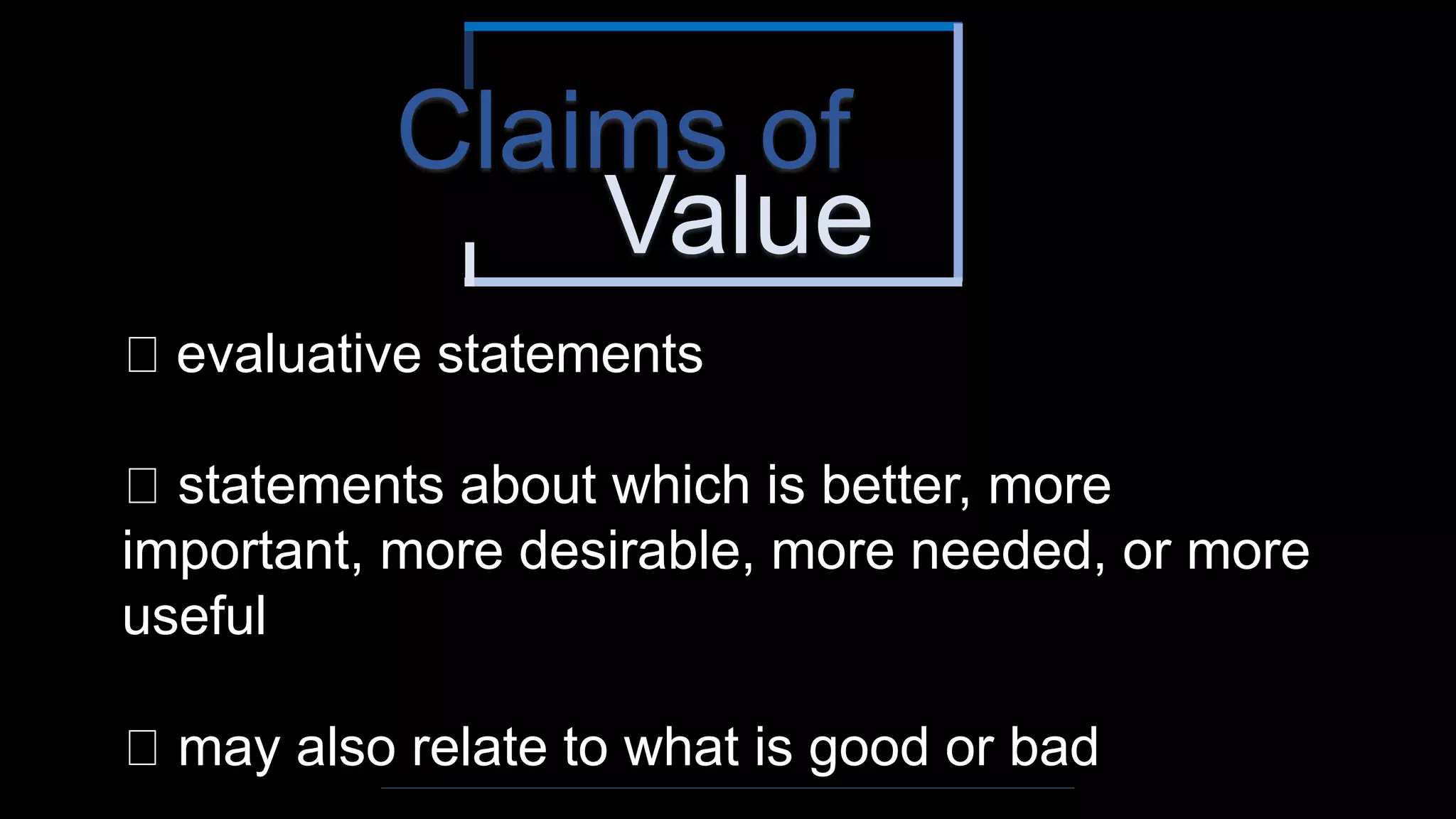
Value
Claims of
evaluative statements
statements about which is better, more
important, more desirable, more needed, or more
useful
may also relate to what is good or bad
Value
Claims of
EXAMPLES:
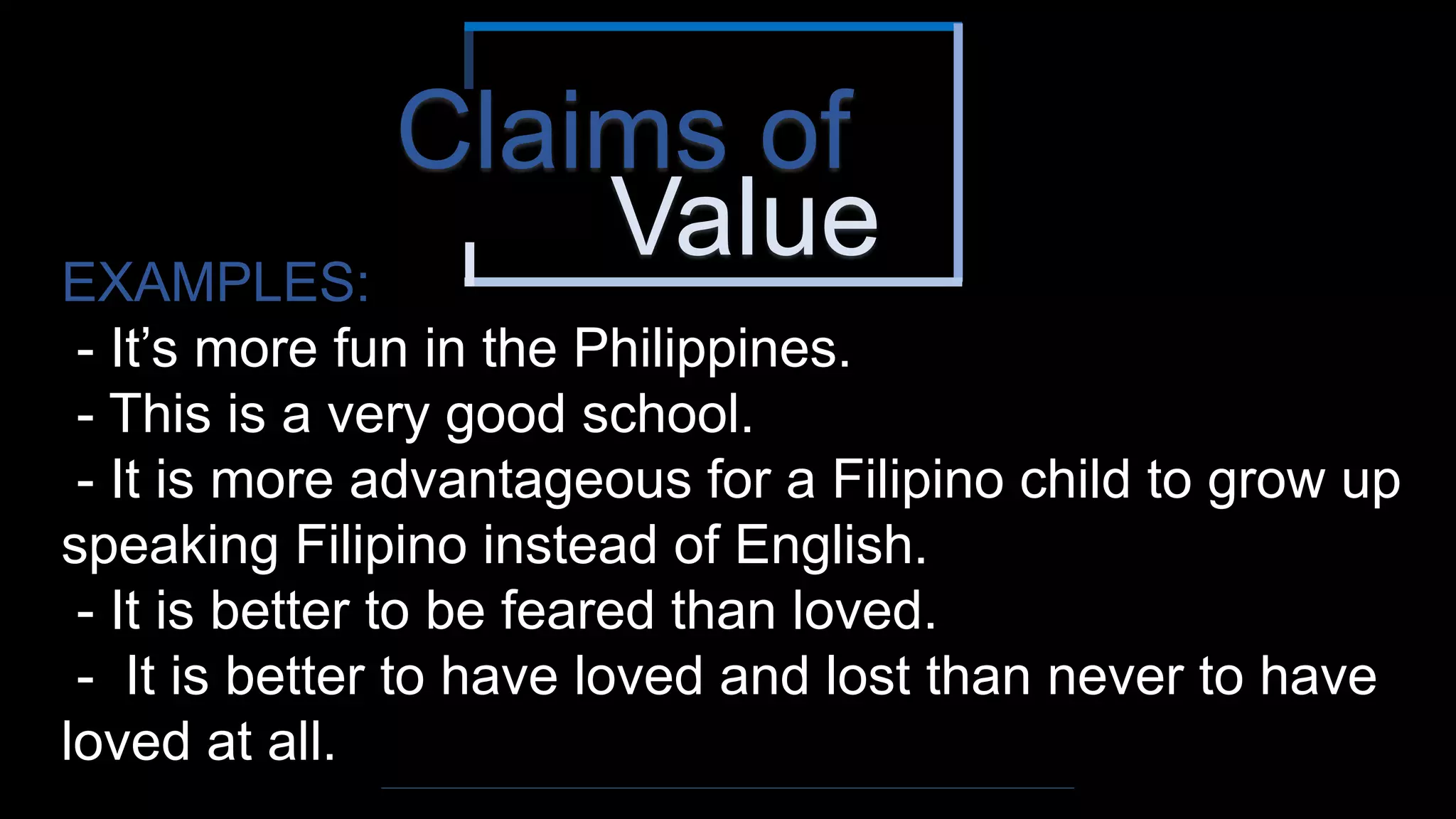
- It’s more fun in the Philippines.
- This is a very good school.
- It is more advantageous for a Filipino child to grow up
speaking Filipino instead of English.
- It is better to be feared than loved.
- It is better to have loved and lost than never to have
loved at all.
Policy
Claims of
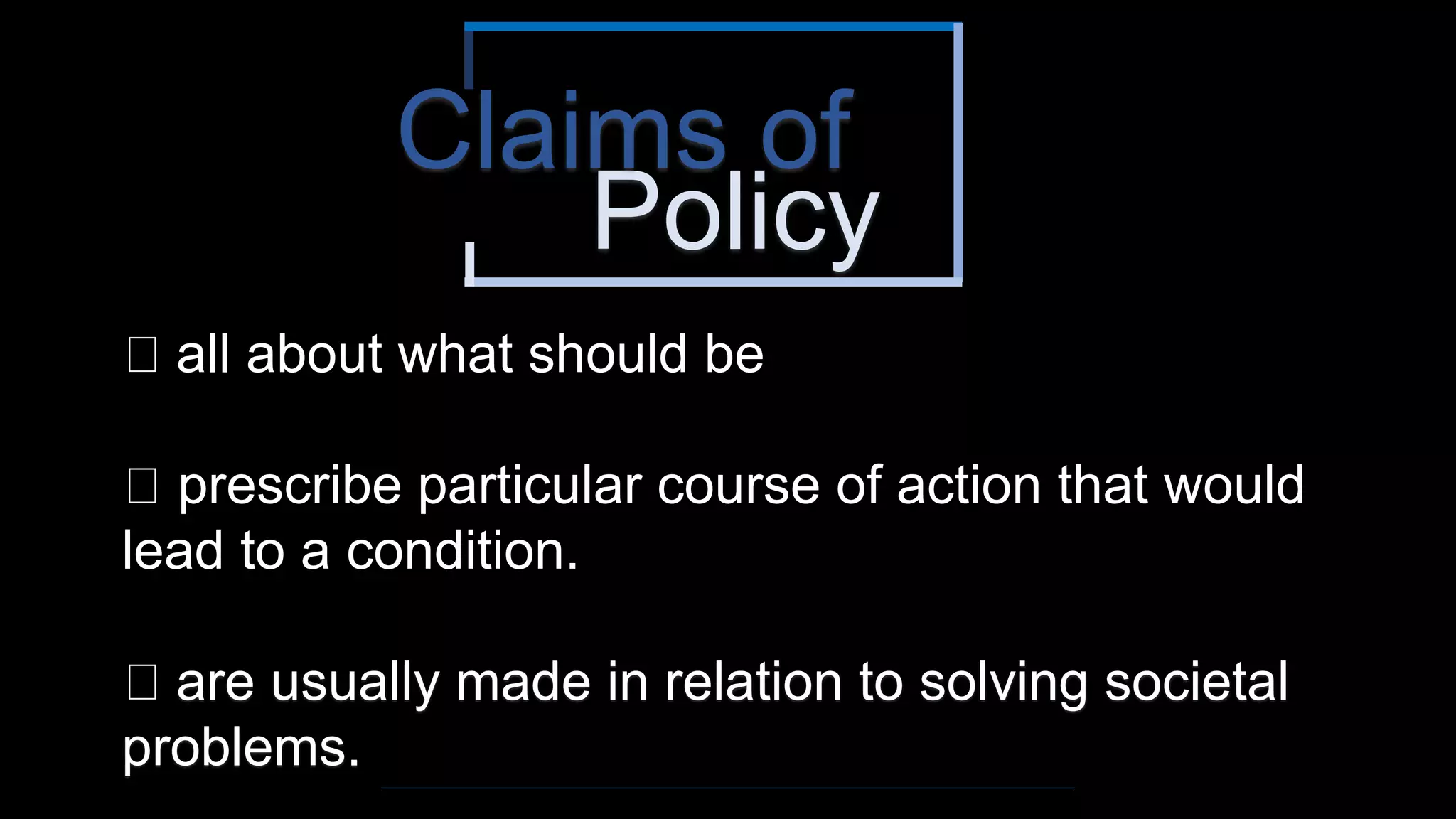
all about what should be
prescribe particular course of action that would
lead to a condition.
are usually made in relation to solving societal
problems.
Policy
Claims of
EXAMPLES:
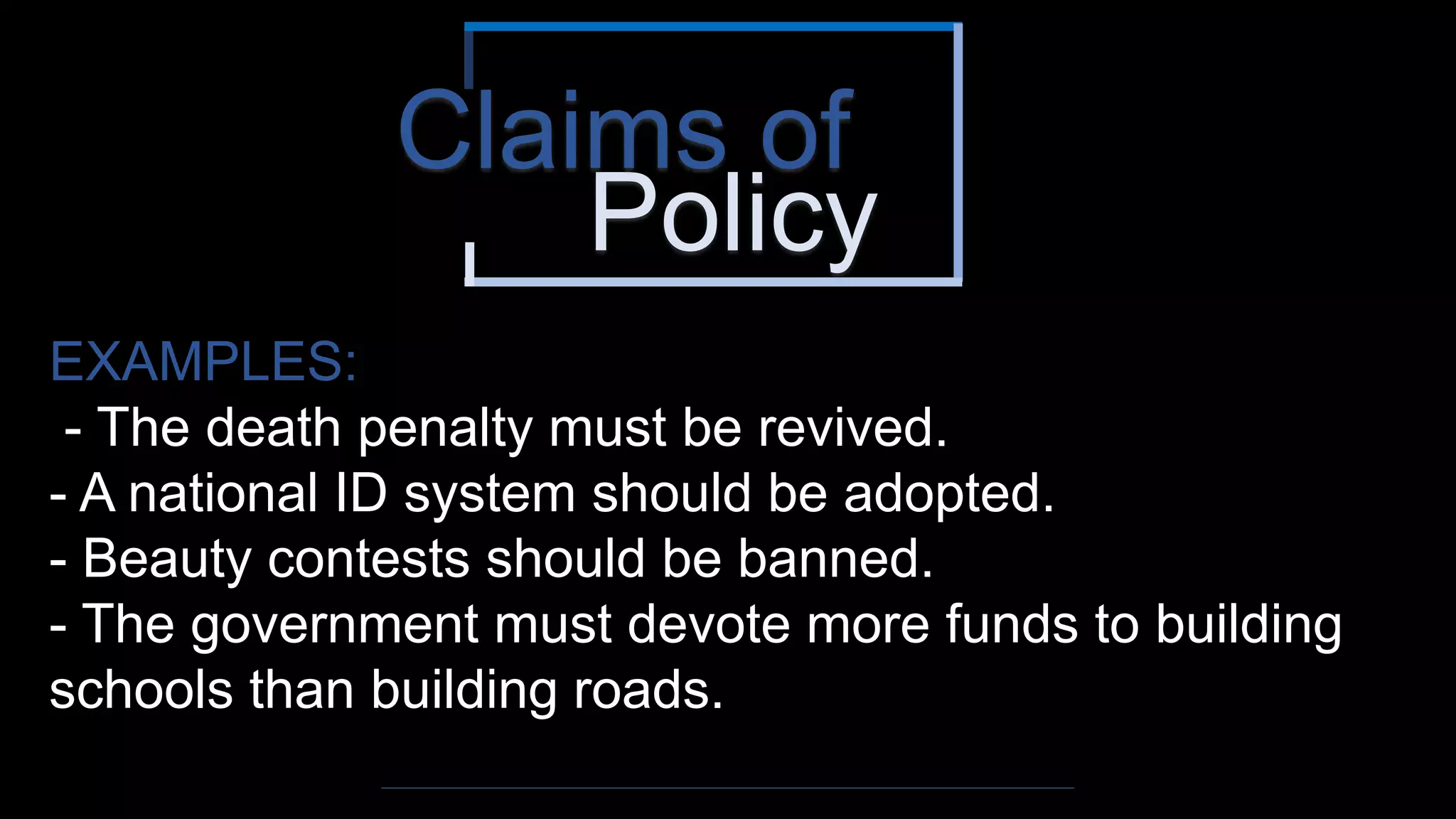
- The death penalty must be revived.
- A national ID system should be adopted.
- Beauty contests should be banned.
- The government must devote more funds to building
schools than building roads.
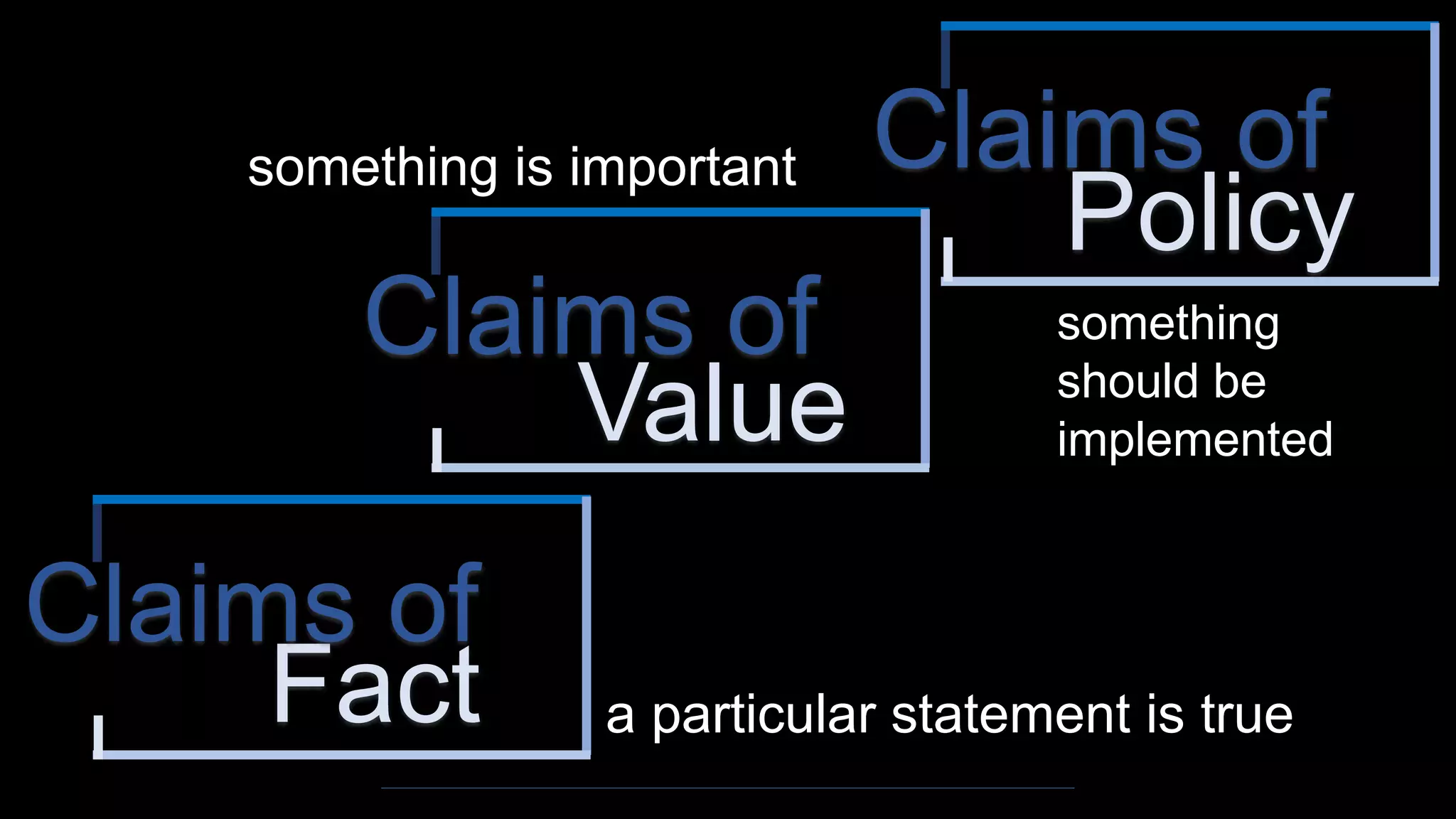
Policy
Claims of
Value
Claims of
Fact
Claims of
something
should be
implemented
something is important
a particular statement is true
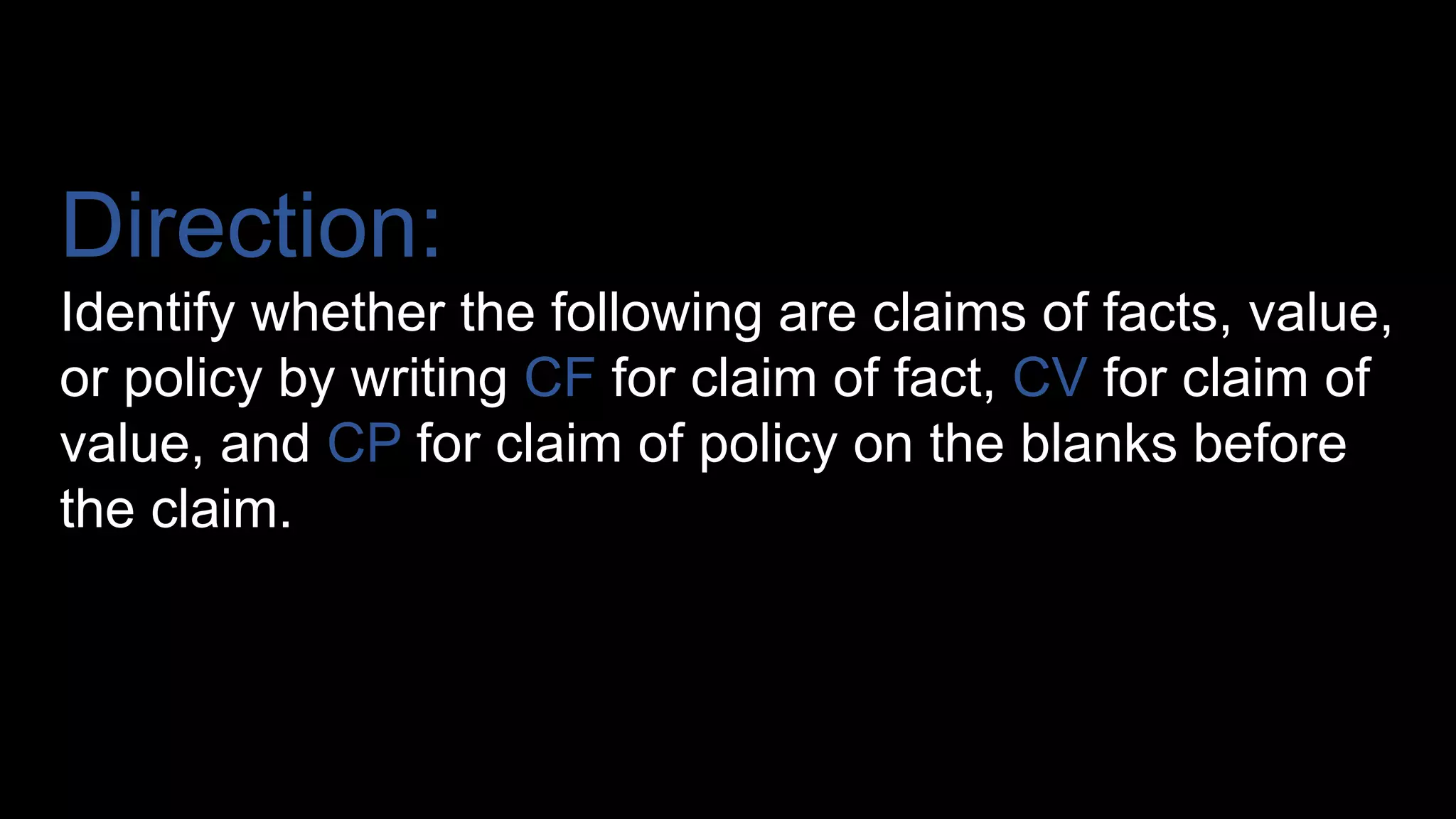
Direction:
Identify whether the following are claims of facts, value,
or policy by writing CF for claim of fact, CV for claim of
value, and CP for claim of policy on the blanks before
the claim.
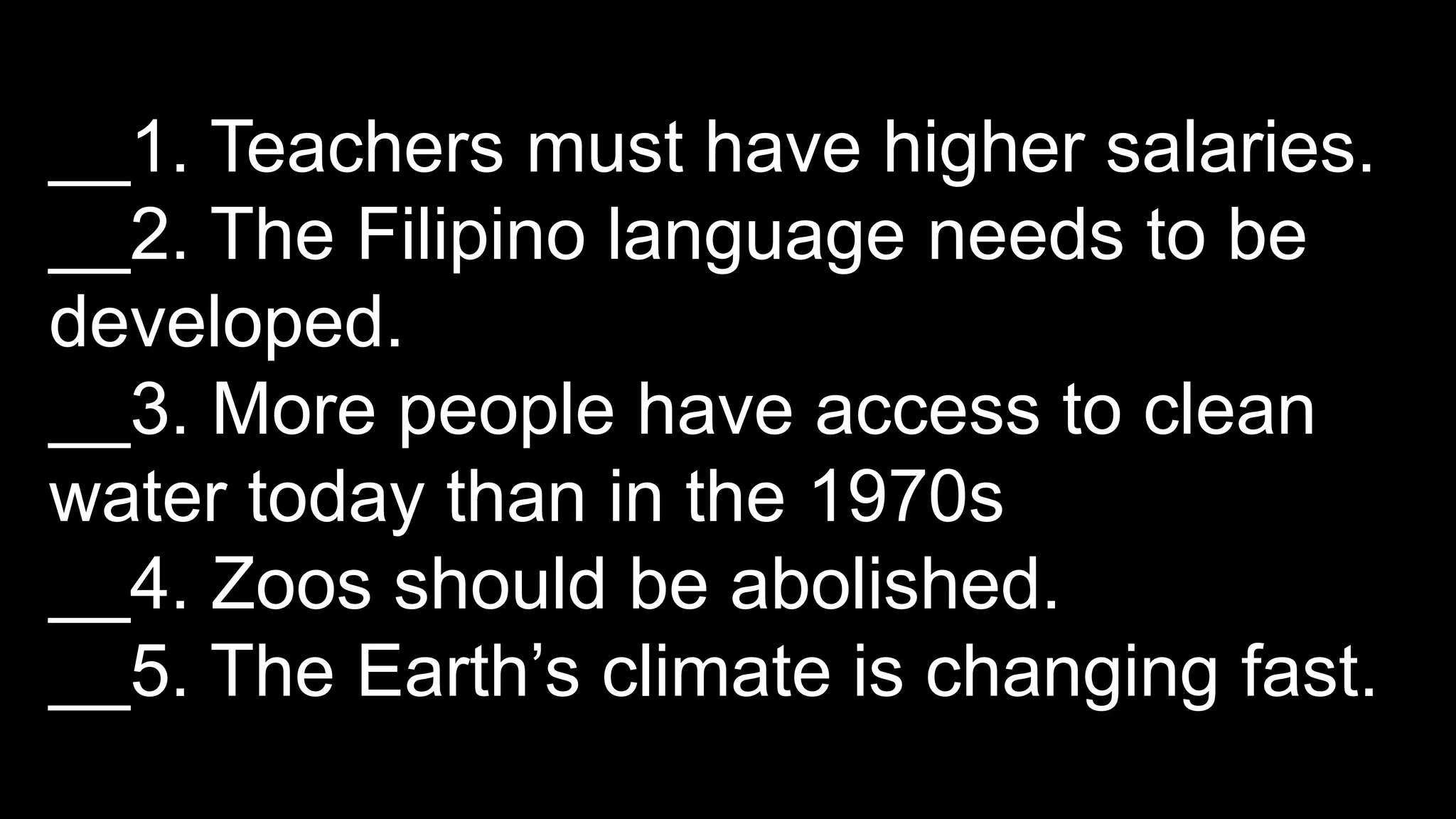
__1. Teachers must have higher salaries.
__2. The Filipino language needs to be
developed.
__3. More people have access to clean
water today than in the 1970s
__4. Zoos should be abolished.
__5. The Earth’s climate is changing fast.
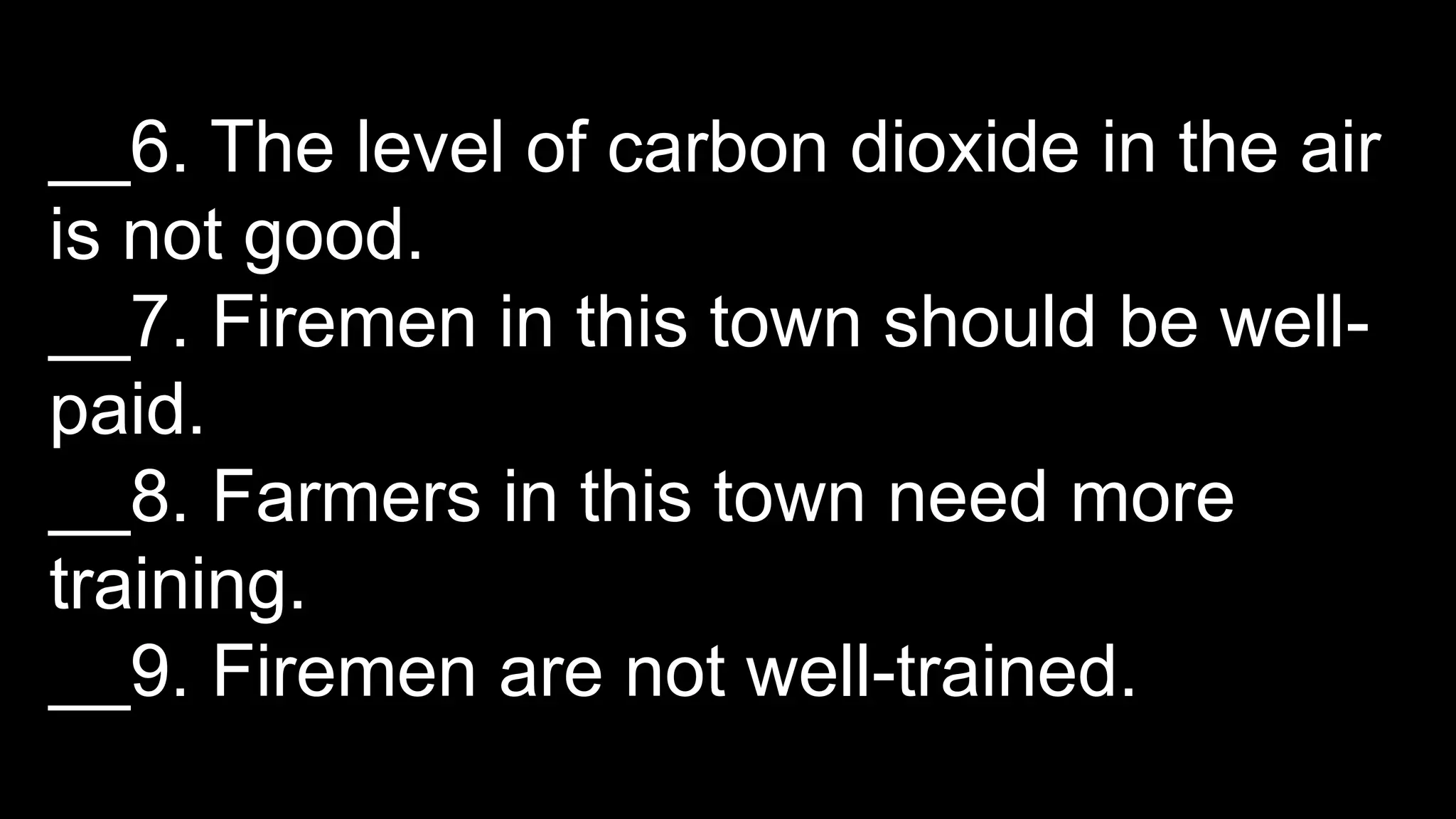
__6. The level of carbon dioxide in the air
is not good.
__7. Firemen in this town should be well-
paid.
__8. Farmers in this town need more
training.
__9. Firemen are not well-trained.
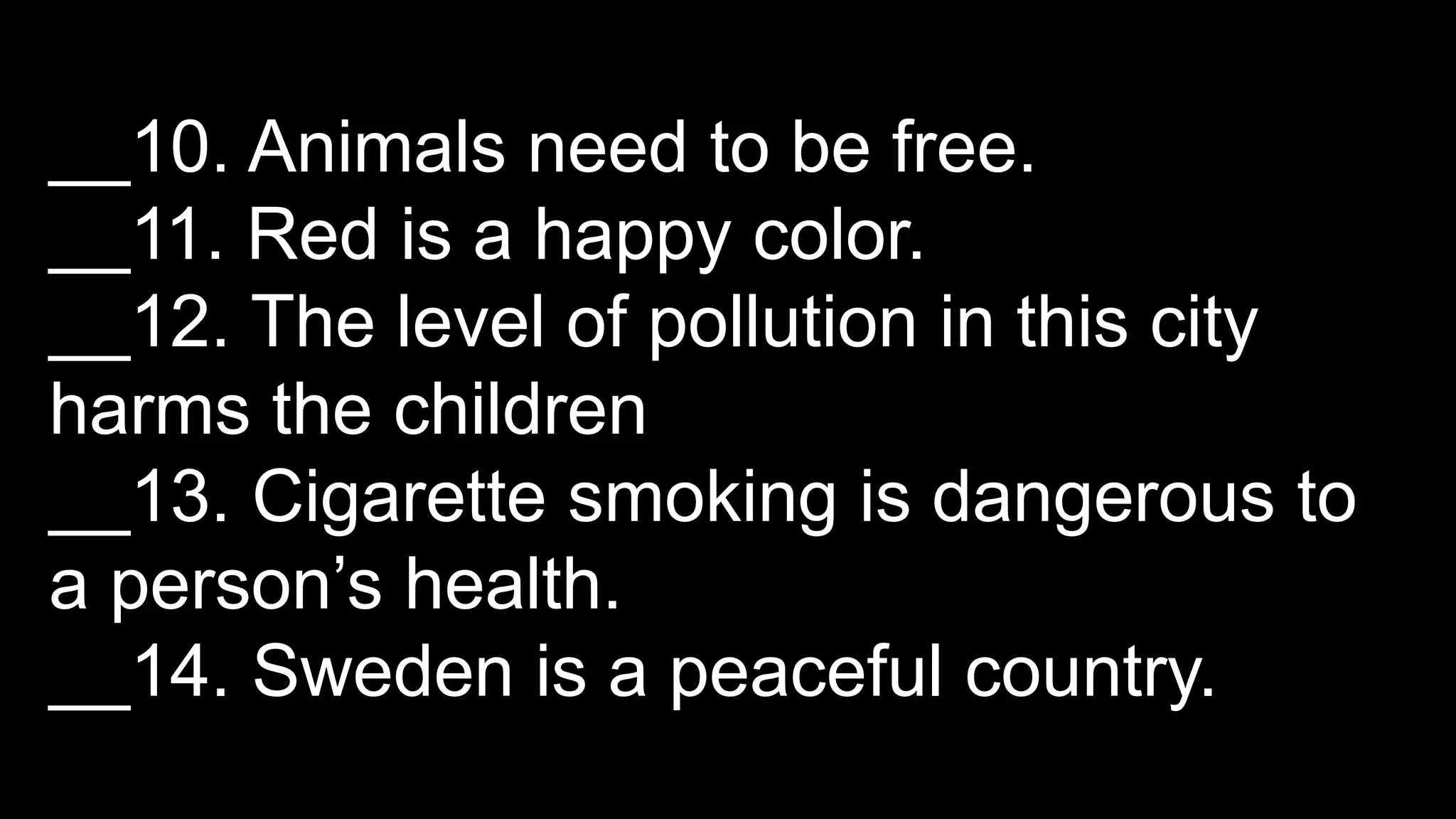
__10. Animals need to be free.
__11. Red is a happy color.
__12. The level of pollution in this city
harms the children
__13. Cigarette smoking is dangerous to
a person’s health.
__14. Sweden is a peaceful country.
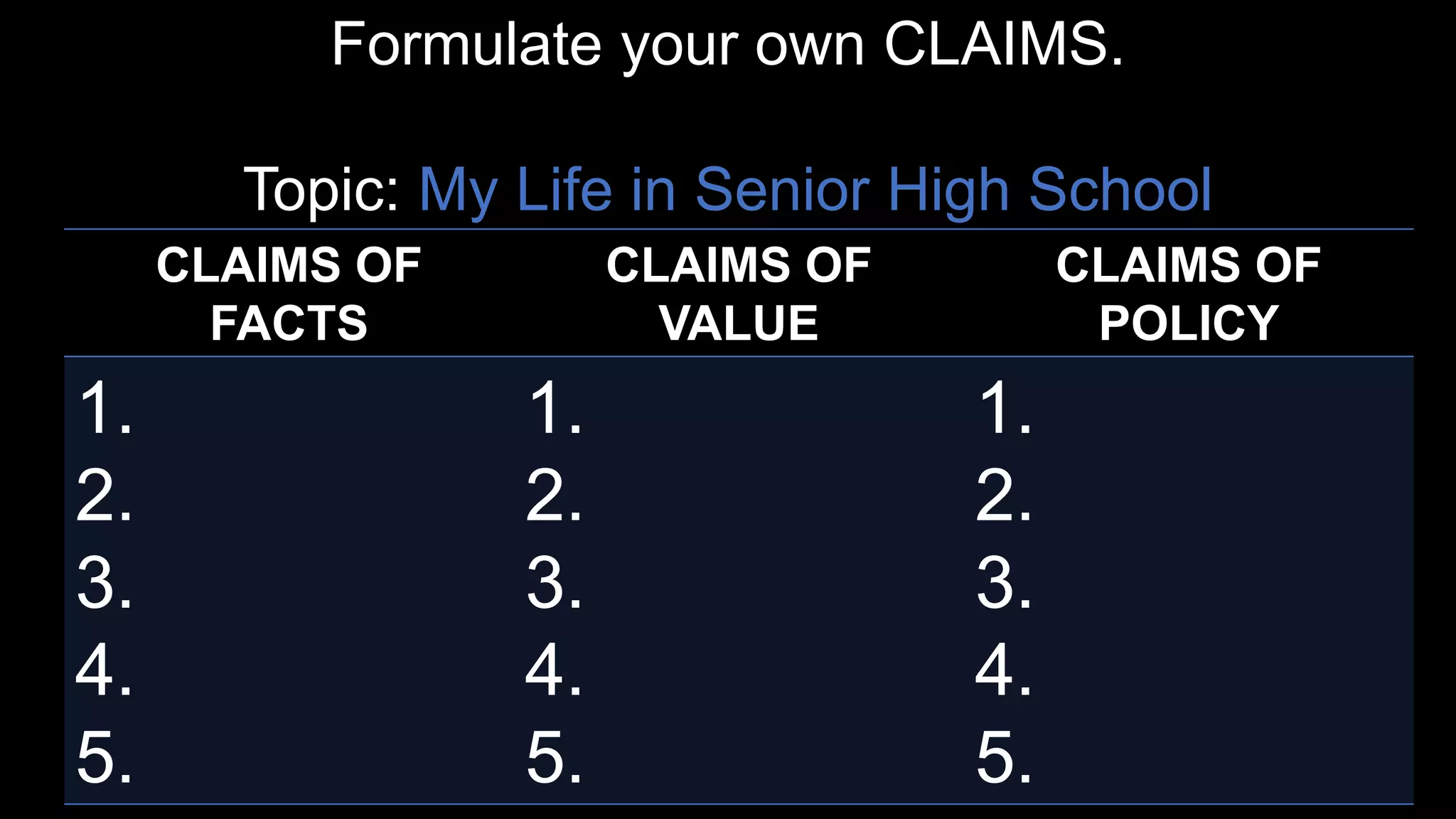
Formulate your own CLAIMS.
Topic: My Life in Senior High School
CLAIMS OF
FACTS
CLAIMS OF
VALUE
CLAIMS OF
POLICY
1.
2.
3.
4.
5.
1.
2.
3.
4.
5.
1.
2.
3.
4.
5.

Explicit and Implicit Claims, Critical Reading

  • 1.
  • 2.
    Reading Critical the reader analyzesand interprets the reading material to understand the text’s deeper meaning; a way of knowing how the writer thinks going beyond what the words say and getting at the important message of the text
  • 3.
    INTERPRETING finding a deepermeaning than what is explicitly stated in the text Example: In this world tinted with envy and deception, she’s the modern-day Maria Clara. What does the author mean with Maria Clara?
  • 4.
    INFERRING “reading between theline” putting together the author’s ideas and coming up with an implicitly stated idea based on those given ideas. Example: I am certain it was Tuesday. I walked straight into a fancy “turo-turo” near my place to grab lunch. When I arrived, a small commotion caused some of the customers to glance at the ruckus. I never paid attention, I was hungry and that’s what mattered to me.
  • 5.
    I ordered Tinolaand settled myself on a seat next to a random stranger. While eating, someone caught my attention. A Filipina woman in her mid 30s walking straight into the counter. She wore a backless dress in gaudy red. Her orange stilettos did not match with her attire, plus her should-be- sultry-make-up made her more of an entertainment clown. Her eye liner smudged around her eyes and her red lips tinted her frontal teeth. “Try-hard woman.” I whispered to myself. I followed her with my eyes, completely distracted from my lunch. After the counter, the woman went directly to the group of people where the commotion was still happening.
  • 6.
    She sat adjacentlyto a a clergy man-a priest, with a bulging belly. The priest doesn’t have a typical Filipino look. In that moment, I found out what the commotion was. It was the “Tinola”. The priest never liked “pakpak and leeg” to be served in front of him. And he kept on bantering the server for that. I looked at my “Tinola”. I’m still pleased.
  • 7.
    “Nonsense.” The manbesides me exclaimed. I looked at him with his book and a pen embedded between his hands. He wore a nameplate just above his chest. The name says: “Jose”. And it all make sense now. Based on the storyline, who were the characters in the story?
  • 8.
    DRAWING CONCLUSIONS -done afterreading the whole text -what you know and what you’ve read -reader combines information and evidence that the author provides and then make a statement about the topic/character/anything else in the text
  • 10.
    ANALYZING looking at separate,detailed parts of the text to understand the entire text. taking apart the ideas and see how they connect with each other to support the main idea of the text. Example: A doctor making a diagnosis based on her patient’s condition.
  • 11.
    DISTINGUISHING FACT FROM OPINION •Facts = statements that can be proved true or false by using reliable sources such as encyclopedia • Opinions = beliefs or judgments • Fact = idea that is already proven and is obviously true. • Opinion = an unverified idea; may or may not be true
  • 12.
    EVALUATING forming an opinionor making a judgment about something being read Example: Reviews
  • 13.
    PREDICTING making intelligent guessabout what will happen next in a text Example: Making Investigatory Projects
  • 14.
    SYNTHESIZING combining/connecting ideas toform a coherent whole which serves as your new understanding. Example: Making a Research Paper
  • 15.
  • 16.
    CLAIMS a statement thatis not considered accepted by all may be unverified or controversial to a certain degree usually related to one side of an issue  also called a position
  • 17.
    CLAIMS of • FACT •VALUE • POLICY
  • 18.
    Fact Claims of relate tothe statement that can be verified, no matter how difficult not dependent merely on a person’s preference, but can be true or false Facts that are universally accepted are not considered claims of fact because there is no more disagreement about their truthfulness
  • 19.
    Fact Claims of EXAMPLES: - SantaClaus is real. - Cancer is not contagious. - The earth is warming rapidly. - The atmosphere has too much carbon dioxide.
  • 20.
    Value Claims of evaluative statements statementsabout which is better, more important, more desirable, more needed, or more useful may also relate to what is good or bad
  • 21.
    Value Claims of EXAMPLES: - It’smore fun in the Philippines. - This is a very good school. - It is more advantageous for a Filipino child to grow up speaking Filipino instead of English. - It is better to be feared than loved. - It is better to have loved and lost than never to have loved at all.
  • 22.
    Policy Claims of all aboutwhat should be prescribe particular course of action that would lead to a condition. are usually made in relation to solving societal problems.
  • 23.
    Policy Claims of EXAMPLES: - Thedeath penalty must be revived. - A national ID system should be adopted. - Beauty contests should be banned. - The government must devote more funds to building schools than building roads.
  • 24.
    Policy Claims of Value Claims of Fact Claimsof something should be implemented something is important a particular statement is true
  • 25.
    Direction: Identify whether thefollowing are claims of facts, value, or policy by writing CF for claim of fact, CV for claim of value, and CP for claim of policy on the blanks before the claim.
  • 26.
    __1. Teachers musthave higher salaries. __2. The Filipino language needs to be developed. __3. More people have access to clean water today than in the 1970s __4. Zoos should be abolished. __5. The Earth’s climate is changing fast.
  • 27.
    __6. The levelof carbon dioxide in the air is not good. __7. Firemen in this town should be well- paid. __8. Farmers in this town need more training. __9. Firemen are not well-trained.
  • 28.
    __10. Animals needto be free. __11. Red is a happy color. __12. The level of pollution in this city harms the children __13. Cigarette smoking is dangerous to a person’s health. __14. Sweden is a peaceful country.
  • 29.
    Formulate your ownCLAIMS. Topic: My Life in Senior High School CLAIMS OF FACTS CLAIMS OF VALUE CLAIMS OF POLICY 1. 2. 3. 4. 5. 1. 2. 3. 4. 5. 1. 2. 3. 4. 5.