Critical Reading
Defining Critical Reading
• Whenever you read something and you evaluate
claims, seek definitions, judge information, demand
proof, and question assumptions, you are thinking
critically.
• This type of reading goes beyond passively
understanding a text because you process the
author’s word and make judgements after carefully
considering the reading message.
Techniques to develop critical thinking:
1. Keeping a reading journal
A reading journal is similar
to keeping a diary, except you
are writing your feelings and
ideas in reaction to your reading
assignment
Techniques to develop critical thinking:
2. Annotating the text
Annotating the text simply means
making notes on your copy of the reading.
This includes highlighting or underlining
important passages and writing notes,
comments, questions, and reaction on the
margins.
Techniques to develop critical thinking:
3. Outlining the text
Creating a rough outline of the text will also
be helpful in gettingto understand it more
critically. By locating the thesis statement, claims,
and evidence, and then plotting these into an
outline, you can see hoe the writer structures,
sequences, and connects his or her ideas.
Techniques to develop critical thinking:
4. Summarizing the text
Summarizing the text is similar to
outlining, in that you need to get the gist.
A summary consists of getting the main
points of the essay and important
supporting details.
Techniques to develop critical thinking:
5. Questioning the text
Questioning the text involves asking
specific questions on points that you are
spektical about. These may be topics that do
not meet your expectations or are not
aligned with your personal views.
Identifying and Analyzing
Claims
Critical reading also means that
you are able to distinguish the
information that is clearly stated
(Explicit) in the text from ideas
that are suggested (implicit). This
will help you make inferences about
what you read.
Determining Explicit and Implicit
Information
Defining Claims
Whenever you read something, you find
yourself looking for the writer’s point or
position regarding the chosen topic. That
point is also known as the claims, or the
central argument or thesis statement of
the text.
This claim is what the writer tries to
prove in the text by providing details,
explanations, and other types of evidence.
Characteristics of good
claims:
1. A claims should be
argumentative and debatable. When
a writer makes a claims, he/she
is making a case for a particular
perspective on the topic.
Characteristics of good
claims:
2. A claims should be specific
and focused. If the claim is
unfocused, the paper will be too
broad in scope and will lack
direction and a clear connection
to the support provided. It may
also lead to overgeneralizations
and vague assertions.
Characteristics of good
claims:
3. A claims should be interesting
and engaging. It should hook the
reader, who may or may not agree
with you, to encourage them to
consider your perspective and
learn something new form you.
Characteristics of good
claims:
4. A claims should be logical. It
should result from reasonable
weighing of the support provided.
Here are some questions to help you
determine the writer’s claim while you are
reading a text:
•What is the author’s main point?
•What is the author’s position
regarding it?
Distinguishing Between
the Types of Claim
Different types of claim
1. Claims of fact state a
quantifiable assertion or a
measurable topic.They assert that
something has existed, exists, or
will exist based on the data.
Claims of fact usually answer a
“what” question.
Different types of claim
2. Claims of value assert something that
can be qualified. They consist of
argument about moral, philosophical, or
aesthetic topics. These types of topics
try to prove that some values are more
or less desirable compared to others.
Claims of value attempt to explain
how problems, situations, or issues
ought to be valued.
Different types of claim
3. Claims of policy posit that
specific actions should be chosen
as solutions to a paticular
problem. You can easily identify a
claims of policy because they begin
with “should” “ought” or “must.”
Claims of policy because they
defend actionable plans, usually
answer “how” questions.
Identifying the Context of Text
Development
Context is defined as the social,
cultural, political, historical, and
other related circumstances that
surround the text and form the terms
form which it can be better
understood and evaluated. Knowledge
of the text’s context helps in
appreciating the text’s message more
deeply.
Intertextuality is the modeling of a text’s meaning
by another text
•It is defined as the connections
between language, images,
characters , themes, or subjects
depending on their similarities
in language, genre, or
discourse.
Hypertext - is a nonlinear way
of showing information. Hypertext
connects topics on a screen to
related information, graphics,
videos, and music--information
that is not simply related text.
Critical Reading as Reasoning
Identifying Assertions
Assertion are declarative
sentences that claims
something is true about
something else. Simply, put,
it is a channel that is either
true or false.
Read the following examples:
1.The sampaguita’s roots are used for
medical purposes, such as an
anesthetic and a sedative.
2.The sampaguita belongs to the genus
jasminum of the family Oleaceae.
Read the following examples:
3.The popularity of sampaguita
flower is most evident in places
of worship.
4.Sampaguita are the most
beautiful and most frangant of
all flower.
The first type of assertion is a
fact. This is a statement that
can be proven objectively by
direct experience, testimonies of
witnesses, verified observations,
or the results of research.
Read the following examples:
1.The sampaguita’s roots are used for
medical purposes, such as an
anesthetic and a sedative.
2.The sampaguita belongs to the genus
jasminum of the family Oleaceae.
The second type is an assertion of
conversation. A convention is a way in
which something is done, similar to
traditions and noms. Conventions depend
on history precedent, laws rules, usage
and customs.
Some to note about conventions is that
they may sound factual due to them
being derived from customs, but becuase
they are socially accepted ways of
doing things, they cannot be verified
objectively by measurements.
Read the following examples:
1.The sampaguita’s roots are used for
medical purposes, such as an
anesthetic and a sedative.
2.The sampaguita belongs to the genus
jasminum of the family Oleaceae.
•The third type of assertion is an
opinion. Opinions are based on
facts, but are difficult to
objectively verify because of
uncertainty of producing
satisfactory proofs of soundness.
Opinion result from ambiguities;
the more ambigous a statement, the
more difficult it is to verify.
Read the following examples:
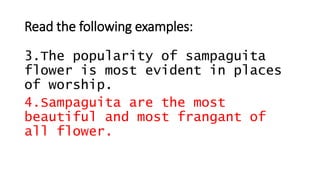
3.The popularity of sampaguita
flower is most evident in places
of worship.
4.Sampaguita are the most
beautiful and most frangant of
all flower.
The fourth type of assertion is a
preference. Preferences are based
on personal choice; therefore, they
are subjective and cannot be
objectively proven of ligocally
attacked.
Read the following examples:
3.The popularity of sampaguita
flower is most evident in places
of worship.
4.Sampaguita are the most
beautiful and most frangant of
all flower.
Critical-Reading-as-Reasoning.pptx

Critical-Reading-as-Reasoning.pptx

  • 1.
  • 2.
    Defining Critical Reading •Whenever you read something and you evaluate claims, seek definitions, judge information, demand proof, and question assumptions, you are thinking critically. • This type of reading goes beyond passively understanding a text because you process the author’s word and make judgements after carefully considering the reading message.
  • 3.
    Techniques to developcritical thinking: 1. Keeping a reading journal A reading journal is similar to keeping a diary, except you are writing your feelings and ideas in reaction to your reading assignment
  • 4.
    Techniques to developcritical thinking: 2. Annotating the text Annotating the text simply means making notes on your copy of the reading. This includes highlighting or underlining important passages and writing notes, comments, questions, and reaction on the margins.
  • 5.
    Techniques to developcritical thinking: 3. Outlining the text Creating a rough outline of the text will also be helpful in gettingto understand it more critically. By locating the thesis statement, claims, and evidence, and then plotting these into an outline, you can see hoe the writer structures, sequences, and connects his or her ideas.
  • 6.
    Techniques to developcritical thinking: 4. Summarizing the text Summarizing the text is similar to outlining, in that you need to get the gist. A summary consists of getting the main points of the essay and important supporting details.
  • 7.
    Techniques to developcritical thinking: 5. Questioning the text Questioning the text involves asking specific questions on points that you are spektical about. These may be topics that do not meet your expectations or are not aligned with your personal views.
  • 8.
  • 9.
    Critical reading alsomeans that you are able to distinguish the information that is clearly stated (Explicit) in the text from ideas that are suggested (implicit). This will help you make inferences about what you read. Determining Explicit and Implicit Information
  • 10.
    Defining Claims Whenever youread something, you find yourself looking for the writer’s point or position regarding the chosen topic. That point is also known as the claims, or the central argument or thesis statement of the text. This claim is what the writer tries to prove in the text by providing details, explanations, and other types of evidence.
  • 11.
    Characteristics of good claims: 1.A claims should be argumentative and debatable. When a writer makes a claims, he/she is making a case for a particular perspective on the topic.
  • 12.
    Characteristics of good claims: 2.A claims should be specific and focused. If the claim is unfocused, the paper will be too broad in scope and will lack direction and a clear connection to the support provided. It may also lead to overgeneralizations and vague assertions.
  • 13.
    Characteristics of good claims: 3.A claims should be interesting and engaging. It should hook the reader, who may or may not agree with you, to encourage them to consider your perspective and learn something new form you.
  • 14.
    Characteristics of good claims: 4.A claims should be logical. It should result from reasonable weighing of the support provided.
  • 15.
    Here are somequestions to help you determine the writer’s claim while you are reading a text: •What is the author’s main point? •What is the author’s position regarding it?
  • 16.
  • 17.
    Different types ofclaim 1. Claims of fact state a quantifiable assertion or a measurable topic.They assert that something has existed, exists, or will exist based on the data. Claims of fact usually answer a “what” question.
  • 18.
    Different types ofclaim 2. Claims of value assert something that can be qualified. They consist of argument about moral, philosophical, or aesthetic topics. These types of topics try to prove that some values are more or less desirable compared to others. Claims of value attempt to explain how problems, situations, or issues ought to be valued.
  • 19.
    Different types ofclaim 3. Claims of policy posit that specific actions should be chosen as solutions to a paticular problem. You can easily identify a claims of policy because they begin with “should” “ought” or “must.” Claims of policy because they defend actionable plans, usually answer “how” questions.
  • 21.
    Identifying the Contextof Text Development Context is defined as the social, cultural, political, historical, and other related circumstances that surround the text and form the terms form which it can be better understood and evaluated. Knowledge of the text’s context helps in appreciating the text’s message more deeply.
  • 22.
    Intertextuality is themodeling of a text’s meaning by another text •It is defined as the connections between language, images, characters , themes, or subjects depending on their similarities in language, genre, or discourse.
  • 23.
    Hypertext - isa nonlinear way of showing information. Hypertext connects topics on a screen to related information, graphics, videos, and music--information that is not simply related text.
  • 24.
  • 25.
    Identifying Assertions Assertion aredeclarative sentences that claims something is true about something else. Simply, put, it is a channel that is either true or false.
  • 26.
    Read the followingexamples: 1.The sampaguita’s roots are used for medical purposes, such as an anesthetic and a sedative. 2.The sampaguita belongs to the genus jasminum of the family Oleaceae.
  • 27.
    Read the followingexamples: 3.The popularity of sampaguita flower is most evident in places of worship. 4.Sampaguita are the most beautiful and most frangant of all flower.
  • 28.
    The first typeof assertion is a fact. This is a statement that can be proven objectively by direct experience, testimonies of witnesses, verified observations, or the results of research.
  • 29.
    Read the followingexamples: 1.The sampaguita’s roots are used for medical purposes, such as an anesthetic and a sedative. 2.The sampaguita belongs to the genus jasminum of the family Oleaceae.
  • 30.
    The second typeis an assertion of conversation. A convention is a way in which something is done, similar to traditions and noms. Conventions depend on history precedent, laws rules, usage and customs. Some to note about conventions is that they may sound factual due to them being derived from customs, but becuase they are socially accepted ways of doing things, they cannot be verified objectively by measurements.
  • 31.
    Read the followingexamples: 1.The sampaguita’s roots are used for medical purposes, such as an anesthetic and a sedative. 2.The sampaguita belongs to the genus jasminum of the family Oleaceae.
  • 32.
    •The third typeof assertion is an opinion. Opinions are based on facts, but are difficult to objectively verify because of uncertainty of producing satisfactory proofs of soundness. Opinion result from ambiguities; the more ambigous a statement, the more difficult it is to verify.
  • 33.
    Read the followingexamples: 3.The popularity of sampaguita flower is most evident in places of worship. 4.Sampaguita are the most beautiful and most frangant of all flower.
  • 34.
    The fourth typeof assertion is a preference. Preferences are based on personal choice; therefore, they are subjective and cannot be objectively proven of ligocally attacked.
  • 35.
    Read the followingexamples: 3.The popularity of sampaguita flower is most evident in places of worship. 4.Sampaguita are the most beautiful and most frangant of all flower.