=
Find the difference
Diary vs. Dairy
Diary- a book in which you write down
your personal experiences and
thoughts each day.
Dairy- a farm that produces milk
Except vs. Accept
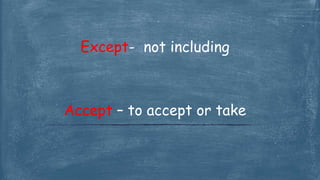
Except- not including
Accept – to accept or take
deceased vs.
diseased
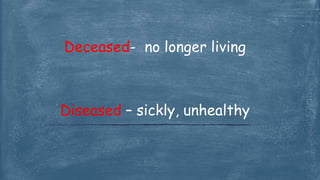
Deceased- no longer living
Diseased – sickly, unhealthy
Implicit vs. Explicit
Ms. Jeny U. Sonio
Teacher (Reading and Writing Skills
for Grade 11 Students
Types of Claims: Claim of Fact, Judgment, Action or Policy
Identifying Explicit &
Implicit Claim in a Text
So what is implicit versus explicit meaning?
Explicit Questions:
• Who are the characters in the story?
• Who is considered a lazy creature?
Implicit Questions:
• What did the ant feel about grasshopper?
• How would you compare the ant from the
grasshopper?
• Why did the ant share his stored food to the
grasshopper?
Let’s do some mind exercise…
Amber wants to buy a new smart phone but
she doesn't have the money. Which question
from the list below would be considered
explicit?
Why does she need a new phone?
Why can't Amber buy the smart phone?
How is Amber going to raise the money?
Where does she plan to buy the phone?
Question 1.
Why can't Amber buy the smart phone?
Answer:
Wendy was walking home from school when she found
a sick bird lying on the ground under a tree. She
stopped and gave the bird a look. She looked up and
noticed a nest in the branch above her. She looked
forward and continued walking home. What implicit
information can you obtain from this story?
Wendy loves animals.
Wendy is running late for an appointment.
Wendy is a selfish person.
Wendy needs to get home before dark.
Question 2.
Wendy is a selfish person.
Answer:
A lot of implicit information can be
gathered by looking at a photograph?
True
False
Question 3.
FALSE
Answer:
Mr. Cantu walked into the classroom and
slammed the door behind him. He threw his
clipboard to the ground and knocked a pile
of papers to the ground. What color is Mr.
Cantu's shirt? Is this an example of an
implicit question?
Yes
No
Question 4.
NO
Answer:
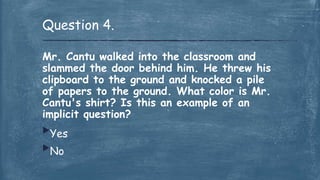
Mr. Cantu walked into the classroom and
slammed the door behind him. He threw his
clipboard to the ground and knocked a pile
of papers to the ground. What color is Mr.
Cantu's shirt? Is this an example of an
implicit question?
Yes
No
Question 4.
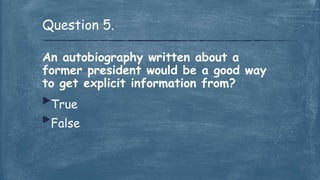
An autobiography written about a
former president would be a good way
to get explicit information from?
True
False
Question 5.
TRUE
Answer:
If Ms. Smith wanted to get into a good nursing
school then she needs to study hard and talk
to people who are already nurses so that she
can know what to expect from nursing school.
What information below is explicit?
 Why she chose to go into nursing.
 Who she will talk to about nursing school.
 Where the nursing school is.
 What kind of school does Ms. Smith want to attend.
Question 6.
What kind of school does Ms. Smith
want to attend.
Answer:
It is in this context that the reader be
made conscious that in order to
engender fruitful reading engagement,
one has to take note that one’s opinion
about the text covers certain claims---
claim of fact, claim of value and claim
of policy.
Things to ponder…
Claim according to del Gandio J.
(2008) is an arguable statement---an
idea that a rhetor (that is, a speaker
or writer) asks an audience to accept.
A claim is an opinion, idea or
assertion.
Overview
It is a statement. A claim is a discourse.
It involves a speaker’s awareness of an
audience. The very idea of a claim
involves a wish about an audience.
It deals with a search for agreement.
The wish is that the audience will agree
with the statement.
Therefore a claim is…
It involves anticipation. To anticipate
the audience’s agreement means we look
hopefully to it, but we are anxious that
they may not give it.
A claim thus forwards a statement that
we worry the audience will not agree to,
but wish them to agree to.
Therefore a claim is…
TYPES OF CLAIMS
- Look for keywords that are a
matter of judgment rather than fact:
good, well, kind, useful, desirable, etc.
- Speakers provide the reasoning
for their judgment, but ultimately is to
assent to the reasons rather than
comparison to the fact that determines
the agreement to the claim.
1. CLAIM OF JUDGMENT OR VALUE
- A claim is based on things we like
or dislike. Thus it deals with goals, with
things we find attractive.
- Your feel for the argument by
judgment or value has to be different
than that of fact. Disagreements over
values are not “wrong” in the sense that
they are inaccurate.
CLAIM OF JUDGMENT OR VALUE
-Argument usually turns on
whether the underlying value of the
claim is accepted as public good.
CLAIM OF JUDGMENT OR VALUE
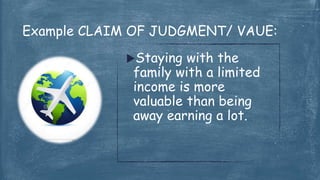
Staying with the
family with a limited
income is more
valuable than being
away earning a lot.
Example CLAIM OF JUDGMENT/ VAUE:
Musical comedy is
the best form of
entertainment.
Example CLAIM OF JUDGMENT/ VAUE:
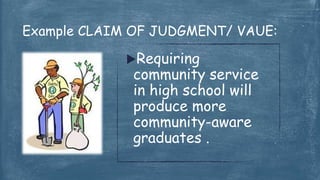
Requiring
community service
in high school will
produce more
community-aware
graduates .
Example CLAIM OF JUDGMENT/ VAUE:
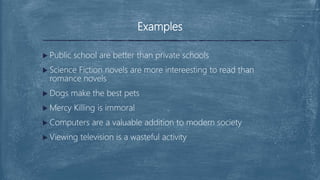
Examples
 Public school are better than private schools
 Science Fiction novels are more intereesting to read than
romance novels
 Dogs make the best pets
 Mercy Killing is immoral
 Computers are a valuable addition to modern society
 Viewing television is a wasteful activity
ACTIVITY TIME:
(10 minutes)
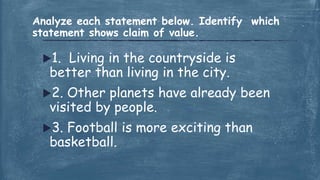
1. Living in the countryside is
better than living in the city.
2. Other planets have already been
visited by people.
3. Football is more exciting than
basketball.
Analyze each statement below. Identify which
statement shows claim of value.
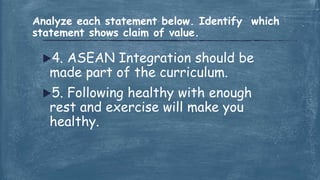
4. ASEAN Integration should be
made part of the curriculum.
5. Following healthy with enough
rest and exercise will make you
healthy.
Analyze each statement below. Identify which
statement shows claim of value.
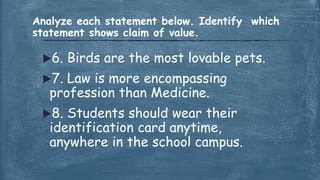
6. Birds are the most lovable pets.
7. Law is more encompassing
profession than Medicine.
8. Students should wear their
identification card anytime,
anywhere in the school campus.
Analyze each statement below. Identify which
statement shows claim of value.
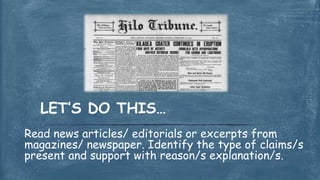
Read news articles/ editorials or excerpts from
magazines/ newspaper. Identify the type of claims/s
present and support with reason/s explanation/s.
LET’S DO THIS…
Article:
_______________________________________
Type of Claim:
_______________________________________
Reason/ Explanation:
_________________________________
TASK 1
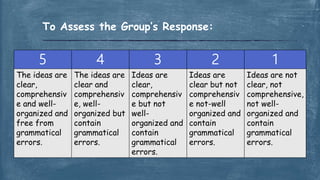
5 4 3 2 1
The ideas are
clear,
comprehensiv
e and well-
organized and
free from
grammatical
errors.
The ideas are
clear and
comprehensiv
e, well-
organized but
contain
grammatical
errors.
Ideas are
clear,
comprehensiv
e but not
well-
organized and
contain
grammatical
errors.
Ideas are
clear but not
comprehensiv
e not-well
organized and
contain
grammatical
errors.
Ideas are not
clear, not
comprehensive,
not well-
organized and
contain
grammatical
errors.
To Assess the Group’s Response:
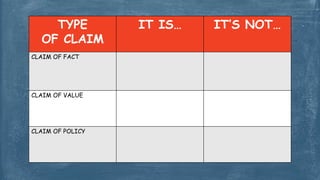
Based on your understanding,
write what each claim is, and what
each is not by filling out the table
below.
WRAP-UP
TYPE
OF CLAIM
IT IS… IT’S NOT…
CLAIM OF FACT
CLAIM OF VALUE
CLAIM OF POLICY
Remember: Identify
whether the stated claim
is a FACT, VALUE or
POLICY.
Let’s Think it Over….
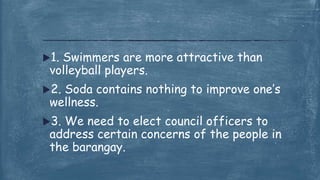
1. Swimmers are more attractive than
volleyball players.
2. Soda contains nothing to improve one’s
wellness.
3. We need to elect council officers to
address certain concerns of the people in
the barangay.
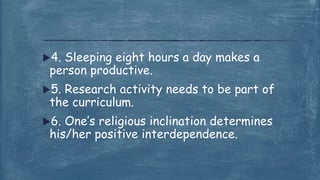
4. Sleeping eight hours a day makes a
person productive.
5. Research activity needs to be part of
the curriculum.
6. One’s religious inclination determines
his/her positive interdependence.
7. Plants are more valuable than animals.
8. The Department of Environmental and Natural
Resources should take equal precautions toward
climate change.
9. “ A family that prays together, stays
together.”
10. A clean environment creates a happy and
peaceful society.

Identifying explicit & implicit claim in a text

  • 2.
  • 3.
  • 4.
    Diary- a bookin which you write down your personal experiences and thoughts each day. Dairy- a farm that produces milk
  • 5.
  • 6.
    Except- not including Accept– to accept or take
  • 7.
  • 8.
    Deceased- no longerliving Diseased – sickly, unhealthy
  • 9.
  • 10.
    Ms. Jeny U.Sonio Teacher (Reading and Writing Skills for Grade 11 Students Types of Claims: Claim of Fact, Judgment, Action or Policy Identifying Explicit & Implicit Claim in a Text
  • 11.
    So what isimplicit versus explicit meaning?
  • 12.
    Explicit Questions: • Whoare the characters in the story? • Who is considered a lazy creature?
  • 13.
    Implicit Questions: • Whatdid the ant feel about grasshopper? • How would you compare the ant from the grasshopper? • Why did the ant share his stored food to the grasshopper?
  • 14.
    Let’s do somemind exercise…
  • 15.
    Amber wants tobuy a new smart phone but she doesn't have the money. Which question from the list below would be considered explicit? Why does she need a new phone? Why can't Amber buy the smart phone? How is Amber going to raise the money? Where does she plan to buy the phone? Question 1.
  • 16.
    Why can't Amberbuy the smart phone? Answer:
  • 17.
    Wendy was walkinghome from school when she found a sick bird lying on the ground under a tree. She stopped and gave the bird a look. She looked up and noticed a nest in the branch above her. She looked forward and continued walking home. What implicit information can you obtain from this story? Wendy loves animals. Wendy is running late for an appointment. Wendy is a selfish person. Wendy needs to get home before dark. Question 2.
  • 18.
    Wendy is aselfish person. Answer:
  • 19.
    A lot ofimplicit information can be gathered by looking at a photograph? True False Question 3.
  • 20.
  • 21.
    Mr. Cantu walkedinto the classroom and slammed the door behind him. He threw his clipboard to the ground and knocked a pile of papers to the ground. What color is Mr. Cantu's shirt? Is this an example of an implicit question? Yes No Question 4.
  • 22.
  • 23.
    Mr. Cantu walkedinto the classroom and slammed the door behind him. He threw his clipboard to the ground and knocked a pile of papers to the ground. What color is Mr. Cantu's shirt? Is this an example of an implicit question? Yes No Question 4.
  • 24.
    An autobiography writtenabout a former president would be a good way to get explicit information from? True False Question 5.
  • 25.
  • 26.
    If Ms. Smithwanted to get into a good nursing school then she needs to study hard and talk to people who are already nurses so that she can know what to expect from nursing school. What information below is explicit?  Why she chose to go into nursing.  Who she will talk to about nursing school.  Where the nursing school is.  What kind of school does Ms. Smith want to attend. Question 6.
  • 27.
    What kind ofschool does Ms. Smith want to attend. Answer:
  • 28.
    It is inthis context that the reader be made conscious that in order to engender fruitful reading engagement, one has to take note that one’s opinion about the text covers certain claims--- claim of fact, claim of value and claim of policy. Things to ponder…
  • 30.
    Claim according todel Gandio J. (2008) is an arguable statement---an idea that a rhetor (that is, a speaker or writer) asks an audience to accept. A claim is an opinion, idea or assertion. Overview
  • 31.
    It is astatement. A claim is a discourse. It involves a speaker’s awareness of an audience. The very idea of a claim involves a wish about an audience. It deals with a search for agreement. The wish is that the audience will agree with the statement. Therefore a claim is…
  • 32.
    It involves anticipation.To anticipate the audience’s agreement means we look hopefully to it, but we are anxious that they may not give it. A claim thus forwards a statement that we worry the audience will not agree to, but wish them to agree to. Therefore a claim is…
  • 33.
  • 34.
    - Look forkeywords that are a matter of judgment rather than fact: good, well, kind, useful, desirable, etc. - Speakers provide the reasoning for their judgment, but ultimately is to assent to the reasons rather than comparison to the fact that determines the agreement to the claim. 1. CLAIM OF JUDGMENT OR VALUE
  • 35.
    - A claimis based on things we like or dislike. Thus it deals with goals, with things we find attractive. - Your feel for the argument by judgment or value has to be different than that of fact. Disagreements over values are not “wrong” in the sense that they are inaccurate. CLAIM OF JUDGMENT OR VALUE
  • 36.
    -Argument usually turnson whether the underlying value of the claim is accepted as public good. CLAIM OF JUDGMENT OR VALUE
  • 37.
    Staying with the familywith a limited income is more valuable than being away earning a lot. Example CLAIM OF JUDGMENT/ VAUE:
  • 38.
    Musical comedy is thebest form of entertainment. Example CLAIM OF JUDGMENT/ VAUE:
  • 39.
    Requiring community service in highschool will produce more community-aware graduates . Example CLAIM OF JUDGMENT/ VAUE:
  • 40.
    Examples  Public schoolare better than private schools  Science Fiction novels are more intereesting to read than romance novels  Dogs make the best pets  Mercy Killing is immoral  Computers are a valuable addition to modern society  Viewing television is a wasteful activity
  • 47.
  • 48.
    1. Living inthe countryside is better than living in the city. 2. Other planets have already been visited by people. 3. Football is more exciting than basketball. Analyze each statement below. Identify which statement shows claim of value.
  • 49.
    4. ASEAN Integrationshould be made part of the curriculum. 5. Following healthy with enough rest and exercise will make you healthy. Analyze each statement below. Identify which statement shows claim of value.
  • 50.
    6. Birds arethe most lovable pets. 7. Law is more encompassing profession than Medicine. 8. Students should wear their identification card anytime, anywhere in the school campus. Analyze each statement below. Identify which statement shows claim of value.
  • 51.
    Read news articles/editorials or excerpts from magazines/ newspaper. Identify the type of claims/s present and support with reason/s explanation/s. LET’S DO THIS…
  • 52.
  • 53.
    5 4 32 1 The ideas are clear, comprehensiv e and well- organized and free from grammatical errors. The ideas are clear and comprehensiv e, well- organized but contain grammatical errors. Ideas are clear, comprehensiv e but not well- organized and contain grammatical errors. Ideas are clear but not comprehensiv e not-well organized and contain grammatical errors. Ideas are not clear, not comprehensive, not well- organized and contain grammatical errors. To Assess the Group’s Response:
  • 54.
    Based on yourunderstanding, write what each claim is, and what each is not by filling out the table below. WRAP-UP
  • 55.
    TYPE OF CLAIM IT IS…IT’S NOT… CLAIM OF FACT CLAIM OF VALUE CLAIM OF POLICY
  • 56.
    Remember: Identify whether thestated claim is a FACT, VALUE or POLICY. Let’s Think it Over….
  • 57.
    1. Swimmers aremore attractive than volleyball players. 2. Soda contains nothing to improve one’s wellness. 3. We need to elect council officers to address certain concerns of the people in the barangay.
  • 58.
    4. Sleeping eighthours a day makes a person productive. 5. Research activity needs to be part of the curriculum. 6. One’s religious inclination determines his/her positive interdependence.
  • 59.
    7. Plants aremore valuable than animals. 8. The Department of Environmental and Natural Resources should take equal precautions toward climate change. 9. “ A family that prays together, stays together.” 10. A clean environment creates a happy and peaceful society.