Title: Expert Systems Presentation By Suresh Pakala 06M21A0556
Expert Systems An expert system is a computer program that is designed to hold the accumulated knowledge of one or more domain experts
Expert System Functionality assist human expert when   integrating   various decisions replace  human expert decision making  when not available expert systems  : programming computers to make decisions in real-life situations (for example, some expert systems help doctors diagnose diseases based on symptoms)
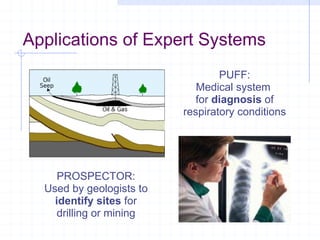
Applications of Expert Systems PROSPECTOR: Used by geologists to  identify sites  for drilling or mining PUFF: Medical system  for  diagnosis  of respiratory conditions
Applications of Expert Systems DESIGN ADVISOR: Gives advice to designers of processor chips MYCIN: Medical system for diagnosing blood disorders. First used in 1979
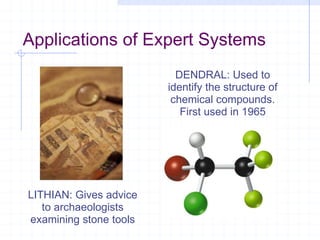
Applications of Expert Systems DENDRAL: Used to identify the structure of chemical compounds. First used in 1965 LITHIAN: Gives advice to archaeologists examining stone tools
Components of an Expert System The  knowledge base  is the collection of facts and rules which describe all the knowledge about the problem domain The  inference engine  is the part of the system that chooses which facts and rules to apply when trying to solve the user’s query The  user interface  is the part of the system which takes in the user’s query in a readable form and passes it to the inference engine. It then displays the results to the user.
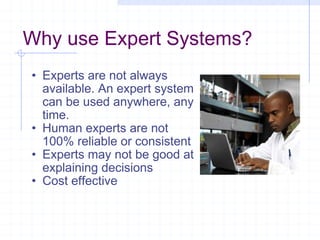
Why use Expert Systems? Experts are not always available. An expert system can be used anywhere, any time. Human experts are not 100% reliable or consistent Experts may not be good at explaining decisions Cost effective
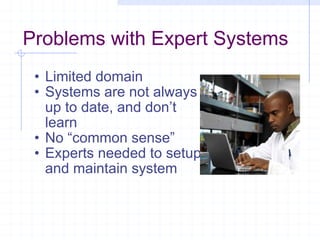
Problems with Expert Systems Limited domain Systems are not always up to date, and don’t learn No “common sense” Experts needed to setup and maintain system
Legal and Ethical Issues Who is responsible if the advice is wrong? The user? The domain expert? The knowledge engineer? The programmer of the expert system shell? The company selling the software?
Expert Systems on the Web http://www.aiinc.ca/demos/whale.html http://www.vanguardsw.com/ decisionscript/examples.htm http://www.exsys.com/demomain.html http://www.expertise2go.com/webesie/car http://www.expertise2go.com/webesie/wine
Limitations of Expert Systems Not widely used or tested Limited to relatively narrow problems Cannot readily deal with “mixed” knowledge Possibility of error Cannot refine own knowledge base Difficult to maintain May have high development costs Raise legal and ethical concerns
Any   Queries ?

Intro Expert Systems test-me.co.uk

  • 1.
    Title: Expert SystemsPresentation By Suresh Pakala 06M21A0556
  • 2.
    Expert Systems Anexpert system is a computer program that is designed to hold the accumulated knowledge of one or more domain experts
  • 3.
    Expert System Functionalityassist human expert when integrating various decisions replace human expert decision making when not available expert systems : programming computers to make decisions in real-life situations (for example, some expert systems help doctors diagnose diseases based on symptoms)
  • 4.
    Applications of ExpertSystems PROSPECTOR: Used by geologists to identify sites for drilling or mining PUFF: Medical system for diagnosis of respiratory conditions
  • 5.
    Applications of ExpertSystems DESIGN ADVISOR: Gives advice to designers of processor chips MYCIN: Medical system for diagnosing blood disorders. First used in 1979
  • 6.
    Applications of ExpertSystems DENDRAL: Used to identify the structure of chemical compounds. First used in 1965 LITHIAN: Gives advice to archaeologists examining stone tools
  • 7.
    Components of anExpert System The knowledge base is the collection of facts and rules which describe all the knowledge about the problem domain The inference engine is the part of the system that chooses which facts and rules to apply when trying to solve the user’s query The user interface is the part of the system which takes in the user’s query in a readable form and passes it to the inference engine. It then displays the results to the user.
  • 8.
    Why use ExpertSystems? Experts are not always available. An expert system can be used anywhere, any time. Human experts are not 100% reliable or consistent Experts may not be good at explaining decisions Cost effective
  • 9.
    Problems with ExpertSystems Limited domain Systems are not always up to date, and don’t learn No “common sense” Experts needed to setup and maintain system
  • 10.
    Legal and EthicalIssues Who is responsible if the advice is wrong? The user? The domain expert? The knowledge engineer? The programmer of the expert system shell? The company selling the software?
  • 11.
    Expert Systems onthe Web http://www.aiinc.ca/demos/whale.html http://www.vanguardsw.com/ decisionscript/examples.htm http://www.exsys.com/demomain.html http://www.expertise2go.com/webesie/car http://www.expertise2go.com/webesie/wine
  • 12.
    Limitations of ExpertSystems Not widely used or tested Limited to relatively narrow problems Cannot readily deal with “mixed” knowledge Possibility of error Cannot refine own knowledge base Difficult to maintain May have high development costs Raise legal and ethical concerns
  • 13.
    Any Queries ?