Course: B.COm
Subject: Foundation of Research
Unit-2.1
8/8/2015 1Prepared By : Prof.Devrshi Upadhayay
CHAPTER-4
EXPERIMENTAL RESEARCH DESIGNS
8/8/2015 2Prepared By : Prof.Devrshi Upadhayay
What is an Experiment?
• An experiment is generally used to infer
a causality. In an experiment, a
researcher actively manipulates one or
more causal variables and measures
their effects on the dependent variable
of interest.
8/8/2015 1.3Prepared By : Prof.Devrshi Upadhayay
Concepts Used in Experiments
• Independent variables: Independent variables
are also known as explanatory variables or
treatments. The levels of these variables are
manipulated (changed) by researchers to
measure their effect on the dependent
variable.
• Test units: Test units are those entities on
which treatments are applied.
• Dependent variables: These variables
measures the effect of treatments
(independent variable) on the test units.
8/8/2015 1.4Prepared By : Prof.Devrshi Upadhayay
Concepts Used In Experiments
• Experiment: An experiment is executed when the
researcher manipulates one or more independent
variables and measures their effect on the
dependent variables while controlling the effect of
the extraneous variables.
• Extraneous variables: These are the variables other
than the independent variables which influence the
response of test units to treatments.
Examples: Store size, government policies,
temperature, food intake, geographical location, etc.
8/8/2015 1.5Prepared By : Prof.Devrshi Upadhayay
Validity in Experimentation
• Internal validity: Internal validity tries to
examine whether the observed effect on a
dependent variable is actually caused by
the treatments (independent variables) in
question.
• External validity: External validity refers to
the generalization of the results of an
experiment.
8/8/2015 1.6Prepared By : Prof.Devrshi Upadhayay
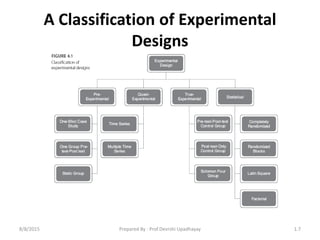
A Classification of Experimental
Designs
8/8/2015 1.7Prepared By : Prof.Devrshi Upadhayay
Statistical designs
Statistical designs allow for statistical control and
analysis of external variables.
• Completely randomized design
• Randomized block design
• Latin square design
• Factorial design
8/8/2015 1.8Prepared By : Prof.Devrshi Upadhayay
• Prepared By : Prof.Devrshi Upadhayay
• 9724256662
8/8/2015 Prepared By : Prof.Devrshi Upadhayay 1.9

experimental research designs

  • 1.
    Course: B.COm Subject: Foundationof Research Unit-2.1 8/8/2015 1Prepared By : Prof.Devrshi Upadhayay
  • 2.
    CHAPTER-4 EXPERIMENTAL RESEARCH DESIGNS 8/8/20152Prepared By : Prof.Devrshi Upadhayay
  • 3.
    What is anExperiment? • An experiment is generally used to infer a causality. In an experiment, a researcher actively manipulates one or more causal variables and measures their effects on the dependent variable of interest. 8/8/2015 1.3Prepared By : Prof.Devrshi Upadhayay
  • 4.
    Concepts Used inExperiments • Independent variables: Independent variables are also known as explanatory variables or treatments. The levels of these variables are manipulated (changed) by researchers to measure their effect on the dependent variable. • Test units: Test units are those entities on which treatments are applied. • Dependent variables: These variables measures the effect of treatments (independent variable) on the test units. 8/8/2015 1.4Prepared By : Prof.Devrshi Upadhayay
  • 5.
    Concepts Used InExperiments • Experiment: An experiment is executed when the researcher manipulates one or more independent variables and measures their effect on the dependent variables while controlling the effect of the extraneous variables. • Extraneous variables: These are the variables other than the independent variables which influence the response of test units to treatments. Examples: Store size, government policies, temperature, food intake, geographical location, etc. 8/8/2015 1.5Prepared By : Prof.Devrshi Upadhayay
  • 6.
    Validity in Experimentation •Internal validity: Internal validity tries to examine whether the observed effect on a dependent variable is actually caused by the treatments (independent variables) in question. • External validity: External validity refers to the generalization of the results of an experiment. 8/8/2015 1.6Prepared By : Prof.Devrshi Upadhayay
  • 7.
    A Classification ofExperimental Designs 8/8/2015 1.7Prepared By : Prof.Devrshi Upadhayay
  • 8.
    Statistical designs Statistical designsallow for statistical control and analysis of external variables. • Completely randomized design • Randomized block design • Latin square design • Factorial design 8/8/2015 1.8Prepared By : Prof.Devrshi Upadhayay
  • 9.
    • Prepared By: Prof.Devrshi Upadhayay • 9724256662 8/8/2015 Prepared By : Prof.Devrshi Upadhayay 1.9