Course:B.COm
Subject: Foundation of Research
Unit:2.4
Wednesday, April 19, 2017 1Prepared By : Prof.Devrshi Upadhayay
CHAPTER-7
ATTITUDE MEASUREMENT AND SCALING
Wednesday, April 19, 2017 2Prepared By : Prof.Devrshi Upadhayay
Meaning of Measurement and Scaling
• Measurement: The term ‘measurement’ means
assigning numbers or some other symbols to the
characteristics of certain objects. When numbers are
used, the researcher must have a rule for assigning a
number to an observation in a way that provides an
accurate description.
• Scaling: Scaling is an extension of measurement.
Scaling involves creating a continuum on which
measurements on objects are located.
Wednesday, April 19, 2017 1.3Prepared By : Prof.Devrshi Upadhayay
Types of Measurement Scale
Nominal scale: This is the lowest level of measurement. Here, numbers
are assigned for the purpose of identification of the objects. Any object
which is assigned a higher number is in no way superior to the one which
is assigned a lower number.
Example:
• Are you married?
(a) Yes (b) No
• Married person may be assigned a no. 1.
• Unmarried person may be assigned a no. 2.
The assigned numbers cannot be added, subtracted, multiplied or
divided. The only arithmetic operations that can be carried out are the
count of each category. Therefore, a frequency distribution table can
be prepared for the nominal scale variables and mode of the
distribution can be worked out.
Wednesday, April 19, 2017 1.4Prepared By : Prof.Devrshi Upadhayay
Types of Measurement Scale
Ordinal scale: This is the next higher level of
measurement. One of the limitations of the nominal
scale measurements is that we cannot say whether the
assigned number to an object is higher or lower than
the one assigned to another option. The ordinal scale
measurement takes care of this limitation. An ordinal
scale measurement tells whether an object has more or
less of characteristics than some other objects.
Wednesday, April 19, 2017 1.5Prepared By : Prof.Devrshi Upadhayay
Types of Measurement Scale
Example:
Rank the following attributes while choosing a restaurant for dinner.
The most important attribute may be ranked one, the next important
may be assigned a rank of 2 and so on.
In the ordinal scale, the assigned
ranks cannot be added, multiplied,
subtracted or
divided. One can compute
median, percentiles and quartiles
of the distribution. The other
major statistical analysis which can
be carried out is the rank order
correlation coefficient, sign test.
Wednesday, April 19, 2017 1.6Prepared By : Prof.Devrshi Upadhayay
Types of Measurement Scale
Interval scale: The interval scale measurement is the next higher level of
measurement.
• It takes care of the limitation of the ordinal scale measurement
where the difference between the score on the ordinal scale does
not have any meaningful interpretation.
• In the interval scale the difference of the score on the scale has
meaningful interpretation.
• It is assumed that the respondent is able to answer the questions on
a continuum scale.
• The mathematical form of the data on the interval scale may be
written as
Y = a + b X where a ≠ 0
• Ratio of the score on this scale does not have a meaningful
interpretation.
Wednesday, April 19, 2017 1.7Prepared By : Prof.Devrshi Upadhayay
Types of Measurement Scale
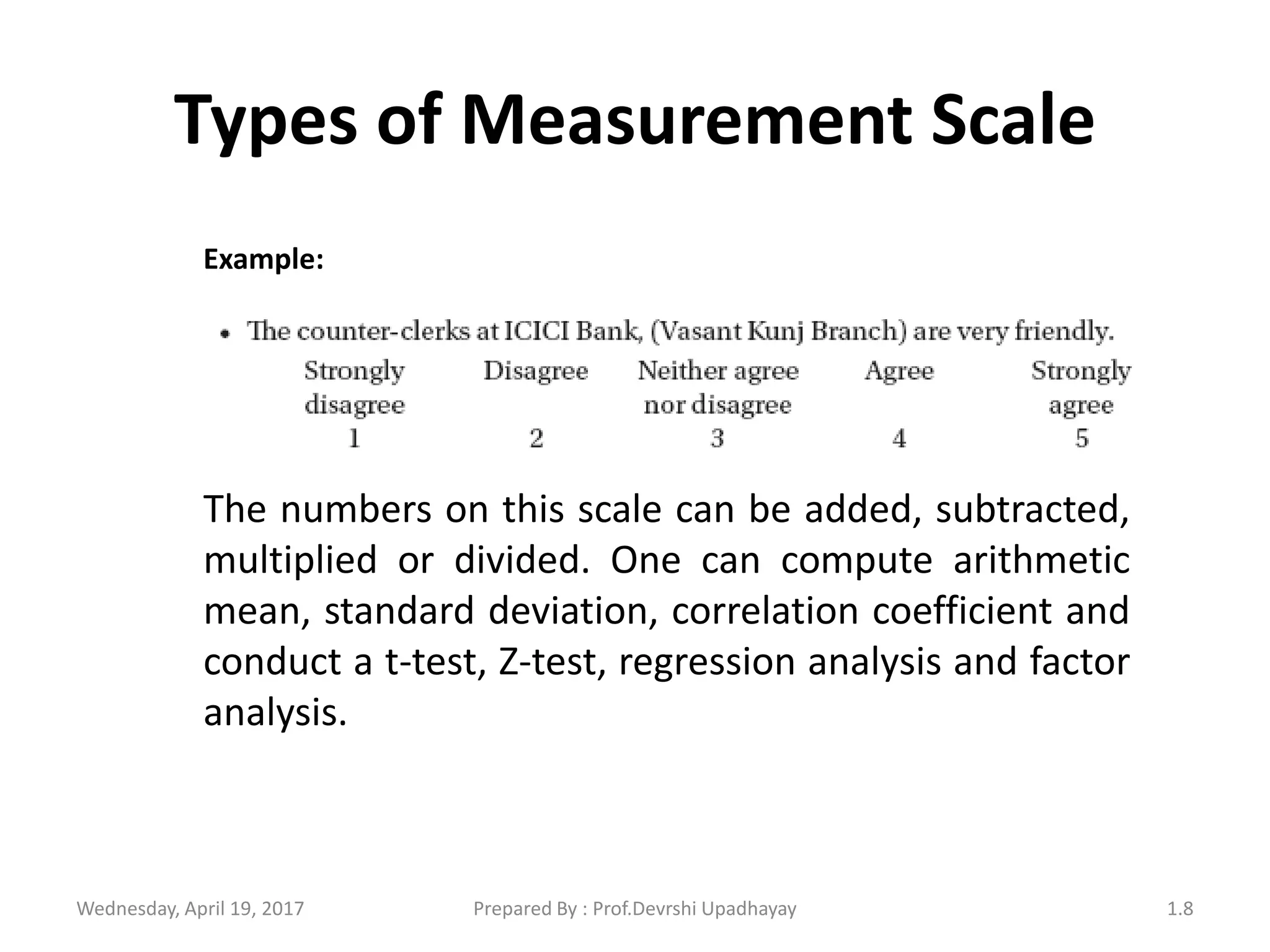
Example:
The numbers on this scale can be added, subtracted,
multiplied or divided. One can compute arithmetic
mean, standard deviation, correlation coefficient and
conduct a t-test, Z-test, regression analysis and factor
analysis.
Wednesday, April 19, 2017 1.8Prepared By : Prof.Devrshi Upadhayay
Types of Measurement Scale
Ratio scale: This is the highest level of measurement and takes care
of the limitations of the interval scale measurement, where the
ratio of the measurements on the scale does not have a meaningful
interpretation.
• The mathematical form of the ratio scale data is given by Y = b X.
• In ratio scale, there is a natural zero (origin).
Example:
How many chemist shops are there in your locality?
How many students are there in the MBA programme at IIFT?
• All mathematical and statistical operations can be carried out
using the ratio scale data.
Wednesday, April 19, 2017 1.9Prepared By : Prof.Devrshi Upadhayay
Definition of Attitude
• An attitude is viewed as an enduring disposition
(Character) to respond consistently in a given
manner to various aspects of the world, including
persons, events and objects.
Components of Attitude:
• Cognitive component
• Affective component
• Intention or action component
Wednesday, April 19, 2017 1.10Prepared By : Prof.Devrshi Upadhayay
Classification of Scales
• Comparative scales – In comparative scales it is assumed that respondents
make use of a standard frame of reference before answering the question.
Example:-
Wednesday, April 19, 2017 1.11Prepared By : Prof.Devrshi Upadhayay
Classification of Scales
Graphic Rating Scale – This is a continuous scale and the
respondent is asked to tick his preference on a graph.
Examples:
Non-comparative scale
Graphic rating scale Itemized rating scale
Wednesday, April 19, 2017 1.12Prepared By : Prof.Devrshi Upadhayay
Classification of Scales
Please put a tick mark (•) on the following line to indicate your
preference for fast food.
Alternative Presentation of Graphic Rating Scale –
Please indicate how much do you like fast food by pointing to the face
that best shows your attitude and taste. If you do not prefer it at all, you
would point to face one. In case you prefer it the most, you would point
to face seven.
Wednesday, April 19, 2017 1.13Prepared By : Prof.Devrshi Upadhayay
Classification of Scales
Example of a Likert Scale:
Wednesday, April 19, 2017 1.14Prepared By : Prof.Devrshi Upadhayay
Criteria for good measurement
Validity
The validity of a scale refers to the question whether we are measuring what
we want to measure.
Different ways to measure Validity
• Content validity
• Concurrent validity
• Predictive validity
Sensitivity
Sensitivity refers to an instrument’s ability to accurately measure the
variability in a concept.
Wednesday, April 19, 2017 1.15Prepared By : Prof.Devrshi Upadhayay
• Prepared By : Prof.Devrshi Upadhayay
• 9724256662
Wednesday, April 19, 2017 Prepared By : Prof.Devrshi Upadhayay 1.16

attitude measurement and scaling

  • 1.
    Course:B.COm Subject: Foundation ofResearch Unit:2.4 Wednesday, April 19, 2017 1Prepared By : Prof.Devrshi Upadhayay
  • 2.
    CHAPTER-7 ATTITUDE MEASUREMENT ANDSCALING Wednesday, April 19, 2017 2Prepared By : Prof.Devrshi Upadhayay
  • 3.
    Meaning of Measurementand Scaling • Measurement: The term ‘measurement’ means assigning numbers or some other symbols to the characteristics of certain objects. When numbers are used, the researcher must have a rule for assigning a number to an observation in a way that provides an accurate description. • Scaling: Scaling is an extension of measurement. Scaling involves creating a continuum on which measurements on objects are located. Wednesday, April 19, 2017 1.3Prepared By : Prof.Devrshi Upadhayay
  • 4.
    Types of MeasurementScale Nominal scale: This is the lowest level of measurement. Here, numbers are assigned for the purpose of identification of the objects. Any object which is assigned a higher number is in no way superior to the one which is assigned a lower number. Example: • Are you married? (a) Yes (b) No • Married person may be assigned a no. 1. • Unmarried person may be assigned a no. 2. The assigned numbers cannot be added, subtracted, multiplied or divided. The only arithmetic operations that can be carried out are the count of each category. Therefore, a frequency distribution table can be prepared for the nominal scale variables and mode of the distribution can be worked out. Wednesday, April 19, 2017 1.4Prepared By : Prof.Devrshi Upadhayay
  • 5.
    Types of MeasurementScale Ordinal scale: This is the next higher level of measurement. One of the limitations of the nominal scale measurements is that we cannot say whether the assigned number to an object is higher or lower than the one assigned to another option. The ordinal scale measurement takes care of this limitation. An ordinal scale measurement tells whether an object has more or less of characteristics than some other objects. Wednesday, April 19, 2017 1.5Prepared By : Prof.Devrshi Upadhayay
  • 6.
    Types of MeasurementScale Example: Rank the following attributes while choosing a restaurant for dinner. The most important attribute may be ranked one, the next important may be assigned a rank of 2 and so on. In the ordinal scale, the assigned ranks cannot be added, multiplied, subtracted or divided. One can compute median, percentiles and quartiles of the distribution. The other major statistical analysis which can be carried out is the rank order correlation coefficient, sign test. Wednesday, April 19, 2017 1.6Prepared By : Prof.Devrshi Upadhayay
  • 7.
    Types of MeasurementScale Interval scale: The interval scale measurement is the next higher level of measurement. • It takes care of the limitation of the ordinal scale measurement where the difference between the score on the ordinal scale does not have any meaningful interpretation. • In the interval scale the difference of the score on the scale has meaningful interpretation. • It is assumed that the respondent is able to answer the questions on a continuum scale. • The mathematical form of the data on the interval scale may be written as Y = a + b X where a ≠ 0 • Ratio of the score on this scale does not have a meaningful interpretation. Wednesday, April 19, 2017 1.7Prepared By : Prof.Devrshi Upadhayay
  • 8.
    Types of MeasurementScale Example: The numbers on this scale can be added, subtracted, multiplied or divided. One can compute arithmetic mean, standard deviation, correlation coefficient and conduct a t-test, Z-test, regression analysis and factor analysis. Wednesday, April 19, 2017 1.8Prepared By : Prof.Devrshi Upadhayay
  • 9.
    Types of MeasurementScale Ratio scale: This is the highest level of measurement and takes care of the limitations of the interval scale measurement, where the ratio of the measurements on the scale does not have a meaningful interpretation. • The mathematical form of the ratio scale data is given by Y = b X. • In ratio scale, there is a natural zero (origin). Example: How many chemist shops are there in your locality? How many students are there in the MBA programme at IIFT? • All mathematical and statistical operations can be carried out using the ratio scale data. Wednesday, April 19, 2017 1.9Prepared By : Prof.Devrshi Upadhayay
  • 10.
    Definition of Attitude •An attitude is viewed as an enduring disposition (Character) to respond consistently in a given manner to various aspects of the world, including persons, events and objects. Components of Attitude: • Cognitive component • Affective component • Intention or action component Wednesday, April 19, 2017 1.10Prepared By : Prof.Devrshi Upadhayay
  • 11.
    Classification of Scales •Comparative scales – In comparative scales it is assumed that respondents make use of a standard frame of reference before answering the question. Example:- Wednesday, April 19, 2017 1.11Prepared By : Prof.Devrshi Upadhayay
  • 12.
    Classification of Scales GraphicRating Scale – This is a continuous scale and the respondent is asked to tick his preference on a graph. Examples: Non-comparative scale Graphic rating scale Itemized rating scale Wednesday, April 19, 2017 1.12Prepared By : Prof.Devrshi Upadhayay
  • 13.
    Classification of Scales Pleaseput a tick mark (•) on the following line to indicate your preference for fast food. Alternative Presentation of Graphic Rating Scale – Please indicate how much do you like fast food by pointing to the face that best shows your attitude and taste. If you do not prefer it at all, you would point to face one. In case you prefer it the most, you would point to face seven. Wednesday, April 19, 2017 1.13Prepared By : Prof.Devrshi Upadhayay
  • 14.
    Classification of Scales Exampleof a Likert Scale: Wednesday, April 19, 2017 1.14Prepared By : Prof.Devrshi Upadhayay
  • 15.
    Criteria for goodmeasurement Validity The validity of a scale refers to the question whether we are measuring what we want to measure. Different ways to measure Validity • Content validity • Concurrent validity • Predictive validity Sensitivity Sensitivity refers to an instrument’s ability to accurately measure the variability in a concept. Wednesday, April 19, 2017 1.15Prepared By : Prof.Devrshi Upadhayay
  • 16.
    • Prepared By: Prof.Devrshi Upadhayay • 9724256662 Wednesday, April 19, 2017 Prepared By : Prof.Devrshi Upadhayay 1.16