Introduction
What is it?
‱ Study health related parameters through
‱ Using scientific method to
‱ Solve any problem or answer a question and
‱ Publish
‱ So research starts with
?
What is Research
Research is the systematic method of
collection, analysis, and interpretation of
data to answer a certain question or solve
a problem
Blending subject
‱ Research is the systematic method
–Epidemiology
‱ Research is the collection, analysis, and
interpretation of data
–Biostatistics
From respondent to population
Respondent
answers to
quenstions
Inference
Characteristics of the
respondent Statistical
analysis
Characteristics of the
sample
Characteristics of the
population
Inference
How a problem lead to research
1. Perceived difference or discrepancy between
what exists and what should exist
2. The reason(s) for this difference should be
unclear (so it leads to bring up question in
mind) and
3. There should be more than one possible
answer to the question or solution to the
problem
Research Problem
‱ A situation or circumstance requiring solution
with description, explanation and prediction
‱ Situation is unsatisfactory (so need to be
addressed)
‱ Establishes the importance
‱ Focuses on how the work to find the answer
would add to existing knowledge
General
Specific
Topic
Research
Problem
Purpose
Research
Question
Child care & Social protection
Early marriage among girls
To explore strengths and weakness
of child protection system in
preventing early marriage
Does child protection scheme
prevent early marriage?
The terminologies
‱ Research topic: broad subject matter being
addressed in a study
‱ Research problem: situation or circumstance
that requires a solution
‱ Purpose: major intent or objective of the
study
‱ Research question(s): those that the
researcher would like answered or addressed
from the study
Characteristics of research
♣ Demands a clear statement of the problem
♣ Requires a plan
♣ Builds on existing data, using both positive and
negative findings and
♣ New data should be collected as required and
be organized in such a way that they answer
the original research question(s)
How to do Research
‱ Identify an issue, question, or problem
– Talk with people who want or need your study
‱ Find out what's already known about it
– Talk with experts
– Read their reviews and the original research on the
topic
‱ Make plan & do the work
– Follow epidemiological methods
– Collect information (literature and data)
– Assess the finding
What to do after finishing the work
‱ Write the report and submit it for assessment
‱ If a good job is done submit for publication
– The work will benefit more people if you publish
– There are two ways: publish or perish
‱ If the work isn’t so good
– Even then publish
– Try to establish your skill in scientific explanation
‱ Remember always
– Publish and publish and publish
– It is to clean yourself from unfinished job
Types of Research
‱ Qualitative
– Mainly done by social scientists
– Qualitative aspect evaluated
– Commonly done by case studies
– Health system research
‱ Quantitative
– Almost everyone is involved
– Qualitative aspect derived from quantitative work
– Health parameter research
Other types of Research
‱ Basic
– Explore basic knowledge
– Generate theoretical knowhow
– Not involved to analyze a problem
‱ Applied
– Analyze a problem
– Decision can be made
– Course of action sought to solve
‱ Operations/Action
– To define needs
– Search key problems to hinder service
– Apply solutions to improve service
Other types of Research
‱ Evaluation
– Analyze a given set of standards
– Appraisal of an ongoing program or project
– To assess whether the objective is met or not
– Determine the merit or quality
‱ Two types of evaluation
– Formative: during the ongoing activity of organization
or program
‱ Aim: improvement of the activity
– Summative: assessment at the end of program
‱ Aim: continue or discontinue the work
Criteria for selecting a research topic
1. Relevance
2. Avoidance of duplication
3. Feasibility
4. Political acceptability
5. Applicability
6. Urgency of data needed
7. Ethical acceptability
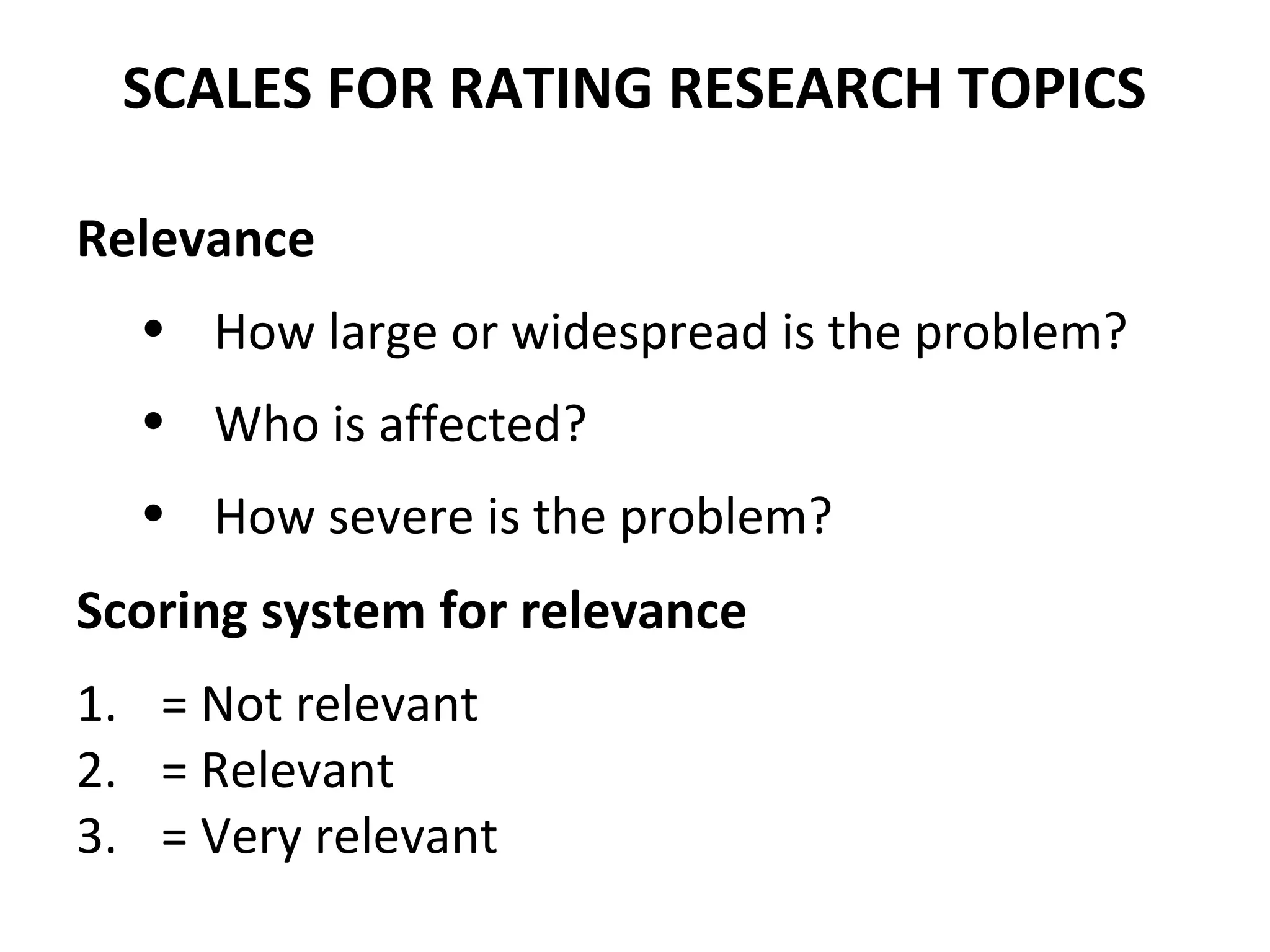
SCALES FOR RATING RESEARCH TOPICS
Relevance
‱ How large or widespread is the problem?
‱ Who is affected?
‱ How severe is the problem?
Scoring system for relevance
1. = Not relevant
2. = Relevant
3. = Very relevant
SCALES FOR RATING RESEARCH TOPICS
Avoidance of duplication
‱ Has somebody had same/similar question?
‱ Has the question been answered?
Scoring for duplication check
1. = Sufficient information already available
2. = Some information available but major issues not
covered
3. = No sound information available on which to base
problem-solving
SCALES FOR RATING RESEARCH TOPICS
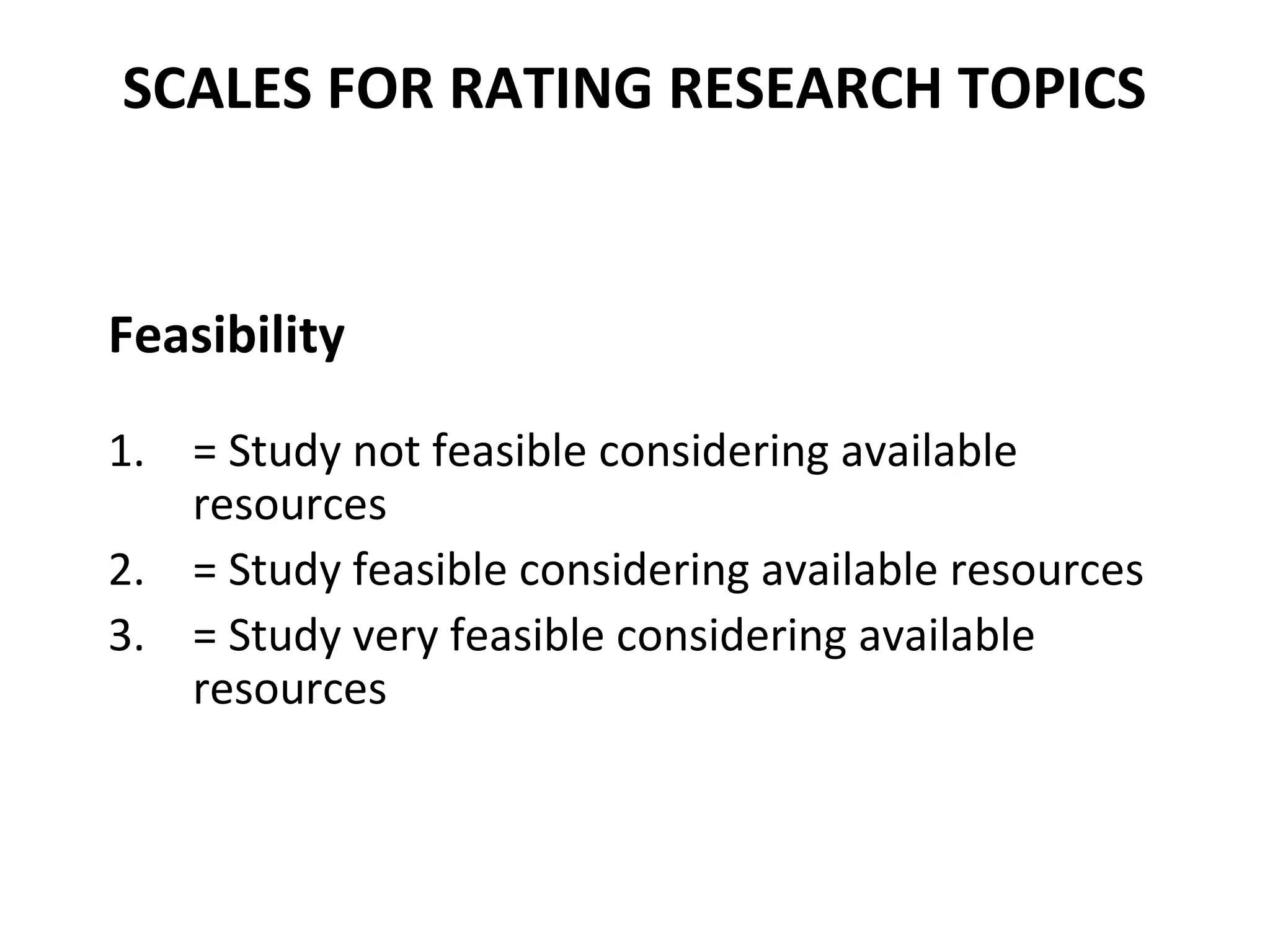
Feasibility
1. = Study not feasible considering available
resources
2. = Study feasible considering available resources
3. = Study very feasible considering available
resources
SCALES FOR RATING RESEARCH TOPICS
Political acceptability
1. = Topic not acceptable to high level
policymakers
2. = Topic more or less acceptable
3. = Topic fully acceptable
SCALES FOR RATING RESEARCH TOPICS
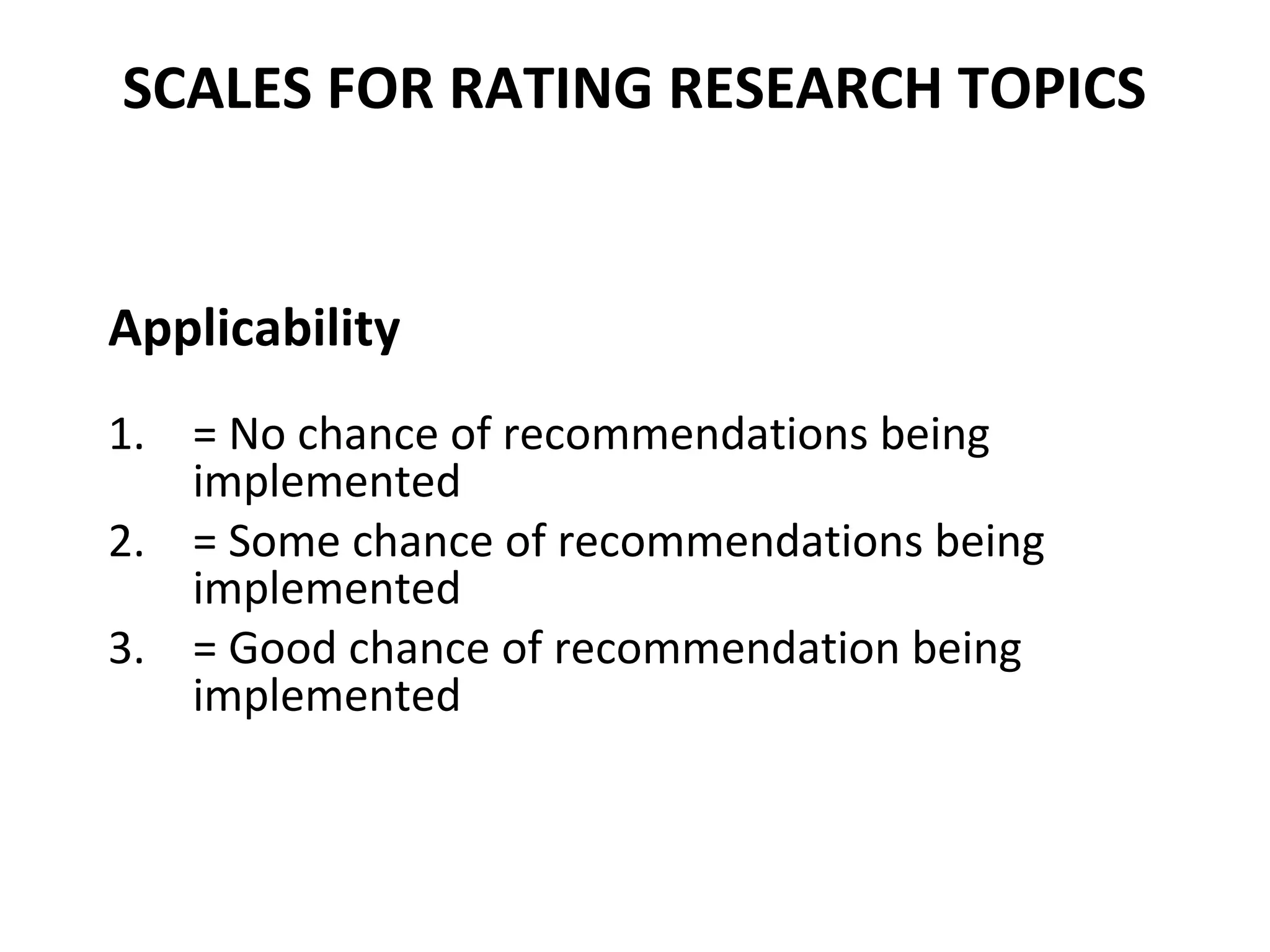
Applicability
1. = No chance of recommendations being
implemented
2. = Some chance of recommendations being
implemented
3. = Good chance of recommendation being
implemented
SCALES FOR RATING RESEARCH TOPICS
Urgency
1. = Information not urgently needed
2. = Information could be used right away but a
delay of some months would be acceptable
3. = Data very urgently needed for decision-
making
SCALES FOR RATING RESEARCH TOPICS
Ethical acceptability
1. = Major ethical problems
2. = Minor ethical problems
3. = No ethical problems
Prioritize a research topic
1. If the criteria add up to ≄ 16: Very good to start
2. If the criteria add up to 12-15: Don’t discard, but
not so suitable to start right now
3. If the criteria add up <12: Can’t pass the decision
threshold
Steps involved in a research
Problem Identification (well defined problem is
half work done)
oProblem Analysis
oTitle Selection
oVariable Identification
Review of Literature (throughout)
Hypothesis Formulation (if any)/ Research
Question(s)
Objectives Setting
Methods and Materials
Budgeting
Steps involved in a research
Decide on sampling design and sample size
Constructing data collection instrument
Pre-testing, modifying and finalizing
Data collection
Data editing and record keeping
Data analysis and interpretation of results
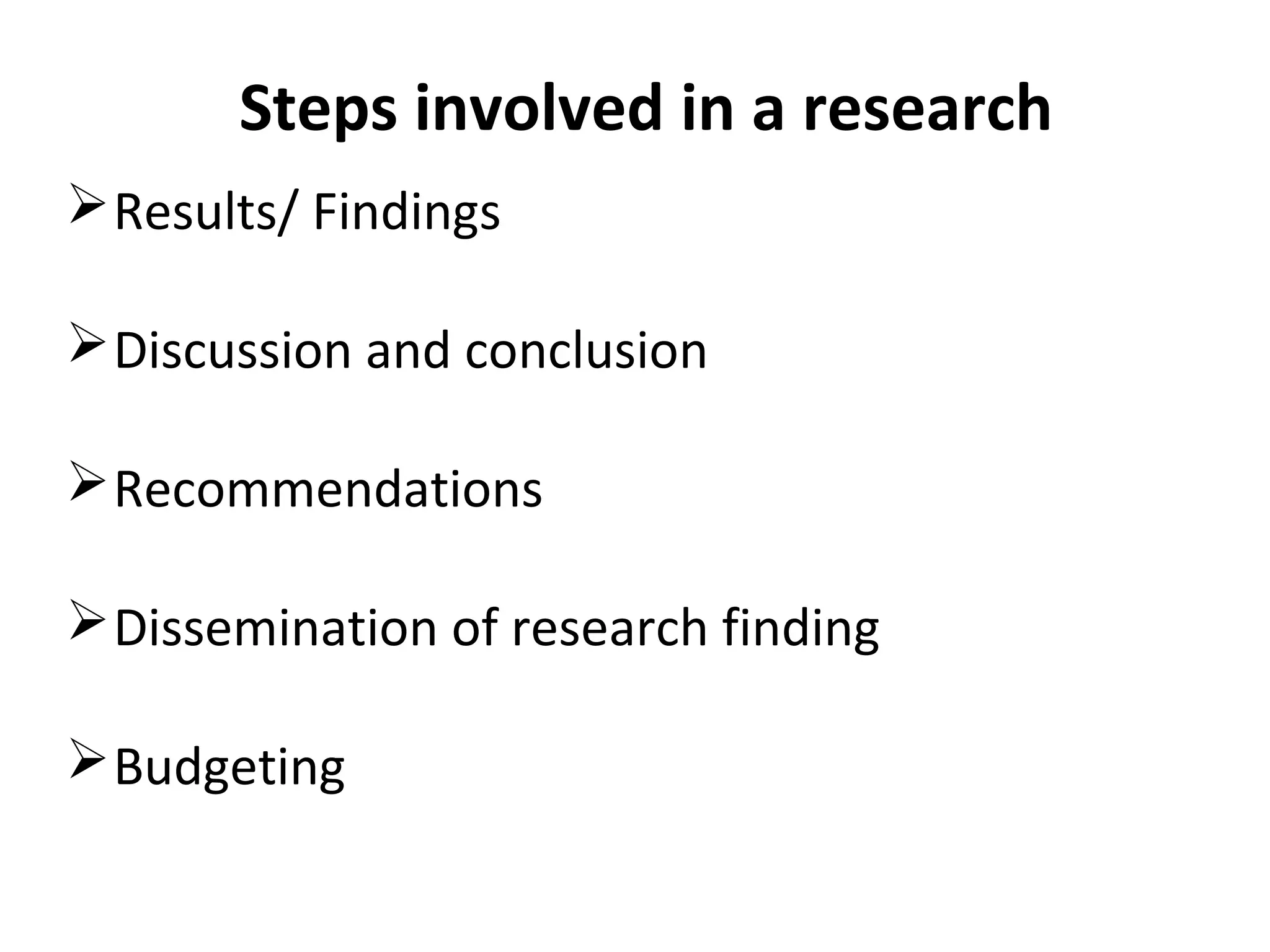
Steps involved in a research
Results/ Findings
Discussion and conclusion
Recommendations
Dissemination of research finding
Budgeting

01. introduction rm

  • 1.
  • 2.
    What is it? ‱Study health related parameters through ‱ Using scientific method to ‱ Solve any problem or answer a question and ‱ Publish ‱ So research starts with ?
  • 3.
    What is Research Researchis the systematic method of collection, analysis, and interpretation of data to answer a certain question or solve a problem
  • 4.
    Blending subject ‱ Researchis the systematic method –Epidemiology ‱ Research is the collection, analysis, and interpretation of data –Biostatistics
  • 5.
    From respondent topopulation Respondent answers to quenstions Inference Characteristics of the respondent Statistical analysis Characteristics of the sample Characteristics of the population Inference
  • 6.
    How a problemlead to research 1. Perceived difference or discrepancy between what exists and what should exist 2. The reason(s) for this difference should be unclear (so it leads to bring up question in mind) and 3. There should be more than one possible answer to the question or solution to the problem
  • 7.
    Research Problem ‱ Asituation or circumstance requiring solution with description, explanation and prediction ‱ Situation is unsatisfactory (so need to be addressed) ‱ Establishes the importance ‱ Focuses on how the work to find the answer would add to existing knowledge
  • 8.
    General Specific Topic Research Problem Purpose Research Question Child care &Social protection Early marriage among girls To explore strengths and weakness of child protection system in preventing early marriage Does child protection scheme prevent early marriage?
  • 9.
    The terminologies ‱ Researchtopic: broad subject matter being addressed in a study ‱ Research problem: situation or circumstance that requires a solution ‱ Purpose: major intent or objective of the study ‱ Research question(s): those that the researcher would like answered or addressed from the study
  • 10.
    Characteristics of research ♣Demands a clear statement of the problem ♣ Requires a plan ♣ Builds on existing data, using both positive and negative findings and ♣ New data should be collected as required and be organized in such a way that they answer the original research question(s)
  • 11.
    How to doResearch ‱ Identify an issue, question, or problem – Talk with people who want or need your study ‱ Find out what's already known about it – Talk with experts – Read their reviews and the original research on the topic ‱ Make plan & do the work – Follow epidemiological methods – Collect information (literature and data) – Assess the finding
  • 12.
    What to doafter finishing the work ‱ Write the report and submit it for assessment ‱ If a good job is done submit for publication – The work will benefit more people if you publish – There are two ways: publish or perish ‱ If the work isn’t so good – Even then publish – Try to establish your skill in scientific explanation ‱ Remember always – Publish and publish and publish – It is to clean yourself from unfinished job
  • 14.
    Types of Research ‱Qualitative – Mainly done by social scientists – Qualitative aspect evaluated – Commonly done by case studies – Health system research ‱ Quantitative – Almost everyone is involved – Qualitative aspect derived from quantitative work – Health parameter research
  • 15.
    Other types ofResearch ‱ Basic – Explore basic knowledge – Generate theoretical knowhow – Not involved to analyze a problem ‱ Applied – Analyze a problem – Decision can be made – Course of action sought to solve ‱ Operations/Action – To define needs – Search key problems to hinder service – Apply solutions to improve service
  • 16.
    Other types ofResearch ‱ Evaluation – Analyze a given set of standards – Appraisal of an ongoing program or project – To assess whether the objective is met or not – Determine the merit or quality ‱ Two types of evaluation – Formative: during the ongoing activity of organization or program ‱ Aim: improvement of the activity – Summative: assessment at the end of program ‱ Aim: continue or discontinue the work
  • 17.
    Criteria for selectinga research topic 1. Relevance 2. Avoidance of duplication 3. Feasibility 4. Political acceptability 5. Applicability 6. Urgency of data needed 7. Ethical acceptability
  • 18.
    SCALES FOR RATINGRESEARCH TOPICS Relevance ‱ How large or widespread is the problem? ‱ Who is affected? ‱ How severe is the problem? Scoring system for relevance 1. = Not relevant 2. = Relevant 3. = Very relevant
  • 19.
    SCALES FOR RATINGRESEARCH TOPICS Avoidance of duplication ‱ Has somebody had same/similar question? ‱ Has the question been answered? Scoring for duplication check 1. = Sufficient information already available 2. = Some information available but major issues not covered 3. = No sound information available on which to base problem-solving
  • 20.
    SCALES FOR RATINGRESEARCH TOPICS Feasibility 1. = Study not feasible considering available resources 2. = Study feasible considering available resources 3. = Study very feasible considering available resources
  • 21.
    SCALES FOR RATINGRESEARCH TOPICS Political acceptability 1. = Topic not acceptable to high level policymakers 2. = Topic more or less acceptable 3. = Topic fully acceptable
  • 22.
    SCALES FOR RATINGRESEARCH TOPICS Applicability 1. = No chance of recommendations being implemented 2. = Some chance of recommendations being implemented 3. = Good chance of recommendation being implemented
  • 23.
    SCALES FOR RATINGRESEARCH TOPICS Urgency 1. = Information not urgently needed 2. = Information could be used right away but a delay of some months would be acceptable 3. = Data very urgently needed for decision- making
  • 24.
    SCALES FOR RATINGRESEARCH TOPICS Ethical acceptability 1. = Major ethical problems 2. = Minor ethical problems 3. = No ethical problems
  • 25.
    Prioritize a researchtopic 1. If the criteria add up to ≄ 16: Very good to start 2. If the criteria add up to 12-15: Don’t discard, but not so suitable to start right now 3. If the criteria add up <12: Can’t pass the decision threshold
  • 26.
    Steps involved ina research Problem Identification (well defined problem is half work done) oProblem Analysis oTitle Selection oVariable Identification Review of Literature (throughout) Hypothesis Formulation (if any)/ Research Question(s) Objectives Setting Methods and Materials Budgeting
  • 27.
    Steps involved ina research Decide on sampling design and sample size Constructing data collection instrument Pre-testing, modifying and finalizing Data collection Data editing and record keeping Data analysis and interpretation of results
  • 28.
    Steps involved ina research Results/ Findings Discussion and conclusion Recommendations Dissemination of research finding Budgeting