DIFFERENT APPROACHES
&
RELATION
WITH HUMAN ECOLOGY
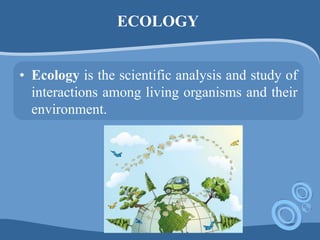
ECOLOGY
• Ecology is the scientific analysis and study of
interactions among living organisms and their
environment.
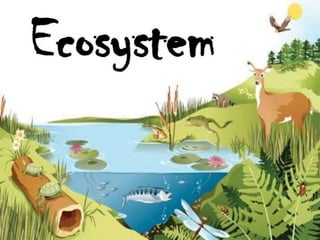
ECOSYSTEM
• An ecosystem is a community of living
organisms in conjunction with the nonliving
components of their environment (things like
air, water and mineral soil), interacting as a
system.
HUMAN ECOLOGY
• Human ecology is a study of the relationship
between humans and their natural, social,
and built environments.
APPROACHES & RELATION
The different approaches for disasters
with human ecology are:
1. Ecosystem Approach
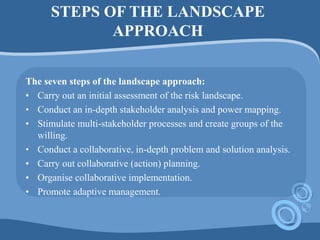
2. Landscape Approach
3. Perception Approach
ECOSYSTEM APPROACH
The ecosystem approach is a strategy for the integrated
management of land, water and living resources that
promotes conservation and sustainable use in an equitable
way. It is focused on levels of biological organization which
encompass the essential processes, functions and
interactions among organisms and their environment. It
recognizes that humans, with their cultural diversity, are an
integral component of ecosystems.
ECOSYSTEM APPROACH
• An ecosystem approach is based on the application
of appropriate scientific methodologies focused on
levels of biological organization, which encompass
(cause to takes place) the essential structure,
processes, functions and interactions among
organisms and their environment. It recognizes that
humans, with their cultural diversity, are an integral
component of many ecosystems.
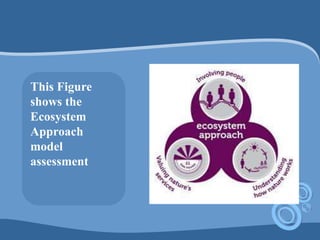
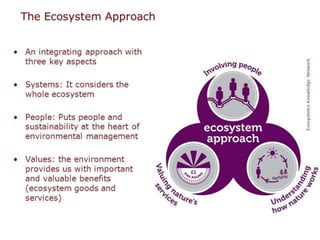
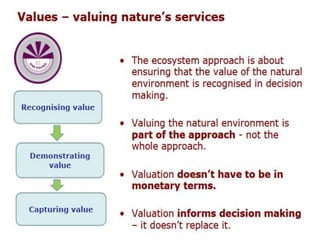
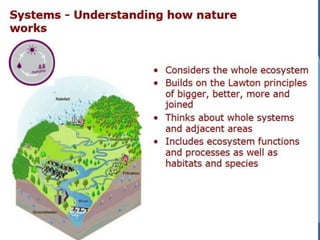
This Figure
shows the
Ecosystem
Approach
model
assessment
FOCUS ON THE RELATIONSHIPS AND
PROCESSES WITHIN ECOSYSTEM
• The many components of biodiversity control the stores
and flows of energy, water and nutrients within ecosystems,
and provide resistance to major perturbations. A much
better knowledge of ecosystem functions and structure, and
the roles of the components of biological diversity in
ecosystems, is required, especially to understand:
• Ecosystem resilience and the effects to biodiversity loss
(species and genetic levels) and habitat fragmentation; and
• Underlying causes of biodiversity loss; and
• Determinants of local biological diversity in management
decisions.
FOCUS ON THE RELATIONSHIPS AND
PROCESSES WITHIN ECOSYSTEM
• Functional biodiversity in ecosystems provides
many goods and services of economic and social
importance. While there is a need to accelerate
efforts to gain new knowledge about functional
biodiversity, ecosystem management has to be
carried out even in the absence of such knowledge.
The ecosystem approach can facilitate practical
management by ecosystem managers (whether
local communities or national policy makers).
LANDSCAPE
• A ‘landscape’ is a flexible concept without a
clearly defined spatial entity or physical
space. It includes natural features of the
landscape, infrastructure, stakeholders and
external forces that affect the physical area.
LANDSCAPE APPROACH
• The landscape approach is an interdisciplinary, cross-
sectoral and holistic approach. For disaster risk
reduction purposes, the approach facilitates an inclusive
and participatory learning process for shared risk
understanding and risk intervention scenario planning.
An inclusive and participatory process allows for more
innovative and integrated, and therefore more impactful,
solutions to risk (e.g. ecosystem-based or hybrid
measures and optimised initiatives on water governance
as part of disaster risk management strategies and
investments).
LANDSCAPE APPROACH
• Applying the landscape approach helps to
overcome barriers by sector and
contributes to effect risk management by
connecting all stakeholders involved,
starting with the communities at risk in
the landscape.
CHARACTERISTICS OF THE
LANDSCAPE APPROACH
1. Communities at the centre.
2. All actors - either contributing to or impacted by disaster
risk.
3. Analysis of the hydrology - groundwater and surface
water)
4. Ecosystem management and restoration.
5. Flexible to future changes – Identifying solutions
6. Long-term perspective
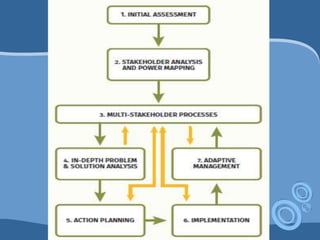
STEPS OF THE LANDSCAPE
APPROACH
The seven steps of the landscape approach:
• Carry out an initial assessment of the risk landscape.
• Conduct an in-depth stakeholder analysis and power mapping.
• Stimulate multi-stakeholder processes and create groups of the
willing.
• Conduct a collaborative, in-depth problem and solution analysis.
• Carry out collaborative (action) planning.
• Organise collaborative implementation.
• Promote adaptive management.
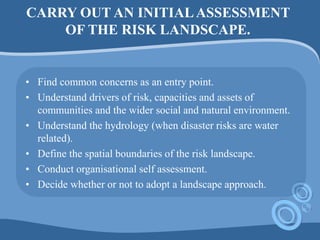
CARRY OUT AN INITIALASSESSMENT
OF THE RISK LANDSCAPE.
• Find common concerns as an entry point.
• Understand drivers of risk, capacities and assets of
communities and the wider social and natural environment.
• Understand the hydrology (when disaster risks are water
related).
• Define the spatial boundaries of the risk landscape.
• Conduct organisational self assessment.
• Decide whether or not to adopt a landscape approach.
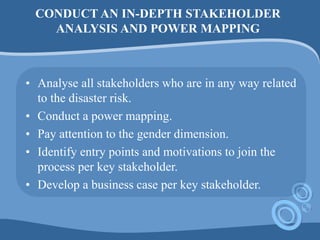
CONDUCT AN IN-DEPTH STAKEHOLDER
ANALYSIS AND POWER MAPPING
• Analyse all stakeholders who are in any way related
to the disaster risk.
• Conduct a power mapping.
• Pay attention to the gender dimension.
• Identify entry points and motivations to join the
process per key stakeholder.
• Develop a business case per key stakeholder.
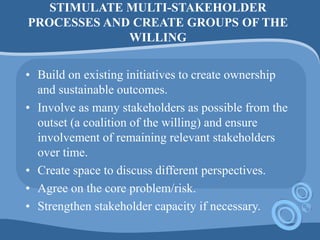
STIMULATE MULTI-STAKEHOLDER
PROCESSES AND CREATE GROUPS OF THE
WILLING
• Build on existing initiatives to create ownership
and sustainable outcomes.
• Involve as many stakeholders as possible from the
outset (a coalition of the willing) and ensure
involvement of remaining relevant stakeholders
over time.
• Create space to discuss different perspectives.
• Agree on the core problem/risk.
• Strengthen stakeholder capacity if necessary.
Conduct a collaborative, in-depth
problem and solution analysis
• Identify root causes of issues of mutual concern.
• Create an open and respectful dialogue while
exploring stakeholders’ roles in relation to the core
problems identified.
• Recognise and use information/practices from
multiple sources including traditional, local and
scientific sources.
• Identify possible solutions to problems identified.
Carry out collaborative (action)
planning
• Develop landscape scenarios.
• Agree on tasks, responsibilities and
communication strategies.
• Keep funding in mind.
• Divide the landscape into smaller and more
manageable units to monitor risks better.
Organise collaborative
implementation
• Implement interventions aimed at addressing the drivers of
risk, enhancing the capacities and assets of communities,
and strengthening the enabling environment.
• Focus on securing some quick wins at the outset of the
implementation phase.
• Link long-term risk reduction goals to socioeconomic
benefits.
• Make use of synergies while avoiding tradeoffs and negative
impacts.
• Promote ownership and gradually hand over responsibilities
to the enabling environment.
Promote adaptive management
• Develop indicators tracking changes in the drivers
of risk, the capacities and assets of communities
and the enabling environment.
• Involve research institutes in monitoring and
evaluation (M&E).
• Use M&E outcomes to improve landscape
management continually.
• Ensure flexible management of projects or
programmes.
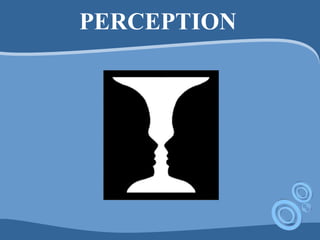
PERCEPTION
APPROACH
PERCEPTION
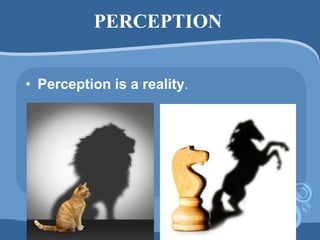
• Perception is a reality.
PERCEPTION
• The mental process of identifying,
Sorting & arranging stimulus data into
meaningful patterns.
• The process of gathering sensory
information and assigning meaning to
it.
PERCEPTION
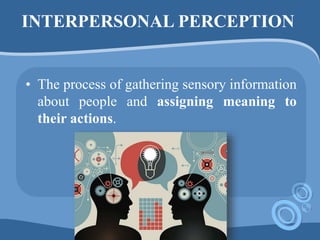
INTERPERSONAL PERCEPTION
• The process of gathering sensory information
about people and assigning meaning to
their actions.
BASIC STAGES IN PERCEPTION
APPROACH
Three basic stages in this perceptional
approach:
• Selection
• Organization
• Interpolation
SELECTION
• The first process of the perception process in
which we focus our attention on certain
incoming sensory information.
ACTIONS
• Selective Perception
• Selective Attention
• Selective Exposure
• Selective Recall
EXAMPLES
• Intensity
• Repetition
• Contrast (or) Change
• Motives/Interests/Needs
• Physiological Limitations
• Expectations
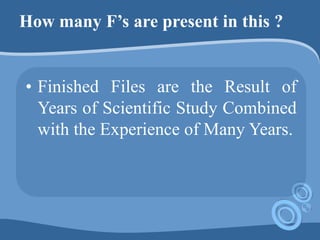
How many F’s are present in this ?
• Finished Files are the Result of
Years of Scientific Study Combined
with the Experience of Many Years.
• Actually there are 6 F’s are present.
• The identifying of F in that paragraph is
one type perception.
OBJECTS ARE PRESENT IN THE
WORLD
• A person observes & uses to select
objects.
• The person organizes the perception of
objects.
• The person interprets the perception.
• The person responds.
INTERNAL FACTORS
• PERSONALITY – influence how a person
selects perception.
• MOTIVATION – what they need at that
moment.
• EXPERIENCE – Learned from the past.
EXTERNAL FACTORS
• Size
• Integrity
• Contrast
• Repetition
• Novelty & Familiarity
ORGANIZATIONAL
• The second part of the perception
process in which we sort & categorize
information that we perceive based on
innovate & learned cognitive patterns.
DIFFERENT WAYS
• There are 3 different ways to sort things into
patterns:
• Proximity – we tend to think that things are close
together
• Similarity - Similarity looking or similarity acting
• Difference – differ from the rest does n’t belong
with the group
ACTIONS
• Figure/ Ground
• Categorized
a) Physical Constructs
b) Role Constructs
c) Interaction Contracts
d) Psychological Contracts
• Link/ Connect Categories
• Closure
INTERPRETATION
• The process of explaining what has
been selected & organized in a way that
makes sense.
ACTIONS
• Works satisfaction
• Present experiences
• Past experiences
• Assumptions about human behaviour
• Expectations
• Knowledge

Different approaches

  • 1.
  • 2.
    ECOLOGY • Ecology isthe scientific analysis and study of interactions among living organisms and their environment.
  • 3.
    ECOSYSTEM • An ecosystemis a community of living organisms in conjunction with the nonliving components of their environment (things like air, water and mineral soil), interacting as a system.
  • 5.
    HUMAN ECOLOGY • Humanecology is a study of the relationship between humans and their natural, social, and built environments.
  • 7.
    APPROACHES & RELATION Thedifferent approaches for disasters with human ecology are: 1. Ecosystem Approach 2. Landscape Approach 3. Perception Approach
  • 8.
    ECOSYSTEM APPROACH The ecosystemapproach is a strategy for the integrated management of land, water and living resources that promotes conservation and sustainable use in an equitable way. It is focused on levels of biological organization which encompass the essential processes, functions and interactions among organisms and their environment. It recognizes that humans, with their cultural diversity, are an integral component of ecosystems.
  • 9.
    ECOSYSTEM APPROACH • Anecosystem approach is based on the application of appropriate scientific methodologies focused on levels of biological organization, which encompass (cause to takes place) the essential structure, processes, functions and interactions among organisms and their environment. It recognizes that humans, with their cultural diversity, are an integral component of many ecosystems.
  • 10.
  • 15.
    FOCUS ON THERELATIONSHIPS AND PROCESSES WITHIN ECOSYSTEM • The many components of biodiversity control the stores and flows of energy, water and nutrients within ecosystems, and provide resistance to major perturbations. A much better knowledge of ecosystem functions and structure, and the roles of the components of biological diversity in ecosystems, is required, especially to understand: • Ecosystem resilience and the effects to biodiversity loss (species and genetic levels) and habitat fragmentation; and • Underlying causes of biodiversity loss; and • Determinants of local biological diversity in management decisions.
  • 16.
    FOCUS ON THERELATIONSHIPS AND PROCESSES WITHIN ECOSYSTEM • Functional biodiversity in ecosystems provides many goods and services of economic and social importance. While there is a need to accelerate efforts to gain new knowledge about functional biodiversity, ecosystem management has to be carried out even in the absence of such knowledge. The ecosystem approach can facilitate practical management by ecosystem managers (whether local communities or national policy makers).
  • 18.
    LANDSCAPE • A ‘landscape’is a flexible concept without a clearly defined spatial entity or physical space. It includes natural features of the landscape, infrastructure, stakeholders and external forces that affect the physical area.
  • 19.
    LANDSCAPE APPROACH • Thelandscape approach is an interdisciplinary, cross- sectoral and holistic approach. For disaster risk reduction purposes, the approach facilitates an inclusive and participatory learning process for shared risk understanding and risk intervention scenario planning. An inclusive and participatory process allows for more innovative and integrated, and therefore more impactful, solutions to risk (e.g. ecosystem-based or hybrid measures and optimised initiatives on water governance as part of disaster risk management strategies and investments).
  • 20.
    LANDSCAPE APPROACH • Applyingthe landscape approach helps to overcome barriers by sector and contributes to effect risk management by connecting all stakeholders involved, starting with the communities at risk in the landscape.
  • 21.
    CHARACTERISTICS OF THE LANDSCAPEAPPROACH 1. Communities at the centre. 2. All actors - either contributing to or impacted by disaster risk. 3. Analysis of the hydrology - groundwater and surface water) 4. Ecosystem management and restoration. 5. Flexible to future changes – Identifying solutions 6. Long-term perspective
  • 22.
    STEPS OF THELANDSCAPE APPROACH The seven steps of the landscape approach: • Carry out an initial assessment of the risk landscape. • Conduct an in-depth stakeholder analysis and power mapping. • Stimulate multi-stakeholder processes and create groups of the willing. • Conduct a collaborative, in-depth problem and solution analysis. • Carry out collaborative (action) planning. • Organise collaborative implementation. • Promote adaptive management.
  • 23.
    CARRY OUT ANINITIALASSESSMENT OF THE RISK LANDSCAPE. • Find common concerns as an entry point. • Understand drivers of risk, capacities and assets of communities and the wider social and natural environment. • Understand the hydrology (when disaster risks are water related). • Define the spatial boundaries of the risk landscape. • Conduct organisational self assessment. • Decide whether or not to adopt a landscape approach.
  • 24.
    CONDUCT AN IN-DEPTHSTAKEHOLDER ANALYSIS AND POWER MAPPING • Analyse all stakeholders who are in any way related to the disaster risk. • Conduct a power mapping. • Pay attention to the gender dimension. • Identify entry points and motivations to join the process per key stakeholder. • Develop a business case per key stakeholder.
  • 25.
    STIMULATE MULTI-STAKEHOLDER PROCESSES ANDCREATE GROUPS OF THE WILLING • Build on existing initiatives to create ownership and sustainable outcomes. • Involve as many stakeholders as possible from the outset (a coalition of the willing) and ensure involvement of remaining relevant stakeholders over time. • Create space to discuss different perspectives. • Agree on the core problem/risk. • Strengthen stakeholder capacity if necessary.
  • 26.
    Conduct a collaborative,in-depth problem and solution analysis • Identify root causes of issues of mutual concern. • Create an open and respectful dialogue while exploring stakeholders’ roles in relation to the core problems identified. • Recognise and use information/practices from multiple sources including traditional, local and scientific sources. • Identify possible solutions to problems identified.
  • 27.
    Carry out collaborative(action) planning • Develop landscape scenarios. • Agree on tasks, responsibilities and communication strategies. • Keep funding in mind. • Divide the landscape into smaller and more manageable units to monitor risks better.
  • 28.
    Organise collaborative implementation • Implementinterventions aimed at addressing the drivers of risk, enhancing the capacities and assets of communities, and strengthening the enabling environment. • Focus on securing some quick wins at the outset of the implementation phase. • Link long-term risk reduction goals to socioeconomic benefits. • Make use of synergies while avoiding tradeoffs and negative impacts. • Promote ownership and gradually hand over responsibilities to the enabling environment.
  • 29.
    Promote adaptive management •Develop indicators tracking changes in the drivers of risk, the capacities and assets of communities and the enabling environment. • Involve research institutes in monitoring and evaluation (M&E). • Use M&E outcomes to improve landscape management continually. • Ensure flexible management of projects or programmes.
  • 31.
  • 32.
  • 33.
    PERCEPTION • The mentalprocess of identifying, Sorting & arranging stimulus data into meaningful patterns. • The process of gathering sensory information and assigning meaning to it.
  • 34.
  • 35.
    INTERPERSONAL PERCEPTION • Theprocess of gathering sensory information about people and assigning meaning to their actions.
  • 36.
    BASIC STAGES INPERCEPTION APPROACH Three basic stages in this perceptional approach: • Selection • Organization • Interpolation
  • 37.
    SELECTION • The firstprocess of the perception process in which we focus our attention on certain incoming sensory information.
  • 38.
    ACTIONS • Selective Perception •Selective Attention • Selective Exposure • Selective Recall
  • 39.
    EXAMPLES • Intensity • Repetition •Contrast (or) Change • Motives/Interests/Needs • Physiological Limitations • Expectations
  • 40.
    How many F’sare present in this ? • Finished Files are the Result of Years of Scientific Study Combined with the Experience of Many Years.
  • 41.
    • Actually thereare 6 F’s are present. • The identifying of F in that paragraph is one type perception.
  • 42.
    OBJECTS ARE PRESENTIN THE WORLD • A person observes & uses to select objects. • The person organizes the perception of objects. • The person interprets the perception. • The person responds.
  • 43.
    INTERNAL FACTORS • PERSONALITY– influence how a person selects perception. • MOTIVATION – what they need at that moment. • EXPERIENCE – Learned from the past.
  • 44.
    EXTERNAL FACTORS • Size •Integrity • Contrast • Repetition • Novelty & Familiarity
  • 45.
    ORGANIZATIONAL • The secondpart of the perception process in which we sort & categorize information that we perceive based on innovate & learned cognitive patterns.
  • 46.
    DIFFERENT WAYS • Thereare 3 different ways to sort things into patterns: • Proximity – we tend to think that things are close together • Similarity - Similarity looking or similarity acting • Difference – differ from the rest does n’t belong with the group
  • 47.
    ACTIONS • Figure/ Ground •Categorized a) Physical Constructs b) Role Constructs c) Interaction Contracts d) Psychological Contracts • Link/ Connect Categories • Closure
  • 48.
    INTERPRETATION • The processof explaining what has been selected & organized in a way that makes sense.
  • 49.
    ACTIONS • Works satisfaction •Present experiences • Past experiences • Assumptions about human behaviour • Expectations • Knowledge