©SHRM 2014 ©SHRM 2017
Train the Trainer:
Strategic Planning Workshop
[Insert Chapter/State Council Name]
[Insert Presenter Name]
©SHRM 2014 ©SHRM 2017
Preparing to Plan
Identify candidates for strategic planning task force, which
should include:
• Current leaders with knowledge of current issues
• Past leaders with knowledge of past issues that may not
have been resolved
• Future leaders to ensure future commitment to plan
• Outside strategic planning expertise in the event that such
expertise does not exist within identified task force-- this
could be Field Services Directors (FSDs)
2
©SHRM 2014 ©SHRM 2017
Before You Plan 3
MISSION STATEMENT
• what we do; purpose of organization
VISION STATEMENT
• how we want it to be; future state of organization
VALUES
• what do we stand for; culture framework
PRIMARY OBJECTIVES
• how to get there; translated into goals and action plans
©SHRM 2014 ©SHRM 2017
Getting to Know You
[Insert Chapter/State Council Name]
[Insert Getting to Know You Question ]
4
©SHRM 2014 ©SHRM 2017
Where is Your North? 5
©SHRM 2014 ©SHRM 2017
Workshop Objectives 6
• Discuss the value of Strategic Planning
• Walk through the Strategic Planning Life Cycle
• Facilitate activities to write clear Mission and Vision
Statements
• Facilitate activities to identify Primary Objectives
• Facilitate activities to develop of SMART Goals
• Facilitate activities to develop Action Plans
• Discuss the fundamentals of Strategic Budgeting
• Discuss execution of the Strategic Plan
• Discuss evaluation of the Strategic Plan
©SHRM 2014 ©SHRM 2017
Strategic Planning is a systematic
process for understanding:
• Where we have been, what we
are doing, how we do it, whom
we do it for, and what value we
bring
• Where we want to go
• How and when we are going to
get there
• How we know that we are on
track
What is Strategic Planning? 7
Common myths about Strategic
Planning:
• Most people plan
• Planning takes too much time
and work; it bogs us down
• Planning is rarely looked upon as
an investment
• The best planning measures are
based on complex strategies
• Planning should be concrete, not
flexible.
©SHRM 2014 ©SHRM 2017
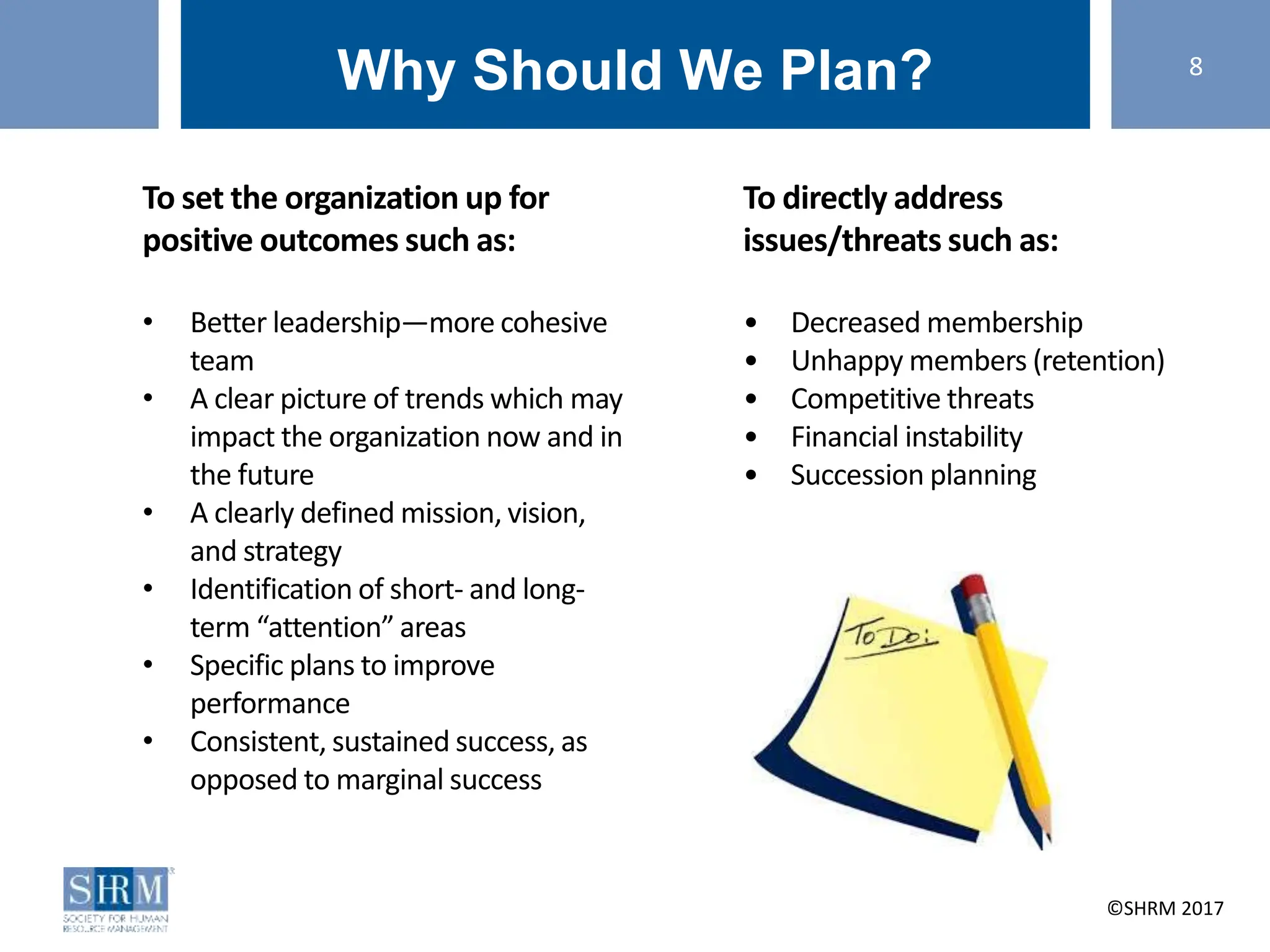
Why Should We Plan?
To set the organization up for
positive outcomes such as:
• Better leadership—more cohesive
team
• A clear picture of trends which may
impact the organization now and in
the future
• A clearly defined mission, vision,
and strategy
• Identification of short- and long-
term “attention” areas
• Specific plans to improve
performance
• Consistent, sustained success, as
opposed to marginal success
To directly address
issues/threats such as:
• Decreased membership
• Unhappy members (retention)
• Competitive threats
• Financial instability
• Succession planning
8
©SHRM 2014 ©SHRM 2017
Potential Barriers to Chapter and
State Council Planning
• Frequent volunteer turnover at
SHRM chapters
• No single source of stability or
permanency, unless a Chapter
Management Professional (CMP)
or Administrative Support
• Key figures in the organization do
not understand the importance
and thus do not make time for it
9
©SHRM 2014 ©SHRM 2017
Mission Statement
Vision Statement
Environmental Scanning
Analytical Methods
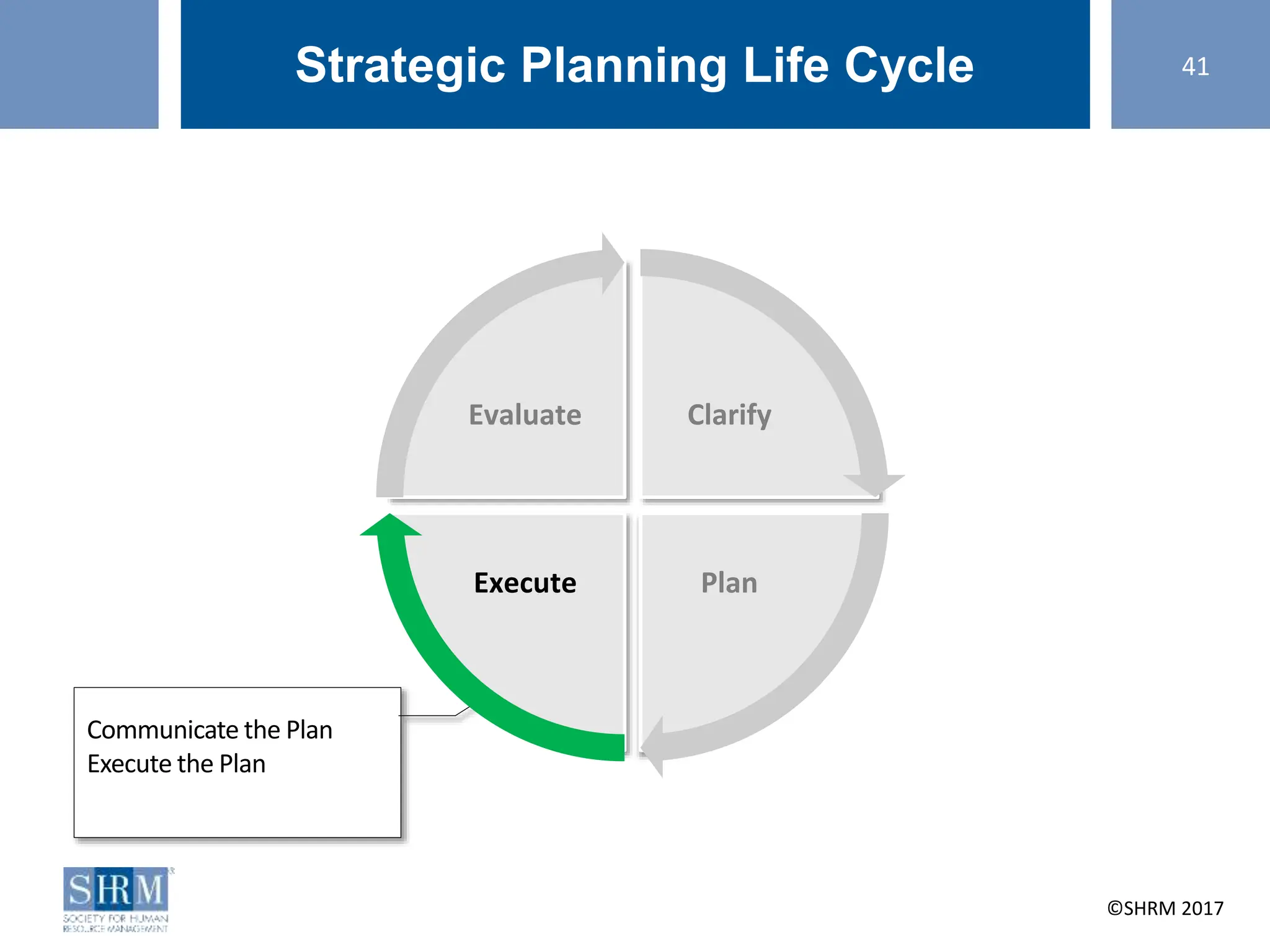
Communicate the Plan
Execute the Plan
Primary Objectives
SMART Goals
Action Planning
Strategic Budgeting
Monitor and Course
Correct
Strategic Planning Life Cycle
Clarify
Plan
Execute
Evaluate
10
©SHRM 2014 ©SHRM 2017
Distinct from SHAPE Planning
SHRM Affiliate Program for Excellence
(SHAPE) Planning
• Planning that is operational and short-term
• Annual Chapter and State Council Planning
Document & Worksheet which is updated
annually
• Available in the Volunteer Leader Resource
Center (VLRC)
11
©SHRM 2014 ©SHRM 2017
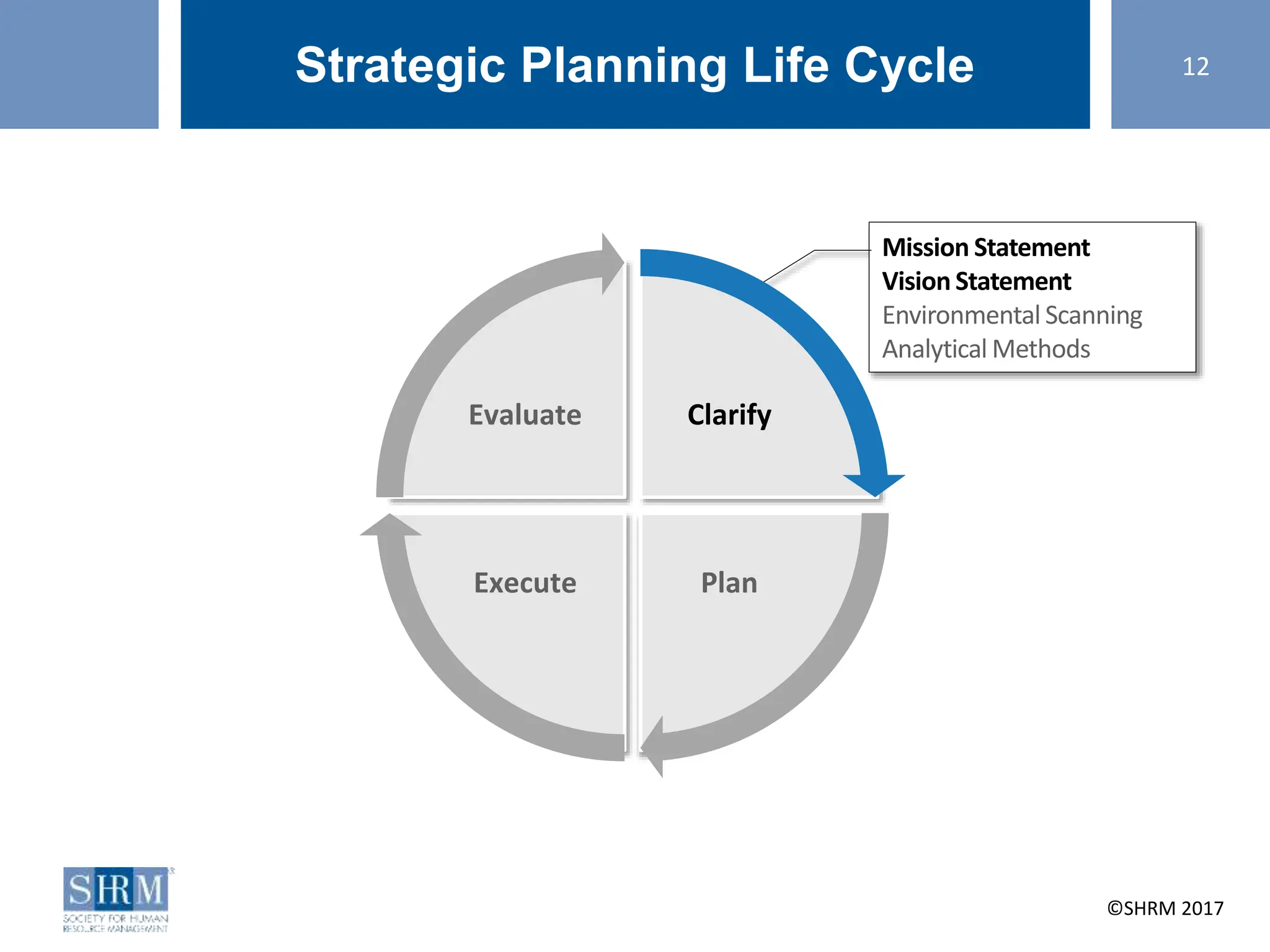
Mission Statement
Vision Statement
Environmental Scanning
Analytical Methods
Strategic Planning Life Cycle
Clarify
Plan
Execute
Evaluate
12
©SHRM 2014 ©SHRM 2017
SHRM’s Mission Statement
SHRM is a globally recognized HR
professional society that exists to
develop and serve the HR professional,
and advance and lead the HR
profession. SHRM provides education,
thought leadership, certification,
community, and advocacy to enhance
the practice of human resource
management and the effectiveness of
HR professionals in the organizations
and communities they serve.
13
©SHRM 2014 ©SHRM 2017
Mission Statement Fundamentals 14
Feeding America: To feed America’s hungry through a nationwide
network of member food banks and engage our country in the
fight to end hunger.
Mayo Clinic: To inspire hope and contribute to health and well-
being by providing the best care to every patient through
integrated clinicalpractice,education and research.
NPR: To work in partnership with member stations to createa
more informed public – one challenged and invigorated by a
deeper understanding and appreciation of events, ideas and
cultures.
TED: SpreadingIdeas.
The Rotary Foundation: To enable Rotariansto advance world
understanding, goodwill, and peace through the improvement of
health, the support of education, and the alleviation of poverty.
Elements of an effective Mission Statement:
• Clear,specific, concise, sharply focused, & memorable
• Focuses on satisfying customer needs
• Based on core competencies & strengths
• Motivates & inspires employee commitment
Examples
Elements
The Mission should answer the following:
• What is the purpose of our business?
• What activity do we do to accomplish our purpose?
• Who benefits from our work?
Questions
A MISSION STATEMENT defines the organization’s purpose and the reason why it exists. It clarifies who is being
served and what products or services the organization provides. It is different from, but correlates to the vision.
©SHRM 2014 ©SHRM 2017
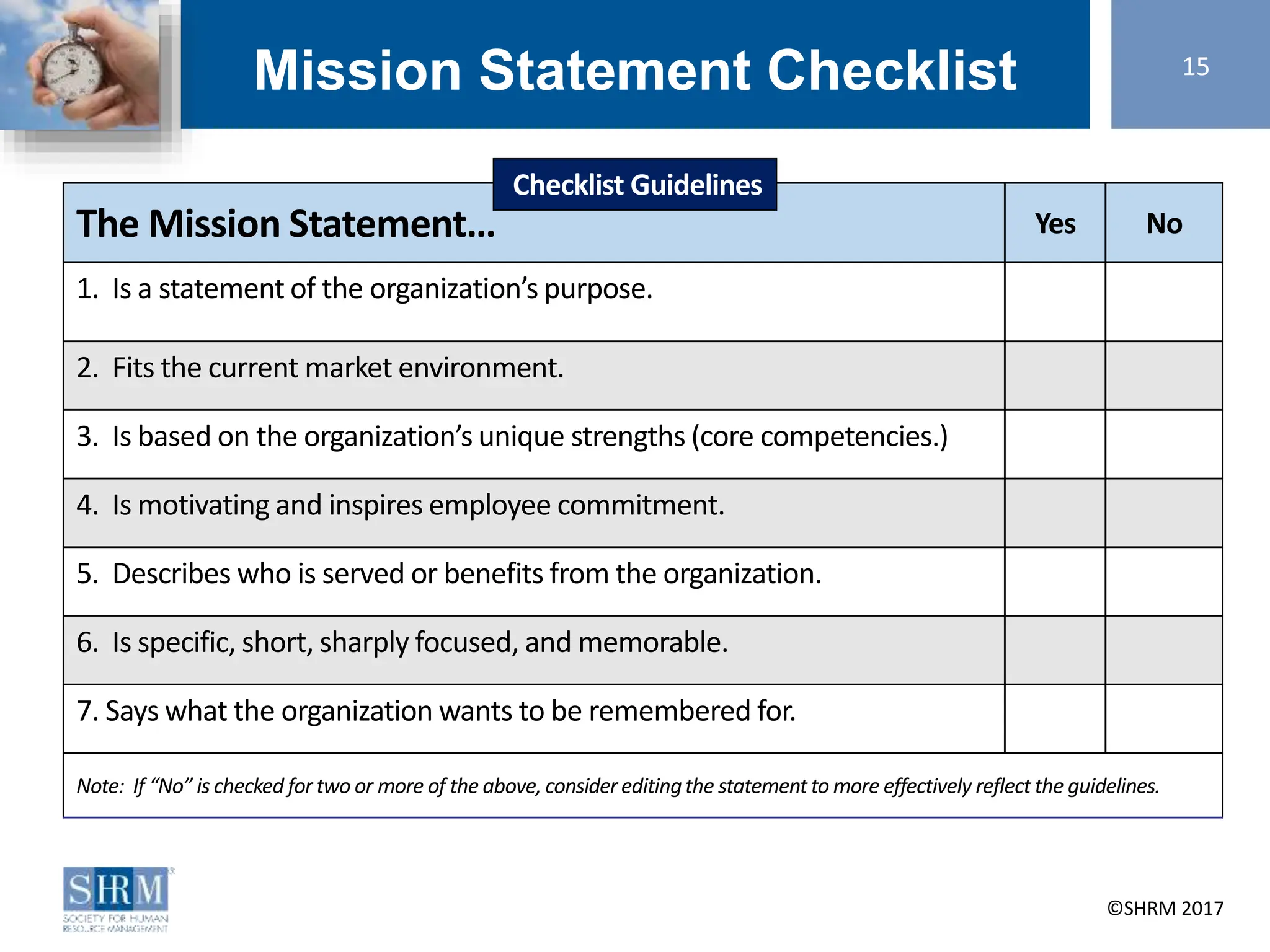
The Mission Statement… Yes No
1. Is a statement of the organization’s purpose.
2. Fits the current market environment.
3. Is based on the organization’s unique strengths (core competencies.)
4. Is motivating and inspires employee commitment.
5. Describes who is served or benefits from the organization.
6. Is specific, short, sharply focused, and memorable.
7. Says what the organization wants to be remembered for.
Note: If “No” is checked for two or more of the above, considereditingthe statementto more effectively reflect the guidelines.
Checklist Guidelines
Mission Statement Checklist 15
©SHRM 2014 ©SHRM 2017
ACTIVITY: Mission Statement 16
[Insert Chapter/State Council Name] Mission
Statement:
[Insert Chapter/State Council Mission Statement]
• Review (chapter/state council) mission statement
and sample mission statements
• Draft mission statement and post mission
statement on flip chart
• Team circles words to include
• Review all circled words
• Discuss and finalize mission statement
©SHRM 2014 ©SHRM 2017
SHRM’s Vision
SHRM is a preeminent and
globally recognized authority
whose leadership, perspective,
resources, and expertise are
sought and utilized to address the
most pressing current and
emerging human resource
management issues.
17
©SHRM 2014 ©SHRM 2017
Vision Statement Fundamentals 18
Feeding America: A hunger-freeAmerica
Human Rights Campaign: Equality for everyone
Habitat for Humanity: A world whereeveryone has a decent place
to live.
Clinton Foundation: To implement sustainable programs that
improve access worldwideto investment, opportunity, and
lifesaving services now and for future generations.
Williamson County HRMA: To be the leader in strategic human
resourcemanagement by advancing the profession and
supporting our members and the community we serve.
Elements of an effective Vision Statement:
• Clear,short, memorable, inspirational
• Capitalizeson corecompetencies
• Paints a pictureof the future
• Motivates employee to push forwardto reachit
Examples
Elements
The Vision should answer the following:
• What will our organization look likein 3-5 years?
• What does success look like?
• What are we aspiring to achieve?
Questions
A VISION STATEMENT defines an optimisticview of the organization's future. It provides long-term direction
and a sense of purposeful action. It is far reaching, but attainable and correlates to the mission.
©SHRM 2014 ©SHRM 2017
The Vision Statement… Yes No
1. Is audacious – represents a dream, the mountain top of the organization.
2. Capitalizes on the organization’s core competencies (history, customer
base, strengths, resources, etc.) and opportunities.
3. Provides a picture of what your organization will look like in the future.
4. Uses exciting and engaging language that inspires.
5. Motivates employees to push forward to reach the vision.
6. Is clear, short, and memorable.
Note: If “No” is checked for two or more of the above, considereditingthe statementto more effectively reflect the guidelines.
Checklist Guidelines
Vision Statement Checklist 19
©SHRM 2014 ©SHRM 2017
ACTIVITY: Vision Statement 20
[Insert Chapter/State Council Name] Vision
Statement:
[Insert Chapter/State Council Mission
Statement]
• Review (chapter/state council) vision statement
and sample mission statements
• Draft vision statement and post vision statement
on flip chart
• Team circles words to include
• Review all circled words
• Discuss and finalize vision statement
©SHRM 2014 ©SHRM 2017
Mission Statement
Vision Statement
Environmental Scanning
Analytical Methods
Strategic Planning Life Cycle
Clarify
Plan
Execute
Evaluate
21
©SHRM 2014 ©SHRM 2017
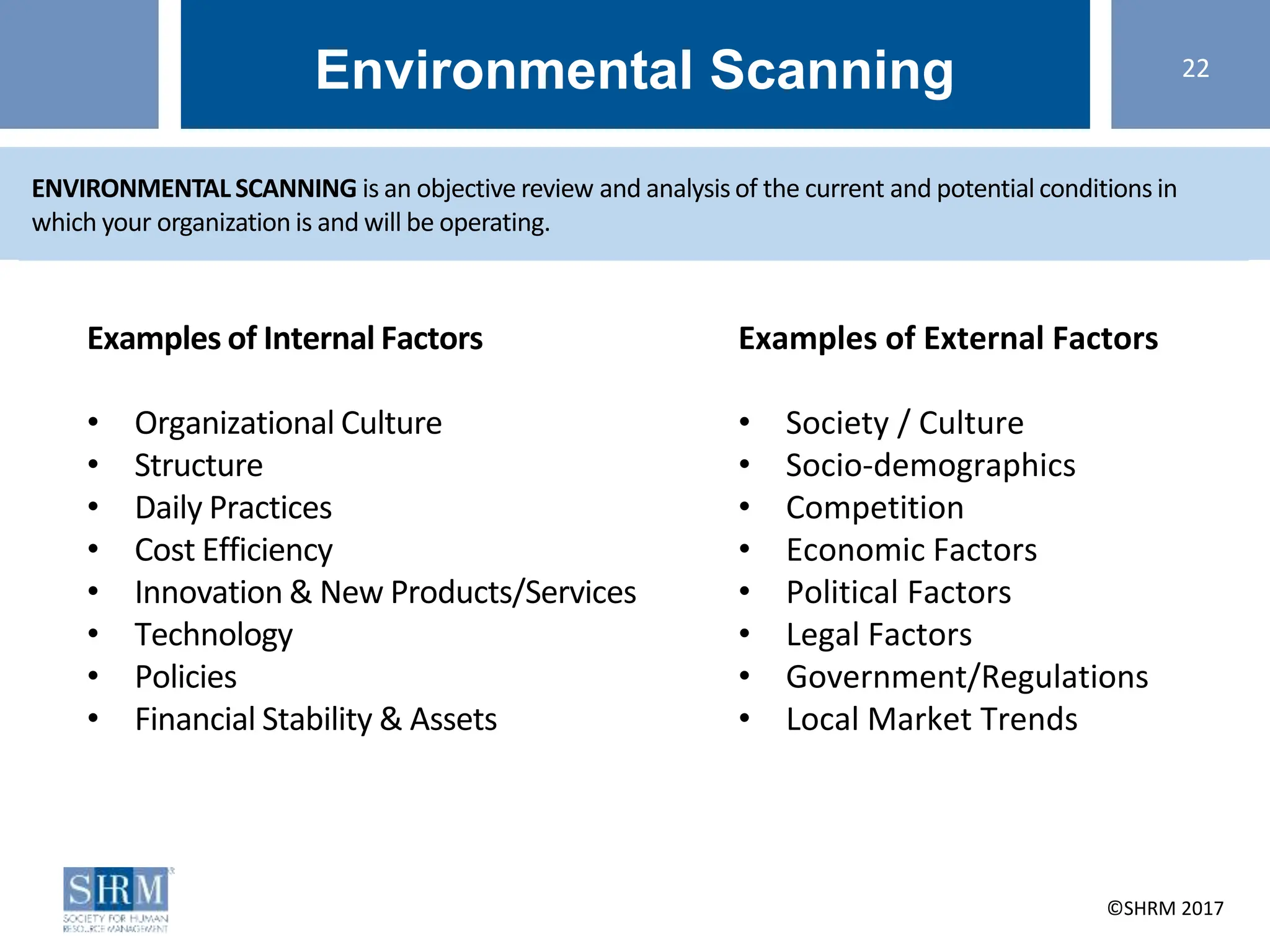
Examples of Internal Factors
• Organizational Culture
• Structure
• Daily Practices
• Cost Efficiency
• Innovation & New Products/Services
• Technology
• Policies
• Financial Stability & Assets
Examples of External Factors
• Society / Culture
• Socio-demographics
• Competition
• Economic Factors
• Political Factors
• Legal Factors
• Government/Regulations
• Local Market Trends
ENVIRONMENTALSCANNING is an objective review and analysisof the current and potential conditions in
which your organization is and will be operating.
Environmental Scanning 22
©SHRM 2014 ©SHRM 2017
ACTIVITY:
Historical Trend Analysis
23
HIGHS
What are our celebrationsfrom
the last threeyears?
Wherehave we made a difference?
LOWS
What werethe disappointments?
What didn’t happen as planned?
HISTORICAL TREND ANALYSIS is the process of comparing business data over time to identify any consistent
results or trends. Trend analysis provides insights on micro-environmentalfactors that impact organizational
performance so that strategies can be developed to respond to trends.
©SHRM 2014 ©SHRM 2017
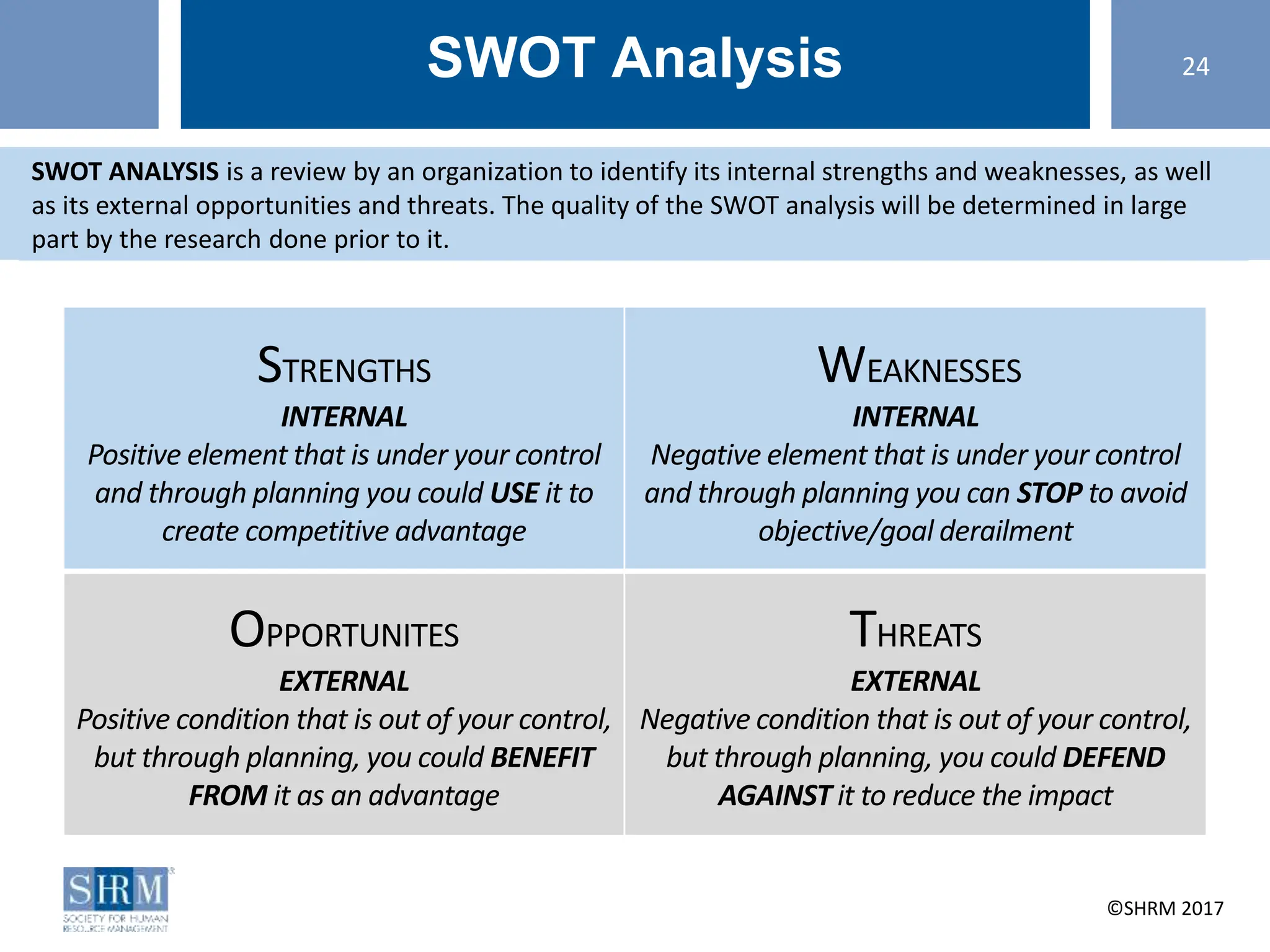
SWOT Analysis 24
SWOT ANALYSIS is a review by an organization to identify its internal strengths and weaknesses, as well
as its external opportunities and threats. The quality of the SWOT analysis will be determined in large
part by the research done prior to it.
STRENGTHS
INTERNAL
Positive element that is under your control
and through planning you could USE it to
create competitive advantage
WEAKNESSES
INTERNAL
Negative element that is under your control
and through planning you can STOP to avoid
objective/goal derailment
OPPORTUNITES
EXTERNAL
Positive condition that is out of your control,
but through planning, you could BENEFIT
FROM it as an advantage
THREATS
EXTERNAL
Negative condition that is out of your control,
but through planning, you could DEFEND
AGAINST it to reduce the impact
©SHRM 2014 ©SHRM 2017
ACTIVITY: SWOT Analysis 25
STRENGTHS
INTERNAL
WEAKNESSES
INTERNAL
OPPORTUNITES
EXTERNAL
THREATS
EXTERNAL
©SHRM 2014 ©SHRM 2017
Gap Analysis 26
GAP ANALYSIS is the process of identifying the gaps you need to overcome to get from where you are now, or
your current state, to where you want to be, or your desired state.
Current State
Whereare wenow?
Desired State
Wheredo we want to be?
GAP
Keyfactorsforchange?
©SHRM 2014 ©SHRM 2017
ACTIVITY: Gap Analysis
ACTIVITY: Conduct a Gap Analysis
INSTRUCTIONS: Now that you have taken a macro
and micro look at your organization, you will now
perform a Gap Analysis to assess where the
organization would like to be (i.e. the desired state)
and how to get there from where it is currently (i.e.
current state).
27
©SHRM 2014 ©SHRM 2017
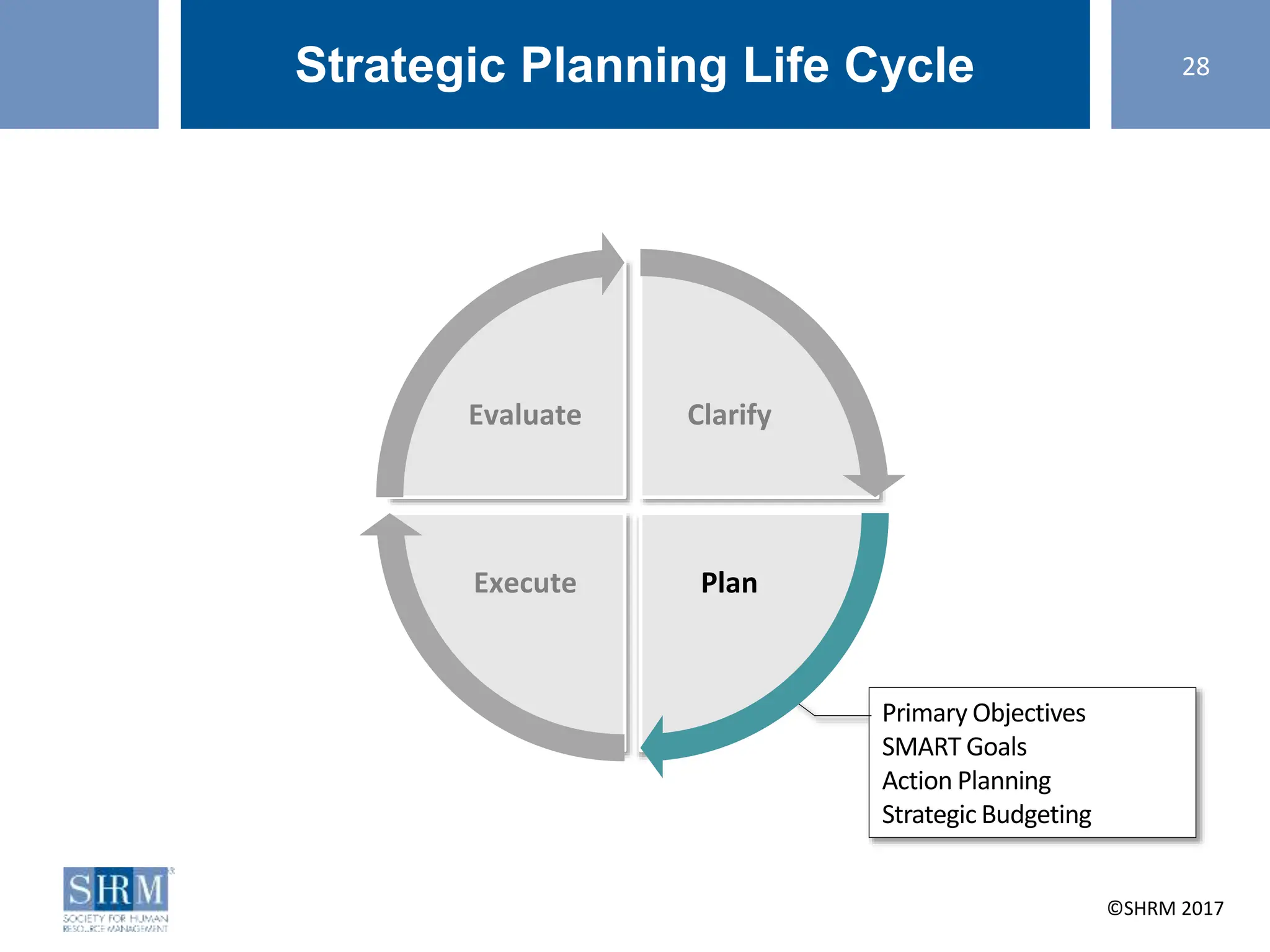
Primary Objectives
SMART Goals
Action Planning
Strategic Budgeting
Strategic Planning Life Cycle
Clarify
Plan
Execute
Evaluate
28
©SHRM 2014 ©SHRM 2017
PRIMARY OBJECTIVE
• A broad statement of purpose or intent describing the end
state towards which goals and action plans are directed
• Directional
• High-level priority
SMART GOAL
• Quantifies the direction given in the objective
• Measurable and specific
• Sets targets so that action plans can be developed
• (Ideally) Developed with SMART test in mind
ACTION PLAN
• Reflects key activities associated with the objectives
• Answers the what/who/when/how questions
Key Definitions 29
©SHRM 2014 ©SHRM 2017
Primary Objectives
SMART Goals
Action Planning
Strategic Budgeting
Strategic Planning Life Cycle
Clarify
Plan
Execute
Evaluate
30
©SHRM 2014 ©SHRM 2017
Cross-Pollination of SWOT 31
STRENGTHS Pursue OPPORTUNIES which are a good
fit for our STRENGTHS
OPPORTUNITES
WEAKNESSES
Overcome WEAKNESSES to pursue OPPORTUNIES
OPPORTUNITES
STRENGTHS
Use STRENGTHS to reduce vulnerability to THREATS
THREATS
WEAKNESSES Overcome WEAKNESSES which would make
us susceptible to THREATS
THREATS
CROSS-POLLINATION across the SWOT findings will help to identify strategically important moves which
could yield benefits to the organization over time.
©SHRM 2014 ©SHRM 2017
ACTIVITY: Primary Objectives
ACTIVITY: Identify and document the organization’s
Primary Objectives
INSTRUCTIONS: Take 6 dots to vote on items listed
on the SWOT analysis. Focus on what is going well
and can be continued or address weaknesses,
opportunities, and threats.
Determine the top 3-5 objectives your organization
should focus on for the next 3-5 years. Use the
Primary Objectives worksheet to document your
organization’s focus.
32
©SHRM 2014 ©SHRM 2017
Primary Objectives
SMART Goals
Action Planning
Strategic Budgeting
Strategic Planning Life Cycle
Clarify
Plan
Execute
Evaluate
33
©SHRM 2014 ©SHRM 2017
SMART Goals Guidelines 34
SMART GOALS are an organization’s most important strategies and are driven by its primary objectives.
They provide detail to primary objective direction and set targets so that action plans can be developed.
SPECIFIC
Who is involved? What will we accomplish? How much change is
needed?
MEASURABLE How much? How many? How will we know when it is accomplished?
ATTAINABLE
List resources needed; do you have the resources or you can obtain
them?
RELEVANT Why this is important to our customer? How does this align to strategy?
TIME-BOUND Ensure a clearly defined time-frame including deadline.
©SHRM 2014 ©SHRM 2017
ACTIVITY: SMART Goals
ACTIVITY: Develop SMART Goals
INSTRUCTIONS: Use the SMART Goal Worksheet to
write SMART (Specific, Measurable, Attainable,
Relevant, and Time-bound) Goals around your
primary objectives. If the goal does not meet the
SMART Goals Guidelines, re-draft it until it does.
Each table will develop one SMART Goal for your
Primary Objective.
35
©SHRM 2014 ©SHRM 2017
Primary Objectives
SMART Goals
Action Planning
Strategic Budgeting
Strategic Planning Life Cycle
Clarify
Plan
Execute
Evaluate
36
©SHRM 2014 ©SHRM 2017
Action Plans
Consider the following questions and document your
organization’s action plans:
• WHAT specifically needs to be done? Start with a SMART
Goal.
• HOW will it be done? Plan specific ACTION ITEMS.
• WHO will be responsible? Establish OWNERS.
• WHEN will it get done? Establish TIMELINE, MILESTONES,
and COMPLETION DATE
• WHAT will the OUTCOMES look like? Ensure Goal Owners
are ACQUAINTED WITH TARGETS
37
©SHRM 2014 ©SHRM 2017
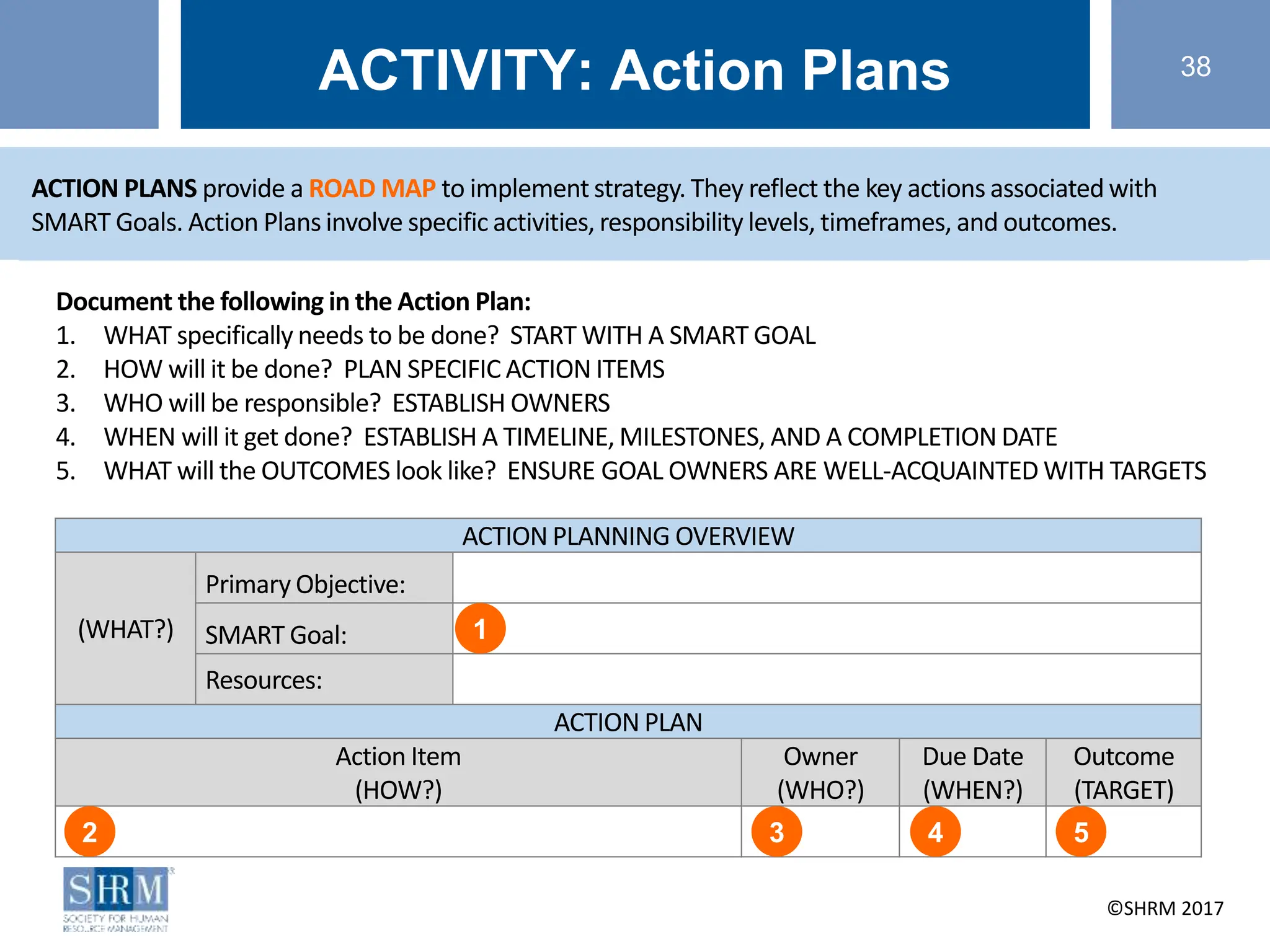
38
ACTION PLANS provide a ROAD MAP to implement strategy. They reflect the key actions associated with
SMART Goals. Action Plansinvolve specific activities, responsibility levels, timeframes, and outcomes.
ACTION PLANNING OVERVIEW
(WHAT?)
Primary Objective:
SMART Goal:
Resources:
ACTION PLAN
Action Item
(HOW?)
Owner
(WHO?)
Due Date
(WHEN?)
Outcome
(TARGET)
Document the following in the Action Plan:
1. WHAT specifically needs to be done? START WITH A SMART GOAL
2. HOW will it be done? PLAN SPECIFIC ACTION ITEMS
3. WHO will be responsible? ESTABLISH OWNERS
4. WHEN will it get done? ESTABLISH A TIMELINE, MILESTONES, AND A COMPLETION DATE
5. WHAT will the OUTCOMES look like? ENSURE GOAL OWNERS ARE WELL-ACQUAINTED WITH TARGETS
1
2 3 4 5
ACTIVITY: Action Plans
©SHRM 2014 ©SHRM 2017
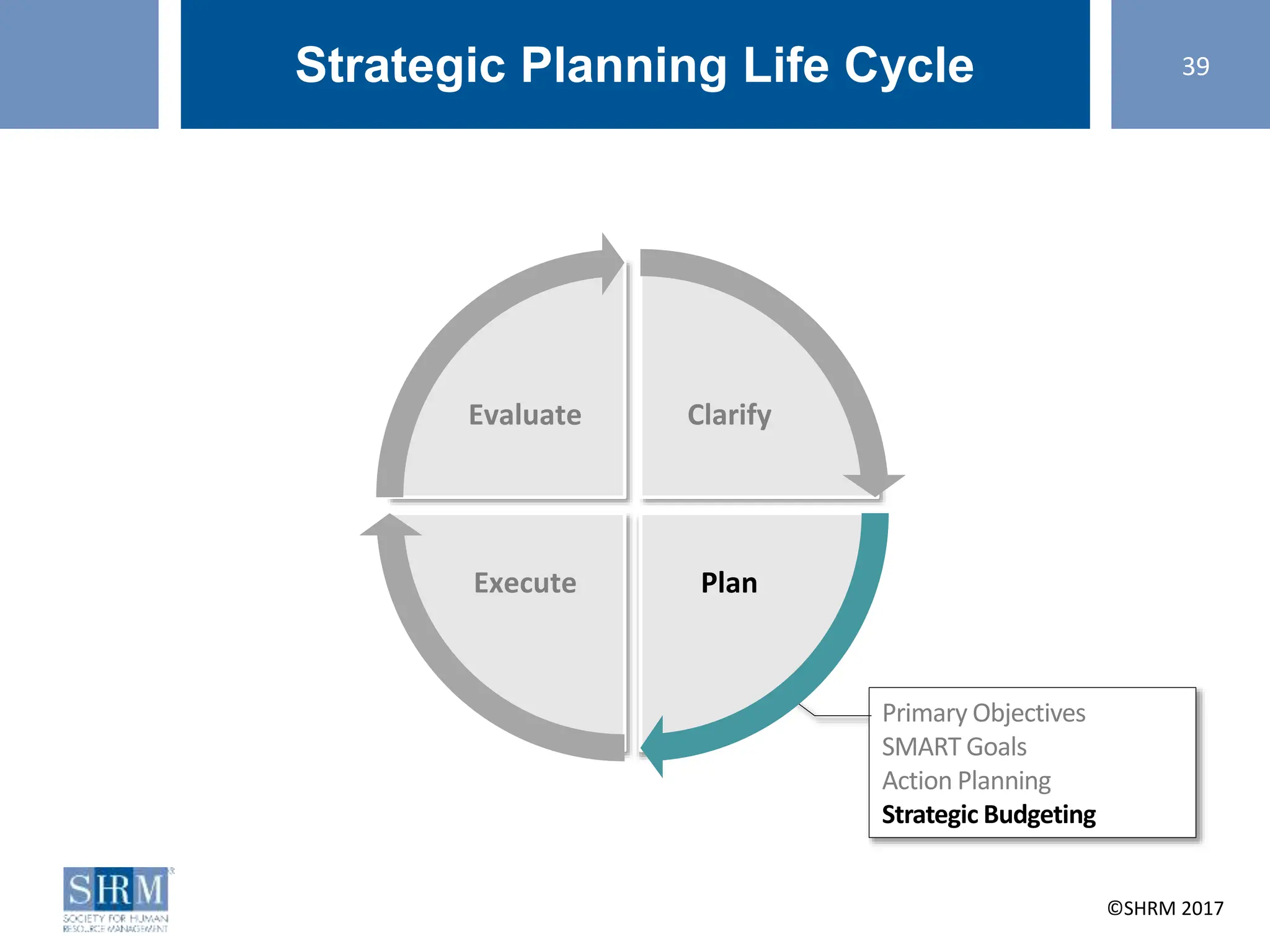
Primary Objectives
SMART Goals
Action Planning
Strategic Budgeting
Strategic Planning Life Cycle
Clarify
Plan
Execute
Evaluate
39
©SHRM 2014 ©SHRM 2017
Strategic Budgeting
Review Strategic budgeting questions on worksheet
Guide to Chapter Financial Management is available on the VLRC:
• Essential financial information: taxes, incorporation, & record
keeping
• Excellent resource for volunteers
• VLRC - “Finance” section
• Questions: contact a local CPA; SHRM does not provide financial
advice, & cannot assist you in contacting the IRS
• Use chapter or state council EIN / tax ID number, not SHRM’s
(numbers cannot be shared)
40
©SHRM 2014 ©SHRM 2017
Communicate the Plan
Execute the Plan
Strategic Planning Life Cycle
Clarify
Plan
Execute
Evaluate
41
©SHRM 2014 ©SHRM 2017
Communicate and Execute the Plan 42
• SHARE THE PLAN
• Celebrate small wins and notable
progress against targets
• Keep members in the loop about your
activities and how you are working for
the best interests and successful
future of the Chapter/State Council
• The most important & difficult thing
about strategic planning
is….FOLLOWING THROUGH
EXECUTION is the most important and difficult thing about strategic planning. It is critical to ensure that
your organization is aware of the strategic plan and that habits are established to foster an execution
mindset with FOLLOW THROUGH.
©SHRM 2014 ©SHRM 2017
Activity: Execution Tips
CONSIDER THE FOLLOWING:
• How and to whom will we communicate our
primary objectives/goals?
• Who will be on the execution teams?
• What roles will everyone have?
• What training and development is necessary to
better position us for the future?
• Use Execution Worksheet
43
©SHRM 2014 ©SHRM 2017
Monitor and Course
Correct
Strategic Planning Life Cycle
Clarify
Plan
Execute
Evaluate
44
©SHRM 2014 ©SHRM 2017
Monitor and Course Correct 45
• Continual review of progress
against goals and gaps in planning
• Watch for changes in membership,
finances, local competition, and
other items from your original
Environmental Scanning and
SWOT Analysis
• If something is not working, re-
think the use of valuable resources
and consider alternate plans
EVALUATION is monitoring the right data at the right time to help people make better decisions, learn what
doesn’t work and correct it. Test for visibility to what works well it can be adapted and replicated.
©SHRM 2014 ©SHRM 2017
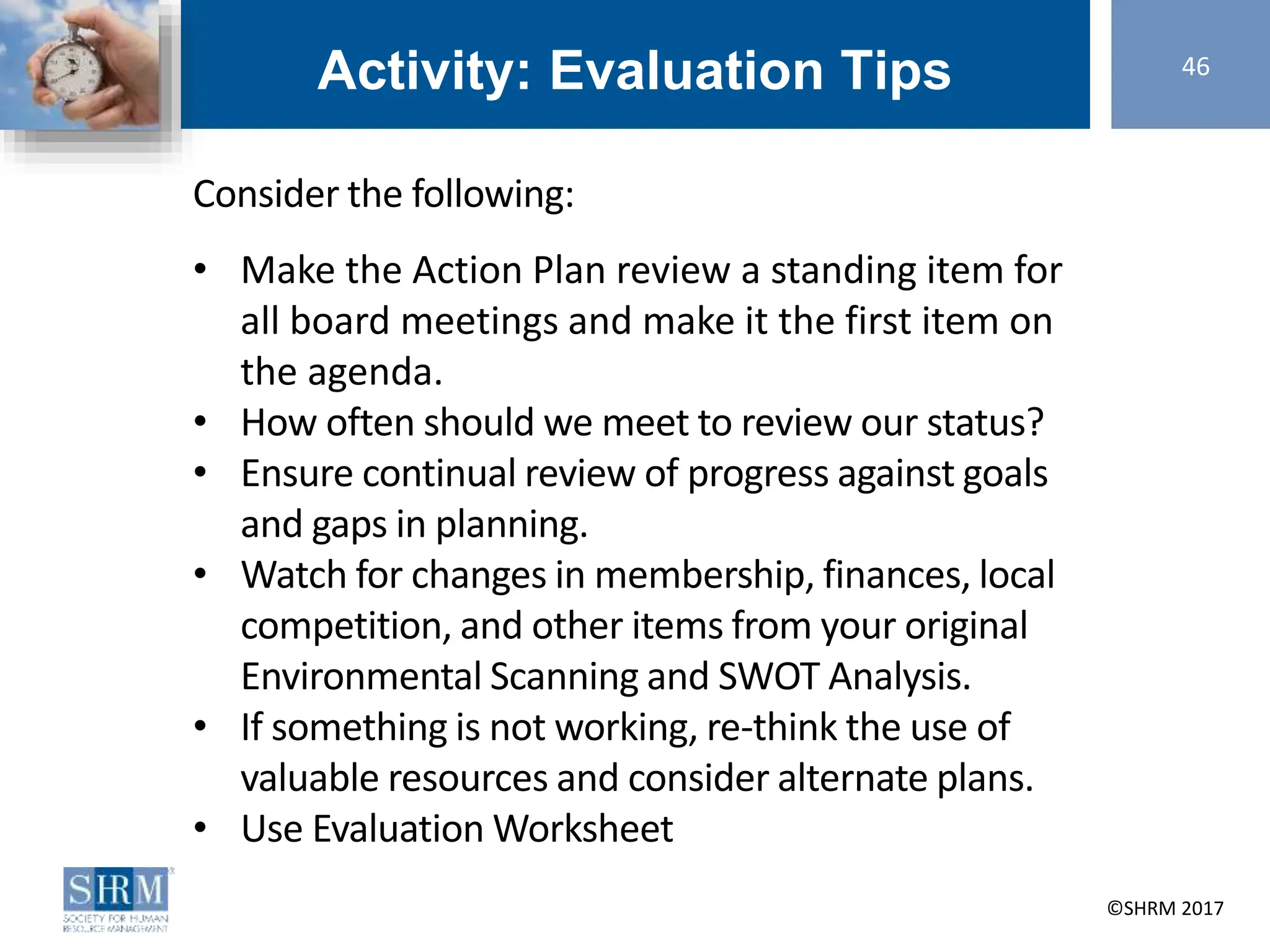
Activity: Evaluation Tips
Consider the following:
• Make the Action Plan review a standing item for
all board meetings and make it the first item on
the agenda.
• How often should we meet to review our status?
• Ensure continual review of progress against goals
and gaps in planning.
• Watch for changes in membership, finances, local
competition, and other items from your original
Environmental Scanning and SWOT Analysis.
• If something is not working, re-think the use of
valuable resources and consider alternate plans.
• Use Evaluation Worksheet
46
©SHRM 2014 ©SHRM 2017
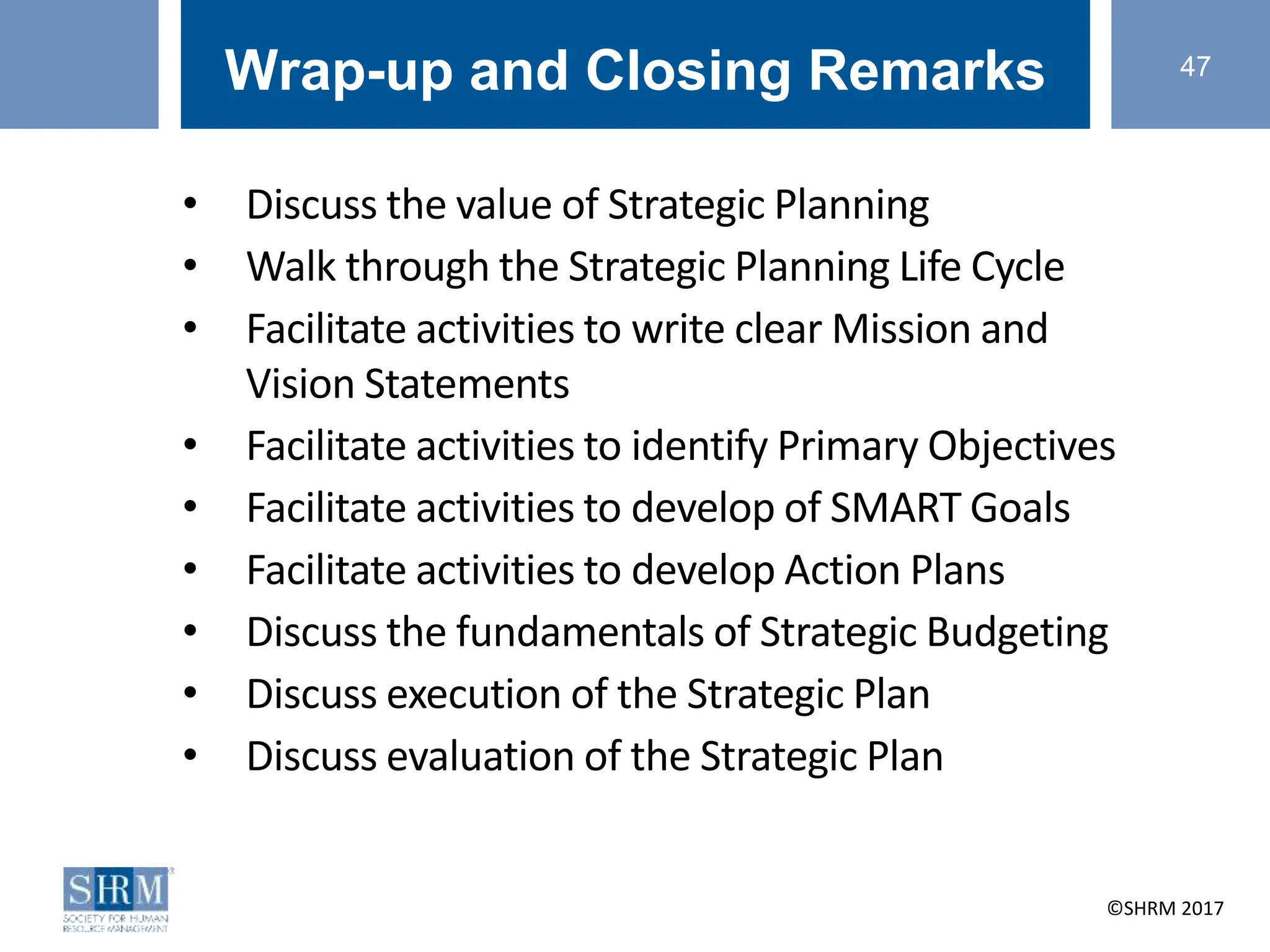
Wrap-up and Closing Remarks 47
• Discuss the value of Strategic Planning
• Walk through the Strategic Planning Life Cycle
• Facilitate activities to write clear Mission and
Vision Statements
• Facilitate activities to identify Primary Objectives
• Facilitate activities to develop of SMART Goals
• Facilitate activities to develop Action Plans
• Discuss the fundamentals of Strategic Budgeting
• Discuss execution of the Strategic Plan
• Discuss evaluation of the Strategic Plan
©SHRM 2014 ©SHRM 2017
©2017 by the Society for Human Resource Management (SHRM). All rights reserved. This material may not be
reproduced, stored in a retrieval system, or transmitted in whole or in part, in any form or by any means,
electronic, mechanical, photocopying, recording or otherwise, without the prior written permission of SHRM.
48
SHRM Recertification Program Number
Contact information for presenter
Thank You!
©SHRM 2014
49
©SHRM 2014 ©SHRM 2017

Strategic Planning Workshop Presentation_2017 FINAL.ppt

  • 1.
    ©SHRM 2014 ©SHRM2017 Train the Trainer: Strategic Planning Workshop [Insert Chapter/State Council Name] [Insert Presenter Name]
  • 2.
    ©SHRM 2014 ©SHRM2017 Preparing to Plan Identify candidates for strategic planning task force, which should include: • Current leaders with knowledge of current issues • Past leaders with knowledge of past issues that may not have been resolved • Future leaders to ensure future commitment to plan • Outside strategic planning expertise in the event that such expertise does not exist within identified task force-- this could be Field Services Directors (FSDs) 2
  • 3.
    ©SHRM 2014 ©SHRM2017 Before You Plan 3 MISSION STATEMENT • what we do; purpose of organization VISION STATEMENT • how we want it to be; future state of organization VALUES • what do we stand for; culture framework PRIMARY OBJECTIVES • how to get there; translated into goals and action plans
  • 4.
    ©SHRM 2014 ©SHRM2017 Getting to Know You [Insert Chapter/State Council Name] [Insert Getting to Know You Question ] 4
  • 5.
    ©SHRM 2014 ©SHRM2017 Where is Your North? 5
  • 6.
    ©SHRM 2014 ©SHRM2017 Workshop Objectives 6 • Discuss the value of Strategic Planning • Walk through the Strategic Planning Life Cycle • Facilitate activities to write clear Mission and Vision Statements • Facilitate activities to identify Primary Objectives • Facilitate activities to develop of SMART Goals • Facilitate activities to develop Action Plans • Discuss the fundamentals of Strategic Budgeting • Discuss execution of the Strategic Plan • Discuss evaluation of the Strategic Plan
  • 7.
    ©SHRM 2014 ©SHRM2017 Strategic Planning is a systematic process for understanding: • Where we have been, what we are doing, how we do it, whom we do it for, and what value we bring • Where we want to go • How and when we are going to get there • How we know that we are on track What is Strategic Planning? 7 Common myths about Strategic Planning: • Most people plan • Planning takes too much time and work; it bogs us down • Planning is rarely looked upon as an investment • The best planning measures are based on complex strategies • Planning should be concrete, not flexible.
  • 8.
    ©SHRM 2014 ©SHRM2017 Why Should We Plan? To set the organization up for positive outcomes such as: • Better leadership—more cohesive team • A clear picture of trends which may impact the organization now and in the future • A clearly defined mission, vision, and strategy • Identification of short- and long- term “attention” areas • Specific plans to improve performance • Consistent, sustained success, as opposed to marginal success To directly address issues/threats such as: • Decreased membership • Unhappy members (retention) • Competitive threats • Financial instability • Succession planning 8
  • 9.
    ©SHRM 2014 ©SHRM2017 Potential Barriers to Chapter and State Council Planning • Frequent volunteer turnover at SHRM chapters • No single source of stability or permanency, unless a Chapter Management Professional (CMP) or Administrative Support • Key figures in the organization do not understand the importance and thus do not make time for it 9
  • 10.
    ©SHRM 2014 ©SHRM2017 Mission Statement Vision Statement Environmental Scanning Analytical Methods Communicate the Plan Execute the Plan Primary Objectives SMART Goals Action Planning Strategic Budgeting Monitor and Course Correct Strategic Planning Life Cycle Clarify Plan Execute Evaluate 10
  • 11.
    ©SHRM 2014 ©SHRM2017 Distinct from SHAPE Planning SHRM Affiliate Program for Excellence (SHAPE) Planning • Planning that is operational and short-term • Annual Chapter and State Council Planning Document & Worksheet which is updated annually • Available in the Volunteer Leader Resource Center (VLRC) 11
  • 12.
    ©SHRM 2014 ©SHRM2017 Mission Statement Vision Statement Environmental Scanning Analytical Methods Strategic Planning Life Cycle Clarify Plan Execute Evaluate 12
  • 13.
    ©SHRM 2014 ©SHRM2017 SHRM’s Mission Statement SHRM is a globally recognized HR professional society that exists to develop and serve the HR professional, and advance and lead the HR profession. SHRM provides education, thought leadership, certification, community, and advocacy to enhance the practice of human resource management and the effectiveness of HR professionals in the organizations and communities they serve. 13
  • 14.
    ©SHRM 2014 ©SHRM2017 Mission Statement Fundamentals 14 Feeding America: To feed America’s hungry through a nationwide network of member food banks and engage our country in the fight to end hunger. Mayo Clinic: To inspire hope and contribute to health and well- being by providing the best care to every patient through integrated clinicalpractice,education and research. NPR: To work in partnership with member stations to createa more informed public – one challenged and invigorated by a deeper understanding and appreciation of events, ideas and cultures. TED: SpreadingIdeas. The Rotary Foundation: To enable Rotariansto advance world understanding, goodwill, and peace through the improvement of health, the support of education, and the alleviation of poverty. Elements of an effective Mission Statement: • Clear,specific, concise, sharply focused, & memorable • Focuses on satisfying customer needs • Based on core competencies & strengths • Motivates & inspires employee commitment Examples Elements The Mission should answer the following: • What is the purpose of our business? • What activity do we do to accomplish our purpose? • Who benefits from our work? Questions A MISSION STATEMENT defines the organization’s purpose and the reason why it exists. It clarifies who is being served and what products or services the organization provides. It is different from, but correlates to the vision.
  • 15.
    ©SHRM 2014 ©SHRM2017 The Mission Statement… Yes No 1. Is a statement of the organization’s purpose. 2. Fits the current market environment. 3. Is based on the organization’s unique strengths (core competencies.) 4. Is motivating and inspires employee commitment. 5. Describes who is served or benefits from the organization. 6. Is specific, short, sharply focused, and memorable. 7. Says what the organization wants to be remembered for. Note: If “No” is checked for two or more of the above, considereditingthe statementto more effectively reflect the guidelines. Checklist Guidelines Mission Statement Checklist 15
  • 16.
    ©SHRM 2014 ©SHRM2017 ACTIVITY: Mission Statement 16 [Insert Chapter/State Council Name] Mission Statement: [Insert Chapter/State Council Mission Statement] • Review (chapter/state council) mission statement and sample mission statements • Draft mission statement and post mission statement on flip chart • Team circles words to include • Review all circled words • Discuss and finalize mission statement
  • 17.
    ©SHRM 2014 ©SHRM2017 SHRM’s Vision SHRM is a preeminent and globally recognized authority whose leadership, perspective, resources, and expertise are sought and utilized to address the most pressing current and emerging human resource management issues. 17
  • 18.
    ©SHRM 2014 ©SHRM2017 Vision Statement Fundamentals 18 Feeding America: A hunger-freeAmerica Human Rights Campaign: Equality for everyone Habitat for Humanity: A world whereeveryone has a decent place to live. Clinton Foundation: To implement sustainable programs that improve access worldwideto investment, opportunity, and lifesaving services now and for future generations. Williamson County HRMA: To be the leader in strategic human resourcemanagement by advancing the profession and supporting our members and the community we serve. Elements of an effective Vision Statement: • Clear,short, memorable, inspirational • Capitalizeson corecompetencies • Paints a pictureof the future • Motivates employee to push forwardto reachit Examples Elements The Vision should answer the following: • What will our organization look likein 3-5 years? • What does success look like? • What are we aspiring to achieve? Questions A VISION STATEMENT defines an optimisticview of the organization's future. It provides long-term direction and a sense of purposeful action. It is far reaching, but attainable and correlates to the mission.
  • 19.
    ©SHRM 2014 ©SHRM2017 The Vision Statement… Yes No 1. Is audacious – represents a dream, the mountain top of the organization. 2. Capitalizes on the organization’s core competencies (history, customer base, strengths, resources, etc.) and opportunities. 3. Provides a picture of what your organization will look like in the future. 4. Uses exciting and engaging language that inspires. 5. Motivates employees to push forward to reach the vision. 6. Is clear, short, and memorable. Note: If “No” is checked for two or more of the above, considereditingthe statementto more effectively reflect the guidelines. Checklist Guidelines Vision Statement Checklist 19
  • 20.
    ©SHRM 2014 ©SHRM2017 ACTIVITY: Vision Statement 20 [Insert Chapter/State Council Name] Vision Statement: [Insert Chapter/State Council Mission Statement] • Review (chapter/state council) vision statement and sample mission statements • Draft vision statement and post vision statement on flip chart • Team circles words to include • Review all circled words • Discuss and finalize vision statement
  • 21.
    ©SHRM 2014 ©SHRM2017 Mission Statement Vision Statement Environmental Scanning Analytical Methods Strategic Planning Life Cycle Clarify Plan Execute Evaluate 21
  • 22.
    ©SHRM 2014 ©SHRM2017 Examples of Internal Factors • Organizational Culture • Structure • Daily Practices • Cost Efficiency • Innovation & New Products/Services • Technology • Policies • Financial Stability & Assets Examples of External Factors • Society / Culture • Socio-demographics • Competition • Economic Factors • Political Factors • Legal Factors • Government/Regulations • Local Market Trends ENVIRONMENTALSCANNING is an objective review and analysisof the current and potential conditions in which your organization is and will be operating. Environmental Scanning 22
  • 23.
    ©SHRM 2014 ©SHRM2017 ACTIVITY: Historical Trend Analysis 23 HIGHS What are our celebrationsfrom the last threeyears? Wherehave we made a difference? LOWS What werethe disappointments? What didn’t happen as planned? HISTORICAL TREND ANALYSIS is the process of comparing business data over time to identify any consistent results or trends. Trend analysis provides insights on micro-environmentalfactors that impact organizational performance so that strategies can be developed to respond to trends.
  • 24.
    ©SHRM 2014 ©SHRM2017 SWOT Analysis 24 SWOT ANALYSIS is a review by an organization to identify its internal strengths and weaknesses, as well as its external opportunities and threats. The quality of the SWOT analysis will be determined in large part by the research done prior to it. STRENGTHS INTERNAL Positive element that is under your control and through planning you could USE it to create competitive advantage WEAKNESSES INTERNAL Negative element that is under your control and through planning you can STOP to avoid objective/goal derailment OPPORTUNITES EXTERNAL Positive condition that is out of your control, but through planning, you could BENEFIT FROM it as an advantage THREATS EXTERNAL Negative condition that is out of your control, but through planning, you could DEFEND AGAINST it to reduce the impact
  • 25.
    ©SHRM 2014 ©SHRM2017 ACTIVITY: SWOT Analysis 25 STRENGTHS INTERNAL WEAKNESSES INTERNAL OPPORTUNITES EXTERNAL THREATS EXTERNAL
  • 26.
    ©SHRM 2014 ©SHRM2017 Gap Analysis 26 GAP ANALYSIS is the process of identifying the gaps you need to overcome to get from where you are now, or your current state, to where you want to be, or your desired state. Current State Whereare wenow? Desired State Wheredo we want to be? GAP Keyfactorsforchange?
  • 27.
    ©SHRM 2014 ©SHRM2017 ACTIVITY: Gap Analysis ACTIVITY: Conduct a Gap Analysis INSTRUCTIONS: Now that you have taken a macro and micro look at your organization, you will now perform a Gap Analysis to assess where the organization would like to be (i.e. the desired state) and how to get there from where it is currently (i.e. current state). 27
  • 28.
    ©SHRM 2014 ©SHRM2017 Primary Objectives SMART Goals Action Planning Strategic Budgeting Strategic Planning Life Cycle Clarify Plan Execute Evaluate 28
  • 29.
    ©SHRM 2014 ©SHRM2017 PRIMARY OBJECTIVE • A broad statement of purpose or intent describing the end state towards which goals and action plans are directed • Directional • High-level priority SMART GOAL • Quantifies the direction given in the objective • Measurable and specific • Sets targets so that action plans can be developed • (Ideally) Developed with SMART test in mind ACTION PLAN • Reflects key activities associated with the objectives • Answers the what/who/when/how questions Key Definitions 29
  • 30.
    ©SHRM 2014 ©SHRM2017 Primary Objectives SMART Goals Action Planning Strategic Budgeting Strategic Planning Life Cycle Clarify Plan Execute Evaluate 30
  • 31.
    ©SHRM 2014 ©SHRM2017 Cross-Pollination of SWOT 31 STRENGTHS Pursue OPPORTUNIES which are a good fit for our STRENGTHS OPPORTUNITES WEAKNESSES Overcome WEAKNESSES to pursue OPPORTUNIES OPPORTUNITES STRENGTHS Use STRENGTHS to reduce vulnerability to THREATS THREATS WEAKNESSES Overcome WEAKNESSES which would make us susceptible to THREATS THREATS CROSS-POLLINATION across the SWOT findings will help to identify strategically important moves which could yield benefits to the organization over time.
  • 32.
    ©SHRM 2014 ©SHRM2017 ACTIVITY: Primary Objectives ACTIVITY: Identify and document the organization’s Primary Objectives INSTRUCTIONS: Take 6 dots to vote on items listed on the SWOT analysis. Focus on what is going well and can be continued or address weaknesses, opportunities, and threats. Determine the top 3-5 objectives your organization should focus on for the next 3-5 years. Use the Primary Objectives worksheet to document your organization’s focus. 32
  • 33.
    ©SHRM 2014 ©SHRM2017 Primary Objectives SMART Goals Action Planning Strategic Budgeting Strategic Planning Life Cycle Clarify Plan Execute Evaluate 33
  • 34.
    ©SHRM 2014 ©SHRM2017 SMART Goals Guidelines 34 SMART GOALS are an organization’s most important strategies and are driven by its primary objectives. They provide detail to primary objective direction and set targets so that action plans can be developed. SPECIFIC Who is involved? What will we accomplish? How much change is needed? MEASURABLE How much? How many? How will we know when it is accomplished? ATTAINABLE List resources needed; do you have the resources or you can obtain them? RELEVANT Why this is important to our customer? How does this align to strategy? TIME-BOUND Ensure a clearly defined time-frame including deadline.
  • 35.
    ©SHRM 2014 ©SHRM2017 ACTIVITY: SMART Goals ACTIVITY: Develop SMART Goals INSTRUCTIONS: Use the SMART Goal Worksheet to write SMART (Specific, Measurable, Attainable, Relevant, and Time-bound) Goals around your primary objectives. If the goal does not meet the SMART Goals Guidelines, re-draft it until it does. Each table will develop one SMART Goal for your Primary Objective. 35
  • 36.
    ©SHRM 2014 ©SHRM2017 Primary Objectives SMART Goals Action Planning Strategic Budgeting Strategic Planning Life Cycle Clarify Plan Execute Evaluate 36
  • 37.
    ©SHRM 2014 ©SHRM2017 Action Plans Consider the following questions and document your organization’s action plans: • WHAT specifically needs to be done? Start with a SMART Goal. • HOW will it be done? Plan specific ACTION ITEMS. • WHO will be responsible? Establish OWNERS. • WHEN will it get done? Establish TIMELINE, MILESTONES, and COMPLETION DATE • WHAT will the OUTCOMES look like? Ensure Goal Owners are ACQUAINTED WITH TARGETS 37
  • 38.
    ©SHRM 2014 ©SHRM2017 38 ACTION PLANS provide a ROAD MAP to implement strategy. They reflect the key actions associated with SMART Goals. Action Plansinvolve specific activities, responsibility levels, timeframes, and outcomes. ACTION PLANNING OVERVIEW (WHAT?) Primary Objective: SMART Goal: Resources: ACTION PLAN Action Item (HOW?) Owner (WHO?) Due Date (WHEN?) Outcome (TARGET) Document the following in the Action Plan: 1. WHAT specifically needs to be done? START WITH A SMART GOAL 2. HOW will it be done? PLAN SPECIFIC ACTION ITEMS 3. WHO will be responsible? ESTABLISH OWNERS 4. WHEN will it get done? ESTABLISH A TIMELINE, MILESTONES, AND A COMPLETION DATE 5. WHAT will the OUTCOMES look like? ENSURE GOAL OWNERS ARE WELL-ACQUAINTED WITH TARGETS 1 2 3 4 5 ACTIVITY: Action Plans
  • 39.
    ©SHRM 2014 ©SHRM2017 Primary Objectives SMART Goals Action Planning Strategic Budgeting Strategic Planning Life Cycle Clarify Plan Execute Evaluate 39
  • 40.
    ©SHRM 2014 ©SHRM2017 Strategic Budgeting Review Strategic budgeting questions on worksheet Guide to Chapter Financial Management is available on the VLRC: • Essential financial information: taxes, incorporation, & record keeping • Excellent resource for volunteers • VLRC - “Finance” section • Questions: contact a local CPA; SHRM does not provide financial advice, & cannot assist you in contacting the IRS • Use chapter or state council EIN / tax ID number, not SHRM’s (numbers cannot be shared) 40
  • 41.
    ©SHRM 2014 ©SHRM2017 Communicate the Plan Execute the Plan Strategic Planning Life Cycle Clarify Plan Execute Evaluate 41
  • 42.
    ©SHRM 2014 ©SHRM2017 Communicate and Execute the Plan 42 • SHARE THE PLAN • Celebrate small wins and notable progress against targets • Keep members in the loop about your activities and how you are working for the best interests and successful future of the Chapter/State Council • The most important & difficult thing about strategic planning is….FOLLOWING THROUGH EXECUTION is the most important and difficult thing about strategic planning. It is critical to ensure that your organization is aware of the strategic plan and that habits are established to foster an execution mindset with FOLLOW THROUGH.
  • 43.
    ©SHRM 2014 ©SHRM2017 Activity: Execution Tips CONSIDER THE FOLLOWING: • How and to whom will we communicate our primary objectives/goals? • Who will be on the execution teams? • What roles will everyone have? • What training and development is necessary to better position us for the future? • Use Execution Worksheet 43
  • 44.
    ©SHRM 2014 ©SHRM2017 Monitor and Course Correct Strategic Planning Life Cycle Clarify Plan Execute Evaluate 44
  • 45.
    ©SHRM 2014 ©SHRM2017 Monitor and Course Correct 45 • Continual review of progress against goals and gaps in planning • Watch for changes in membership, finances, local competition, and other items from your original Environmental Scanning and SWOT Analysis • If something is not working, re- think the use of valuable resources and consider alternate plans EVALUATION is monitoring the right data at the right time to help people make better decisions, learn what doesn’t work and correct it. Test for visibility to what works well it can be adapted and replicated.
  • 46.
    ©SHRM 2014 ©SHRM2017 Activity: Evaluation Tips Consider the following: • Make the Action Plan review a standing item for all board meetings and make it the first item on the agenda. • How often should we meet to review our status? • Ensure continual review of progress against goals and gaps in planning. • Watch for changes in membership, finances, local competition, and other items from your original Environmental Scanning and SWOT Analysis. • If something is not working, re-think the use of valuable resources and consider alternate plans. • Use Evaluation Worksheet 46
  • 47.
    ©SHRM 2014 ©SHRM2017 Wrap-up and Closing Remarks 47 • Discuss the value of Strategic Planning • Walk through the Strategic Planning Life Cycle • Facilitate activities to write clear Mission and Vision Statements • Facilitate activities to identify Primary Objectives • Facilitate activities to develop of SMART Goals • Facilitate activities to develop Action Plans • Discuss the fundamentals of Strategic Budgeting • Discuss execution of the Strategic Plan • Discuss evaluation of the Strategic Plan
  • 48.
    ©SHRM 2014 ©SHRM2017 ©2017 by the Society for Human Resource Management (SHRM). All rights reserved. This material may not be reproduced, stored in a retrieval system, or transmitted in whole or in part, in any form or by any means, electronic, mechanical, photocopying, recording or otherwise, without the prior written permission of SHRM. 48 SHRM Recertification Program Number Contact information for presenter Thank You!
  • 49.