6. Angina Pectoris & MI
Angina Pectoris
• Define
􀁻Angina pectoris is a symptom
characterized by discomfort in the chest.
Transient chest pain caused by
myocardial ischemia
it is caused by inadequate blood supply to
the myocardium
• Pathophysiology in the development of Angina
􀁻 Myocardial oxygen demand exceeds supply.
􀁻 Related primarily to atherosclerosis
􀁻 L Ventricle most susceptible
􀁻 Higher myocardial oxygen demand
􀁻 Higher systemic pressure
• Ischemia results in anaerobic metabolism
􀁻 Lactic acid accumulates
􀁻 Irritating to myocardial nerve fibers
􀁻 Send pain message to cardiac nerves &
􀁻 Upper thoracic posterior root
• Identify other causes of Angina
􀁻 Coronary Spasms
􀁻 Low blood pressure
􀁻 Low blood volume
􀁻 Excessive Catecholamine stimulation
􀁻 Cocaine intoxication/overdose
• factors that precipitate an anginal attack.
􀁻 Physical exertion
􀁻 Increases the heart rate
􀁻 Strong emotions
􀁻 Consumption of a heavy meal
􀁻 Temperature extremes
􀁻 Cigarette smoking
• Precipitating factors cont
􀁻 Sexual activity
􀁻 Stimulants
􀁻 Circadian rhythm patterns
• Differentiate between the various types of
angina
• 􀁻 Stable
• 􀁻 Unstable
• 􀁻 Variant (Prinzmetal’s)
• Stable Angina
􀁻 Classic type
–The typical angina that occurs during
exertion
–Relieved by rest and drugs
–The severity does not change
• Unstable Angina
Occurs unpredictably during exertion and
emotion
Severity increases with time
Pain may not be relieved by rest and
drugs
can occur at rest or during sleep
• Variant Angina
Prinzmetal’s Angina
Often occurs at rest
Results from coronary artery vasospasms
 Longer duration than typical angina and
make wake person from sleep
Clinical Manifestations
• Chest pain- most characteristic symptom
– Mild to severe retrosternal , squeezing,
tightness or burning sensation (3-5 mins)
– Radiates to the jaw and left arm
– Relieved by rest and Nitroglycerin
• Diaphoresis
• N/V
• Cold, Clammy skin
• Sense of apprehension and doom
• Dizziness and syncope
Diagnosis
1. ECG
– May show normal tracing if patient is pain-
free
– Ischemic changes may show ST depression
and T wave inversion
2. Cardiac catheterization
– Provides the most definitive source of
diagnosis by showing the presence of
atherosclerotic lesions
Nursing Management
1. Pharmacologic therapy
 Nitrate therapy – to enhance coronary blood flow.
􀁻 Mainstay of treatment
􀁻 Vasodilator (decreases preload), dilates
coronary arteries
 Aspirin- to prevent thrombus formation
 Beta blockers- to reduce BP and RR
 Calcium Channel Blockers- to dilate coronary artery and
reduce vasospasm
• Pharmacologic therapy
􀁻 Nitroglycerin sublingually
􀁻 1 tab q5 min x3
􀁻 Pain relief
􀁻 Approximately 3 minutes
􀁻 Duration
􀁻 Approx. 20-45 minutes
* NTG decreases venous return because it not only dilates
the coronary arteries but causes a peripheral
vasodilation, which decreases venous return therefore
the heart does not have to work as hard & there is less
O2 consumption
• Pharmacologic therapy
􀁻 Side-effects
􀁻 Flushing
􀁻 Throbbing
􀁻 Postural hypotension
Headache
• tachycardia
Nursing Management
2. Teach patient management of anginal attacks
 Advice patient to stop all activities
 Put one nitroglycerin tab under the tongue
 If unrelieved after 3 tabs with 5 mins interval,
consult physician
3. Obtain a 12-lead ECG
Nursing Management
4. Promote myocardial perfusion
 Instruct patient to maintain bed rest
 Administer O2 @ 3 LPM
 Avoid valsalva maneuver
 Provide laxatives or high fiber diet to lessen
constipation
 Encourage to avoid increased physical activities
5. Assist in possible treatment modalities
Nursing Management
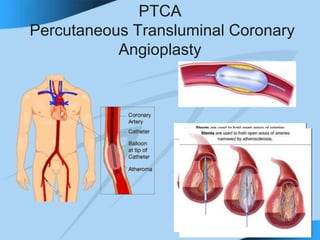
6. PTCA- Pecutaneous Transluminal Coronary
Angioplasty
- To compress plaque against the vessel wall, increasing
the arterial lumen
7. CABG- Coronary Artery Bypass Graft
- To improve the blood flow to the myocardial tissue
8. Provide information to family members to
minimize anxiety and promote family
cooperation
9. Assist client to identify risk factors that can be
modified
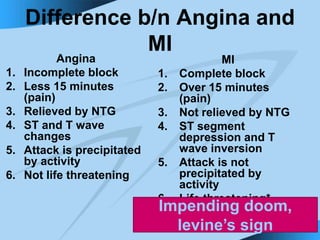
Difference b/n Angina and
MI
Angina
1. Incomplete block
2. Less 15 minutes
(pain)
3. Relieved by NTG
4. ST and T wave
changes
5. Attack is precipitated
by activity
6. Not life threatening
MI
1. Complete block
2. Over 15 minutes
(pain)
3. Not relieved by NTG
4. ST segment
depression and T
wave inversion
5. Attack is not
precipitated by
activity
6. Life threatening*
Impending doom,
levine’s sign
Angina and MI
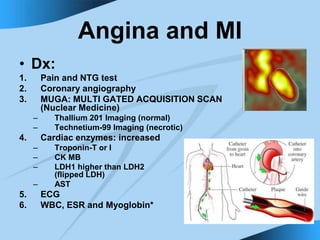
• Dx:
1. Pain and NTG test
2. Coronary angiography
3. MUGA: MULTI GATED ACQUISITION SCAN
(Nuclear Medicine)
– Thallium 201 Imaging (normal)
– Technetium-99 Imaging (necrotic)
4. Cardiac enzymes: increased
– Troponin-T or I
– CK MB
– LDH1 higher than LDH2
(flipped LDH)
– AST
5. ECG
6. WBC, ESR and Myoglobin*
• Possible ECG
results:
• Elevation of ST
segment = MI
• Peaked or
inverted T
wave = MI
• Pathological Q
wave = MI
Nursing Diagnosis
1. Pain related to an imbalance in oxygen supply and
demand
2. Anxiety related to chest pain, fear of death and
threatening environment
3. Decreased cardiac output related to impaired
contraction of the heart
4. Altered tissue perfusion (myocardial) related to
coronary stenosis
5. Activity intolerance related to insufficient
oxygenation
6. Risk for injury (bleeding) related to dissolution of
clots
7. Ineffective individual coping related to threats to self
esteem*
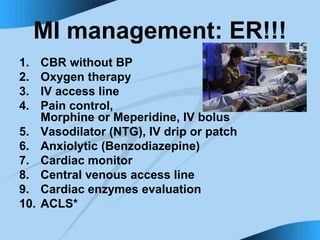
MI management: ER!!!
1. CBR without BP
2. Oxygen therapy
3. IV access line
4. Pain control,
Morphine or Meperidine, IV bolus
5. Vasodilator (NTG), IV drip or patch
6. Anxiolytic (Benzodiazepine)
7. Cardiac monitor
8. Central venous access line
9. Cardiac enzymes evaluation
10. ACLS*
Other drugs for MI:
• Pharmacologic Therapy
1. Thrombolytic Agents
1. TPA tissue plasminogen activator
2. Streptokinase (streptase)
3. Urokinase
2. Anticoagulant
1. Heparin
2. Warfarin
3. ASA (antiplatelets)
4. Plavix
3. Beta adrenergic blocking agents
1. Propranolol
4. Antidysrhythmic
1. Lidocaine (Xylocaine)
5. Calcium Channel Blockers
1. Diltiazem*
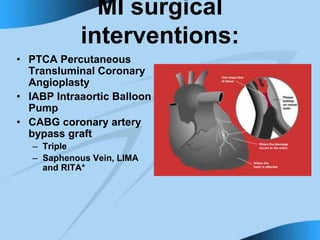
MI surgical
interventions:
• PTCA Percutaneous
Transluminal Coronary
Angioplasty
• IABP Intraaortic Balloon
Pump
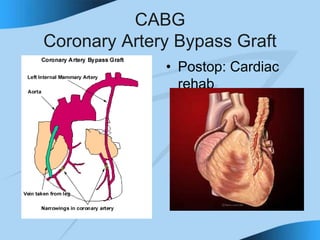
• CABG coronary artery
bypass graft
– Triple
– Saphenous Vein, LIMA
and RITA*
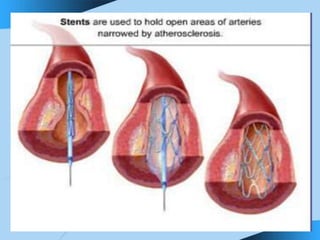
PTCA
Percutaneous Transluminal Coronary
Angioplasty
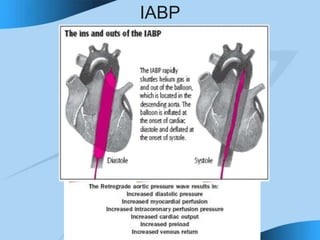
IABP
Intra aortic Balloon Pump
CABG
Coronary Artery Bypass Graft
• Postop: Cardiac
rehab
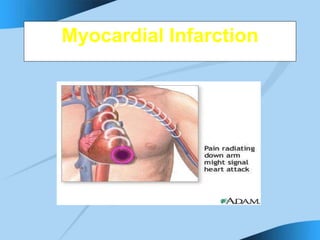
Myocardial Infarction
• Abrupt interruption of blood (O2)
supply to the myocardium or an
increased demand for oxygen.
• Necrosis or death to the
myocardial tissue
• Attack may be sudden or gradual
Myocardial Infarction
• Etiology
– CAD
– Coronary artery vasospasm
– Coronary artery occlusion by embolus and
thrombus
– Conditions that decrease perfusion
• Hemorrhage
• shock
Myocardial Infarction
• Risk Factors
– Hypercholesterolemia
– Smoking
– Hypertension
– Obesity
– Stress
– Sedentary lifestyle
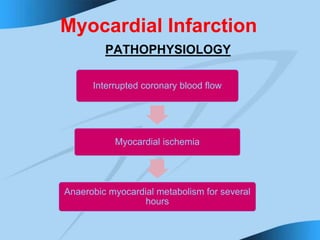
Myocardial Infarction
PATHOPHYSIOLOGY
Interrupted coronary blood flow
Myocardial ischemia
Anaerobic myocardial metabolism for several
hours
Myocardial Infarction
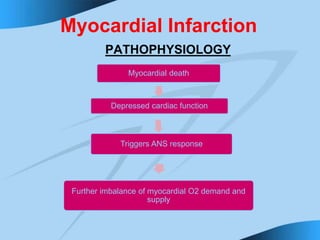
PATHOPHYSIOLOGY
Myocardial death
Depressed cardiac function
Triggers ANS response
Further imbalance of myocardial O2 demand and
supply
1. Chest pain:
– Severe, steady crushing and squeezing
– Substernal discomfort
– Not relieved by rest or NTG
– May continue for 15-30 mins or longer
– Radiates to the arm, neck, jaw and back
– Occurs without cause, primarily early morning
– May produce anxiety and fear resulting to
increased HR, and RR
2. Diaphoresis
3. cold clammy skin
4. facial pallor
5. Dyspnea
6. n/v
7. Restlessness, sense of doom
8. Tachycardia or bradycardia
9. Hypotension
10. dysrhythmia
Diagnostic Evaluation:
• Chest pain can’t be relieved by NTG
• ECG- ST segment elevation and T wave inversion,
presence of Q wave
• Cardiac enzymes: increased
– Troponin-T
– CK MB
– LDH
• Test for acute stage- exercise tolerance test, cardiac
catheterization
Management:
• Provide O2 at 2 LPM
• Semi-fowler’s position
• Administer medications
• Morphine- to relieve pain
• Nitrates, thrombolytics, aspirin and anti-
coagulants
• Stool softeners and hypolipidemics
• Minimize patient anxiety
• Provide info as to procedures and drug therapy
• Allow verbalization of feelings
• morphine
Management:
• Provide adequate rest periods
• Bed rest during acute period
• Minimize metabolic demands
• Provide soft diet
• Provide low sodium, low cholesterol and low fat
diet
• Assist in treatment modalities (CABG,PTCA)
• Monitor for complications of MI-dysrhythmias
• Ventricular dysrhythmias can occur for the first few
hours post MI attack
• Provide client teaching
• Acute Management of MI:
General Measures
1) maintain bed rest for the first 3 days
2) provide passive ROM exercises
3) Progress with dangling of the feet at side of the bed
4) Proceed with sitting out of bed, on the chair for 30 mins
TID
5) Proceed with ambulation in the room, toilet,
hallway…TID
Pharmacologic Therapy
• Thrombolytic Agents- dissolves clots in the
coronary artery allowing blood flow.
Streptokinase (streptase), Urokinase
• Anticoagulant
Heparin, Warfarin
• Analgesic- Morphine
– Reduces pain and anxiety
– Relaxes bronchioles to enhance oxygenation
• ACE inhibitors
– Limits area of infarction
• Heparin
– To aid in recannalization or reduce
reocclusion of coronary artery
– To reduce systemic embolism and stroke
from left ventricle mural thrombus
– To reduce deep venous thrombosis and
pulmonary embolus
Analgesic – Morphine Sulfate
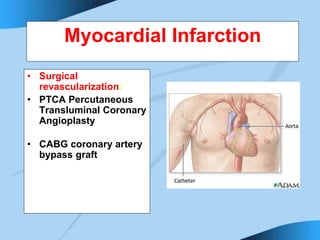
Myocardial Infarction
• Surgical
revascularization:
• PTCA Percutaneous
Transluminal Coronary
Angioplasty
• CABG coronary artery
bypass graft
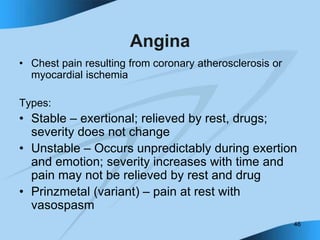
46
Angina
• Chest pain resulting from coronary atherosclerosis or
myocardial ischemia
Types:
• Stable – exertional; relieved by rest, drugs;
severity does not change
• Unstable – Occurs unpredictably during exertion
and emotion; severity increases with time and
pain may not be relieved by rest and drug
• Prinzmetal (variant) – pain at rest with
vasospasm
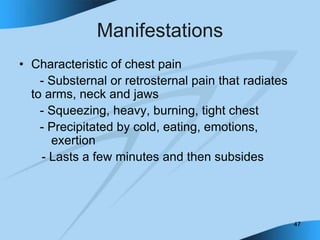
47
Manifestations
• Characteristic of chest pain
- Substernal or retrosternal pain that radiates
to arms, neck and jaws
- Squeezing, heavy, burning, tight chest
- Precipitated by cold, eating, emotions,
exertion
- Lasts a few minutes and then subsides
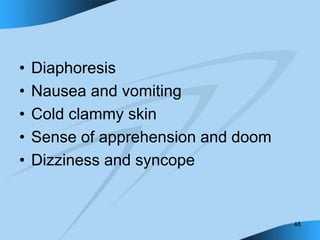
48
• Diaphoresis
• Nausea and vomiting
• Cold clammy skin
• Sense of apprehension and doom
• Dizziness and syncope
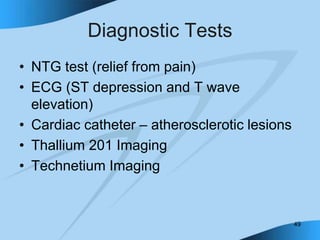
49
Diagnostic Tests
• NTG test (relief from pain)
• ECG (ST depression and T wave
elevation)
• Cardiac catheter – atherosclerotic lesions
• Thallium 201 Imaging
• Technetium Imaging
50
Nursing Diagnosis
• Pain related to imbalance in myocardial
oxygen demand
• Decreased cardiac output related to
reduced preload and afterload
• Anxiety related to pain, uncertain
prognosis and threatening environment
51
Management
• Relieve pain
• Place in comfortable position
• Administer O2
• Decrease Anxiety
• PTCA - percutaneous transluminal
coronary angioplasty
– To compress the plaque against the vessel
wall, increasing the arterial lumen
• CABG - coronary artery bypass graft
– To improve the blood flow to the myocardial
tissue
• Explain the reasons for hospitalization,
diagnostic tests and therapies
52
53
Give antianginal drugs
• Aspirin- prevent thrombus formation
• Beta-blockers- reduce BP and HR
• Calcium-channel blockers- dilate
coronary artery and reduce
vasospasm
• Nitrates- to dilate the coronary
arteries
54
• Put one nitroglycerin tablet under the
tongue
• Wait for 5 minutes
• If not relieved, take another tablet and
wait for 5 minutes
• Another tablet can be taken (third
tablet)
• If unrelieved after THREE tablets
seek medical attention
55
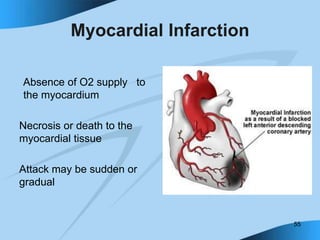
Myocardial Infarction
Absence of O2 supply to
the myocardium
Necrosis or death to the
myocardial tissue
Attack may be sudden or
gradual
56
Etiology
1. CAD
2. Coronary vasospasm
3. Coronary artery occlusion by
embolus and thrombus
4. Conditions that decrease
perfusion- hemorrhage, shock
57
Risk factors
1. Hypercholesterolemia
2. Smoking
3. Hypertension
4. Obesity
5. Stress
6. Sedentary lifestyle
58
Pathophysiology
Interrupted coronary blood flow myocardial
ischemia anaerobic myocardial metabolism for
several hours myocardial death  depressed
cardiac function  triggers autonomic nervous
system response  further imbalance of
myocardial O2 demand and supply
59
Chest pain:
• Severe, steady crushing and squeezing
substernal pain
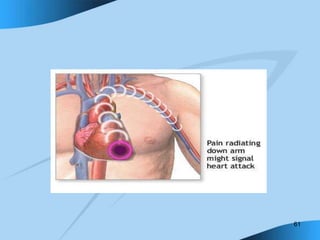
• Radiates to the neck, arm, jaw and back
• Not relieved by rest or NTG
• May continue for 15-30 minutes
• May produce anxiety and fear resulting to
increased HR, BP and RR
60
• dyspnea
• Diaphoresis
• cold clammy skin
• N/V
• restlessness, sense of doom
• tachycardia or bradycardia
• hypotension
• dysrhythmias
61
62
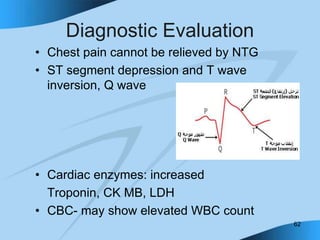
Diagnostic Evaluation
• Chest pain cannot be relieved by NTG
• ST segment depression and T wave
inversion, Q wave
• Cardiac enzymes: increased
Troponin, CK MB, LDH
• CBC- may show elevated WBC count
63
Nursing Diagnosis
• Pain related to an imbalance in oxygen
supply and demand
• Anxiety related to chest pain, fear of death
and threatening environment
• Decreased cardiac output related to
impaired contraction of the heart
64
• Altered tissue perfusion (myocardial)
related to coronary stenosis
• Activity intolerance related to insufficient
oxygenation
• Risk for injury (bleeding) related to
dissolution of clots
• Ineffective individual coping related to
threats to self esteem
65
Management
• Oxygen therapy
• Provide adequate rest periods
• Minimize metabolic demands
– Provide soft diet
– Provide a low-sodium, low cholesterol
and low fat diet
• Passive ROM
• Minimize anxiety
– Reassure client and provide
information as needed
66
Pharmacologic Therapy
• Thrombolytic agents - Dissolve clots in
the coronary artery allowing blood to
flow
ie TPA tissue plasminogen activator
(Alteplase), Streptokinase (streptase),
Urokinase
• Anticoagulant – prevents formation of
new blood clots
ie Heparin, Warfarin
67
• Antiplatelet – hypersensitivity to aspirin
ie Ticlopidine, Clopidogrel
• Beta adrenergic blocking agents –
reduce myocardial O2 demand by blocking
sympathetic stimulation; dec HR, contractility,
BP
ie Propranolol
• Calcium channel blockers –
dec contraction, HR; relax blood vessels
ie Diltiazem
68
• Morphine - reduces pain and anxiety
- Relaxes bronchioles to enhance oxygenation
• ACE Inhibitors - Prevents formation of angiotensin II
which causes vasoconstriction; dec O2 demand
– Limits the area of infarction
69
Surgical revascularization:
• Percutaneous Transluminal Coronary
Angioplasty (PTCA);
• coronary artery bypass graft (CABG )
After the condition had been stabilized:
- CBR without BP (complete bedrest without
bathroom privilege)
- Gradual resumption of ADL to full recovery

Angina Pectoris and MI.pptx

  • 1.
  • 2.
    Angina Pectoris • Define 􀁻Anginapectoris is a symptom characterized by discomfort in the chest. Transient chest pain caused by myocardial ischemia it is caused by inadequate blood supply to the myocardium
  • 3.
    • Pathophysiology inthe development of Angina 􀁻 Myocardial oxygen demand exceeds supply. 􀁻 Related primarily to atherosclerosis 􀁻 L Ventricle most susceptible 􀁻 Higher myocardial oxygen demand 􀁻 Higher systemic pressure
  • 4.
    • Ischemia resultsin anaerobic metabolism 􀁻 Lactic acid accumulates 􀁻 Irritating to myocardial nerve fibers 􀁻 Send pain message to cardiac nerves & 􀁻 Upper thoracic posterior root
  • 5.
    • Identify othercauses of Angina 􀁻 Coronary Spasms 􀁻 Low blood pressure 􀁻 Low blood volume 􀁻 Excessive Catecholamine stimulation 􀁻 Cocaine intoxication/overdose
  • 6.
    • factors thatprecipitate an anginal attack. 􀁻 Physical exertion 􀁻 Increases the heart rate 􀁻 Strong emotions 􀁻 Consumption of a heavy meal 􀁻 Temperature extremes 􀁻 Cigarette smoking
  • 7.
    • Precipitating factorscont 􀁻 Sexual activity 􀁻 Stimulants 􀁻 Circadian rhythm patterns
  • 8.
    • Differentiate betweenthe various types of angina • 􀁻 Stable • 􀁻 Unstable • 􀁻 Variant (Prinzmetal’s)
  • 9.
    • Stable Angina 􀁻Classic type –The typical angina that occurs during exertion –Relieved by rest and drugs –The severity does not change
  • 10.
    • Unstable Angina Occursunpredictably during exertion and emotion Severity increases with time Pain may not be relieved by rest and drugs can occur at rest or during sleep
  • 11.
    • Variant Angina Prinzmetal’sAngina Often occurs at rest Results from coronary artery vasospasms  Longer duration than typical angina and make wake person from sleep
  • 12.
    Clinical Manifestations • Chestpain- most characteristic symptom – Mild to severe retrosternal , squeezing, tightness or burning sensation (3-5 mins) – Radiates to the jaw and left arm – Relieved by rest and Nitroglycerin • Diaphoresis • N/V • Cold, Clammy skin • Sense of apprehension and doom • Dizziness and syncope
  • 13.
    Diagnosis 1. ECG – Mayshow normal tracing if patient is pain- free – Ischemic changes may show ST depression and T wave inversion 2. Cardiac catheterization – Provides the most definitive source of diagnosis by showing the presence of atherosclerotic lesions
  • 14.
    Nursing Management 1. Pharmacologictherapy  Nitrate therapy – to enhance coronary blood flow. 􀁻 Mainstay of treatment 􀁻 Vasodilator (decreases preload), dilates coronary arteries  Aspirin- to prevent thrombus formation  Beta blockers- to reduce BP and RR  Calcium Channel Blockers- to dilate coronary artery and reduce vasospasm
  • 15.
    • Pharmacologic therapy 􀁻Nitroglycerin sublingually 􀁻 1 tab q5 min x3 􀁻 Pain relief 􀁻 Approximately 3 minutes 􀁻 Duration 􀁻 Approx. 20-45 minutes * NTG decreases venous return because it not only dilates the coronary arteries but causes a peripheral vasodilation, which decreases venous return therefore the heart does not have to work as hard & there is less O2 consumption
  • 16.
    • Pharmacologic therapy 􀁻Side-effects 􀁻 Flushing 􀁻 Throbbing 􀁻 Postural hypotension Headache • tachycardia
  • 17.
    Nursing Management 2. Teachpatient management of anginal attacks  Advice patient to stop all activities  Put one nitroglycerin tab under the tongue  If unrelieved after 3 tabs with 5 mins interval, consult physician 3. Obtain a 12-lead ECG
  • 18.
    Nursing Management 4. Promotemyocardial perfusion  Instruct patient to maintain bed rest  Administer O2 @ 3 LPM  Avoid valsalva maneuver  Provide laxatives or high fiber diet to lessen constipation  Encourage to avoid increased physical activities 5. Assist in possible treatment modalities
  • 19.
    Nursing Management 6. PTCA-Pecutaneous Transluminal Coronary Angioplasty - To compress plaque against the vessel wall, increasing the arterial lumen 7. CABG- Coronary Artery Bypass Graft - To improve the blood flow to the myocardial tissue 8. Provide information to family members to minimize anxiety and promote family cooperation 9. Assist client to identify risk factors that can be modified
  • 20.
    Difference b/n Anginaand MI Angina 1. Incomplete block 2. Less 15 minutes (pain) 3. Relieved by NTG 4. ST and T wave changes 5. Attack is precipitated by activity 6. Not life threatening MI 1. Complete block 2. Over 15 minutes (pain) 3. Not relieved by NTG 4. ST segment depression and T wave inversion 5. Attack is not precipitated by activity 6. Life threatening* Impending doom, levine’s sign
  • 21.
    Angina and MI •Dx: 1. Pain and NTG test 2. Coronary angiography 3. MUGA: MULTI GATED ACQUISITION SCAN (Nuclear Medicine) – Thallium 201 Imaging (normal) – Technetium-99 Imaging (necrotic) 4. Cardiac enzymes: increased – Troponin-T or I – CK MB – LDH1 higher than LDH2 (flipped LDH) – AST 5. ECG 6. WBC, ESR and Myoglobin*
  • 22.
    • Possible ECG results: •Elevation of ST segment = MI • Peaked or inverted T wave = MI • Pathological Q wave = MI
  • 23.
    Nursing Diagnosis 1. Painrelated to an imbalance in oxygen supply and demand 2. Anxiety related to chest pain, fear of death and threatening environment 3. Decreased cardiac output related to impaired contraction of the heart 4. Altered tissue perfusion (myocardial) related to coronary stenosis 5. Activity intolerance related to insufficient oxygenation 6. Risk for injury (bleeding) related to dissolution of clots 7. Ineffective individual coping related to threats to self esteem*
  • 24.
    MI management: ER!!! 1.CBR without BP 2. Oxygen therapy 3. IV access line 4. Pain control, Morphine or Meperidine, IV bolus 5. Vasodilator (NTG), IV drip or patch 6. Anxiolytic (Benzodiazepine) 7. Cardiac monitor 8. Central venous access line 9. Cardiac enzymes evaluation 10. ACLS*
  • 25.
    Other drugs forMI: • Pharmacologic Therapy 1. Thrombolytic Agents 1. TPA tissue plasminogen activator 2. Streptokinase (streptase) 3. Urokinase 2. Anticoagulant 1. Heparin 2. Warfarin 3. ASA (antiplatelets) 4. Plavix 3. Beta adrenergic blocking agents 1. Propranolol 4. Antidysrhythmic 1. Lidocaine (Xylocaine) 5. Calcium Channel Blockers 1. Diltiazem*
  • 26.
    MI surgical interventions: • PTCAPercutaneous Transluminal Coronary Angioplasty • IABP Intraaortic Balloon Pump • CABG coronary artery bypass graft – Triple – Saphenous Vein, LIMA and RITA*
  • 27.
  • 29.
  • 30.
    CABG Coronary Artery BypassGraft • Postop: Cardiac rehab
  • 31.
  • 32.
    Myocardial Infarction • Abruptinterruption of blood (O2) supply to the myocardium or an increased demand for oxygen. • Necrosis or death to the myocardial tissue • Attack may be sudden or gradual
  • 33.
    Myocardial Infarction • Etiology –CAD – Coronary artery vasospasm – Coronary artery occlusion by embolus and thrombus – Conditions that decrease perfusion • Hemorrhage • shock
  • 34.
    Myocardial Infarction • RiskFactors – Hypercholesterolemia – Smoking – Hypertension – Obesity – Stress – Sedentary lifestyle
  • 35.
    Myocardial Infarction PATHOPHYSIOLOGY Interrupted coronaryblood flow Myocardial ischemia Anaerobic myocardial metabolism for several hours
  • 36.
    Myocardial Infarction PATHOPHYSIOLOGY Myocardial death Depressedcardiac function Triggers ANS response Further imbalance of myocardial O2 demand and supply
  • 37.
    1. Chest pain: –Severe, steady crushing and squeezing – Substernal discomfort – Not relieved by rest or NTG – May continue for 15-30 mins or longer – Radiates to the arm, neck, jaw and back – Occurs without cause, primarily early morning – May produce anxiety and fear resulting to increased HR, and RR
  • 38.
    2. Diaphoresis 3. coldclammy skin 4. facial pallor 5. Dyspnea 6. n/v 7. Restlessness, sense of doom 8. Tachycardia or bradycardia 9. Hypotension 10. dysrhythmia
  • 39.
    Diagnostic Evaluation: • Chestpain can’t be relieved by NTG • ECG- ST segment elevation and T wave inversion, presence of Q wave • Cardiac enzymes: increased – Troponin-T – CK MB – LDH • Test for acute stage- exercise tolerance test, cardiac catheterization
  • 40.
    Management: • Provide O2at 2 LPM • Semi-fowler’s position • Administer medications • Morphine- to relieve pain • Nitrates, thrombolytics, aspirin and anti- coagulants • Stool softeners and hypolipidemics • Minimize patient anxiety • Provide info as to procedures and drug therapy • Allow verbalization of feelings • morphine
  • 41.
    Management: • Provide adequaterest periods • Bed rest during acute period • Minimize metabolic demands • Provide soft diet • Provide low sodium, low cholesterol and low fat diet • Assist in treatment modalities (CABG,PTCA) • Monitor for complications of MI-dysrhythmias • Ventricular dysrhythmias can occur for the first few hours post MI attack • Provide client teaching
  • 42.
    • Acute Managementof MI: General Measures 1) maintain bed rest for the first 3 days 2) provide passive ROM exercises 3) Progress with dangling of the feet at side of the bed 4) Proceed with sitting out of bed, on the chair for 30 mins TID 5) Proceed with ambulation in the room, toilet, hallway…TID
  • 43.
    Pharmacologic Therapy • ThrombolyticAgents- dissolves clots in the coronary artery allowing blood flow. Streptokinase (streptase), Urokinase • Anticoagulant Heparin, Warfarin • Analgesic- Morphine – Reduces pain and anxiety – Relaxes bronchioles to enhance oxygenation • ACE inhibitors – Limits area of infarction
  • 44.
    • Heparin – Toaid in recannalization or reduce reocclusion of coronary artery – To reduce systemic embolism and stroke from left ventricle mural thrombus – To reduce deep venous thrombosis and pulmonary embolus Analgesic – Morphine Sulfate
  • 45.
    Myocardial Infarction • Surgical revascularization: •PTCA Percutaneous Transluminal Coronary Angioplasty • CABG coronary artery bypass graft
  • 46.
    46 Angina • Chest painresulting from coronary atherosclerosis or myocardial ischemia Types: • Stable – exertional; relieved by rest, drugs; severity does not change • Unstable – Occurs unpredictably during exertion and emotion; severity increases with time and pain may not be relieved by rest and drug • Prinzmetal (variant) – pain at rest with vasospasm
  • 47.
    47 Manifestations • Characteristic ofchest pain - Substernal or retrosternal pain that radiates to arms, neck and jaws - Squeezing, heavy, burning, tight chest - Precipitated by cold, eating, emotions, exertion - Lasts a few minutes and then subsides
  • 48.
    48 • Diaphoresis • Nauseaand vomiting • Cold clammy skin • Sense of apprehension and doom • Dizziness and syncope
  • 49.
    49 Diagnostic Tests • NTGtest (relief from pain) • ECG (ST depression and T wave elevation) • Cardiac catheter – atherosclerotic lesions • Thallium 201 Imaging • Technetium Imaging
  • 50.
    50 Nursing Diagnosis • Painrelated to imbalance in myocardial oxygen demand • Decreased cardiac output related to reduced preload and afterload • Anxiety related to pain, uncertain prognosis and threatening environment
  • 51.
    51 Management • Relieve pain •Place in comfortable position • Administer O2 • Decrease Anxiety • PTCA - percutaneous transluminal coronary angioplasty – To compress the plaque against the vessel wall, increasing the arterial lumen • CABG - coronary artery bypass graft – To improve the blood flow to the myocardial tissue • Explain the reasons for hospitalization, diagnostic tests and therapies
  • 52.
  • 53.
    53 Give antianginal drugs •Aspirin- prevent thrombus formation • Beta-blockers- reduce BP and HR • Calcium-channel blockers- dilate coronary artery and reduce vasospasm • Nitrates- to dilate the coronary arteries
  • 54.
    54 • Put onenitroglycerin tablet under the tongue • Wait for 5 minutes • If not relieved, take another tablet and wait for 5 minutes • Another tablet can be taken (third tablet) • If unrelieved after THREE tablets seek medical attention
  • 55.
    55 Myocardial Infarction Absence ofO2 supply to the myocardium Necrosis or death to the myocardial tissue Attack may be sudden or gradual
  • 56.
    56 Etiology 1. CAD 2. Coronaryvasospasm 3. Coronary artery occlusion by embolus and thrombus 4. Conditions that decrease perfusion- hemorrhage, shock
  • 57.
    57 Risk factors 1. Hypercholesterolemia 2.Smoking 3. Hypertension 4. Obesity 5. Stress 6. Sedentary lifestyle
  • 58.
    58 Pathophysiology Interrupted coronary bloodflow myocardial ischemia anaerobic myocardial metabolism for several hours myocardial death  depressed cardiac function  triggers autonomic nervous system response  further imbalance of myocardial O2 demand and supply
  • 59.
    59 Chest pain: • Severe,steady crushing and squeezing substernal pain • Radiates to the neck, arm, jaw and back • Not relieved by rest or NTG • May continue for 15-30 minutes • May produce anxiety and fear resulting to increased HR, BP and RR
  • 60.
    60 • dyspnea • Diaphoresis •cold clammy skin • N/V • restlessness, sense of doom • tachycardia or bradycardia • hypotension • dysrhythmias
  • 61.
  • 62.
    62 Diagnostic Evaluation • Chestpain cannot be relieved by NTG • ST segment depression and T wave inversion, Q wave • Cardiac enzymes: increased Troponin, CK MB, LDH • CBC- may show elevated WBC count
  • 63.
    63 Nursing Diagnosis • Painrelated to an imbalance in oxygen supply and demand • Anxiety related to chest pain, fear of death and threatening environment • Decreased cardiac output related to impaired contraction of the heart
  • 64.
    64 • Altered tissueperfusion (myocardial) related to coronary stenosis • Activity intolerance related to insufficient oxygenation • Risk for injury (bleeding) related to dissolution of clots • Ineffective individual coping related to threats to self esteem
  • 65.
    65 Management • Oxygen therapy •Provide adequate rest periods • Minimize metabolic demands – Provide soft diet – Provide a low-sodium, low cholesterol and low fat diet • Passive ROM • Minimize anxiety – Reassure client and provide information as needed
  • 66.
    66 Pharmacologic Therapy • Thrombolyticagents - Dissolve clots in the coronary artery allowing blood to flow ie TPA tissue plasminogen activator (Alteplase), Streptokinase (streptase), Urokinase • Anticoagulant – prevents formation of new blood clots ie Heparin, Warfarin
  • 67.
    67 • Antiplatelet –hypersensitivity to aspirin ie Ticlopidine, Clopidogrel • Beta adrenergic blocking agents – reduce myocardial O2 demand by blocking sympathetic stimulation; dec HR, contractility, BP ie Propranolol • Calcium channel blockers – dec contraction, HR; relax blood vessels ie Diltiazem
  • 68.
    68 • Morphine -reduces pain and anxiety - Relaxes bronchioles to enhance oxygenation • ACE Inhibitors - Prevents formation of angiotensin II which causes vasoconstriction; dec O2 demand – Limits the area of infarction
  • 69.
    69 Surgical revascularization: • PercutaneousTransluminal Coronary Angioplasty (PTCA); • coronary artery bypass graft (CABG ) After the condition had been stabilized: - CBR without BP (complete bedrest without bathroom privilege) - Gradual resumption of ADL to full recovery