GEOLOGIC
PROCESSES
(Exogenic
Process)
Exogenic
Processes
Types of Exogenic Processes
01 03 04
02
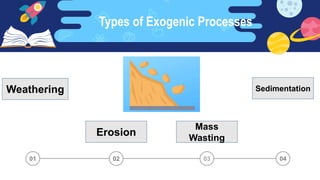
Weathering
Erosion
Mass
Wasting
Sedimentation
Weathering
03 04
02
01
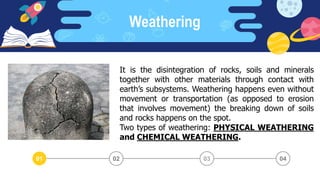
It is the disintegration of rocks, soils and minerals
together with other materials through contact with
earth’s subsystems. Weathering happens even without
movement or transportation (as opposed to erosion
that involves movement) the breaking down of soils
and rocks happens on the spot.
Two types of weathering: PHYSICAL WEATHERING
and CHEMICAL WEATHERING.
Physical Weathering
03 04
02
01
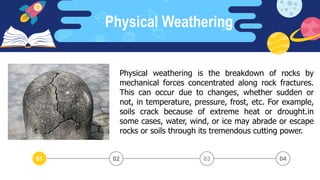
Physical weathering is the breakdown of rocks by
mechanical forces concentrated along rock fractures.
This can occur due to changes, whether sudden or
not, in temperature, pressure, frost, etc. For example,
soils crack because of extreme heat or drought.in
some cases, water, wind, or ice may abrade or escape
rocks or soils through its tremendous cutting power.
Chemical Weathering
03 04
02
01
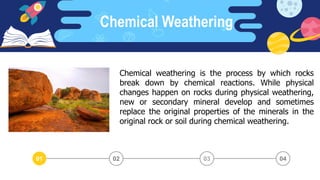
Chemical weathering is the process by which rocks
break down by chemical reactions. While physical
changes happen on rocks during physical weathering,
new or secondary mineral develop and sometimes
replace the original properties of the minerals in the
original rock or soil during chemical weathering.
Chemical Weathering
03 04
02
01
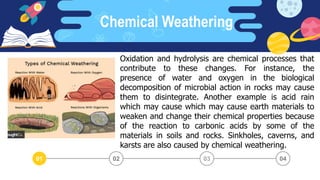
Oxidation and hydrolysis are chemical processes that
contribute to these changes. For instance, the
presence of water and oxygen in the biological
decomposition of microbial action in rocks may cause
them to disintegrate. Another example is acid rain
which may cause which may cause earth materials to
weaken and change their chemical properties because
of the reaction to carbonic acids by some of the
materials in soils and rocks. Sinkholes, caverns, and
karsts are also caused by chemical weathering.
Chemical Weathering
03 04
02
01
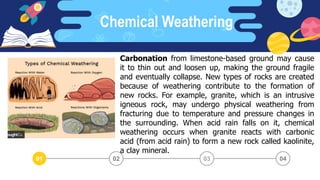
Carbonation from limestone-based ground may cause
it to thin out and loosen up, making the ground fragile
and eventually collapse. New types of rocks are created
because of weathering contribute to the formation of
new rocks. For example, granite, which is an intrusive
igneous rock, may undergo physical weathering from
fracturing due to temperature and pressure changes in
the surrounding. When acid rain falls on it, chemical
weathering occurs when granite reacts with carbonic
acid (from acid rain) to form a new rock called kaolinite,
a clay mineral.
Erosion
03 04
02
01
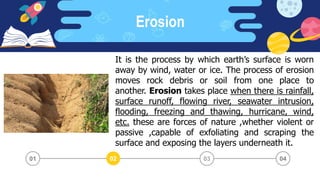
It is the process by which earth’s surface is worn
away by wind, water or ice. The process of erosion
moves rock debris or soil from one place to
another. Erosion takes place when there is rainfall,
surface runoff, flowing river, seawater intrusion,
flooding, freezing and thawing, hurricane, wind,
etc. these are forces of nature ,whether violent or
passive ,capable of exfoliating and scraping the
surface and exposing the layers underneath it.
Erosion
03 04
02
01
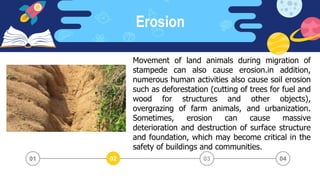
Movement of land animals during migration of
stampede can also cause erosion.in addition,
numerous human activities also cause soil erosion
such as deforestation (cutting of trees for fuel and
wood for structures and other objects),
overgrazing of farm animals, and urbanization.
Sometimes, erosion can cause massive
deterioration and destruction of surface structure
and foundation, which may become critical in the
safety of buildings and communities.
Mass Wasting
03 04
02
01
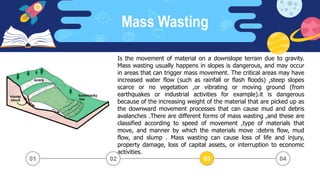
Is the movement of material on a downslope terrain due to gravity.
Mass wasting usually happens in slopes is dangerous, and may occur
in areas that can trigger mass movement. The critical areas may have
increased water flow (such as rainfall or flash floods) ,steep slopes
scarce or no vegetation ,or vibrating or moving ground (from
earthquakes or industrial activities for example).it is dangerous
because of the increasing weight of the material that are picked up as
the downward movement processes that can cause mud and debris
avalanches .There are different forms of mass wasting ,and these are
classified according to speed of movement ,type of materials that
move, and manner by which the materials move :debris flow, mud
flow, and slump . Mass wasting can cause loss of life and injury,
property damage, loss of capital assets, or interruption to economic
activities.
03
02
Mass Wasting
03 04
02
01
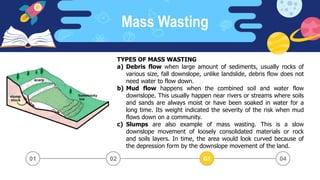
TYPES OF MASS WASTING
a) Debris flow when large amount of sediments, usually rocks of
various size, fall downslope, unlike landslide, debris flow does not
need water to flow down.
b) Mud flow happens when the combined soil and water flow
downslope. This usually happen near rivers or streams where soils
and sands are always moist or have been soaked in water for a
long time. Its weight indicated the severity of the risk when mud
flows down on a community.
c) Slumps are also example of mass wasting. This is a slow
downslope movement of loosely consolidated materials or rock
and soils layers. In time, the area would look curved because of
the depression form by the downslope movement of the land.
02 03
SEDIMENTATION
03 04
02
01
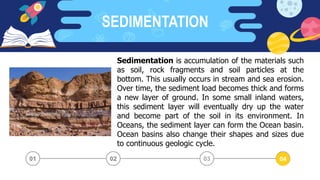
Sedimentation is accumulation of the materials such
as soil, rock fragments and soil particles at the
bottom. This usually occurs in stream and sea erosion.
Over time, the sediment load becomes thick and forms
a new layer of ground. In some small inland waters,
this sediment layer will eventually dry up the water
and become part of the soil in its environment. In
Oceans, the sediment layer can form the Ocean basin.
Ocean basins also change their shapes and sizes due
to continuous geologic cycle.
02 04
01 03 04
02
ASSIGNMENT
Thank you for
listening!!!

Earth Science Exogenic Processes.pptx

  • 1.
  • 2.
  • 3.
    Types of ExogenicProcesses 01 03 04 02 Weathering Erosion Mass Wasting Sedimentation
  • 4.
    Weathering 03 04 02 01 It isthe disintegration of rocks, soils and minerals together with other materials through contact with earth’s subsystems. Weathering happens even without movement or transportation (as opposed to erosion that involves movement) the breaking down of soils and rocks happens on the spot. Two types of weathering: PHYSICAL WEATHERING and CHEMICAL WEATHERING.
  • 5.
    Physical Weathering 03 04 02 01 Physicalweathering is the breakdown of rocks by mechanical forces concentrated along rock fractures. This can occur due to changes, whether sudden or not, in temperature, pressure, frost, etc. For example, soils crack because of extreme heat or drought.in some cases, water, wind, or ice may abrade or escape rocks or soils through its tremendous cutting power.
  • 6.
    Chemical Weathering 03 04 02 01 Chemicalweathering is the process by which rocks break down by chemical reactions. While physical changes happen on rocks during physical weathering, new or secondary mineral develop and sometimes replace the original properties of the minerals in the original rock or soil during chemical weathering.
  • 7.
    Chemical Weathering 03 04 02 01 Oxidationand hydrolysis are chemical processes that contribute to these changes. For instance, the presence of water and oxygen in the biological decomposition of microbial action in rocks may cause them to disintegrate. Another example is acid rain which may cause which may cause earth materials to weaken and change their chemical properties because of the reaction to carbonic acids by some of the materials in soils and rocks. Sinkholes, caverns, and karsts are also caused by chemical weathering.
  • 8.
    Chemical Weathering 03 04 02 01 Carbonationfrom limestone-based ground may cause it to thin out and loosen up, making the ground fragile and eventually collapse. New types of rocks are created because of weathering contribute to the formation of new rocks. For example, granite, which is an intrusive igneous rock, may undergo physical weathering from fracturing due to temperature and pressure changes in the surrounding. When acid rain falls on it, chemical weathering occurs when granite reacts with carbonic acid (from acid rain) to form a new rock called kaolinite, a clay mineral.
  • 9.
    Erosion 03 04 02 01 It isthe process by which earth’s surface is worn away by wind, water or ice. The process of erosion moves rock debris or soil from one place to another. Erosion takes place when there is rainfall, surface runoff, flowing river, seawater intrusion, flooding, freezing and thawing, hurricane, wind, etc. these are forces of nature ,whether violent or passive ,capable of exfoliating and scraping the surface and exposing the layers underneath it.
  • 10.
    Erosion 03 04 02 01 Movement ofland animals during migration of stampede can also cause erosion.in addition, numerous human activities also cause soil erosion such as deforestation (cutting of trees for fuel and wood for structures and other objects), overgrazing of farm animals, and urbanization. Sometimes, erosion can cause massive deterioration and destruction of surface structure and foundation, which may become critical in the safety of buildings and communities.
  • 11.
    Mass Wasting 03 04 02 01 Isthe movement of material on a downslope terrain due to gravity. Mass wasting usually happens in slopes is dangerous, and may occur in areas that can trigger mass movement. The critical areas may have increased water flow (such as rainfall or flash floods) ,steep slopes scarce or no vegetation ,or vibrating or moving ground (from earthquakes or industrial activities for example).it is dangerous because of the increasing weight of the material that are picked up as the downward movement processes that can cause mud and debris avalanches .There are different forms of mass wasting ,and these are classified according to speed of movement ,type of materials that move, and manner by which the materials move :debris flow, mud flow, and slump . Mass wasting can cause loss of life and injury, property damage, loss of capital assets, or interruption to economic activities. 03 02
  • 12.
    Mass Wasting 03 04 02 01 TYPESOF MASS WASTING a) Debris flow when large amount of sediments, usually rocks of various size, fall downslope, unlike landslide, debris flow does not need water to flow down. b) Mud flow happens when the combined soil and water flow downslope. This usually happen near rivers or streams where soils and sands are always moist or have been soaked in water for a long time. Its weight indicated the severity of the risk when mud flows down on a community. c) Slumps are also example of mass wasting. This is a slow downslope movement of loosely consolidated materials or rock and soils layers. In time, the area would look curved because of the depression form by the downslope movement of the land. 02 03
  • 13.
    SEDIMENTATION 03 04 02 01 Sedimentation isaccumulation of the materials such as soil, rock fragments and soil particles at the bottom. This usually occurs in stream and sea erosion. Over time, the sediment load becomes thick and forms a new layer of ground. In some small inland waters, this sediment layer will eventually dry up the water and become part of the soil in its environment. In Oceans, the sediment layer can form the Ocean basin. Ocean basins also change their shapes and sizes due to continuous geologic cycle. 02 04
  • 14.
  • 15.