CHAPTER 7
PRINCIPLES OF
EXERCISE TRAINING
MEMBERS:
KRISTINE JURADA
KRYSSHA JAVIER
REYNA MAE VENEGAS
JANFORT TANDOY
TERMINOLOGIES
GENERAL PRINCIPLES OF TRAINING
RESISTANCE TRAINING PROGRAM
LEARNING OBJECTIVES
TERMINOLOGY
STRENGTH
is the maximal force a muscle group can generate.
POWER
is the rate of performing work.
Power = force x distance / time
MUSCULAR ENDURANCE
is the capacity to sustain repeated muscle actions
or a single static contraction.
AN ISOKINETIC TESTING
AND TRAINING DEVICE
AEROBIC POWER
The rate of energy release by
cellular metabolic processes that
depend on the involvement and
availability of oxygen.
Maximal Aerobic Power is the
maximal capacity for aerobic
resynthesis of ATP.
ANAEROBIC POWER
The rate of energy release by
cellular metabolic processes that
function without the involvement
of oxygen.
Maximal Anaerobic Power is the
maximal capacity of the anaerobic
system to produce ATP.
GENERAL
PRINCIPLES
OF TRAINING
GENERAL PRINCIPLES OF TRAINING
INDIVIDUALITY
any training program must consider the specific
needs and abilities of the individual for whom it is
designed.
SPECIFICITY
adaptations to training are highly specific to the
nature of the training activity and should be
carefully matched to an athlete's specific
performance needs.
REVERSIBILITY
training programs must include a maintenance
plan to ensure that the gains from training are not
lost.
PROGRESSIVE OVERLOAD
the training stimulus must be progressively
increased as the body adapts to the current
stimulus.
HARD/EASY
programs must alternate high-intensity workouts
with low-intensity workouts to help the body
recover and achieve optimal training adaptations.
PERIODIZATION
the gradual cycling of specificity, intensity, and
volume of training to achieve peak levels of fitness
for competition.
RESISTANCE TRAINING
PROGRAMS
RESISTANCE TRAINING
PROGRAMS
Muscle groups to be trained
Types of training
Energy systems to be trained
Sites of concern for injury prevention
TRAINING NEEDS ANALYSIS
1.
2.
3.
4.
DESIGNING RESISTANCE
TRAINING PROGRAMS:
THINGS TO DECIDE
Exercise that will be performed.
Order in which they will be performed.
Number of sets of each exercise.
Rest periods between sets and exercises.
Intensity (amount of resistance), number
of repetitions, and velocity of movement.
1.
2.
3.
4.
5.
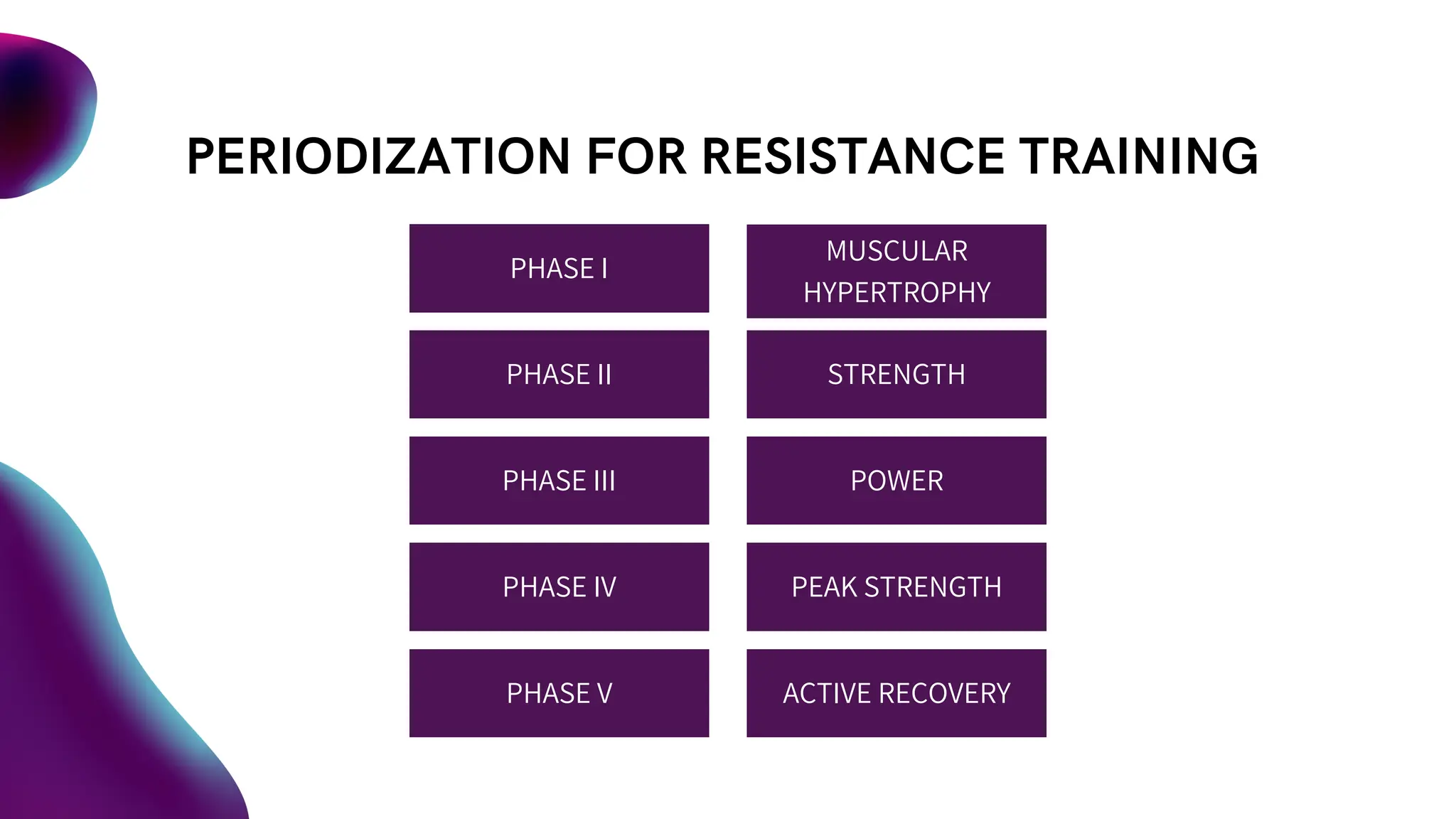
PERIODIZATION FOR RESISTANCE TRAINING
PHASE I
PHASE IV
PHASE II
PHASE III
PHASE V
MUSCULAR
HYPERTROPHY
STRENGTH
POWER
PEAK STRENGTH
ACTIVE RECOVERY
TYPES OF RESISTANCE
TRAINING
TYPES OF RESISTANCE TRAINING
Static-Contraction (Isometric) Resistance Training
Free Weights
Eccentric Training
Variable-Resistance Training
Isokinetic Training
Plyometrics
Electrical Stimulation Training
PLYOMETRIC
BOX
JUMPING
RESISTANCE TRAINING PROGRAMS
KEY POINTS:
Low-repetition, high-resistance training enhances strength development.
High-repetition, low-resistance training optimizes muscular endurance.
Periodization is important to prevent overtraining and burnout.
A typical periodization cycle has 4 active phases, each emphasizing a
different muscular fitness component, plus an active recovery.
RESISTANCE TRAINING PROGRAMS
KEY POINTS:
Resistance training can use static or dynamic contractions.
Eccentric training appears to be essential to maximizing hypertrophy.
Electrical stimulation can be successfully used in rehabilitationg athletes.
ANAEROBIC AND AEROBIC POWER
TRAINING PROGRAMS
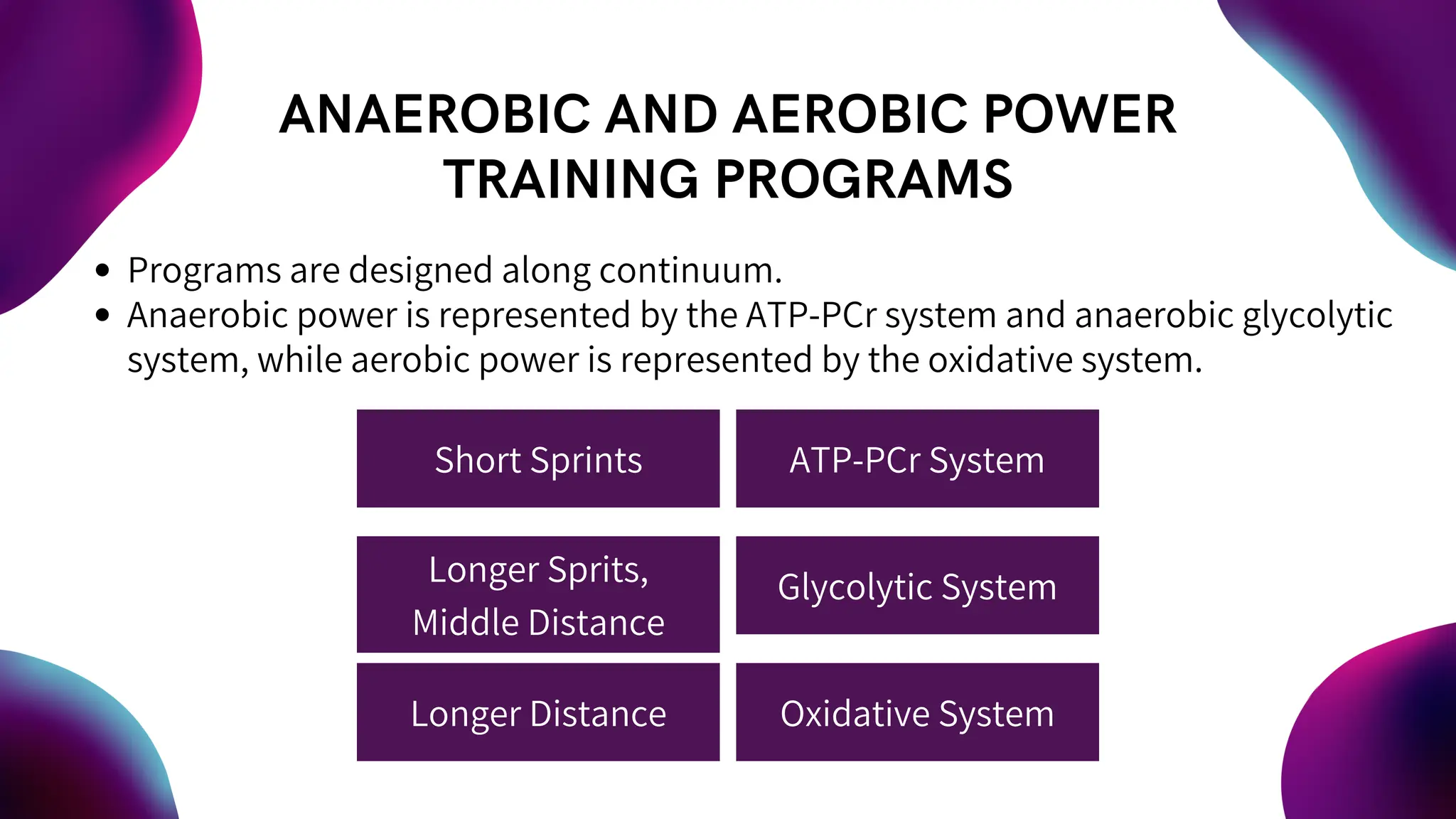
Programs are designed along continuum.
Anaerobic power is represented by the ATP-PCr system and anaerobic glycolytic
system, while aerobic power is represented by the oxidative system.
Short Sprints
Longer Sprits,
Middle Distance
Longer Distance
ATP-PCr System
Glycolytic System
Oxidative System
VARIABLES TO MANIPULATE
FOR INTERVAL TRAINING
Rate of the exercise interval.
Distance of the exercise interval.
Number of repetitions and sets during each training session.
Duration of rest or active recovery interval.
Type of activity during the active recovery interval.
Frequency of training per week.
TYPES OF TRAINING
Interval Training
Continuous Training
Interval-Circuit Training
KEY POINTS:
ANAEROBIC AND
AEROBIC POWER
TRAINING
ANAEROBIC AND AEROBIC POWER TRAINING
KEY POINTS:
Training programs are designed to train one or more of
the three metabolic energy systems.
Interval training consists of repeated bouts of high to
moderate intensity exercise interspersed with periods
of rest or reduced-intensity exercise.
Exercise intensity and recover rate can be monitored
with a heart rate monitor.
Interval training is appropriate for all sports.
ANAEROBIC AND AEROBIC POWER TRAINING
KEY POINTS:
Continuous training has no rest intervals and can vary from LSD
training to high intensity training.
Fartlek training is an excellent activity recovering from several
days of more intense exercise.
Interval-circuit training combines interval training and circuit
training into one workout.

Principle of training exercises Simple report ppt.

  • 1.
  • 2.
  • 3.
    TERMINOLOGIES GENERAL PRINCIPLES OFTRAINING RESISTANCE TRAINING PROGRAM LEARNING OBJECTIVES
  • 4.
    TERMINOLOGY STRENGTH is the maximalforce a muscle group can generate. POWER is the rate of performing work. Power = force x distance / time MUSCULAR ENDURANCE is the capacity to sustain repeated muscle actions or a single static contraction.
  • 5.
  • 6.
    AEROBIC POWER The rateof energy release by cellular metabolic processes that depend on the involvement and availability of oxygen. Maximal Aerobic Power is the maximal capacity for aerobic resynthesis of ATP. ANAEROBIC POWER The rate of energy release by cellular metabolic processes that function without the involvement of oxygen. Maximal Anaerobic Power is the maximal capacity of the anaerobic system to produce ATP.
  • 7.
  • 8.
    GENERAL PRINCIPLES OFTRAINING INDIVIDUALITY any training program must consider the specific needs and abilities of the individual for whom it is designed. SPECIFICITY adaptations to training are highly specific to the nature of the training activity and should be carefully matched to an athlete's specific performance needs. REVERSIBILITY training programs must include a maintenance plan to ensure that the gains from training are not lost. PROGRESSIVE OVERLOAD the training stimulus must be progressively increased as the body adapts to the current stimulus. HARD/EASY programs must alternate high-intensity workouts with low-intensity workouts to help the body recover and achieve optimal training adaptations. PERIODIZATION the gradual cycling of specificity, intensity, and volume of training to achieve peak levels of fitness for competition.
  • 9.
  • 10.
    RESISTANCE TRAINING PROGRAMS Muscle groupsto be trained Types of training Energy systems to be trained Sites of concern for injury prevention TRAINING NEEDS ANALYSIS 1. 2. 3. 4.
  • 11.
    DESIGNING RESISTANCE TRAINING PROGRAMS: THINGSTO DECIDE Exercise that will be performed. Order in which they will be performed. Number of sets of each exercise. Rest periods between sets and exercises. Intensity (amount of resistance), number of repetitions, and velocity of movement. 1. 2. 3. 4. 5.
  • 12.
    PERIODIZATION FOR RESISTANCETRAINING PHASE I PHASE IV PHASE II PHASE III PHASE V MUSCULAR HYPERTROPHY STRENGTH POWER PEAK STRENGTH ACTIVE RECOVERY
  • 13.
  • 14.
    TYPES OF RESISTANCETRAINING Static-Contraction (Isometric) Resistance Training Free Weights Eccentric Training Variable-Resistance Training Isokinetic Training Plyometrics Electrical Stimulation Training
  • 17.
  • 18.
    RESISTANCE TRAINING PROGRAMS KEYPOINTS: Low-repetition, high-resistance training enhances strength development. High-repetition, low-resistance training optimizes muscular endurance. Periodization is important to prevent overtraining and burnout. A typical periodization cycle has 4 active phases, each emphasizing a different muscular fitness component, plus an active recovery.
  • 19.
    RESISTANCE TRAINING PROGRAMS KEYPOINTS: Resistance training can use static or dynamic contractions. Eccentric training appears to be essential to maximizing hypertrophy. Electrical stimulation can be successfully used in rehabilitationg athletes.
  • 20.
    ANAEROBIC AND AEROBICPOWER TRAINING PROGRAMS Programs are designed along continuum. Anaerobic power is represented by the ATP-PCr system and anaerobic glycolytic system, while aerobic power is represented by the oxidative system. Short Sprints Longer Sprits, Middle Distance Longer Distance ATP-PCr System Glycolytic System Oxidative System
  • 21.
    VARIABLES TO MANIPULATE FORINTERVAL TRAINING Rate of the exercise interval. Distance of the exercise interval. Number of repetitions and sets during each training session. Duration of rest or active recovery interval. Type of activity during the active recovery interval. Frequency of training per week.
  • 22.
    TYPES OF TRAINING IntervalTraining Continuous Training Interval-Circuit Training
  • 23.
  • 24.
    ANAEROBIC AND AEROBICPOWER TRAINING KEY POINTS: Training programs are designed to train one or more of the three metabolic energy systems. Interval training consists of repeated bouts of high to moderate intensity exercise interspersed with periods of rest or reduced-intensity exercise. Exercise intensity and recover rate can be monitored with a heart rate monitor. Interval training is appropriate for all sports.
  • 25.
    ANAEROBIC AND AEROBICPOWER TRAINING KEY POINTS: Continuous training has no rest intervals and can vary from LSD training to high intensity training. Fartlek training is an excellent activity recovering from several days of more intense exercise. Interval-circuit training combines interval training and circuit training into one workout.