
Muscular Strength
Making Muscles Stronger
Why is this important ?
What do you need to know ?
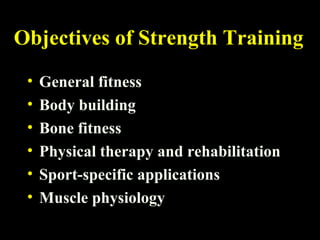
Objectives of Strength Training
• General fitness
• Body building
• Bone fitness
• Physical therapy and rehabilitation
• Sport-specific applications
• Muscle physiology
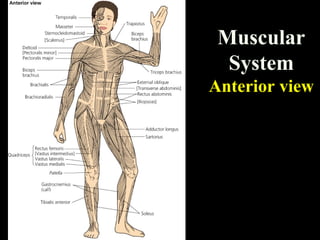
Muscular
System
Anterior view
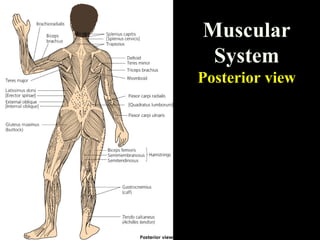
Muscular
System
Posterior view
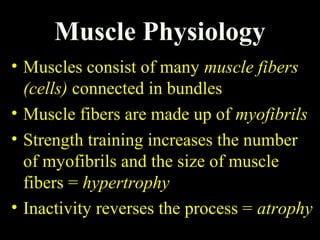
Muscle Physiology
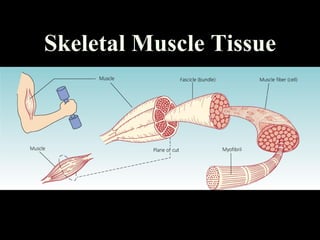
• Muscles consist of many muscle fibers
(cells) connected in bundles
• Muscle fibers are made up of myofibrils
• Strength training increases the number
of myofibrils and the size of muscle
fibers = hypertrophy
• Inactivity reverses the process = atrophy
Skeletal Muscle Tissue
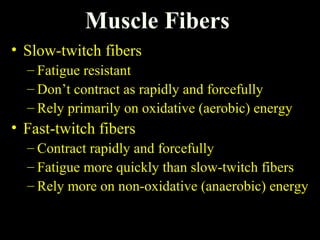
Muscle Fibers
• Slow-twitch fibers
– Fatigue resistant
– Don’t contract as rapidly and forcefully
– Rely primarily on oxidative (aerobic) energy
• Fast-twitch fibers
– Contract rapidly and forcefully
– Fatigue more quickly than slow-twitch fibers
– Rely more on non-oxidative (anaerobic) energy
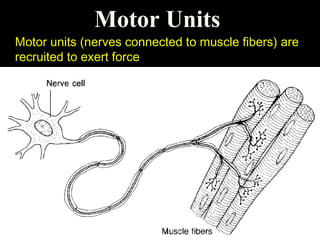
Motor Units
Motor units (nerves connected to muscle fibers) are
recruited to exert force
Physiological Effects of Strength Training
– Increased muscle mass and size of muscle fibers
– Increased utilization and coordination of motor
units
– Increased strength of tendons, ligaments, and
bones
– Increased storage of fuel in and blood supply to
muscles
– Improvements in blood fat levels and biochemical
processes
Benefits of Muscular Strength
and Endurance
 Improved performance of physical activities
 Injury prevention
 Improved body composition
 Enhanced self-image and quality of life
 Improved muscle and bone health with aging
 Prevention, management of chronic disease
Assessing Muscular Strength & Endurance
• Muscular strength assessed by determining repetition
maximum (1 RM), the maximum resistance that can
be lifted 1x
• Muscular endurance assessed by counting the
maximum number of repetitions of a muscular
contraction
Types of Strength Training Exercises
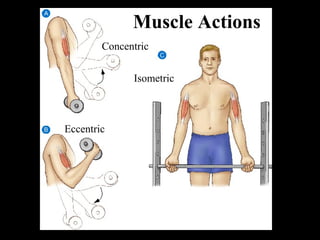
• Static (isometric) exercise = muscle contraction
without a change in the length of the muscle
• Dynamic (isotonic) exercise = muscle
contraction with a change in the length of the
muscle
– Concentric contraction = muscle applies force as it
shortens
– Eccentric contraction = muscle applies force as it
lengthens
Muscle Actions
Concentric
Eccentric
Isometric
Types of Dynamic Exercise
• Constant resistance = constant load throughout a joint’s
range of motion
• Variable resistance = changing load to provide maximal
resistance throughout a joint’s range of motion
• Eccentric loading = placing load on a muscle as it
lengthens
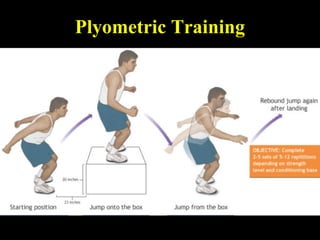
• Plyometrics = sudden eccentric loading and stretching
followed by a concentric contraction
• Speed loading = moving a load as rapidly as possible
• Isokinetic exercise = exerting force at a constant speed
against an equal force
Plyometric Training
Creating a Successful Weight Training Program
Choosing equipment: Weight machines versus free
weights
– Resistance is provided by both types
– Exercise machines
• Safer, convenient, and easy to use
– Free weights
• Require more care, balance, and coordination
• Strength transfers to daily activities
Applying the FITT Principle
• Frequency = days per week
• Intensity = amount of resistance
• Time = number of repetitions and sets
• Type = strength training exercises for all
major muscle groups
Frequency of Exercise
• American College of Sports
Medicine recommends 2-3 days
per week
–Allow 1 full day of rest between
workouts
• 8 minutes in the morning- daily
Intensity of Exercise: Amount of Resistance
Choose resistance based on your current
fitness level and goals
• To build strength
– Lift heavy weights (80% of 1 RM)
– Perform a low number of repetitions
• To build endurance
– Lift lighter weights (40-60% of 1 RM)
– Perform a high number of repetitions
• For a general fitness program
– Lift moderate weights (70% of 1 RM)
– Moderate number of repetitions
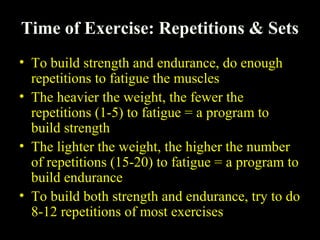
Time of Exercise: Repetitions & Sets
• To build strength and endurance, do enough
repetitions to fatigue the muscles
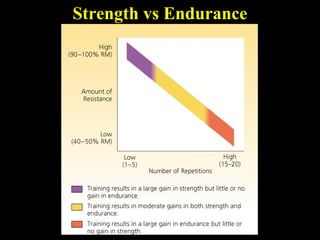
• The heavier the weight, the fewer the
repetitions (1-5) to fatigue = a program to
build strength
• The lighter the weight, the higher the number
of repetitions (15-20) to fatigue = a program to
build endurance
• To build both strength and endurance, try to do
8-12 repetitions of most exercises
Strength vs Endurance
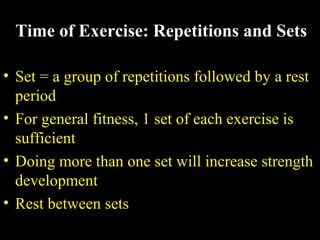
Time of Exercise: Repetitions and Sets
• Set = a group of repetitions followed by a rest
period
• For general fitness, 1 set of each exercise is
sufficient
• Doing more than one set will increase strength
development
• Rest between sets
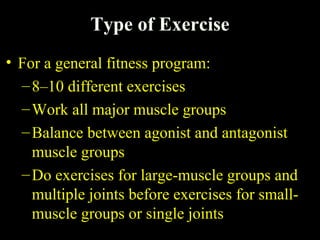
Type of Exercise
• For a general fitness program:
–8–10 different exercises
–Work all major muscle groups
–Balance between agonist and antagonist
muscle groups
–Do exercises for large-muscle groups and
multiple joints before exercises for small-
muscle groups or single joints
Strength Testing
• Standardization
• Warm-Up
• Practice
• Muscle Angle
Which System is Best?
• Specificity Rules
(Specific adaptations to imposed demands )
- SAID
• Overload is the key
Comparative Training
Responses in Men and Women
Muscular hypertrophy occurs to a
much greater extent in men
–Represents the largest sex difference in
response to resistance training
–Both sexes experience similar
percentage strength improvements
Creating a Successful
Weight Training Program
• Making progress
• More advanced strength training programs
• Weight training safety
– Using proper lifting techniques
– Using spotters and collars with free weights
– Be alert for injuries
Setting Up Your Program (cont)
• Avoid max lifts initially
• Use 12 to 15 reps initially
• Increase weight after 2 weeks
–Use 6 – 8 reps
–Progress gradually
• Work larger muscle groups first
Detraining
Gains in strength may be seen
after 1 to 2 weeks of training
Training as few as 1 to 2 times
per week may be adequate to
maintain strength training gains
Combining Strength & Endurance Training
• Resistance training plus aerobic
training equals less strength
improvement
• Incorporate a break between workouts
• Health benefits of both types of
training may be obtained by training
for both strength & endurance
Muscle Soreness [DOMS]
• Cell damage hypothesis
• Spasm hypothesis
• Tear hypothesis
• Excess metabolite hypothesis
• Connective tissue damage
hypothesis
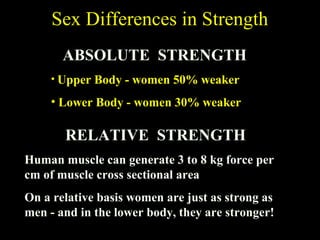
RELATIVE STRENGTH
Human muscle can generate 3 to 8 kg force per
cm of muscle cross sectional area
On a relative basis women are just as strong as
men - and in the lower body, they are stronger!
Sex Differences in Strength
ABSOLUTE STRENGTH
• Upper Body - women 50% weaker
• Lower Body - women 30% weaker
Warm Up and Cool Down
• Warm up prior to each weight training
session with a general warm-up and a
warm-up for the exercises you will
perform
• Cool down after weight training, relax
for 5-10 minutes, lower your heart rate
Weight Training Safety
• Use proper lifting techniques
• Use spotters & collars with free weights
• Be alert for injuries

Alpha Muscle Strength & Weight Training

  • 1.
    Muscular Strength Making MusclesStronger Why is this important ? What do you need to know ?
  • 2.
    Objectives of StrengthTraining • General fitness • Body building • Bone fitness • Physical therapy and rehabilitation • Sport-specific applications • Muscle physiology
  • 3.
  • 4.
  • 5.
    Muscle Physiology • Musclesconsist of many muscle fibers (cells) connected in bundles • Muscle fibers are made up of myofibrils • Strength training increases the number of myofibrils and the size of muscle fibers = hypertrophy • Inactivity reverses the process = atrophy
  • 6.
  • 7.
    Muscle Fibers • Slow-twitchfibers – Fatigue resistant – Don’t contract as rapidly and forcefully – Rely primarily on oxidative (aerobic) energy • Fast-twitch fibers – Contract rapidly and forcefully – Fatigue more quickly than slow-twitch fibers – Rely more on non-oxidative (anaerobic) energy
  • 8.
    Motor Units Motor units(nerves connected to muscle fibers) are recruited to exert force
  • 9.
    Physiological Effects ofStrength Training – Increased muscle mass and size of muscle fibers – Increased utilization and coordination of motor units – Increased strength of tendons, ligaments, and bones – Increased storage of fuel in and blood supply to muscles – Improvements in blood fat levels and biochemical processes
  • 10.
    Benefits of MuscularStrength and Endurance  Improved performance of physical activities  Injury prevention  Improved body composition  Enhanced self-image and quality of life  Improved muscle and bone health with aging  Prevention, management of chronic disease
  • 11.
    Assessing Muscular Strength& Endurance • Muscular strength assessed by determining repetition maximum (1 RM), the maximum resistance that can be lifted 1x • Muscular endurance assessed by counting the maximum number of repetitions of a muscular contraction
  • 12.
    Types of StrengthTraining Exercises • Static (isometric) exercise = muscle contraction without a change in the length of the muscle • Dynamic (isotonic) exercise = muscle contraction with a change in the length of the muscle – Concentric contraction = muscle applies force as it shortens – Eccentric contraction = muscle applies force as it lengthens
  • 13.
  • 14.
    Types of DynamicExercise • Constant resistance = constant load throughout a joint’s range of motion • Variable resistance = changing load to provide maximal resistance throughout a joint’s range of motion • Eccentric loading = placing load on a muscle as it lengthens • Plyometrics = sudden eccentric loading and stretching followed by a concentric contraction • Speed loading = moving a load as rapidly as possible • Isokinetic exercise = exerting force at a constant speed against an equal force
  • 15.
  • 16.
    Creating a SuccessfulWeight Training Program Choosing equipment: Weight machines versus free weights – Resistance is provided by both types – Exercise machines • Safer, convenient, and easy to use – Free weights • Require more care, balance, and coordination • Strength transfers to daily activities
  • 17.
    Applying the FITTPrinciple • Frequency = days per week • Intensity = amount of resistance • Time = number of repetitions and sets • Type = strength training exercises for all major muscle groups
  • 18.
    Frequency of Exercise •American College of Sports Medicine recommends 2-3 days per week –Allow 1 full day of rest between workouts • 8 minutes in the morning- daily
  • 19.
    Intensity of Exercise:Amount of Resistance Choose resistance based on your current fitness level and goals • To build strength – Lift heavy weights (80% of 1 RM) – Perform a low number of repetitions • To build endurance – Lift lighter weights (40-60% of 1 RM) – Perform a high number of repetitions • For a general fitness program – Lift moderate weights (70% of 1 RM) – Moderate number of repetitions
  • 20.
    Time of Exercise:Repetitions & Sets • To build strength and endurance, do enough repetitions to fatigue the muscles • The heavier the weight, the fewer the repetitions (1-5) to fatigue = a program to build strength • The lighter the weight, the higher the number of repetitions (15-20) to fatigue = a program to build endurance • To build both strength and endurance, try to do 8-12 repetitions of most exercises
  • 21.
  • 22.
    Time of Exercise:Repetitions and Sets • Set = a group of repetitions followed by a rest period • For general fitness, 1 set of each exercise is sufficient • Doing more than one set will increase strength development • Rest between sets
  • 23.
    Type of Exercise •For a general fitness program: –8–10 different exercises –Work all major muscle groups –Balance between agonist and antagonist muscle groups –Do exercises for large-muscle groups and multiple joints before exercises for small- muscle groups or single joints
  • 24.
    Strength Testing • Standardization •Warm-Up • Practice • Muscle Angle
  • 25.
    Which System isBest? • Specificity Rules (Specific adaptations to imposed demands ) - SAID • Overload is the key
  • 26.
    Comparative Training Responses inMen and Women Muscular hypertrophy occurs to a much greater extent in men –Represents the largest sex difference in response to resistance training –Both sexes experience similar percentage strength improvements
  • 27.
    Creating a Successful WeightTraining Program • Making progress • More advanced strength training programs • Weight training safety – Using proper lifting techniques – Using spotters and collars with free weights – Be alert for injuries
  • 28.
    Setting Up YourProgram (cont) • Avoid max lifts initially • Use 12 to 15 reps initially • Increase weight after 2 weeks –Use 6 – 8 reps –Progress gradually • Work larger muscle groups first
  • 29.
    Detraining Gains in strengthmay be seen after 1 to 2 weeks of training Training as few as 1 to 2 times per week may be adequate to maintain strength training gains
  • 30.
    Combining Strength &Endurance Training • Resistance training plus aerobic training equals less strength improvement • Incorporate a break between workouts • Health benefits of both types of training may be obtained by training for both strength & endurance
  • 31.
    Muscle Soreness [DOMS] •Cell damage hypothesis • Spasm hypothesis • Tear hypothesis • Excess metabolite hypothesis • Connective tissue damage hypothesis
  • 32.
    RELATIVE STRENGTH Human musclecan generate 3 to 8 kg force per cm of muscle cross sectional area On a relative basis women are just as strong as men - and in the lower body, they are stronger! Sex Differences in Strength ABSOLUTE STRENGTH • Upper Body - women 50% weaker • Lower Body - women 30% weaker
  • 33.
    Warm Up andCool Down • Warm up prior to each weight training session with a general warm-up and a warm-up for the exercises you will perform • Cool down after weight training, relax for 5-10 minutes, lower your heart rate
  • 34.
    Weight Training Safety •Use proper lifting techniques • Use spotters & collars with free weights • Be alert for injuries

Editor's Notes

  • #27 Physically, on a relative scale, when comparing body mass to strength… women are stronger a lot of times!