Developing Training 
Programs 
1147 Spring2014
Targeting Muscle Groups
Targeting Muscle Groups 
• Should you target a different muscle group each day like 
arms, legs, abs…? 
• Depends on the goal. This can be an effective way of increasing 
muscle mass. However, for performance, it is not optimal. There 
is no one answer for this, but rather 
•
You first need… 
• Your plan: to improve YOUR GOALS in your training 
system. Written down, a training system would reflect the 
core training principles (that we learned in CH3)and your 
goals. 
• A full system has an ultimate goal (winning competitions, 
improving health, looking better), methods (specific exercises, 
specific intensities of exercises, etc.), a plan for individual 
sessions (ME/DE upper and lower days, high or low intensity 
days), and some sort of forward-thinking view (why you place 
things at certain times within the week). 
• Training systems MUST have progressive overload and this is 
often VIA intensity (percentage of 1rm or max heart rate), 
duration, or volume (sets x reps x load)
Training System Terms 
Periodized training: a 
string of related and 
planned training 
sessions (workouts) that 
are created to develop 
specific training traits 
(health related or 
performance related 
components of fitness)to 
achieve a goal over the 
span of months or years. 
AKA training 
organization 
• TRAINING TRAITS 
• Muscular strength 
• Muscular endurance 
• Velocity 
• Power 
• Flexibility 
• Body Composition 
• Hypertrophy 
• Cardiovascular 
endurance 
• Aerobic capacity 
• Etc
Terms.. 
Microcycle: smallest complete and sequentially repeatable group of 
sessions in a given system. 
*week long and broken down into days to accommodate the 
calendar week. 
*They generally have some degree of volume/intensity undulation 
to help manage fatigue and promote positive adaptations. 
Mesocycle: covers multiple microcycles (often several months worth), 
and is designed to build up certain qualities. 
shifts between mesocycles are sometimes called “transitional 
phases 
Often 3 weeks long 
• Macrocycle: This is the largest unit of periodization. incorporates all 
of the mesocycles, microcycles. 
• They are frequently a year in length 
• Created to achieve a set goal
Example 
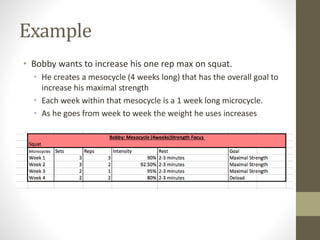
• Bobby wants to increase his one rep max on squat. 
• He creates a mesocycle (4 weeks long) that has the overall goal to 
increase his maximal strength 
• Each week within that mesocycle is a 1 week long microcycle. 
• As he goes from week to week the weight he uses increases
So within each Microcyle 
• Apply FITT principles 
• Frequency 
• Intensity 
• Time 
• Type
Meso, Micro, Macro
What are some workouts to train for stronger bones? I know 
that resistance training is good for that but I’m not sure exactly 
what it is? 
Activity increases the physical stresses on bone. These stresses help 
activate the osteoblasts and favor bone deposition (Robergs & 
Roberts, 1997). Resistance training actually increases bone mineral 
density in response to axial loading. This is very important in women 
and elderly individuals. 
In females, estrogen tends to inhibit the activity of the osteoclasts and 
therefore helps retain bone mineral (Robergs & Roberts, 1997). The 
maintenance of bone mineral density levels is an important concern 
for postmenopausal women because they no longer have the 
protective effects of estrogen 
Interestingly, testosterone in males tends to have similar effects on 
bone remodeling as does estrogen (Robergs & Roberts, 1997). 
Therefore, it is also important for elderly men to weight train to 
maintain BMD levels.
Question 
• When an exercise program is interrupted with studying, 
extracurricular activities, or tasks to be completed, 
where/how should you start back up? Should you begin 
where you left off or rebuild up toward where you left off? 
• This will depend on how long you are removed from the 
exercise, and your previous training status.
Question… 
• How can you stay physically fit and modify an exercise 
program while battling a virus (such as mono), that prevents 
you from heavy lifting or running? Are there specific 
exercises that are “mono-friendly”? 
• No you must actually do bed rest, because continuing to stress 
the body will cause the virus to stay active chronically. 
Chronically active mono can lead to chronic fatigue syndrome 
and is extremely dangerous.
Workouts for… 
• How would I set up a workout to train for swimming? 
• How would I set up a workout to focus on muscular 
endurance? 
• How would I set up a workout to be able to carry a 40lbs 
drum, using a harness that puts the weight on my back, for 12 
hours. 
• How would I design a program to specifically strengthen the 
muscles involved with the knee. 
• Thoughts? Ideas?
What if I want to… 
• How to set up workouts for my personal fitness and fit my 
busy work schedule? 
• Make sure you clearly understand your goals and optimally 
program activity to achieve them. 
• If I only have four hours a week to train, and my goal is to get 
stronger, then I will spend those 4 hours focusing on strength 
training, not 2 hours of strength training and 2 hours of cardio. 
• Specificity is key!
Toning? 
• How do you set up workouts to tone muscles and lose 
weight without “overdoing” it? 
• If you resistance train, this will increase your metabolic rate so 
that you burn more calories at rest. This aids in fat loss, which 
provides that “toned” look. 
• If you are dieting, training with weights provides a stimulus to 
continue to maintain muscle while your body is burning though 
tissue, leaving you in favor of losing fat rather than muscle mass 
• When given the choice, it is easer for the body to give up muscle 
mass, rather than fat mass, so there needs to be a stimulus to tell 
the body it should keep muscle and give up fat.
Toning… 
• How to set up workouts to train for weight loss in the stomach and 
to tone up all parts of the arm. 
• Toning is actually just the result of reduced body fat and presence of 
muscle mass. If you want to achieve this look you need to reduce 
body fat and have muscle mass. To do this you need a clean diet and 
resistance training. If you want to focus on building muscle mass in 
the arm, you could do train parts of the upper body separately or 
you could train parts of the arm multiple times per week. 
• What types of exercises are better for toning muscles, full range of 
motion ones or machine based programs? 
You can grow a muscle with both types of exercise, so it will be more 
based on what you are able to consistently do…And more than 
anything, diet!
Recovery
Recovery 
• Do rest days mean you shouldn’t do anything or that you 
should just take it easy and do less? 
• Yes 
• If you are training for something, then most likely deloads 
“recovery periods (a few days to a week) are written in the 
program to help you adapt to a period of overstressing done the 
week (or weeks before). These deloads are specific and are a 
reduction in volume (can be sets, reps, intensity or all three) 
• If you are exercising for fitness they can be less specific, but are 
still important for recovery. These are called off days.
So back to Programming..
Terms 
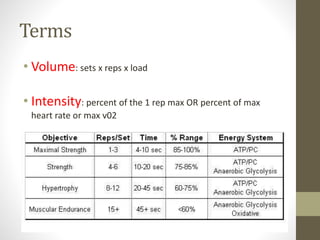
• Volume: sets x reps x load 
• Intensity: percent of the 1 rep max OR percent of max 
heart rate or max v02
Terms 
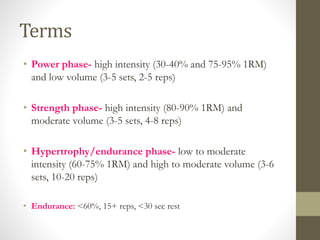
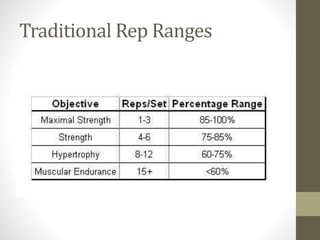
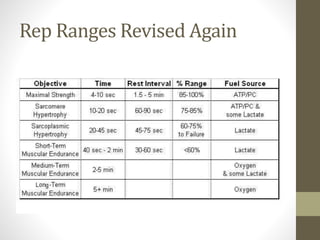
• Power phase- high intensity (30-40% and 75-95% 1RM) 
and low volume (3-5 sets, 2-5 reps) 
• Strength phase- high intensity (80-90% 1RM) and 
moderate volume (3-5 sets, 4-8 reps) 
• Hypertrophy/endurance phase- low to moderate 
intensity (60-75% 1RM) and high to moderate volume (3-6 
sets, 10-20 reps) 
• Endurance: <60%, 15+ reps, <30 sec rest
Periodization Models 
Linear: Volume (reps x sets) remains constant during training 
period. Intensity increases with load progression. 
• (ex)strength training = adding extra sets and reps to exercises 
performed during a session, or adding extra sessions in a week. 
• Traditional-Linear: Volume and intensity are systematically 
manipulated. Training cycle begins with a high-volume, low-intensity 
profile, then progresses to low volume, high intensity over time. 
• (ex) volume might increase by 10% one session, 13% the next, and 15% 
on the third. As long as the increase is continuous, it’s considered 
linear.
Progression 
• All training programs need to progress overtime. 
• When a quality (strength, power, speed) increases or 
decreases over time in what appears to be a fairly straight, 
angled line, it is said to be a linear progression. 
• In non-linear progression there can be a gentle rising and 
falling of training traits 
• undulating or wave progressions 
• steeper progressions are called pyramids 
• while sharply-alternating, peaked charts indicate a pendulum 
progression. 
• A random or jumbled progression usually indicates a lack of 
thoughtful planning or caffeine abuse.
Periodization Models 
• Random Variation: Volume and/or intensity change randomly, 
with no consideration other than to introduce variation into 
the program.
Continued.. 
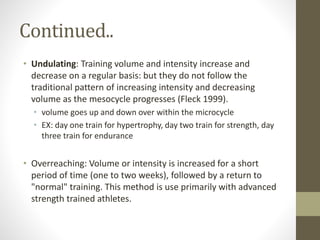
• Undulating: Training volume and intensity increase and 
decrease on a regular basis: but they do not follow the 
traditional pattern of increasing intensity and decreasing 
volume as the mesocycle progresses (Fleck 1999). 
• volume goes up and down over within the microcycle 
• EX: day one train for hypertrophy, day two train for strength, day 
three train for endurance 
• Overreaching: Volume or intensity is increased for a short 
period of time (one to two weeks), followed by a return to 
"normal" training. This method is use primarily with advanced 
strength trained athletes.
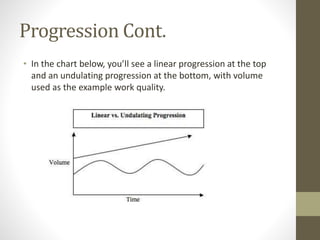
Progression Cont. 
• In the chart below, you’ll see a linear progression at the top 
and an undulating progression at the bottom, with volume 
used as the example work quality.
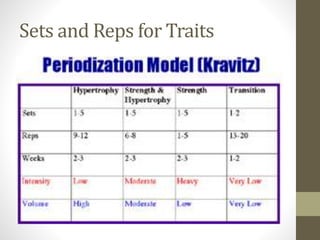
Sets and Reps for Traits
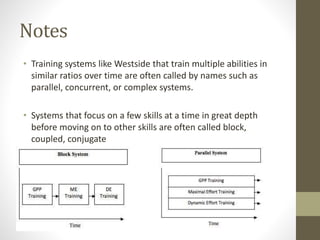
Notes 
• Training systems like Westside that train multiple abilities in 
similar ratios over time are often called by names such as 
parallel, concurrent, or complex systems. 
• Systems that focus on a few skills at a time in great depth 
before moving on to other skills are often called block, 
coupled, conjugate
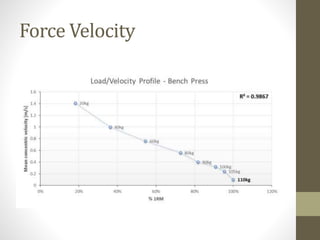
Force Velocity
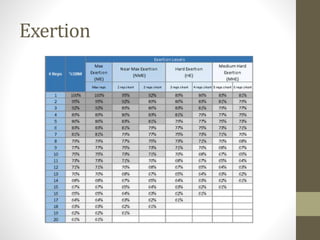
Exertion
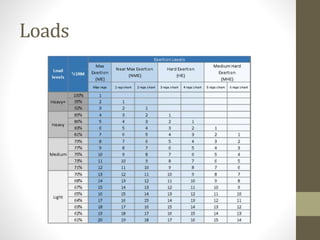
Loads
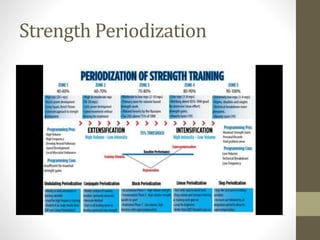
Strength Periodization
Cardio Periodization
Traditional Rep Ranges
Energy Systems
Rep Ranges Revised Again

Periodiz.

  • 1.
  • 2.
  • 3.
    Targeting Muscle Groups • Should you target a different muscle group each day like arms, legs, abs…? • Depends on the goal. This can be an effective way of increasing muscle mass. However, for performance, it is not optimal. There is no one answer for this, but rather •
  • 4.
    You first need… • Your plan: to improve YOUR GOALS in your training system. Written down, a training system would reflect the core training principles (that we learned in CH3)and your goals. • A full system has an ultimate goal (winning competitions, improving health, looking better), methods (specific exercises, specific intensities of exercises, etc.), a plan for individual sessions (ME/DE upper and lower days, high or low intensity days), and some sort of forward-thinking view (why you place things at certain times within the week). • Training systems MUST have progressive overload and this is often VIA intensity (percentage of 1rm or max heart rate), duration, or volume (sets x reps x load)
  • 5.
    Training System Terms Periodized training: a string of related and planned training sessions (workouts) that are created to develop specific training traits (health related or performance related components of fitness)to achieve a goal over the span of months or years. AKA training organization • TRAINING TRAITS • Muscular strength • Muscular endurance • Velocity • Power • Flexibility • Body Composition • Hypertrophy • Cardiovascular endurance • Aerobic capacity • Etc
  • 6.
    Terms.. Microcycle: smallestcomplete and sequentially repeatable group of sessions in a given system. *week long and broken down into days to accommodate the calendar week. *They generally have some degree of volume/intensity undulation to help manage fatigue and promote positive adaptations. Mesocycle: covers multiple microcycles (often several months worth), and is designed to build up certain qualities. shifts between mesocycles are sometimes called “transitional phases Often 3 weeks long • Macrocycle: This is the largest unit of periodization. incorporates all of the mesocycles, microcycles. • They are frequently a year in length • Created to achieve a set goal
  • 7.
    Example • Bobbywants to increase his one rep max on squat. • He creates a mesocycle (4 weeks long) that has the overall goal to increase his maximal strength • Each week within that mesocycle is a 1 week long microcycle. • As he goes from week to week the weight he uses increases
  • 8.
    So within eachMicrocyle • Apply FITT principles • Frequency • Intensity • Time • Type
  • 9.
  • 10.
    What are someworkouts to train for stronger bones? I know that resistance training is good for that but I’m not sure exactly what it is? Activity increases the physical stresses on bone. These stresses help activate the osteoblasts and favor bone deposition (Robergs & Roberts, 1997). Resistance training actually increases bone mineral density in response to axial loading. This is very important in women and elderly individuals. In females, estrogen tends to inhibit the activity of the osteoclasts and therefore helps retain bone mineral (Robergs & Roberts, 1997). The maintenance of bone mineral density levels is an important concern for postmenopausal women because they no longer have the protective effects of estrogen Interestingly, testosterone in males tends to have similar effects on bone remodeling as does estrogen (Robergs & Roberts, 1997). Therefore, it is also important for elderly men to weight train to maintain BMD levels.
  • 11.
    Question • Whenan exercise program is interrupted with studying, extracurricular activities, or tasks to be completed, where/how should you start back up? Should you begin where you left off or rebuild up toward where you left off? • This will depend on how long you are removed from the exercise, and your previous training status.
  • 12.
    Question… • Howcan you stay physically fit and modify an exercise program while battling a virus (such as mono), that prevents you from heavy lifting or running? Are there specific exercises that are “mono-friendly”? • No you must actually do bed rest, because continuing to stress the body will cause the virus to stay active chronically. Chronically active mono can lead to chronic fatigue syndrome and is extremely dangerous.
  • 13.
    Workouts for… •How would I set up a workout to train for swimming? • How would I set up a workout to focus on muscular endurance? • How would I set up a workout to be able to carry a 40lbs drum, using a harness that puts the weight on my back, for 12 hours. • How would I design a program to specifically strengthen the muscles involved with the knee. • Thoughts? Ideas?
  • 14.
    What if Iwant to… • How to set up workouts for my personal fitness and fit my busy work schedule? • Make sure you clearly understand your goals and optimally program activity to achieve them. • If I only have four hours a week to train, and my goal is to get stronger, then I will spend those 4 hours focusing on strength training, not 2 hours of strength training and 2 hours of cardio. • Specificity is key!
  • 15.
    Toning? • Howdo you set up workouts to tone muscles and lose weight without “overdoing” it? • If you resistance train, this will increase your metabolic rate so that you burn more calories at rest. This aids in fat loss, which provides that “toned” look. • If you are dieting, training with weights provides a stimulus to continue to maintain muscle while your body is burning though tissue, leaving you in favor of losing fat rather than muscle mass • When given the choice, it is easer for the body to give up muscle mass, rather than fat mass, so there needs to be a stimulus to tell the body it should keep muscle and give up fat.
  • 16.
    Toning… • Howto set up workouts to train for weight loss in the stomach and to tone up all parts of the arm. • Toning is actually just the result of reduced body fat and presence of muscle mass. If you want to achieve this look you need to reduce body fat and have muscle mass. To do this you need a clean diet and resistance training. If you want to focus on building muscle mass in the arm, you could do train parts of the upper body separately or you could train parts of the arm multiple times per week. • What types of exercises are better for toning muscles, full range of motion ones or machine based programs? You can grow a muscle with both types of exercise, so it will be more based on what you are able to consistently do…And more than anything, diet!
  • 17.
  • 18.
    Recovery • Dorest days mean you shouldn’t do anything or that you should just take it easy and do less? • Yes • If you are training for something, then most likely deloads “recovery periods (a few days to a week) are written in the program to help you adapt to a period of overstressing done the week (or weeks before). These deloads are specific and are a reduction in volume (can be sets, reps, intensity or all three) • If you are exercising for fitness they can be less specific, but are still important for recovery. These are called off days.
  • 19.
    So back toProgramming..
  • 20.
    Terms • Volume:sets x reps x load • Intensity: percent of the 1 rep max OR percent of max heart rate or max v02
  • 21.
    Terms • Powerphase- high intensity (30-40% and 75-95% 1RM) and low volume (3-5 sets, 2-5 reps) • Strength phase- high intensity (80-90% 1RM) and moderate volume (3-5 sets, 4-8 reps) • Hypertrophy/endurance phase- low to moderate intensity (60-75% 1RM) and high to moderate volume (3-6 sets, 10-20 reps) • Endurance: <60%, 15+ reps, <30 sec rest
  • 22.
    Periodization Models Linear:Volume (reps x sets) remains constant during training period. Intensity increases with load progression. • (ex)strength training = adding extra sets and reps to exercises performed during a session, or adding extra sessions in a week. • Traditional-Linear: Volume and intensity are systematically manipulated. Training cycle begins with a high-volume, low-intensity profile, then progresses to low volume, high intensity over time. • (ex) volume might increase by 10% one session, 13% the next, and 15% on the third. As long as the increase is continuous, it’s considered linear.
  • 23.
    Progression • Alltraining programs need to progress overtime. • When a quality (strength, power, speed) increases or decreases over time in what appears to be a fairly straight, angled line, it is said to be a linear progression. • In non-linear progression there can be a gentle rising and falling of training traits • undulating or wave progressions • steeper progressions are called pyramids • while sharply-alternating, peaked charts indicate a pendulum progression. • A random or jumbled progression usually indicates a lack of thoughtful planning or caffeine abuse.
  • 24.
    Periodization Models •Random Variation: Volume and/or intensity change randomly, with no consideration other than to introduce variation into the program.
  • 25.
    Continued.. • Undulating:Training volume and intensity increase and decrease on a regular basis: but they do not follow the traditional pattern of increasing intensity and decreasing volume as the mesocycle progresses (Fleck 1999). • volume goes up and down over within the microcycle • EX: day one train for hypertrophy, day two train for strength, day three train for endurance • Overreaching: Volume or intensity is increased for a short period of time (one to two weeks), followed by a return to "normal" training. This method is use primarily with advanced strength trained athletes.
  • 26.
    Progression Cont. •In the chart below, you’ll see a linear progression at the top and an undulating progression at the bottom, with volume used as the example work quality.
  • 27.
    Sets and Repsfor Traits
  • 28.
    Notes • Trainingsystems like Westside that train multiple abilities in similar ratios over time are often called by names such as parallel, concurrent, or complex systems. • Systems that focus on a few skills at a time in great depth before moving on to other skills are often called block, coupled, conjugate
  • 29.
  • 30.
  • 31.
  • 32.
  • 33.
  • 34.
  • 35.
  • 36.